

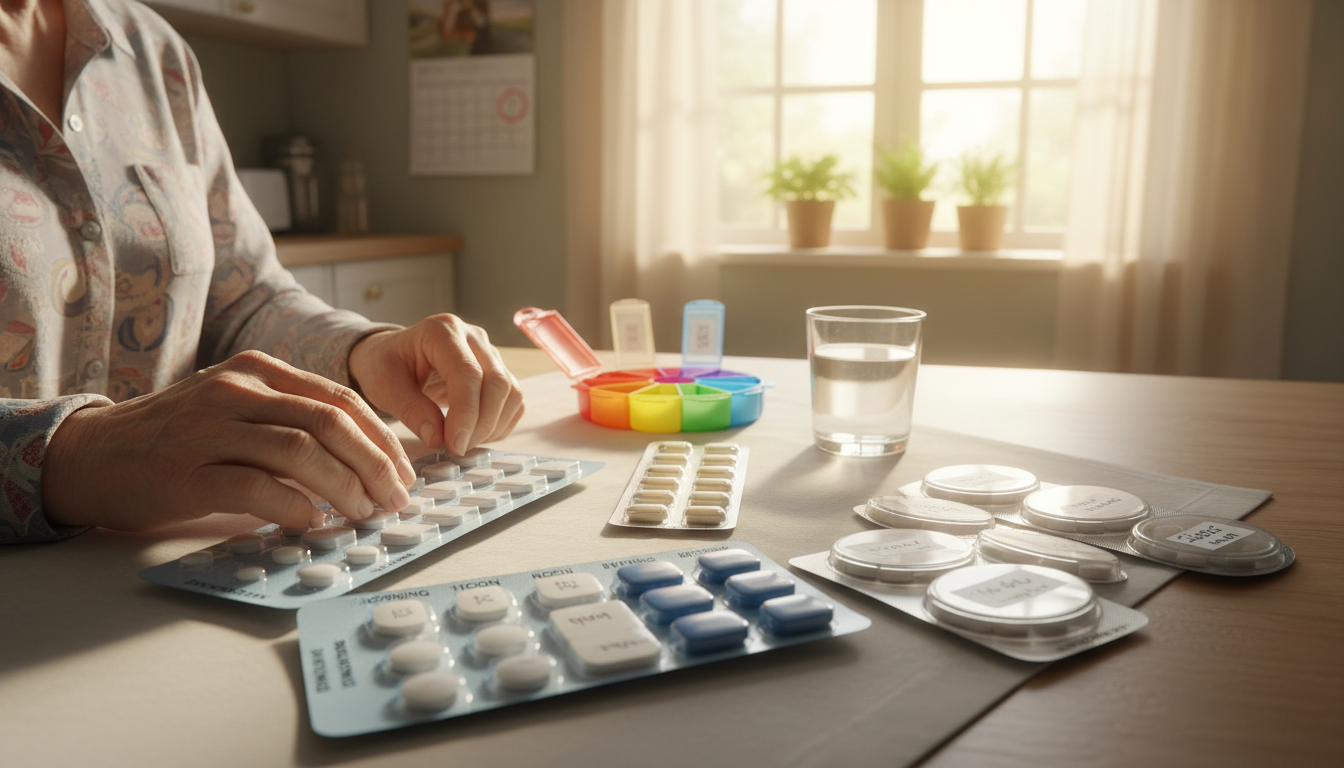
What if the simple act of taking daily pills didn’t have to be a source of daily worry for your family? For many adult children, the thought of a parent managing multiple medications alone is a constant, quiet concern. It’s the anxiety that creeps in during a busy workday. You wonder, “Did Mom take her morning pill?”
This struggle is real. It often looks like pill bottles scattered on the counter and sticky notes with reminders. The fear of a missed dose or an accidental double dose is heavy. It’s a challenge that can make care feel complicated from afar.
But there is a way to bring calm to the chaos. Using a system like blister packs for seniors can transform this daily routine. It offers a clear, organized approach to handling prescriptions. This guide will walk you through how these systems work and their many benefits.
Our goal is to help you find a solution that honors your loved one’s independence while giving you peace of mind. Seeking help with medication management is a smart, loving choice.
Key Takeaways
- Managing multiple medications is a common and serious challenge for older adults and their families.
- Confusion with prescriptions can lead to dangerous missed or double doses.
- Organized packaging systems directly address the worry experienced by long-distance caregivers.
- These solutions aim to balance safety with a senior’s desire for independence.
- Exploring medication management tools is a proactive step toward protecting health and reducing anxiety.
Understanding Blister Packs and Medication Management
Picture a system that takes the guesswork out of managing multiple prescriptions. Each pill is clearly visible in its own compartment, organized by day and time.
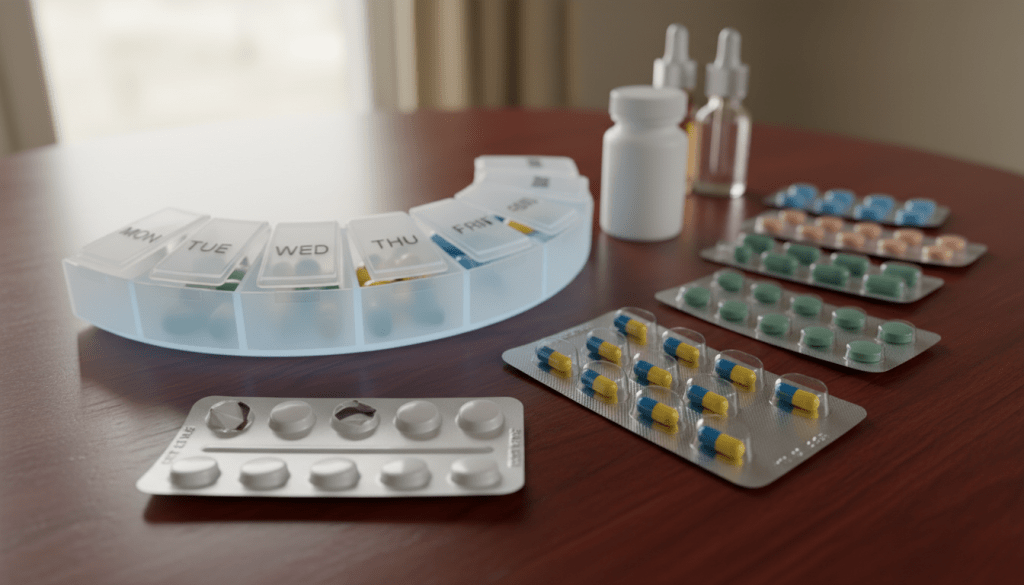
This visual approach transforms confusion into confidence. It’s designed specifically for those handling complex medication schedules.
Definition and Composition of Blister Packs
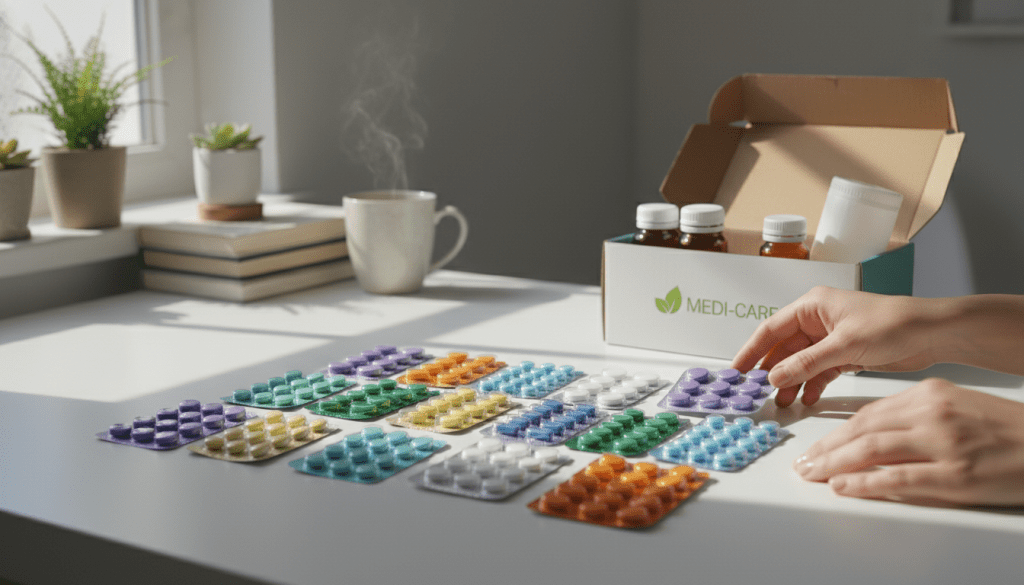
These organized systems feature rows of clear plastic bubbles attached to a card. Each bubble contains one complete dose of medication.
A trained pharmacist carefully prepares each package. They sort every pill according to the exact prescription schedule.
The layout is simple to follow. Days run down one side, while times like Morning and Evening appear across the top.
How Blister Packs Enhance Medication Safety
Each compartment stays sealed until needed. This protects against moisture, light, and contamination.
The visual design provides immediate clarity. You can see at a glance whether today’s dose has been taken.
Try JoyCalls Free
No app or new device needed. Start with a free 7-day trial.
Important details are printed directly on the package. This includes patient information and clear instructions.
This system creates a vital safety net. It helps prevent errors before they happen, giving families peace of mind about medication safety when they can’t be there.
Key Benefits of Blister Packs for Seniors
The true power of an organized system lies in the quiet confidence it gives back to a person. It transforms a complex task into a simple, manageable part of the day. This is especially vital for managing health with multiple prescriptions.
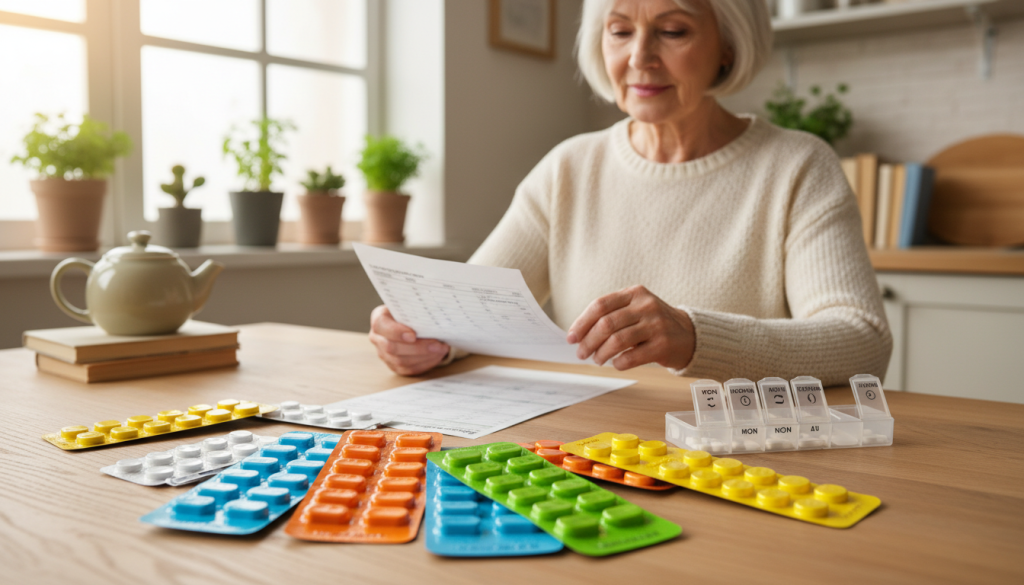
This approach offers profound advantages that touch every aspect of daily life.
- Clear visual tracking of what has been taken.
- Reduced anxiety about making a mistake.
- Protected independence in managing one’s own health.
Improved Adherence and Reduced Errors
Following a prescription plan correctly is essential for well-being. These packaging systems make it easy. Each dose is sealed and labeled by day and time.
This visual setup is a powerful tool. It instantly shows if a morning or evening dose is still needed. The risk of a missed or double dose drops significantly.
Better adherence means medications work as intended. This leads to more stable health and fewer complications.
Promoting Independence and Ease of Use
Many older adults deeply value their self-reliance. This method supports that dignity perfectly. There’s no need to struggle with numerous bottles or rely on memory.
The routine becomes straightforward. Just press the pills from the correct slot and continue with the day. It’s a simple act that preserves control and reduces daily stress for everyone involved.
Implementing Blister and Bubble Packs in Care Settings
Imagine reclaiming precious moments with your loved one instead of spending time sorting weekly medications. This organized approach transforms caregiving from a complex chore into a streamlined routine.
Try JoyCalls Free
No app or new device needed. Start with a free 7-day trial.
The system works seamlessly within existing care environments. It brings clarity to daily medication management.
Practical Guidance for Caregivers
For busy caregivers, this method eliminates the weekly pill-sorting task. Your pharmacist prepares each dose in advance.
This frees up valuable time for meaningful connection. You can focus on being present rather than managing medications.

Effective Organization for Daily Routines
Each day and time is clearly marked on the packaging. The morning dose is simple to identify and administer.
Multiple caregivers can coordinate care effectively. Everyone sees the same clear information about what’s been taken.
This convenience brings emotional relief. You no longer worry about sorting errors or missed doses.
The organized system supports better communication with healthcare providers. It provides a clear record of the medication schedule.
A Practical Guide to Deciding if Blister Packs Will Truly Work for You or a Loved One
For many older adults, the question is not whether blister packs and bubble packs sound helpful. On paper, they usually do. Medications are sorted in advance, doses are easier to track, and there is less guesswork than managing several separate bottles. Pharmacy-prepared adherence packaging is widely used to improve medication organization and support more consistent medication-taking, especially for seniors and other at-risk patients. question is more personal than that.
Will this system actually fit the senior’s daily routine, physical abilities, memory needs, and healthcare situation?
That is where many families get stuck. A blister pack can be extremely helpful for one older adult and frustrating for another. A son or daughter may feel relieved seeing medications sorted by day and time, while the senior taking them may feel confused, dependent, or irritated if the system does not match how they live. Some older adults love the structure. Others do better with a different approach. And sometimes blister packs help most when they are introduced with a few small routine changes instead of simply being dropped into the home and expected to solve everything on their own.
This is why it helps to think beyond the packaging itself. The packaging is only a tool. What matters is whether the tool reduces stress, lowers the chance of mistakes, and makes medication-taking easier to follow in everyday life.
This section is meant to help seniors, adult children, spouses, and caregivers answer that question in a practical way. Not in a salesy way. Not in an abstract way. In a real-life way.
Start With the Right Question: What Problem Are You Actually Trying to Solve?
One of the most common mistakes families make is adopting blister packs too quickly without identifying the actual medication problem first.
Sometimes the issue is forgetfulness. Sometimes it is confusion. Sometimes it is poor vision, shaky hands, arthritis, or being overwhelmed by too many prescription bottles. Sometimes it is a caregiver who visits only once a week and wants a clearer way to check whether doses were taken. And in other cases, the true issue is not organization at all. It may be medication changes happening too often, side effects, affordability, or a senior not fully understanding why they need the medicine.
Blister packs are most helpful when the main problem is one or more of the following:
A senior takes several medicines at different times of day
Older adults often manage multiple prescriptions at once. When morning, midday, evening, and bedtime medications all look similar, it becomes much easier to mix things up. Packaging that groups doses by date and time helps reduce that mental load. Sources aimed at seniors and pharmacies consistently describe this as one of the biggest benefits of blister packaging. n often asks, “Did I already take this?”
This is where bottles become surprisingly unreliable. A bottle may tell you what medicine it is, but it does not show whether the dose for today has already been taken. A labeled blister cavity or packet provides immediate visual proof. That can reduce double-dosing anxiety and lower stress for both seniors and caregivers. mbers want a simple way to monitor adherence without hovering
For many families, blister packs offer something emotionally important: less nagging and less tension. A caregiver can glance at the pack and see whether the expected dose is still there. That can make check-ins feel more respectful and less intrusive.
Managing bottles has become physically difficult
Some seniors struggle with small labels, child-resistant caps, or sorting pills into weekly organizers. Blister systems can remove some of that burden, though ease of opening depends on the specific format and the person’s hand strength. Some seniors with arthritis may find certain packs easier than bottles, but others may struggle to push pills through foil and may do better with pouch-based systems instead. not the main problems, blister packs may not be the best answer. For example, if medications change every few days, the packaging may become outdated quickly. If the senior is very independent and already has a system that works consistently, changing to blister packs may create unnecessary friction. And if cost, transportation to the pharmacy, or lack of pharmacist coordination is the real challenge, those issues need to be solved too.
So before deciding yes or no, ask this:
What keeps going wrong now, and will blister packaging directly fix that problem?
If the answer is not clear, it is too early to switch.
Who Usually Benefits the Most From This System?
Blister packs are not only for people with serious cognitive decline or advanced illness. In fact, many people can benefit earlier than families expect.
Seniors managing five or more medications
Medication complexity increases fast once multiple prescriptions enter the picture. Research and pharmacy guidance consistently point to adherence packaging as especially helpful for people managing several daily medications. lts with mild memory changes
A senior does not have to be diagnosed with dementia to benefit from better organization. Mild forgetfulness, interrupted routines, or “senior moments” around medication timing are often enough to make pre-sorted doses valuable.
Spouses caring for one another
In many homes, one older spouse is helping manage the other’s medications while also dealing with their own health needs. That can become exhausting. A blister-pack system reduces some of the planning and sorting labor and can make medication support feel more manageable.
Seniors returning home after hospitalization
Transitions are risky. A person comes home with new prescriptions, changed doses, and instructions that may not feel easy to remember. A pharmacist-prepared pack can create more order during this unstable period, though it is especially important to verify that the pack reflects the latest medication list. Medication packaging programs also emphasize pharmacist review as part of the process. supporting a parent from a distance
When children live in another city or state, they often worry most about two things: missed doses and accidental repeat doses. Blister packs do not solve everything, but they can create a clearer routine and make phone check-ins easier.
When Blister Packs May Not Be the Best Fit
This part matters just as much as the benefits. A good article for seniors should not present blister packs as a cure-all.
Medications change frequently
If a doctor is adjusting doses often, or if new medications are added and removed regularly, pre-packed systems can become inconvenient. Some pharmacies may need time to prepare a new pack, and partially outdated packaging can create confusion. This is a commonly noted limitation of adherence packaging. r uses many “as needed” medications
Blister packs work best for routine, scheduled medicines. They are less useful for medications that are taken only occasionally, such as pain relievers, nausea medicines, or rescue medications, unless a pharmacist has specifically explained how those should be managed alongside the pack.
Opening the packaging is physically frustrating
Not every blister is easy to press. If the senior has severe arthritis, tremors, hand weakness, or fragile skin, opening each dose may become another daily struggle. In those cases, the family should ask whether the pharmacy offers easier-to-open alternatives, perforated packs, or pouch-based systems.
The person strongly dislikes change
Medication systems are emotional, not just practical. Some seniors feel reassured by seeing their original bottles. Others feel uncomfortable when pills are removed from manufacturer packaging. If someone feels they are losing control, they may resist the new system even if it is clinically sensible.
There is poor coordination between prescribers and the pharmacy
Blister packs work best when the pharmacy has an accurate, updated medication list. If multiple doctors are prescribing without clear communication, packaging can only organize confusion, not solve it.
A Smarter Way to Decide: Use a 7-Point Readiness Check
Before switching, families should walk through a short readiness check together. This helps make the decision more realistic.
1. Can the senior read the labels clearly?
If the labels for day and time are too small or hard to understand, the system loses much of its value. Guidance for safe blister-pack use specifically recommends confirming that the senior can read the pack labeling before using it. ey physically open the pack?
Do not assume. Test it.
3. Are the medicines mostly stable from week to week?
If not, ask the pharmacy how changes are handled.
4. Does the senior usually take medication at consistent times?
Blister packs work better when there is already some routine.
5. Is one pharmacy managing most or all prescriptions?
Centralizing prescriptions improves accuracy and refill coordination.
6. Does the senior understand what each medicine is for?
Even with good packaging, basic understanding still matters. Older adults should know what they are taking and when to call the pharmacy with questions. Safe-use guidance also stresses checking the label and medication list with each new pack. re someone who can help review the first few weeks?
A new system is easier to adopt when someone checks in early, even briefly.
If the answer is “yes” to most of these, blister packs are more likely to succeed. If several answers are “no,” the family should solve those issues first rather than expecting the packaging alone to carry the whole system.
How to Make Blister Packs Actually Work in Daily Life
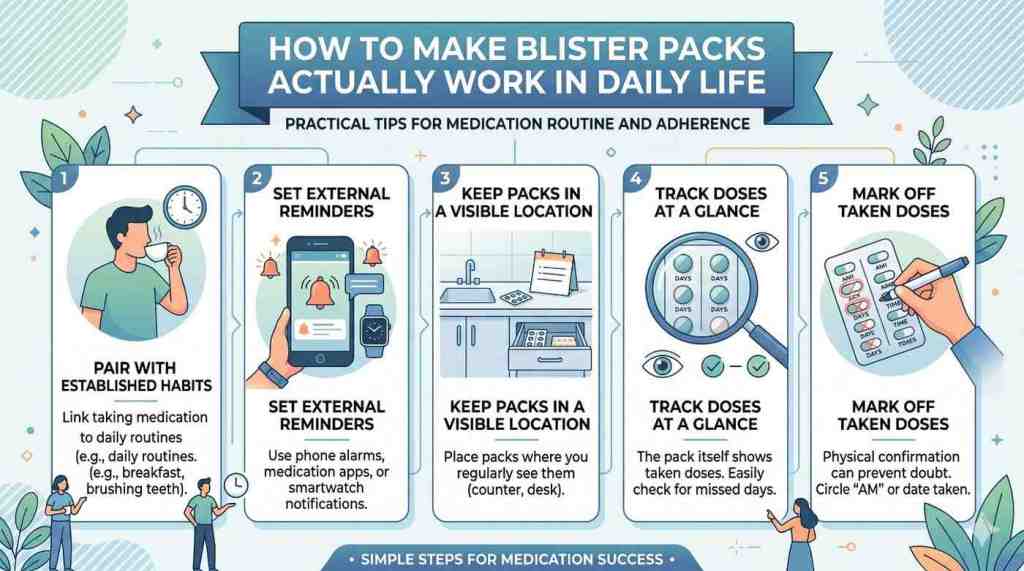
This is the part many articles skip. Even a well-designed medication system fails if it is introduced poorly.
Keep the routine anchored to existing habits
Do not tell a senior to “remember the blister pack.” Attach it to something they already do.
Examples:
- Morning dose right after brushing teeth
- Lunch dose after sitting down to eat
- Evening dose after the nightly news
- Bedtime dose after locking the door or turning off lights
This is far more effective than relying on memory alone.
Store the pack in the right place
Not random. Not hidden in a drawer. Not next to similar-looking old medication bottles.
Choose one visible, safe place with good lighting and low clutter. The ideal location is easy to reach but away from moisture, excess heat, and household confusion.
Remove expired systems and duplicates
One of the quickest ways to create medication mistakes is to keep old pill organizers, loose bottles, sample packs, and new blister packs all in the same area. Once the blister-pack routine starts, the medication zone should be simplified.
Use a first-week observation period
For the first week, someone should watch for friction points:
- Is the senior opening it correctly?
- Are they skipping a dose because they are unsure?
- Are the printed times confusing?
- Are they embarrassed to ask questions?
- Are they taking pills from the wrong day?
These small problems are common and fixable, but only if someone notices them early.
Pair the system with pharmacist communication
Many packaging services note that pharmacists review and prepare the medication schedule, which makes the pharmacy an important partner, not just a dispenser. ld ask:
- What happens if a medication changes mid-cycle?
- Which medications will stay outside the blister pack?
- How are refills synchronized?
- Who do we call if a dose is missed?
- Can labels be made easier to read?
- Are travel-friendly options available?
The more clearly this is explained at the beginning, the smoother the routine becomes.
How Blister Packs Can Support Independence Without Making Seniors Feel Dependent
For many older adults, medication management is about much more than pills.
It is about privacy. It is about routine. It is about confidence. And in many cases, it is about identity.
A senior who has handled their own medications for years may not see blister packs as a simple organizational tool. They may see them as a sign that other people think they are no longer capable. Even when family members mean well, the conversation can accidentally feel controlling. A daughter may think, “This will make things safer,” while a parent hears, “You can’t manage on your own anymore.”
That emotional gap matters.
If blister packs are introduced without sensitivity, even a practical system can be rejected. But when they are introduced in the right way, they can do the opposite. They can actually help seniors stay independent longer by reducing confusion, lowering the risk of medication mistakes, and making routines easier to manage without constant supervision.
That is the real value. Not just sorting pills, but preserving autonomy where possible.
This is especially important in aging households where the goal is not total caregiver control. The goal is to support the older adult in staying involved, informed, and as self-directed as possible.
So instead of asking only, “Do blister packs improve medication management?” families should also ask:
Can this system help the senior stay more confident and more independent in daily life?
Often, the answer depends less on the packaging itself and more on how the system is introduced, explained, and supported.
Why Independence Matters So Much in Medication Routines
Medication is one of the most personal parts of daily life. Seniors may accept help with groceries, cleaning, transportation, or even cooking before they are comfortable accepting help with medication. That is because medications are closely tied to dignity and self-trust.
When a person can still say, “I know what I take, I know when I take it, and I can handle it,” that feeling matters deeply.
Once that confidence starts to slip, even slightly, the emotional effect can be larger than family members realize. A senior may begin to feel embarrassed by forgetfulness, worried about being judged, or afraid that any mistake will lead to more restrictions.
That is why blister packs should never be framed as a “fix” for failure.
They are better introduced as a support tool:
- a way to reduce stress,
- a way to make things easier,
- a way to protect energy and mental focus,
- and a way to stay in charge with less effort.
That framing changes everything.
Instead of saying:
“You keep getting mixed up, so this will help.”
A better approach is:
“You already manage a lot. This could make your routine simpler and give you one less thing to keep track of.”
That difference in tone is not small. It can determine whether the senior feels respected or managed.
The Best Outcomes Happen When Seniors Still Feel Involved
A blister pack should not turn an older adult into a passive participant in their own health.
In fact, the most successful medication systems are usually the ones where the senior remains actively involved in a few important ways.
They still know what medications they are taking
Even if the medications are pre-sorted, the person should still understand the basics:
- what each medication is for,
- when it is taken,
- what changes have recently happened,
- and who to call if something seems wrong.
This reduces dependence and helps prevent a “just take whatever is in the pack” mindset. Blister packs improve organization, but they should not replace awareness.
They still have some control over the routine
This might mean:
- choosing where the pack is kept,
- deciding whether medications are taken with breakfast or right after breakfast,
- helping review new packs when they arrive,
- or keeping their own calendar note when a refill is due.
These are small forms of control, but they matter. Seniors are more likely to accept systems that still leave room for ownership.
They are invited into the decision, not informed after the fact
A very common family mistake is arranging everything with the pharmacy first and presenting the new system later. That may be efficient, but it often creates resistance.
A better process is to ask:
- “Would this make your day easier?”
- “What do you dislike about bottles now?”
- “Would you rather have morning and evening doses separated more clearly?”
- “Would you want to try it for one month first?”
When seniors participate in the decision, they are more likely to feel the system is working for them rather than being imposed on them.
The Emotional Reasons Some Seniors Resist Blister Packs
Resistance does not always mean the person is being difficult. Often, it means something important is underneath the objection.
“I’ve always done it this way.”
This usually means the current routine is familiar and changing it feels disruptive. Familiarity often feels safer than efficiency, especially in later life.
“I don’t need that.”
This may mean the senior is protecting their identity as capable and independent. The fear is not really about the packaging. It is about what the packaging symbolizes.
“Those things are confusing.”
Sometimes this is true. Sometimes it means the format was not explained well. Sometimes it means the senior is worried they will make mistakes and would rather reject the system than fail at using it.
“I prefer the bottles.”
This may come from habit, visual recognition, or trust. The person may be used to reading labels on original containers and may feel uncomfortable when medications are grouped into compartments.
Families do better when they respond to the feeling behind the objection rather than arguing the logistics.
For example, instead of saying:
“But this is easier.”
Try:
“I understand you are used to your old system. Let’s look at whether this would actually make one part of the day less stressful.”
That keeps the conversation respectful and collaborative.
How Families Can Introduce the Idea Without Starting a Power Struggle
The goal is to reduce stress, not create a new battle around medications.
Lead with convenience, not decline
Avoid opening the conversation with fear-based language like:
- “You might forget.”
- “You’re getting older.”
- “This is safer because you’re not as sharp as before.”
Even if the concern is real, that kind of language often triggers defensiveness.
Instead, focus on relief:
- “This might save you time.”
- “This could make mornings simpler.”
- “This might reduce the hassle of so many bottles.”
- “It could make it easier when routines are busy or interrupted.”
Use trial language
People are more open to trying something than agreeing to a permanent change.
Say:
- “Would you be open to trying it for a few weeks?”
- “Let’s test whether it actually helps.”
- “If it doesn’t make life easier, we can revisit it.”
That lowers emotional pressure.
Ask where current medication routines feel annoying
This is a practical entry point. A senior may not say yes to blister packs directly, but they may say:
- “The evening pills are the hardest.”
- “The labels are too small.”
- “I hate sorting everything every Sunday.”
- “I’m never sure if I took the lunchtime tablets.”
Once the real friction point is visible, blister packs can be discussed as one possible solution rather than a broad correction.
Avoid teaming up against the senior
If several family members are all pushing the idea at once, the older adult may feel cornered. It is usually better for one trusted person to lead the conversation calmly.
How Blister Packs Can Reduce Caregiver Stress Without Taking Over the Senior’s Life
Caregivers often live in a difficult middle ground. They want to help, but they do not want every interaction to become a medication check.
That is where blister packs can be genuinely useful.
They provide a simple visual cue without requiring constant oversight. A spouse, adult child, or home helper can often tell quickly whether a dose has likely been taken. That can reduce repetitive reminders, daily tension, and the emotional fatigue that comes from feeling like the “medication police.”
But this only works well if caregivers use the system thoughtfully.
Good caregiver use looks like support
Examples:
- “Just checking whether today’s morning dose is done.”
- “Do you want me to leave the pack by your breakfast place?”
- “Would a reminder note help, or do you prefer to handle it yourself?”
This keeps the senior in the lead.
Poor caregiver use feels like surveillance
Examples:
- “You missed this again.”
- “Why is this one still here?”
- “You clearly can’t keep track.”
Even if the caregiver is frustrated, this approach damages trust. It makes the system feel like a monitoring tool instead of a support tool.
The best blister-pack routines reduce caregiver burden quietly, without making the senior feel watched.
Building a Medication Routine That Feels Manageable, Not Medicalized
One subtle risk with organized medication systems is that life can begin to feel too clinical. The older adult may feel their home routine is no longer natural and has turned into a care schedule.
That is why the routine around the blister pack matters just as much as the pack itself.
Keep the process calm
Medication time should not feel rushed, loud, or chaotic. A calm setting supports consistency and reduces mistakes.
Connect it to normal life, not only illness
Instead of making the medication routine the center of attention, connect it to ordinary daily anchors:
- breakfast,
- tea time,
- evening reading,
- bedtime preparation.
This keeps the system integrated into life rather than making life revolve around medication.
Use plain language
Avoid overcomplicating things with medical phrasing. “Morning pills” may be more useful than “first administration interval” in everyday life. Simpler language often supports better follow-through.
Respect privacy
Some seniors do not want medication packs left in public view when visitors come over. Others prefer visibility because it helps them remember. Ask what feels comfortable. Small preferences like this affect acceptance more than families often realize.
Signs the System Is Preserving Independence Well
Families and seniors should check not only whether the system is functioning, but whether it is doing so in a healthy way.
Positive signs include:
- the senior reaches for the pack without prompting,
- medication times feel calmer than before,
- there is less confusion and less second-guessing,
- caregivers remind less often,
- the person still understands the purpose of their medications,
- and the senior expresses more confidence, not less.
These are strong signs that the system is helping the person stay capable.
Signs the System May Be Quietly Undermining Confidence
Not every problem is obvious. Sometimes the pack is technically being used, but the senior is feeling less independent than before.
Watch for:
- embarrassment when using the pack in front of others,
- reluctance to ask questions,
- comments like “I guess I can’t manage on my own anymore,”
- withdrawing from responsibility altogether,
- waiting for others to check every dose,
- or increasing anxiety around making a mistake.
When this happens, the answer is not always to abandon the system. Sometimes it simply means the support approach needs to change.
Maybe the senior needs:
- more explanation,
- more involvement,
- easier labeling,
- fewer people commenting on medication,
- or more reassurance that the tool is there to support independence, not replace it.
Practical Ways to Keep Seniors Empowered While Using Blister Packs
This is where families can make a major difference.
Let the senior review new packs first
When a new pack arrives, invite them to look over it with you or with the pharmacist’s instructions nearby. This reinforces familiarity and confidence.
Keep a simple medication reference sheet nearby
A one-page list that explains:
- medication name,
- purpose,
- general time of day,
- and any key instructions
can help the senior stay informed without needing to rely only on memory.
Ask, don’t assume
Instead of rearranging the setup every week, ask:
- “Is this location working for you?”
- “Is the label clear enough?”
- “Would you like a different reminder style?”
- “Does this feel easier than before?”
That maintains collaboration.
Let them do what they can still do
If the senior can still open the pack, identify the right time slot, and take the dose correctly, do not over-assist. Too much help can shrink confidence.
Focus praise on capability
Say:
- “This looks like it’s making your routine smoother.”
- “You seem more comfortable with this now.”
- “You’re handling this well.”
That reinforces competence rather than dependence.
Blister Packs Work Best When They Are Part of a Larger Respectful System
A medication tool alone does not create dignity. The surrounding behavior does.
The family culture around medication matters:
- Are questions welcomed?
- Is the senior spoken to directly?
- Are decisions explained clearly?
- Is help offered respectfully?
- Are routines adjusted when something is not working?
When those things are in place, blister packs can be part of a very healthy support structure. When they are not, even the most organized system can feel demeaning.
This is why the “worth it” question is not only practical. It is relational.
A good medication system should protect:
- safety,
- clarity,
- routine,
- and self-respect.
If one of those is missing, the solution is incomplete.
A Better Standard for Families to Use
Instead of asking only:
“Will blister packs reduce medication errors?”
Ask the fuller question:
“Will this make medication management safer while still allowing the senior to feel informed, respected, and in control?”
That is the better standard.
Because seniors do not just need correct medication routines. They also need systems that fit their lives with dignity.
And often, that is exactly where blister packs can be most useful.
Not by taking over, but by removing just enough confusion that the older adult can keep doing more for themselves.
Actionable Next Steps for Seniors and Families
Here is a practical way to apply this thoughtfully.
If you are a senior
- Think about which part of medication-taking feels hardest right now: remembering, opening bottles, reading labels, or keeping track of timing.
- Ask whether a pre-sorted system would reduce effort without making you feel less in control.
- Request a clear explanation of how the pack is organized before agreeing to switch.
- Stay involved in reviewing what is in the pack.
If you are an adult child or caregiver
- Start the conversation with ease and support, not decline and fear.
- Ask what part of the current system your parent or loved one dislikes most.
- Introduce blister packs as an option, not an instruction.
- Watch whether the system improves confidence as well as consistency.
- Adjust your communication style if the senior seems monitored rather than supported.
Common Mistakes Families Should Avoid
Even good systems can go wrong when people get casual.
Mistake 1: Assuming every medication is inside the pack
Some medicines may not be included, especially “as needed” medications, inhalers, liquids, refrigerated items, or drugs that require special handling. Always confirm what is and is not included.
Mistake 2: Mixing medications from old bottles into the pack routine
Never improvise by adding pills from somewhere else unless the pharmacist has instructed you to do so.
Mistake 3: Doubling up after a forgotten dose
Safe blister-pack guidance specifically warns against taking two doses together to make up for a missed one without professional advice. : Using multiple packs at once
This can happen when an old pack is not discarded or a new cycle arrives early. Guidance also warns against taking medicines from more than one blister pack at the same time because errors become more likely. : Treating the system as fully self-managing
A blister pack can support adherence. It does not replace medication reviews, doctor follow-up, side-effect monitoring, or conversations about whether the medication plan still makes sense.
What Caregivers and Adult Children Should Watch For

Families often focus only on whether the pack is being used. A better question is whether it is genuinely making life easier.
Positive signs include:
- Fewer “Did I take it?” moments
- Less resistance around medication time
- Fewer calls about confusion
- Better refill consistency
- More confidence from the senior
- Less caregiver stress
Warning signs include:
- Pills left behind in multiple slots
- The senior opening the wrong section
- Complaints that the labels are hard to see
- Frustration with pressing out medication
- Continued confusion despite the packaging
- More reliance on family than before, not less
If the pack is increasing stress rather than reducing it, that does not mean the senior has failed. It may simply mean the system needs to be adjusted.
A Balanced Way to Think About “Worth It”
For seniors, “worth it” should not mean trendy, modern, or convenient for everyone else. It should mean:
Does this make medication-taking safer, clearer, and less exhausting?
That is the standard that matters.
For some people, blister packs are absolutely worth it because they reduce daily uncertainty and bring calm to a complicated routine. For others, they are only worth it if paired with refill coordination, caregiver support, or a simplified medication schedule. And for some, another system may be better.
The key is not to ask whether blister packs are good in general.
Ask whether they are good for this person, in this home, with this medication routine, right now.
That is the kind of decision that protects independence while still being realistic.
Action Steps Seniors and Families Can Take This Week
To turn this from information into action, here is a practical next-step plan:
If you are a senior:
- Write down every medication you take and what time you take it.
- Circle the times you most often feel confused or rushed.
- Bring that list to your pharmacist and ask whether blister packaging would simplify your schedule.
- Test whether you can comfortably read and open a sample pack before enrolling.
If you are an adult child or caregiver:
- Watch one full medication routine without interrupting.
- Notice where the process breaks down: memory, vision, labels, timing, or physical handling.
- Ask the pharmacy how medication changes are handled.
- Confirm which prescriptions would be inside the pack and which would remain separate.
- Do a one-week check-in after switching rather than assuming all is well.
If you are writing for a broader senior audience:
Encourage readers not to choose blister packs simply because they sound organized. Encourage them to choose based on fit, safety, and ease of use.
That is what makes the decision meaningful.
Comparing Blister Packs and Bubble Packs in Long-Term Care Facilities
When touring long-term care options, one of the most reassuring sights is seeing organized medication systems in action. Families want to understand exactly how prescriptions will be managed in these settings.

Professional living facilities rely on sophisticated packaging solutions. These systems ensure each resident receives the right medications at the correct times.
Safety, Convenience, and Customization
Color-coded systems provide an extra safety layer. Different colors for morning, noon, evening, and bedtime doses prevent timing errors.
Barcode scanning technology creates electronic verification. Staff scan each package before administration, ensuring the right patient gets the proper treatment.
Packaging options accommodate various needs. Some systems work best for stable regimens, while others handle frequently changing prescriptions.
| Packaging System | Best For | Safety Features | Flexibility |
|---|---|---|---|
| 31-Day Blister Cards | Stable medication regimens | Color-coding, barcode scanning | Monthly organization |
| 7-Day Color Coded Cards | Frequently changing medications | Weekly verification, tamper-evident | Easy adjustments |
| Strip Packaging Systems | Multiple medications per dose | Individual pouches, date labeling | Complex schedules |
| Multi-Dose Compliance Packages | Residents needing assistance | Disposable cups, time coding | Staff administration |
Specialized pharmacies customize packaging for each individual’s needs. They accommodate large pills and complex schedules while maintaining security.
These organized systems benefit both staff and families. Staff efficiently manage medications for multiple residents. Families can easily verify proper medication management during visits.
Facilities choose from multiple packaging options that best fit their workflow. This ensures optimal care for every resident.
Getting Started with Your Medication Packaging Solution
Many families hesitate to make changes to medication routines, fearing complexity or loss of independence. But the transition is designed to be gentle and supportive.
Your local pharmacy team understands these concerns. They’ve helped countless patients find the right system for their unique needs.
How to Enroll with JoyCalls for Seamless Setup
While organized packaging handles the physical aspect, JoyCalls provides the gentle reminders and companionship. This combination addresses both organization and accountability.
The enrollment process takes just minutes. Caregivers can customize call times to match medication schedules. This creates a comprehensive support solution that brings peace of mind.
Steps to Transition to Organized Medication Packaging
Begin with an honest conversation with your pharmacist. Bring all current prescriptions and discuss daily routines. They’ll assess which option fits best.
The pharmacy team reviews compatibility and prepares your first organized card. Many facilities offer this service at minimal cost, especially when it improves health outcomes.
This approach works beautifully alongside services like daily check-ins and the benefits of organized systems. Within days, what felt unfamiliar becomes natural and reassuring.
Are Blister Packs the Best Option? How Seniors and Families Can Compare Cost, Convenience, and Real-World Safety
By the time many seniors and families seriously consider blister packs or bubble packs, they are no longer asking a basic question like, “What is this?” They are asking something more practical.
Is this actually the best system for us?
That is a smart question.
Medication packaging can look appealing because it promises structure, convenience, and peace of mind. But older adults do not need a medication system that merely sounds organized. They need one that works well in the real world — in their home, with their habits, with their prescriptions, with their budget, and with the level of help they actually have.
That is where careful comparison matters.
For one senior, blister packs can be a major relief because they remove the burden of sorting pills by hand each week. For another, a simple pill organizer may be enough. For someone else, the real problem may not be organization at all, but medication changes, poor communication between prescribers, or difficulty remembering to take doses on time. In those cases, blister packs may help somewhat, but not enough on their own.
This is why families should slow down and compare options strategically instead of assuming the most structured-looking solution is automatically the best one.
A good medication routine should do five things well:
- reduce the chance of missed doses or accidental repeat doses,
- feel manageable in daily life,
- fit the senior’s physical and cognitive abilities,
- avoid unnecessary stress or complexity,
- and make sense financially over time.
If a system fails on any of these, it may not be the right long-term fit, even if it looks neat on paper.
This section is designed to help seniors, adult children, spouses, and caregivers compare blister packs with other common medication-management approaches, understand what costs and tradeoffs to think about, and ask better questions before choosing a system.
Because the best medication system is not always the most impressive one.
It is the one a senior can actually live with consistently and safely.
The First Rule: Do Not Compare Systems by Looks Alone
One reason families make poor medication decisions is that they compare systems visually instead of functionally.
A blister pack often looks more professional than a weekly pillbox. It feels more structured. It may even feel safer at first glance because doses are pharmacy-prepared and clearly separated. That visual structure can be reassuring.
But a medication system should not be judged only by how organized it appears.
It should be judged by questions like:
- Can the senior use it correctly every day?
- Does it still work when routines change?
- Is it easy to update when prescriptions change?
- Will the person accept it emotionally?
- Can the caregiver support it without conflict?
- Does the cost make sense month after month?
- Does it simplify life, or simply change the form of the stress?
These are the real comparison points.
A plain weekly organizer that a senior uses correctly every single day may be better than a blister-pack system that causes frustration, confusion, or repeated calls to the pharmacy. On the other hand, a blister pack may be far safer than a manually filled organizer if the senior has memory issues, poor vision, or trouble sorting medications accurately.
So before comparing products or pharmacy services, compare actual daily functioning.
That is the lens that matters most.
Option 1: Blister Packs or Bubble Packs
Blister packs and bubble packs are usually best when the goal is to reduce sorting errors, increase clarity, and make it easier to see whether a scheduled dose has been taken.
Where blister packs usually do well
They often work well for seniors who:
- take multiple medications at set times each day,
- get confused by several separate bottles,
- benefit from visual structure,
- have caregivers who want a quick, respectful way to monitor adherence,
- or are transitioning home after illness, hospitalization, or a period of medication instability.
They can also be very helpful for families who want a pharmacy-supported system instead of relying on one relative to manually organize everything.
Where blister packs can fall short
They may be less ideal when:
- medications change frequently,
- the senior uses many “as needed” medicines,
- opening the packaging is physically difficult,
- the person strongly prefers original bottles,
- or the home routine is so irregular that time-of-day grouping is not enough support on its own.
Blister packs also create a subtle dependency on refill timing and pharmacy coordination. If the pharmacy process is inconsistent, the senior’s medication routine may feel interrupted or unstable.
Best fit profile
Blister packs tend to be strongest when the medication list is fairly stable, the routine is structured, and the senior wants organization without having to fill a box manually.
Option 2: Traditional Weekly Pill Organizers
The weekly pill organizer remains one of the most common medication tools for older adults. It is simple, familiar, and often inexpensive. For many seniors, that is enough.
Where pill organizers do well
They are often a good fit when:
- the medication routine is stable,
- the senior or caregiver is capable of filling it accurately,
- cost needs to stay low,
- the person prefers a familiar, reusable solution,
- and the number of medications is manageable.
A weekly organizer can work particularly well for an older adult who is still independent, understands their medications clearly, and just needs a straightforward way to avoid opening multiple bottles each day.
Where pill organizers can create risk
The biggest weakness is the filling process itself.
Someone has to:
- read each bottle correctly,
- place each pill in the correct slot,
- notice dose changes,
- remove discontinued medicines,
- and refill the organizer consistently.
That creates room for human error. If the person filling it is tired, distracted, visually impaired, or confused about recent medication changes, mistakes can happen before the week even begins.
Another challenge is that once pills are transferred into a generic organizer, some seniors lose track of what each pill is. If something seems different, there may be less confidence about whether it is correct.
Best fit profile
A weekly pill organizer is often best for seniors with a simple, stable medication routine and enough confidence, vision, and attention to either fill it themselves or review it carefully with a trusted helper.
Option 3: Original Prescription Bottles Only
Some older adults prefer to keep all medications in their original bottles and take them directly from there. This approach works better than many people assume — but only under the right conditions.
Where bottles work well
They may work well when:
- the senior takes only a small number of medicines,
- the medication schedule is simple,
- the person is highly consistent,
- labels are readable,
- and there is little confusion about timing.
Some seniors trust bottles more because they can see the prescription label directly and associate each medication with a name and purpose more easily.
Where bottles become difficult
As the number of medications increases, bottles become harder to manage. This is especially true when:
- multiple medicines look similar,
- timing varies across the day,
- hands are weak or painful,
- or the senior is interrupted often and cannot remember whether a dose was already taken.
Bottles are usually weakest in one important area: confirmation. They do not clearly tell you whether today’s morning dose has already been taken unless the senior uses another tracking method.
Best fit profile
Bottles alone are usually best only for relatively simple routines. Once medication management becomes layered or stressful, bottles are often not enough by themselves.
Option 4: Digital Reminders and Medication Apps
Technology-based reminders are increasingly common. These may include phone alarms, smart speakers, medication reminder apps, text prompts, or even smart dispensers.
Where digital tools do well
They can be very effective when the main problem is not sorting medications, but remembering when to take them.
They are especially useful for:
- tech-comfortable seniors,
- adult children supporting parents from a distance,
- households that already rely on phones or voice assistants,
- and seniors who take the right medicines but miss doses because routines vary.
Where digital tools fall short
A reminder is not the same as a medication system.
An alarm can tell someone it is time to take a pill, but it does not necessarily reduce confusion about:
- which pills to take,
- whether today’s dose was already taken,
- how to handle dose changes,
- or what to do if a pack, bottle, or box is not organized properly.
Some seniors also dislike technology or find it stressful. Others may dismiss reminders too easily, silence alarms, or forget why the alert appeared.
Best fit profile
Digital tools work best as a support layer, not always as a complete solution. They are strongest when added to a clear physical medication system, such as blister packs or a pill organizer.
Option 5: Caregiver-Managed Medication Support
In some households, the real medication system is not the packaging at all. It is the caregiver.
A spouse, adult child, aide, or family friend may remind, prepare, hand over, and monitor medications daily. This can work extremely well — and it can also become exhausting.
Where caregiver support does well
It can be essential when:
- the senior has significant memory impairment,
- the medication schedule is complex,
- multiple formulations are involved,
- or the person is no longer able to manage medications safely alone.
A strong caregiver can adapt in real time, notice changes, and respond when something seems wrong.
Where caregiver-led systems become risky
The problem is that caregiver support is not always consistent. People get tired. They get busy. They travel. They become ill themselves. In some homes, one person carries the entire burden and the system depends too much on their availability.
There is also an emotional cost. When every medication decision flows through one relative, the senior may begin to feel supervised rather than supported.
Best fit profile
Caregiver involvement is often necessary, but it works best when it is supported by a clear system instead of being the only system. In many cases, blister packs can reduce caregiver burden without removing the human support entirely.
The Most Important Comparison: Which System Fails Most Gracefully?
Families rarely ask this question, but they should.
Every medication system will be imperfect at times. The real issue is what happens when something goes wrong.
- If a senior misses a reminder in an app, can they still tell whether they took the dose?
- If a weekly organizer was filled incorrectly, will anyone notice before several days pass?
- If a blister pack arrives after a medication change, is there a clear process for correction?
- If the main caregiver is unavailable, can the senior still follow the routine safely?
A good system should not only work on ideal days. It should also be resilient on messy days.
That is one reason blister packs appeal to many families. They tend to create visible structure that is easier to check quickly. But that advantage only holds if the pharmacy coordination is strong and the senior can physically and mentally use the format comfortably.
How to Think About Cost Without Making It Only About Price
Cost matters, especially for seniors on fixed incomes. But medication systems should not be judged by price alone.
A cheap system that leads to confusion, missed doses, or family stress may not actually be inexpensive in the broader sense. At the same time, a paid packaging system is not automatically worth it just because it looks more advanced.
The better question is:
What value does this system add relative to the problems it solves?
Consider direct cost
Ask:
- Is there a packaging fee?
- Is it charged monthly, per medication, or per cycle?
- Are delivery charges involved?
- Does insurance cover any part of it?
- Is there a charge for repackaging after medication changes?
Consider indirect cost
Families should also think about:
- the time spent sorting pills manually,
- caregiver stress,
- repeated calls about medication confusion,
- avoidable refill problems,
- and the risk of mistakes that could lead to health complications.
A system that reduces those burdens may justify some added cost.
Consider sustainability
A good system should be affordable not just for one month, but over time. If blister packs seem helpful but the monthly cost creates strain, families may abandon the system later. That kind of stop-start approach can create more confusion.
The best option is often the one the senior can comfortably maintain.
Questions Seniors and Families Should Ask the Pharmacy Before Saying Yes
This is one of the most important practical steps. Many families agree to blister packs without asking enough operational questions, then discover the friction only later.
Here are the questions worth asking.
About what is included
- Which medications will go into the blister pack?
- Which ones will remain separate?
- Are vitamins, supplements, “as needed” medications, liquids, inhalers, or refrigerated items handled differently?
About medication changes
- What happens if a doctor changes a dose after the pack has already been prepared?
- Will the pharmacy redo the pack?
- Is there a charge for that?
- How quickly can corrections be made?
About readability and usability
- Can the labels be printed larger?
- Is the day and time easy to read?
- Is this the easiest package type to open for someone with arthritis or weak hands?
- Can we test a sample?
About coordination
- Can all prescriptions be synchronized to refill together?
- How much notice is needed before the next cycle?
- Who contacts whom if something changes?
- What happens if one medication is delayed?
About support
- Can the pharmacist review the full medication list with us before starting?
- Who should we call if a dose is missed or the pack seems incorrect?
- Is delivery available?
- Can caregivers be included in communication if the senior wants that?
These questions do more than clarify logistics. They reveal how reliable the service really is.
A good pharmacy partner will answer them clearly and patiently.
Red Flags That Suggest a Blister-Pack Service May Not Be the Right Fit
Not every pharmacy packaging service is equally thoughtful or well-organized. Families should watch for warning signs early.
Red flag 1: Vague answers about medication changes
If the pharmacy cannot clearly explain what happens when prescriptions change mid-cycle, expect confusion later.
Red flag 2: No effort to review the full medication list
A packaging service should be grounded in an accurate medication profile. If the pharmacy seems to treat the pack as simple packaging rather than part of medication management, that is not a good sign.
Red flag 3: Labels are hard to read or confusing
If a senior struggles to read a sample pack at the beginning, that issue will not become less important later.
Red flag 4: The service seems convenient for the pharmacy but not for the senior
A good system should fit the person’s real life. If the schedule feels rigid, the pack is physically hard to use, or questions are brushed aside, the service may not be senior-centered enough.
Red flag 5: Families are expected to figure out the gaps themselves
If the pharmacy is unclear about what happens with “as needed” medicines, delays, missing items, or temporary changes, families may end up doing too much manual problem-solving around the system.
When a Combination Approach Is Actually Best
Families sometimes think they must choose one single medication strategy and use it exclusively. In real life, mixed systems often work best.
For example:
- a senior may use blister packs for routine daily prescriptions,
- keep original bottles for occasional medications,
- use a phone reminder for lunchtime doses,
- and have a caregiver review the new pack once a week.
That kind of layered approach can be much more effective than relying on one tool to do everything.
The key is clarity.
If a combination system is used, everyone should know:
- what is in the blister pack,
- what is outside of it,
- what the reminders are for,
- and who is responsible for checking changes.
A mixed system works well only when it is clearly explained and consistently followed.
A Simple Decision Framework for Families
If the family is still unsure, use this practical framework.
Choose blister packs when:
- medications are numerous and scheduled,
- sorting errors are a concern,
- the senior wants more structure,
- caregiver stress is high,
- and pharmacy coordination is reliable.
Choose a weekly organizer when:
- medications are stable,
- the routine is simple enough,
- cost needs to stay very low,
- and someone can fill it carefully and consistently.
Choose bottles alone when:
- the medication routine is very simple,
- the senior is highly organized,
- and there is little confusion about timing or adherence.
Add digital reminders when:
- the main issue is remembering time,
- the senior is comfortable with technology,
- or caregivers want a light-touch support method.
Increase caregiver involvement when:
- cognition or safety concerns are too significant for the senior to manage alone,
- or when any system still leaves too much room for error.
This kind of comparison often brings clarity quickly.
The Best Choice Is the One That Feels Easier Week After Week
Medication systems should not be judged based on the first day. They should be judged based on how they feel after several weeks.
The right system usually creates these outcomes:
- less second-guessing,
- fewer stressful reminders,
- a calmer daily rhythm,
- fewer refill surprises,
- less caregiver tension,
- and more confidence for the senior.
If a system creates more frustration than relief, it may be too complicated, too rigid, or simply not matched to the person’s needs.
That does not mean the senior failed.
It means the system was not the right fit.
And that is a useful discovery.
Because choosing the wrong system and keeping it out of pride or momentum can be worse than going back and choosing a simpler one.
Final Practical Advice for Readers Comparing Their Options
If a senior or family is deciding between blister packs and other medication systems, the best next step is not to ask, “Which one is best in general?”
The best next step is to ask:
- What exactly keeps going wrong now?
- What kind of help is actually needed: sorting, reminding, checking, or monitoring?
- What can the senior comfortably manage on their own?
- What system can we maintain without burnout or confusion?
- What will still work when life gets busy, routines shift, or medications change?
Those questions lead to better decisions than marketing language ever will.
Blister packs can absolutely be worth it. For many seniors, they are a highly practical, reassuring tool. But they are most valuable when chosen deliberately — not because they look organized, but because they genuinely solve the right problem.
That is the standard readers should use.
Conclusion
Transforming medication management from a source of stress to a routine of reassurance is closer than you think. The journey many families take—from noticing struggles to finding working solutions—leads to genuine peace of mind.
These organized systems do more than sort pills. They preserve dignity and maintain independence. Research shows that well-designed packaging significantly improves usability for older adults. This leads to better health outcomes and confidence for everyone involved.
Whether supporting someone at home or in long-term care, organized medication solutions make a real difference. You don’t have to navigate this alone. Pharmacists and services like JoyCalls can help create a comprehensive care plan.
Reach out to discuss options today. Taking this step honors your loved one’s safety while giving you relief. Creating an effective emergency plan brings additional security. Both seniors and caregivers deserve this support.