


What if your loving concern for an aging parent feels like a constant battle against their fierce independence? You call to check in, only to be met with a wall of resistance. It’s a heartbreaking situation many families face.
This pushback isn’t about you. It’s about a deep-seated need for control. For many seniors, the aging process can feel frightening. It can bring a loss of autonomy they desperately want to hold onto. This fear can make them secretive about new challenges.
Your loved one might insist they are “just fine,” even when signs suggest otherwise. This creates a painful gap. You want to provide care and ensure safety, but you also want to honor their dignity.
Finding a balance is not only possible; it’s essential for your relationship. This guide will help you understand the resistance. We will explore how to create a gentle, daily routine that respects their independence while giving you peace of mind.
Key Takeaways
- Resistance to check-ins is often a sign of a senior’s desire to maintain control and dignity.
- Understanding the emotional reasons behind the pushback is the first step toward a solution.
- A successful routine prioritizes respect for independence alongside safety.
- Small, consistent strategies can transform check-ins from a source of conflict into a positive connection.
- Technology can offer a discreet and effective way to bridge the gap between care and autonomy.
Understanding Why Elderly Hates Being Checked On
When daily check-ins become a source of tension rather than connection, understanding the ‘why’ behind the resistance is crucial. This pushback often stems from deep emotional currents that deserve compassion and careful navigation.
Emotional Impact and Independence Concerns
Your loved one has likely spent decades being the caregiver, not the one receiving care. Accepting help can feel like admitting they’re no longer capable. This shift challenges their identity and self-worth.
The fear of losing independence is profound. Each well-meaning call can feel like a reminder that things are changing beyond their control. This emotional landscape requires gentle understanding.

Root Causes Behind Resistance
Many seniors face internal battles with pride and fear. They worry about becoming a burden or losing decision-making power. These concerns are valid and deeply personal.
Some parents become secretive about new challenges because verbalizing them makes the situation feel more real. Understanding these root causes helps you approach with empathy rather than frustration.
When your mom doesn’t answer the phone, it’s rarely about you personally. It’s about their struggle with aging’s inevitable changes. Recognizing this distinction transforms your approach to daily communication.
The Importance of a Gentle Daily Check-In Routine
What if your daily contact could become a moment your parent actually looks forward to? A gentle routine transforms check-ins from obligation to opportunity. It builds a bridge of care that honors their independence while providing essential support.
Try JoyCalls Free
No app or new device needed. Start with a free 7-day trial.
This approach recognizes that aging brings changes, but doesn’t define the entire relationship. The benefits extend far beyond basic safety monitoring.
Benefits of Consistent Communication
Regular contact creates a safety net that catches small issues early. You might notice subtle changes in your mom’s voice or mood during brief calls. These observations can prevent larger problems down the road.
Consistency also reduces feelings of isolation. Your loved one knows someone cares enough to connect daily. This regular daily phone check-in becomes a comforting ritual.

Fostering Trust and Safety
Trust grows when check-ins feel like conversations, not interrogations. Your parents need to see you as a partner, not a supervisor. This shift makes them more likely to share concerns openly.
Building this trust takes time and patience. The entire family benefits when communication flows naturally. Your loved one feels respected, and you gain peace of mind.
| Approach | Frequency | Tone | Likely Outcome |
|---|---|---|---|
| Authoritative Check-In | Multiple times daily | Demanding | Resistance and secrecy |
| Gentle Routine | Once daily | Conversational | Openness and connection |
| Irregular Contact | Sporadic | Rushed | Anxiety and missed issues |
The right balance provides real safety while respecting independence. These benefits create a foundation of mutual care that strengthens your entire family dynamic.
Recognizing Early Signs of Dementia and Behavioral Changes
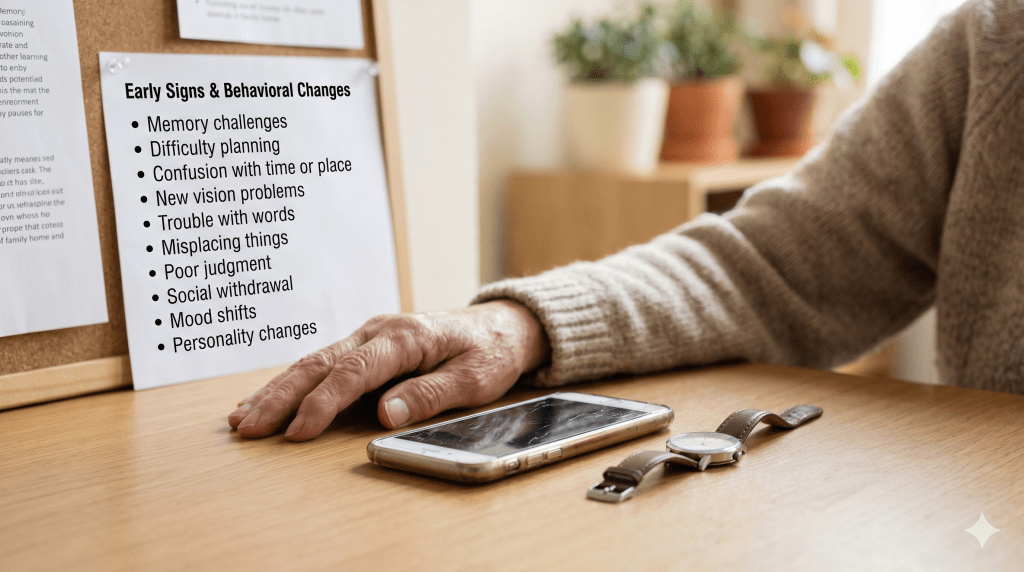
When familiar patterns in your mom’s behavior start to change unexpectedly, it can be both confusing and concerning for the entire family. These shifts often appear gradually, making them easy to dismiss as normal aging.
Identifying Cognitive Shifts
Memory lapses that go beyond occasional forgetfulness may signal cognitive changes. Your loved one might repeatedly ask the same questions or struggle with familiar tasks.
These memory issues can contribute to feelings of isolation and frustration. Recognizing these early signs allows for timely medical evaluation.

Try JoyCalls Free
No app or new device needed. Start with a free 7-day trial.
Understanding Mood and Personality Alterations
Personality changes can be particularly jarring. A typically gentle person may become irritable or make uncharacteristic comments.
Sometimes these behavioral shifts stem from underlying health conditions like urinary tract infections. Other times, they indicate diseases like Alzheimer’s.
| Normal Aging | Potential Concern | Action Needed |
|---|---|---|
| Occasionally misplacing items | Frequent confusion about item locations | Monitor patterns |
| Minor memory slips | Repeating questions multiple times daily | Discuss with doctor |
| Mild mood changes | Dramatic personality shifts | Seek medical assessment |
Many seniors with early cognitive decline become defensive during check-ins. They may sense something is wrong but feel too frightened to discuss it. Gentle observation becomes crucial for their wellbeing.
Empathetic Communication Strategies for Caregivers
The tone of your voice and choice of words can transform a simple check-in from a confrontation to a connection. How you express your concerns makes all the difference in how your loved one receives them.

Using “I” Statements Effectively
Instead of saying “You’re not eating properly,” try “I’m concerned because I notice you’ve lost weight.” This small shift changes everything. Your parent feels less accused and more understood.
“I” statements express your feelings without placing blame. They open doors instead of triggering defenses. This way of speaking shows respect for your loved one’s autonomy.
Timing and Patience in Conversations
Choose the right moment for important talks. Avoid times when your parent is tired or stressed. Wait for calm moments when you’re both relaxed.
Patience is essential when addressing resistance to help. Change happens gradually. Rushing conversations often backfires.
| Communication Approach | Likely Response | Relationship Impact |
|---|---|---|
| “You” statements (critical) | Defensiveness and withdrawal | Creates distance and tension |
| “I” statements (empathetic) | Openness and understanding | Builds trust and connection |
| Rushed timing | Frustration and resistance | Damages communication flow |
| Patient, well-timed approach | Receptiveness and collaboration | Strengthens caregiver bond |
These communication tips help caregivers navigate challenging things with aging parents. The right words at the right time make all the difference for your loved one.
Navigating Challenging Behaviors in Aging Parents
When your parent’s words sting with unexpected anger, it can feel like a personal rejection. This difficult behavior often stems from deeper sources like chronic pain, fear, or medication side effects.
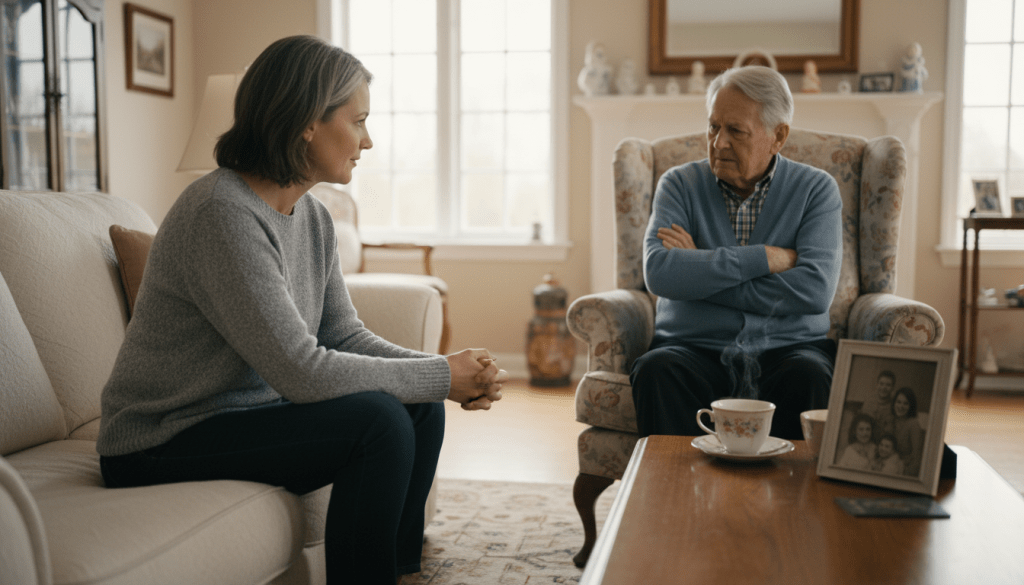
Chronic pain affects many older adults, transforming gentle personalities into irritable ones. Prescription medications for blood pressure or other conditions can also trigger mood changes.
Addressing Outbursts and Negativity
Instead of reacting to anger with frustration, pause to consider what might be driving it. Is it physical discomfort? Fear of losing independence? Sometimes explaining how their behavior affects you opens a compassionate dialogue.
For aging parents with dementia, reasoning about inappropriate behavior rarely works. Redirecting the conversation often proves more effective than confrontation.
Strategies for Avoiding Power Struggles
Power struggles damage relationships and solve nothing. Avoid ultimatums and nagging—these approaches make parents defensive. Instead, involve your loved one in decisions about their care.
When things become overwhelming, step away briefly if safety allows. This isn’t abandonment—it’s self-care that lets you return with patience. Consulting their doctor about new behavior can identify treatable causes.
These strategies for dealing with stubborn aging help maintain connection during difficult years. Understanding the root cause of challenging behavior changes everything.
Tailoring Check-In Methods to Respect Your Parent’s Independence
The key to successful daily contact lies in personalizing your approach to match your parent’s unique preferences. What feels supportive to one loved one might feel intrusive to another.
Customizing Interaction Techniques
Start by asking your mom or parent what type of contact feels most comfortable. Some prefer quick daily texts, while others appreciate longer weekly visits. This collaborative approach gives your loved one a sense of control.
Frame check-ins as tools for maintaining independence rather than surveillance. Emphasize how regular contact helps them stay in their home safely. Say something like: “I know you value your living situation, and I want to help you maintain it.”
Consider different options based on privacy needs. A simple “good morning” text or standing coffee date can feel more social than supervisory. This respects their autonomy while providing essential care.
When discussing future assisted living or senior living options, current check-ins become valuable reference points. They help both of you recognize when additional support might enhance quality of life. Remember that balancing safety with dignity is an ongoing process that requires flexibility and understanding.
How to Build a Check-In Routine That Feels Respectful, Not Controlling
A daily check-in routine works best when it does not feel like a rule imposed on an older adult by worried family members. It works when it feels like a simple structure that protects independence, lowers stress, and makes everyday life easier. That difference matters more than most families realize.
Many seniors do not resist contact because they dislike the people who care about them. They resist the feeling behind certain interactions. If every call sounds like an inspection, every text sounds like a test, and every visit turns into a list of corrections, the routine will fail no matter how loving the intention is. Older adults can sense when they are being monitored instead of respected. Once that feeling takes over, even a kind check-in can start to feel invasive.
The smartest daily check-in routines are built on one principle: the senior should experience the routine as supportive and predictable, not intrusive and open-ended. That means the routine needs clear boundaries, familiar timing, a comfortable format, and a tone that protects dignity. It should reduce friction, not create more of it.
A good way to think about it is this: the goal is not to “keep tabs” on someone. The goal is to create a low-pressure rhythm that helps everyone stay connected, notice changes early, and avoid unnecessary alarm. For seniors who hate being checked on, the routine should be so natural that it feels closer to a habit than a supervision system.
Start With One Simple Question: “What Would Feel Comfortable to You?”
Before setting up any routine, begin with a conversation that gives the senior real input. Not fake input. Real input.
That conversation might sound like this:
“I’m not trying to hover. I just want us to have a simple system so neither of us has to worry. What kind of daily check-in would feel comfortable to you?”
That question changes the emotional tone immediately. It does three important things:
- It lowers defensiveness.
- It shows respect.
- It shifts the senior from being managed to being included.
This matters because people are more likely to cooperate with routines they help create. Seniors who dislike being checked on often react better when they can choose parts of the process themselves. Even small choices can make a big difference:
- Morning or evening?
- Quick call, text, or voice message?
- One family member or rotating relatives?
- Two minutes or ten?
- Casual conversation first, practical questions second?
When a senior says, “I don’t want all these check-ins,” families often hear a total refusal. But sometimes the real message is more specific:
- “I don’t want three people calling me.”
- “I don’t want random calls all day.”
- “I don’t want to explain myself every time.”
- “I don’t want to be treated like I can’t manage.”
If you slow down and separate the need for contact from the style of contact, solutions usually become easier.
Define the Purpose of the Check-In So It Does Not Drift
One major reason check-ins become irritating is that they start without a clear purpose. A family says they only want a quick daily touchpoint. Then over time, each call grows into a mini-investigation:
- Did you eat?
- Did you take your medicine?
- Did you go outside?
- Did you call the doctor?
- Why do you sound tired?
- Why didn’t you answer right away yesterday?
That kind of drift makes seniors feel watched.
To prevent that, decide what the check-in is actually for. In most families, the daily routine should serve just a few core functions:
- confirm the person is okay,
- create a moment of connection,
- notice meaningful changes,
- identify whether follow-up is needed.
That is enough.
A daily check-in should not become the place to solve every problem, rehash every disagreement, or correct every household habit. If it turns into that, the senior will start avoiding it. The routine stays sustainable when it remains light, clear, and consistent.
A useful internal rule for families is this:
Daily check-ins are for connection and quick awareness. Bigger concerns belong in separate conversations.
That one boundary can dramatically improve cooperation.
Keep the Routine Predictable So It Feels Calm
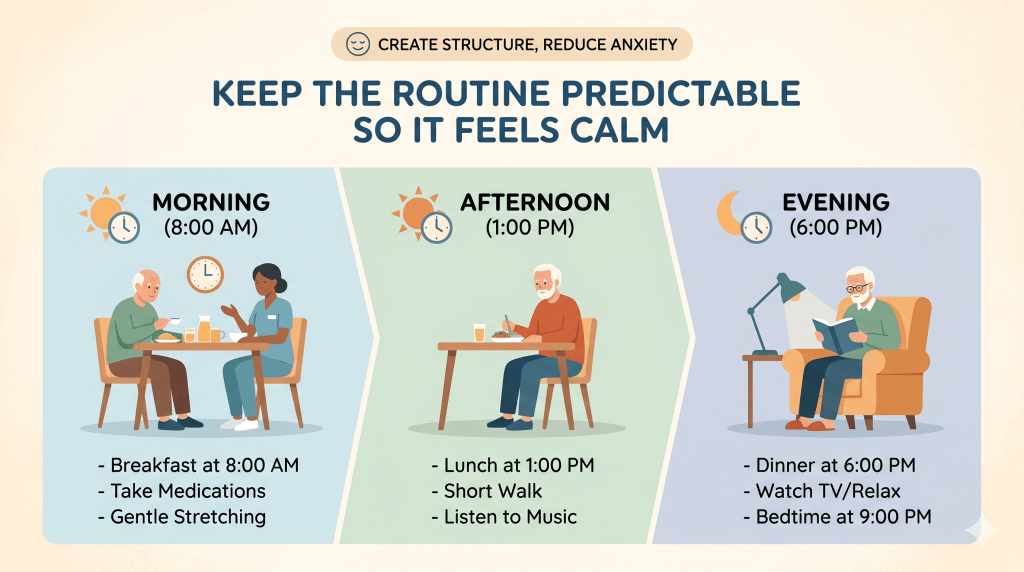
Unpredictable contact often feels more intrusive than frequent contact. A senior may tolerate one short call every day at 9:00 a.m. far better than three random calls at different times. Predictability lowers mental strain. It helps the senior know what to expect, when to expect it, and how long it will last.
A predictable routine also reduces anxiety for caregivers. Instead of worrying all day or contacting the senior impulsively whenever concern spikes, family members know there is a built-in check-in point.
To make the routine feel calm:
- pick one primary time window,
- keep the interaction roughly the same length,
- use the same person or same format as often as possible,
- avoid surprise “just checking” interruptions unless there is a real reason.
For example:
- “We’ll do a quick morning call every weekday around 9:30.”
- “You send a thumbs-up text after breakfast.”
- “We’ll have a five-minute evening chat after dinner.”
- “The AI call happens at the same time each day so it feels routine.”
A predictable routine feels less like surveillance and more like daily structure.
Create a “Light-Touch” Format First
Families often make the mistake of starting too intensely. They begin with a long daily phone call, several questions, and immediate follow-up if anything feels off. For someone protective of their independence, that can feel overwhelming right away.
A better strategy is to start with the lightest effective version.
That might mean:
- a one-line morning text,
- a short “good morning” call,
- a routine voice message,
- an AI companion call that feels conversational,
- a pre-agreed signal such as “I’m up and doing okay.”
This approach respects the fact that some seniors do better with less emotional load. A person who dislikes being checked on may not want a daily heart-to-heart. That does not mean they should be left unsupported. It simply means the format should match their comfort level.
Think of the routine in layers:
Layer 1: Basic confirmation
A quick signal that all is well.
Layer 2: Friendly conversation
A brief connection that feels natural.
Layer 3: Follow-up only if needed
Additional questions only when something genuinely seems off.
This layered structure prevents every check-in from feeling heavy. It also keeps the senior from feeling as though they must “perform wellness” every day.
Use Questions That Invite, Not Corner
The questions used during check-ins matter enormously. Some questions make people feel cared for. Others make them feel examined.
Questions that often create resistance:
- “Did you take your meds?”
- “Are you sure you’re okay?”
- “Why didn’t you answer?”
- “What did you eat today?”
- “Did you remember what the doctor said?”
These are not always wrong. But when used daily and without warmth, they can sound parental, suspicious, or repetitive.
Instead, use questions that are easy to answer and emotionally lighter:
- “How’s your morning going so far?”
- “What’s on your agenda today?”
- “How are you feeling compared with yesterday?”
- “Anything you need me to handle later?”
- “What was the best part of your day?”
These types of questions give useful information without immediately putting the senior on the defensive.
A helpful technique is to move in this order:
- start social,
- listen for cues,
- ask practical follow-up only if needed.
For example:
“Hi, just wanted to say good morning. How’s today starting?”
“Pretty normal.”
“Good to hear. What are you up to after breakfast?”
“Not much, maybe resting.”
“Got it. Need me to help with anything later?”
That sounds very different from:
“Did you eat? Did you sleep? Did you take your medicine? Why do you sound tired?”
One feels like a conversation. The other feels like a checklist being read at someone.
Agree on What Counts as “Concerning”
Many family conflicts begin because the senior and caregiver have completely different ideas about what deserves concern.
A daughter may panic if her father sounds tired.
A mother may see that as normal and feel insulted by the reaction.
A son may worry when a parent misses one call.
The parent may see that as proof that the routine is excessive.
To reduce these conflicts, define in advance what kinds of things should trigger follow-up. This makes the system feel fairer and less arbitrary.
Examples of reasonable follow-up triggers:
- no response after the agreed window,
- confusion that seems unusual,
- sudden weakness or dizziness,
- mention of a fall or near-fall,
- not eating or drinking much,
- marked change in mood,
- repeated missed medication,
- signs of illness or unusual pain.
When expectations are clear, the routine feels less personal and more practical. The senior is less likely to think, “They overreact to everything,” and the caregiver is less likely to spiral over small variations.
This agreement can be framed very respectfully:
“I don’t need every detail of your day. I just want us to know what should count as a real concern so we’re not both guessing.”
That kind of clarity protects dignity on both sides.
Build an Escalation Plan Before You Need One
One of the most stressful parts of any check-in routine is not the check-in itself. It is what happens when the routine breaks.
What should happen if the senior does not answer?
How long should someone wait?
Who calls next?
Who has a key?
When should a neighbor be contacted?
When should it become an emergency?
Families often avoid this discussion because they do not want to sound dramatic. But not having a plan creates even more distress later.
An escalation plan does not have to be frightening or rigid. It just needs to be simple.
For example:
- If no response within one hour of the usual check-in, send one follow-up text.
- If still no response, call once more.
- If still no answer, contact the backup person.
- If the situation seems unusual, ask a nearby friend, neighbor, or building staff member to knock.
- If there are signs of a medical emergency, call emergency services.
This is especially helpful for seniors who dislike repeated calls. With a plan in place, family members do not have to improvise emotionally. They can follow the agreed steps.
Framed correctly, this can actually increase trust:
“This isn’t because I expect something bad. It’s so we both know exactly what happens if there’s ever a missed check-in.”
A plan lowers panic. And routines that lower panic are more likely to last.
Protect the Senior’s Sense of Adulthood
A daily check-in can fail even when the logistics are correct if the emotional tone is wrong. Seniors do not want to feel reduced to a problem to manage. They want to feel like adults whose preferences still carry weight.
That means avoiding habits such as:
- talking about them like they are not in charge,
- correcting them in a scolding tone,
- using the check-in to lecture,
- turning every concern into a debate,
- involving too many people without permission.
Even well-meaning family systems can accidentally become infantilizing. For example, an adult child may start speaking too quickly, too loudly, or too simply. Or siblings may create group threads discussing the parent’s behavior in ways that would feel humiliating if overheard.
Respect sounds different. It sounds like:
- “What would you prefer?”
- “Would you like help with that, or are you handling it?”
- “I’m checking in because I care, not because I doubt you.”
- “Let’s find something that works for both of us.”
- “You’re still in charge of your day.”
This is not just about politeness. It is strategic. Seniors cooperate more when their identity is protected.
Make the Routine Pleasant Enough to Continue
A sustainable check-in routine should not feel like a daily compliance exercise. It should contain at least one element the senior genuinely likes.
That could be:
- discussing a favorite TV show,
- sharing family news,
- talking about the weather and garden,
- reviewing the day’s plan,
- mentioning a grandchild,
- hearing a familiar voice at the same time each day,
- speaking to an AI companion that remembers interests and keeps the exchange friendly.
The point is simple: if every interaction is only about risk, medication, eating, and symptoms, the senior will start associating contact with loss and decline. But when the routine includes normal human conversation, it protects emotional dignity.
This does not mean pretending problems do not exist. It means not making problems the only subject.
A useful rule is:
every check-in should contain one practical purpose and one human moment.
That human moment may last only thirty seconds. It still matters.
Review the Routine Every Few Weeks
A check-in routine should not be treated as permanent once it is set up. Needs change. Energy levels change. Hearing changes. Mood changes. Seasons change. Caregiving demands change too.
What worked well three months ago may now feel irritating, too light, too frequent, or poorly timed.
So every few weeks, ask:
- Is this timing still working?
- Does this format still feel comfortable?
- Are we asking too many questions?
- Are we missing important signs?
- Does the senior still feel respected?
- Does the caregiver still feel reassured?
This review can be very short:
“Do you want to keep doing it this way, or should we adjust anything?”
That question alone keeps resentment from silently building.
When seniors know the routine can be adjusted, they are less likely to resist it. Flexibility makes the arrangement feel collaborative rather than controlling.
A Simple Example of a Respectful Daily Check-In Routine
For families who want a practical model, here is a low-resistance version:
Morning:
A brief check-in at the same time each day by phone, text, or AI call.
Opening:
Warm and normal. No urgent tone.
Core questions:
One connection question, one practical question, one optional support question.
Example:
- “Good morning, how’s today starting?”
- “What’s your plan for the morning?”
- “Anything you want me to take care of later?”
What to notice quietly:
Energy, clarity, mood, consistency, mention of pain, appetite, or confusion.
What not to do unless needed:
Rapid-fire questioning, correcting, lecturing, or escalating based on minor variation.
If something seems off:
Follow up gently, not dramatically.
Example:
“You sound a little more tired than usual. Want to tell me what’s going on?”
If there is no response:
Follow the agreed escalation plan rather than reacting impulsively.
This kind of structure is simple enough to maintain and respectful enough to protect the relationship.
The Real Goal Is Cooperation, Not Compliance
The most effective daily check-in routines are not the strictest ones. They are the ones the senior does not feel the need to fight.
That is the real benchmark.
If the routine keeps arguments low, preserves dignity, creates real connection, and still alerts the family when something is wrong, then it is working. It does not need to look perfect from the outside. It needs to feel workable from the inside.
For seniors who hate being checked on, the answer is rarely “check less” or “check more” in a simplistic way. The answer is usually to check in better: with more structure, more respect, more clarity, and less emotional pressure.
When the routine is built thoughtfully, daily contact stops feeling like surveillance. It starts feeling like what it should have been all along: a dependable, caring rhythm that helps an older adult stay safe without feeling like they have lost themselves.
How to Avoid Turning Daily Check-Ins Into Daily Arguments
A daily check-in routine can fail even when the timing is right, the intentions are good, and the structure looks sensible on paper. Why? Because for many seniors, the real issue is not the call itself. It is the emotional meaning attached to the call.
A two-minute conversation can feel comforting to one person and insulting to another. A simple “Just checking in” can sound warm on Monday and controlling on Thursday. A loving daughter may think she is being helpful, while her father hears suspicion in every question. A son may feel he is being responsible, while his mother feels she is slowly losing her authority over her own life.
This is why families often say, “I don’t understand why such a small check-in becomes such a big problem.” The answer is that the problem is rarely about the length of the interaction. It is about dignity, control, repetition, tone, and the fear of being treated differently because of age.
For seniors who hate being checked on, the daily routine is not just a communication habit. It is also a test of whether they still feel trusted. If the routine repeatedly makes them feel corrected, doubted, monitored, or handled, they may resist it even when they know the family means well. In some cases, they may resist it especially because they know the family means well. They do not want love to start sounding like management.
That is why one of the smartest things a caregiver or family member can do is learn how to reduce friction before it grows into resentment. The goal is not merely to complete the check-in. The goal is to preserve the relationship while still creating a dependable safety net.
Understand What Seniors May Really Be Resisting
When an older adult pushes back against daily contact, the family often assumes the resistance is about stubbornness. Sometimes it is. But very often, it is about something deeper and more reasonable than that.
The senior may be resisting:
- the feeling of being watched,
- the loss of privacy,
- the fear of becoming dependent,
- embarrassment about needing help,
- frustration at being asked the same questions,
- grief over declining abilities,
- irritation at being treated as fragile,
- the sense that other people now have opinions about how they live.
That last point is especially important. Many seniors have spent decades making their own decisions, running households, raising children, solving problems, and carrying responsibilities without asking anyone for permission. Later in life, even small shifts in how others speak to them can feel deeply unsettling.
What a younger family member sees as “simple concern” may feel to the senior like a symbolic change in status. Yesterday they were the person others leaned on. Today they feel like the person being managed. That emotional transition is not small. It can carry pride, grief, anger, and fear all at once.
That is why daily check-ins have to be handled with maturity and restraint. Families who focus only on safety can accidentally create daily power struggles. Families who balance safety with dignity tend to get far better results.
A useful question to ask yourself is:
What might this check-in represent to them emotionally?
Until you answer that, you may keep trying to solve the wrong problem.
Do Not Make Every Check-In About Risk
One of the fastest ways to make check-ins emotionally exhausting is to center every interaction around what could go wrong.
If every conversation is about:
- falls,
- medication,
- confusion,
- weakness,
- safety,
- doctor appointments,
- mistakes,
- memory slips,
then the senior begins to associate contact with decline. Over time, daily check-ins can start feeling like repeated reminders that other people are watching for signs of failure.
That emotional effect is stronger than many families realize.
Of course, those topics matter. They cannot be ignored. But if they dominate every exchange, the older adult may begin to dread the interaction. Not because they dislike the family, but because the check-in has become psychologically heavy.
A healthier approach is to treat risk as only one part of the conversation. The routine should include:
- normal life,
- preferences,
- light conversation,
- practical planning,
- moments of warmth,
- signs of enjoyment,
- shared routines that are not centered on decline.
For example, instead of opening with:
“Did you take your pills?”
a better opening may be:
“Good morning. What’s on your list today?”
That question still provides useful information. You may hear whether the person sounds alert, engaged, tired, confused, or upbeat. But it begins from a place of personhood rather than surveillance.
This shift matters. Seniors need to feel that they are still being seen as whole people, not as daily risk assessments.
Stop Repeating Questions That Create Irritation
Many check-ins become tense simply because the same questions are repeated too often and too bluntly.
A senior who gets asked every day:
- “Did you eat?”
- “Did you sleep?”
- “Did you take your medicine?”
- “Are you okay?”
- “Did you go out?”
- “Did you drink enough water?”
may start to feel like they are reporting to someone rather than talking with someone.
Even if those questions are relevant, repetition without variation quickly becomes draining. Some older adults begin giving short answers just to end the interaction. Others become sarcastic. Others dodge the call entirely. Others grow quietly resentful but continue participating without warmth.
None of these outcomes is ideal.
A better strategy is to rotate the style of questions and make them feel more natural.
Instead of “Did you eat?” try:
- “What did you have today?”
- “Have you had breakfast yet or are you taking it slow?”
- “Anything sound good for lunch today?”
Instead of “Did you take your medicine?” try:
- “How’s your morning routine going?”
- “Is today moving along normally?”
- “Do you need me to remind you about anything later?”
Instead of “Are you okay?” try:
- “How are you feeling compared with yesterday?”
- “How’s your energy today?”
- “What kind of day is it so far?”
These variations sound more human and less interrogative. They still allow the caregiver to gather meaningful information, but with less resistance.
The key is not merely to ask fewer questions. It is to ask better ones.
Learn the Difference Between a Helpful Follow-Up and a Controlling One
Many family tensions start not with the first question, but with the second and third question after the senior has already answered.
For example:
“Did you go for your appointment?”
“Yes.”
“What did the doctor say?”
“It was fine.”
“What do you mean, fine?”
“Nothing major.”
“Well, did they change anything?”
“Why do you need every detail?”
At that point, the interaction is no longer a check-in. It has become a pressure loop.
Families often do this because they are anxious and want clarity. That is understandable. But to the senior, relentless follow-up can feel invasive, especially when they have already given the amount of information they are comfortable sharing in that moment.
This does not mean you should never ask a follow-up question. It means follow-up should be paced, respectful, and proportionate.
A helpful follow-up sounds like:
- “Anything I should know?”
- “Do you want to talk about it?”
- “Was it routine, or is there anything we need to plan for?”
- “Would it help to go over next steps together later?”
A controlling follow-up sounds like:
- “That doesn’t tell me anything.”
- “You’re leaving things out.”
- “Why are you being vague?”
- “I need you to be more specific.”
- “That’s not enough information.”
The difference is tone, pressure, and respect for boundaries.
If the senior feels cornered, they are more likely to protect themselves by shutting down. If they feel invited, they are more likely to share.
Avoid Correcting Too Much During the Check-In Itself
Many caregivers see problems during conversation and instinctively try to fix them in real time. They hear something concerning and immediately switch into solution mode:
- “You should not be doing that.”
- “I told you not to skip that.”
- “That’s exactly what I was worried about.”
- “You need to stop doing that.”
- “Why didn’t you tell me sooner?”
Although this may come from concern, it often makes the daily routine feel punishing. Seniors who expect correction during every call will begin to filter what they say. They may stop mentioning struggles altogether because the emotional cost of honesty feels too high.
That creates a serious problem. The routine starts looking successful on the surface because the senior sounds “fine,” but in reality the communication has become less truthful.
A more strategic response is to separate observation from correction.
During the check-in, respond first with calm interest:
- “Thanks for telling me.”
- “I’m glad you mentioned that.”
- “Let’s think through that.”
- “Okay, that helps me understand.”
- “Would you like my take on that?”
Then, if a bigger issue needs discussion, move it into a separate conversation.
For example:
“I don’t want to turn this quick check-in into a whole discussion, but I do think it’s worth talking about later today. Let’s revisit it when we both have more time.”
That sentence protects the routine. It allows the check-in to remain emotionally safe while still making room for real concerns to be handled properly.
Never Use the Check-In as a Daily Performance Review
Some seniors start to feel that every contact is an evaluation of how well they are managing life. That feeling is toxic to cooperation.
If the check-in keeps circling back to:
- what they forgot,
- what they should do better,
- what they failed to mention,
- what they did not answer properly,
- why they did not pick up fast enough,
- why their habits are worrying,
then the routine becomes a daily performance review of aging.
That is not just unpleasant. It is demoralizing.
A senior who feels evaluated every day may begin to protect their dignity in one of several ways:
- minimizing problems,
- refusing help,
- acting irritated,
- rejecting the check-in,
- pretending everything is fine,
- pushing family members away emotionally.
This is why praise, acknowledgment, and normal conversation matter so much.
Caregivers should not be afraid to say things like:
- “I appreciate how consistent you’ve been with this routine.”
- “I’m glad we found something that works.”
- “You always make it easier when you tell me directly.”
- “I know this isn’t your favorite thing, and I appreciate you meeting me halfway.”
- “You’ve handled a lot well.”
These are not empty compliments. They reduce defensiveness by showing the senior that the routine is not just about catching mistakes.
Watch Your Tone More Than Your Words
Families often focus on what they are saying, but seniors often react more strongly to how it sounds.
A sentence like “Did you take your medication?” can be received in very different ways depending on tone. Warm, calm, and casual may feel fine. Tight, urgent, or frustrated may feel insulting.
Tone becomes especially important when there is already tension in the relationship. If previous interactions have included arguments, criticism, or repeated worry, the senior may begin hearing even neutral questions through a negative filter.
That means a caregiver needs to pay attention to:
- speed,
- sharpness,
- impatience,
- sighing,
- sounding rushed,
- sounding suspicious,
- sounding exasperated,
- sounding like they expect something to be wrong.
A useful self-check is this:
Would I use this same tone with another adult I respect?
If the answer is no, the tone probably needs adjusting.
Many seniors are highly sensitive to condescension. They may not always say so directly, but they feel it quickly. When tone improves, resistance often falls even if the questions stay mostly the same.
Do Not Turn One Missed Check-In Into an Emotional Explosion
Few things damage a routine faster than overreaction after one missed call or delayed response.
A caregiver who says,
“You scared me to death!”
or
“Why didn’t you answer? I was panicking!”
may be speaking honestly, but the emotional intensity can make the senior feel blamed rather than cared for.
After enough experiences like that, the senior may begin to view the check-in routine as a trigger for drama. Then the resistance grows.
This is where structure helps. If the family has already agreed on what happens when a check-in is missed, then the response can stay calm and consistent.
Instead of:
“Why didn’t you answer? I’ve been worried sick.”
try:
“I missed you at our usual time, so I’m just following up now.”
Instead of:
“You need to keep your phone with you every second.”
try:
“I know things happen. Let’s make sure our backup plan still works when you’re away from the phone.”
This tone keeps the focus on the system, not on blame.
Seniors who dislike being checked on often react strongly when they feel they are being held emotionally responsible for another adult’s anxiety. The routine should reduce stress, not transfer it onto them.
Give the Senior a Way to Succeed Easily
A routine is more likely to last when it is easy for the senior to complete successfully.
That sounds obvious, but many families create systems that require too much:
- answering at the exact moment,
- remembering multiple steps,
- responding to several people,
- navigating unfamiliar technology,
- tolerating long conversations every day,
- giving detailed answers when tired.
Then when the senior struggles, the family interprets it as resistance.
A better system makes success simple.
For example:
- one familiar time,
- one familiar voice,
- one easy expected response,
- minimal pressure,
- no unnecessary complexity,
- backup options if they miss it.
Some seniors do best with a very short phone call. Some prefer a text. Some respond better to voice than typing. Some appreciate an automated or AI-based system because it feels consistent and non-judgmental. Some do better when the family member calls less often but more predictably.
The question is not what seems ideal to the caregiver. The question is what the senior can realistically and comfortably keep up with.
The easier the system is to follow, the less likely it is to become a source of friction.
Let Independence Be Visible Inside the Routine
A big mistake in caregiving communication is talking about independence as if it exists outside the check-in routine. In reality, the routine itself should contain signs of independence.
That means the older adult should still be able to:
- choose the preferred time,
- decline a longer conversation,
- state what kind of help they want,
- say “not today” to non-essential follow-up,
- decide what level of detail they share,
- keep parts of their day private,
- feel ownership over their schedule.
Even small phrases help:
- “Would now or later be better?”
- “Do you want to talk more about it or leave it there?”
- “Need help, or are you all set?”
- “I’m here if you want backup.”
- “Let me know how involved you want me to be.”
These phrases communicate a crucial message:
the senior is still a decision-maker.
That message can transform how the entire routine feels.
Do Not Confuse Compliance With Trust
Some caregivers believe the routine is working if the senior answers regularly. But regular answers do not always mean the system is healthy.
A senior may answer every day and still feel:
- annoyed,
- watched,
- emotionally distant,
- reluctant to be honest,
- tired of the routine,
- resentful about the tone.
That is why families need to look beyond compliance and ask whether the check-ins are building trust.
Signs of trust include:
- the senior volunteers useful information,
- the tone stays relaxed,
- missed responses are not treated as moral failures,
- concerns can be raised without immediate conflict,
- the senior feels heard, not managed,
- the routine can be adjusted without drama.
If a routine gets responses but damages openness, it is not as effective as it looks.
Trust is what makes a daily check-in meaningful. Without trust, the system may still function mechanically, but it will be fragile.
What to Say When a Senior Says, “Stop Checking On Me”
This moment happens in many families, and how you respond matters enormously.
The wrong response is defensive:
- “I’m only trying to help.”
- “You should be grateful someone cares.”
- “Fine, I just won’t call anymore.”
- “You’re being unreasonable.”
- “We have to do this because you’re older now.”
Those responses escalate shame and conflict.
A more effective response is calm and respectful:
“I hear you. I don’t want you to feel watched or controlled. I do want us to have some kind of simple routine that works for both of us. Let’s figure out what feels respectful to you.”
That sentence does several things at once:
- it acknowledges the concern,
- it does not argue with the emotion,
- it keeps the door open,
- it reframes the routine as collaborative.
Another helpful response is:
“I’m not trying to supervise your life. I’m trying to create a simple way for us to stay connected without either of us feeling stressed.”
That phrasing lowers intensity and keeps dignity intact.
In many cases, resistance softens when seniors realize the goal is not total access, but a predictable and respectful point of contact.
The Strongest Check-In Routines Feel Light, But Are Designed Carefully
The best daily routines often look simple from the outside. A short call. A familiar voice. A steady time. A light question. A calm tone. A clear next step if something seems off.
But that simplicity usually comes from thoughtful design.
Behind a good routine, there is usually:
- respect for autonomy,
- awareness of emotional triggers,
- clarity about purpose,
- realistic expectations,
- restraint in how concerns are raised,
- a willingness to adjust,
- and a strong commitment not to turn care into control.
That is what makes the difference between a routine the senior tolerates and a routine they can genuinely live with.
For families, this is the deeper lesson: the success of a check-in routine depends less on frequency and more on emotional skill. Daily contact only works when the senior still feels like themselves inside it.
That is the real standard worth protecting.
Leveraging Technology for Effective Daily Check-Ins

Technology offers a gentle bridge between your care and your parent’s independence. Modern tools can provide consistent connection without feeling intrusive.
Introduction to JoyCalls AI-Powered Companion
JoyCalls is an AI-powered phone companion that makes daily calls to your loved one. No app or special device is needed—just their regular phone.
The service feels like a friendly chat rather than a check-up. For seniors who value privacy, this approach respects their autonomy while providing essential care.
Each conversation focuses on your loved one’s interests and well-being. The AI companion has unlimited time to listen and engage meaningfully.
How to Get Started with JoyCalls
Getting started takes just minutes. Visit https://app.joycalls.ai/signup to create your account.
You can customize call schedules and conversation topics. This personalization ensures the experience matches your loved one’s preferences.
After each call, you receive a summary with key information. The system alerts you to any concerns while maintaining your parent’s dignity.
This technology doesn’t replace your relationship—it enhances it. By handling routine check-ins, JoyCalls frees you to focus on quality time together.
Supporting Your Own Well-Being as a Caregiver

When you’re focused on supporting your parent’s well-being, it’s easy to overlook your own mounting stress. The emotional toll of caregiving can creep up quietly, affecting every aspect of your life.
Remember: you cannot pour from an empty cup. Prioritizing your own health isn’t selfish—it’s essential for providing quality care. This journey requires sustainable energy for the years ahead.
Practicing Self-Care and Stress Management
Simple daily practices make a significant difference. A short walk, mindful breathing, or protecting time for hobbies replenishes your resilience. These small things help manage the complex emotions that come with watching older adults face challenges.
Accept that some things are beyond your control. This situation involves natural aging processes that you cannot change. Focusing on what you can influence reduces frustration.
| Self-Care Approach | Time Commitment | Key Benefit |
|---|---|---|
| Daily Mindfulness | 5-10 minutes | Reduces stress and improves patience |
| Regular Exercise | 20-30 minutes | Boosts energy and mental clarity |
| Social Connection | Weekly | Prevents isolation and provides perspective |
| Hobby Protection | As needed | Maintains personal identity beyond caregiving |
Finding Support Through Groups and Professional Help

You don’t have to navigate this alone. Caregiver support groups connect you with people who understand your experience. They offer practical advice and emotional validation.
Professional help from counselors specializing in family dynamics provides valuable tools. They help you process grief, frustration, and the sense of loss that often accompanies this way of life.
Explore all your options for caregiver support. Respite care, geriatric managers, and technology solutions can reduce daily stress. Your well-being directly impacts the quality of care you provide.
Conclusion
Navigating this journey with your loved one is about building bridges, not walls. The goal is to provide essential care while honoring their spirit of independence.
By using gentle communication and respecting their preferences, daily contact becomes a source of connection. This approach protects your precious relationship and ensures their safety at home.
Tools like JoyCalls offer families a compassionate way to maintain this connection. It provides peace of mind without feeling intrusive.
Remember, you have a network of support. Your loved one’s doctor and professional resources can offer valuable guidance as needs change.
Whether your parent continues living independently or considers senior living options, the foundation of trust you build today is priceless. It ensures you face the future together, with dignity and love.