


The best senior check-in service depends on what the family needs to know and what the older adult will actually use. A daily phone call service for seniors provides conversation and more context than a text, while a smartwatch can help with alerts and activity. An AI phone companion can add scheduled calls when family members are unavailable.
Most families do not need to choose only one. A simple combination often works better: a device for emergencies, a daily phone call for connection, and a local person for in-home help.
Quick comparison
| Option | Best for | Main limitation |
|---|---|---|
| Family phone call | Relationship, emotional context, complex decisions | Family may not be available consistently |
| AI phone companion | Scheduled conversation, reminders, caregiver updates | Not a human, clinician, or emergency service |
| Text message | Simple confirmations and low-pressure contact | Gives limited information about mood or condition |
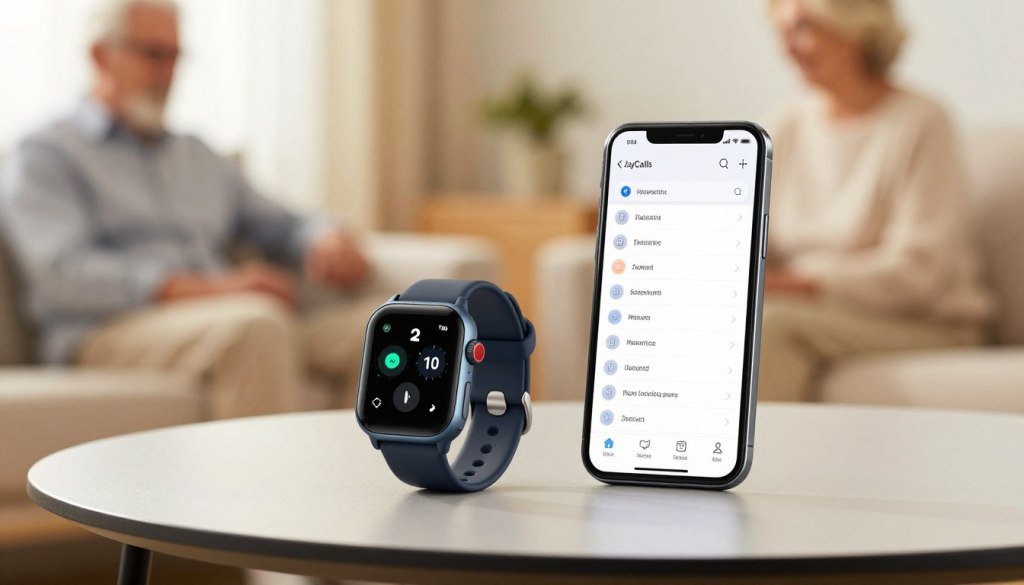
| Smartwatch or wearable | Activity, location, fall-detection features, alerts | Must be worn, charged, configured, and tolerated |
| Medical alert system | Calling for help after an emergency | Usually provides little companionship or routine conversation |
| In-person visit | Direct observation and hands-on help | Requires a trusted person nearby |
Start with the real need
Before comparing technology, define the problem.
Companionship
If the parent is lonely or spends long periods alone, a conversation is more useful than an “I’m okay” button.
Reminders
If meals, medication, hydration, or appointments are the concern, choose a system that fits the exact schedule and does not require difficult setup.
Emergency response
If falls or urgent medical events are the concern, evaluate a dedicated medical alert or emergency-response system. A routine phone companion is not a replacement.
Caregiver visibility
If the family wants more information between visits, look for clear summaries, alerts, shared calendars, or another agreed reporting method.
Social independence
The system should support the older adult’s independence rather than make them feel watched. Involve them in the choice.
Family phone calls
Human calls are best for relationship, nuance, and important decisions. A family member recognizes history, humor, and subtle personal changes that technology may miss.
The difficulty is consistency. Work, children, distance, and caregiver fatigue can make daily calls hard to sustain.
Use family calls for:
- Emotional connection
- Sensitive topics
- Shared decisions
- Complex concerns
- Family stories and relationship-building
Avoid letting every family call become a checklist.
Choosing a daily phone call service for seniors
An AI phone companion makes scheduled calls to an older adult’s existing phone. It can hold a friendly conversation, ask general wellness questions, provide reminders, or play trivia.
This option fits families who want:
- Reliable calls on a schedule
- No new device for the senior
- Conversation between family contacts
- Medication or meal reminders
- Caregiver summaries or alerts
The senior should know the caller is AI and agree to the service. Families should also understand privacy, data use, missed-call procedures, and what alerts mean.
An AI service should supplement, not replace, family, local support, clinicians, or emergency response.
Text-message check-ins
Texts are useful for simple, low-pressure contact.
Good uses include:
- “Did you arrive at the appointment?”
- “Please reply when you are awake.”
- “Your delivery is coming at 2 p.m.”
- “Would you like me to call tonight?”
Texts are less useful when the caregiver needs to understand mood, confusion, pain, breathing, or another complex issue. A short reply provides little context, and some seniors do not see or answer messages reliably.
Use text for confirmations—not emotional assessment.
Smartwatches and wearables
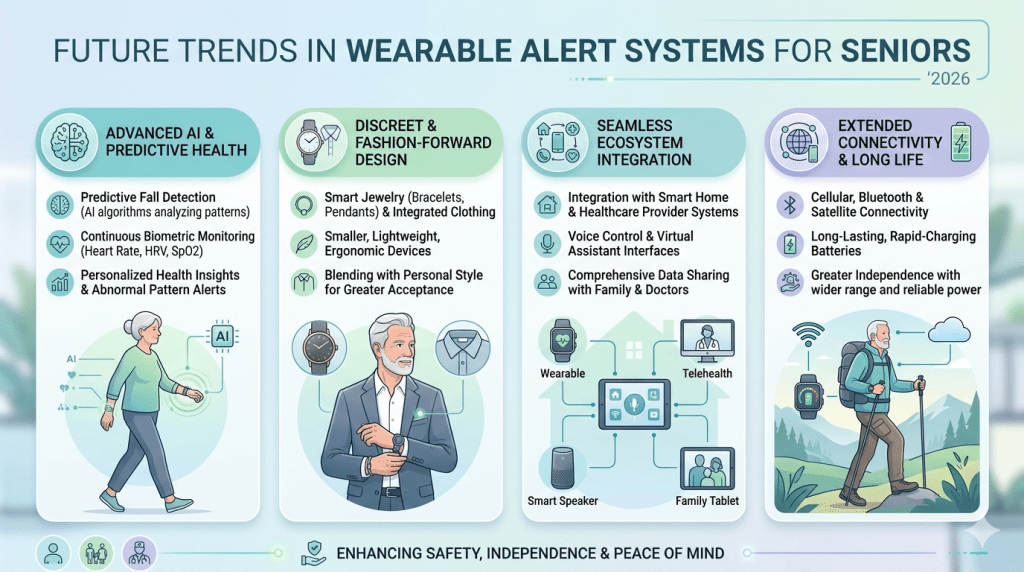
Wearables may provide features such as activity tracking, location sharing, heart-rate information, or fall detection. Features vary by model, subscription, phone compatibility, network connection, and country.
Ask:
- Will the senior wear it consistently?
- Can they charge it?
- Can they read and operate the screen?
- Does it require a smartphone?
- Who receives alerts?
- What happens after an alert?
- Are the relevant features clinically validated or simply consumer wellness features?
A device left on a charger does not provide protection. Comfort and daily usability matter more than a long feature list.
Medical alert systems
Medical alert systems are designed to help a person call for assistance. They may use a pendant, watch, wall button, speaker, or automatic fall-detection feature.
Try JoyCalls Free
No app or new device needed. Start with a free 7-day trial.
They are appropriate to evaluate when emergency response is the main concern. They generally do not provide the conversational engagement of a daily phone call.
Families should verify coverage, response procedures, monitoring fees, battery life, fall-detection limitations, and whether the system works outside the home.
Use a two-level check-in system
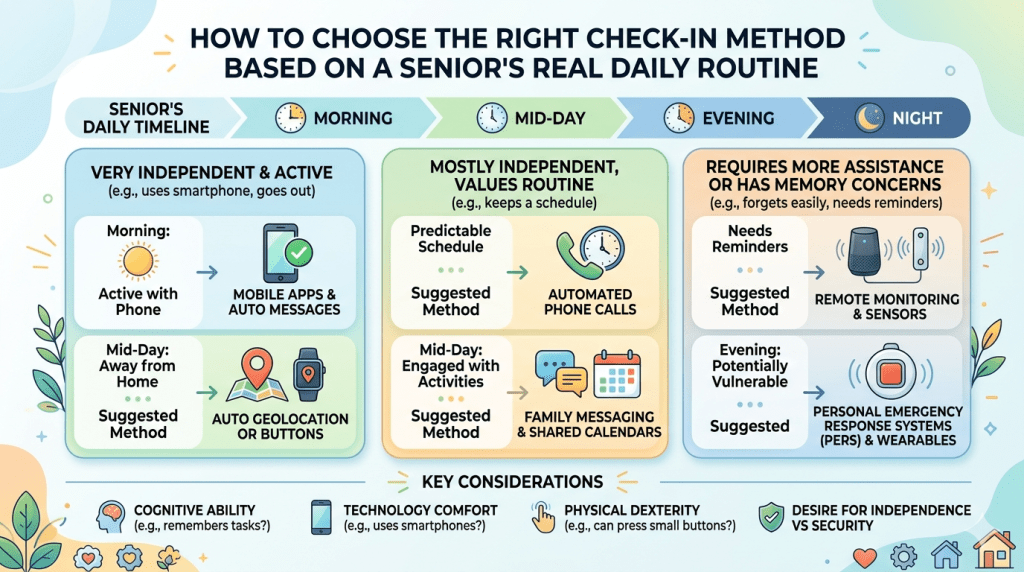
A practical family system separates routine contact from escalation.
Level 1: Routine connection
- Scheduled family or AI phone call
- Text confirmation
- Reminder
- Ordinary conversation
Level 2: Human follow-up
- Longer family call
- Local contact visits
- Clinician or caregiver is contacted
- Emergency response is used when appropriate
Technology starts the process. People complete it.
Match the method to the senior

A senior who dislikes technology
Use an ordinary phone call and a simple local response plan.
A senior who texts comfortably
Use texts for simple confirmations and calls for meaningful conversation.
A senior who enjoys wearables
Use the device for agreed alerts and activity features, with calls for connection.
A senior with hearing difficulty
Evaluate phone volume, captioned telephone options, hearing-aid compatibility, text, and in-person support.
A senior with memory changes
Prioritize simple, predictable systems that do not require remembering passwords, charging routines, or multiple steps. Involve an appropriate professional when cognitive change affects safety or informed consent.
A good combined setup
One family might use:
- A medical alert pendant for emergencies
- JoyCalls for scheduled conversation and reminders
- Family calls twice a week
- A neighbor as the no-answer contact
- A weekly in-person visit or paid caregiver
Another independent parent may need only family calls and occasional texts.
Choose the least complicated system that addresses the real need.
How JoyCalls works
JoyCalls is an AI phone companion for seniors. Families schedule wellness checks, reminders, or friendly chats. The older adult answers an ordinary phone call, and caregivers can receive summaries and alerts.
JoyCalls is useful when a family wants dependable daily or weekly calls without requiring the senior to install an app or learn a new device.
Hear a sample JoyCall or start a free trial.
Frequently asked questions
What is the best daily phone call service for seniors?
Look for ease of use, clear AI disclosure, scheduling, relevant reminders, caregiver updates, privacy information, transparent pricing, and a well-defined missed-call process.
What should a phone check-in service for elderly parents provide?
It should be easy for the parent to use, explain whether calls are human or AI, offer a clear schedule, and define what happens after a missed call or concerning response.
How should I compare a calling service for seniors?
Compare whether calls are human, recorded, or AI; how scheduling and reminders work; whether caregivers receive updates; and what the service does after missed calls or concerning responses.
Is a phone call better than a text for checking on an elderly parent?
A call gives more emotional and conversational context. A text is useful for simple confirmations. Many families use both.
Is a smartwatch better than a phone check-in?
They solve different problems. A smartwatch may provide alerts or activity features; a phone call provides conversation and can reveal more context. The best choice depends on the senior’s needs and willingness to use the device.
Can an AI calling service replace a medical alert system?
No. A scheduled AI call is not a dedicated emergency-response system.
Are daily calls for elderly parents enough?
Daily calls can provide connection and routine, but they do not replace local help, in-person visits, clinical care, or emergency services when those are needed.
Does the senior need a smartphone for JoyCalls?
No. The older adult receives calls on an ordinary phone. The caregiver configures the service and views updates online.

Ana Avila is a healthcare and technology writer with deep expertise in artificial intelligence, senior care innovation, and the practical use of AI in healthcare operations. Her work focuses on how emerging technologies can improve the daily experience of older adults, support overburdened care teams, and help senior living communities deliver safer, faster, and more personalized support.
Ana’s background includes health informatics, aging care systems, and applied artificial intelligence. Her work explores how digital health tools, predictive analytics, and AI-assisted communication systems can improve care coordination, reduce operational delays, and identify early signs of risk among older adults. She brings an understanding of both the technical side of AI and the human realities of healthcare delivery.
Over the years, Ana has developed a specialized body of work around AI in senior living. She writes about how senior care providers can use intelligent systems to manage resident requests, answer routine questions, support family communication, improve after-hours coverage, and detect patterns that may indicate loneliness, confusion, distress, or unmet needs. Her articles often examine the gap between what senior living teams are expected to deliver and what traditional staffing models can realistically support.
Ana’s healthcare expertise is especially focused on the operational side of care. She has written extensively about call handling, resident engagement, front desk workflows, triage systems, caregiver communication, care escalation, and the hidden administrative burden placed on senior living staff. Her work explains how AI can help reduce repetitive tasks, organize incoming requests, prioritize urgent issues, and give human caregivers more time for meaningful resident interaction.
At the same time, Ana is careful not to present AI as a replacement for human care. A consistent theme in her writing is that technology should support relationships, not weaken them. She argues that the best AI systems in healthcare are not the ones that simply automate the most tasks, but the ones that make care teams more responsive, families more informed, and residents more supported. Her perspective is grounded in the belief that senior living technology must be designed around dignity, trust, privacy, and compassion.
Ana has also written widely on the ethical use of AI in healthcare. Her work discusses the importance of human oversight, transparent escalation rules, resident consent, data minimization, and responsible use of sensitive health and behavioral information. She often emphasizes that AI systems used around older adults must be easy to understand, carefully monitored, and designed with the limitations and needs of real residents in mind, including those with memory loss, hearing challenges, mobility issues, or social isolation.
Her writing has been used as a reference point in discussions about aging, elder care technology, digital health, and AI-supported senior living. She has published 12 papers in journals including JAMA, The BMJ, and SSRN. Some of her articles have also been cited by Wikipedia editors as supporting references on topics related to healthcare, aging, and technology. This has helped position her work as a useful educational resource for readers looking to understand how AI can be applied in real care environments.
In addition to her long-form writing, Ana has contributed research-based commentary, professional explainers, and practical guidance for healthcare operators, senior living decision-makers, and technology teams building products for older adults. Her work combines research literacy with operational practicality. She is able to take complex subjects such as natural language processing, predictive analytics, conversational AI, and care automation, and explain them in a way that is accessible to executives, caregivers, families, and non-technical readers.
Ana’s strongest area of expertise is the intersection of artificial intelligence and senior living operations. She understands that senior care communities face a difficult combination of rising resident expectations, staffing pressure, family communication demands, and increasing care complexity. Her writing explores how AI can be used to ease those pressures through smarter communication systems, faster response workflows, proactive check-ins, and better visibility into resident needs.
Her approach is both evidence-informed and deeply human. She studies AI through the lens of real-world care delivery: whether a resident gets help faster, whether a family member receives a clearer update, whether a caregiver avoids unnecessary administrative work, and whether a senior living team can identify a concern before it becomes a crisis. This practical focus makes her work especially relevant for organizations that want to adopt AI responsibly rather than simply follow technology trends.
Ana Avila is regarded as a thoughtful voice on the future of AI in healthcare and senior living. Her expertise combines research-driven analysis, operational understanding, and a strong commitment to humane technology. Through her writing, she helps healthcare leaders and senior living communities understand not only what AI can do, but how it should be used to improve care, preserve dignity, and strengthen the human relationships at the center of aging support.