


Have you ever stood in your kitchen, completely frozen, trying to remember if you or your loved one took that important pill today? That moment of panic is all too familiar for many families. It turns a simple act of care into a daily source of stress.
But what if there was a gentler way? Research, like the findings from the British Heart Foundation, shows that timing is a critical part of how well our medicines work. Aligning your pill schedule with your day can transform confusion into calm.
This guide is here to help you build a simple, effective medication routine. We will explore compassionate strategies for pairing your health regimen with breakfast, lunch, and dinner. You’ll discover how this approach creates peace of mind and protects your well-being through consistent action.
Whether you’re managing your own medicines or supporting a family member, you are not alone. Simple tools, like the supportive check-ins from JoyCalls, can provide gentle reminders that fit seamlessly into life. Let’s find a time that truly works for you.
Key Takeaways
- Pairing pill schedules with daily meals can reduce stress and improve consistency.
- The timing of when you take your medicine can significantly impact its effectiveness.
- Creating a simple, reliable habit is more important than a complex system.
- Gentle reminders, like daily phone calls, can provide crucial support for staying on track.
- This approach is designed to offer peace of mind for both individuals and their caregivers.
- You can transform a confusing task into a manageable part of your day.
Crafting a “medication routine with meals” for Better Health
Turning medication management from a source of stress into a seamless part of daily life begins with understanding your body’s natural rhythms. When you connect your health regimen to activities you already do consistently, you build a foundation for success.
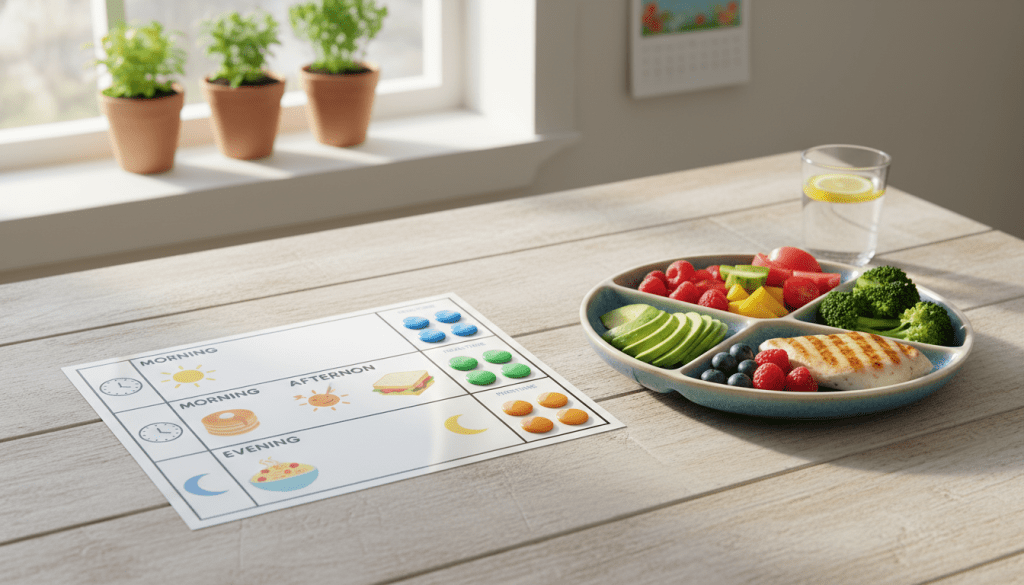
Why Aligning Medications with Meals Is Effective
Your daily eating patterns create natural anchors for your medications. This approach works because it taps into habits your mind and body already recognize. You’re not creating a new system—you’re enhancing what already exists.
For example, if you always have breakfast at 7 AM, that becomes the perfect time for your morning medicines. The meal serves as a built-in reminder that doesn’t rely on memory alone.
| Benefit | How It Helps | Result |
|---|---|---|
| Natural Timing | Uses existing daily rhythms | Reduces forgotten doses |
| Consistent Absorption | Food can help some medications work better | Improved effectiveness |
| Reduced Stress | Creates predictable patterns | Peace of mind for caregivers |
| Better Compliance | Makes taking medicines feel natural | Healthier outcomes |
Reviewing Your Medication List for Daily Consistency
Before building your schedule, gather all your medications in one place. This includes prescriptions, over-the-counter products, and supplements. Write down each name, dose, and specific instructions.
This comprehensive review helps prevent missed doses and ensures proper food interactions. It also reduces health risks associated with inconsistent dosing.
Having everything organized transforms confusion into confident care. Your personalized schedule becomes a tool for better health management.
Understanding Timing and Food Interactions
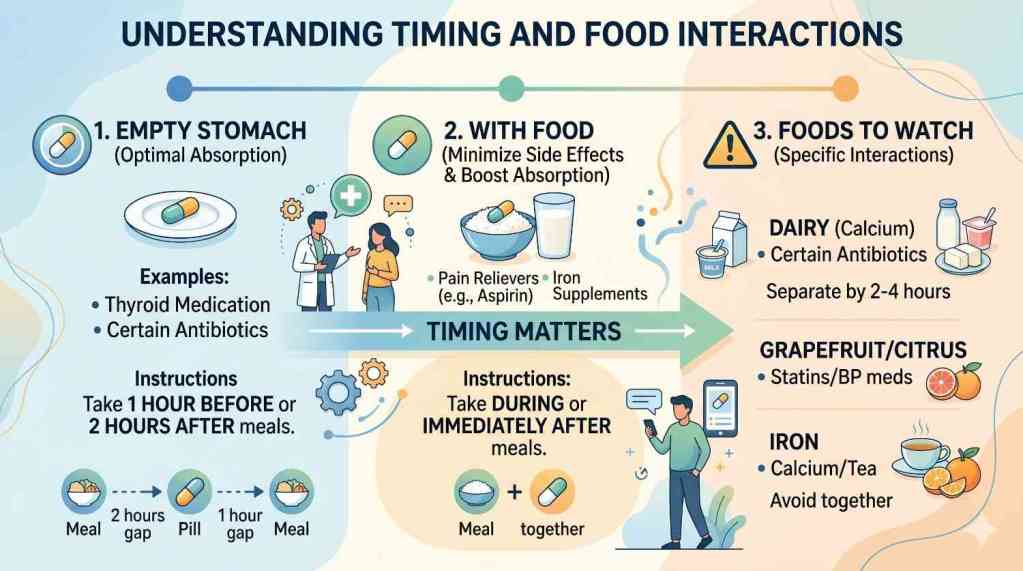
Timing your pill-taking around meals isn’t just about convenience—it’s about making sure your treatment works as intended. The right timing can transform good care into truly effective care.
Try JoyCalls Free
No app or new device needed. Start with a free 7-day trial.
How Food Impacts Medication Absorption and Effectiveness
Your stomach plays a crucial role in how your body processes drugs. Some products need food to help with proper absorption. Others work best on an empty stomach.
If your label says “take with food,” aim to do so within an hour of eating. This supports better absorption and protects your stomach. Neutral foods like crackers or toast work well.

For an empty stomach, wait about two hours after eating. This timing ensures maximum effectiveness for certain drugs.
Navigating Special Dietary Considerations Like Grapefruit Warnings
Grapefruit is a well-known concern with many common drugs. It can interfere with how your system processes certain products. The effect can be similar to taking too much medicine.
Other foods like leafy greens, bananas, and alcohol may also interact. Try to avoid these within two hours of taking your dose. If you accidentally consume something concerning, contact your pharmacist immediately.
Understanding these interactions protects your health and ensures your treatment works properly. It’s a simple step that makes a big difference in your well-being.
Integrating Medications into Your Daily Meal Schedule
What if your daily pills became as natural as your morning coffee or evening tea? This gentle approach turns health management into a seamless part of your life.
Pairing medications with breakfast, lunch, and dinner
Your existing eating patterns create perfect anchors for your health regimen. Breakfast becomes your morning reminder system. Lunch offers a midday checkpoint. Dinner provides an evening ritual.
Keep your pill organizer near where you eat. This visual cue supports consistency. It turns taking your medicines into a natural habit.
For those on the go, small portable containers work well. They fit in bags or pockets. This approach helps maintain your schedule anywhere.
Try JoyCalls Free
No app or new device needed. Start with a free 7-day trial.
Adjusting timing for medications requiring an empty stomach
Some treatments work best without food in your system. These need special timing consideration. Planning ahead prevents confusion.
Take these products about one hour before eating. Or wait two hours after your last meal. This ensures proper absorption.
“The simplest systems often work best. When health care fits naturally into daily life, everyone breathes easier.”
| Medication Type | Ideal Timing | Simple Strategy |
|---|---|---|
| With food | During or right after meals | Keep near dining area |
| Empty stomach | 1 hour before or 2 hours after eating | Set gentle phone reminders |
| Multiple times daily | Spread across main meals | Use colorful pill organizers |
Consistency protects your health long-term. Simple medication reminder strategies build confidence. They work alongside your natural weekly social routine.
What to Do When Meals Don’t Go as Planned
Building a medication routine around meals is one of the simplest ways to make daily doses easier to remember. But many older adults know that life does not always run on a perfect breakfast-lunch-dinner schedule. Some mornings start late. Some afternoons are busy with appointments. Some evenings come with low appetite, stomach upset, fatigue, or simple forgetfulness. On other days, a caregiver may not be present, a refill may be delayed, or a person may not remember whether the dose was already taken.
This is where many good routines quietly begin to break down.
The goal is not to create a rigid system that only works on perfect days. The goal is to build a medication habit that still works on ordinary, imperfect days too. That is especially important for seniors and older adults, because changes in appetite, sleep, energy, mobility, and memory can all affect how a routine plays out in real life. A schedule that depends on everything going smoothly is not a strong schedule. A good routine should be able to absorb small disruptions without turning into confusion.
That is why the most helpful medication plan is not just “take this with breakfast” or “take this at dinner.” It is also a backup plan for the days when breakfast is late, dinner is light, or a dose is forgotten. If readers can prepare for those situations in advance, they are far less likely to guess, skip something important, or accidentally double up later. Following the medicine’s directions exactly, keeping a current medication list, and checking with a pharmacist when something is unclear are all central parts of using medicines safely.
Start with one simple rule: never improvise with medication timing
When a day gets off track, it is tempting to make quick decisions in the moment. Many people tell themselves things like, “I missed lunch, so I’ll just take it now anyway,” or “I forgot the morning pills, so I’ll take two tonight.” That kind of improvisation often comes from good intentions. The person is trying to stay on schedule. But it can create more risk than reassurance.
A safer approach is to decide in advance how you will handle an off-schedule day. That means knowing which medications are flexible, which ones are not, and what to do if you are unsure. In general, a missed dose should not automatically be made up by taking extra later. Many medication instructions specifically advise taking a missed dose when remembered unless it is almost time for the next one, and not taking a double dose to catch up. When the instructions are unclear, the patient information leaflet, the pharmacy label, or the pharmacist should guide the decision.
That may sound obvious, but it is one of the most useful principles for older adults and family caregivers to remember. A calm pause is safer than a rushed correction.
So before you build your backup system, write this down somewhere easy to see:
If the day goes off schedule, do not guess. Check the label, check the written plan, or call the pharmacist.
That single habit can prevent a great deal of stress.
Create a “plan B” for irregular meals
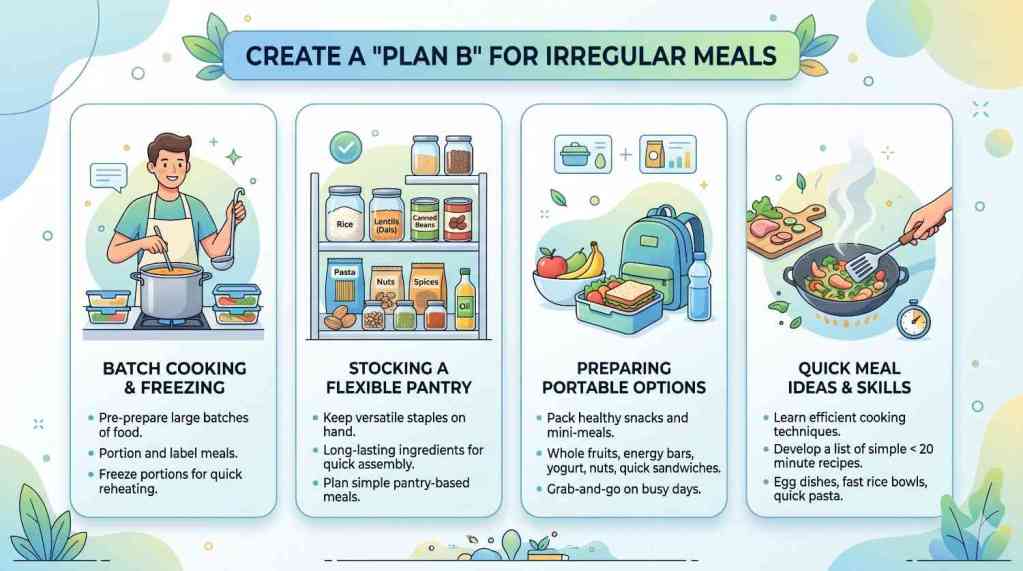
Some people eat three reliable meals a day. Others do not. Many seniors eat smaller meals, snack throughout the day, or have changing appetites depending on energy level, digestion, or the weather. A medication routine should reflect that reality.
A practical way to handle this is to stop thinking only in terms of named meals and start thinking in terms of medication conditions. For example:
- Does this medication need a full meal, or just some food?
- Does it need to be taken on an empty stomach?
- Does it need to be taken at the same time every day, whether food is involved or not?
- Does it need spacing away from other medications, supplements, or certain foods?
Those are better questions than simply asking whether it is a “breakfast pill” or a “dinner pill.”
For a medication that says “take with food,” your backup plan might be:
“Take it with breakfast if breakfast happens on time. If breakfast is skipped, take it with a small snack that the pharmacist has said is acceptable.” The original article already explains that some medicines are better tolerated or absorbed with food, and that even simple foods such as crackers or toast may help in some cases. That idea can be extended here into a more realistic routine for low-appetite days.
For a medication that says “take on an empty stomach,” the backup plan might be:
“If the morning is delayed, wait until the correct empty-stomach window rather than squeezing it in randomly with coffee or a snack.” Again, the point is not to be perfect. The point is to have a pre-decided method so the person is not making judgment calls when tired or distracted. Drug instructions vary, and some medicines have very specific missed-dose advice, so the safest habit is to use the medicine’s own directions first and ask the pharmacist to help convert those directions into plain language.
Build your routine around eating patterns, not idealized meals
Many older adults do better with a routine based on what actually happens every day, rather than what they wish happened. That means observing the person’s true rhythm for one week.
Ask:
- What time do they usually wake up?
- When do they usually have their first food or drink?
- Is lunch reliable or often skipped?
- Is dinner the most consistent eating time?
- Are evenings calm or more confusing?
- Are there certain days with appointments, religious activities, visitors, or fatigue that disrupt the flow?
This kind of observation is incredibly useful. It helps families stop building routines around the clock alone and start building them around behavior.
For example, if breakfast is inconsistent but tea and toast always happen around 10:00 a.m., then that may be the true anchor. If lunch is frequently skipped but dinner is always eaten, the schedule may need to lean more heavily on morning and evening routines, depending on the medication directions. If appetite is strongest earlier in the day, then “with food” medicines may need special planning for evenings.
A good medication habit is not built around a perfect day. It is built around a familiar day.
What to do if appetite is poor
Low appetite is common among older adults for many reasons, including illness, fatigue, grief, medication side effects, dental issues, digestive discomfort, and simply changing hunger patterns with age. When appetite drops, medication routines often become shaky because the person associates pills with a full plate of food and assumes they cannot take anything unless they have eaten “properly.”
That is where a written clarification helps.
If a medication label says “with food,” it is worth asking the pharmacist a practical question: “What counts as enough food for this medicine?” The answer may not always be a full meal. For some medications, a small amount of food may be sufficient, while others may have stricter instructions. The key is to ask before a difficult day arrives.
It also helps to keep a few easy, senior-friendly backup foods in the house for medication timing, such as toast, crackers, applesauce, yogurt if appropriate, or another simple option that the person tolerates well. This does not replace medical guidance. It supports it. The idea is to remove the barrier of “I cannot take my medicine because I do not feel like making a meal.”
If appetite loss lasts more than a short period, or if medicine is being skipped because food intake is consistently poor, that should not be treated as a minor inconvenience. It is a reason to call the doctor or pharmacist. Medication adherence problems are often symptoms of a larger issue, not just a scheduling problem.
A safe response to missed doses
Few medication questions create more anxiety than this one: “I forgot. What now?”
That moment can feel surprisingly stressful, especially for seniors managing several prescriptions or for adult children supporting from a distance. The fear is understandable. People worry they have undone their treatment or created harm. But panic does not help. A written missed-dose plan does.
The best approach is to prepare medication-specific guidance ahead of time for the prescriptions that matter most. Many official medicine instructions say some version of: take the missed dose when you remember, unless it is almost time for the next one, and do not double up. But that is not universal, and some higher-risk medicines need special instructions. That is why general memory is not enough. The label, leaflet, pharmacist, or prescriber should guide the plan for each medication.
Here is an easy system that works well in practice:
Step 1: Stop and verify.
Before taking anything, confirm whether the dose was actually missed. Check the pill organizer, chart, or reminder log.
Step 2: Read the medicine instructions.
Look for the missed-dose guidance on the pharmacy label or medication information sheet.
Step 3: Follow the written plan.
If the plan says take it when remembered, do that. If it says skip and continue normally, do that. If it is unclear, call the pharmacist.
Step 4: Never “catch up” by doubling unless a clinician specifically tells you to.
A double dose is not a harmless correction. In many cases, it increases risk without restoring the benefit you hoped for.
Step 5: Record what happened.
A tiny note on a chart or calendar can prevent a second mistake later in the day.
This kind of calm, repeatable method is far more protective than relying on memory in the moment.
Make a written “if this happens” chart
One of the most helpful things a senior or caregiver can do is create a one-page medication exception chart. This is not a replacement for the official medication list. It is a plain-language backup tool.
It can include simple lines such as:
- If breakfast is late, take this one at the first food of the day.
- If no meal happens, use the pharmacist-approved snack plan.
- If this dose is missed and it is close to the next dose, skip it.
- If vomiting happens after taking this medicine, call the pharmacist for advice.
- If I am not sure whether I took it, do not take another one until I verify.
This kind of chart reduces hesitation and guesswork. It also makes support easier for spouses, adult children, home aides, and neighbors. The FDA encourages people to keep an up-to-date medication list that includes prescription medicines, OTC products, vitamins, and supplements, and to share that information with trusted caregivers and health professionals. Adding a plain-language exception plan alongside that list makes the routine even more usable in daily life.
Plan ahead for appointments, travel, and long days away from home
Meal-based routines often work beautifully at home and then fall apart outside the house. A medical appointment that runs long can delay lunch. A family visit can push dinner late. Travel can change both meal timing and time awareness.
This is where simple preparation matters.
The first step is to identify which medications are most time-sensitive and which are simply easiest to remember at set times. Then prepare a small, clearly labeled travel setup for planned outings. That might include the day’s doses in a portable case, a printed list of medications, water, and a short written instruction sheet if the person is easily flustered away from home.
The second step is to think in advance about food access. If a medication usually goes with lunch, but you know lunch may be delayed during an appointment day, do not leave that decision until 2:30 p.m. Bring the pharmacist-approved snack option or adjust timing in advance if that is consistent with the medication directions.
The third step is communication. If a caregiver is helping, they should know whether the person has already taken the dose before leaving the house. This sounds basic, but many medication mix-ups begin with poor handoff between two well-meaning people.
Know when routine problems are actually warning signs
Sometimes missed doses are just missed doses. Sometimes they signal something bigger.
If a senior is frequently forgetting whether medications were taken, regularly eating too little to follow instructions, skipping doses because the routine feels overwhelming, or becoming confused by changes in refill appearance or timing, the issue may not be solved by another alarm alone. It may point to vision changes, memory concerns, low health literacy, medication burden, side effects, or caregiver strain.
That is why it is important not to normalize chronic confusion. Medication routines should feel manageable most days. If they do not, it is time for a review.
A pharmacist can help simplify instructions, explain food-related timing, identify duplications, and clarify which medicines need special attention. The FDA also advises patients to keep an updated medication record and tell the pharmacist exactly how medicines are being taken, including OTC products and supplements. That kind of honest review is especially important if the real-life routine has drifted away from the official plan.
A gentler goal: consistency, not perfection
The healthiest medication routine is not the one that looks the neatest on paper. It is the one a person can actually live with.
For older adults, especially, kindness and realism matter. There will be days when breakfast is late, appetite is poor, energy is low, or memory is not at its best. A strong routine makes room for that. It uses meals as anchors, but it also uses written instructions, backup foods, caregiver communication, pharmacist guidance, and a clear missed-dose plan to keep small disruptions from becoming bigger problems.
That is the mindset shift that helps medication habits last. Instead of asking, “How do I make sure nothing ever goes wrong?” ask, “How do I make sure I know what to do when the day is imperfect?”
That question leads to safer systems, calmer caregiving, and more confidence for the person taking the medicine.
And for many families, that confidence is just as valuable as the reminder itself.
Turn a Meal-Based Medication Routine Into a Support System
Taking medicine regularly is often described as a personal responsibility, but for many older adults, that framing is too narrow. Medication adherence is rarely just about discipline. It is about memory, appetite, daily structure, physical comfort, confidence, understanding instructions, and sometimes the quiet emotional weight of managing health every single day. That is why even a well-designed medication routine can start to slip if it depends on one person remembering everything alone.
A meal-based schedule is helpful because it connects medicine to something familiar. Breakfast, lunch, and dinner are easier to notice than abstract times like 8:00 a.m. or 1:00 p.m. But the routine becomes much stronger when it is supported by people, communication, and a clear system that reduces stress rather than adding to it.
This matters especially for seniors and older adults who may be managing more than one prescription, adjusting to a new diagnosis, recovering after illness, or living with mild memory changes that do not always show up dramatically but still affect daily consistency. It also matters for adult children, spouses, professional caregivers, and home aides who want to help without making the older adult feel monitored, corrected, or infantilized.
The most successful medication routines often have one thing in common: they are not built on reminders alone. They are built on shared understanding. The person taking the medicine knows what each part of the routine is for. The people helping know what to look for. And everyone involved understands what to do when something changes.
That kind of support system does not need to be complicated. In fact, the simpler it is, the better it usually works. The goal is not to create a medical operation inside the home. The goal is to reduce uncertainty. A good support system should answer the questions that come up in everyday life: Did I take this already? What if I ate late today? Is this medicine supposed to be taken with a full meal or just some food? What do I do if I feel nauseated? Who should I call if I am confused?
When those answers are clear, medication routines become less fragile. They stop depending only on memory and start depending on structure. That shift is incredibly valuable for older adults because it turns medication management from a daily test into a repeatable habit.
Start with clarity, not just compliance
One of the biggest mistakes families make is focusing only on whether the medicine was taken, without checking whether the older adult actually understands the routine. A person may nod, follow directions for a few days, and still feel uncertain underneath. They may not want to ask “simple” questions. They may not remember which pill is for what. They may be embarrassed to admit that they do not know why one medicine has to be taken with food while another must be taken before eating.
That uncertainty matters. People are much more likely to stick to a routine when it makes sense to them.
So one of the most useful things a caregiver or family member can do is slow the process down and make the routine understandable in plain language. Instead of saying, “Take this one twice a day with meals,” say, “This one goes better with food, so we’re linking it to your first meal and your evening meal.” Instead of saying, “You must not miss this,” say, “This is one of the medicines we want to keep very steady from day to day, so let’s make it part of something you already do.”
That kind of explanation is not fluff. It increases follow-through because people remember logic better than orders.
This is also where writing things down helps. Many seniors do not need more information; they need easier-to-use information. A short medication guide posted in the kitchen or kept near the dining table can be far more helpful than a long stack of pharmacy papers in a drawer. The guide should be simple enough that the person can glance at it during a normal day and feel reassured instead of overwhelmed.
Build a routine that respects independence
Older adults are more likely to accept help when the help feels respectful. That may sound obvious, but it is often overlooked. Medication support can quickly feel controlling if the tone becomes too corrective, too rushed, or too childlike. Even well-meaning family members sometimes slip into patterns that create resistance: “Did you take your pills yet?” “No, not that one.” “You forgot again.” “I told you this yesterday.”
The problem with that approach is not just emotional. It can actually make adherence worse. When people feel criticized, they may hide mistakes, avoid asking questions, or insist they are fine even when they are unsure.
A better approach is collaborative language. Try phrases like:
- “Let’s make this easier.”
- “What part of this routine feels annoying?”
- “Would you rather connect this to breakfast or to the tea you always have first?”
- “What usually throws the day off?”
- “Would it help if we put the checklist here instead?”
This tone preserves dignity. It also reveals the real barriers. Sometimes the issue is not memory at all. It may be that the pill bottle is hard to open. The label may be hard to read. The person may dislike taking medicine in front of guests. They may delay breakfast because cooking has become tiring. Or they may feel discouraged by how many medications they have to manage. None of those problems will be solved by stronger reminders alone.
The more medication planning respects how the person actually lives, the more sustainable it becomes.
Decide who is responsible for what
Medication routines get messy quickly when several people are involved but nobody has defined roles. This is common in families where a spouse helps some of the time, an adult child calls in the afternoon, and a home aide comes on certain days. Everyone assumes someone else confirmed the dose. Everyone means well. And that is exactly how double dosing, skipped doses, or confusion begin.
The solution is simple but powerful: decide who is responsible for each step.
For example, one household may decide that the older adult takes the medicine independently, but the daughter refills the pill organizer every Sunday. Another may decide that breakfast medications are self-managed, while evening doses are confirmed by a spouse. In a home-care setting, the aide may prepare the meal and verbally prompt the medicine, but the family member may remain responsible for refills and prescription changes.
There is no single correct model. What matters is clarity.
A useful framework is to divide responsibilities into five small categories:
Preparation – who picks up refills, sorts pills, and updates the list
Prompting – who reminds, if reminders are needed
Observation – who notices side effects, appetite changes, or missed meals
Documentation – who marks doses taken, if a checklist is being used
Escalation – who calls the pharmacist or doctor when something changes
Once those roles are clear, the routine becomes much safer. It also reduces tension because people stop stepping on each other’s toes.
Use one visible record, not several half-systems
Many medication problems come from fragmented tracking. A note on the fridge, a reminder in one person’s phone, a pillbox in the bedroom, refill information in a purse, and verbal updates shared only sometimes—this creates a false sense of organization. It looks like many systems, but in reality it is no system at all.
Older adults do best when there is one primary place where the truth lives.
That may be a printed medication chart. It may be a pill organizer with a checklist beside it. It may be a caregiver notebook kept in the kitchen. For some families, it may be a shared digital note, but for many seniors, a visible paper system is easier and more reassuring.
The important thing is consistency. If someone wants to know whether the breakfast medication was taken, there should be one trusted place to check. If a doctor asks for the current medication list, there should be one updated version. If a caregiver notices that lunch was skipped and the medication timing may need adjustment, there should be one place to record that.
When the system is simple and visible, small problems get caught earlier. That is what makes it effective.
Pair medication support with meal support
Since the article is about building medication habits around meals, it is worth saying something that families often miss: sometimes the medication problem is actually a meal problem.
If an older adult regularly misses doses that should be taken with food, the issue may not be forgetfulness. It may be that cooking has become tiring. Grocery shopping may feel harder than before. Appetite may be inconsistent. The person may delay meals because eating alone feels unappealing. Denture problems, dry mouth, digestive discomfort, or grief can also quietly change how and when people eat.
In that situation, simply emphasizing medicine adherence does not solve the real issue. The more strategic response is to support the meal anchor itself.
That may mean preparing easy breakfast options in advance. It may mean creating a habit of tea and toast before the morning dose. It may mean arranging meal delivery, simplifying lunch, or making dinner more consistent. In some homes, it may mean choosing one reliable eating moment each day that can serve as the strongest anchor for certain medications, depending on the prescription instructions.
In other words, if the meal is the anchor, the meal needs support too.
This is especially important for seniors who live alone. A person may say, “I forgot my medicine,” when the deeper truth is, “I didn’t really have a proper meal today.” The answer, then, is not just another reminder. It is a gentler redesign of the day.
Watch for subtle signs that the routine is slipping
Medication problems do not always begin with a dramatic missed dose. Often they begin quietly.
The older adult may start asking more often, “Did I take this already?” They may begin eating at unusual times. Pill bottles may remain full longer than expected. Refill dates may drift. The person may become vague about the routine or change the subject when asked. A spouse may say, “We’re mostly on track,” but sound unsure. A caregiver may notice that medication is being delayed more often because meals are less predictable.
These are early warning signs, and they matter.
It is much easier to fix a routine that is wobbling than a routine that has already collapsed into confusion. That is why families should pay attention not only to obvious errors, but also to patterns of hesitation, inconsistency, and low confidence. If the person seems less sure than before, that is information. If the routine works only when one specific caregiver is present, that is information too.
The right response is not alarm. It is adjustment.
Perhaps the checklist needs to be clearer. Perhaps the morning routine needs to move from the bedroom to the kitchen. Perhaps the pill organizer needs larger labels. Perhaps the evening dose should be linked to dinner cleanup instead of dinner itself. Perhaps the person needs a medication review because the regimen has simply become too complex for the current stage of life.
Support systems work best when they are updated before things become unmanageable.
Make handoffs between caregivers more deliberate
Many older adults receive help from more than one person across a week. This may include a spouse, adult child, paid caregiver, neighbor, or visiting nurse. Whenever more than one person participates, handoffs become important.
A handoff is simply the transfer of responsibility from one person to another. But in medication routines, weak handoffs create real risk. If one caregiver assumes the dose was already given and another assumes it was not, the older adult can end up with a missed dose or an accidental repeat. These errors are common precisely because everyone involved is trying to help.
To prevent that, families should agree on one handoff method.
That might be a written note left in the same place every day. It might be a text message sent after the dose is confirmed. It might be a checklist initialed at each meal-linked dose. It might be a brief update in a caregiver notebook: “Breakfast eaten at 8:30. Morning meds taken.” The specific method matters less than the consistency.
The rule should be simple: do not rely on memory for handoffs.
This is especially helpful for households with changing schedules, rotating aides, or adult children coordinating support from a distance. A clear handoff keeps medication care from becoming a guessing game.
Prepare for changes before they happen
Medication routines often fail not because the original system was poor, but because the system was never updated when life changed.
A new diagnosis is added. A medicine is stopped. Appetite decreases after an illness. A caregiver leaves. A spouse becomes less able to help. A formerly independent older adult starts needing more prompting. Yet the routine stays the same on paper, even though it no longer matches reality.
That mismatch can create confusion very quickly.
A strategic medication support system should be reviewed anytime one of these changes happens:
- a new prescription is added
- dose timing changes
- the person starts eating less or at different times
- there is a hospital stay or rehabilitation period
- a new caregiver becomes involved
- the older adult becomes less confident managing the routine alone
- side effects make meals or pill-taking harder
Families do not always need to rebuild everything. But they do need to ask: does the current system still fit the current life?
That one question can prevent a lot of avoidable stress.
Keep the emotional tone calm and matter-of-fact
Medication management can carry more emotion than people realize. For older adults, it may symbolize aging, dependence, or loss of control. For family caregivers, it may trigger worry, guilt, or frustration. Those feelings are understandable, but if they shape the routine too heavily, the entire process starts to feel tense.
That is why tone matters so much.
The best medication support systems are calm, ordinary, and low-drama. The medicine is not treated like a daily crisis. It is treated like part of the normal structure of the day. Meals happen. Medicine happens. The checklist gets marked. Life moves on.
That kind of calm normalizes the routine and reduces resistance. It also makes it easier to discuss mistakes honestly. If an older adult knows they will not be scolded, they are more likely to say, “I’m not sure if I took it,” or “I skipped breakfast,” or “This one makes me not want to eat.” Those honest moments are exactly what allow the routine to stay safe.
Families should aim for steady support, not constant pressure.
Focus on what makes the habit repeatable
At the heart of all of this is one practical question: what makes the routine easy to repeat tomorrow?
That is the standard worth using. Not what sounds impressive. Not what seems most strict. What actually repeats.
A repeatable medication routine is one that fits the person’s appetite, attention, household rhythm, and support network. It is visible. It is respectful. It survives late breakfasts, changing caregivers, and ordinary human forgetfulness. It includes meals, but it is not dependent on perfect meals. It includes reminders, but it does not depend only on reminders. It includes help, but it preserves the older adult’s dignity.
That is what turns a meal-linked medication habit into something stronger: a dependable system.
And for seniors, that kind of dependability is deeply valuable. It reduces stress, preserves confidence, and makes health management feel less like a burden and more like a part of daily life that can be handled calmly and well.
Choosing the Right Tools and Strategies for Medication Management
What if you could build a safety net that ensures your health regimen stays on track, even on your busiest days? The right support system transforms worry into confidence.
Simple tools work together to create reliable protection. They help you follow your schedule without relying on memory alone.
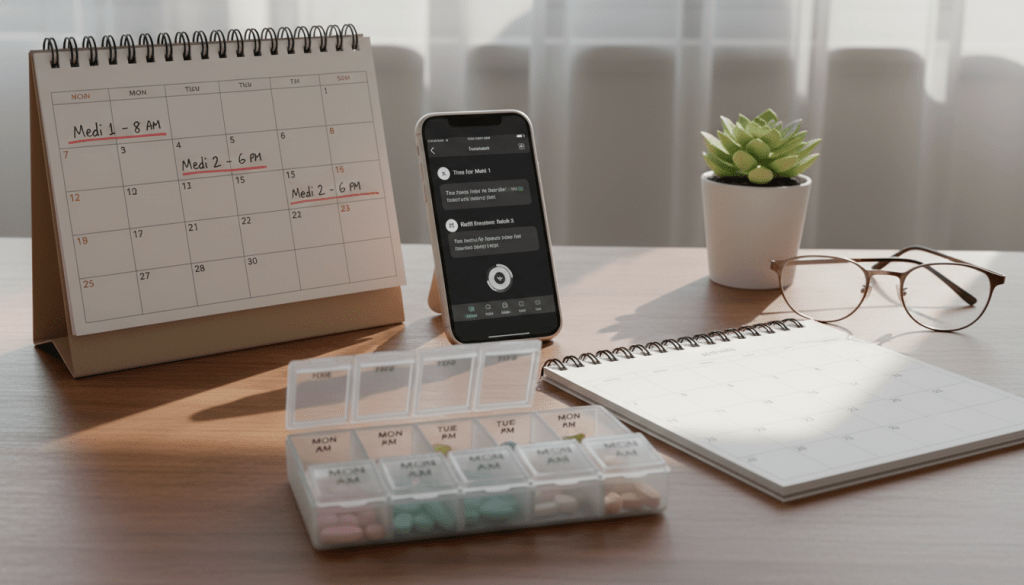
Using Pill Organizers and Printed Medication Charts
Weekly pill boxes let you prepare doses in advance. You can see at a glance if today’s products were taken.
Printed charts on your refrigerator provide visual reminders. They create accountability throughout the day.
Leveraging Digital Reminders and Pharmacist Support
Smartphone alerts notify you at exact times. Some apps share your schedule with family members providing care.
For those not using smartphones, services like JoyCalls offer daily phone reminders. A friendly voice ensures nothing is missed.
Your pharmacist recommends the best tools for your specific medications. They provide clear instructions and support.
Creating a Personalized Medication Chart
A custom chart organizes all your health needs in one place. It includes doses, times, and special notes.
This personalized approach builds confidence. It ensures consistent follow-through with your health plan.
| Tool Type | Best For | Key Benefit |
|---|---|---|
| Pill Organizers | Visual learners | Pre-prepared doses |
| Digital Reminders | Tech-friendly users | Exact timing alerts |
| Phone Call Services | Seniors preferring voice | Friendly check-ins |
| Pharmacist Guidance | Complex regimens | Professional advice |
“The right tools don’t just remind you—they reassure you that everything is taken care of.”
Combining these strategies creates powerful support. Research shows consistent management improves health outcomes. This approach works beautifully for long-distance caregiving situations.
Your pharmacist can help customize your system. They understand how different tools work together for optimal results.
Addressing Side Effects, Dosage, and Risk Factors
Listening to your body’s subtle messages can be the key to ensuring your health products work effectively. Even with careful planning, sometimes treatments cause unexpected reactions.
Recognizing potential side effects and necessary precautions
Your stomach often signals when something isn’t right. If you feel nausea or discomfort 15-30 minutes after taking your dose, you might need more food. These side effects are common when medications aren’t taken properly.
Keep a simple journal of any unusual effects. Note when they occur and how they feel. This information helps your doctor make informed adjustments.

Consulting healthcare professionals when adjusting doses
Never change your dose or stop taking medicines on your own. Even if you experience side effects, consult your provider first. This prevents serious health risk factors.
If you miss a dose, contact your pharmacist for guidance. Some drugs can be taken late, while others require skipping. Learning to manage drug side effects properly protects your well-being.
Open communication with your healthcare team ensures your treatment plan supports your overall health. They can adjust medications to minimize unwanted effects.
Working with Your Pharmacist to Perfect Your Routine
Your local pharmacy holds a secret weapon for perfecting your health management strategy. That expert behind the counter offers more than prescriptions—they provide personalized guidance for your entire wellness journey.
Building a collaborative approach with your pharmacist
Your pharmacist serves as a trusted guide through complex medications schedules. They understand how different drugs interact with food, supplements, and other products.
This professional can spot potential problems before they occur. They become an essential member of your healthcare team.

Clarifying instructions and addressing medication interactions
Never hesitate to ask questions about confusing instructions. Your pharmacist can explain timing requirements in simple terms.
They help you understand which drugs need spacing and which can be taken together. This prevents harmful interactions between your medications.
Many pharmacies offer synchronization programs that align refills to one monthly time. This simplifies pickup and reduces missed doses.
Your pharmacist coordinates with your doctor when adjustments are needed. They bridge communication gaps within your care team.
Whether you have questions about supplements or missed doses, they provide answers. This collaborative relationship creates confidence in your health care plan.
This support works beautifully alongside other tools like AI companionship services that provide daily check-ins.
Conclusion
Creating a system that protects your well-being doesn’t have to feel like another chore. When you build your treatment schedule around natural daily anchors, you create sustainable habits that support your long-term health.
Understanding how different foods affect absorption ensures your treatment works effectively. Simple tools like pill organizers work beautifully alongside compassionate services. For families supporting loved ones from a distance, daily check-ins provide that extra layer of reassurance.
Remember, your pharmacist and healthcare team are always available to answer questions and clarify instructions. Don’t hesitate to reach out—they want to help you succeed.
You’re taking a powerful step toward consistent, confident care. JoyCalls offers gentle reminders that fit seamlessly into daily life, giving families peace of mind while supporting independent living.