


What if forgetting a pill wasn’t a simple mistake, but a sign of a much larger struggle? That untouched Tuesday compartment in the weekly pill organizer can feel like a quiet alarm bell. It’s a moment many families know well, sparking worry and a search for answers.
This challenge touches millions. In fact, over half of our older loved ones manage four or more prescriptions. Juggling this many pills can be overwhelming, confusing, and physically tough. It’s not about carelessness. It’s about a complex puzzle of daily life.
The stakes are high. Missed doses can lead to worsening health and preventable trips to the hospital. Understanding the real reasons behind these struggles is the first, most compassionate step toward a solution. This is about preserving independence and quality of life.
Research, like this systematic review, shows that factors like complex routines, multiple doctors, and even social isolation play a huge role. It’s a mix of personal, medical, and practical hurdles.
Whether you’re a busy adult child checking in or someone wanting to stay on top of your own well-being, you’re not alone. Here, we explore the ‘why’ with empathy, offering real support for the path ahead.
Key Takeaways
- Missing prescribed doses is rarely due to simple forgetfulness and is often a complex issue.
- Managing multiple prescriptions daily is a common and significant challenge for older individuals.
- The consequences of not following a treatment plan can seriously impact long-term health.
- Factors like complex routines, social isolation, and cognitive changes contribute to the difficulty.
- Understanding these challenges is the essential first step to finding effective, compassionate support.
- Practical solutions exist that can help maintain independence and peace of mind for everyone involved.
Introduction to Medication Adherence in Older Adults
Behind every skipped medication lies a complex web of real-life obstacles that deserve our understanding. This guide exists because you’re not alone in worrying about your aging parent’s well-being.
Purpose and Scope of the Guide
We’re here to explore why treatment plans sometimes fall short. It’s not about pointing fingers, but finding compassionate solutions. Individual choices are rarely the main issue when prescriptions aren’t followed.
As Kelly A. Thompson-Brazill from Georgetown University explains, “There are so many different things that underlie why someone may not be able to adhere to a medication regimen.”
| Traditional Approach | Modern Understanding | Better Outcomes |
|---|---|---|
| Focuses on forgetfulness | Addresses multiple barriers | Reduces health risks |
| One-size-fits-all solutions | Personalized support systems | Maintains independence |
| Blames the individual | Recognizes systemic challenges | Improves quality of life |
Understanding the Need for Better Management
Traditional methods often overlook aging realities like vision changes, stiff hands, and fixed incomes. Research from the National Institutes of Health shows that cost, health literacy, and communication gaps significantly impact treatment success.
Our purpose is practical: giving you knowledge and tools to make medication management safer. This includes addressing emotional challenges that come with caregiving. By understanding these barriers, you can help reduce health risks and support lasting independence.
Understanding Barriers to Medication Adherence
Many well-intentioned individuals face invisible hurdles that turn simple pill-taking into a daily battle against multiple obstacles. These challenges often have little to do with willingness or memory.
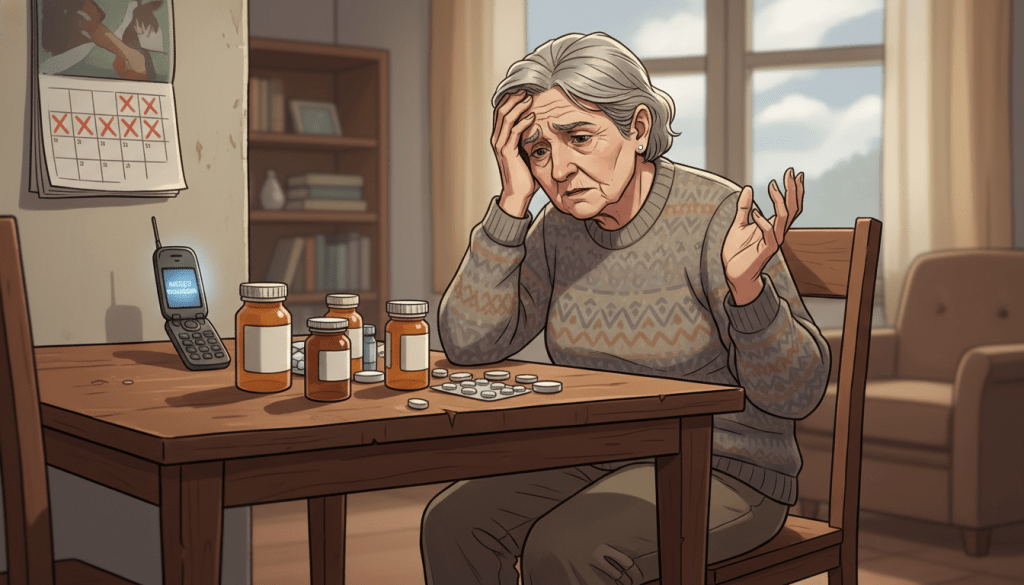
Instead, real-life circumstances create barriers that make consistent treatment difficult. Understanding these obstacles is the first step toward compassionate solutions.
Financial Constraints and Cost Issues
Money worries can directly impact health outcomes. According to the Kaiser Family Foundation, nearly one-quarter of people find prescription costs difficult to afford.
When a single medication costs more than a week’s groceries, some patients make heartbreaking choices. They might skip doses to stretch their supply, risking their well-being.
Health Literacy and Communication Challenges
Understanding medical instructions isn’t always easy. Some individuals nod politely at appointments but leave confused about their treatment plan.
Poor communication creates gaps where questions go unasked. Without clear information and support, even determined people struggle with treatment adherence.
Physical limitations like arthritis or vision changes add another layer of complexity. These daily frustrations make consistent care challenging for many older adults.
The Impact of Polypharmacy on Treatment Compliance
When the medicine cabinet starts to look like a pharmacy shelf, the simple act of taking prescribed treatments becomes overwhelming. This is polypharmacy—managing multiple prescriptions that each come with their own timing and rules.
Kelly A. Thompson-Brazill explains the reality: “If you have patients who have to take medicine once a day, they are a lot more likely to be adherent compared to someone who has to take medication three or four times a day.”
The numbers tell a sobering story. About half of older adults live with three or more chronic conditions. Nearly 40% of them manage five or more different medications daily.
This creates a perfect storm of complexity. Remembering which pill to take when becomes a mental puzzle. Should it be with food? In the morning or evening? What combinations are unsafe?
Research shows that 74% of people taking four or more daily medications say complexity itself is their biggest barrier. Each additional prescription multiplies the chances of confusion and missed doses.
The impact ripples through health outcomes. Missed treatments lead to poorly managed conditions. This often results in even more prescriptions being added. It becomes a difficult cycle to break without support.
Try JoyCalls Free
No app or new device needed. Start with a free 7-day trial.
Treatment compliance suffers not because older adults don’t care about their health. The system hands them an impossibly complicated routine to solve multiple times every day.
Effective Solutions for medication adherence seniors
Research reveals that targeted interventions have significant, measurable impacts on helping people stay on track with their health plans. A major analysis found that these approaches create a meaningful medium effect size of 0.500 for those with ongoing health conditions.
Face-to-face counseling stands out as particularly effective. Personalized behavioral strategies also show strong results. These methods work because they address individual barriers rather than offering generic advice.

The most successful approaches consider the whole person. They look at physical abilities, cognitive function, financial situation, and emotional needs. This comprehensive care leads to better health outcomes and fewer emergency visits.
Simple changes can make a big difference. Consolidating prescriptions or switching to once-daily formulas reduces daily burden. Building a support system with family and providers creates multiple safety nets.
When you improve medication adherence, you’re doing more than following a schedule. You’re helping maintain independence and quality of life. These solutions offer real hope for sustainable management of treatment plans.
Simplifying Complex Medication Regimens
The path to better health management might start with asking one simple question: ‘Do we really need all of these?’ When pill bottles crowd the counter, simplification becomes the kindest solution.
Open conversations with healthcare providers can reveal surprising opportunities to streamline treatment. Sometimes prescriptions from different specialists overlap or even work against each other.
Tips for Deprescribing and Combining Medications
Deprescribing—the careful reduction of unneeded prescriptions—can dramatically lighten the daily load. This isn’t about skipping vital treatments. It’s about eliminating what’s no longer necessary.
Ask providers directly about combination options. “Could any medications be combined into one pill?” or “Is there a once-daily version instead of multiple doses?” These questions can transform overwhelming routines.
Timing adjustments matter too. Grouping prescriptions that can be taken together reduces the number of separate moments to remember. This approach works beautifully with established daily routines.
The goal is reducing cognitive load and physical effort. Working with pharmacists and physicians creates care plans tailored to actual daily life. Streamlined regimens become manageable rather than overwhelming.
Improving Communication Between Providers and Patients
Have you ever left a doctor’s appointment feeling more confused than when you arrived? That quiet nod in the examination room often hides a world of uncertainty. When medical conversations become one-sided lectures instead of two-way dialogues, vital information gets lost.

As expert Kelly A. Thompson-Brazill emphasizes, “It is very important for providers, especially nurse practitioners, to ask their patients questions about their medication.” This simple shift transforms the entire dynamic.
Building Trust Through Open Dialogue
Creating space for your loved one to ask questions without embarrassment is crucial. Encourage them to voice concerns without fear of being dismissed. This builds the foundation for true partnership in health management.
Come prepared to appointments with specific questions: “What exactly will this treatment do?” “How will I know if it’s working?” “What should I do about side effects?” This proactive approach ensures nothing gets lost in translation.
When patients understand the purpose behind each prescription and feel their providers genuinely care about their circumstances, following treatment plans shifts from a chore to a collaborative goal. Research shows that effective communication strategies significantly impact treatment success.
Clear, jargon-free information provided both verbally and in writing makes all the difference. This approach, combined with supportive resources like conversation starters for meaningful connections, creates an environment where everyone feels heard and understood.
Educational Interventions for Better Medication Use
What happens when the ‘why’ behind a treatment gets lost in translation? A person might stop taking a pill because they still feel symptoms, not realizing the goal was management, not a complete cure. This frustration, not defiance, is a common reason plans fall apart.
True education goes beyond a handout. It builds understanding that empowers better health decisions. Studies show structured programs have a powerful impact, with an effect size of 0.883. They explain realistic outcomes and timelines.
These programs work best when tailored. Some adults learn from written materials. Others need visual aids or repeated conversations. The health belief model is effective. It helps patients grasp their personal risks and the real benefits of their regimen.
Practical skills are just as vital. Learning to read labels, track doses, and handle missed pills builds confidence. This comprehensive approach is key to improving medication adherence in older adults.
| Basic Information | Structured Education | Sustained Support |
|---|---|---|
| Hands out a prescription sheet | Explains the purpose and goals | Offers ongoing check-ins and updates |
| Assumes one-time understanding | Tailors to individual learning styles | Evolves with changing health needs |
| Focuses only on “how” | Teaches practical “what if” skills | Builds a long-term partnership in care |
Improving medication use is not a single event. It’s an ongoing conversation. As conditions change, so does the need for clear, compassionate education. This support turns confusion into confidence.
Leveraging Digital Health Solutions
Technology is quietly revolutionizing how we support our aging parents’ well-being from afar. These innovative tools transform daily health routines into supported, monitored processes that bring peace of mind to everyone involved.

Utilizing Mobile Apps and Telehealth
Mobile applications send gentle reminders at exactly the right time. They track which doses have been taken and alert family members if anything is missed.
Telehealth services bring healthcare providers directly into your loved one’s living room. Video calls make it easier to discuss concerns without transportation stress.
Barcode Scanning and Smart Device Integration
Barcode systems add a critical safety layer in healthcare settings. They ensure the right treatment reaches the right person and flag potential interactions.
Smart devices like electronic pill bottles create automatic tracking. They light up and beep at dose time without requiring tech skills.
| Traditional Methods | Digital Solutions | Family Benefits |
|---|---|---|
| Manual pill organizers | Smart reminders and tracking | Real-time peace of mind |
| In-person doctor visits | Telehealth consultations | Reduced transportation stress |
| Memory-dependent routines | Automated safety checks | Fewer missed doses |
For families seeking simple solutions, JoyCalls offers daily check-in calls using your parent’s regular phone. This AI companion provides medication reminders and sends updates to caregivers. These tools enhance human connection rather than replace it.
Recognizing and Managing Side Effects and Risks
When an unpleasant reaction makes someone want to stop their treatment, it’s not defiance but a cry for help that needs listening. Many people face this difficult choice between enduring discomfort and maintaining their health.
Not every new symptom means “just aging.” Sometimes it’s actually a reaction to a prescription that needs addressing. Dizziness, nausea, or confusion shouldn’t be dismissed as normal.
The risk comes when people stop treatments abruptly rather than seeking help. There are often alternative options that provide the same benefits without the troublesome side effects.
| Symptoms to Watch | Typical Duration | Right Response |
|---|---|---|
| Mild nausea, headache | 1-2 weeks | Monitor and report |
| Dizziness, confusion | Any duration | Contact provider immediately |
| Rash, breathing changes | Immediate | Seek emergency care |
“Empower your loved one to speak up when something doesn’t feel right. Early action prevents minor issues from becoming serious complications.”
Ask providers proactive questions before problems start. “What are the most common side effects of this drug?” “Which ones signal a genuine risk?” Understanding the difference between temporary adjustment effects and serious reactions helps patients stick with beneficial treatments.
For those managing multiple prescriptions, the risk of interactions multiplies. Having one provider who knows the complete list is essential for safe medication management. This vigilance protects against unexpected side effects.
What to Do After a Missed Dose: A Practical Recovery Plan for Seniors and Caregivers
Missing a dose can feel small in the moment, but emotionally it often lands much heavier. For many seniors, one forgotten pill quickly turns into worry, self-blame, confusion, or fear of “messing everything up.” For adult children and caregivers, discovering a missed dose can trigger panic and a sudden sense that the whole routine is falling apart. The truth is far more reassuring: a missed dose is important, but it does not need to become a crisis. What matters most is having a calm, repeatable plan for what happens next.
This is where many medication routines quietly fail. Families may have a pill organizer, phone alarms, pharmacy labels, and even caregiver support, but they still do not have a clear system for handling real-life disruptions. And disruptions happen all the time. A senior may oversleep. A refill may run late. A meal may be delayed. A doctor’s appointment may throw off the day. A visitor may interrupt the usual routine. A person may simply not remember whether they took the medication or not. In those moments, the problem is no longer just adherence. It becomes decision-making under stress.
A practical recovery plan is one of the most overlooked ways to improve long-term medication adherence. It helps seniors stay safe, protects their independence, and reduces the fear that one mistake will undo everything. It also helps caregivers respond with confidence instead of frustration. Most importantly, it turns medication management from a fragile routine into a resilient one.
Why Missed Doses Need a Plan, Not Shame
Many older adults already feel embarrassed when they miss medication. They may hide it because they do not want to seem forgetful, incapable, or dependent. That silence creates a second problem: the missed dose itself is no longer the only issue. Now there is also uncertainty, guessing, and delayed action.
Shame is one of the most dangerous barriers in medication management because it pushes people away from asking the exact questions that could help them. A senior who says nothing may decide to “double up” later without guidance. Another may skip the next dose entirely because they are unsure what to do. A caregiver who reacts with alarm may unintentionally make the older adult more reluctant to be honest the next time. Over time, these moments build a pattern of secrecy instead of safety.
A better approach is to normalize the situation early. Missing a dose does not mean someone is careless. It means the system needs a backup plan. That mindset shift is powerful. It replaces blame with problem-solving. It tells the older adult, “This can happen. We know what to do. We will handle it step by step.”
That is the tone every medication routine should aim for. Calm. Clear. Practical. No lectures. No panic. Just a reliable next step.
The First Rule: Never Guess When You Are Unsure
One of the most common medication mistakes is taking action based on assumption rather than certainty. If a senior is not sure whether a dose was taken, they may try to reconstruct the day from memory. They may look at a bottle cap, search the kitchen counter, or rely on a vague feeling that “I think I already took it.” That is risky.
The safest recovery routines begin with one principle: do not guess.
If there is uncertainty, the next move should be to check a system, not memory. This is why visual tracking matters so much. A pill organizer can show whether the dose compartment is still full. A written medication log can confirm time and date. A smart reminder system may show whether the dose was marked complete. A caregiver text thread might include a confirmation. Even a simple paper checklist near the dining table can prevent dangerous uncertainty.
Without a tracking method, every missed dose becomes a detective story. With a tracking method, it becomes a quick check.
For seniors who prefer simplicity, a printed daily sheet often works better than an app. It can include:
Daily Medication Check Sheet
- medication name
- dose
- time to take it
- whether it should be taken with food
- box to mark “taken”
- box to mark “missed”
- notes for side effects or issues
This kind of sheet is not just administrative. It reduces mental pressure. It helps the older adult trust the process instead of their memory alone.
Create a “What Happens If I Miss It?” List Before There Is a Problem
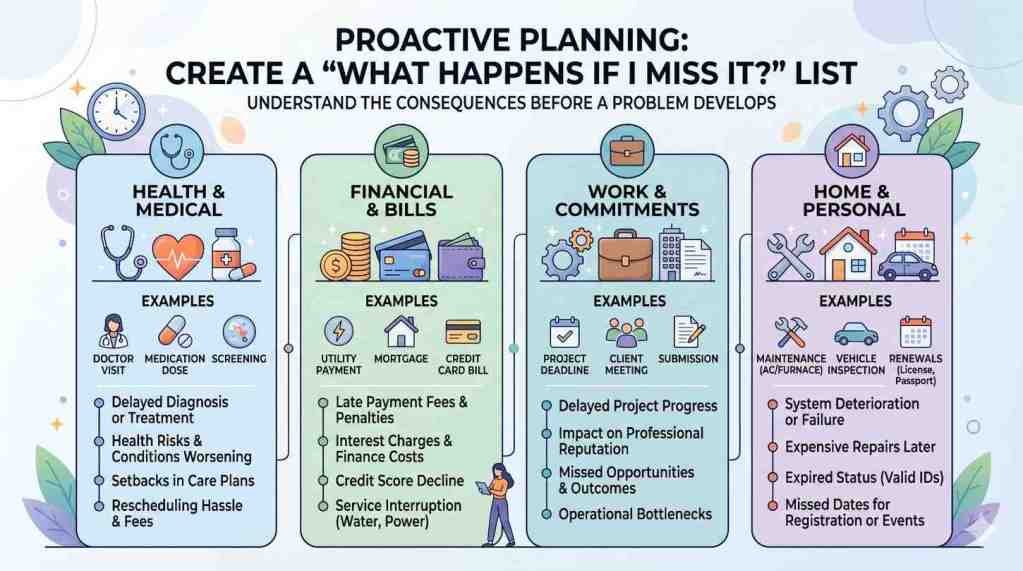
Most families prepare the routine for normal days, but not for disrupted days. That is the gap. The easiest way to prevent panic is to create a written “missed dose action list” in advance with the prescribing doctor or pharmacist.
This should not be vague. It should be medication-specific whenever possible. Different medicines have different safety rules, and the correct action can vary depending on the drug, the timing, and the patient’s condition. That is why a general internet search or a rushed guess is not a strong system. A personalized plan is much safer.
Ask the doctor or pharmacist to help create a simple version using plain language. For each medication, include:
Missed Dose Action Notes
- What should I do if I remember a little late?
- What should I do if it is almost time for the next dose?
- Should I ever double the next dose?
- Which medications require a call to the doctor if missed?
- Which medications are especially important to take on schedule?
- What warning signs mean I need medical advice right away?
Then store this list in a place where it will actually be used. The best locations are:
- inside the medication drawer
- taped inside a kitchen cabinet
- in the weekly medication planner
- saved as a printed page in a caregiver binder
- shared by photo with family members involved in care
When this list exists ahead of time, a missed dose stops being a moment of confusion and becomes a moment of reference.
Build a Recovery Routine for the Most Common Real-Life Scenarios
Seniors do not usually miss doses in dramatic ways. Most missed doses happen during ordinary disruptions. That is why the recovery plan should be built around real life.
Scenario 1: The Morning Routine Starts Late
A senior wakes up later than usual, feels rushed, and is unsure whether to take morning medications on the delayed schedule or wait until the next regular time.
The fix here is not just a reminder. It is anchor planning. Instead of tying medication only to a clock, tie it to a sequence. For example:
- after brushing teeth
- with breakfast
- after morning coffee
- after the first bathroom trip
- before the morning news
That way, even if the day starts at 7:00 a.m. one day and 9:00 a.m. the next, the routine still has a logical home.
For caregivers, this is a useful question to ask: Is the medication attached to a time, or attached to a habit?
Habits are usually easier to recover than exact times.
Scenario 2: The Senior Cannot Remember Whether the Dose Was Taken
This is one of the most stressful situations because it tempts people to act quickly. The solution is to remove memory from the center of the process.
Use one primary confirmation method only. Not three. Not five. One. For example:
- a weekly pill box where an empty slot means “taken”
- a check mark on paper immediately after taking it
- a digital reminder that must be manually marked complete
Too many systems create their own confusion. The goal is not complexity. The goal is one dependable source of truth.
Scenario 3: A Dose Is Missed Because of Appetite or Meal Changes
Some seniors miss medication because meals become irregular. They may not feel hungry, may eat at unusual times, or may skip meals entirely. If medication instructions are linked to food, this can cause hesitation and delay.
The helpful strategy here is to separate “eating a full meal” from “having enough in the stomach,” when medically appropriate and confirmed by the provider. Some older adults do better when they keep a few safe, easy backup foods on hand for medication times:
- plain crackers
- toast
- yogurt
- banana
- applesauce
- a small glass of milk if tolerated
This reduces the all-or-nothing thinking of “I did not eat properly, so I guess I cannot take it.” A small backup option can rescue the routine.
Scenario 4: The Refill Is Not Ready in Time
Medication adherence often breaks not because a person forgets a dose, but because the supply runs out. That is a systems problem, not a memory problem.
The solution is to create a refill buffer. Refill management should start before the last few pills. A practical system includes:
- checking remaining supply on the same day each week
- ordering refills when about 7 days remain, if possible
- keeping one pharmacy on file whenever feasible
- asking about automatic refill options
- asking whether synchronization is available so multiple medications refill at the same time each month
For caregivers, refill gaps are one of the highest-value areas to fix because they are predictable and preventable.
Turn the Home Into a Safer Medication Environment
Medication adherence does not happen in isolation. It happens in a physical environment. And often, small environmental changes make a surprisingly large difference.
If the home setup is cluttered, dimly lit, inconsistent, or hard to navigate, doses get missed more easily. A strategic medication area should be built around visibility, ease, and routine.
Design a Single Medication Station
Instead of storing medications in several rooms, create one main location for daily use, unless a provider has instructed otherwise for specific storage reasons. This station should include:
- current daily medications
- the medication list
- the missed dose action sheet
- a pen
- reading glasses if needed
- a glass or water bottle nearby
- a small lamp or good lighting
- contact numbers for doctor, pharmacy, and caregiver
The point is to remove friction. If taking medication requires opening multiple cabinets, searching for glasses, finding water, and checking labels in poor lighting, adherence becomes harder than it needs to be.
Reduce Visual Overload
Some seniors feel overwhelmed simply by seeing too many bottles at once. If there are expired bottles, duplicate over-the-counter medications, old prescriptions, or unused supplements mixed in, confusion increases.
A regular medication clean-up can make the system calmer and safer. Remove anything outdated, unclear, or no longer in use according to provider instructions and pharmacy disposal guidance. Keep only what belongs in the current routine.
Use Scripts That Make Honest Communication Easier
One of the most practical tools in medication management is language. Seniors often know something is off, but they do not know how to explain it. Caregivers may notice a pattern, but they worry about sounding controlling. Helpful scripts make these conversations gentler and more productive.
Here are examples that work well:
For Seniors
- “I think I may have missed this dose, and I want to handle it safely.”
- “I am not sure whether I took this already.”
- “This medication routine is getting harder for me to keep straight.”
- “I need the instructions explained in a simpler way.”
- “This seems to upset my stomach, so I keep putting it off.”
For Caregivers
- “Let’s make this easier, not stricter.”
- “We do not need to panic. Let’s check the plan.”
- “Can we ask the pharmacist to help us simplify this?”
- “Would it help if we wrote down exactly what to do when a dose is missed?”
- “I want to support your independence, but I also want this to feel safe.”
These phrases matter because they keep the conversation focused on solutions. They lower defensiveness and make medication problems easier to discuss early, before they become bigger.
Know the Difference Between a One-Time Miss and a Pattern
Not every missed dose means the same thing. One missed dose may reflect a simple disruption. Repeated missed doses usually signal a deeper issue.
That deeper issue may be:
- the schedule is too complicated
- side effects are discouraging adherence
- the senior does not fully understand the purpose of the medication
- vision, hearing, or dexterity problems are interfering
- the routine depends too much on memory
- depression, loneliness, or low motivation is affecting self-care
- there are cost or refill barriers
- the person may be experiencing cognitive changes
This is why tracking matters. You cannot improve a pattern you cannot see.
A useful rule is this: if missed doses are happening more than occasionally, stop treating each one as a separate event. Instead, ask what the pattern is trying to reveal.
For example:
- Is the same medication being missed again and again?
- Is the problem mostly in the evening?
- Does the senior skip medication when the schedule changes?
- Are doses more likely to be missed on weekends?
- Is confusion worse after doctor visits when medications are updated?
These patterns point directly toward better solutions.
When a Medication Routine Needs to Be Redesigned
Sometimes the kindest, safest step is not adding another reminder. It is redesigning the routine completely.
That may mean:
- asking for fewer daily dosing times
- requesting easy-open packaging if safe
- switching to larger-print labels
- using pharmacy blister packs or pouch packaging
- moving from self-managed tracking to caregiver-supported tracking
- replacing a complicated chart with a much simpler one
- scheduling a pharmacist consultation just to review the whole regimen
- creating a shared monthly medication review with family
A routine that looks organized on paper but fails in real life is not a good routine. The goal is not to create the most detailed system. The goal is to create the system most likely to be followed consistently.
A Calm Medication Recovery Mindset for Families
Families often think the solution to missed doses is more pressure. More reminders. More checking. More urgency. But pressure can backfire. It can make seniors feel monitored instead of supported. It can create resistance where cooperation is needed.
A better family mindset sounds like this:
We plan ahead.
We track clearly.
We respond calmly.
We look for patterns.
We simplify quickly.
We ask for help early.
This mindset protects both safety and dignity. It acknowledges that seniors deserve support without being treated like children. It also gives caregivers permission to move away from constant worry and toward structured support.
The Most Actionable Place to Start Today
If this all feels like a lot, start with just three actions today:
1. Create one current medication list
Include every prescription, supplement, dosage, and timing instruction.
2. Ask for missed-dose guidance
Call the pharmacist or doctor’s office and ask for simple instructions on what to do if a dose is missed or delayed.
3. Set up one visible tracking method
Choose a pill box, paper checklist, or simple app and use only that method consistently.
These three steps alone can dramatically reduce confusion.
Final Thought: A Strong Medication Routine Is Not Perfect, It Is Recoverable
The best medication system is not the one that never breaks. It is the one that can recover quickly, safely, and calmly when life gets messy. Seniors do not need perfection. They need support systems that work on ordinary days, difficult days, and forgetful days too.
That is what truly improves medication adherence over time. Not fear. Not shame. Not constant correction. But a thoughtful routine with backup steps, clear communication, and enough flexibility to handle real life.
When seniors know what to do after a missed dose, they feel less anxious. When caregivers know how to respond without panic, the whole home feels steadier. And when a medication routine becomes more recoverable, it also becomes more sustainable.
That is the kind of support that protects health while preserving independence.
The Role of Healthcare Professionals and Pharmacists in Adherence
Your local pharmacist does more than fill prescriptions—they’re your first line of defense against medication confusion. These dedicated professionals transform overwhelming routines into manageable daily habits.
They serve as educators and problem-solvers, not just pill dispensers. When you build a relationship with your pharmacy team, you gain advocates for safer, simpler medication routines.
Pharmacist-Led Interventions
Pharmacist-led programs have proven remarkably effective. Your pharmacist can organize pills into easy daily packs and recommend reminder systems that fit your lifestyle.

They simplify complex regimens by coordinating with prescribers. Regular medication reviews identify drugs that may no longer be necessary.
Team-Based Care Approaches
Team-based care brings doctors, nurses, and pharmacists together. This collaborative model ensures everyone understands your health goals.
Information doesn’t get lost between specialists. Duplicate prescriptions are caught before they’re filled. Someone always monitors the big picture of your treatment safety.
When providers build trusting relationships, they tailor guidance to what works in real life. This personalized approach makes following treatment plans feel like a partnership.
Caregiver Support and Family Involvement in Medication Management
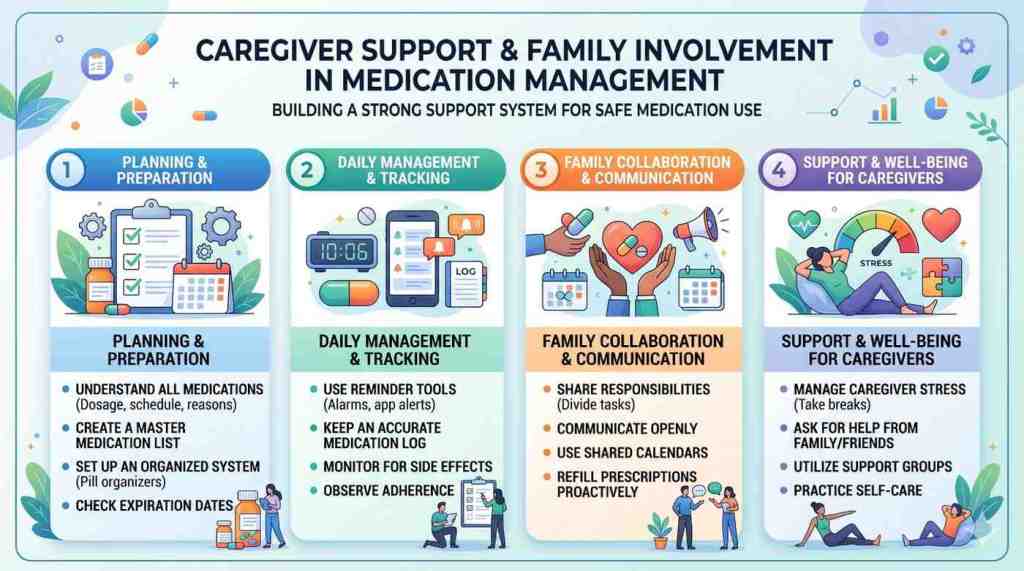
Sometimes the most powerful medicine isn’t found in a bottle, but in the loving support of family members who help organize daily routines. When you’re the adult child checking in on aging parents, your role becomes a gentle partnership that preserves dignity while providing essential help.
Family involvement works best as a collaboration, not a takeover. This might mean organizing weekly pill boxes together or being the person your parent calls when they’re confused about a new prescription. Respecting their independence creates trust.
Getting formal access to health information (with permission) allows you to follow up with providers and spot potential issues early. Sharing observations about daily realities—like vision changes or stiff hands—helps doctors design workable treatment plans.
Caregivers can advocate for simpler regimens by asking, “Is there a way to reduce the number of daily doses?” Practical help with reminders, whether through phone calls or shared apps, creates consistent touchpoints. This approach is especially valuable for those managing long-distance caregiving situations.
The emotional support you provide matters just as much as the logistical help. Knowing someone cares and will help problem-solve reduces the isolation that often derails treatment consistency. Your presence becomes their safety net.
Practical How-To Guide: Step-by-Step Medication Management
Imagine transforming medication chaos into a peaceful daily rhythm that actually works with your parent’s real life. This isn’t about creating perfect systems on paper, but building routines that fit naturally into their world.
Creating a Personalized Medication Schedule
Start by gathering every prescription, vitamin, and supplement. Create one master list with dosages and purposes. This clarity is the foundation of good management.
Map out when each pill should be taken around daily anchors like meals or favorite TV shows. Use a simple chart showing morning, afternoon, evening, and bedtime slots.
Consider which treatments need food or empty stomachs. Build these requirements into the schedule. This turns constant decision-making into one smooth routine.
Invest in a quality weekly pill organizer with clear compartments. Filling it together becomes a ritual that ensures accuracy. It provides a visual check of what’s been taken.
Keep the schedule visible on the refrigerator with emergency contacts. Update this personalized plan whenever medications change. Share copies with all caregivers so everyone follows the same playbook.
Utilizing Reminder Tools and Digital Solutions
Technology now offers quiet companions that transform medication management from a chore into a supported routine. These tools provide gentle prompts exactly when needed, reducing the mental burden of remembering complex schedules.
Simple devices like pill containers with built-in alarms beep or flash at dose times. They offer a non-judgmental nudge without requiring smartphone skills or tech comfort.
For those comfortable with technology, mobile applications provide customizable alerts and tracking. These apps can notify family members about missed doses, creating a safety net for consistent medication use.
Some pharmacy services now offer prepackaged daily pouches labeled with dates and times. This eliminates sorting confusion and makes taking medications crystal clear.
For individuals who prefer traditional phones, JoyCalls provides warm, human-like check-ins through their regular landline. This AI companion offers medication reminders and friendly conversation without any technology learning curve.
The key is choosing tools that match personal comfort levels and daily habits. The best reminder system is the one that will be used consistently, supporting better treatment adherence through thoughtful design.
Accessing Resources and Assistance Programs
Did you know there are hidden resources that can dramatically reduce prescription expenses? Many people struggle with treatment costs without realizing help is available. These programs exist specifically to make essential health care more affordable.
Financial barriers shouldn’t prevent anyone from getting the care they need. Assistance programs can transform overwhelming costs into manageable expenses.
JoyCalls Signup and Additional Support Options
Beyond financial help, comprehensive support services address daily management challenges. Combining cost assistance with practical reminders creates a complete safety net.
| Resource Type | Key Benefits | Best For |
|---|---|---|
| NeedyMeds | Free cost reduction programs | Finding hidden assistance |
| GoodRx | Immediate pharmacy discounts | Quick savings without enrollment |
| Benefits CheckUp | Multiple program matching | Comprehensive benefit discovery |
“The right combination of financial assistance and daily support can transform treatment from a burden into a manageable routine.”
JoyCalls provides gentle medication reminders through regular phone calls. This service works alongside cost assistance programs to address both financial and practical barriers. The benefits include peace of mind for families and consistent support for older adults.
Easy access to these resources begins with a simple search or JoyCalls signup. Combining assistance creates sustainable health management that preserves independence and quality of life.
Evidence-Based Interventions and Research Insights
Recent studies have uncovered powerful insights about what really works when it comes to supporting consistent treatment plans. The research gives families confidence that certain approaches deliver measurable improvements.
Key Findings from Recent Studies
A major analysis revealed that well-designed support strategies have a meaningful impact. The average effect size was 0.500, showing medium but significant results for health outcomes.
The most effective approach combined personal meetings with ongoing telephone support. This method achieved an impressive effect size of 1.222, demonstrating how connection and follow-up create strong results.
Educational programs based on understanding personal health risks also showed strong effects. However, education or remote counseling alone weren’t as effective without personalization.
These findings confirm that tailored strategies addressing individual barriers make the real difference. The research provides clear guidance for achieving better health outcomes through evidence-based methods.
When implemented correctly, these interventions translate into improved quality of life for older adults. Patients experience fewer complications and maintain greater independence through consistent treatment.
How to Build a Medication Routine That Seniors Can Actually Stick To
Medication adherence often gets treated like a memory issue, but in real life, it is usually a routine design issue. Many seniors do not miss doses because they do not care. They miss them because the routine is too complicated, too fragile, too confusing, or too dependent on doing everything perfectly every single day. That is an unrealistic standard for anyone, especially for older adults managing multiple health conditions, changing energy levels, doctor visits, side effects, and daily life at home.
A medication routine should not feel like a test. It should feel like support. If the system only works on the best days, then it is not a strong system. It needs to work on ordinary days, busy days, low-energy days, travel days, and days when the senior simply does not feel like themselves. That is what makes a routine sustainable.
This is especially important for seniors because medication management is rarely just about one pill at one time. It often involves a web of instructions. Some medicines need to be taken with food. Some need to be taken at the same time every day. Some need to be spaced away from other medications. Some are taken only at night. Others are taken once a week, not daily. Add hearing issues, poor sleep, vision changes, arthritis, forgetfulness, emotional stress, or limited mobility, and even a well-intended routine can start to fall apart.
That is why the smartest approach is not simply reminding seniors more often. It is creating a medication system that fits naturally into how they already live. A good routine reduces thinking, reduces friction, and reduces the number of chances for something to go wrong. It respects independence while making success easier.
Start With the Real Day, Not the Ideal Day
One of the biggest medication mistakes families make is designing routines around an ideal version of the day instead of the one the senior actually lives. On paper, it may sound simple to take one pill at 8 a.m., another at noon, another at 4 p.m., and another at bedtime. But what if the senior sleeps late, skips lunch, naps unexpectedly, watches television at bedtime, or has caregivers coming at changing times? The more the plan depends on a perfect schedule, the more likely it is to break.
A better approach is to map the real daily rhythm first. Before changing anything, look at what the senior already does consistently. For example:
- waking up and brushing teeth
- morning tea or coffee
- breakfast
- the daily newspaper
- afternoon rest
- evening television
- preparing for bed
These are called anchors. Anchors matter because habits stick better when they are attached to something familiar. A medication routine that is connected to stable habits is often easier to maintain than one built only around exact times on the clock.
For example, instead of saying, “Take this at 8:00 a.m.,” it may be more practical to say, “Take this after breakfast.” Instead of “Take this at 9:00 p.m.,” it may work better as, “Take this when you put on your night clothes.” These anchors reduce mental effort and help the routine survive even when the exact timing of the day shifts a little.
This does not mean medical timing instructions should be ignored. Some medications truly do need closer timing consistency. But even then, the routine should be designed around the senior’s real life as much as possible, not around a rigid system that looks neat but is difficult to follow.
Simplify the Routine Before Adding More Tools
When medication adherence becomes difficult, people often respond by adding more: more reminders, more alarms, more charts, more instructions, more check-ins. Sometimes that helps. But sometimes the real answer is not adding more. It is simplifying what already exists.
A complicated routine creates hidden failure points. If a senior has to read tiny labels, remember several different times, separate medications from supplements, take certain pills with specific foods, keep track of refills, and also remember whether each dose was already taken, that is not a memory issue alone. It is a system burden issue.
This is why medication routines should be reviewed regularly with one simple question: What can be simplified safely?
That conversation may lead to practical changes such as:
- asking whether medications can be taken at the same time
- requesting once-daily alternatives where medically appropriate
- asking if non-essential supplements are making the routine harder
- checking whether the schedule can be adjusted to fit meals better
- using combination medications if prescribed and suitable
- aligning refill dates to reduce confusion
These changes may sound small, but they can dramatically improve adherence because they reduce cognitive load. The easier it is to understand the routine, the easier it is to stick to it.
Make Every Medication Easy to Identify
Confusion often begins with the bottles themselves. Many seniors are dealing with containers that look alike, names that sound alike, and labels that are difficult to read. If a person has poor vision or shaky hands, the problem grows even larger. A routine cannot be reliable if the basic act of identifying the medication already feels stressful.
That is why visual clarity is such an important part of adherence. Every effort should be made to help seniors immediately recognize what each medication is, when it should be taken, and what role it plays.
Some helpful strategies include:
- using large-print medication lists
- asking the pharmacy for bigger labels if available
- using color-coded stickers for times of day
- organizing medications by routine rather than by bottle type
- placing only current medications in the active daily area
- keeping outdated or discontinued bottles completely separate
Another effective tactic is to write a plain-language purpose next to each medication on the medication list. For example:
- blood pressure
- sugar control
- pain relief
- thyroid
- sleep
- heart
This helps seniors connect the medication to its meaning, not just its name. That connection often improves consistency because people are more likely to take medications correctly when they understand what each one is for.
Build a Routine That Respects Energy Levels
Not all medication challenges are about memory. Some are about energy and motivation. Seniors may technically remember a dose but delay it because they feel tired, overwhelmed, unwell, or emotionally drained. Over time, “I’ll do it in a minute” becomes “I forgot.”
This is why routine design should take energy patterns seriously. Many older adults have stronger focus and energy at certain times of day and lower capacity at others. A medication plan that requires too much effort during low-energy hours may be difficult to sustain.
It helps to notice questions like:
- When does the senior seem most alert?
- When do they seem most tired or distracted?
- Are evening medications being missed more often?
- Does the person struggle more when in pain or after naps?
- Are certain parts of the day consistently rushed?
These patterns can reveal why a routine is not sticking. Once identified, the routine can often be redesigned. Evening medications may need a stronger cue. Morning doses may need to be placed closer to breakfast materials. Bedtime medication may need to be paired with a lamp, glasses, and water so the final step feels easy rather than tiring.
Medication adherence improves when the system works with the person’s energy, not against it.
Involve Seniors in the Design, Not Just the Following
A medication routine is far more likely to succeed when the senior has ownership of it. Too often, routines are created around older adults rather than with them. Family members, caregivers, or clinicians may decide what should happen without fully understanding what the senior finds confusing, frustrating, or unrealistic.
That can lead to resistance that gets misread as stubbornness. In reality, the routine may simply not feel manageable or respectful. Seniors are more likely to follow a plan when they helped shape it.
Useful questions to ask include:
- What part of this routine feels hardest?
- Which medicines are easiest to remember?
- What time of day feels most confusing?
- Would you rather use a checklist, pill box, or reminders?
- What would make this feel simpler?
- Do you want help, or do you want more independence with a safer system?
These questions do more than improve logistics. They preserve dignity. They signal that the senior is not just a patient being managed, but a person whose preferences matter. That emotional difference is important. People support what they help create.
Create Routines for Weekends, Visitors, and Disrupted Days
Many medication plans work reasonably well Monday through Friday and then start slipping during disruptions. That is because the routine was built for normal days only. But real life includes holidays, overnight guests, doctor visits, religious gatherings, family outings, travel, and days when the schedule changes completely.
A strong adherence plan accounts for this ahead of time.
This can be done by identifying common disruptions and deciding what the backup version of the routine will look like. For example:
- If breakfast is late, where does the morning medication shift?
- If a senior leaves the house early, what needs to be packed?
- If there is an all-day hospital visit, who is responsible for checking medication timing?
- If family visits and the day becomes noisy, what reminder should stay in place?
- If the senior sleeps somewhere else in the house, how will nighttime medication still happen?
These questions may sound basic, but they are exactly where medication routines often break. Adherence is rarely lost in theory. It is lost in exceptions. The more exceptions you plan for, the safer the system becomes.
Use “Low-Friction” Supports Instead of Constant Supervision
Seniors often want support, but not constant monitoring. That distinction matters. A good medication system should feel supportive without making the person feel watched all the time.
Low-friction supports are tools or habits that quietly make the routine easier without making the senior feel controlled. Examples include:
- a weekly pill organizer prepared in advance
- a reminder call at the same time each day
- a shared log between family members
- refill synchronization
- placing the medication station near a daily habit zone
- one daily check-in rather than repeated questioning
- a pharmacy-prepared blister pack
These systems reduce risk while preserving autonomy. That balance is especially important because adults are more likely to engage with routines that feel respectful. If the system becomes too intrusive, some seniors may start avoiding help altogether.
Watch for Emotional Barriers, Not Just Practical Ones
Sometimes the routine is clear, the pill box is filled, the labels are readable, and reminders are in place, but doses still get missed. In those cases, the barrier may not be practical. It may be emotional.
A senior may feel discouraged about needing medication in the first place. They may resent what the medications represent. They may feel frightened by side effects, frustrated by dependence, or tired of being reminded that they are managing chronic illness. Some may be grieving the loss of a healthier version of themselves. Others may quietly be dealing with loneliness, depression, or anxiety.
These emotional barriers are easy to miss because they do not look like logistical problems. But they strongly affect adherence.
Signs that emotions may be playing a role include:
- avoidance of medication conversations
- repeated delay without a clear reason
- statements like “I’m tired of all these pills”
- low motivation in other daily self-care tasks
- seeming withdrawn or unusually indifferent about health
When this happens, practical support should be paired with compassionate conversation. Instead of saying, “You keep forgetting,” it is often more helpful to say, “This seems to be getting harder. What does it feel like for you?” That question opens a different kind of door.
Make the Routine Easy for Caregivers Too
Medication adherence systems often fail not just because they are hard for seniors, but because they are difficult for caregivers to maintain consistently. If several family members are involved and nobody knows exactly who checked what, confusion grows quickly. If refill duties, appointment follow-ups, and medication updates are not clearly assigned, errors become more likely.
Caregivers benefit from structure just as much as seniors do. A medication routine should answer:
- who prepares the weekly organizer
- who orders refills
- who attends medication review appointments
- who updates the medication list after changes
- who is the first contact if something seems off
- how missed doses are communicated
Even in caring families, assumptions are risky. One person may think another already handled the refill. Someone may assume the doctor’s office already updated the medication instructions. A caregiver may think the senior understood a medication change when they did not.
A shared system removes guesswork. It also reduces tension because responsibility becomes clearer.
Schedule Medication Reviews Before Problems Build Up
Many medication problems do not begin with a dramatic event. They begin with small confusion that slowly becomes normal. A new pill gets added. A timing instruction changes. An old medication is not fully removed from the routine. A supplement is added without full discussion. Before long, the system is no longer clean and manageable.
That is why medication reviews are so important. They should not happen only after a mistake. They should happen regularly, even when things appear stable.
A helpful medication review can include:
- confirming what medications are current
- checking whether instructions are still understood
- asking which doses are hardest to manage
- reviewing side effects or hesitations
- checking refill timing and pharmacy coordination
- updating the written list
- removing outdated or duplicate information
This kind of review helps keep the routine accurate and workable. It also helps seniors and caregivers speak up before small issues turn into bigger adherence problems.
Practical Actions Seniors and Families Can Take This Week
Improving medication adherence does not require a total overhaul overnight. In most homes, meaningful progress starts with a few focused changes.
Here are high-value actions to take this week:
Create one master medication list
Write down every current medication, dose, purpose, and time. Keep it updated and visible.
Choose one tracking method
Pick either a pill box, a paper checklist, or a digital reminder system. Use one main method consistently.
Identify two strong daily anchors
Connect medication to habits that already happen every day, like breakfast and bedtime.
Review the hardest part of the routine
Ask the senior directly what feels most confusing or tiring.
Set one refill check day
Choose one day each week to check how many pills remain and whether refills are needed.
Prepare for one disruption
Decide what happens if the schedule changes, the senior leaves home, or a meal is delayed.
These steps are manageable, practical, and immediately useful. They also build momentum. Once the routine feels more stable, more improvements can be added if needed.
The Goal Is Not Control. It Is Confidence.
The strongest medication routine is not the strictest one. It is the one that gives seniors and caregivers confidence. Confidence that the right medication can be taken at the right time. Confidence that a missed dose can be handled calmly. Confidence that the system makes sense even on difficult days. Confidence that support is available without taking away dignity.
That confidence changes the entire experience of medication management. Instead of feeling like a daily source of worry, the routine becomes part of a stable life structure. That matters not only for physical health, but for emotional well-being too.
Medication adherence improves when seniors feel supported, when caregivers feel organized, and when the routine itself is designed to succeed in real life. That is what makes it sustainable. And sustainability, much more than perfection, is what protects health over time.
Conclusion
The journey toward consistent health management begins with recognizing the human struggles behind each prescription. As Kelly A. Thompson-Brazill reminds us, “Medications do not work in patients who do not take them.” This simple truth carries profound weight for those managing chronic conditions.
Throughout this guide, we’ve explored how non-adherence stems from real barriers, not carelessness. Financial strain, confusing routines, and physical limitations create daily challenges that deserve compassionate solutions.
You now have practical strategies to support your loved one. Simplifying regimens, improving communication, and leveraging supportive technology can transform overwhelming routines into manageable habits. The most effective approach combines personalized attention with consistent follow-up.
Remember that improving medication adherence is an ongoing process requiring patience and flexibility. By addressing these challenges thoughtfully, you’re protecting independence and ensuring the best possible quality of life for years ahead.
FAQ
What are the most common reasons older adults miss their doses?
How can a complex list of prescriptions be made simpler to follow?
What role do caregivers play in helping with daily health plans?
Are there tools that can help with reminders without needing a smartphone?
How can I talk to a healthcare provider about concerns with my treatment?
Where can I find assistance if the cost of drugs is a problem?

Ana Avila, PhD, is a healthcare and technology writer with deep expertise in artificial intelligence, senior care innovation, and the practical use of AI in healthcare operations. Her work focuses on how emerging technologies can improve the daily experience of older adults, support overburdened care teams, and help senior living communities deliver safer, faster, and more personalized support.
Dr. Avila’s academic background is rooted in health informatics, aging care systems, and applied artificial intelligence. Her doctoral work focused on how digital health tools, predictive analytics, and AI-assisted communication systems can be used to improve care coordination, reduce operational delays, and identify early signs of risk among older adults. Her training gives her a rare ability to understand both the technical side of AI and the human realities of healthcare delivery.
Over the years, Ana has developed a specialized body of work around AI in senior living. She writes about how senior care providers can use intelligent systems to manage resident requests, answer routine questions, support family communication, improve after-hours coverage, and detect patterns that may indicate loneliness, confusion, distress, or unmet needs. Her articles often examine the gap between what senior living teams are expected to deliver and what traditional staffing models can realistically support.
Ana’s healthcare expertise is especially focused on the operational side of care. She has written extensively about call handling, resident engagement, front desk workflows, triage systems, caregiver communication, care escalation, and the hidden administrative burden placed on senior living staff. Her work explains how AI can help reduce repetitive tasks, organize incoming requests, prioritize urgent issues, and give human caregivers more time for meaningful resident interaction.
At the same time, Ana is careful not to present AI as a replacement for human care. A consistent theme in her writing is that technology should support relationships, not weaken them. She argues that the best AI systems in healthcare are not the ones that simply automate the most tasks, but the ones that make care teams more responsive, families more informed, and residents more supported. Her perspective is grounded in the belief that senior living technology must be designed around dignity, trust, privacy, and compassion.
Ana has also written widely on the ethical use of AI in healthcare. Her work discusses the importance of human oversight, transparent escalation rules, resident consent, data minimization, and responsible use of sensitive health and behavioral information. She often emphasizes that AI systems used around older adults must be easy to understand, carefully monitored, and designed with the limitations and needs of real residents in mind, including those with memory loss, hearing challenges, mobility issues, or social isolation.
Her writing has been used as a reference point in discussions about aging, elder care technology, digital health, and AI-supported senior living. She has published 12 papers on journals like JAMA (Journal of the American Medical Association), The BMJ (British Medical Journal), SSRN and more. Some of her articles have also been cited by Wikipedia editors as supporting references on topics related to healthcare, aging, and technology. This has helped position her work as a useful educational resource for readers looking to understand how AI can be applied in real care environments.
In addition to her long-form writing, Ana has contributed research-based commentary, professional explainers, and practical guidance for healthcare operators, senior living decision-makers, and technology teams building products for older adults. Her work combines research literacy with operational practicality. She is able to take complex subjects such as natural language processing, predictive analytics, conversational AI, and care automation, and explain them in a way that is accessible to executives, caregivers, families, and non-technical readers.
Ana’s strongest area of expertise is the intersection of artificial intelligence and senior living operations. She understands that senior care communities face a difficult combination of rising resident expectations, staffing pressure, family communication demands, and increasing care complexity. Her writing explores how AI can be used to ease those pressures through smarter communication systems, faster response workflows, proactive check-ins, and better visibility into resident needs.
Her approach is both evidence-informed and deeply human. She studies AI through the lens of real-world care delivery: whether a resident gets help faster, whether a family member receives a clearer update, whether a caregiver avoids unnecessary administrative work, and whether a senior living team can identify a concern before it becomes a crisis. This practical focus makes her work especially relevant for organizations that want to adopt AI responsibly rather than simply follow technology trends.
Ana Avila is regarded as a thoughtful voice on the future of AI in healthcare and senior living. Her expertise combines academic training, research-driven analysis, operational understanding, and a strong commitment to humane technology. Through her writing, she helps healthcare leaders and senior living communities understand not only what AI can do, but how it should be used to improve care, preserve dignity, and strengthen the human relationships at the center of aging support.