

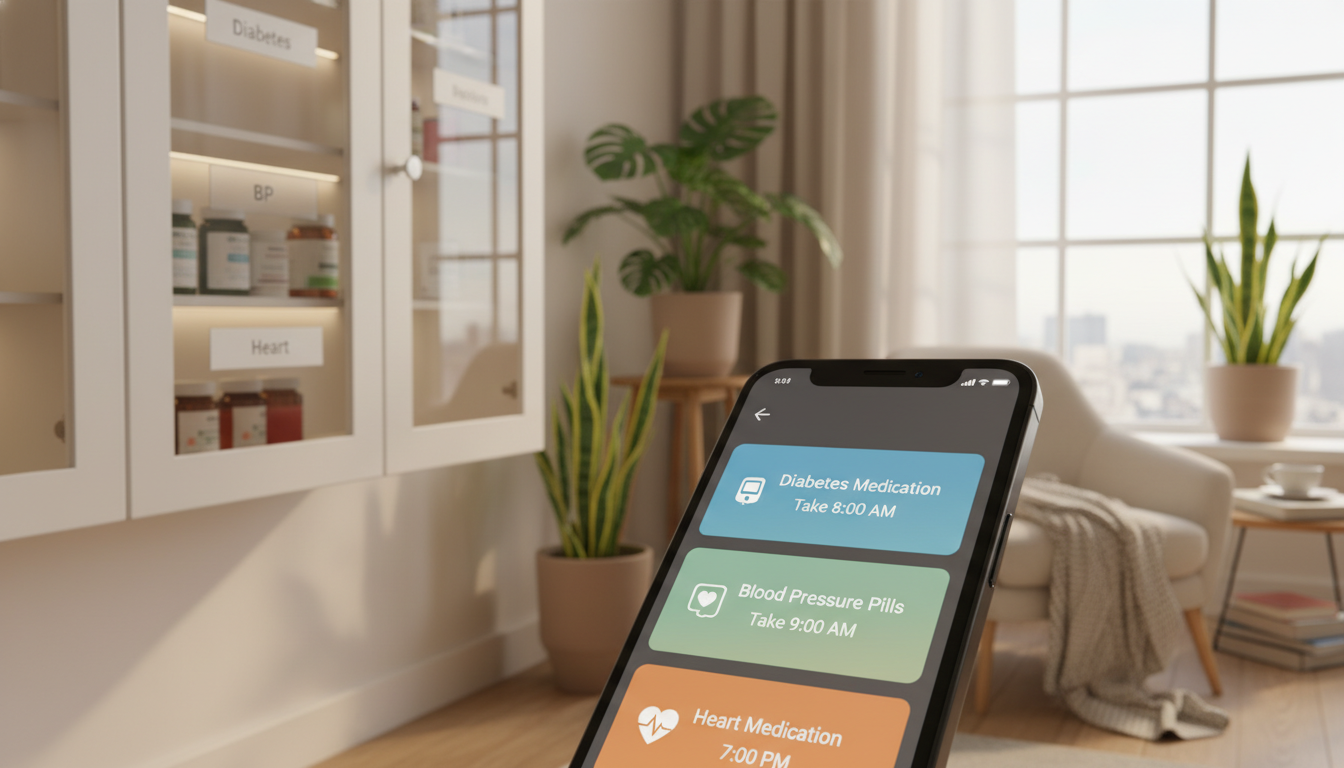
What if the single biggest hurdle to your loved one’s health wasn’t a medical condition, but simply remembering to take their prescribed treatments? It’s a quiet worry that nags at so many families.
Juggling prescriptions for conditions like high blood pressure and heart issues can feel overwhelming. You’re managing your own life while caring from a distance. Missing a single dose can disrupt crucial stability.
The good news is that simple, effective systems exist. Research, including a 2017 study, shows that consistent reminders can dramatically improve adherence. Forgetting can drop from nearly half the time to just 5%.
This guide is about finding practical solutions that fit into real life. We’ll explore tools that bring peace of mind, from visual cues to supportive technologies like compassionate daily check-ins. These aren’t just tips; they are proven systems that stick.
Key Takeaways
- Nearly half of all adults struggle to remember their treatments consistently.
- Simple, daily reminders can drastically reduce missed doses and delays.
- Effective systems are designed to fit seamlessly into existing routines.
- Supportive technology can provide gentle prompts without requiring new skills.
- Creating a reliable system brings significant relief to both caregivers and loved ones.
- Combining different reminder methods often creates the most robust safety net.
- Peace of mind is achievable with accessible and affordable solutions.
Understanding the Importance of Medication Reminders
When multiple conditions require attention, staying on track with treatments becomes a delicate balancing act. Your loved one’s well-being depends on this daily consistency.
Managing Multiple Health Conditions Effectively
Most older adults juggle several prescriptions simultaneously. They might be coordinating treatments for their heart, regulating their blood pressure, and managing blood sugar levels.
This complexity makes it easy to understand how one missed dose can create a domino effect. Research confirms that consistent adherence prevents serious complications.
The reality is genuinely complicated. It’s not about being careless—life gets busy, routines change, and memory naturally shifts with age.
The Role of Reminders in Preventing Missed Doses
Forgetting even one treatment can cause dangerous fluctuations. Blood pressure medications work best when taken at the same time daily.
Effective systems aren’t luxuries—they’re essential health tools. They prevent emergency situations and hospital visits.
When your loved one takes their medications consistently, you both experience less anxiety. Supportive daily check-in systems provide that gentle nudge without requiring new skills.
Understanding why these systems matter helps you prioritize solutions that truly work. It brings confidence in managing health conditions together.
Creating a Personalized Medication Schedule
The secret to a reliable health routine isn’t a complex gadget; it’s weaving essential tasks into the fabric of an ordinary day. A personalized schedule turns stress into simplicity.

This approach respects your loved one’s independence. It provides the gentle structure needed for consistency.
Linking Medications with Daily Routines
Our brains love habits. Linking a pill with morning coffee or the evening news makes remembering to take medications almost automatic.
It becomes part of the rhythm of the day, not a separate chore. This simple connection is powerful for building lasting habits.
Using Checklists for Consistent Tracking
A clear checklist is a game-changer. It takes the guesswork out of each time of day.
Your parent can keep one list on the fridge and another in a purse. This makes it easy to track medications anywhere.
Physically checking off each item provides a sense of accomplishment. It also creates a clear record, eliminating the worry of a double dose.
Creating a personalized medication schedule that works is a thoughtful first step. For added peace of mind, consider a supportive daily check-in system as a friendly backup.
| Checklist Type | Best For | Key Advantage |
|---|---|---|
| Simple Written List | Starting a new routine | Easy to create and understand |
| Laminated Card | Kitchen or bathroom | Durable for daily use |
| Pocket Checklist | On-the-go tracking | Provides information anywhere |
Implementing diabetes medication reminders for Daily Success
Your loved one’s home environment can become their most reliable assistant in maintaining health consistency. Simple placement strategies turn everyday spaces into gentle prompts.

Strategic placement makes all the difference. When essential items live where daily routines happen, remembering becomes automatic.
Try JoyCalls Free
No app or new device needed. Start with a free 7-day trial.
Benefits of Visual and Digital Reminders
Placing a pill bottle on the kitchen counter creates an immediate visual cue. This works because it catches attention at the right moment.
A sticky note on the bathroom mirror serves as a gentle prompt. The home itself does the reminding, which feels respectful.
Digital alerts from smartphones add another layer. They work even when someone leaves for appointments. Research shows this multi-layered approach significantly improves consistency, as detailed in this adherence study.
Establishing a Habit with Timely Cues
Building new routines takes about three weeks. But with the right cues, it becomes automatic. The dining table becomes the perfect place for morning items.
These systems create a safety net that catches forgotten doses. They work together—visual cues at home combined with technology.
For example, combining home-based strategies with remote monitoring creates comprehensive support. Tools like meal and hydration tracking provide additional peace of mind.
| Reminder Type | Best Location | Key Benefit |
|---|---|---|
| Visual Cue | Kitchen counter | Works with morning routine |
| Written Note | Bathroom mirror | Gentle, non-intrusive prompt |
| Digital Alert | Smartphone | Works anywhere, anytime |
| Routine Placement | Dining table | Links with meal times |
Utilizing Technology and Apps for Better Adherence
Technology offers gentle, consistent support that travels wherever your parent goes. The smartphone they already use for calls can become a powerful health assistant.
This approach builds on existing habits rather than creating new ones. It brings peace of mind through accessible digital tools.
Smartphone Calendar and Alarm Features
Start with the features already on their device. The built-in calendar can schedule daily appointments like “9 a.m. Take prescribed treatments.”
Setting a simple alarm takes just minutes. It provides reliable prompts without requiring new skills or equipment.
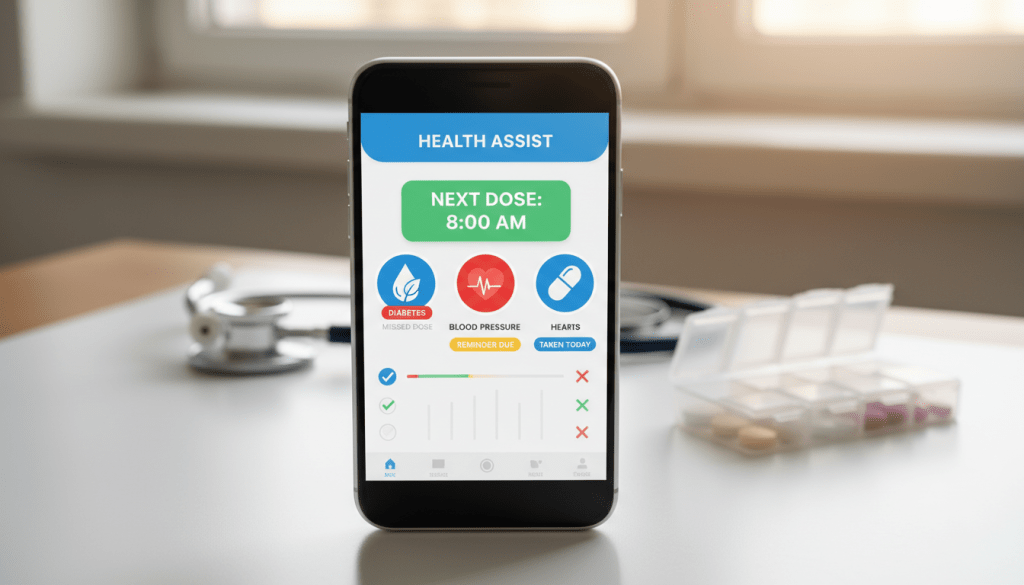
For parents unsure about technology, beginning with basic alarms builds confidence. The phone becomes a helpful companion that reminds at the right time.
Popular Medication Reminder Apps and Their Advantages
Specialized apps like Medisafe offer advanced features. They can send you a text alert if a dose is missed.
This creates an extra safety net when you can’t be there. The Medisafe app has excellent ratings—4.7 stars on iOS and 4.6 on Android.
Research confirms these tools work effectively. A 2019 study found significantly better adherence after three months of use.
Other well-reviewed options include Round Health and Dosecast. Many are free or affordable, requiring no additional equipment.
These apps track when treatments were taken, creating helpful records. They work alongside compassionate support systems like AI companionship services.
Smart Strategies for Organizing Your Medications
Running out of a critical prescription is a fear that keeps many family caregivers awake at night. But with a few smart organizational strategies, you can create a system that prevents those anxious moments.
It’s about building a safety net that works quietly in the background. This brings immense peace of mind for everyone involved.
Choosing the Right Pill Organizer
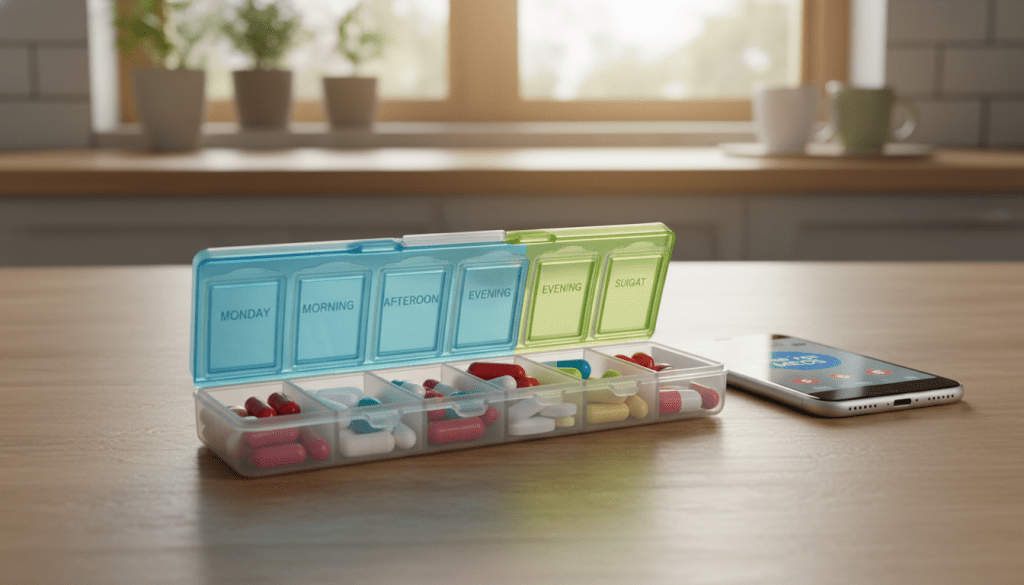
A simple pill organizer can eliminate daily confusion. Instead of fumbling with multiple bottles, your parent sees exactly what they need to take.
Spend a little time each week filling the pillbox. This small effort makes the entire week smoother. They simply grab the correct day’s compartment.
For more complex routines, consider an organizer with multiple daily slots.
- Morning, noon, evening, and bedtime compartments keep everything sorted.
- The empty slots provide a clear visual record of what has been taken.
- More advanced options with built-in alarms can hold a larger supply.
Setting Up Automatic Pharmacy Refills
Never worry about an empty bottle again. Most local pharmacy locations offer free automatic refills.
You simply set it up once. The pharmacy will then call or text when the refill is ready for pickup.
Some services even deliver the supply directly to your loved one’s home. This proactive management is a game-changer.
It ensures a continuous flow of essential medications. This simple step protects their health and your peace of mind.
Building a Backup Plan for Real Life: What Seniors Should Do When the Routine Breaks
A reminder system works best when life is calm and predictable. But real life is rarely that neat. A doctor’s appointment runs late. A grandchild visits. Breakfast happens two hours later than usual. A refill is delayed. A pill causes nausea, so it gets skipped “just for today.” Then one missed dose becomes a pattern.
This is where many medication routines quietly fall apart. Not because the person forgot how important their treatment is, and not because they do not care. Usually, it happens because the routine was designed only for ideal days. For older adults managing diabetes, blood pressure, or heart medications, the more reliable approach is to build a system that can survive imperfect days too.
That is the difference between a reminder and a real medication strategy.
A reminder tells someone when to take a pill. A good backup plan tells them what to do when the normal routine changes. It reduces panic, guesswork, and risky decisions. It also protects independence. Seniors often do much better when they have a clear plan they can follow confidently, instead of feeling they need to ask for help every time something changes.
This section is about creating that backup plan in a practical, calm, and easy-to-follow way.
Why routines fail even when intentions are good
Most medication mistakes do not come from laziness or carelessness. They come from friction. Something small gets in the way, and there is no clear next step.
Common examples include:
- Waking up later than usual and not knowing whether the morning dose should still be taken
- Feeling dizzy or nauseous and deciding to skip a medication without guidance
- Eating at a different time and becoming unsure about medicines linked to meals
- Leaving the house and realizing the day’s pills were left at home
- Running low on medication and trying to “stretch” the remaining tablets
- Receiving a new prescription and becoming confused about what replaces what
- Coming home from a hospital stay with changes that do not match the old pillbox
- Forgetting whether a dose was already taken and being afraid of taking it twice
These are not unusual situations. They are normal, everyday disruptions. The safest system is one that assumes they will happen and prepares for them ahead of time.
The goal is not perfection. The goal is fewer risky moments.
Seniors and caregivers often put too much pressure on “never missing a dose.” Of course consistency matters, but the better mindset is this: create a system that reduces confusion, prevents double dosing, and makes it easy to recover from mistakes quickly.
That is a more realistic standard. It is also far less stressful.
Instead of asking, “How do we make sure this never goes wrong?” ask:
- What should happen if breakfast is late?
- What if we are out for the day?
- What if a refill is not ready?
- What if a pill causes discomfort?
- What if we are not sure whether it was taken?
When these answers are written down in advance, the entire routine becomes steadier.
Create a “What If” Medication Sheet
One of the most useful tools for seniors is a simple one-page sheet titled: What If Something Changes?
This does not need to be complicated. In fact, it works best when it is short, visible, and written in plain language.
It can be kept:
- on the refrigerator
- inside the medication drawer
- in the senior’s handbag or wallet
- next to the pill organizer
- as a photo saved on a phone
What to include on this sheet
Each medication does not need a long explanation. The goal is to answer the situations most likely to cause confusion.
Use a format like this:
Medication name:
Usual time:
Take with food or without food:
What to do if breakfast/lunch/dinner is delayed:
What to do if a dose is missed:
What to do if side effects show up:
Who to call with questions:
When not to guess and call the doctor or pharmacist immediately:
This sheet should be prepared with input from the prescribing doctor or pharmacist, especially for medications that have special timing instructions.
The real power of this tool is emotional. It gives older adults something concrete to follow instead of relying on memory when they are tired, anxious, or distracted.
Set rules for the four situations that cause the most errors
Not every possible situation needs a response plan. Start with the ones that create the most trouble.
1. “I’m not sure if I already took it.”
This is one of the most common and dangerous moments, especially for seniors taking several medications.
The first rule should always be: do not guess.
If someone cannot remember whether they took a dose, the next steps should be clearly defined in advance. This is exactly why visual systems matter so much.
Helpful safeguards include:
Use a pill organizer that shows empty vs. full compartments
This creates immediate visual proof. If the morning slot is empty, the medication was likely taken. If it is still full, it likely was not.
Mark doses as soon as they are taken
Not ten minutes later. Not after breakfast. Right away. A small paper checklist or magnetic whiteboard can help.
Keep medication in one main location
If pills are sometimes taken at the dining table, sometimes in the bedroom, and sometimes from a handbag, memory becomes less reliable. One stable location reduces uncertainty.
Use a “taken today” signal
Some seniors do well with a simple flip card, sticky tab, or dry-erase board that says:
- Morning meds taken
- Evening meds taken
This is especially helpful for people who do not want to rely on smartphone apps.
2. “My routine is off today.”
Late wake-ups, family visits, religious events, travel, appointments, or poor sleep can all interrupt timing.
What older adults need here is not a lecture about being consistent. They need a safe fallback routine.
A practical approach is to divide medicines into categories on the medication sheet:
- Must stay close to the usual time
- Has a small time window
- Can be taken later if the day gets off track
That way, if a senior wakes up late, they do not stare at five pill bottles wondering what to do. They already know which ones need more careful timing and which ones are flexible.
This is especially important for people managing both blood sugar and heart or blood pressure treatments, because mealtimes, symptoms, and energy levels can shift from day to day.
3. “This medication makes me feel bad.”
A lot of nonadherence starts here. The senior may not stop the medication forever. They may simply skip it because it caused dizziness, upset stomach, frequent urination, fatigue, or discomfort at an inconvenient moment.
The mistake is often silence. They do not tell anyone. They just quietly avoid it.
The better system is to normalize reporting discomfort early.
Create a rule like this:
- Do not stop a medication on your own unless a clinician has already told you to do so in that exact situation.
- If something feels off, write down what happened and when it happened.
- Contact the pharmacist or doctor’s office the same day if the side effect is new, repeated, or worrying.
A simple symptom log can help:
Medication:
Time taken:
What was eaten:
Symptom:
How long it lasted:
Did it happen before?:
This turns vague discomfort into useful information. It also helps the doctor decide whether the problem is the medication itself, the timing, food intake, hydration, or an interaction.
4. “I’m running low.”
This problem often announces itself quietly. A few pills are left. The refill is not requested. The pharmacy is closed over the weekend. Then doses get rationed.
Older adults should never be put in a position where they feel they need to make the remaining supply “last.”
A good rule is simple: refill when there is at least 7 days left, not 2 days left.
That buffer creates room for:
- delivery delays
- out-of-stock issues
- insurance delays
- a need for doctor approval
- forgotten pickup
Some seniors benefit from a weekly “supply check” built into the same day the pill organizer is filled. This can be as simple as asking:
- Do we have enough for next week?
- Are any bottles below one-third full?
- Does anything expire soon?
That small weekly check prevents far more stress than last-minute problem solving ever will.
Prepare for the three transition moments that disrupt medication habits

Some periods are more dangerous than others because routines are being reset. These moments deserve special attention.
After a doctor’s appointment
A doctor visit can change everything in one sentence:
“Stop this one.”
“Take half now.”
“Move this to bedtime.”
“Start this new tablet tomorrow.”
The problem is that seniors often leave the appointment with verbal instructions but no updated home system.
The fix is immediate reconciliation.
As soon as the appointment ends:
- Review every medication on the current list
- Mark what stays the same
- Cross out what was stopped
- Add what is new
- Update the pill organizer only after the list is corrected
- Remove outdated bottles from the active medication area
Do not leave old and new instructions sitting side by side. That is how double dosing and confusion start.
After a hospital stay or emergency visit
This is one of the highest-risk moments for medication mistakes.
People often come home with:
- changed dosages
- temporary medications
- discontinued medications still sitting in the cabinet
- discharge paperwork that is hard to read
- follow-up instructions that were only partly understood
The first 24 hours at home matter. Before returning to the old routine, someone should compare:
- the pre-hospital medication list
- the discharge paperwork
- what is physically at home in bottles and pillboxes
Anything unclear should be confirmed with the hospital team, primary care office, cardiologist, endocrinologist, or pharmacist before the next fill cycle.
During travel or overnight stays
Even one night away can disrupt the rhythm of medication management.
For seniors, travel medication planning should be simple and repetitive.
Create a travel checklist:
- Pack enough medication for the full trip plus 2 to 3 extra days
- Carry medicines in the bag that stays with the person, not in checked luggage
- Bring a current medication list
- Pack a small water bottle if allowed and appropriate
- Set alarms that still match the local time plan
- Keep the day’s doses separate and accessible
- Never rely on memory while traveling
For short trips, a labeled daily pouch can work well. For longer trips, use the regular organizer rather than a loose collection of bottles.
Make meal-linked medications easier to manage
Many seniors do not forget medication itself. They get confused because the medication is tied to food, and meals do not happen at exactly the same time every day.
This can become especially stressful for people with diabetes or for adults whose appetite changes due to age, illness, or other medications.
The solution is not just “take it with meals.” That is too vague.
Instead, define what a meal-linked routine actually means in that home.
For example:
- What counts as breakfast on a low-appetite morning?
- What happens if lunch is skipped?
- What happens if dinner is much later than usual?
- Should the medication be taken with the first few bites, right after eating, or at another specific point according to instructions?
These details should come from the prescribing team, but once confirmed, they should be translated into plain language for the senior.
That way, the person is not trying to interpret medical instructions in the middle of a disrupted day.
Reduce decision fatigue by simplifying the environment
Older adults often do better when the system asks them to make fewer choices.
Medication management becomes harder when the environment creates too many mini-decisions:
Where are the pills?
Was I supposed to take this before food?
Did I already check the box?
Which bottle is the new one?
Should I take it now or wait?
Each extra decision increases the chance of delay or avoidance.
To reduce decision fatigue:
Keep only active medications in the main medication area
Move discontinued, expired, or occasional-use medications elsewhere.
Use large-print labels where possible
If the bottle text is hard to read, confusion rises quickly.
Create a consistent “medication station”
This can include:
- pill organizer
- written medication list
- pen
- checklist
- water
- reading glasses
Use the same sequence every day
For example:
- Sit down
- Check the schedule
- Open the correct compartment
- Take medications
- Mark them as taken
- Put everything back
A repeated sequence lowers mental effort and increases follow-through.
Build a calm response plan for mistakes
Even with a strong system, mistakes can still happen. The safest households are not the ones with zero mistakes. They are the ones that know how to respond calmly.
Write down a short response guide:
If a dose is missed
Follow the doctor’s or pharmacist’s instructions for that medication. Do not invent a catch-up plan.
If a double dose may have happened
Call the pharmacist, prescribing office, or emergency line appropriate to the situation right away.
If symptoms appear after taking medication
Write down what happened and get clinical guidance promptly if the symptom is serious, new, or worsening.
If there is confusion after a medication change
Pause the refill box setup until the medication list is clarified.
The key principle is this: confusion is a reason to verify, not to guess.
Give seniors language that protects their independence
How this section is framed matters. Many older adults resist systems that feel controlling. But most appreciate tools that help them stay confident and self-directed.
So instead of saying:
- “You need someone to check on you”
say: - “Let’s make this easier to manage on your own”
Instead of:
- “You keep forgetting”
say: - “Let’s build a backup plan for busy days”
Instead of:
- “This is too complicated”
say: - “We can simplify this so it feels more manageable”
That small shift in language preserves dignity. It also makes people much more willing to use the system.
A practical weekly reset that keeps everything on track
If you want one habit that has the biggest payoff, make it this: a 15-minute weekly medication reset.
Choose the same day each week. Then do the following:
Weekly Medication Reset Checklist
Review the next 7 days
Look at appointments, outings, fasting needs, visitors, and any routine changes.
Fill or review the pill organizer
Check each compartment carefully.
Count remaining supply
Flag anything running low.
Confirm no medication changes were missed
Especially after recent appointments.
Check the reminder system
Are alarms still on? Is the checklist current? Is the written schedule still accurate?
Prepare for one likely disruption
For example:
- an early appointment
- a dinner out
- a weekend away
- a delayed breakfast
This weekly reset is what turns medication management from reactive to steady.
The strongest reminder system is the one that still works on a messy day
That is the real standard.
Not whether the routine looks perfect on paper. Not whether the app is advanced. Not whether the pillbox is color-coded beautifully.
The strongest system is the one that still works when the senior wakes up late, feels off, has company over, leaves home unexpectedly, or gets new instructions after an appointment.
That is the system that protects health in the real world.
And for older adults managing diabetes, blood pressure, or heart medications, that kind of practical reliability matters far more than complexity ever will.
A caring medication routine is not built on pressure. It is built on clarity, backup options, and calm next steps. Once those are in place, seniors feel less overwhelmed, caregivers feel less anxious, and daily treatment becomes much more sustainable.
Incorporating Support Systems and Accountability
Sometimes the most powerful reminder system isn’t a device, but a caring voice asking ‘Did you remember to take your treatments today?’ Building a network of support creates both accountability and connection.
Engaging Family or Friends for Reminder Support
Ask a trusted family member or neighbor to help with gentle check-ins. Share your treatment schedule with them.
This creates natural accountability without feeling like constant monitoring. A quick text or phone call can make all the difference.

Leveraging Community and Online Tools
Some app options can alert a family member via email if a dose is missed. This provides an immediate safety net.
JoyCalls offers something special—a friendly AI companion that calls your parent’s home phone. No app or new device is needed.
Your loved one simply answers and has a warm conversation that includes gentle prompts. You receive email summaries for peace of mind.
This combines human connection with reliable support. It’s like having a compassionate daily check-in system that respects independence.
Tips for a Seamless Transition to Effective Medication Routines
Building lasting health routines starts with creating an environment that naturally supports consistency. The goal is to make remembering to take medications feel effortless rather than like another chore on the to-do list.
Optimizing Your Daily Environment for Reminders
Start by identifying the specific times of day when your parent tends to forget. Focus your efforts there first. For example, if mornings are challenging, create a dedicated spot on the kitchen counter.
This becomes the go-to place for their daily routine. Keep in mind that small changes work better than complete overhauls. A simple note card by the coffee maker can make it easy to remember take what’s needed.
When leaving the home, prepare a small daily container they can carry along. This ensures they can take medication consistently throughout the day. The key is removing barriers so taking medication becomes the simplest choice.
Be patient during this adjustment period. It takes time for new habits to feel natural. Work together on your guide to medication management, making your parent feel involved rather than managed.
Soon, these routines become second nature. Both of you can rest easier, knowing essential medications are taken consistently. This peace of mind reduces stress and strengthens your connection, much like the support found in addressing retirement loneliness.

Simplify the Medication Routine Before It Becomes Overwhelming
For many seniors, the real problem is not motivation. It is not carelessness either. The real problem is that the medication routine slowly becomes too complicated to manage comfortably.
One tablet is taken before breakfast. Another is taken after breakfast. One must be taken at the same time every day. Another may need to be adjusted after a doctor visit. A refill gets changed from one brand to another, and suddenly the pill looks different. A cardiologist says one thing, the family doctor says another, and the pharmacist adds another layer of instructions. Over time, even a very responsible person can start to feel uncertain.
That uncertainty is important to pay attention to.
Because the moment a medication routine starts feeling confusing, frustrating, or mentally tiring, the risk of missed doses goes up. So does the risk of taking something incorrectly, delaying a refill, ignoring side effects, or quietly skipping a medicine that feels difficult to manage.
This is why the best long-term medication system is not just built around reminders. It is built around simplicity.
A strong reminder tells someone when to take their medicine. A strong overall system makes the medicine routine easy enough to follow in the first place.
That is a major difference.
For seniors managing diabetes, blood pressure, and heart medications, simplification is not about cutting corners. It is about reducing the mental load of treatment so that consistency becomes more realistic, safer, and less stressful.
And in many cases, there is more room to simplify than people realize.
Why medication routines become complicated so quickly
Medication management rarely becomes overwhelming all at once. It usually happens gradually.
A new prescription gets added after a checkup.
A dose is changed after lab work.
A medicine gets moved from morning to night.
One specialist adds something temporary, but it stays on the list longer than expected.
An older prescription is technically discontinued, but the bottle remains in the cabinet.
The person starts relying on memory because the written list is outdated.
None of these changes sounds dramatic on its own. But together, they create friction.
That friction shows up in ways like:
- “I know I take it, but I’m not sure when anymore.”
- “I have too many bottles and I don’t know which ones are current.”
- “This one looks different from last month.”
- “I take some with food, but I’m not sure which ones.”
- “The doctor changed something, but I forgot to update my organizer.”
- “I’m doing my best, but it’s getting harder to keep track.”
When a senior starts saying things like this, that is not a small issue. It is a signal that the system needs to be simplified before adherence slips further.
The goal is not just remembering more. It is managing less confusion.
A lot of medication advice is built around memory. Set an alarm. Use a pillbox. Put a sticky note by the kettle. All of that can help, but it only solves one part of the problem.
Sometimes the bigger issue is not memory. It is complexity.
If a person has to stop and think through every medication every day, the routine becomes mentally expensive. And mental fatigue affects adherence just as much as forgetfulness does.
A better question to ask is:
How can this routine become easier to understand, easier to repeat, and easier to trust?
That shift leads to smarter decisions, such as:
- grouping doses more logically where medically appropriate
- making instructions easier to read
- creating one up-to-date medication list
- reviewing whether every current medicine is still necessary
- making sure every clinician involved is working from the same information
- removing outdated bottles and duplicate information
- replacing vague verbal instructions with plain-language written guidance
This kind of work may sound small, but it is often what makes the biggest difference for older adults.
Start with a full medication review at home
Before anyone tries to improve adherence, they need a clear picture of what the senior is actually managing.
That means gathering everything in one place.
Not just the medicines used every day. Everything.
This includes:
- prescription medications
- insulin or injectable medicines if applicable
- over-the-counter items
- aspirin if taken regularly
- vitamins and supplements
- occasional “as needed” medications
- older bottles that may still be sitting in the medicine area
- blister packs, sample packs, and duplicate refills
Spread them out on a table and review them carefully.
The purpose of this exercise is not to create alarm. It is to see the real system, not the imagined one.
Questions to ask during the review
Go through each item and ask:
- Is this still being taken?
- Is this taken daily, occasionally, or no longer at all?
- What is this for?
- When is it supposed to be taken?
- Did a doctor recently change the dose?
- Does the label match what the person is actually doing?
- Does this still belong in the active medication area?
- Is there more than one bottle for the same medication?
- Is there any confusion about whether it was stopped or continued?
This process often reveals problems quickly.
It may show that:
- an old prescription is still mixed in with active ones
- the senior is following outdated instructions
- one doctor’s update never made it into the routine
- the person does not actually know what a medication is for
- there are too many medications being handled in too many places
Once this becomes visible, it becomes much easier to fix.
Create one master medication list and make it the only version that matters
One of the simplest and most powerful things a senior can have is a clear master medication list.
Not three versions. Not one half-updated list in the drawer and another one in a hospital folder.
One clean, readable list.
This list should include:
- medication name
- purpose in plain language
- dose
- time taken
- whether it should be taken with food
- special instructions
- prescribing doctor if relevant
- pharmacy phone number
- allergies
- emergency contact
The most important part is this: the list should be written in a way that the senior can actually use.
That means plain language.
For example:
Instead of:
Metoprolol succinate ER 50 mg once daily
Write:
Metoprolol 50 mg – for heart/blood pressure – take 1 tablet every morning
Instead of:
Take BID with meals
Write:
Take 1 in the morning with breakfast and 1 in the evening with dinner
The list does not have to sound clinical. It has to be clear.
Where to keep the master list
Keep copies:
- near the medication station
- in a wallet or purse
- in a caregiver’s phone as a photo
- in a hospital folder for appointments
- in the senior’s phone if they use one
If the list changes, all copies should be updated.
That one habit prevents a great deal of confusion.
Ask the most useful question at every doctor’s visit: “Can this be simplified?”
Seniors and caregivers often go to appointments focused on diagnosis, symptoms, test results, and refills. All of that matters. But when medication adherence is hard, one especially important question deserves to be asked regularly:
“Can this routine be simplified safely?”
That question opens the door to useful discussions such as:
- Can any doses be timed more conveniently?
- Are there medications that may no longer be necessary?
- Can the schedule be made easier to follow?
- Can instructions be aligned better with the senior’s daily routine?
- Are there combination medications that might reduce pill burden?
- Is there a safer or simpler way to take these medicines given the person’s age, memory, appetite, or daily life?
Not every routine can be streamlined dramatically. But many can be improved at least a little. And those small improvements matter.
For example, a system that goes from “four separate medication moments per day” to “two clearer medication times” may suddenly become much easier to maintain consistently.
That kind of simplification can do more for adherence than adding another reminder ever could.
Help seniors understand what each medication is for
Many older adults take their pills faithfully without really knowing what each one does. That may seem acceptable on the surface, but it creates problems later.
When a senior does not understand the purpose of a medicine, they are more likely to:
- skip it when they feel fine
- stop it if it seems inconvenient
- confuse it with another medication
- underestimate the importance of timing
- feel frustrated by the number of pills they take
Understanding creates meaning. Meaning improves consistency.
The explanation does not have to be complex.
A clear, respectful version works best:
- “This one helps protect your heart.”
- “This one helps keep your blood pressure steady.”
- “This one supports your blood sugar control.”
- “This one helps reduce strain on your system over time.”
When seniors know why a medication matters, it feels less like random compliance and more like active self-care.
That emotional shift is important.
Watch for “silent confusion” after pill appearance changes
One very common but often overlooked problem is when a refill looks different.
The tablet changes color.
The shape is different.
The bottle has a new label style.
The pharmacy switched manufacturers.
The senior becomes unsure whether this is really the same medicine.
Some older adults ask right away. Others do not. They simply become cautious, delay taking it, or assume something changed when it did not.
That is why seniors and caregivers should treat any pill appearance change as a moment to pause and verify.
A good rule is:
if the pill looks different, confirm before taking it with uncertainty.
This can be done by:
- asking the pharmacist at pickup
- comparing the label carefully
- calling the pharmacy if the change is noticed at home
- writing down which medicines changed appearance recently
This sounds minor, but it prevents many avoidable errors.
Make the pharmacist part of the system, not just the pickup point
Many households underuse the pharmacist.
The doctor prescribes. The senior takes the medicine. The caregiver manages the routine. The pharmacist is seen mainly as the person behind the counter.
But pharmacists are often one of the most practical and accessible sources of medication support.
They can help with:
- clarifying instructions
- checking for interactions
- explaining timing
- reviewing side effects
- confirming pill changes
- helping with refill timing
- identifying duplication
- flagging confusing directions
- explaining what to do when labels seem inconsistent
For seniors managing multiple chronic conditions, the pharmacist should be treated as an ongoing support partner.
Good questions to ask the pharmacist
- Can you explain this in simpler language?
- Should this be taken with food?
- What should we do if the usual meal is delayed?
- What side effects should we watch for?
- Does this interact with anything else on the list?
- Why does this refill look different?
- What is the safest refill timing for this medication?
- Is there anything here that commonly confuses patients?
These questions can save a great deal of stress.
Build a medication routine around the person’s real day, not an ideal day
A medication plan that sounds good in theory may still fail in practice if it does not match how the senior actually lives.
For example:
- some seniors eat breakfast very early
- others do not eat much until later
- some rest during the afternoon
- some are sharp in the morning but fatigued in the evening
- some live alone and need minimal steps
- some have help only at certain hours of the day
These realities matter.
A routine should be designed around the senior’s actual rhythm wherever medically possible.
That means asking:
- When is the person most alert?
- When is the home environment calmest?
- When are meals most reliable?
- When is help available?
- When does confusion usually happen?
- Which part of the day feels rushed or unstable?
Medication routines work better when they fit into existing habits instead of fighting them.
This is especially important for older adults who are proud of their independence. A system that feels natural is more likely to be followed without resistance.
Remove expired, discontinued, and inactive medications from the active area
Many medication stations become harder to manage because they contain too much history.
Old bottles remain “just in case.”
Discontinued prescriptions sit beside current ones.
Samples from months ago are mixed in with daily medications.
Occasional-use items clutter the same drawer as essential daily treatments.
This is not just untidy. It increases risk.
A senior looking for the right bottle should not have to sort through medications that are no longer part of the plan.
The active medication area should contain only:
- currently used daily medications
- clearly labeled current as-needed medications if still appropriate
- the current medication list
- the tools needed for safe use
Everything else should be removed from that area.
This lowers visual overload and reduces mistakes.
Build a “bring this to every appointment” habit
Medication instructions often go wrong because the doctor is not seeing the full picture.
The chart may not reflect what the senior is actually taking.
A recent dose change may not be recorded.
A specialist may not know what another specialist added.
This is why every important appointment should include either:
- the full current medication list
- or the actual medications, if practical and requested
Bringing the current list supports safer decisions and more useful conversations.
At the appointment, ask:
- Is this list correct as of today?
- Is anything missing?
- Is anything no longer needed?
- Should any timing be changed?
- Are there instructions here that need to be clearer?
That habit alone can prevent a surprising number of medication errors.
Use plain-language written instructions after every change
A medication update that stays verbal is a weak update.
It may sound clear in the appointment room, but by the time the person gets home, small details are easily forgotten.
After any medication change, the senior or caregiver should create a plain-language written version immediately.
For example:
Old plan:
Take 1 tablet in the morning
New plan:
Starting tomorrow, take half a tablet in the morning for 7 days, then stop
Or:
Old plan:
Take with breakfast
New plan:
Move this medicine to bedtime starting tonight
These written updates should be added to the master list right away.
Do not rely on memory, especially after long appointments or stressful medical visits.
Be alert when the routine starts feeling emotionally heavy
Medication adherence is not just a logistical issue. It is emotional too.
Some seniors begin to feel:
- tired of taking pills
- discouraged by the number of medications
- resentful that the routine controls the day
- embarrassed about needing reminders
- anxious about making mistakes
These feelings are more common than people admit.
If they go unaddressed, they often show up as quiet nonadherence.
That is why caregivers and clinicians should listen for phrases like:
- “I’m tired of all this.”
- “It’s too much.”
- “I don’t even know what half of these are.”
- “I just want one day without thinking about medicine.”
Those statements are not complaints to dismiss. They are signals that the routine may need emotional support and practical simplification.
Sometimes the best next step is not another app or another lecture. Sometimes it is sitting down, clearing the clutter, rewriting the list, calling the pharmacist, and making the system feel manageable again.
A monthly medication reset can prevent slow drift
Daily reminders are helpful, and weekly checks are useful, but a monthly medication reset is where long-term clarity comes from.
Once a month, set aside time to review:
- Is the medication list still accurate?
- Did any doctor make changes recently?
- Are any refills running low too often?
- Are any pills causing ongoing discomfort?
- Is the timing still practical?
- Has the senior become more confused about anything?
- Has anything started to feel like a burden?
This monthly review catches the slow drift that happens in many households.
Without it, routines often become outdated without anyone noticing.
Simplicity protects consistency, safety, and dignity
That is really the heart of this entire section.
Older adults do not just need reminders. They need a medication routine that respects their energy, their memory, their habits, and their independence.
When the system is too complicated, even highly motivated people start to struggle. But when it is simplified thoughtfully, everything changes.
The senior feels more confident.
The caregiver feels less anxious.
Appointments become more productive.
Mistakes become less likely.
And medication adherence starts to feel less like a daily battle and more like a steady routine.
For diabetes, blood pressure, and heart medications, consistency matters greatly. But consistency is much easier to achieve when the plan itself is clear, uncluttered, and manageable.
So whenever a medication routine starts feeling hard to keep up with, do not assume the answer is only “try harder.”
Often, the better answer is:
make the system simpler, clearer, and easier to live with.
Conclusion
True peace of mind comes when daily health routines become automatic and reliable. You’ve discovered practical systems that help your loved one take medications consistently for their overall wellbeing.
From simple pill organizers to compassionate phone check-ins, you have multiple tools to create the perfect combination. Research confirms that the right approach dramatically reduces missed doses.
Talk with your doctor about which treatments are most time-sensitive. Understanding the stakes helps you prioritize effectively.
Create your medication list today and choose an organizer that fits your parent’s needs. Set up automatic pharmacy refills to ensure they never run out unexpectedly.
Remember that while many health apps are available, research shows that only about half of high-quality options actually promote strong adherence. Choose wisely.
These systems transform management from a constant worry into a reliable routine. Your loved one deserves to age safely at home with their health well-managed.
Start building your safety net today. The day you stop wondering “Did they take their pill?” is the day you’ll know these systems are working.
FAQ
What’s the best way to remember to take my pills if I don’t have a smartphone?
How can I keep track of my blood pressure and blood sugar readings along with my doses?
I worry about running out of my heart medicine. How can I stay on top of refills?
My dad lives alone and sometimes forgets his afternoon dose. What can I do to help from afar?
Are medication reminder apps difficult to set up?

Ana Avila is a healthcare and technology writer with deep expertise in artificial intelligence, senior care innovation, and the practical use of AI in healthcare operations. Her work focuses on how emerging technologies can improve the daily experience of older adults, support overburdened care teams, and help senior living communities deliver safer, faster, and more personalized support.
Ana’s background includes health informatics, aging care systems, and applied artificial intelligence. Her work explores how digital health tools, predictive analytics, and AI-assisted communication systems can improve care coordination, reduce operational delays, and identify early signs of risk among older adults. She brings an understanding of both the technical side of AI and the human realities of healthcare delivery.
Over the years, Ana has developed a specialized body of work around AI in senior living. She writes about how senior care providers can use intelligent systems to manage resident requests, answer routine questions, support family communication, improve after-hours coverage, and detect patterns that may indicate loneliness, confusion, distress, or unmet needs. Her articles often examine the gap between what senior living teams are expected to deliver and what traditional staffing models can realistically support.
Ana’s healthcare expertise is especially focused on the operational side of care. She has written extensively about call handling, resident engagement, front desk workflows, triage systems, caregiver communication, care escalation, and the hidden administrative burden placed on senior living staff. Her work explains how AI can help reduce repetitive tasks, organize incoming requests, prioritize urgent issues, and give human caregivers more time for meaningful resident interaction.
At the same time, Ana is careful not to present AI as a replacement for human care. A consistent theme in her writing is that technology should support relationships, not weaken them. She argues that the best AI systems in healthcare are not the ones that simply automate the most tasks, but the ones that make care teams more responsive, families more informed, and residents more supported. Her perspective is grounded in the belief that senior living technology must be designed around dignity, trust, privacy, and compassion.
Ana has also written widely on the ethical use of AI in healthcare. Her work discusses the importance of human oversight, transparent escalation rules, resident consent, data minimization, and responsible use of sensitive health and behavioral information. She often emphasizes that AI systems used around older adults must be easy to understand, carefully monitored, and designed with the limitations and needs of real residents in mind, including those with memory loss, hearing challenges, mobility issues, or social isolation.
Her writing has been used as a reference point in discussions about aging, elder care technology, digital health, and AI-supported senior living. She has published 12 papers in journals including JAMA, The BMJ, and SSRN. Some of her articles have also been cited by Wikipedia editors as supporting references on topics related to healthcare, aging, and technology. This has helped position her work as a useful educational resource for readers looking to understand how AI can be applied in real care environments.
In addition to her long-form writing, Ana has contributed research-based commentary, professional explainers, and practical guidance for healthcare operators, senior living decision-makers, and technology teams building products for older adults. Her work combines research literacy with operational practicality. She is able to take complex subjects such as natural language processing, predictive analytics, conversational AI, and care automation, and explain them in a way that is accessible to executives, caregivers, families, and non-technical readers.
Ana’s strongest area of expertise is the intersection of artificial intelligence and senior living operations. She understands that senior care communities face a difficult combination of rising resident expectations, staffing pressure, family communication demands, and increasing care complexity. Her writing explores how AI can be used to ease those pressures through smarter communication systems, faster response workflows, proactive check-ins, and better visibility into resident needs.
Her approach is both evidence-informed and deeply human. She studies AI through the lens of real-world care delivery: whether a resident gets help faster, whether a family member receives a clearer update, whether a caregiver avoids unnecessary administrative work, and whether a senior living team can identify a concern before it becomes a crisis. This practical focus makes her work especially relevant for organizations that want to adopt AI responsibly rather than simply follow technology trends.
Ana Avila is regarded as a thoughtful voice on the future of AI in healthcare and senior living. Her expertise combines research-driven analysis, operational understanding, and a strong commitment to humane technology. Through her writing, she helps healthcare leaders and senior living communities understand not only what AI can do, but how it should be used to improve care, preserve dignity, and strengthen the human relationships at the center of aging support.