

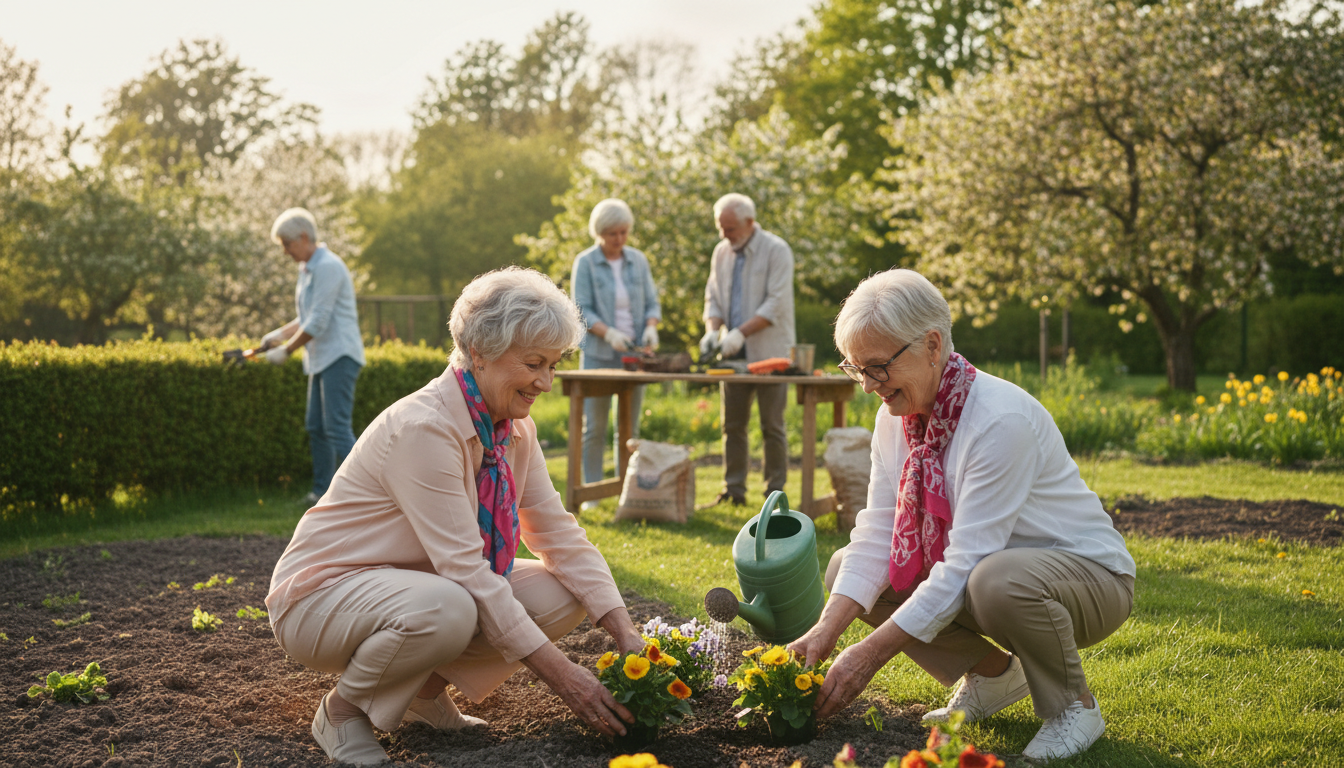
After decades of a busy career, retirement can feel surprisingly quiet. The daily structure and sense of purpose fade away. Many older adults find themselves missing the camaraderie and feeling that their days matter.
If you worry about a parent feeling isolated at home, you’re not alone. Adult children often wonder if Mom or Dad has enough meaningful interaction. They want to ensure their loved ones feel valued and connected.
This is where giving back shines. It’s far more than just a way to pass the time. It’s a genuine path to rediscovering purpose. It offers a chance to use a lifetime of skills to make a real difference.
You might have concerns. “Am I too old? Do I have the energy?” The answer is a resounding yes. Communities deeply need the wisdom and experience that older adults possess.
The beautiful truth is that helping others often gives back even more. It brings renewed joy, new friends, and the powerful knowledge that your life continues to have a meaningful impact. This guide will walk you through the benefits and practical steps to get started, including exploring specific volunteer opportunities for seniors.
Key Takeaways
- Retirement can lead to a loss of daily purpose and social connection.
- Giving back provides a powerful path to feeling valued and engaged.
- A lifetime of experience is a tremendous asset to the community.
- Common concerns about age or energy are often unfounded.
- Helping others frequently brings personal joy and new friendships.
- This guide offers reassuring, practical information for taking the first step.
Understanding the Benefits of Volunteering for Seniors
What many don’t anticipate about retirement is how deeply we miss the sense of contribution that work provided. Giving back fills this void in remarkable ways, offering real health advantages that extend far beyond just feeling good.
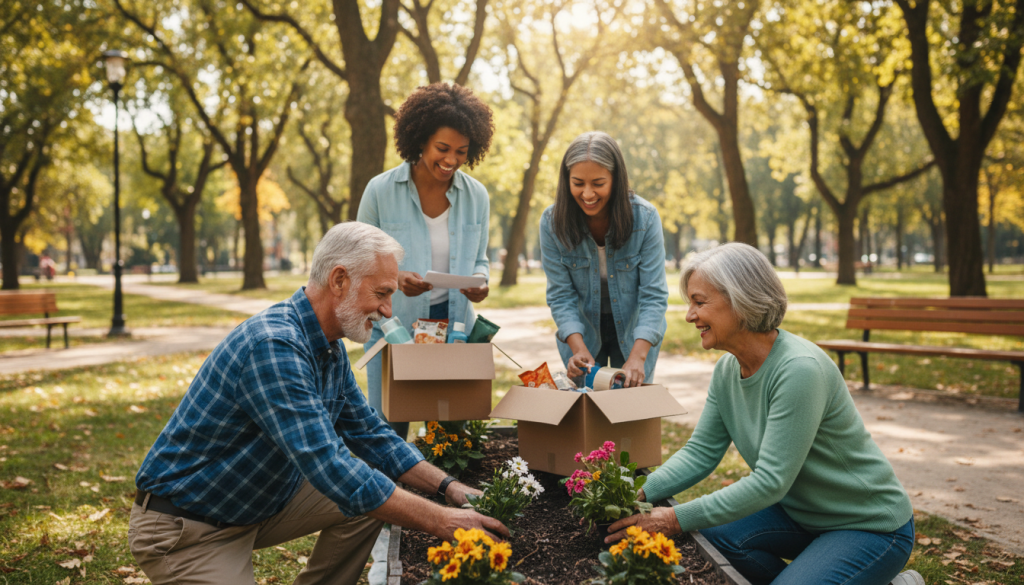
Mental and Physical Health Advantages
Staying engaged through volunteer work keeps the mind sharp. Learning new skills and solving problems maintains cognitive function. This mental exercise is crucial for brain health as we age.
Many volunteer activities naturally include gentle movement. Walking to deliver meals or sorting donations provides physical activity. Regular outings help maintain mobility and overall wellness.
Having a weekly commitment creates valuable structure. It gives older adults something to anticipate. This routine encourages self-care and daily preparation.
Building New Social Connections
Working alongside others creates meaningful bonds. These interactions combat isolation effectively. Research shows these social connections significantly improve quality of.
Volunteering brings together people of different ages and backgrounds. This diversity enriches life experience. Everyone gains fresh perspectives through shared work.
Try JoyCalls Free
No app or new device needed. Start with a free 7-day trial.
Feeling needed and appreciated boosts emotional well-being. This sense of purpose protects against depression and loneliness. The emotional rewards are as valuable as the physical benefits.
How Volunteering Improves the Quality of Life for Seniors
After years of having clear daily objectives, the sudden absence of routine can be surprisingly disorienting. Many older adults find their days blending together without the structure that gave them purpose.
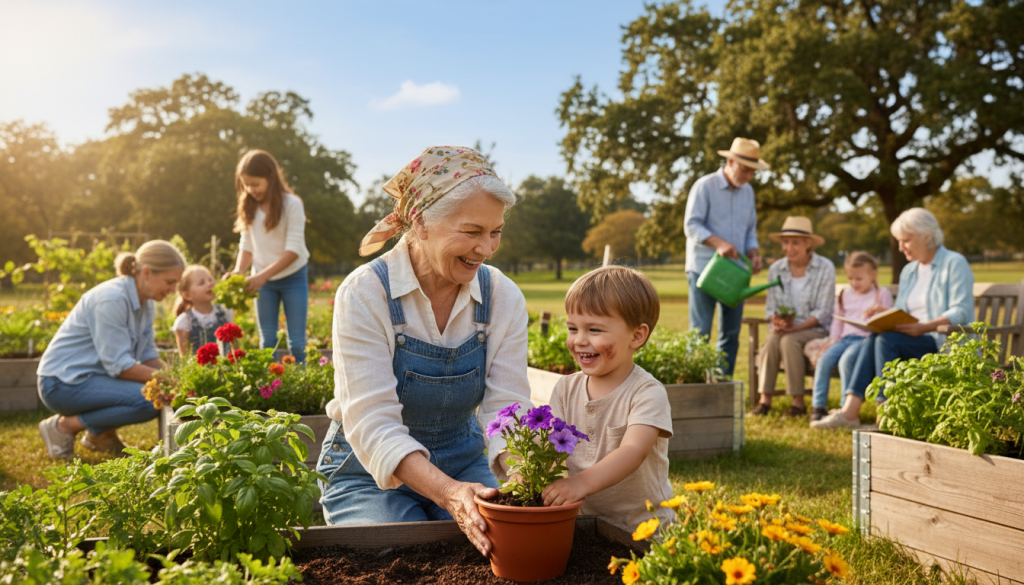
Enhancing Daily Routines and Independence
Regular volunteer commitments create natural rhythm to the week. Knowing you’re expected somewhere gives each day meaning. This structure replaces the empty hours with purposeful activity.
Staying engaged through community work supports independence beautifully. It keeps older adults active and mobile. They remain connected rather than becoming increasingly homebound.
Volunteer work often requires learning new skills. Whether it’s understanding procedures or developing interpersonal abilities, this keeps the mind adaptable. The mental stimulation is invaluable.
The benefits ripple through other areas of life. Those who give back often report sleeping better and eating more regularly. Having people counting on them encourages self-care.
This opportunity eases the transition from career life. It replaces work-related purpose with community connection. Older adults can redefine their identity beyond former roles.
Staying active in these roles helps maintain independence longer. The physical activity and mental sharpness gained make daily self-care easier to manage.
For families, seeing a loved one engaged provides wonderful reassurance. It shows they’re staying connected and living with purpose. This brings peace of mind to everyone involved.
Exploring Volunteer Opportunities: From Local to Global Impact
One of the most reassuring aspects of getting involved is the sheer variety of ways to contribute. There is truly something for every interest and energy level.
Try JoyCalls Free
No app or new device needed. Start with a free 7-day trial.

Local Community Programs and Senior Corps
Your own neighborhood is filled with meaningful opportunities. Libraries, animal shelters, and community centers always welcome helping hands. Even a few hours each week makes a tremendous difference.
Senior Corps is a national program designed for those 55 and older. It includes initiatives like Foster Grandparents, where experienced individuals mentor youth. Another option, Senior Companions, helps peers maintain their independence.
Staying local offers wonderful reassurance. You build connections close to home. The commitment can easily match your pace.
International Volunteer Experiences
For those seeking adventure, the entire world opens up. Organizations like IVHQ create safe, supported projects abroad. These experiences often include meals, accommodation, and local guidance.
You could spend a few weeks teaching English or supporting conservation efforts. The range of programs is vast. It’s a powerful way to explore new cultures while giving back.
The wisdom and patience that older volunteers bring is irreplaceable. They are the steady hands that guide so many initiatives to success.
| Opportunity Type | Time Commitment | Best For | Support Level |
|---|---|---|---|
| Local Community | A few hours per week | Staying close to home, flexible schedules | Immediate local network |
| Senior Corps | 15-40 hours per week | Structured roles, mentoring | National organization support |
| International Program | 1-24 weeks | Adventure, cultural immersion | Full in-country hosting |
Whether local or global, your life experience is a valued asset. You can start small or dream big. The right fit is waiting for you.
JoyCalls: Connecting Seniors to Meaningful Volunteer Programs
Sometimes the hardest part about helping others is simply getting started. JoyCalls offers a thoughtful solution for families supporting loved ones who want to stay connected to their community.
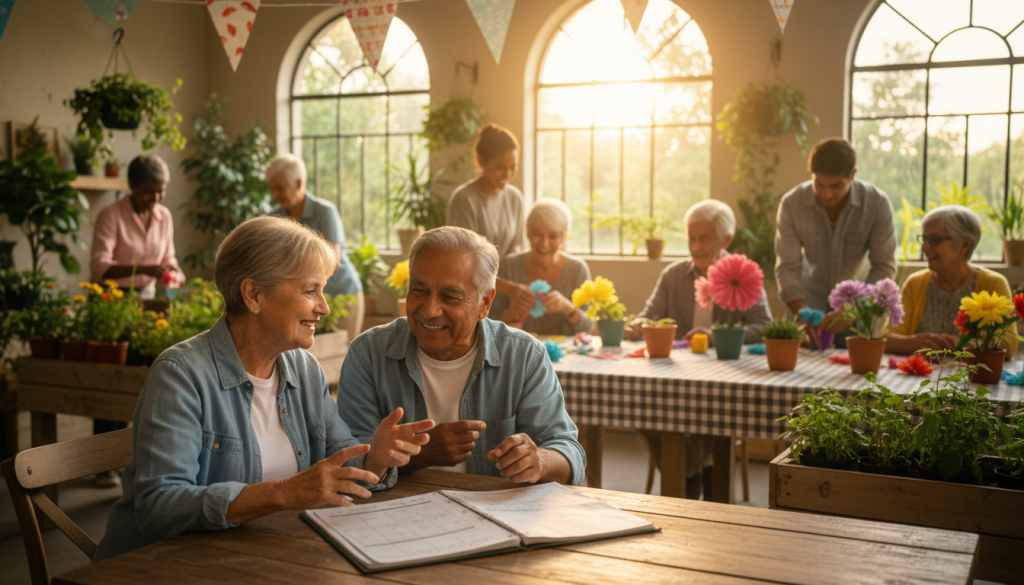
This AI-powered phone companion calls older adults regularly using their existing phone. No app or smartphone is needed. It provides friendly conversation, reminders, and information about local opportunities.
Signup Process and Getting Started via JoyCalls
JoyCalls helps discover volunteer roles that match interests and abilities. It gently reminds about upcoming commitments and transportation details. This service turns intention into action with gentle accountability.
The system supports busy adult children by sending summaries and alerts. Families stay informed about their loved one’s activities without constant phone calls. This creates meaningful conversation topics during family check-ins.
For those exploring giving back, JoyCalls serves as an encouraging companion. It asks about experiences and celebrates contributions. This helps individuals feel connected to their impact.
The signup process is simple. Visit the JoyCalls signup page, enter basic information, and customize call topics. Include reminders about local programs and community connection.
JoyCalls bridges the gap between wanting to participate and actually beginning. It provides the support that helps older adults feel confident. The service reminds about orientation dates and practical details, reducing anxiety about new opportunities.
This innovative approach to care represents the future of supportive technology. As Joy AI calls continue to evolve, they offer more ways to stay engaged with meaningful programs.
Volunteering for Seniors: Tips to Get Started
Taking that first step toward helping others can feel both exciting and a little uncertain. The good news? With some thoughtful preparation, you can find a role that feels perfectly suited to your life and brings genuine joy.

Choosing the Right Volunteer Program
Begin with honest self-reflection. Consider your physical comfort, weekly schedule, and transportation options. What causes truly move you? The right fit makes all the difference.
Start small if you’re new to this experience. Commit to a few hours monthly rather than weekly. You can always increase involvement as you grow more comfortable.
Look for organizations that provide clear role descriptions and proper training. Ask questions about flexibility for mobility or health considerations. A good program will welcome these discussions.
| Program Type | Time Commitment | Best Match For |
|---|---|---|
| Local Community | 2-4 hours weekly | Those preferring familiar surroundings |
| Skill-Based Roles | Flexible scheduling | People with specific professional backgrounds |
| Short-Term Projects | 1-2 week commitments | Individuals wanting variety |
Preparing for Your First Volunteering Experience
Confirm transportation arrangements ahead of time. Understand any dress code or physical requirements. Knowing these details reduces first-day anxiety.
It’s completely normal to feel nervous. Most organizations expect a learning curve. Fellow volunteers are typically welcoming and helpful to newcomers.
Remember that the right volunteer programs should feel rewarding. If something doesn’t fit after a fair try, it’s okay to explore other opportunities. Your comfort matters.
For additional guidance, the AARP volunteer resource guide offers wonderful starting points tailored for older adults.
Inspiring Stories from Senior Volunteers

The most powerful proof that age is no barrier comes from those who have already taken the leap. Their journeys show how giving back creates meaningful connections at any stage of life.
Real-Life Testimonials and Experiences
At 75, Julien Comeau spent three weeks in Ghana with young adults from around the world. He calls it his most rewarding trip in 50 years of travel. “There is no age limit to this work,” he reflects.
Michelle Barnes, 54, emphasizes not waiting for “someday.” Her Galapagos Islands experience touched her heart more than any other journey. She discovered that postponement can mean missing precious opportunities.
Susan Erdman has made this a lifestyle pattern. At 65, she’s contributed in India, Kenya, Peru, and Morocco. Each placement brought new fulfillment using her lifetime skills.
Glenda Bernstein’s Tanzania homestay became one of her greatest life experiences. The connections she formed with local families showed how age brings valuable perspective to any community.
These volunteers aren’t exceptional people with unusual abilities. They’re ordinary individuals who stepped outside comfort zones. Each found purpose through meaningful contribution.
Their stories share common threads: genuine welcome from host communities, work that truly helps others, and personal growth. As you read more senior volunteer abroad stories, you’ll see how age becomes an asset rather than limitation.
Programs and Projects That Transform Communities
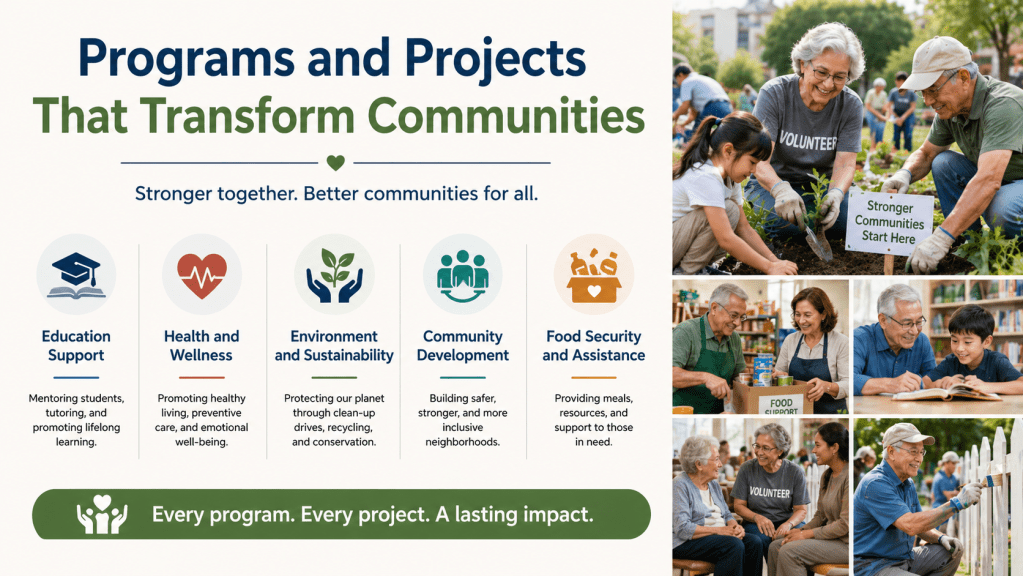
The world is filled with incredible organizations ready to welcome experienced hands. Their well-structured programs create real impact locally and globally. You can trust their proven track records.
Impactful Nonprofit Organizations and Initiatives
Rotary International has over 35,000 clubs worldwide. Volunteers use career skills to promote peace and support education. It’s a perfect fit for sharing a lifetime of expertise.
Lions Clubs focus on health and hunger relief. Their 48,000+ clubs offer diverse projects. You can find a role that matches your personal interests.
Kiwanis International runs nearly 150,000 service projects yearly for children. This includes building playgrounds and mentoring teens. It’s ideal for those who enjoy working with youth.
Meals on Wheels addresses senior nutrition across all 50 states. Volunteers package and deliver meals. This directly combats isolation in your own community.
Senior Corps creates roles specifically for those 55 and older. These structured programs provide training and support. They make getting started simple and secure.
If you’re looking for something different, you can also discover other engaging activities that fit your pace.
| Organization | Primary Focus | Charity Navigator Score |
|---|---|---|
| Rotary International | Peace, Disease, Education | 100/100 |
| Meals on Wheels | Senior Nutrition & Connection | 94.84/100 |
| Lions Clubs International | Health, Vision, Hunger Relief | 90.17/100 |
| Senior Corps | Mentoring & Senior Support | Government Program |
These groups offer a powerful way to connect. Your time creates a positive impact through trusted, effective programs.
How Seniors Can Choose the Right Volunteer Role Without Feeling Overwhelmed
Volunteering can be deeply meaningful, but the right opportunity matters. For seniors, the goal is not to “stay busy” for the sake of it. The goal is to find a role that feels safe, manageable, socially rewarding, and emotionally satisfying.
This is especially important because social isolation and loneliness can affect older adults’ physical and mental well-being, including mood, memory, heart health, and overall quality of life. Volunteering can be one practical way to rebuild regular human contact, but only when the role fits the person’s energy, mobility, personality, and comfort level.
Start With Your “Connection Style”
Before choosing a volunteer role, seniors should ask one simple question: What kind of connection do I want more of?
Some people miss deep one-on-one conversations. Others want to be part of a group. Some prefer helping children, while others feel more comfortable supporting people their own age. There is no correct answer.
A senior who feels lonely after losing a spouse may benefit from companion-style volunteering, where conversations are personal and steady. Someone who misses professional life may enjoy mentoring, tutoring, organizing, or serving on a committee. A quieter person may prefer behind-the-scenes roles such as packing donations, writing letters, preparing materials, or making phone check-ins.
This small bit of self-awareness prevents a common mistake: signing up for a role that sounds noble but feels draining.
Match the Role to Your Energy, Not Your Younger Self
Many older adults choose volunteer work based on what they used to be able to do. That can lead to frustration.
A better approach is to choose based on current energy.
Ask:
“How many hours can I give without feeling exhausted later?”
“Do I prefer morning, afternoon, or evening?”
“Can I stand for long periods?”
“Do I need easy parking, seating, or restroom access?”
“Would I rather volunteer from home?”
“Do I enjoy social interaction, or do I need quiet tasks?”
A good volunteer role should leave a senior feeling useful, not depleted. Even one hour a week can be meaningful if it is consistent.
Use the “Three-Visit Test” Before Committing
Instead of making a long-term commitment immediately, seniors can use the three-visit test.
Visit or volunteer three times before deciding whether to continue. After each visit, ask:
Did I feel welcomed?
Was the task clearly explained?
Did I feel physically comfortable?
Did someone check in on me?
Did I leave feeling better than when I arrived?
Would I look forward to coming again?
If the answer is mostly yes, the role may be a good fit. If the senior feels ignored, confused, rushed, unsafe, or emotionally heavy, it is acceptable to step back.
Volunteering should not feel like another obligation. It should feel like a meaningful rhythm.
Look for Roles With Built-In Social Contact
Some volunteer roles are helpful but lonely. For example, sorting supplies alone in a back room may serve a good cause, but it may not help a senior feel connected.
For seniors looking to reduce loneliness, the best roles usually include regular interaction. Examples include:
Reading to children at a library
Greeting visitors at a community center
Calling homebound seniors
Helping at a senior meal program
Teaching basic computer skills
Joining a church, temple, or community outreach team
Mentoring young adults
Supporting caregiver groups
Participating in local advocacy or neighborhood committees
Programs like AmeriCorps Seniors are built specifically for adults aged 55 and older and include service areas such as tutoring, mentoring, elderly care, and disaster support. AARP also lists volunteer opportunities that can be local, national, in-person, or remote.
Choose a Cause That Feels Personal
Volunteering becomes easier to continue when the cause feels personal.
A retired teacher may enjoy helping children read. A former nurse may enjoy health education. Someone who loved gardening may help with a community garden. A grandparent who misses regular time with children may enjoy school-based volunteering. A senior who once cared for a spouse may feel called to support caregivers.
The best cause is not always the most dramatic one. It is the one that makes the senior think, “This matters to me.”
That emotional connection creates motivation on days when leaving the house feels difficult.
Consider Remote Volunteering if Mobility Is a Concern
Not every senior can travel easily. Weather, transportation, pain, caregiving duties, vision changes, or mobility challenges may make in-person volunteering difficult.
Remote volunteering can still create real connection.
Options may include:
Friendly phone calls to isolated adults
Virtual tutoring
Writing encouragement letters
Helping nonprofits with emails or newsletters
Mentoring by phone or video
Making reminder calls for events
Joining online advocacy teams
Teaching basic skills over video
Reviewing documents or helping with simple administrative tasks
Remote volunteering is especially helpful for seniors who want purpose but need flexibility. AARP notes that some volunteer roles can be done from home while still helping older adults and communities.
Ask the Right Questions Before Saying Yes
Seniors should feel comfortable interviewing the organization too. A respectful organization will welcome questions.
Before committing, ask:
What exactly will I be doing?
How many hours are expected?
Is training provided?
Will I work alone or with others?
Who should I contact if I feel uncomfortable?
Is transportation available?
Are breaks allowed?
Is the space accessible?
Are background checks required?
Can I start with a short trial period?
What happens if I need to miss a day because of health or family needs?
These questions are not demanding. They are practical. They help prevent misunderstandings and make volunteering safer and more enjoyable.
Set Boundaries Early
Many caring seniors overgive. They say yes too often, stay longer than planned, or accept tasks that are physically or emotionally too much.
Boundaries protect the volunteer experience.
A senior can say:
“I can help once a week, but not more than that.”
“I’m happy to make calls, but I’m not comfortable driving.”
“I can volunteer for two hours, but I’ll need a seated role.”
“I’d like to help, but I need clear instructions.”
“I can try this for one month and then decide.”
Good organizations will respect these limits. If they do not, that is a sign to look elsewhere.
Make Volunteering Part of a Weekly Routine
Connection grows through repetition. A one-time event can feel good, but a regular role helps people recognize each other, remember names, and build trust.
For example:
Every Tuesday morning: library reading hour
Every Thursday afternoon: friendly phone calls
First Saturday of the month: food pantry support
Twice a month: mentoring session
Weekly routines give seniors something to look forward to. They also reduce the anxiety of deciding what to do each week.
The key is to start small. A predictable one-hour commitment is better than an ambitious schedule that becomes tiring.
Volunteer With a Friend First
Starting alone can feel intimidating. Seniors who feel nervous can invite a friend, neighbor, sibling, adult child, or fellow community member to join them for the first visit.
This makes the first step easier. It also creates accountability. When two people plan to go together, both are more likely to follow through.
For seniors who do not have someone to accompany them, calling the organization ahead of time can help. They can ask, “Will someone meet me when I arrive?” or “Can you introduce me to another volunteer?”
That small request can make the experience feel much warmer.
Pay Attention to Emotional Fit
Some volunteer work is emotionally heavy. Helping in hospitals, hospice programs, crisis lines, shelters, or grief support groups can be meaningful, but it may not be right for every senior.
A good role should stretch the heart without breaking it.
After volunteering, seniors should ask:
Do I feel peaceful or emotionally drained?
Am I carrying other people’s problems home with me?
Do I feel supported by the organization?
Can I talk to someone if a situation upsets me?
Is this role bringing connection into my life?
If the work feels too heavy, switching roles is not failure. It is wisdom.
Turn Skills Into Service
Many seniors underestimate how valuable their life experience is.
A person who managed a household can organize donations. A retired accountant can help with tax assistance or budgeting workshops. A former business owner can mentor entrepreneurs. A good cook can support meal programs. A patient listener can make companionship calls. A bilingual senior can help translate or support immigrant families.
AARP’s volunteer programs include areas such as tax assistance, safe driving, childhood literacy, technology help, fraud prevention, caregiving support, and age-friendly communities.
The message is simple: seniors do not need to become someone new to volunteer. They can start with what they already know.
Create a Personal Volunteer Plan
A simple plan can make volunteering easier to begin.
Seniors can write down:
My reason for volunteering:
“I want to feel connected again.”
“I want to use my experience.”
“I want to help children.”
“I want to have a weekly reason to leave the house.”
My ideal schedule:
“One morning a week.”
“Two short calls from home.”
“One monthly event.”
My limits:
“No heavy lifting.”
“No night driving.”
“No more than two hours.”
“Seated roles only.”
My preferred people:
“Children.”
“Other seniors.”
“Veterans.”
“Caregivers.”
“People learning English.”
My first step:
“Call the library.”
“Ask my church office.”
“Search AARP volunteer opportunities.”
“Contact the local senior center.”
“Ask a friend to come with me.”
This turns a vague desire into a practical next action.
Know When to Change Roles
Sometimes the first volunteer role is not the right one. That is normal.
A senior may need to change roles if:
The schedule is too demanding
The physical tasks are uncomfortable
The environment feels disorganized
The emotional burden is too high
The commute is stressful
The senior does not feel welcomed
The work does not create meaningful connection
Leaving one role does not mean giving up on volunteering. It simply means adjusting.
The right role should feel like a place where a senior is valued, seen, and useful.
A Gentle First-Step Script
For seniors who are unsure what to say, here is a simple phone or email script:
“Hello, my name is [Name]. I’m interested in volunteering, but I’d like to start with something manageable. I’m available [day/time], and I’m looking for a role where I can help while also connecting with people. I’d prefer [seated work/phone calls/working with children/helping other seniors/short shifts]. Do you have any beginner-friendly opportunities?”
This script is clear, polite, and practical. It helps the organization suggest a role that actually fits.
The Best Volunteer Role Is the One You Can Keep Enjoying
The most meaningful volunteer work is not always the biggest or most impressive. It is the role a senior can return to with a sense of purpose.
A good role should offer three things:
It should help someone else.
It should fit the senior’s real-life abilities.
It should create healthy connection.
When those three things come together, volunteering becomes more than an activity. It becomes a gentle structure for belonging again.
How to Sustain Volunteering Long-Term and Build Meaningful Relationships
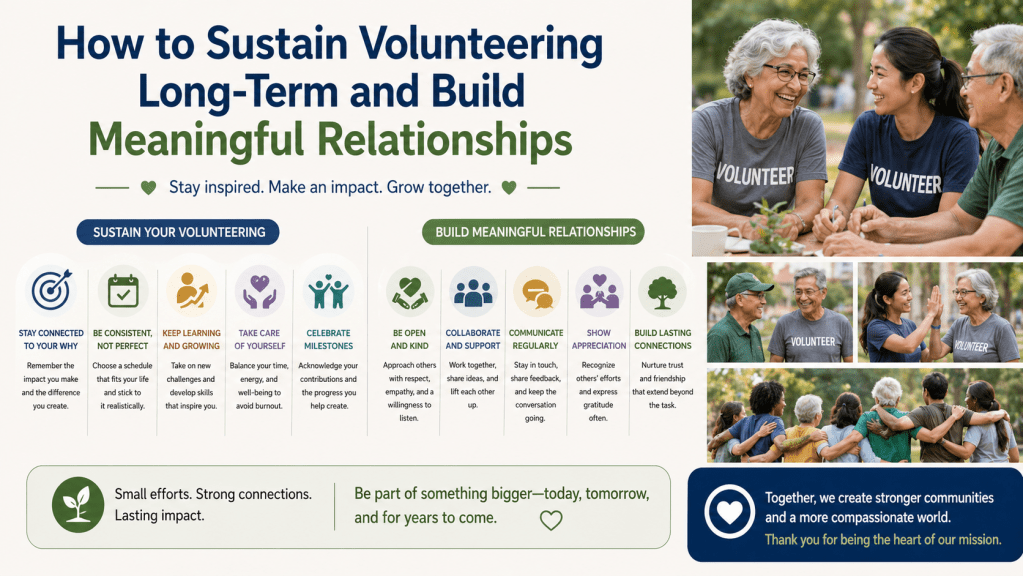
Starting volunteering is one step. Staying with it—and allowing it to truly enrich your life—is another.
Many seniors begin volunteering with enthusiasm, only to gradually drift away. Not because they don’t care, but because the experience becomes tiring, repetitive, or emotionally unclear. The difference between short-term participation and long-term fulfillment often comes down to how the experience is managed.
This section focuses on something deeper than “how to volunteer.” It focuses on how to make volunteering a lasting, meaningful part of life—without burnout, pressure, or disappointment.
Shift From “Helping” to “Belonging”
One of the most important mindset shifts seniors can make is this:
Volunteering is not just about helping others.
It is also about finding a place where you belong.
If volunteering is treated only as an act of giving, it can slowly feel one-sided. Over time, that can lead to quiet emotional fatigue.
But when volunteering becomes a space where:
- People know your name
- Someone notices when you’re absent
- Conversations continue week after week
- You feel included, not just useful
…it begins to feel like a community, not a task.
This shift changes everything.
Instead of asking, “Am I doing enough?”
A better question becomes, “Do I feel like I’m part of something?”
That feeling of belonging is what keeps seniors engaged long-term.
Focus on Familiar Faces, Not Just Tasks
Consistency builds connection.
When seniors volunteer in the same place, at the same time, with the same people, something powerful happens: familiarity turns into comfort, and comfort turns into relationships.
Over time:
- A quick greeting becomes a real conversation
- A shared task becomes teamwork
- A polite interaction becomes genuine care
This is why it is often better to:
Stay in one role longer
Return to the same location
Work with a smaller, consistent group
…rather than constantly trying new opportunities.
Connection grows slowly. Repetition is what makes it real.
Create Small Moments of Personal Interaction
Not every volunteer role automatically creates connection. Sometimes, the interaction stays surface-level unless someone gently deepens it.
Seniors can do this in simple, natural ways:
Ask one personal question per visit
Remember one detail about someone and follow up next time
Use names often
Offer a genuine compliment
Share a small story from your own life
For example:
Instead of saying, “Good morning,”
you might say, “Good morning, how did your grandson’s exam go?”
Instead of completing a task silently,
you might say, “This reminds me of something I used to do years ago…”
These small actions create warmth. Over time, they build familiarity and trust.
Recognize the Early Signs of Burnout
Burnout does not happen suddenly. It builds slowly.
For seniors, burnout can feel like:
Feeling tired before going to volunteer
Losing interest in conversations
Feeling unappreciated or unnoticed
Feeling physically drained afterward
Wanting to skip sessions more often
Feeling emotionally heavy after interactions
These signs do not mean volunteering is wrong. They simply mean something needs to be adjusted.
Ignoring burnout can lead to complete withdrawal. Recognizing it early allows seniors to adapt without losing connection.
Adjust the Role Instead of Quitting Entirely
A common mistake is to quit volunteering completely when it becomes difficult.
A better approach is to adjust.
For example:
Reduce hours instead of stopping completely
Switch to a quieter role within the same organization
Move from physical tasks to conversational ones
Take short breaks during busy periods
Change from weekly to biweekly participation
The goal is to preserve connection while reducing strain.
Even a small, consistent role is more valuable than none at all.
Build a “Volunteering Comfort Zone”
Every senior benefits from having a volunteering setup that feels safe, predictable, and manageable.
This includes:
A familiar location
Known faces
A clear routine
A comfortable schedule
A role that fits physical ability
This “comfort zone” acts as a foundation. From there, seniors can explore new roles if they want—but they always have something stable to return to.
Without this base, volunteering can feel uncertain and tiring.
Use Volunteering as a Social Anchor
For many seniors, days can blend into each other—especially after retirement or major life changes.
Volunteering can act as a social anchor—a fixed point in the week that provides structure.
For example:
“Every Wednesday, I go to the community center.”
“Every Friday, I make my calls.”
“Every first Sunday, I help at the event.”
This structure:
Breaks isolation
Gives something to prepare for
Creates anticipation
Builds routine-based connection
Over time, this routine becomes something to rely on emotionally—not just logistically.
Let Relationships Grow at Their Own Pace
One of the quiet challenges seniors face is expecting deep connection too quickly.
Real relationships take time.
In the beginning, interactions may feel polite or surface-level. That is normal.
With repetition:
Conversations become easier
Silences become comfortable
People begin to open up
Trust develops naturally
The key is patience.
Trying to force closeness can feel unnatural. Allowing it to grow gradually makes it more genuine.
Stay Open to Unexpected Friendships
Connection does not always come from where you expect.
A senior volunteering to help children may form a bond with another volunteer instead. Someone making phone calls may connect deeply with just one person. A quiet role may unexpectedly lead to meaningful conversations.
Being open to these moments matters.
Instead of focusing only on the task, notice:
Who do I enjoy talking to?
Who seems comfortable around me?
Who do I naturally connect with?
These are often the beginnings of meaningful relationships.
Balance Giving and Receiving
Healthy volunteering is not one-sided.
Seniors should feel comfortable:
Accepting help when needed
Sharing their own feelings occasionally
Allowing others to support them
Receiving appreciation
When volunteering becomes only about giving, it can feel draining.
When it includes receiving—whether that’s kindness, recognition, or conversation—it becomes sustainable.
Celebrate Small Wins
Not every volunteer session will feel extraordinary. But small moments matter.
A good conversation
A smile from someone
A thank-you
A moment of laughter
A task completed well
Recognizing these moments helps seniors stay motivated.
At the end of each session, it can help to ask:
“What was one good moment today?”
This simple reflection shifts focus from effort to meaning.
Stay Flexible With Life Changes
Health, energy, and personal circumstances can change over time.
Seniors should feel comfortable adapting their volunteer role as life evolves.
This might mean:
Taking a break during illness
Switching to remote roles
Reducing frequency
Choosing less physically demanding tasks
Volunteering should support life—not compete with it.
Flexibility ensures it remains a positive experience.
Build Connection Outside the Role
Sometimes the strongest connections grow beyond the volunteer setting.
This could include:
Having tea after a session
Walking together afterward
Exchanging phone numbers
Celebrating small occasions
Checking in on each other
These steps turn volunteering relationships into real friendships.
Even one meaningful connection can significantly reduce feelings of loneliness.
Keep the Purpose Personal
Over time, routines can become mechanical. Seniors may forget why they started volunteering in the first place.
It helps to revisit that purpose regularly.
Ask:
Why did I begin?
How does this help me feel connected?
What part of this still matters to me?
Reconnecting with purpose renews motivation.
When It’s Time to Step Back
There may come a time when a senior needs to step back from a role.
This can happen due to:
Health changes
Family responsibilities
Emotional fatigue
Shifting priorities
Stepping back is not failure.
What matters is how it’s done.
A gentle exit might include:
Informing the organization in advance
Expressing gratitude
Offering to return in a smaller capacity later
Staying in touch with people you connected with
This preserves dignity and relationships.
The Real Outcome of Sustained Volunteering
Over time, something subtle but powerful happens.
Volunteering stops feeling like an activity and starts feeling like part of life.
Seniors may begin to notice:
They are recognized and remembered
They have regular conversations
They feel expected and valued
They have something to look forward to
They feel less alone
This is the true impact.
Not just helping others—but rebuilding a sense of connection, identity, and belonging.
Volunteering for Seniors With Health Limitations, Anxiety, or Low Confidence
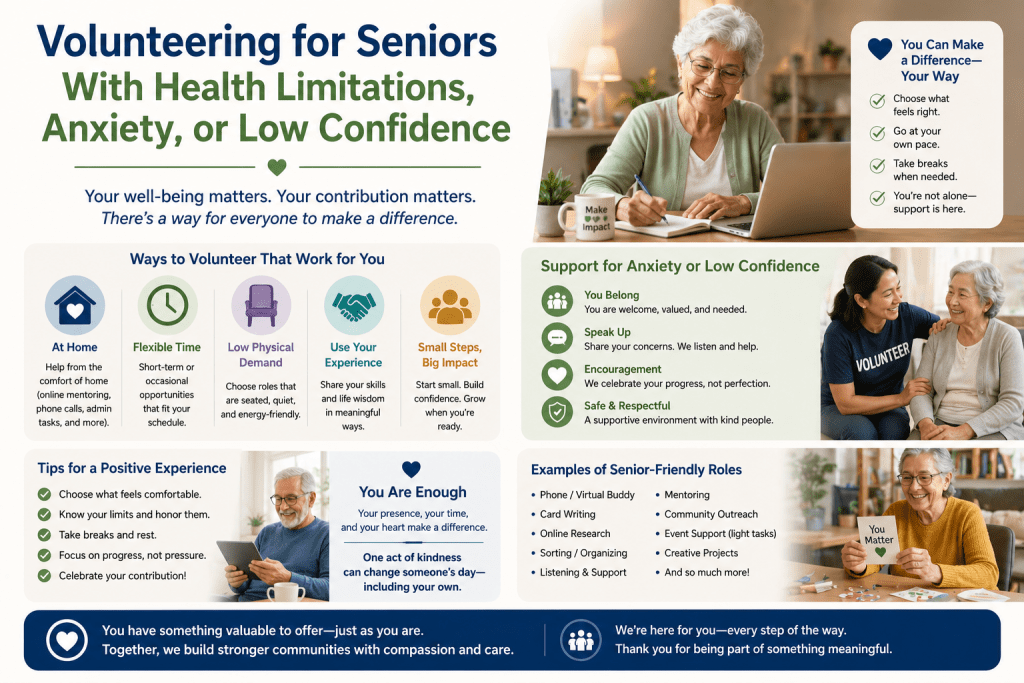
Not every senior feels ready to step into a social environment, even if they deeply want connection.
Health concerns, reduced mobility, chronic pain, hearing or vision changes, social anxiety, or simply being “out of practice” socially can make volunteering feel intimidating. Some seniors may even think:
“I want to connect, but I don’t know if I can handle it.”
“What if I can’t keep up?”
“What if I feel awkward or out of place?”
These concerns are real—and they deserve thoughtful solutions, not pressure.
The truth is: volunteering does not have to be physically demanding, socially overwhelming, or emotionally intense to be meaningful. With the right approach, it can be adapted to almost any situation.
Start With Emotional Readiness, Not Just Opportunity
Before choosing a role, it helps to check in emotionally.
Instead of asking, “Where can I volunteer?”
Ask, “What feels comfortable for me right now?”
For some seniors, that may mean:
Speaking to one person instead of a group
Volunteering for 30 minutes instead of two hours
Starting from home instead of going out
Observing first instead of participating immediately
There is no “correct” starting point.
Connection grows best when it begins within a space that feels safe.
Low-Pressure Ways to Begin Volunteering
For seniors who feel anxious or unsure, starting small can make all the difference.
Some gentle entry points include:
Listening in on a volunteer orientation without committing
Visiting a location just to observe the environment
Starting with a one-time event instead of a weekly role
Choosing tasks that do not require immediate interaction
Volunteering alongside a staff member rather than independently
These approaches remove the pressure of immediate performance and allow seniors to adjust gradually.
Ideal Volunteer Roles for Limited Mobility
Physical limitations should never be a barrier to connection. The key is choosing roles that respect comfort and safety.
Some excellent options include:
Phone-based companionship programs
Writing letters to isolated individuals
Virtual tutoring or mentoring
Helping with administrative work (emails, scheduling, organizing)
Preparing materials while seated
Greeting or guiding visitors from a seated position
Helping with registration desks
Supporting community helplines
Participating in advocacy or awareness campaigns
These roles focus on presence and contribution rather than physical effort.
Volunteering From Home: A Powerful Option
Home-based volunteering is often underestimated, but it can be incredibly impactful.
For seniors who are homebound or prefer familiar surroundings, this option offers both flexibility and comfort.
Examples include:
Calling other seniors who feel lonely
Reading to children virtually
Helping nonprofits with simple digital tasks
Providing language support or translation
Offering emotional support through structured programs
Participating in online community groups with a purpose
Writing or storytelling for community newsletters
Even short interactions—like a 10-minute call—can create meaningful connection for both people involved.
Managing Social Anxiety While Volunteering
Social anxiety is more common than many people realize, especially after long periods of isolation or major life changes.
The key is not to eliminate anxiety, but to manage it gently.
Some helpful strategies include:
Arriving early to avoid crowded or rushed environments
Preparing a few simple conversation starters
Focusing on the task rather than social performance
Taking short breaks when needed
Choosing roles with predictable interactions
Letting a coordinator know you prefer a slower introduction
A simple mindset shift can help:
Instead of thinking, “I need to be social,”
Think, “I just need to show up.”
Connection often follows naturally.
Simple Conversation Starters That Feel Natural
For seniors who feel unsure about what to say, having a few go-to phrases can ease anxiety.
Examples include:
“How long have you been volunteering here?”
“What do you enjoy most about this place?”
“Is it usually this busy?”
“What got you interested in this work?”
“I’m new here—do you have any tips?”
These questions are easy, respectful, and open-ended. They invite conversation without pressure.
Dealing With Hearing, Vision, or Memory Challenges
Some seniors hesitate to volunteer because of sensory or cognitive changes.
But many roles can be adapted.
Helpful adjustments include:
Choosing quieter environments
Working with smaller groups
Using written instructions instead of verbal ones
Asking for repetition or clarification when needed
Using name tags or note cards
Selecting roles with clear, structured tasks
Taking notes during instructions
It is perfectly acceptable to say:
“I may need things explained clearly or written down.”
“I prefer a quieter role.”
Clear communication prevents frustration and builds confidence.
Build Confidence Through Familiarity
Confidence grows through repetition.
The first visit may feel uncomfortable. The second feels slightly easier. By the third or fourth visit, the environment starts to feel familiar.
Seniors can support this process by:
Returning to the same place consistently
Greeting the same people each time
Following a predictable routine
Keeping expectations simple
Familiarity reduces anxiety and builds a sense of comfort.
Don’t Compare Yourself to Other Volunteers
One common mistake is comparing oneself to others.
Some volunteers may be more energetic, talkative, or experienced. That does not make them “better.”
Every volunteer brings something different.
A calm presence, patience, listening ability, life experience—these are deeply valuable qualities.
Instead of comparing, it helps to ask:
“Am I doing what I can, in a way that feels right for me?”
That is enough.
Create a Personal “Exit Plan” for Comfort
Knowing you can leave if needed reduces anxiety significantly.
Before starting, seniors can decide:
“I will stay for 30 minutes and then reassess.”
“If I feel overwhelmed, I will take a break.”
“I can step outside if I need quiet.”
Having this plan creates a sense of control.
Ironically, when people know they can leave, they often feel more comfortable staying.
Ask for Support Without Hesitation
Good volunteer organizations want seniors to succeed.
Seniors should feel comfortable asking:
“Can someone show me how to do this step by step?”
“Is there a quieter role I can start with?”
“Can I begin with shorter shifts?”
“Who can I talk to if I feel unsure?”
Asking for help is not a weakness—it is a way to create a better experience.
Use Volunteering to Rebuild Social Confidence
For seniors who feel socially disconnected, volunteering can act as a gentle bridge back into interaction.
It provides:
A reason to speak to others
A structured environment
Shared topics of conversation
Repeated exposure to social settings
Over time, this reduces hesitation.
Many seniors find that after a few weeks:
Conversations feel easier
Confidence improves
Fear reduces
Connection begins to feel natural again
This progress is gradual—but very real.
Respect Your Limits Without Guilt
Some days will be better than others.
Health, mood, energy, and circumstances can vary.
Seniors should feel comfortable saying:
“I need to rest today.”
“I’ll come next week instead.”
“I can’t stay as long today.”
Volunteering should support well-being, not create pressure.
Consistency matters—but so does self-care.
Celebrate Courage, Not Just Contribution
For seniors facing anxiety or limitations, simply showing up is an achievement.
It takes courage to:
Try something new
Enter a social space
Speak to strangers
Step outside comfort zones
These moments deserve recognition.
Instead of measuring success only by “how much was done,”
it helps to ask:
“Did I take a step forward today?”
That step matters.
The Quiet Power of Showing Up
Not every volunteer needs to lead, organize, or speak loudly.
Sometimes, the most meaningful impact comes from quiet presence.
Listening to someone
Offering a smile
Being consistent
Showing kindness in small ways
These actions create real connection.
They may seem small—but to someone who feels alone, they can mean everything.
Essential Guidance on Volunteer Program Safety and Support

Safety concerns are often the biggest hesitation for families considering meaningful opportunities. “Will my loved one be secure?” This worry shows how much you care.
Reputable organizations understand this priority completely. They build comprehensive protection into every aspect of their programs.
Risk Management and Travel Insurance Insights
Quality volunteer programs maintain rigorous health and safety measures. These protocols protect participants of all ages and abilities.
Travel coverage is essential for international experiences. Some providers offer age-inclusive policies at flat rates. This means no extra charges regardless of age.
Flexible booking policies provide additional security. Volunteers can change dates or destinations up to 14 days before starting. This protects your investment if situations change.
| Safety Feature | Local Programs | International Programs |
|---|---|---|
| Airport Pickup | Not applicable | Always included |
| Local Coordinator | On-site staff | 24/7 support |
| Emergency Procedures | Established protocols | Comprehensive systems |
| Health Protocols | Standard guidelines | Enhanced measures |
Practical Safety Measures for Volunteers
Life experience gives older participants natural advantages. They tend to be more cautious and prepared than younger volunteers.
Research the organization’s safety record before committing. Understand local healthcare access and bring properly labeled medications.
Share detailed itineraries with family members. Maintain regular communication during your experience.
Structured programs often provide more support than independent travel. They offer group settings, vetted accommodations, and established emergency procedures.
Open communication about health conditions ensures proper placement. Reputable organizations will accommodate needs to ensure everyone’s wellbeing.
Resources and Guidance for Senior Volunteer Opportunities
Finding the perfect fit can feel overwhelming with countless options available. This practical toolkit provides trusted resources that simplify your search significantly.
Bookmark these tools to discover meaningful roles that match your interests and schedule. They transform random searching into targeted discovery.
Where to Find Comprehensive Volunteer Information
VolunteerMatch stands out for local opportunities. With 4.5 million positions from 127,000 nonprofits, you’ll find detailed descriptions and realistic schedules.
For international projects, Go Overseas offers authentic reviews from past participants. Read firsthand experiences before committing your time.
Charity Navigator provides financial ratings for organizations. This ensures your efforts support well-managed communities making real impact.
Don’t overlook local resources like the comprehensive Seniors Resource Guide for tailored suggestions.
Networks and Additional Support for Volunteers
Specialized Facebook groups connect you with peers. IVHQ’s community lets you ask questions and get advice from experienced volunteers.
Word-of-mouth remains powerful. Talk with friends about their experiences—you might discover wonderful opportunities together.
Informational interviews help too. Contact coordinators to discuss physical requirements before applying. This approach reduces uncertainty.
Remember that finding the right role might require trying different work. These resources help you explore safely while making a genuine difference.
For families supporting this journey, our guide on choosing remote care options offers additional peace of mind.
Conclusion
Every person has something precious to offer, regardless of their age or circumstances. This journey isn’t about filling empty hours—it’s about reclaiming purpose and building genuine connections.
Taking that first step might feel uncertain. But the rewards far outweigh any hesitation. Your life experience brings irreplaceable value to this way of giving back.
The benefits flow in both directions. While you create positive impact in your community, you receive renewed joy and meaningful friendships. Starting small is a wonderful way to begin.
JoyCalls stands ready as your companion, offering gentle reminders and encouragement. Your best contributions are ahead of you, waiting to enrich lives including your own.