


That quiet thought — “No one needs me anymore” — can echo loudly in an empty house. Careers wind down, children build their own lives, and the daily rhythm that gave the week its shape slows to a whisper.
What helps is rarely “staying busy.” What helps is having a role: a specific person who is glad you called, a small thing only you can pass on. This is a practical way to rebuild that — a weekly Purpose Plan you or your parent can write on one sheet of paper, plus what to do when the old sources of meaning are gone for good.

Why feeling needed matters more than staying busy
One of the hardest parts of loneliness in later life is not being alone. It is feeling as if your presence no longer changes anything for anyone. If I did not call, would anyone notice? If I stopped doing what I do, would anything be different?
A person can attend events, watch television, and scroll through photos and still feel emotionally unseen. Public health guidance links loneliness and social isolation in older adults with poorer health and well-being, which is part of why connection deserves the same planning attention as meals or medication. It is also why a shift in how retirement is framed matters so much — something we cover in more depth in retirement loneliness. Purpose does not have to be grand; research suggests it evolves throughout life rather than ending at a certain age.
A Purpose Plan is a simple weekly structure that answers three questions:
- Who do I matter to this week?
- What small contribution can I make?
- What will remind me that my life still has value?
It does not require travel, money, perfect health, or a busy social calendar. It can be built around phone calls, small acts of care, memory-sharing, faith, learning, or quiet routines at home. The goal is not to fill every hour. It is a steady rhythm of being connected, useful, and emotionally alive.
Start with roles, not activities
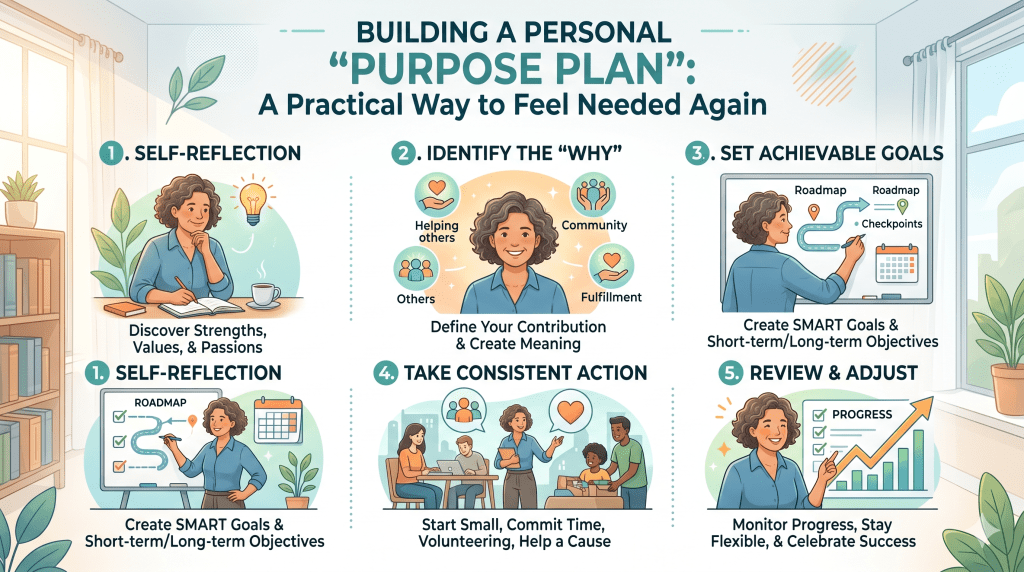
Instead of asking, “What should I do today?” ask, “What role can I play today?” Your parent may no longer be a full-time employee, a daily caregiver, or the head of a busy household. But these roles are still open:
- Family storyteller or historian
- Encourager
- Prayer partner
- Recipe keeper
- Neighborly checker-in
- Mentor
- Birthday reminder
- Plant caretaker
- Listener
- Tradition keeper
- Emotional anchor for grandchildren
These look small from the outside, but they carry weight. A weekly call to a grandson before his exams is a role. Sending a recipe to a daughter is a role. Checking on another widowed friend every Thursday is a role. The question is not “Is this impressive?” It is “Does this help someone feel loved, guided, remembered, or supported?” If the answer is yes, it counts.
Build a weekly contribution map
Write this on paper, keep it on the fridge, or work through it with your parent over the phone. Divide the week into three kinds of contribution.
1. A connection contribution
Something that strengthens a relationship: calling one family member just to ask about their day, sending a voice note with a memory, writing a letter to a grandchild, asking a neighbor how they are, or scheduling a regular Sunday call.
Make it specific. “I should talk to people more” is too vague. “I will call Anna every Wednesday after lunch” is easy to follow. For a parent who hesitates because they do not want to “bother” anyone, a gentle script helps: “I was thinking about you today and just wanted to hear your voice. Do you have five minutes?” It does not demand attention. It opens the door. If starting the conversation is the hard part, a list of easy questions for phone calls takes the pressure off both sides.
2. A help contribution
Something that makes another person’s life easier. It does not have to be physical. Reminding a family member of an important date, helping plan a meal over the phone, sharing advice from experience, listening while someone talks through a problem, praying for someone and telling them so, reading to a grandchild over a video call, or keeping track of family birthdays all qualify.
Feeling useful is often more healing than being entertained. Entertainment passes time. Contribution gives time meaning.
3. A self-respect contribution
Purpose is not only about serving others. Your parent also needs things that say, “My life is still worth caring for”: a short walk if it is safe, chair stretches, watering plants, a meaningful passage, music from a favorite decade, one nourishing meal, twenty minutes of a hobby, sitting in sunlight, a gratitude notebook, or a class or service attended by phone.
A good plan includes all three: connection, help, and self-respect.
Use the “one person, one task, one time” rule
When loneliness feels heavy, even good advice feels like a demand. A parent hears “Volunteer, join a group, call friends, start a hobby” and quietly thinks, that sounds exhausting. So start with one of each:
- One person: “I will call my sister.”
- One task: “I will ask how her doctor’s appointment went.”
- One time: “I will call Tuesday at 6 p.m.”
That is far more effective than “I need to be more social.” Other examples: “I will send my grandson one encouraging message before his exam on Friday.” “I will ask my neighbor if she needs anything from the store this week.” “I will write down one childhood memory for my daughter on Sunday.”
Small promises rebuild trust with yourself. Over time they create rhythm, and rhythm makes loneliness easier to carry.
Plan for low-energy days too
Purpose should not be designed only for active, mobile seniors. Pain, fatigue, illness, vision or hearing changes, and transportation barriers make “join a club” unrealistic. A good plan respects energy, so make two lists.
Green-day purpose
For days when energy is better: attend a group, visit a friend, cook something simple, work on a hobby, go for a walk, volunteer for an hour, help with family planning.
Gray-day purpose
For days when energy is low: make one call, send one message, share one memory, say one prayer, sit near sunlight, listen to music, ask someone about their day, finish one small household task.
These are not lesser forms of purpose. They are accessible ones, and having both lists prevents all-or-nothing thinking — nobody fails a day just because they could not do something big.
Ask better questions
Families want to help but often ask the one question that closes the conversation: “Are you lonely?” Most parents answer “No, I’m fine,” because they do not want to worry you, or they have no words for the ache. Warmer, more specific questions work better:
- “What part of the day feels longest for you?”
- “Who did you enjoy talking to this week?”
- “Is there someone you miss hearing from?”
- “What would make tomorrow feel a little better?”
- “Is there something you used to do that you wish you still had a way to do?”
- “What family story should we write down before we forget it?”
Avoid turning every call into a checklist. Medication, meals, and appointments matter, but if every conversation is only tasks, your parent feels managed rather than loved. Try this order: start with warmth, ask about feelings or memories, then cover practical needs, then end with something to look forward to — “I loved hearing that story. Next time, will you tell me more about how you celebrated holidays when you were young?” That gives the next call a purpose before it begins.
Try JoyCalls Free
No app or new device needed. Start with a free 7-day trial.
Predictable routines help too. When Monday is the grandchild’s story call and Sunday is the family group call, nobody has to wonder, “Should I call? Am I interrupting?” Say “We love hearing from you, let’s make this our regular time” rather than “We need to check on you every day.” That small language change protects dignity. The National Institute on Aging has more on staying engaged in activities you enjoy as you age.
Rebuilding purpose after retirement, illness, or loss
After a major change — retirement, the death of a spouse, a move, lost mobility — purpose often disappears not because there is nothing left to offer, but because the old form of contribution is gone and the new form has not been named yet.
So do not try to return to the old version. Instead of “Why can’t I be who I used to be?” ask, “What part of who I have always been can still be shared today?” A teacher still explains things beautifully. A business owner can still mentor. A homemaker still preserves traditions. The role changes; the core gift usually remains.
A short exercise helps name it. Ask your parent to finish these sentences: “I have always been someone who cares about…” “People used to come to me for…” “I still enjoy helping with…” “Even now, I can still offer…” The answers are purpose clues. “I have always cared about children” may become reading stories to grandchildren. “People came to me for advice” may become mentoring a younger relative.
After a death, do not rush this. Grief needs tenderness first, and what is missed is often not only the person but the shared rituals — morning tea, evening walks, the comfort of being expected. Over time, new rituals give life shape again: lighting a candle each evening and naming one thing to be grateful for, calling a family member at the hour that feels loneliest, cooking one favorite dish of the person they miss, or helping in their memory. Our guide on loneliness in widowhood goes further into that first year. If hopelessness lasts for weeks, or your parent talks about being a burden or having no reason to go on, treat that as a reason to call their doctor rather than a phase to wait out.
One more habit worth stealing: the before-lunch method. Unstructured hours are when loneliness hits hardest, so do one meaningful thing before lunch — one phone call, one paragraph written, one step outside, one page read. The point is not productivity. It is being able to say, “I did something today.”
A one-page weekly purpose plan
Copy these six lines onto a sheet of paper and fill them in together each week:
- This week, I want to feel connected to: name one person or group.
- One small way I can help is: choose one action.
- One story, skill, or memory I can share is: write one idea.
- One thing I will do for my own well-being is: choose one self-care action.
- The day and time I will do it: make it specific.
- Afterward, I will remind myself: “My presence still matters.”
Review it once a month with three questions: What felt good? What felt tiring? Is there a role you want to try, or one you want to stop? The plan should make your parent feel more alive, not more obligated.
Aging changes what contribution looks like, but it does not erase the need to contribute. Your parent can still encourage, remember, guide, teach, listen, notice, and comfort. You do not have to be needed by everyone. Being meaningfully needed by someone is enough — and that someone usually starts with one phone call at a time you can both count on.
If it would help to know that someone talks with your parent every day, JoyCalls makes a friendly phone call at the times you choose, asks how they are doing, and sends you a short summary afterward. Learn how JoyCalls works or call 1-415-569-2439 to hear a sample call.

Ana Avila is a writer who covers the everyday challenges of supporting older adults: staying connected, checking in regularly, remembering medications, maintaining routines, and helping family caregivers stay informed without feeling overwhelmed.
Her work for the JoyCalls blog focuses on the practical side of aging at home and family caregiving. She writes about loneliness and social connection, wellness check-ins, medication reminders, memory support, caregiver stress, aging in place, and the ways AI companions and voice technology can provide consistent support between visits and phone calls. Most of her articles start with a simple question: what is a family caregiver worried about today, and what practical steps can make that situation easier?
Ana writes for people who are busy and often juggling caregiving with work, family, and their own responsibilities. Her guides are designed to be easy to understand, useful right away, and grounded in the realities of caring for an aging parent or loved one. She avoids jargon, explains technology in plain language, and is careful not to oversell what any tool, including AI, can do.
A consistent theme in her writing is that technology should strengthen human connection rather than replace it. The measure of a good system, in her view, is simple: does an older adult feel less alone, does a family member have greater peace of mind, and does a caregiver have more time and energy for the moments that matter most.