


If your parent lives alone, the worry is rarely about one dramatic event. It’s the quiet stretch between phone calls when you have no idea how the day went. This is a plan for both halves of that problem: making the home safer, and making sure the lonely hours have something in them. It ends with a one-page version you can write tonight.
Why living alone changes the math

Living alone in later life is ordinary, not unusual. Pew Research Center found that 27% of adults aged 60 and older lived by themselves in 2020, and for women over 75 the figure is closer to half. Most of them are managing fine.
What changes is the margin for error. A fall that someone else would notice in ten minutes can go unnoticed for hours. The CDC reports that one in four older adults falls each year. A skipped meal becomes a skipped week. And many older adults go long stretches with very little conversation, which research links to worse mental and physical health over time.
So the plan has to cover two things at once: reducing physical risk, and making sure someone would actually notice if something changed. Neither one works without the other. The National Institute on Aging makes the same point: staying connected is a health measure, not a nicety.
Make the home safer first
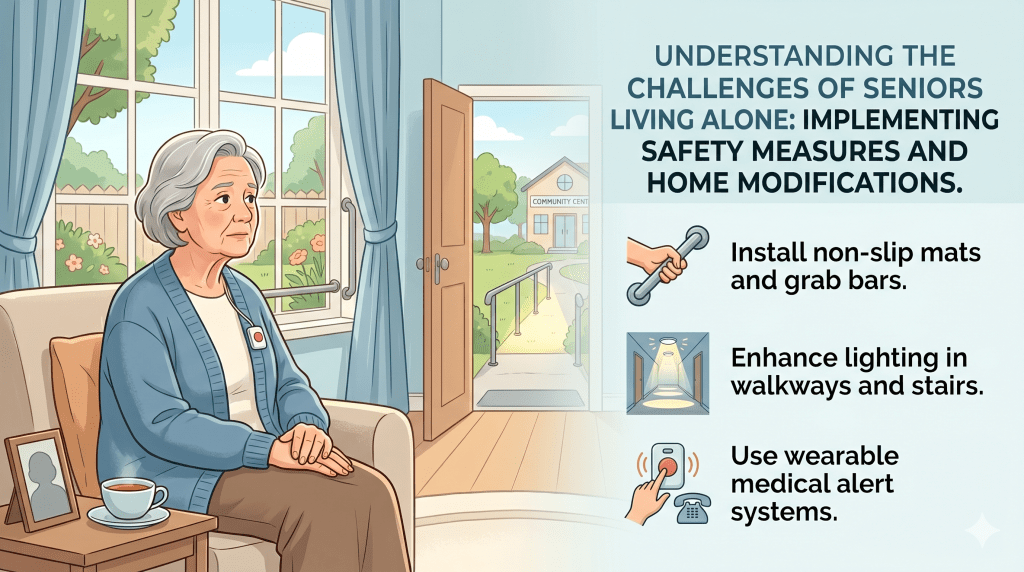
Walk through the house with fresh eyes. Your parent has stopped seeing the hazards because they’ve lived with them for twenty years.
Put night lights in the hallway and bathroom. Get rid of loose scatter rugs or tape them down. Clear walkways of stacked papers, cords and furniture that has crept into the path. In the bathroom, install grab bars by the toilet and inside the shower, use non-slip mats, and add a shower chair if standing is tiring. In the kitchen, move everyday items to waist height so nothing needs a step stool, and use a timer for anything on the stove.
| Room | Priority | Simple fix |
|---|---|---|
| Hallways | Clear pathways | Night lights, remove clutter and loose rugs |
| Bathroom | Slip prevention | Grab bars, non-slip mats, shower chair |
| Kitchen | Fire and reach | Timers, everyday items at waist height |
| Living areas | Lighting and access | Brighter bulbs, clear route to the phone |
Do the decluttering with your parent, not for them. Throwing out someone’s belongings while they watch is the fastest way to lose their cooperation on everything else.
Start with their real day, not your fears
Families usually build support around what they’re afraid of: falls, missed medication, scams. Those worries are valid, but a plan built only from fear feels like surveillance. Start by asking what the day actually looks like.
- What part of the day feels longest?
- Which errands or chores feel harder than they used to?
- Are there times you wish someone would call, but you don’t want to bother anyone?
- Who do you enjoy talking to most?
The answers tell you where to put the support. Mornings often feel manageable because there are tasks. Evenings get heavy when the house goes quiet. Weekends can be the hardest, because appointments, services and visitors all pause. Someone who feels flat after dinner needs an evening call, not a morning reminder. Someone who forgets lunch needs a midday nudge, not another general talk about eating better.
The goal isn’t to fill every empty hour. It’s to cover the vulnerable ones.
Three levels of support: daily, weekly, emergency
Splitting support into three levels keeps you from checking constantly while still covering what matters. It also gives siblings and neighbors something concrete to sign up for, which is the difference between a schedule that holds and one that fades after two weeks.
Daily: is today going normally?
A short phone call, a text, a neighbor’s wave. Short and consistent beats long and unpredictable. A good daily check touches five things: mood, whether they’ve eaten and had something to drink, whether they’ve moved around, anything on the schedule, and who they’ve spoken to.
Keep the tone conversational. Instead of “Did you take your pills?” every single day, try “How did your morning routine go?” Same information, and it doesn’t sound like an inspection.
Weekly: is anything slowly changing?
One person takes a slightly longer call at a predictable time — Sunday afternoon works for a lot of families. You’re looking for drift that a daily check can’t see: going out less, eating the same low-effort food every day, mail piling up, less interest in hobbies, more mentions of bad sleep, skipped appointments, new confusion about dates or bills.
End the weekly call on something good. “What was the best part of your week?” or “What are you looking forward to?” No one wants every conversation with their kids to be a problem audit.
Emergency: what happens if something seems wrong?
Decide this before you need it. Write down who gets called first, second and third, with numbers: family, a nearby neighbor, the doctor, the pharmacy, the building manager. Then write down what counts as urgent, so nobody is debating it at 9pm.
- No answer after two scheduled calls — call the neighbor and ask them to knock.
- Confusion, chest pain, trouble breathing, sudden difficulty speaking, or a fall — call emergency services.
- One missed dose — a family call is enough.
- Missed doses repeatedly — ask the doctor or pharmacist to review the regimen.
- A sudden change in mood or behavior — book a medical appointment rather than waiting it out.
Vague plans cost time. A written escalation ladder makes the response calmer and faster, and it means whoever is nearest can act without a family conference call first.
Spread the load across a circle, not one person
The common failure is one adult child becoming the default caller, driver, note-taker, organizer and emergency contact. That works for a few months and then curdles into burnout.
A circle of care spreads it: siblings, neighbors, friends, someone from their faith community, senior center staff, a paid caregiver, the pharmacist, a meal delivery volunteer, a daily check-in service. Let your parent help choose who’s in it. Being organized around behind your back is humiliating; being consulted is not.
Keep each role small and specific. Not “can you keep an eye on Dad?” but “would you call me if his porch light is still off at 10am, or his mail sits out more than a day?” Specific requests turn goodwill into support that actually happens.
Plan for the hours you know will be hard
Loneliness usually isn’t constant — it has triggers. Evenings. Weekends. Bad weather. Holidays and anniversaries of a loss. The weeks after stopping driving, after a hospital stay, after a close friend moves away or dies. Hearing or vision getting worse.
Once you know the triggers, you can get ahead of them instead of reacting. If Sunday evenings are hard, make a standing Sunday call. If winter keeps them indoors, line up audiobooks, services by phone, and neighbors who’ll drop in. Put grief anniversaries on the family calendar and plan extra contact around them rather than waiting to be asked.
Then make contact easier rather than just more frequent. “You should get out more” ignores why it got hard: group settings exhaust someone with hearing loss, driving at dusk is stressful, grief makes parties unbearable. Ask “what would make this easier?” The answer is often a ride, a quieter setting, someone going along the first time, or permission to leave after half an hour. That’s also how you help from a distance without hovering.
And give every week one thing to look forward to: a favorite meal, a call with a grandchild, a library run, a puzzle afternoon. A blank week feels like chores. Anticipation is what makes a day feel like living rather than maintenance.
Try JoyCalls Free
No app or new device needed. Start with a free 7-day trial.
The quiet warning signs
Most older adults will never say “I’m lonely” or “I need more help.” They minimize, because they’re afraid of losing their independence. Watch for the indirect version: saying “I’m fine” quickly and changing the subject, sleeping far more or far less, letting grooming slide, not picking up the phone, repeating that they don’t want to be a burden, eating badly, dropping hobbies, a house that’s unusually cluttered, new irritability or tearfulness, confusion about bills and appointments, or saying there’s “no point” in things they used to enjoy.
None of these prove anything on their own, but they earn a gentle conversation. Not “you seem depressed,” but “you haven’t sounded like yourself lately, and I care about you — could we make this week a bit easier together?”
If the change is sudden or severe, involve their doctor. Loneliness, depression, medication side effects, dehydration, infection, pain, poor sleep and cognitive change all overlap and can look identical from the outside. Checking early is cheaper than a crisis. If they ever talk about hurting themselves or not wanting to be here, call or text 988 for the Suicide & Crisis Lifeline.
Write the one-page version tonight
If the whole plan feels like too much, put six things on one sheet of paper and stick it on the fridge:
- Three people your parent trusts.
- The best time of day for a check-in.
- One loneliness trigger you already know about.
- One thing each week worth looking forward to.
- A neighbor or nearby contact for urgent concerns.
- What happens if there’s no answer.
Revisit it once a month and ask what’s working, what feels unnecessary, and whether anything new has come up. The best plan isn’t the strictest one. It’s the one your parent will accept and your family can actually keep up.
If it would help to know someone checks in on the days you can’t, JoyCalls makes a friendly phone call at the times you choose and sends you a short summary afterward. Learn how JoyCalls works or call 1-415-569-2439 to hear a sample call.

Ana Avila is a writer who covers the everyday challenges of supporting older adults: staying connected, checking in regularly, remembering medications, maintaining routines, and helping family caregivers stay informed without feeling overwhelmed.
Her work for the JoyCalls blog focuses on the practical side of aging at home and family caregiving. She writes about loneliness and social connection, wellness check-ins, medication reminders, memory support, caregiver stress, aging in place, and the ways AI companions and voice technology can provide consistent support between visits and phone calls. Most of her articles start with a simple question: what is a family caregiver worried about today, and what practical steps can make that situation easier?
Ana writes for people who are busy and often juggling caregiving with work, family, and their own responsibilities. Her guides are designed to be easy to understand, useful right away, and grounded in the realities of caring for an aging parent or loved one. She avoids jargon, explains technology in plain language, and is careful not to oversell what any tool, including AI, can do.
A consistent theme in her writing is that technology should strengthen human connection rather than replace it. The measure of a good system, in her view, is simple: does an older adult feel less alone, does a family member have greater peace of mind, and does a caregiver have more time and energy for the moments that matter most.