


If your parent has more free time than ever and still sounds flat when you call, a hobby really can help. The trouble is that most hobby lists fail for the same reason: the activities they suggest are too big to start on a tired Tuesday afternoon.
So this guide keeps everything small. You will find gentle activities that are easy to begin and cheap to try, plus the part most lists skip — how to help the hobby stick once the novelty wears off. The move from a structured working life to open-ended days takes real adjustment, and a small repeatable routine helps with that far more than a long list of suggestions.

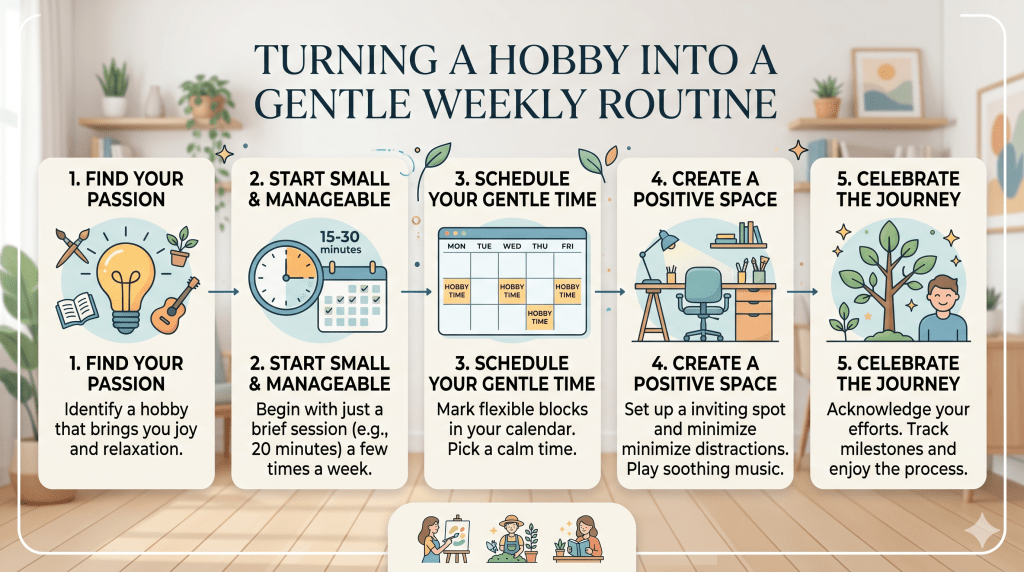
Start with the tiniest version of the hobby
Most people give up because they begin too big. They decide to paint, so they buy a large canvas and a full set of supplies. They decide to walk, so they plan a long route. They decide to read again, so they choose a thick book. It feels exciting for a week. Then it feels tiring, and the hobby quietly disappears.
Suggest the smallest possible version instead:
- Reading: five pages. If that is too much, one poem, one short article, or one page of a familiar book.
- Gardening: one potted plant. Not a balcony, a yard, or a vegetable bed.
- Writing: three sentences — what they ate, what the weather did, one memory from childhood.
- Music: one song after breakfast, sitting down and listening properly.
- Reconnecting: one short call or one note a week.
The tiny version works because it removes pressure. The hobby feels friendly instead of demanding, and once it is familiar your parent can do more if they feel like it. A useful rule: pick a version that would still feel possible on a low-energy day. If they can do it when they are tired, it has a chance of becoming part of life.
Attach it to something they already do
A new habit is much easier when it sits next to an old one. Instead of “I will start journaling,” it becomes “after my morning tea, I write three lines.” Instead of “I will do puzzles,” it becomes “after lunch, I spend ten minutes on a crossword.”
The day already has anchors — meals, medication times, tea, the evening news, bedtime. A hobby only needs to attach itself to one of them:
- After breakfast, water one plant.
- After lunch, read for ten minutes.
- After afternoon tea, call one friend or relative.
- Before dinner, play one favorite song.
- Before bed, write down one thing worth appreciating from the day.
It does not need to be long. Shorter is better at the start, because repetition matters more than duration. A small hobby done three or four times a week brings more comfort than a big one done once and then forgotten.
Put the supplies within arm’s reach
For someone with low energy, stiff hands, weaker eyesight, or memory trouble, setup is usually the real barrier. If the supplies live in another room or on a high shelf, the activity never happens.
Make one hobby spot: a side table, a basket beside the chair, a drawer by the bed, or a tray that moves easily.
- Reading: book, glasses, bookmark, and a small lamp together.
- Writing: notebook and pen in the same place every day.
- Coloring: pencils already sharpened, pages already open.
- Puzzles: the puzzle book left open with a pen tucked inside.
- Knitting or crochet: yarn, needles, and scissors in one soft bag.
- Phone calls: a written list of names and numbers kept beside the phone.
This is where you can help far more than by suggesting a hobby. Your parent may like the idea of painting, but if they first have to hunt for supplies, clear the table, fix the lighting, and clean everything afterwards, it will not happen. A ready-to-use tray makes the difference.
Comfort matters too. A chair that supports the back, light that is genuinely bright enough, water nearby, large-print books or a magnifier, easy-grip pens or thick-handled brushes if hands feel stiff. A hobby should feel inviting, not like a test of endurance.
Gentle hobbies that are easy to start
Quiet indoor options
- Reading — a novel, a magazine, or short articles; audiobooks count.
- Journaling, which also preserves family stories no one else knows.
- Adult coloring books, which produce something nice with no skill required.
- Knitting or crochet, where the repetitive motion is soothing and you end up with something to keep or give away.
- An old instrument from the cupboard, or something forgiving like a harmonica.
- Cooking one familiar recipe, slowly, for the pleasure of it.
Outdoors, without the effort
- Container plants or a raised bed, tended at whatever pace suits the day.
- A slow walk around the neighborhood or a nearby park, with no set pace.
- Bird watching from a window or on a short visit to the park.
- A flat, accessible trail — short at first, longer only if it feels good.
Free or nearly free
- The local library: books, audiobooks, online learning, and often community events and clubs.
- Community centers, which frequently run game nights, exercise classes, and workshops built for older adults.
- Parks, walking, and bird watching, which cost nothing at all.
- Gardening from seeds or cuttings shared with a neighbor.
- Swapping puzzle books, craft materials, or garden tools with friends.
If they enjoy a screen
- Podcasts on almost any subject, free and available whenever they want them.
- Simple online games, which can be played with grandchildren who live far away.
- Photographs taken on a phone camera, with no equipment to buy.
- Genealogy databases, which turn family history into a long, absorbing project.
Many libraries and senior centers run free technology classes for older adults at a patient pace. But if your parent would rather not, reading, gardening, knitting, walking, and writing are every bit as good. Technology is a tool, not a requirement. If a group class is the sticking point rather than the hobby itself, it may help to read about a parent who keeps turning down social activities.
Plan for low-energy days
Some days the pain is worse, sleep was poor, the weather is grim, or the mood dips for no clear reason. A plan that only works on good days tends to end after one bad week, so give each hobby three levels.
| Hobby | Easy | Easier | Easiest |
|---|---|---|---|
| Reading | Read one chapter | Read two pages | Listen to an audiobook or have someone read aloud |
| Gardening | Water and trim the plants | Check the soil and pull off dry leaves | Sit near the plant and enjoy looking at it |
| Writing | Write one full page | Write three sentences | Write one word that describes the day |
| Movement | Take a short walk | Do seated stretches | Three slow breaths, gently moving ankles and hands |
| Connection | Call a friend | Send a short message | Ask someone to call, or set up a check-in |
This protects confidence. Doing less still counts, and the routine survives a rough week instead of ending with it.
Build a small hobby menu
Rather than relying on one activity, write a short menu of choices. Loneliness makes decisions harder, and a prepared list gives the mind a gentle prompt on the days when nothing sounds appealing.
- Quiet days: reading, music, coloring, journaling.
- Restless days: walking, stretching, light gardening, tidying one drawer.
- Lonely days: calling someone, writing a letter, sharing a memory.
- Curious days: documentaries, podcasts, history, genealogy.
- Creative days: crafting, cooking, drawing, photography, arranging flowers.
Make the menu together on a visit. Ask what feels easy, what they loved years ago, and what they would like to try again, then write the answers down and leave the list somewhere visible. It should reflect their taste and energy, not yours.
Let the hobby change your phone calls
If every call opens with health, appointments, and problems, life starts to feel smaller than it is. A hobby gives your parent a different subject — small updates, stories, something in progress.
So instead of only asking how they are, ask something specific: what did you read today? Did the plant put out new leaves? What song did you play this morning? Did you get anywhere with the puzzle? These are gentle questions, but they open the door to a real conversation, much like other check-in questions that work better than “how are you?”.
Keep the tone encouraging rather than supervisory. “I loved hearing you worked on the puzzle this week” lands very differently from “did you do your hobby today?” If a hobby turns out to be boring, tiring, or fiddly, dropping it is information, not failure — ask what part they enjoyed, what felt hard, and whether a simpler version would work.
A shared hobby also gives you a reason to be in touch that is not a status check, which matters a lot when you live too far away to drop in. Read the same short story and talk about it by phone. Watch the same program and compare notes. Swap recipes. Mail a handwritten note once a week. Ask a grandchild to teach them one new word or song.
A seven-day way to start
If you want one concrete plan, this is a fair trial without a long commitment:
- Day 1: Choose one hobby that sounds gentle and mildly interesting.
- Day 2: Set up the hobby spot with everything needed in one place.
- Day 3: Try it for ten minutes only.
- Day 4: Note how it felt — calming, tiring, boring, or enjoyable.
- Day 5: Try it again, making it easier if day three was a stretch.
- Day 6: Tell someone about it. One small detail is enough.
- Day 7: Decide whether to continue, simplify, or try something else.
Loneliness rarely lifts because of one big change. It lifts through small, repeated moments of comfort, interest, and contact — and a hobby that is easy enough to repeat is one of the simplest ways to create them.
If it would help to know your parent has something to look forward to on the quiet days, JoyCalls makes a friendly phone call at the times you choose, asks how they are doing, and sends you a short summary afterward. Learn how JoyCalls works or call 1-415-569-2439 to hear a sample call.
Try JoyCalls Free
No app or new device needed. Start with a free 7-day trial.

Ana Avila is a writer who covers the everyday challenges of supporting older adults: staying connected, checking in regularly, remembering medications, maintaining routines, and helping family caregivers stay informed without feeling overwhelmed.
Her work for the JoyCalls blog focuses on the practical side of aging at home and family caregiving. She writes about loneliness and social connection, wellness check-ins, medication reminders, memory support, caregiver stress, aging in place, and the ways AI companions and voice technology can provide consistent support between visits and phone calls. Most of her articles start with a simple question: what is a family caregiver worried about today, and what practical steps can make that situation easier?
Ana writes for people who are busy and often juggling caregiving with work, family, and their own responsibilities. Her guides are designed to be easy to understand, useful right away, and grounded in the realities of caring for an aging parent or loved one. She avoids jargon, explains technology in plain language, and is careful not to oversell what any tool, including AI, can do.
A consistent theme in her writing is that technology should strengthen human connection rather than replace it. The measure of a good system, in her view, is simple: does an older adult feel less alone, does a family member have greater peace of mind, and does a caregiver have more time and energy for the moments that matter most.