


Have you ever felt that quiet knot of worry in your stomach when you think about your mom or dad and their daily pills? You’re not alone. In fact, three out of four people in the U.S. struggle to take their prescriptions correctly. This common challenge weighs heavily on families every single day.
This guide is like having a direct line to the heart of the matter. We share straightforward, proven strategies that work in real life. These are the same supportive approaches used by healthcare professionals to help seniors and their families stay on a healthy path.
We know life is busy. The goal is to find real solutions that fit seamlessly into your routine and your loved one’s life. Managing health shouldn’t feel like another overwhelming chore on the list.
You’ll find compassionate support here that tackles the real reasons doses are missed. We address forgetfulness, confusion about instructions, cost worries, and even doubts about a prescription’s effectiveness. These are human problems, and they deserve human-centered solutions.
Whether you’re helping a parent from across the country or are a senior looking for better ways to manage your own health, this guide offers actionable steps. Think of it as a caring conversation with someone who truly understands.
Key Takeaways
- A vast majority of Americans find it difficult to follow their prescription schedules correctly.
- Practical strategies exist that can make a significant difference in daily health management.
- Effective solutions are designed to fit into busy, real-world lives without adding stress.
- Common hurdles include simple forgetfulness, confusion, cost, and uncertainty.
- The focus is on compassionate, straightforward support that respects the individual’s journey.
- This guidance is valuable for both family caregivers and seniors managing their own well-being.
Introduction to Medication Adherence
The distance between your home and your parent’s feels much farther when you’re worried about whether they’re taking care of their health properly. This concern touches millions of families every day.
Overview of the Adherence Challenge
Following prescription directions sounds simple. But life gets complicated. The American Heart Association reveals a startling truth: 3 out of 4 Americans don’t take their prescriptions correctly.
People managing chronic health issues face the toughest challenges. Multiple pills at different times create confusion. It’s completely understandable when someone feels overwhelmed.
Importance for Seniors and Chronic Conditions
For older adults with ongoing health needs, consistency with prescriptions isn’t just important—it’s essential for maintaining independence. Missing doses can lead to serious complications.
Understanding this challenge helps families approach it with empathy rather than frustration. As former U.S. Surgeon General C. Everett Koop wisely noted:
Drugs don’t work in patients who don’t take them.
This isn’t about blame. It’s about recognizing a common struggle and finding compassionate solutions together.
Understanding the Challenges of Medication Adherence
Behind every missed prescription dose lies a human story—a reason that makes perfect sense to the person living it. These aren’t acts of defiance. They’re responses to real obstacles that make consistent health management difficult.
When we understand what people actually face each day, we can offer support that truly helps.
Common Barriers Faced by Patients
People stop taking their prescriptions for reasons that feel immediate and personal. Side effects that disrupt daily life. Confusion about complex schedules. Financial stress making choices painful.
Simple forgetfulness isn’t carelessness—it’s human. Busy lives, changing routines, and multiple prescriptions create perfect conditions for doses to be missed.

Impact on Health and Healthcare Costs
The consequences extend far beyond a single missed pill. Failure to follow a treatment plan is a leading cause of poor health outcomes. It can lead to hospital visits that were preventable.
This creates a heavy burden—emotional stress for families and significantly higher medical expenses. What begins as a small stumble can become a serious health crisis.
Recognizing these challenges is the first step toward building solutions that work in real life, not just on paper.
Pharmacist tips medication adherence
There’s a quiet ally in your neighborhood who holds practical wisdom about making daily health routines work in real life. Your local pharmacist sees your family member regularly and notices patterns that others might miss.
These professionals understand that the goal isn’t perfection. They aim to help patients take their prescriptions consistently enough to reach about 80% adherence—the point where treatments become truly effective.
Simple Strategies from Pharmacists
Community pharmacists offer practical tips that fit naturally into daily life. They might suggest keeping pills by your toothbrush or using simple pill organizers.
One powerful approach involves asking gentle questions about daily routines. This reveals real challenges without making anyone feel defensive about their medication management.
When pharmacists focus on adherence as part of quality care, everyone benefits. Patients stay healthier, and families experience less worry about safety concerns when they can’t be.
Try JoyCalls Free
No app or new device needed. Start with a free 7-day trial.
These simple ways of providing consistent care make a real difference in health outcomes. They transform prescription management from a chore into supported daily living.
Utilizing Medication Therapy Management (MTM)
What if healthcare came to your loved one’s kitchen table instead of requiring another stressful trip to the clinic? This is the heart of Medication Therapy Management programs. They transform prescription management from a clinical chore into supportive conversations.

Role of Kitchen Table Consults
Kitchen table consultations bring healthcare professionals directly into homes. Christy Whitlock, RPh of Winyah Home Rx in South Carolina, partners with local hospitals to identify people needing extra support.
Her program sends medication coaches to patients’ homes. They examine all prescriptions together in a comfortable setting. This approach helps people open up about their real challenges.
Coaching and Personalized Care
The role of MTM goes beyond simple prescription reviews. It involves coaching patients through complex regimens. This personalized care addresses individual needs and routines.
Medication coaches investigate financial assistance programs many families don’t know exist. They remove cost as a barrier to consistent health management. This comprehensive approach makes patients feel truly supported.
When care happens in familiar environments, solutions become practical and sustainable. The pharmacy team becomes a trusted partner in health journey management.
Improving Pharmacy Workflow for Better Adherence
Ever wonder why some pharmacies feel calm and organized while others seem chaotic? The answer lies in workflow systems that directly impact patient care. Donald Grove, RPh, developed the SmartFlow Pharmacy Workflow System to create more efficient pharmacies.
This organized approach uses color-coded prescription baskets to prioritize needs. Urgent cases get immediate attention. Special insurance issues have dedicated baskets. Nothing gets overlooked.
Organizing Prescription Processes
SmartFlow clearly defines staff roles. Technicians handle routine prescriptions. A dedicated counter technician manages customer interactions. Production pharmacists focus on verification. Clinical pharmacists concentrate on patient care services.
This separation creates space for what matters most. Pharmacists can step away from the counter. They have time for meaningful conversations with patients. Counseling becomes possible rather than rushed.
The benefits extend throughout the pharmacy. Staff experience less stress and lower turnover. Patients see familiar faces during each visit. Continuity of care improves relationships.
| Traditional Pharmacy | Organized Workflow Pharmacy | Patient Impact |
|---|---|---|
| Mixed roles and responsibilities | Clear staff specialization | More focused attention |
| First-come, first-served processing | Priority-based color coding | Urgent needs addressed faster |
| Pharmacists multitasking constantly | Dedicated counseling time | Thorough medication reviews |
| High staff turnover | Balanced schedules and roles | Consistent, familiar care |
Well-run pharmacies catch potential issues early. They prevent problems before medications leave the counter. This proactive approach gives families peace of mind.
The goal is creating environments where patients feel heard. Where questions get answered completely. Where health management becomes a partnership rather than a transaction.
Simplifying Medication Regimens
Imagine replacing the monthly scramble of prescription pickups with one simple, predictable day. This vision becomes reality through medication synchronization programs that transform chaotic health management into organized care.

The National Community Pharmacists Association offers a free program called Simplify My Meds. It helps coordinate all refills to be ready simultaneously. Patients can collect everything during one monthly visit.
Benefits of Consolidated Pickup Days
Multiple pharmacy trips create confusion and exhaustion. When all prescriptions align on one date, the burden lifts significantly. Family caregivers can plan around a single pickup day with confidence.
This approach prevents running out of one prescription while others remain at home. It’s a common reason people miss doses. Synchronization creates safety through organization.
Pharmacies using these programs report remarkable results. Some see 30% more patients staying consistent with their regimens. The convenience clearly makes a difference in whether people take medication as directed.
| Before Synchronization | After Synchronization | Impact on Daily Life |
|---|---|---|
| 3-4 separate pharmacy visits monthly | One coordinated pickup day | Reduced transportation stress |
| Different refill dates causing confusion | All medications ready together | Simplified tracking for caregivers |
| Frequent “emergency” refill calls | Predictable monthly schedule | Less last-minute scrambling |
| Higher risk of missed doses | Improved consistency | Better health outcomes |
Research shows that structured programs significantly improve prescription consistency. When the pharmacy experience becomes streamlined, patients feel more supported in their health journey.
The emotional relief is palpable. Seniors appreciate the personalized service. Families gain peace of mind knowing everything is managed proactively.
Identifying Patient-Specific Adherence Issues
Each person carries their own quiet reasons for why prescriptions sometimes get left behind. Your uncle might feel fine and decide he doesn’t need his heart medicine today. Your neighbor might struggle with a complex schedule that makes consistent timing impossible.
Elizabeth Whalley Buono, a healthcare expert, emphasizes that automatic refills alone don’t solve the real problem. Just because someone picks up their prescription doesn’t mean they’re taking it correctly. The solution requires understanding what happens after the pharmacy visit.
Recognizing Behavioral Cues
Simple questions can reveal complex challenges. “How do you remember to take your medications?” opens a conversation without judgment. The answer shows whether someone has a reliable system or is struggling day by day.
Another revealing question is “How would you know if you missed a dose?” This tells healthcare providers whether the patient has organizational strategies in place. Some people take “drug holidays” when they feel better, not realizing consistency matters.
Behavioral cues like frequently needing early refills or always having extra pills left over signal underlying issues. When providers focus on individual challenges rather than generic solutions, they can recommend strategies that actually work for each person’s unique life.
Implementing Technology in Medication Management
What if technology could provide the gentle nudge your loved one needs, without adding another screen to their life? Modern tools are designed to support, not complicate. They work quietly in the background of daily routines.

Digital systems give pharmacies real-time access to important information. They can see which patients might need extra support. This helps them use their time more effectively.
Digital Tools and Automated Reminders
Automated reminders can send texts or make phone calls. The most helpful solutions feel personal, not robotic. They should fit naturally into someone’s day.
For seniors who find smartphones confusing, services like JoyCalls offer a simple alternative. It’s an AI-powered phone companion that makes daily check-in calls. No apps or downloads required—just a regular telephone conversation.
This service acts as both a reminder and a friendly voice. It asks how your loved one is feeling and mentions their schedule. Then it sends you a brief summary so you stay connected.
| Technology Type | Best For | Family Benefit |
|---|---|---|
| Smartphone Apps | Tech-comfortable seniors | Immediate notifications |
| Automated Phone Calls | All phone users | Consistent check-ins |
| JoyCalls AI Companion | Seniors preferring conversation | Personalized updates |
| Pharmacy Tracking Systems | Healthcare providers | Proactive support alerts |
Tracking Patient Interactions with Tech
Digital management systems help pharmacies track interactions over time. They identify patterns that might need attention. This proactive approach improves outcomes for patients.
These tools give providers clear access to trends. They can see who might be struggling with their routine. This allows for timely support before small issues become big problems.
The goal isn’t to replace human connection. It’s to use technology to enhance care. To provide consistent support that gives families peace of mind.
Enhancing Patient-Pharmacist Communication
Think about the familiar face your parent sees most often when managing their health—it’s likely not their doctor, but their local pharmacist. This regular contact creates a powerful opportunity for support that goes far beyond simply handing over a prescription bottle.
When this professional takes just a few minutes for a real conversation, it can change everything. It’s about building a bridge of trust, one friendly question at a time.
Effective Consultation Practices
A great consultation starts with listening. Instead of lecturing, a skilled pharmacist asks open-ended questions. “How are you feeling with this new medication?” or “Have you noticed any changes?”
These simple inquiries invite the patient to share concerns they might not mention in a rushed doctor’s visit. This approach provides crucial information and makes the person feel heard. Studies confirm that this supportive dialogue is a cornerstone of effective health management.
Building Trust Through Regular Dialogue
Trust grows when your loved one feels remembered and genuinely cared for. The role of the pharmacist evolves into a consistent source of reassurance.
Patients often have more questions after starting a therapy. A welcoming environment where they can ask anything without judgment is vital. This ongoing care helps catch small issues early, making adjustments before they become big problems.
When communication flows easily, your family member feels supported every step of the way. This connection turns a routine errand into a partnership for better health.
Scheduling and Workflow Optimization for MTM Reviews
There’s a quiet transformation happening in community pharmacies that turns chaotic moments into opportunities for genuine connection. During peak hours, you’ll see phones ringing and lines forming. Yet meaningful conversations about health are still happening.

The secret lies in smart scheduling. When pharmacies pre-book medication therapy management reviews, they create protected time. This allows for in-depth conversations without the pressure of a growing line.
Planning ahead for prescription refills makes a huge difference. Instead of reacting to the next script in the queue, successful professionals manage their workflow proactively. This approach creates valuable opportunities for the people who need support.
One pharmacy expert noted the importance of this shift:
Proper workflow management isn’t about working harder—it’s about working smarter to ensure every patient receives the attention they deserve.
These scheduled sessions give your loved one dedicated, unhurried time. They can review all their prescriptions and ask questions that might otherwise get overlooked. The structured approach to patient care ensures nothing gets missed.
| Traditional Approach | Optimized Workflow | Patient Experience |
|---|---|---|
| First-come, first-served | Pre-scheduled appointments | Predictable, stress-free visits |
| Constant reaction to demand | Proactive planning | More thorough consultations |
| Rushed conversations | Protected consultation time | All questions answered completely |
| High-pressure environment | Calm, organized space | Confidence in care received |
This thoughtful management of time and resources benefits everyone. Professionals feel less rushed. People receive better attention. Families gain peace of mind knowing their loved one’s health is being handled thoroughly.
Educating Patients on Medication Expectations
Starting a new therapy often comes with more questions than answers, leaving many patients feeling uncertain about what lies ahead. This uncertainty can lead to premature decisions about their treatment.
What to Expect with New Therapies
When people begin new medications, they often expect immediate results. Some drugs take weeks to show full effects. Others work quietly without obvious changes.
Doctors typically spend less than a minute explaining how a drug works. This leaves gaps in understanding. Patients need clear timelines for when to expect improvements.
Managing Side Effects and Concerns
Side effects can scare people away from beneficial treatments. Many temporary reactions are normal. Patients should know which side effects require immediate attention.
Education transforms the experience. People who understand their medications become partners in their health. They’re more likely to continue their treatment even during challenging periods.
Proper guidance helps patients distinguish between normal adjustments and concerning symptoms. This knowledge is crucial for maintaining consistent care, much like tracking daily wellness habits from a distance.
| Common Patient Assumption | What Providers Should Explain | Impact on Treatment Success |
|---|---|---|
| “I feel better, so I’m cured” | Many medications require ongoing use for maintenance | Prevents premature discontinuation |
| “Side effects mean the drug is bad” | Some effects are temporary and manageable | Reduces treatment abandonment |
| “No immediate change means it’s not working” | Timelines vary significantly between medications | Maintains patience during adjustment period |
Create a Fail-Safe Home Medication System That Seniors Can Actually Stick To
Staying on track with medication is rarely about “trying harder.” For most older adults, the real issue is that the system around the medication is too fragile. One late morning, one confusing label change, one skipped refill, or one rushed evening can throw everything off.
That is why the most effective medication routine is not built on memory alone. It is built on structure.
For seniors, older adults, and family caregivers, the goal should be simple: create a home medication system that still works on busy days, tired days, forgetful days, and stressful days. In other words, the routine should not depend on perfect focus. It should be reliable even when life is not.
A safer home system usually includes five things: one clear medication list, one consistent storage method, one organized dose routine, one plan for changes and missed doses, and one backup person or checkpoint. Health agencies also recommend keeping an updated medication list, including prescriptions, over-the-counter medicines, vitamins, and supplements, and sharing it with a trusted caregiver or family member. That step alone can prevent confusion during appointments, emergencies, or medication changes.
The good news is that this does not have to be complicated. In fact, the best systems are usually the simplest. Let’s walk through what that can look like in real life.
Start With One Master Medication List, Not Scattered Notes
Many seniors have medication information in too many places at once. One bottle is on the kitchen counter. Another instruction is written on a sticky note. A recent dosage change is remembered “somewhere in the back of the mind.” A caregiver has one version of the list, and the doctor’s office has another.
That kind of patchwork is where mistakes begin.
Instead, create one master medication list and treat it as the single source of truth. This list should include:
- the name of each medication
- what it is for
- the exact dose
- when it should be taken
- whether it should be taken with food or without food
- special instructions
- the prescribing doctor
- the pharmacy name and phone number
- any allergies or past reactions
- all vitamins, supplements, inhalers, drops, creams, and over-the-counter medicines
The FDA recommends keeping a complete medication list and carrying or sharing it with caregivers and healthcare professionals because it helps prevent errors and improves safety. AHRQ also recommends bringing all medicines, including nonprescription items and medicines used only occasionally, when reviewing medications with a care team.
For seniors, the most useful version is usually not the most “digital” one. It is the one that is easiest to update and easiest to read. A large-print paper list in a folder often works better than a phone note that gets lost. Keep one copy at home, one in a wallet or purse, and one with the main caregiver.
Action step: Set a monthly “medication list check” date. On that day, confirm that every dose, timing instruction, and refill status is still accurate.
Build One Home Base for Medications
A lot of adherence problems start with poor setup at home. Medicines are stored in three different rooms. Some are near the sink, some in a purse, some in a bedside drawer, and some are mixed with old bottles that should no longer be used.
When the setup is scattered, the routine becomes scattered too.
Choose one main medication home base. This should be a dry, easy-to-reach location that fits the senior’s daily routine. For many people, that means a dedicated shelf, drawer organizer, or labeled bin in a low-humidity area. MedlinePlus advises storing medicines carefully and notes that heat and moisture can damage some medications; it also recommends keeping medicines in their original containers unless a pill organizer is being used as part of an organized system.
One important reminder: the bathroom medicine cabinet is often not the best place. Bathrooms tend to get warm and humid, which can affect medication quality. Also, never mix different medications into one unlabeled bottle just to “save space.” That creates unnecessary risk and can lead to dose mix-ups.
If a weekly pill organizer is used, keep the original prescription bottles too. The original containers still matter because they hold the label, refill number, expiration details, and instructions. That becomes especially helpful when the pharmacy changes a tablet’s appearance or a new caregiver steps in.
Action step: Create three clearly labeled zones:
- Current daily medicines
- As-needed medicines
- No longer used / needs disposal review
That small separation can prevent a surprising number of mistakes.
Match the Medication Routine to Daily Life, Not the Other Way Around
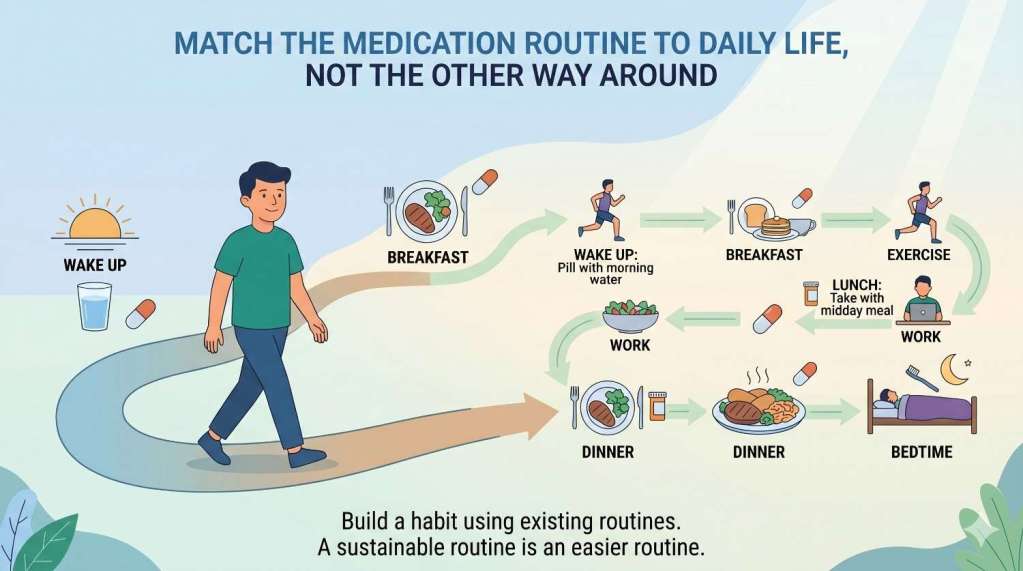
Many medication routines fail because they are designed around the prescription label, but not around the person’s actual life.
If a senior wakes up at different times every day, a rigid 7:00 a.m. plan may not hold. If lunch is irregular, a noon medication may be forgotten. If evenings are when fatigue sets in, a bedtime medication may be the one that gets missed again and again.
The better approach is to attach each medication time to a stable daily anchor. MedlinePlus recommends creating a routine, using charts, checklists, reminder calls, and storing medicines in a consistent place to make taking medication easier at home.
Good anchor examples include:
- after brushing teeth
- with breakfast
- after the morning news
- with the evening meal
- after feeding the pet
- before turning off the bedroom lamp
This sounds simple, but it is powerful. A stable anchor reduces the mental effort of remembering. The brain stops asking, “Did I take it yet?” and starts connecting medication to a predictable event.
For seniors taking multiple medications, do not aim for a “perfectly elegant” schedule. Aim for a schedule that is realistic. If three morning pills can safely be taken during one breakfast routine, that may be much more sustainable than spacing them out in ways that create confusion. Any change like that, of course, should first be confirmed with the prescriber or pharmacist.
Action step: For each medication time, complete this sentence:
“I will take this when I ______.”
If that blank is hard to fill, the routine is probably too vague and needs to be redesigned.
Use a Pill Organizer the Right Way
A pill organizer can be extremely helpful, but only if it is used carefully. MedlinePlus specifically notes that weekly organizers with multiple compartments can help people keep track of medicines by day and time.
The mistake many families make is assuming the organizer itself solves the problem. It does not. It only works if there is a clear filling process and a clear checking process.
For seniors, a pill organizer works best when:
- it matches the number of dose times per day
- it is filled on the same day each week
- it is filled in a quiet setting, without distractions
- the filled organizer is double-checked against the medication list
- one person is clearly responsible for updating it after medication changes
If the senior has vision issues, hand tremors, or mild cognitive impairment, the filling process should not be rushed. That is when errors happen. Some families do best when a caregiver fills the organizer and the senior only focuses on taking what is already prepared.
Another strong practice is to leave a simple paper checklist next to the organizer for the first few weeks after any medication change. That gives the senior one more visual confirmation until the new routine becomes automatic.
Action step: Choose one “refill and reset” time every week, such as Sunday after breakfast. Treat it like an appointment, not an optional task.
Plan for the Two Most Common Problems: Missed Doses and Medication Changes
Even a good system will be tested. The real question is not whether problems will happen. It is whether the senior knows what to do next.
Two situations cause the most confusion:
1. A missed dose
Many people panic, guess, or double up. That can be risky. The right response depends on the medication, the dose timing, and the person’s condition. If there is no clear instruction from the doctor or pharmacist, the safest move is to call the pharmacy or prescriber rather than improvise. FDA resources emphasize asking questions and making sure directions are understood, especially when there is uncertainty about safe use.
2. A recent medication change
This is where older routines become dangerous. A senior may keep taking the old dose from habit. Or an old bottle remains in the cabinet and gets mixed into the new plan.
Whenever a medication is added, stopped, or changed, the following should happen the same day:
- update the master medication list
- remove or clearly separate old bottles
- update the pill organizer
- write down the new instructions in plain language
- tell the caregiver or backup support person
This is also the right time for a “brown bag review.” Put every current medication, supplement, inhaler, and over-the-counter item into one bag and review them with the pharmacist or clinician. That kind of full review helps catch duplicates, outdated bottles, and conflicting instructions.
Action step: Keep a bright note near the medication station that says:
“If something changed this week, update the list before the next dose.”
Create a Refill Safety Net Before the Bottle Runs Low
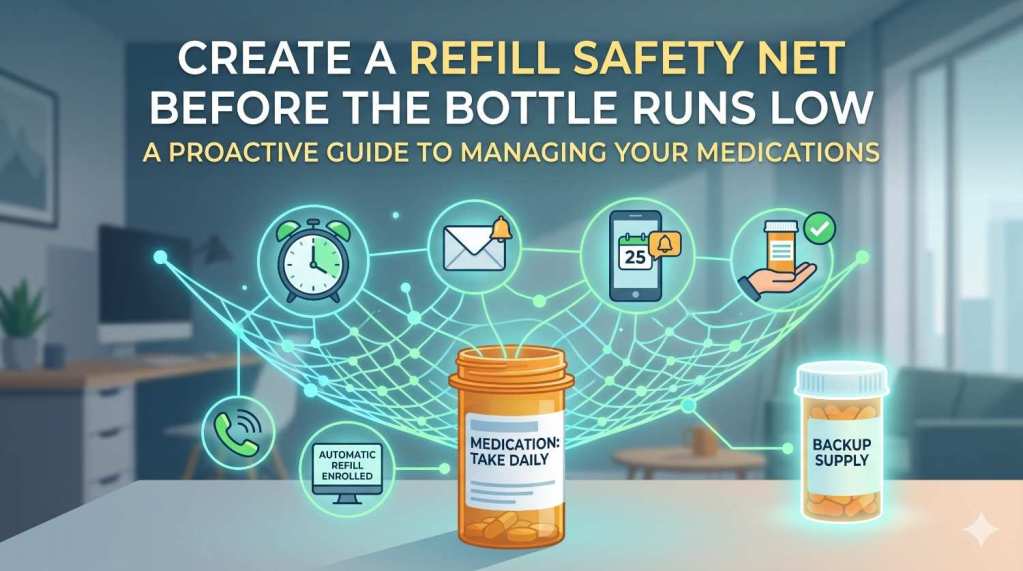
A lot of nonadherence has nothing to do with forgetting a dose. It starts earlier, when the person is running low but assumes there is still “plenty left.” Then the refill gets delayed by a weekend, a transportation issue, a prior authorization, or simple procrastination.
Instead of reacting late, seniors should build a refill rule. A very practical one is this: when there is about a 7-day supply left, check refill status immediately. That gives enough room to solve problems before doses are missed.
Families should also decide in advance who handles refill follow-up. Is it the senior? The adult child? The spouse? A home aide? Ambiguity creates gaps.
To make this easier, keep a refill section on the master list with:
- medication name
- refill number
- prescribing office
- next refill date
- last pickup date
The article already talks about synchronization, but this home-level refill safety net is different. This is the practical day-to-day follow-through that prevents a good refill system from breaking down in real life.
Action step: Add a standing calendar reminder called “Check what is under 7 days left.” Do it weekly.
Watch for Silent Signs the System Is Failing
Medication problems often show up before anyone says, “I’m confused.” Seniors may feel embarrassed, or they may not realize the routine is slipping.
That is why families should watch for patterns, not just one-off mistakes.
Signs the system may be failing include:
- pills left over at the end of the week
- organizer compartments that are repeatedly missed
- frequent uncertainty about whether a dose was taken
- old bottles mixed with new ones
- running out early or very late
- new dizziness, fatigue, stomach upset, or confusion after a medication change
- the senior saying things like “I take the blue one when I feel I need it”
CDC notes that medication-related harm is a significant safety issue, and risk can rise as adults get older and use more medicines. Learning medication safety practices can reduce preventable harm.
The key is to respond early and calmly. Not with blame. Not with panic. Just with a reset.
A helpful phrase for caregivers is:
“Let’s make the system easier,”
instead of
“Why are you missing doses?”
That difference matters. Shame makes people hide mistakes. Support helps them solve them.
Give Every Senior a Backup Layer
No medication system should rely on one person having a perfect week forever.
Every senior needs a backup layer. That might be:
- an adult child who checks in once a week
- a spouse who reviews the organizer at dinner
- a caregiver who confirms changes after appointments
- a friend who does a refill reminder call
- a phone-based reminder service for people who do better with spoken prompts
MedlinePlus recommends reminder supports such as calls, charts, and help from family members. The FDA also advises sharing medication information with a trusted relative, friend, or caregiver.
This does not mean taking away independence. It means protecting independence by putting light support around a routine that matters.
For seniors who strongly value privacy, the backup layer can be very respectful. It can be as simple as one weekly question:
“Has anything changed with your medicines this week?”
That one question catches more problems than most people expect.
Make the System Easier Every Time It Fails
A medication routine should be adjusted the way a good home setup is adjusted: based on what keeps going wrong.
If breakfast pills are often missed, the issue may not be motivation. The issue may be that breakfast is too inconsistent.
If bedtime doses are skipped, the medication may need to move to an earlier evening anchor if clinically appropriate.
If labels are hard to read, the issue may be visual accessibility, not memory.
If medications are correct but not taken, the senior may still not fully understand what each one is for.
That is the right mindset: every mistake is information.
Do not just tell the person to “be careful.” Change the setup so being careful is easier.
A strong home medication system is not judged by how it works on an ideal day. It is judged by how well it protects the senior on an ordinary, imperfect one.
How Family Caregivers Can Support Medication Adherence Without Taking Away Independence
For many seniors, medication adherence is not just a health issue. It is also an emotional issue.
Taking medication every day can carry a quiet weight. It can remind someone that their body has changed, that routines are no longer as simple as they once were, or that they now need support in ways they did not need before. That is why conversations around medication can easily become tense, even inside loving families. A son may think he is being helpful by checking every bottle. A daughter may call twice a day to “make sure Mom took her pills.” A spouse may repeat reminders with good intentions but create frustration instead of cooperation.
And the result is often the opposite of what everyone wants.
The senior may feel watched instead of supported. The caregiver may feel ignored instead of appreciated. Both sides may become defensive, and medication adherence can quietly get worse.
The best caregiver support does not begin with control. It begins with respect.
Older adults are much more likely to stay consistent with medication when the support around them feels collaborative, calm, and dignified. That means the goal is not to “take over” unless truly necessary. The goal is to make adherence easier while helping the older adult keep as much independence as possible.
This is especially important because nonadherence is often caused by issues that are not visible at first glance. A senior may not be “refusing help” at all. They may be confused by a label change, embarrassed about forgetting a dose, afraid of side effects, tired of taking too many pills, or unsure whether the medicine is even helping. If a caregiver only responds with more reminders, they may miss the real reason the routine is slipping.
A better approach is to treat medication adherence as a shared system, not a power struggle. The caregiver’s role is to reduce friction, lower stress, catch problems early, and help the senior feel safe enough to be honest.
That shift matters. Because once honesty enters the process, medication routines become much easier to fix.
Start With a Supportive Conversation, Not a Correction
One of the biggest mistakes caregivers make is entering the topic at the moment of frustration.
It usually sounds like this:
- “You missed your pills again.”
- “Why didn’t you take this?”
- “I’ve told you three times already.”
- “You can’t keep doing this.”
Even when those statements come from concern, they often sound like criticism. And criticism tends to shut people down.
A more effective starting point is a calm, low-pressure conversation that happens before the next problem. The tone should communicate partnership. Not suspicion. Not urgency. Not blame.
Try language like:
- “I want to make this easier for you, not harder.”
- “What part of your medication routine feels annoying or difficult right now?”
- “Is there anything about your pills that has become confusing?”
- “Would it help if we made the system simpler together?”
These questions do something important. They assume there is a reason behind the problem. That opens the door for honesty.
A senior is much more likely to admit, “I keep forgetting the evening dose,” or “These two bottles look too similar,” if they do not feel they are about to be judged.
The caregiver should also pay attention to what is not said. Sometimes the real problem is hidden under a more acceptable explanation. A senior may say, “I just forgot,” when the deeper issue is actually, “This medication makes me feel unwell,” or “I hate needing help.” The caregiver’s job is not to force a confession. It is to create enough safety that the truth can surface over time.
Find Out Which Type of Adherence Problem You Are Actually Dealing With
Not every missed dose means the same thing.
This is where caregivers often lose time. They treat every problem like forgetfulness, when in reality the issue may be emotional, physical, practical, or financial.
In general, medication adherence problems tend to fall into a few broad categories:
1. Memory-related problems
The senior intends to take the medication but forgets, especially with midday or evening doses.
2. Understanding-related problems
The senior does not fully understand what the medicine is for, when it should be taken, or what to do after a missed dose.
3. Motivation-related problems
The senior does not feel the medication is necessary because the condition does not “feel” urgent, or because the benefit is not obvious.
4. Side-effect-related problems
The medication causes discomfort, fatigue, dizziness, stomach upset, or other unwanted effects, so the person quietly avoids it.
5. Routine-related problems
The schedule is simply too messy. Medicines are taken at too many times, stored in too many places, or not connected to a stable daily routine.
6. Access-related problems
The senior runs out, cannot get to the pharmacy, struggles with refill timing, or cannot comfortably manage cost.
7. Independence-related resistance
The senior sees reminders as interference and begins resisting because the process feels infantilizing.
A caregiver should not assume the answer. They should investigate gently.
For example, if someone keeps missing only their bedtime pill, this may not be a memory problem at all. It may be a fatigue problem. If a person takes some medications reliably but skips one specific medicine, that may point to side effects or doubt about its value. If someone is confused after every recent doctor appointment, the issue may be transition-related rather than chronic forgetfulness.
The better the caregiver gets at identifying the category, the more targeted the solution becomes.
Protect Dignity While Increasing Oversight
This is the balance many families struggle with most.
There comes a point when some seniors clearly need more support. But support that feels too intrusive can create resentment, hiding, or quiet noncompliance. So how do you increase oversight without making the person feel controlled?
The answer is to match the level of involvement to the actual level of risk.
A senior who is generally independent but occasionally forgets a dose may only need a weekly check-in and a pill organizer review. A senior who recently had a hospitalization, multiple medication changes, or signs of cognitive decline may need closer involvement. The mistake is using the same caregiver approach for every situation.
A respectful support ladder can help:
Light support
- weekly check-in call
- refill reminders
- shared medication list
- help setting up organizers
- brief review after appointments
Moderate support
- daily text or phone reminder
- caregiver fills organizer weekly
- caregiver checks for missed compartments
- medication changes reviewed together
Higher support
- caregiver supervises doses
- medications stored in a controlled system
- prescriber and pharmacist looped in more often
- regular review of adherence and side effects
This helps families avoid overcorrecting too early. It also helps the older adult see that support can be adjusted, not permanently imposed.
One helpful phrase is:
“Let’s use the least amount of help that still keeps you safe.”
That sentence communicates respect. It frames support as flexible and practical, rather than as a loss of freedom.
Avoid Turning Every Reminder Into a Test
Many caregivers unintentionally turn medication reminders into mini-exams.
They ask:
- “Did you take it?”
- “Are you sure?”
- “Which one did you take?”
- “What time did you take it?”
Asked once in a while, this may be fine. Asked constantly, it can feel exhausting and infantilizing.
A better model is to create systems that reduce the need for repeated verbal checking. For example:
- use a clearly marked pill organizer
- use a written checklist or daily log
- place the organizer in a consistent location
- use a simple reminder call with the same wording each day
- create a “taken” signal, like turning over a card or checking a box
This reduces conflict because the routine is not built around interrogation. It is built around visible structure.
If a verbal reminder is needed, make it short and neutral. Something like:
- “It’s your morning pill time.”
- “Quick medication check before lunch.”
- “Just a reminder to look at your evening organizer.”
That tone feels much less parental and much more respectful.
The purpose of a reminder should be to prompt action, not to prove compliance.
Help the Senior Understand Why Each Medication Matters
A surprising number of older adults take medications faithfully without really understanding what each one does. Others understand the purpose of one or two medicines but see the rest as a blur of names, colors, and routines.
That becomes a real problem because adherence improves when people see meaning behind the task.
A caregiver does not need to explain medications like a clinician. But they can help the senior connect each medicine to a simple, clear purpose.
For example:
- “This one helps keep your blood pressure stable.”
- “This one protects your heart.”
- “This one helps prevent your blood sugar from getting too high.”
- “This one is for your breathing, even if you feel okay right now.”
The key is clarity, not overload.
It can also help to divide medications into categories the senior can easily remember:
- protective medicines for prevention
- symptom medicines for relief
- routine daily medicines
- as-needed medicines
When seniors understand why something matters, they are less likely to quietly skip it because they “felt fine that day.”
This is especially important for conditions that do not always cause obvious symptoms, such as hypertension or high cholesterol. A person may believe the medication is unnecessary simply because the illness is not felt in the moment. A caregiver can bridge that gap by gently reinforcing the long-term value of staying consistent.
Watch for Emotional Resistance, Not Just Practical Errors
Sometimes medication nonadherence is not really about the medication.
It may be about grief, identity, aging, fear, or fatigue.
A senior may be tired of feeling like every part of the day revolves around health management. They may miss the freedom they once had. They may feel discouraged by the number of pills. They may resent being reminded because every reminder feels like a reminder of decline.
Caregivers who overlook this emotional layer often become more practical when they should become more compassionate.
Look for clues such as:
- “I’m sick of all these pills.”
- “At my age, what difference does it make?”
- “I don’t want my whole day controlled by medication.”
- “I’m tired of everyone asking about this.”
These are not simply signs of stubbornness. They may be signs of emotional overload.
When that happens, the caregiver should not jump straight to correction. They should first acknowledge the feeling.
Try:
- “I can understand why this feels exhausting.”
- “You’ve been managing a lot.”
- “It makes sense that you’re frustrated.”
- “Let’s see if there’s any part of this routine we can simplify.”
Validation is not the same as agreeing to stop the medication. It is simply a way to lower emotional resistance so problem-solving can happen.
Make Appointments and Medication Changes Easier to Manage
One of the most common times adherence breaks down is right after an appointment or hospital visit.
A dosage changes. A new prescription is added. An old one is stopped. The caregiver assumes the senior understood. The senior assumes they will remember later. Then the old routine and the new routine get mixed together.
This is why caregivers should treat every medication change like a transition point that needs active management.
After any appointment involving medications, do these five things:
- Write down exactly what changed
- Compare the new instructions with the old medication list
- Remove outdated instructions or bottles from the main medication area
- Update the pill organizer only after the new instructions are clear
- Repeat the new plan in plain language with the senior
Do not rely on memory. Do not assume the senior “probably got it.” And do not wait until the next dose time to figure it out.
A very simple script can help:
“Before we leave this appointment, let’s make sure we know what stays, what changes, and what stops.”
That one habit can prevent many avoidable mistakes.
Know When the Problem Needs Professional Help
Caregivers should be careful not to carry the entire burden alone. Some medication problems need professional input.
It is time to involve the pharmacist, doctor, or another clinician when:
- the senior repeatedly misses or refuses the same medication
- there are new side effects after starting or changing a medication
- the senior seems unusually sleepy, dizzy, confused, or weak
- the medication schedule has become too complex to manage safely
- there are duplicate bottles or conflicting instructions
- the caregiver suspects cognitive decline
- the senior is skipping medication because of cost or fear
Caregivers do not have to solve every problem themselves. In fact, trying to do so can delay better solutions.
Sometimes the most helpful next step is not another reminder. It is asking whether the regimen can be simplified, whether a side effect needs attention, whether a lower-cost alternative exists, or whether a different format would be easier to manage.
Strong caregiving includes knowing when to escalate.
Build a Calm Weekly Medication Check-In
Daily reminders may be needed in some situations, but one of the most useful long-term tools is a calm weekly review.
This should not feel like an inspection. It should feel like a routine reset.
A weekly medication check-in can cover:
- Are there enough pills left for the next week?
- Has anything changed since the last appointment?
- Were any doses missed repeatedly?
- Is anything causing side effects or discomfort?
- Is the organizer setup still working?
- Does the senior have any questions they have not mentioned yet?
This type of check-in helps catch small issues before they become serious. It also reduces the need for constant day-to-day correction because there is already a built-in space to discuss problems.
If possible, keep the same day and time each week. Familiarity lowers resistance.
For example:
“Every Sunday after breakfast, we do a quick medication reset.”
That rhythm makes the process feel normal rather than reactive.
Support Independence by Giving Choices Wherever Possible
Even when support is necessary, seniors should still have room to choose.
Choice protects dignity. And dignity improves cooperation.
Caregivers can offer choice in small but meaningful ways:
- “Would you rather do your medication check in the morning or evening?”
- “Do you want a weekly organizer or separate morning and evening boxes?”
- “Would you like me to call, text, or just check in during dinner?”
- “Do you want to keep the medication list in the kitchen folder or near your chair?”
These are not trivial details. They help the older adult stay involved in the system rather than feeling managed by it.
Even when the caregiver must take a more active role, preserving small choices can make a big difference in how the support is received.
The Goal Is Reliability, Not Dependence
Family caregivers often worry that helping more will make the older adult less independent. Sometimes that concern is valid. But in many cases, the opposite is true.
The right support does not create dependence. It creates reliability.
When a senior has the right level of structure, they are more likely to stay well, avoid preventable complications, and maintain day-to-day independence longer. A missed medication routine can lead to health setbacks that reduce independence far more than a respectful weekly check-in ever would.
That is the real mindset shift.
Medication support is not about taking over someone’s life. It is about protecting the parts of life they most want to keep.
And the strongest caregiver systems are usually not the loudest or most controlling ones. They are the quiet, respectful, dependable ones. The ones that reduce confusion. The ones that make honesty easier. The ones that solve problems early. The ones that say, in both words and actions:
“I’m here to support you, not to control you.”
That is often where better adherence begins.
Building Strong Healthcare Team Relationships
The best health outcomes happen when different professionals share what they’re seeing. Your loved one’s wellbeing isn’t managed by one person alone. It’s a team effort involving doctors, nurses, and pharmacy professionals.
When these professionals communicate regularly, they catch potential issues early. A pharmacy professional might contact a doctor about patterns they notice. This partnership approach prevents small problems from becoming emergencies.
The role of pharmacy professionals has evolved significantly. They’re no longer just dispensing prescriptions. They’ve become an active part of the care team.
This collaboration benefits patients through coordinated support. Everyone works toward the same health goals. Information flows smoothly between medical practices and pharmacies.
| Traditional Model | Team-Based Approach | Patient Benefit |
|---|---|---|
| Separate silos of care | Shared observations and goals | Comprehensive support system |
| Reactive problem-solving | Proactive issue prevention | Fewer health emergencies |
| Individual responsibility | Collective accountability | Consistent monitoring |
| Limited communication | Regular team updates | Coordinated treatment plans |
Accountable care organizations (ACOs) now evaluate entire teams on patient outcomes. This system encourages the collaboration that leads to better healthcare results. When everyone communicates effectively, your family member receives support from every direction.
This team approach ensures no single patient slips through the cracks. It creates a safety net of professionals all working together for your loved one’s wellbeing.
Overcoming Barriers with Innovative Solutions
The real breakthrough in helping someone stay on track with their health comes from understanding that each person’s barriers require personalized solutions. There’s no single answer that works for everyone.
Effective approaches look at the whole picture. They consider your loved one’s daily routines, social connections, and specific challenges. This comprehensive view leads to better adherence outcomes.
When forgetfulness is the main issue, simple reminders work well. For cost concerns, access to affordable options becomes essential. Each barrier needs its own strategy.
Family caregivers provide crucial support. You notice patterns that professionals might miss. Your involvement makes a significant difference in successful health management.
| Common Barrier | Personalized Solution | Support System Involved |
|---|---|---|
| Forgetfulness | Daily reminder calls or pill organizers | Family + AI companion services |
| Cost Concerns | Generic alternatives or assistance programs | Pharmacy professionals |
| Fear of Side Effects | Education about what to expect | Healthcare team |
| Complex Schedules | Medication synchronization | Pharmacy workflow systems |
The most successful strategies combine multiple approaches. They address different challenges simultaneously. This layered support gives patients the comprehensive help they need.
Research shows that multifaceted interventions work best. When family, technology, and healthcare professionals collaborate, patients achieve better health outcomes. The right combination of solutions makes consistent adherence possible.
Synchronizing Medications for Daily Routines
The calendar can become a source of stress when managing multiple prescription schedules. Different refill dates create confusion and gaps in care.
Medication synchronization solves this challenge beautifully. All refills align on one predictable day each month. This ensures continuous therapy without interruptions.
Patients appreciate the simplicity. They know exactly when to pick up their medications. No more partial fills or forgotten prescriptions.
| Before Synchronization | After Synchronization | Family Benefit |
|---|---|---|
| Multiple pharmacy trips monthly | One coordinated visit | Reduced transportation stress |
| Confusing refill schedules | Predictable pickup day | Easy planning for caregivers |
| Risk of missed doses | Continuous therapy coverage | Peace of mind about health |
| Last-minute scrambles | Organized monthly routine | Less daily worry |
For complex regimens with multiple pills, compliance packaging offers brilliant organization. Each dose comes in labeled packets showing day and time.
Patients simply grab today’s packet. They know they’re taking the right medications at the right times. This system works well with daily wellness check-ins for comprehensive support.
Synchronization transforms medication management from a daily puzzle into a smooth routine. It brings calm confidence to seniors and their families.
Best Practices for Chronic Medication Management
Living with a chronic health condition means managing your wellness day after day, year after year. The most effective approaches make this daily routine sustainable rather than stressful.
Consistency forms the foundation of successful treatment. Missing occasional doses might seem minor, but over time it undermines the entire therapy. This consistency directly impacts health outcomes for conditions like diabetes or heart disease.
Forward-thinking pharmacies combine multiple strategies for comprehensive support. They schedule regular reviews, synchronize refills, and provide personalized counseling. This proactive management monitors how well treatments are working over the long term.
Understanding complex regimens dramatically improves compliance. When people see their progress and have systems removing daily decision-making, they feel more confident. Practical tools like automatic reminders and pill organizers create reliable routines.
The CDC emphasizes that chronic medication management requires ongoing attention. Patients who maintain consistent adherence avoid complications and hospitalizations. Their health outcomes improve significantly.
Family involvement creates a crucial support system. For those providing long-distance caregiving support, understanding these best practices brings peace of mind. The most effective approaches treat the whole person—recognizing that emotional support and practical solutions work together.
When pharmacies, patients, and families collaborate, chronic condition management becomes a shared journey. This partnership approach transforms daily drug routines into sustainable wellness practices that support long-term health.
Utilizing Pharmacist Services for Improved Outcomes
Sometimes the most valuable healthcare resource is right around the corner, waiting to be fully utilized. Your neighborhood pharmacy offers more than prescriptions—it provides a gateway to better health through personal connection and community engagement.
Leveraging Community Engagement
When pharmacy professionals participate in local health fairs and senior centers, they build relationships that extend beyond the counter. This community presence creates trust and makes health conversations more comfortable for everyone.
Comprehensive medication reviews offer powerful opportunities for one-on-one discussions. These sessions help uncover challenges that might otherwise go unnoticed. The education provided during these consultations improves wellbeing for patients and families alike.
One healthcare leader observed the transformative power of this approach:
When pharmacists engage deeply with their communities, they become preventive health champions rather than just medication dispensers.
The benefits of utilizing these services are significant. They include catching potential issues early and optimizing treatment plans for better results. Patients gain a trusted expert who understands their complete health picture.
As healthcare systems recognize the expanded role of community pharmacies, their impact on positive outcomes continues to grow. Families who take advantage of these opportunities transform health management from stressful to sustainable.
Conclusion
The journey toward consistent health management becomes smoother when you combine practical tools with genuine human connection. You’ve discovered that sustainable solutions honor each person’s unique circumstances.
Medication adherence improves when patients feel supported rather than supervised. The strategies we’ve shared—from simplified routines to compassionate communication—create environments where consistent care feels natural.
Remember that you’re part of a larger support system. Your local pharmacist, healthcare team, and services like JoyCalls work alongside you. For ongoing support that blends companionship with gentle reminders, consider daily check-in calls that combat isolation while supporting health routines.
Your commitment to your loved one’s wellbeing makes all the difference. With the right approach, managing medications transforms from a worry into an act of loving care that preserves independence and brings peace to everyone involved.
FAQ
Why is it so important for my parent to take their prescriptions correctly?
What are some simple ways I can help my mom remember to take her pills?
How can talking to a pharmacist help with treatment plans?
My dad finds his drug regimen confusing. What can be done?
What if my loved one is worried about side effects?

Ana Avila, PhD, is a healthcare and technology writer with deep expertise in artificial intelligence, senior care innovation, and the practical use of AI in healthcare operations. Her work focuses on how emerging technologies can improve the daily experience of older adults, support overburdened care teams, and help senior living communities deliver safer, faster, and more personalized support.
Dr. Avila’s academic background is rooted in health informatics, aging care systems, and applied artificial intelligence. Her doctoral work focused on how digital health tools, predictive analytics, and AI-assisted communication systems can be used to improve care coordination, reduce operational delays, and identify early signs of risk among older adults. Her training gives her a rare ability to understand both the technical side of AI and the human realities of healthcare delivery.
Over the years, Ana has developed a specialized body of work around AI in senior living. She writes about how senior care providers can use intelligent systems to manage resident requests, answer routine questions, support family communication, improve after-hours coverage, and detect patterns that may indicate loneliness, confusion, distress, or unmet needs. Her articles often examine the gap between what senior living teams are expected to deliver and what traditional staffing models can realistically support.
Ana’s healthcare expertise is especially focused on the operational side of care. She has written extensively about call handling, resident engagement, front desk workflows, triage systems, caregiver communication, care escalation, and the hidden administrative burden placed on senior living staff. Her work explains how AI can help reduce repetitive tasks, organize incoming requests, prioritize urgent issues, and give human caregivers more time for meaningful resident interaction.
At the same time, Ana is careful not to present AI as a replacement for human care. A consistent theme in her writing is that technology should support relationships, not weaken them. She argues that the best AI systems in healthcare are not the ones that simply automate the most tasks, but the ones that make care teams more responsive, families more informed, and residents more supported. Her perspective is grounded in the belief that senior living technology must be designed around dignity, trust, privacy, and compassion.
Ana has also written widely on the ethical use of AI in healthcare. Her work discusses the importance of human oversight, transparent escalation rules, resident consent, data minimization, and responsible use of sensitive health and behavioral information. She often emphasizes that AI systems used around older adults must be easy to understand, carefully monitored, and designed with the limitations and needs of real residents in mind, including those with memory loss, hearing challenges, mobility issues, or social isolation.
Her writing has been used as a reference point in discussions about aging, elder care technology, digital health, and AI-supported senior living. She has published 12 papers on journals like JAMA (Journal of the American Medical Association), The BMJ (British Medical Journal), SSRN and more. Some of her articles have also been cited by Wikipedia editors as supporting references on topics related to healthcare, aging, and technology. This has helped position her work as a useful educational resource for readers looking to understand how AI can be applied in real care environments.
In addition to her long-form writing, Ana has contributed research-based commentary, professional explainers, and practical guidance for healthcare operators, senior living decision-makers, and technology teams building products for older adults. Her work combines research literacy with operational practicality. She is able to take complex subjects such as natural language processing, predictive analytics, conversational AI, and care automation, and explain them in a way that is accessible to executives, caregivers, families, and non-technical readers.
Ana’s strongest area of expertise is the intersection of artificial intelligence and senior living operations. She understands that senior care communities face a difficult combination of rising resident expectations, staffing pressure, family communication demands, and increasing care complexity. Her writing explores how AI can be used to ease those pressures through smarter communication systems, faster response workflows, proactive check-ins, and better visibility into resident needs.
Her approach is both evidence-informed and deeply human. She studies AI through the lens of real-world care delivery: whether a resident gets help faster, whether a family member receives a clearer update, whether a caregiver avoids unnecessary administrative work, and whether a senior living team can identify a concern before it becomes a crisis. This practical focus makes her work especially relevant for organizations that want to adopt AI responsibly rather than simply follow technology trends.
Ana Avila is regarded as a thoughtful voice on the future of AI in healthcare and senior living. Her expertise combines academic training, research-driven analysis, operational understanding, and a strong commitment to humane technology. Through her writing, she helps healthcare leaders and senior living communities understand not only what AI can do, but how it should be used to improve care, preserve dignity, and strengthen the human relationships at the center of aging support.