


What if a simple, five-minute phone call could be the most powerful safety tool for your aging parent? Every day, millions of adult children carry a quiet worry. They juggle careers and family life while their thoughts drift to a loved one living independently. The statistics are sobering. Each year, falls affect a vast number of our elders, leading to injuries and hospital stays.
But here’s the good news. A daily check-in is more than a quick “hello.” It’s a caring conversation designed to spot small changes before they become big problems. This guide provides a practical routine. It turns anxious calls into meaningful talks that truly protect your loved one’s independence.
You will learn the essential points to discuss, inspired by professional fall risk factors and prevention. We will also explore how technology, like an AI-powered phone companion, can offer consistent support. This is your first step toward greater peace of mind.
Key Takeaways
- Daily conversations are a powerful tool for safeguarding an older adult’s well-being.
- Effective check-ins focus on specific, caring questions about daily life and comfort.
- Spotting small changes early can help prevent more serious incidents.
- A structured routine provides comfort and predictability for both you and your loved one.
- Combining personal check-ins with supportive technology creates a strong safety net.
Overview of Fall Risks in Older Adults
The statistics surrounding falls in later life paint a picture far more urgent than many of us realize. It’s the leading cause of serious injuries that can dramatically alter a person’s independence.

Let’s look at the numbers. About one in three older adults living at home experiences a fall each year. For those in nursing facilities, that number jumps to one in two. This isn’t a rare event; it’s a widespread concern affecting millions of people and their families.
The consequences are serious. A single injury can lead to a loss of confidence and mobility. Over the past decade, the rate of these incidents has increased by 30%. Understanding this scope is why daily awareness is so critical.
Understanding Fall Statistics and Costs
The impact extends beyond physical harm. The financial burden is staggering, costing the nation around $50 billion annually. But the emotional cost—the worry, the loss of independence—is immeasurable for families.
Common Risk Factors and Causes
Many factors contribute to a higher risk. These include muscle weakness, balance issues, and certain medications. Hazards at home, like loose rugs or poor lighting, also play a significant role.
Sometimes, the fear of falling itself becomes a problem. When adults limit their activity out of fear, they can become weaker, which ironically increases their risk. The good news is that many of these factors can be changed. With the right assessment and effective fall prevention strategies, you can help create a safer environment for your loved one.
fall risk questions for seniors
What you discuss during those precious minutes on the phone can build a safety net around your aging parent. The right approach turns simple chats into powerful protective tools.

Key Questions to Assess Recent Falls and Fear of Falling
Begin with gentle inquiries recommended by health experts. “Have you had any stumbles or trips lately?” This opens the door for honest sharing.
Many people don’t mention minor incidents. They might feel embarrassed or worry about losing independence. Follow up with caring questions about their comfort moving around.
| Essential Question | What It Reveals | Follow-Up Approach |
|---|---|---|
| “How steady do you feel on your feet?” | Balance confidence and physical changes | Ask about specific situations like getting up from chairs |
| “Are you still enjoying your usual activities?” | Emotional wellbeing and mobility patterns | Compare current activity level to six months ago |
| “Do you feel concerned about losing your footing?” | Psychological safety and confidence levels | Discuss specific worries and comfort measures |
“The most protective conversations happen when we listen not just to words, but to the spaces between them.”
Interpreting Answers for Effective Check-Ins
Pay attention to hesitation or quick subject changes. These subtle cues often reveal more than direct answers. If your parent mentions any unsteadiness, explore the circumstances gently.
Regular monitoring through consistent communication methods helps track changes over time. This creates a valuable pattern of information for healthcare providers.
Remember that withdrawal from favorite pastimes can signal declining confidence. Celebrate small victories and encourage gradual activity maintenance.
Turning Daily Answers Into a Fall Risk Action Plan
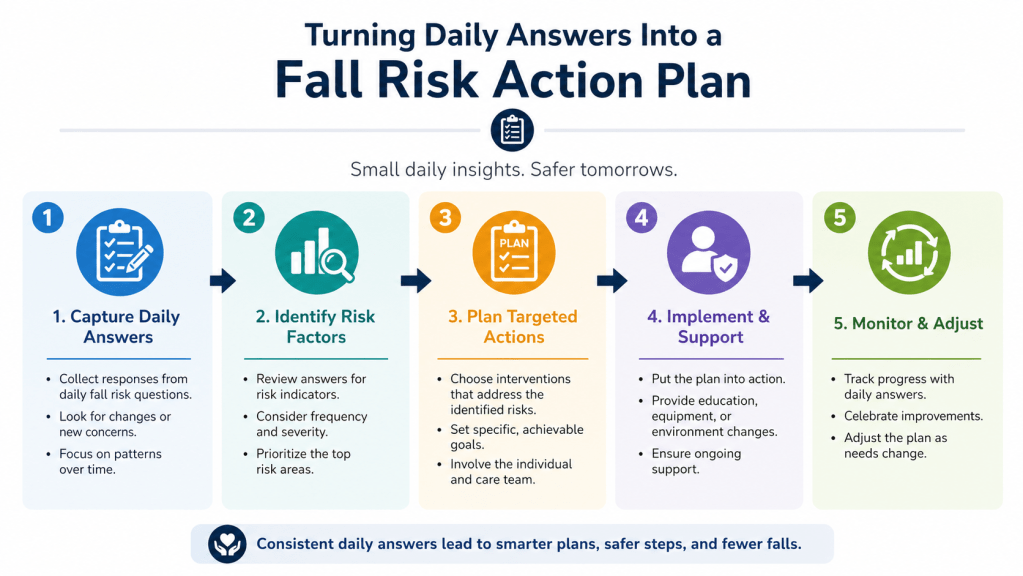
A daily check-in becomes much more useful when it does not stop at asking questions. The real value comes from noticing patterns, understanding what the answers mean, and knowing what to do next. Many older adults will not say, “I am at risk of falling today.” Instead, they may say things like, “I feel a little off,” “I did not sleep well,” “I am staying in today,” or “I almost slipped but I caught myself.”
Those small comments matter.
Falls are often not random. They usually happen after several small warning signs build up: poor sleep, dizziness, new medication, weaker legs, clutter in the hallway, rushing to the bathroom, dehydration, or fear of walking alone. A daily routine helps families catch these changes early. The goal is not to alarm the older adult. The goal is to create a calm, practical system that helps everyone know what needs attention today.
The CDC’s STEADI program encourages fall prevention through screening, assessment, and intervention, while the National Institute on Aging emphasizes that many falls can be prevented with practical changes to health habits and the home environment.
Use a Simple Green, Yellow, and Red System
A daily check-in should not feel like a medical interview. One of the easiest ways to make it practical is to sort answers into three levels: green, yellow, and red.
Green: Normal Day
A green day means the older adult sounds steady, clear, and confident. They have not had dizziness, a stumble, a near fall, sudden weakness, or unusual pain. They are moving around as usual, eating and drinking normally, and their home routine feels manageable.
On a green day, the best action is encouragement. You might say:
Try JoyCalls Free
No app or new device needed. Start with a free 7-day trial.
“Great, I’m glad today feels steady. Please keep your phone nearby, turn on the lights before walking, and take your time when getting up.”
This keeps the conversation positive. It also reinforces safe habits without making the person feel watched or controlled.
Yellow: Caution Day
A yellow day means something is slightly off. Maybe they feel lightheaded. Maybe they slept badly. Maybe they skipped breakfast. Maybe they are avoiding the stairs. Maybe they had a small stumble but did not fall. These signs do not always require emergency help, but they do deserve attention.
On a yellow day, slow the routine down. Ask a few follow-up questions:
“Did the dizziness happen when you stood up?”
“Have you had enough water today?”
“Are you using your cane or walker every time you get up?”
“Is there anything on the floor that could trip you?”
“Would it be safer to avoid the stairs today?”
The action step may be simple: drink water, eat something, sit before standing, use an assistive device, keep lights on, postpone a shower until someone is nearby, or call a doctor if symptoms continue. A yellow day is a good time to reduce risk before it becomes urgent.
Red: Get Help Now
A red day means there may be an immediate safety concern. Examples include a fall, head injury, new confusion, chest pain, fainting, severe dizziness, sudden weakness, trouble speaking, new shortness of breath, or being unable to stand or walk safely.
In this situation, do not rely on more questioning. The priority is help.
You can say:
“I’m concerned about your safety right now. Please sit down and do not try to walk. I’m going to get help.”
If there has been a fall, especially with a head hit, severe pain, bleeding, confusion, or inability to move normally, medical help should be contacted right away. The daily check-in should have a clear emergency plan so family members are not deciding under stress.
Ask About “Near Falls,” Not Just Falls
Many seniors will deny falling because they technically did not hit the ground. But a near fall can be just as important. A near fall means the body lost control for a moment and was saved by luck, furniture, a wall, or another person.
Instead of only asking, “Did you fall?” ask:
“Did you slip, trip, or lose your balance today, even if you caught yourself?”
“Did you grab a wall, chair, counter, or railing to keep from falling?”
“Did you feel like your legs were not keeping up with you?”
“Did you avoid walking somewhere because you felt unsure?”
These questions feel less accusing and more practical. They also give a more accurate picture of risk. If near falls are happening repeatedly, it is time to tell a healthcare provider. A pattern of near falls can point to balance changes, medication side effects, vision problems, weakness, or unsafe areas in the home.
Track the Time and Place of Risky Moments
When someone mentions a stumble, do not stop at the event itself. Ask when and where it happened. This often reveals the real cause.
For example:
If it happened in the morning, the issue may be stiffness, low blood pressure, dehydration, or getting out of bed too quickly.
If it happened at night, the issue may be poor lighting, bathroom urgency, sleep medication, or not using a walker.
If it happened in the bathroom, the issue may be slippery floors, missing grab bars, low toilet height, or rushing.
If it happened outside, the issue may be uneven pavement, poor footwear, weather, or fatigue.
If it happened after meals or medication, the issue may need medical review.
This turns a vague concern into a solvable problem. Instead of saying, “Mom is getting unsteady,” you can say, “Mom has felt dizzy twice this week when standing up after breakfast.” That is far more useful for a doctor, pharmacist, physical therapist, or caregiver.
Build a Daily “Before You Walk” Habit
A powerful fall prevention habit is teaching the older adult to pause before walking. Many falls happen because someone stands up and moves too quickly.
Encourage a short routine:
Sit upright first.
Place both feet flat on the floor.
Take one slow breath.
Check for dizziness.
Stand up slowly.
Hold a stable surface.
Wait a few seconds.
Start walking only when steady.
This is especially useful after waking, after sitting for a long time, after taking medication, or when getting up at night. It is simple, but it can prevent rushed movement during moments when balance is weakest.
During the daily call, ask:
“Are you taking a moment before standing up today?”
“Are you waiting until you feel steady before walking?”
“Are you keeping your walker or cane within reach before you get up?”
The point is not to lecture. The point is to make safe movement automatic.
Include Bathroom Safety in the Daily Routine
The bathroom deserves special attention because it combines several risks: water, hard surfaces, privacy, urgency, bending, turning, and getting up from low seats. Many older adults also avoid mentioning bathroom struggles because they feel embarrassed.
Ask in a respectful way:
“Are you getting to the bathroom safely today?”
“Are you rushing when you need to go?”
“Do you feel steady getting on and off the toilet?”
“Is the floor dry?”
“Are your grab bars or support rails easy to reach?”
“Do you have enough light if you go at night?”
If there is frequent rushing, talk to a healthcare provider. Bathroom urgency, incontinence, constipation, urinary tract infections, and medication timing can all affect fall risk. Practical home changes can also help, such as night lights, non-slip mats, raised toilet seats, grab bars, and keeping the pathway clear.
Watch for Changes in Confidence
Fall risk is not only physical. Confidence matters. Some older adults begin limiting movement because they are afraid of falling. At first, this may seem safe. But over time, less movement can lead to weaker muscles, poorer balance, and more dependence.
During check-ins, listen for phrases like:
“I did not want to risk it.”
“I stayed in my chair most of the day.”
“I skipped my walk.”
“I do not feel safe going outside.”
“I’m fine as long as I don’t move too much.”
These comments deserve gentle follow-up. Try saying:
“I understand why that feels safer. Would it help to do a shorter walk inside the house today?”
Or:
“Maybe we can ask your doctor or physical therapist what kind of movement is safest for you.”
The goal is not to push the person beyond their ability. The goal is to keep them safely active. Even small, regular movement can help preserve strength and independence.
Review Footwear Every Day
Shoes are easy to overlook, but they affect stability all day. Slippers, loose sandals, worn-out soles, socks on smooth floors, and backless shoes can increase the chance of slipping or tripping. CDC caregiver resources include feet and footwear as part of fall prevention education.
Ask:
“What shoes are you wearing around the house today?”
“Are they secure on your feet?”
“Do the soles grip the floor?”
“Are you avoiding walking in socks?”
“Do your feet hurt anywhere today?”
Foot pain matters because it changes how a person walks. If an older adult is limping, shuffling, or avoiding pressure on one foot, they may become less stable. Foot pain, numbness, swelling, or poorly fitting shoes should be discussed with a healthcare professional.
Create a “No Rushing” Rule
Rushing is one of the most preventable fall triggers. Older adults may rush to answer the phone, reach the door, use the bathroom, turn off the stove, or pick up something that dropped.
A daily check-in can reinforce one simple rule:
Nothing is worth rushing for.
You can say:
“If the phone rings, let it ring.”
“If someone is at the door, they can wait.”
“If something falls, sit first and decide if it is safe to pick up.”
“If you need the bathroom, use your walker and keep the lights on.”
This may sound basic, but it gives the older adult permission to move slowly. Many seniors rush because they do not want to inconvenience others. Reassure them that safety comes first.
Keep a Small Fall Risk Log
Families do not need a complicated spreadsheet. A simple note on paper or in a phone can be enough. Record only the details that help identify patterns.
Use these fields:
Date
Energy level
Dizziness or lightheadedness
Pain
Near fall or fall
Where it happened
Medication changes
Sleep quality
Appetite and hydration
Action taken
This log helps during medical appointments. Instead of trying to remember everything, you can share a clear pattern. For example:
“She felt dizzy three mornings this week after taking her blood pressure medication.”
“He had two near falls in the hallway at night.”
“She has stopped going outside because she feels unsure on the front steps.”
This kind of information helps healthcare providers make better decisions.
Know When to Call the Doctor
Not every concern is an emergency, but some patterns should be discussed with a healthcare provider promptly.
Call the doctor if the older adult reports:
Repeated dizziness
New weakness
A recent fall or near fall
New confusion
Worsening balance
Pain that affects walking
New foot numbness
Vision changes
Medication side effects
Fear of walking
Avoiding normal activities
The CDC notes that medications for sleep, anxiety, high blood pressure, and chronic pain can increase fall risk through side effects such as drowsiness, loss of balance, vision changes, or slower reaction time.
This does not mean stopping medication without medical advice. It means asking for a review. A pharmacist or doctor may adjust timing, dosage, combinations, or safer alternatives.
Make the Older Adult a Partner, Not a Patient
The way questions are asked matters. Seniors may resist check-ins if they feel tested, judged, or treated like a child. Use language that protects dignity.
Instead of:
“Did you use your walker like you were supposed to?”
Say:
“Has your walker been helpful today?”
Instead of:
“You shouldn’t be going downstairs alone.”
Say:
“Would it feel safer to save the stairs for when someone is nearby?”
Instead of:
“You’re not steady anymore.”
Say:
“I noticed you sounded a little unsure today. Let’s think through what would make moving around easier.”
The goal is teamwork. Older adults are more likely to share honest information when they feel respected.
End Every Check-In With One Clear Safety Step
A good daily check-in should end with a small action, not a vague reminder. Choose one step based on the conversation.
Examples:
“Keep your cane beside your chair today.”
“Turn on the hallway light before sunset.”
“Drink a glass of water now.”
“Wear your supportive shoes inside.”
“Use the bathroom before you feel rushed.”
“Move the laundry basket out of the hallway.”
“Call me before going down the steps.”
“Write down the dizziness so we can tell the doctor.”
One clear action is better than ten general tips. It is easier to remember and more likely to happen.
A Sample Daily Fall Risk Action Script
Here is a simple script families can use:
“Hi Mom, I’m glad to hear your voice. Before we talk about the day, I want to check how steady you’re feeling. Have you had any dizziness, weakness, slips, trips, or moments where you had to grab onto something?”
If the answer is no:
“That’s good. Are you wearing safe shoes, keeping your phone nearby, and taking your time when you stand up?”
If the answer is yes:
“Thank you for telling me. Where did it happen? What were you doing right before it happened? Are you feeling steady now?”
Then choose the next step:
“Please sit for a few minutes, drink some water, and use your walker today.”
Or:
“Since this has happened more than once, I think we should call your doctor and explain what changed.”
Or:
“Because you fell and hit your head, we need medical help now.”
This kind of routine keeps the conversation calm, practical, and loving.
The Real Goal: Safer Independence
The purpose of daily fall risk questions is not to make an older adult feel fragile. It is to help them stay independent for as long as possible. A good check-in protects freedom by catching small risks before they become serious injuries.
When families ask specific questions, listen for patterns, respond with clear action steps, and involve healthcare professionals when needed, daily calls become more than reassurance. They become a practical fall prevention system.
The most helpful question is not only, “Are you okay?”
It is:
“What can we do today to help you move safely and confidently?”
Assessing and Screening for Fall Risk
The transition from family observations to clinical assessment marks a crucial step in comprehensive safety planning. When your daily check-ins reveal consistent concerns, understanding professional screening methods becomes essential.
Validated Screening Tools and Questionnaires
Healthcare providers use simple but effective tests to measure physical capabilities. The Timed Up-and-Go test evaluates gait by timing how long it takes to stand, walk ten feet, and return to a chair.
The 30-Second Chair Stand measures leg strength by counting repetitions. The 4-Stage Balance Test progressively challenges stability in different positions.

Overview of STEADI and CDC Guidelines
The CDC’s STEADI initiative provides a structured framework that many healthcare providers follow. This approach combines screening, comprehensive assessment, and targeted intervention strategies.
A thorough evaluation examines multiple factors beyond physical tests. Providers check medications that might affect stability and measure blood pressure in different positions.
Vision checks, footwear assessment, and cognitive testing complete the picture. Research shows these tools effectively identify who needs support, much like how consistent companionship through services like an AI companion provides ongoing reassurance.
When assessment scores indicate elevated concern, early intervention can make a significant difference in maintaining independence and safety.
Preventative Measures and Home Safety Practices

Simple changes to daily habits and living spaces can build a protective environment that supports lasting independence. Your caring check-ins become the gentle nudge that turns concern into concrete action.
Daily Check-In Routines and Balance Exercises
Movement truly is medicine when it comes to stability. Regular physical activities that build leg strength and improve coordination make a significant difference.
Many people believe staying seated is safer, but balance works like a muscle—it weakens when unused. Gentle practices like Tai Chi or simple standing exercises help maintain this crucial skill.
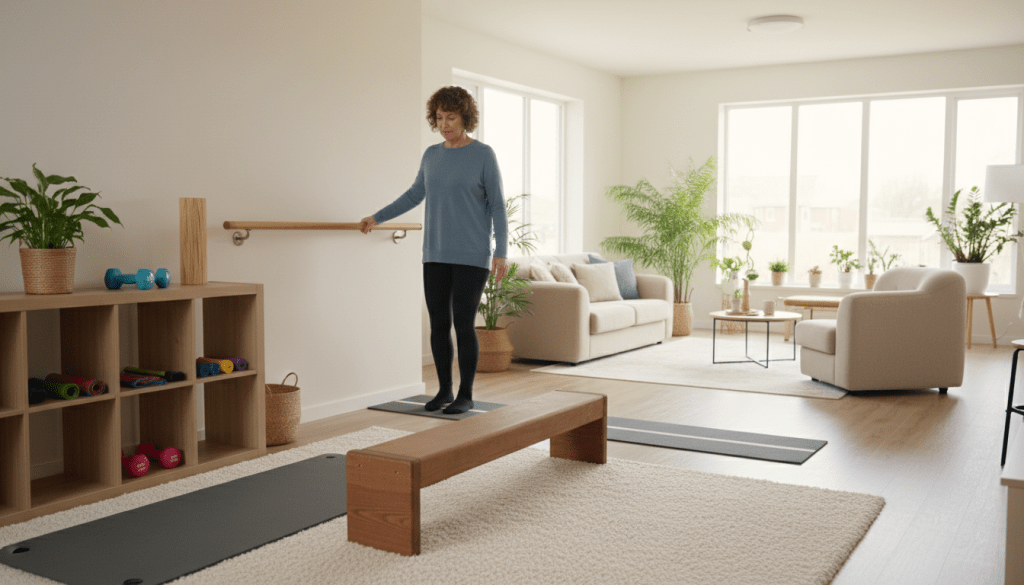
During your calls, ask about their daily movement. Celebrate small victories and encourage the activities they love. This positive reinforcement builds confidence.
Home Environment Modifications and Safety Tips
Most incidents occur in familiar spaces where comfort can mask hazards. Thoughtful adjustments create a safer living environment.
| Area of Home | Key Modification | Safety Benefit |
|---|---|---|
| Bathroom | Install grab bars near toilet & shower | Provides stable support in slippery areas |
| Stairways | Add railings on both sides | Improves balance during ascent/descent |
| Living spaces | Improve lighting, secure rugs | Reduces tripping hazards in pathways |
Use your daily conversations to gently discuss home safety. Ask about clutter or loose rugs noticed during their routine. The CDC offers a comprehensive home safety checklist that complements these efforts.
Remember that isolation can impact safety awareness. Maintaining social connection through services like an AI companion provides both companionship and consistent safety monitoring.
Healthcare Strategies and Resources for Fall Prevention
There’s a whole team of experts ready to help you protect your loved one’s independence and safety. Your daily check-ins become even more powerful when combined with professional healthcare strategies.

Role of Medical Providers and Therapists in Fall Risk Assessment
Healthcare providers can identify patients who need support. They conduct thorough assessments and refer to specialists. Physical therapists address gait and balance problems. Occupational therapists make home environments safer.
Home health care brings professional strategies right to the door. This includes skilled nursing for medication management. Therapists provide strength exercises and safety evaluations.
Integrating Technology and Tools
For busy families, technology offers compassionate solutions. JoyCalls is an AI-powered phone companion that makes daily check-ins. No app or device needed—just regular phone conversations.
The service asks the right questions and monitors responses over time. It sends summaries and alerts to caregivers. Explore JoyCalls to transform worry into proactive protection.
Medication Review and Management Techniques
Medication review is absolutely critical. Certain prescriptions can cause dizziness or confusion. Blood pressure drugs, sedatives, and pain relievers increase danger.
If your loved one takes four or more medications daily, side effects multiply. Have their doctor review everything at least annually. The CDC’s STEADI guidelines offer comprehensive medication management advice.
Speech therapists address cognitive changes and hydration issues. Social workers provide counseling and connect families to community resources. Combining your attention with professional strategies creates multiple layers of protection.
Why Micro-Habits Work Better Than “Exercise Plans”
Traditional advice often suggests structured routines like “30 minutes of exercise daily.” While helpful in theory, this can feel intimidating or unrealistic for many older adults—especially those already feeling unsteady.
Micro-habits work because they are:
- Easy to remember
- Low effort
- Built into existing routines
- Less physically demanding
- More consistent over time
Instead of asking someone to “exercise,” you are helping them move better during normal daily activities.
During your daily check-in, instead of asking:
“Did you exercise today?”
Ask:
“Were you able to move around comfortably today?”
“Did you get up and walk a few times?”
“Did your legs feel strong when standing up?”
This shifts the focus from performance to function.
The “Every Sit-to-Stand Counts” Rule
One of the simplest and most effective movements for preventing falls is standing up from a seated position. This movement strengthens the legs, improves balance, and supports independence.
Encourage a habit:
Every time they stand up from a chair, they do it slowly and intentionally.
You can guide them like this:
“Try using your legs as much as possible instead of pushing with your hands.”
“Pause for a second after standing to make sure you feel steady.”
“Keep your feet flat and slightly behind your knees before standing.”
During check-ins, ask:
“Are you taking your time when getting up from your chair?”
“Do your legs feel strong when you stand?”
“Are you needing to use your hands more than usual?”
If standing becomes harder, it may signal declining strength or balance, which should be addressed early.
Encourage “Safe Movement Repetition” Throughout the Day
Instead of a single exercise session, aim for frequent small movements:
- Walking to the kitchen
- Standing during TV breaks
- Light stretching after sitting
- Short indoor walks
You can say:
“Try to get up every hour, even just for a minute.”
“Walk a little inside the house after meals.”
“Don’t stay in one position for too long.”
This prevents stiffness, improves circulation, and reduces sudden instability when moving after long periods of rest.
Build Confidence With “Supported Movement”
Many falls happen because seniors attempt movements they are unsure about. Instead of avoiding movement entirely, encourage supported movement.
Examples:
- Walking while holding onto furniture
- Using a walker consistently
- Holding railings on stairs
- Keeping one hand free for balance
Ask during check-ins:
“Are you using support when you walk today?”
“Is your walker or cane within easy reach?”
“Are you holding onto something stable when needed?”
The key message is:
Using support is a strength, not a weakness.
Train Balance in Everyday Situations
Balance is not just about standing still—it’s about staying stable while moving, turning, or reaching.
You can subtly encourage balance awareness:
“Are you turning slowly instead of quickly?”
“Are you avoiding sudden movements?”
“Are you reaching safely without stretching too far?”
Simple habits include:
- Turning the whole body instead of twisting
- Avoiding leaning too far forward
- Keeping frequently used items within easy reach
- Using both hands when carrying objects
These small adjustments reduce instability in daily tasks.
Focus on Walking Quality, Not Just Walking Quantity
It is not just about how much someone walks—it is about how they walk.
Listen for cues during check-ins:
“Are your steps feeling steady today?”
“Do you feel like your feet are lifting properly?”
“Are you shuffling or dragging your feet?”
Shuffling or slower steps may indicate:
- Muscle weakness
- Joint stiffness
- Neurological changes
- Fear of falling
Encourage:
“Take slightly bigger, slower steps.”
“Look ahead instead of down at your feet.”
“Keep your posture upright.”
If walking changes suddenly, it should be discussed with a healthcare provider.
Hydration as a Hidden Fall Prevention Tool
Dehydration is a major but often overlooked cause of dizziness, weakness, and confusion.
Older adults may drink less because:
- They do not feel thirsty
- They want to avoid frequent bathroom trips
- They forget
- They limit fluids in the evening
During check-ins, ask:
“Have you had enough water today?”
“Are you feeling lightheaded at all?”
“Did you have anything to drink this morning?”
Encourage simple habits:
- One glass of water after waking
- One glass with each meal
- Keeping water within reach
- Drinking before feeling thirsty
Even mild dehydration can increase fall risk.
Nutrition and Energy Stability
Low energy can lead to slower reaction times and weaker movements.
Ask:
“Did you eat properly today?”
“Are you feeling low on energy?”
“Did you skip any meals?”
Encourage:
- Regular meals
- Protein intake (helps muscle strength)
- Balanced diet
- Light snacks if needed
Skipping meals can lead to:
- Weakness
- Dizziness
- Poor coordination
Which increases fall risk significantly.
Sleep Quality and Its Impact on Stability
Poor sleep affects balance, alertness, and reaction time.
Ask:
“How did you sleep last night?”
“Do you feel rested today?”
“Are you feeling unusually tired?”
If sleep is poor:
- Encourage slower movement during the day
- Avoid risky activities
- Ensure proper lighting at night
- Keep pathways clear
Also watch for:
- Night-time confusion
- Frequent waking
- Grogginess from medications
These increase fall risk, especially during nighttime bathroom trips.
Reduce Multi-Tasking While Walking
Many falls happen when seniors try to do too many things at once.
Examples:
- Walking while carrying items
- Talking on the phone while moving
- Turning quickly while distracted
Encourage a simple rule:
“Stop first, then do the task.”
You can say:
“Pause before answering the phone.”
“Stand still before turning around.”
“Hold onto something before reaching.”
This improves focus and stability.
Strengthen the Mind-Body Connection
Balance is not just physical—it is also neurological.
Encourage awareness:
“Are you paying attention to how your body feels today?”
“Do you notice when you feel slightly off?”
“Are you stopping when something feels unsafe?”
This builds body awareness, which helps prevent falls before they happen.
Keep Movement Fear-Free
Fear of falling can be just as dangerous as physical weakness.
If someone is too afraid to move:
- They become less active
- Muscles weaken
- Balance worsens
- Confidence drops
Ask:
“Are you avoiding anything because you feel unsafe?”
“What would make you feel more confident moving today?”
Encourage:
- Small, safe movements
- Supervised activity if needed
- Gradual confidence building
The goal is safe movement, not avoidance.
Create a Personalized Daily Movement Checklist
You can build a simple checklist tailored to the individual:
- Stood up slowly each time
- Walked at least a few times
- Used support when needed
- Stayed hydrated
- Ate regular meals
- Avoided rushing
- Felt steady while moving
This does not need to be written every day. It can be part of the conversation.
When to Seek Professional Support for Mobility
If you notice consistent changes, it may be time for professional help:
- Physical therapy
- Balance training
- Strength exercises
- Assistive device evaluation
Watch for:
- Repeated near falls
- Increased dependence on furniture
- Slower or unsteady walking
- Fear of movement
- Difficulty standing up
Early intervention can prevent serious falls.
Turn Daily Calls Into Gentle Coaching Moments
Instead of just checking, you are guiding.
Instead of:
“Be careful.”
Say:
“Take your time when you stand up.”
“Keep your walker close.”
“Turn on the lights before walking.”
“Pause if you feel unsure.”
These are specific, actionable, and easy to follow.
The Long-Term Impact of Small Daily Changes
Over time, these small habits lead to:
- Stronger muscles
- Better balance
- Increased confidence
- Reduced fall risk
- Greater independence
The older adult may not notice dramatic changes day-to-day, but the consistency builds resilience.
Creating a Safer Living Environment Through Daily Observation

While health, balance, and habits play a major role in fall prevention, the home environment itself is often the silent contributor. Many falls are not caused by sudden medical events, but by small, unnoticed hazards that build up over time—poor lighting, clutter, loose rugs, uneven flooring, or misplaced objects.
The important thing to understand is this:
Homes do not become unsafe overnight—they become unsafe gradually.
That is why daily check-ins should include subtle, ongoing observation of the living space. Instead of doing one-time safety audits and forgetting about them, families should use conversations to continuously monitor and improve the environment.
This section focuses on how to turn everyday conversations into a powerful system for keeping the home safer without overwhelming the older adult.
Why Daily Environmental Awareness Matters
Many seniors live in spaces they have been comfortable in for years. Because of familiarity, they often stop noticing risks. What once felt safe may no longer match their current mobility, vision, or balance.
For example:
- A rug that never caused trouble before may now be a tripping hazard
- Dim lighting that once felt cozy may now reduce visibility
- Furniture placement that worked years ago may now block safe walking paths
- Frequently used items may now be stored too high or too low
During daily calls, the goal is not to criticize the home—it is to gently bring attention to safety without disrupting comfort or independence.
Ask About Movement Pathways, Not Just Rooms
Instead of asking general questions like:
“Is everything okay at home?”
Be more specific:
“Are your walkways clear today?”
“Is there anything on the floor that could get in your way?”
“Are you able to move from your bed to the bathroom easily?”
“Is the path to the kitchen clear?”
This focuses on how the person moves through the home, not just the condition of the home itself.
Encourage them to notice:
- Objects left on the floor
- Loose wires or cords
- Shoes or slippers left in walking areas
- Furniture that feels too close together
Even small obstacles can cause a trip, especially when balance or reaction time is reduced.
Lighting: The Most Underrated Safety Factor
Poor lighting is one of the most common contributors to falls, especially at night.
Ask daily:
“Are your lights working properly today?”
“Do you turn on lights before walking?”
“Is your hallway and bathroom well-lit at night?”
“Can you clearly see where you’re walking?”
Encourage simple habits:
- Turn on lights before standing up
- Use night lights in bedrooms, hallways, and bathrooms
- Keep a lamp within easy reach of the bed
- Avoid walking in dim or shadowy areas
Lighting should support movement—not require effort to find.
Focus on the Bedroom-to-Bathroom Route
This is one of the highest-risk pathways in any home, especially at night.
Ask:
“Is your path to the bathroom clear right now?”
“Do you have enough light to see at night?”
“Are you rushing when you need to go?”
“Is there anything near your bed that could trip you?”
Encourage:
- Keeping the path completely clear
- Using night lights
- Wearing proper footwear
- Sitting briefly before standing
- Keeping assistive devices within reach
This route should be simple, direct, and obstacle-free at all times.
Address “Temporary Clutter” Before It Becomes Permanent
Clutter often starts as temporary:
- Laundry baskets
- Grocery bags
- Packages
- Newspapers
- Shoes
Over time, these items remain in walking paths and become hazards.
During check-ins, ask:
“Is there anything new on the floor today?”
“Did anything get left in the hallway?”
“Are there any items you’ve been meaning to move?”
Encourage a daily habit:
If something is in the way today, move it today.
Do not let clutter become part of the environment.
Rethink Furniture Placement for Safer Movement
Furniture should support movement—not block it.
Ask:
“Do you have enough space to walk comfortably between furniture?”
“Is there anything you have to squeeze past?”
“Do you feel stable moving around your living room?”
Encourage:
- Wider walking paths
- Stable furniture that can be used for support
- Avoiding sharp corners in high-traffic areas
- Keeping frequently used items within easy reach
If the older adult is using furniture for balance, ensure it is sturdy and not movable.
Watch for Changes in How the Space Is Used
Sometimes the environment has not changed—but how the person uses it has.
For example:
- They may now avoid certain rooms
- They may sleep in a chair instead of a bed
- They may stop using stairs
- They may rearrange items to avoid bending
Ask:
“Are you using all areas of your home comfortably?”
“Is there anywhere you’re avoiding?”
“Have you changed how you move around recently?”
These changes can signal growing discomfort or risk, even if the home itself appears unchanged.
Kitchen Safety Through Daily Habits
The kitchen involves standing, turning, reaching, and carrying—activities that require balance and coordination.
Ask:
“Are you able to move safely in the kitchen today?”
“Are the items you use most within easy reach?”
“Are you avoiding reaching too high or bending too low?”
Encourage:
- Keeping frequently used items at waist level
- Avoiding step stools unless supervised
- Using both hands when carrying items
- Taking breaks while cooking
- Wearing non-slip footwear
Also remind:
“If something feels out of reach, it’s okay to leave it and ask for help.”
Flooring and Surface Awareness
Different floor surfaces can affect stability:
- Slippery tiles
- Uneven rugs
- Wet floors
- Transitions between rooms
Ask:
“Are your floors dry today?”
“Do any areas feel slippery?”
“Are your rugs staying in place?”
Encourage:
- Removing loose rugs or securing them
- Cleaning spills immediately
- Using non-slip mats
- Being extra careful on smooth surfaces
Even familiar flooring can become dangerous if conditions change.
Stairs: Daily Safety Reinforcement
If the home has stairs, they require constant attention.
Ask:
“Are you using the handrail every time?”
“Are the stairs well-lit?”
“Do you feel steady going up and down?”
Encourage:
- Always using handrails
- Avoiding carrying items on stairs
- Taking one step at a time
- Ensuring proper lighting
- Asking for help when needed
If stairs are becoming difficult, it may be time to limit use or modify routines.
Keep Essential Items Within Easy Reach
Reaching too far or bending too low can lead to loss of balance.
Ask:
“Are the things you need today within easy reach?”
“Do you have to stretch or bend to get anything?”
Encourage:
- Keeping daily items at waist to shoulder height
- Using long-handled tools if needed
- Avoiding overreaching
- Asking for help instead of risking a fall
Convenience should never come at the cost of safety.
Pets as a Hidden Risk Factor
Pets can unintentionally cause falls by:
- Moving unpredictably
- Getting underfoot
- Leaving toys in walkways
Ask:
“Is your pet moving around your feet?”
“Are there toys or bowls in walking areas?”
Encourage:
- Keeping pet items out of pathways
- Being aware of pet movement
- Taking extra care when walking
Pets bring joy—but they also require awareness.
Daily Safety Reset Habit
Encourage a simple daily routine:
Before evening or bedtime, do a quick safety check:
- Clear pathways
- Turn on night lights
- Place assistive devices within reach
- Ensure floors are dry
- Keep essentials nearby
This creates a safer environment for nighttime movement, which is when many falls occur.
Involve the Senior in Decision-Making
Do not make changes without discussion.
Ask:
“What would make your home feel safer?”
“Is there anything bothering you about moving around?”
“Would you be open to a small change to make this easier?”
When seniors are involved, they are more likely to accept and maintain changes.
When to Consider a Home Safety Assessment
If risks continue despite small adjustments, it may be time for a professional evaluation.
Consider:
- Occupational therapy home assessment
- Fall prevention specialists
- Safety equipment installation
Signs include:
- Repeated near falls in the same area
- Avoiding certain parts of the home
- Increasing clutter
- Difficulty navigating spaces
Early intervention can prevent serious injuries.
Turn Conversations Into Continuous Improvement
Instead of treating safety as a one-time task, make it part of daily life.
Each call can include one small improvement:
“Let’s clear that hallway today.”
“Can we move that chair slightly?”
“Let’s add a light near your bed.”
“Keep your shoes by the door so you don’t walk barefoot.”
These small steps build a safer environment over time.
Building a Reliable Support System and Emergency Response Plan

Even with the best routines, habits, and home safety measures, risks cannot be eliminated completely. What truly makes a difference is how quickly and effectively support is available when something feels wrong.
A strong fall prevention strategy is not just about avoiding falls—it is also about ensuring that if something happens, the older adult is not alone, not confused, and not without help.
Daily check-ins are the perfect place to reinforce this support system. This section focuses on how to build a clear, dependable, and stress-free response plan that seniors and families can rely on every single day.
Why a Support System Matters More Than You Think
Many seniors live independently, which is a positive sign of confidence and autonomy. However, independence should never mean isolation.
The biggest risks arise when:
- A fall happens and no one knows
- The person cannot reach a phone
- They feel unsure about asking for help
- They delay reporting symptoms
- They try to manage alone
During daily conversations, the goal is to make sure the older adult feels:
- Supported
- Connected
- Prepared
- Comfortable asking for help
A strong support system reduces panic, speeds up response, and prevents complications.
Start With One Simple Question: “If Something Happens, What Will You Do?”
This question reveals a lot.
Ask:
“If you feel dizzy or unsteady, what would you do?”
“If you fell, how would you get help?”
“Who would you call first?”
“Do you always keep your phone with you?”
If the answers are unclear, hesitant, or uncertain, that is your signal to build a clearer plan.
Make Phone Access Non-Negotiable
A phone is one of the most important safety tools.
Ask daily:
“Do you have your phone with you right now?”
“Is it charged?”
“Can you reach it easily from where you are sitting or lying down?”
Encourage:
- Keeping the phone within arm’s reach at all times
- Charging it regularly
- Using simple dialing options (favorites or speed dial)
- Avoiding leaving it in another room
A phone is only helpful if it is accessible when needed.
Create a Clear “Who to Call” Priority List
In stressful moments, thinking becomes harder. A simple plan removes confusion.
Help them identify:
- First contact (family member or caregiver)
- Second contact (backup person)
- Emergency services
During check-ins, reinforce:
“If something feels wrong, call immediately—don’t wait.”
“Even if you’re unsure, it’s better to call.”
The goal is to eliminate hesitation.
Normalize Asking for Help
Many older adults avoid calling for help because they do not want to “bother” anyone.
You may hear:
“I didn’t want to disturb you.”
“I thought it would pass.”
“I didn’t think it was serious.”
Address this directly:
“You are never a bother.”
“I would rather you call early than wait.”
“Your safety matters more than anything else.”
This reassurance must be repeated often. It removes the emotional barrier to seeking help.
Prepare for “What If I Fall?” Situations
Falls can happen even in safer environments. The key is preparation.
Ask:
“If you fall and can’t get up, what would you do?”
“Do you know how to stay calm and call for help?”
“Do you feel confident using your phone in that situation?”
Encourage:
- Staying still after a fall until sure it’s safe to move
- Calling for help immediately
- Avoiding trying to stand too quickly
- Keeping emergency numbers easily accessible
The goal is not fear—it is readiness.
Consider Emergency Alert Systems
Technology can provide an extra layer of safety.
Options include:
- Wearable alert buttons
- Fall detection devices
- Smart home assistants
- Emergency call systems
Ask:
“Would you feel more comfortable having a button you can press if needed?”
“Would a wearable device make you feel safer?”
These tools are especially helpful for those who:
- Live alone
- Have had previous falls
- Feel unsteady
- Have medical conditions
They provide reassurance for both seniors and families.
Build a Daily Check-In Routine That Feels Natural
Consistency builds safety.
Instead of random calls, create a predictable pattern:
- Morning check-in
- Evening check-in
- Additional calls if needed
During these calls:
- Ask about physical condition
- Ask about environment
- Reinforce safety habits
- Confirm readiness for the day
Routine reduces uncertainty and ensures regular monitoring.
Create a “No Silence” Rule
One of the simplest but most powerful rules:
If something changes, say something.
Encourage:
“If you feel even slightly off, tell me.”
“If something doesn’t feel right, don’t ignore it.”
“If you have a near fall, mention it.”
Silence often leads to missed warning signs.
Involve Neighbors or Nearby Contacts
Support does not always have to come from family.
Ask:
“Is there someone nearby you trust?”
“Do you have a neighbor who could help if needed?”
“Would you feel comfortable reaching out to them?”
Having a nearby contact can:
- Provide quicker assistance
- Reduce response time
- Add another layer of safety
Plan for Times When Routine Is Disrupted
Not every day follows the same pattern.
Ask:
“What happens if I can’t reach you at our usual time?”
“What will you do if your routine changes?”
Create backup plans:
- Alternative contact times
- Secondary contacts
- Clear instructions for missed calls
This ensures safety even when routines shift.
Recognize Emotional Barriers to Safety
Sometimes the issue is not physical—it is emotional.
Watch for:
- Resistance to help
- Denial of risk
- Frustration or irritability
- Withdrawal from conversation
Respond with empathy:
“I understand this can feel frustrating.”
“We’re doing this to help you stay independent.”
“You’re still in control—this is just support.”
Respect builds cooperation.
Encourage Honest Communication
The effectiveness of a check-in depends on honesty.
Create a safe space where the older adult feels comfortable sharing:
- Weakness
- Fear
- Mistakes
- Near falls
Avoid reacting with alarm or criticism. Instead, respond calmly:
“Thank you for telling me.”
“That helps us understand what’s going on.”
“Let’s figure out a simple way to make that safer.”
Reinforce Independence While Providing Support
Support should never feel like control.
Balance is key:
- Offer guidance, not commands
- Suggest options, not restrictions
- Respect choices, while explaining risks
For example:
Instead of:
“You shouldn’t do that.”
Say:
“That might be a bit risky—what would make it safer?”
This keeps dignity intact.
Create a Simple Emergency Plan Card
A physical reminder can help in stressful moments.
Include:
- Emergency contacts
- Medical conditions
- Medications
- Address
- Instructions
Place it:
- Near the phone
- On the refrigerator
- In a visible area
This ensures quick access to critical information.
Practice the Plan
Preparation is only effective if it is understood.
Ask:
“Do you feel confident calling for help?”
“Would you like to walk through the steps together?”
Practice:
- Calling a contact
- Using emergency buttons
- Describing location clearly
Familiarity reduces panic.
Use Daily Calls to Build Trust Over Time
Trust does not happen instantly—it builds through consistency.
Daily check-ins should feel:
- Supportive
- Predictable
- Non-judgmental
- Reassuring
Over time, the older adult will:
- Share more openly
- Accept guidance more easily
- Feel less alone
- Respond more quickly in emergencies
Watch for Signs That Support Needs to Increase
Sometimes additional support becomes necessary.
Look for:
- Increased falls or near falls
- Confusion
- Missed calls
- Difficulty following routines
- Reduced mobility
This may indicate the need for:
- More frequent check-ins
- In-person support
- Professional care
Early adjustment prevents crises.
Turn Every Check-In Into a Safety Anchor
Each call should end with reassurance:
“You’re not alone.”
“I’m here if you need anything.”
“Call me anytime.”
“Let’s talk again later.”
This emotional connection is just as important as physical safety.
Conclusion

Your consistent attention is the gentle shield that protects your parent’s independence every single day. You now have the essential tools to transform ordinary chats into meaningful safety check-ins.
The path forward combines loving daily contact with professional health strategies. Regular screening and assessments create multiple layers of protection. Studies confirm this approach makes a real difference in prevention.
Remember that isolation can impact safety awareness. Maintaining social connection through services like an AI companion provides both companionship and consistent monitoring. Your efforts help create a supportive environment where older adults can thrive safely at home.
Your caring questions are more than words—they’re active expressions of love and protection. Start today with that important call, because every conversation builds toward lasting safety and confidence.
FAQ
What are the most important daily check-in questions to ask an older adult about their balance and safety?
How can I tell if my parent’s answers indicate a real problem with their gait or strength?
What simple home modifications can significantly reduce the chance of a fall?
Are there specific screening tools that health care providers use for fall risk assessment?
How can a service like JoyCalls help with daily fall prevention strategies?
Why is a medication review important for preventing injuries in older adults?

Ana Avila, PhD, is a healthcare and technology writer with deep expertise in artificial intelligence, senior care innovation, and the practical use of AI in healthcare operations. Her work focuses on how emerging technologies can improve the daily experience of older adults, support overburdened care teams, and help senior living communities deliver safer, faster, and more personalized support.
Dr. Avila’s academic background is rooted in health informatics, aging care systems, and applied artificial intelligence. Her doctoral work focused on how digital health tools, predictive analytics, and AI-assisted communication systems can be used to improve care coordination, reduce operational delays, and identify early signs of risk among older adults. Her training gives her a rare ability to understand both the technical side of AI and the human realities of healthcare delivery.
Over the years, Ana has developed a specialized body of work around AI in senior living. She writes about how senior care providers can use intelligent systems to manage resident requests, answer routine questions, support family communication, improve after-hours coverage, and detect patterns that may indicate loneliness, confusion, distress, or unmet needs. Her articles often examine the gap between what senior living teams are expected to deliver and what traditional staffing models can realistically support.
Ana’s healthcare expertise is especially focused on the operational side of care. She has written extensively about call handling, resident engagement, front desk workflows, triage systems, caregiver communication, care escalation, and the hidden administrative burden placed on senior living staff. Her work explains how AI can help reduce repetitive tasks, organize incoming requests, prioritize urgent issues, and give human caregivers more time for meaningful resident interaction.
At the same time, Ana is careful not to present AI as a replacement for human care. A consistent theme in her writing is that technology should support relationships, not weaken them. She argues that the best AI systems in healthcare are not the ones that simply automate the most tasks, but the ones that make care teams more responsive, families more informed, and residents more supported. Her perspective is grounded in the belief that senior living technology must be designed around dignity, trust, privacy, and compassion.
Ana has also written widely on the ethical use of AI in healthcare. Her work discusses the importance of human oversight, transparent escalation rules, resident consent, data minimization, and responsible use of sensitive health and behavioral information. She often emphasizes that AI systems used around older adults must be easy to understand, carefully monitored, and designed with the limitations and needs of real residents in mind, including those with memory loss, hearing challenges, mobility issues, or social isolation.
Her writing has been used as a reference point in discussions about aging, elder care technology, digital health, and AI-supported senior living. Some of her articles have also been cited by Wikipedia editors as supporting references on topics related to healthcare, aging, and technology. This has helped position her work as a useful educational resource for readers looking to understand how AI can be applied in real care environments.
In addition to her long-form writing, Ana has contributed research-based commentary, professional explainers, and practical guidance for healthcare operators, senior living decision-makers, and technology teams building products for older adults. Her work combines research literacy with operational practicality. She is able to take complex subjects such as natural language processing, predictive analytics, conversational AI, and care automation, and explain them in a way that is accessible to executives, caregivers, families, and non-technical readers.
Ana’s strongest area of expertise is the intersection of artificial intelligence and senior living operations. She understands that senior care communities face a difficult combination of rising resident expectations, staffing pressure, family communication demands, and increasing care complexity. Her writing explores how AI can be used to ease those pressures through smarter communication systems, faster response workflows, proactive check-ins, and better visibility into resident needs.
Her approach is both evidence-informed and deeply human. She studies AI through the lens of real-world care delivery: whether a resident gets help faster, whether a family member receives a clearer update, whether a caregiver avoids unnecessary administrative work, and whether a senior living team can identify a concern before it becomes a crisis. This practical focus makes her work especially relevant for organizations that want to adopt AI responsibly rather than simply follow technology trends.
Ana Avila is regarded as a thoughtful voice on the future of AI in healthcare and senior living. Her expertise combines academic training, research-driven analysis, operational understanding, and a strong commitment to humane technology. Through her writing, she helps healthcare leaders and senior living communities understand not only what AI can do, but how it should be used to improve care, preserve dignity, and strengthen the human relationships at the center of aging support.