


Your heart drops. You called for the usual daily chat, but there’s no answer. That simple moment can send your mind racing. Are they okay? Did something happen? This worry is a heavy weight many people carry.
Consider the story of a son and his 80-year-old father. The older man lives contentedly without a cell phone or voicemail. He often ignores ringing landlines, forcing family to visit just to share news. This situation creates a real struggle between respecting independence and ensuring safety.
You want your loved one to live life on their terms. But you also need peace of mind. This guide offers a compassionate path forward. We’ll explore practical steps and modern tools, like the framework offered by JoyCalls, to ease your anxiety. It’s about creating a system that works for your entire family.
Key Takeaways
- That sinking feeling is common; you are not alone in this experience.
- Balancing a loved one’s independence with your safety concerns is the core challenge.
- Understanding the reasons behind a missed call is the first step to a solution.
- A clear, step-by-step plan can transform anxiety into a manageable routine.
- Modern technology can provide discreet safety nets without being intrusive.
- It’s important to know when to escalate concerns, similar to protocols for other safety situations like those outlined by the Canadian government for international child abductions.
- The goal is to protect their well-being while honoring their dignity.
Recognizing the Underlying Reasons for Missed Check-Ins
Often, a missed connection has more to do with routine than risk. Before concern escalates, it helps to understand the common, non-emergency reasons behind a silent phone.

Many older people have lived full life without constant connectivity. Their daily rhythm might not include monitoring a device. They could be gardening, napping, or simply enjoying peace.
“I just don’t get to it in time. By the time I’m out of my chair, it’s stopped ringing.”
Physical and technical factors are also frequent culprits. Hearing loss can mask the ring. A dead battery or silent mode stops calls from getting through. For some, crossing the room is a real challenge.
Understanding Behavioral Patterns and Lifestyle Choices
A healthy wariness of scams means many seniors screen calls intentionally. This protective habit, while wise, can lead to missed connections. Their independence is precious, and understanding these patterns is key to finding compassionate solutions, much like navigating complex family dynamics.
Identifying Communication Barriers and Technical Limitations
Simple technology can be a barrier. Some have never used voicemail or cell phones. These tools don’t fit their world. Recognizing these limitations helps us build better systems, like establishing reliable daily phone check-ins for seniors.
| Category | Common Reasons | Simple Explanation |
|---|---|---|
| Lifestyle & Habits | Napping, gardening, watching TV | Engaged in other activities |
| Technical Issues | Dead battery, silent mode, no voicemail | The device isn’t working or set up to receive calls |
| Physical Factors | Hearing loss, mobility challenges | Can’t hear the ring or reach the phone in time |
Knowing these reasons transforms worry into a solvable puzzle. It’s the first step toward peace of mind.
Parent not answering phone what to do: Step-by-Step Solutions
A silent line can trigger immediate worry, but having a clear plan transforms anxiety into action. This systematic approach respects boundaries while ensuring safety.
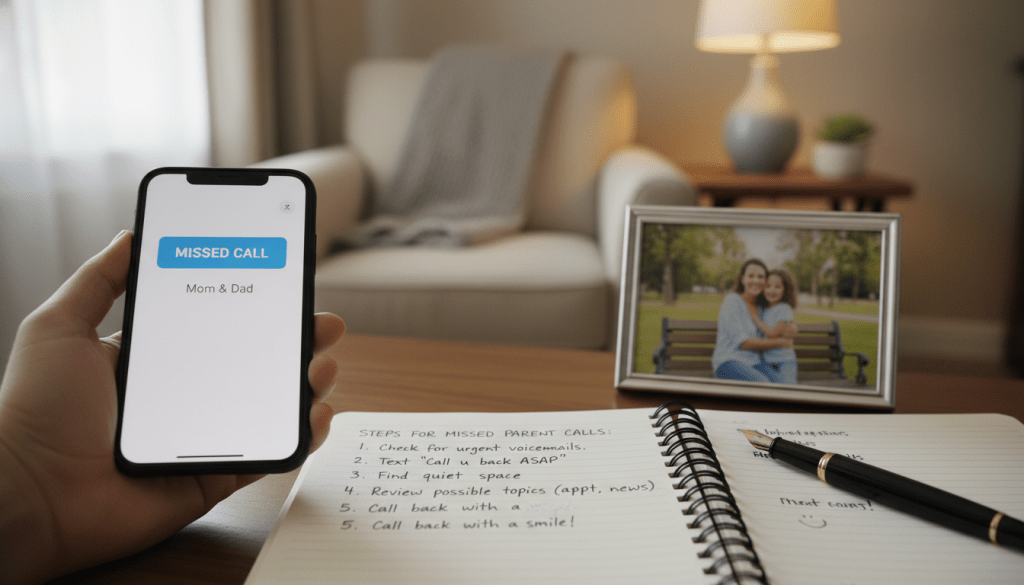
Try JoyCalls Free
No app or new device needed. Start with a free 7-day trial.
Start with patience instead of panic. Resist calling repeatedly—this creates tension rather than connection.
Leaving Compassionate Voicemails and Messages
Your first message sets the tone. Leave a warm voicemail that sounds calm: “Hi, just thinking of you. Call when you have a moment.” This reassures rather than alarms.
If they don’t have voicemail, try alternative methods. Text a sibling or send an email. Wait 2-3 hours before trying again unless there’s emergency concern.
Trying Alternative Communication Methods
Some seniors prefer texting over talking. A simple text message allows them to respond at their convenience. This approach often works better for their daily rhythm.
Reach out to their friends or neighbors. A quick “Have you seen them today?” provides immediate peace of mind. Consider calling from a different number if they screen unknown calls.
These strategies create a balanced approach to meaningful communication while addressing common concerns like those discussed by AgingCare community members.
Build a “Missed Check-In Recovery Plan” Before the Next Missed Call Happens
A missed check-in feels most frightening when there is no agreed plan. The silence itself is hard, but the uncertainty around what to do next is often what creates panic. Should you call again? Should you text? Should you ask a neighbor? Should you drive over? Should you call emergency services? When every decision has to be made in the middle of worry, even a small delay can feel like a crisis.
That is why families should create a simple missed check-in recovery plan before the next missed call happens.
This plan is not about treating your parent like a child. It is not about watching them all day or taking away their independence. It is about replacing fear with a calm, respectful process that everyone understands. Your parent knows what will happen if they miss a call. You know what steps to take. Siblings, neighbors, or caregivers know when they should get involved. Most importantly, no one has to guess.
A good recovery plan should answer five questions:
Who should try to reach your parent first?
How long should the family wait before trying again?
Which backup contact methods should be used?
Who nearby can physically check on them if needed?
At what point does the situation become urgent?
Try JoyCalls Free
No app or new device needed. Start with a free 7-day trial.
Once these answers are written down, a missed check-in becomes less chaotic. You are still concerned, of course, but you are no longer reacting blindly. You are following a plan your parent helped create.
Start With a Calm Conversation When Nothing Is Wrong
The worst time to create a safety plan is during an argument or immediately after a scare. If your parent has just missed a call and you are upset, they may feel accused. They may say, “I was just in the bathroom,” or “I do not need everyone checking up on me.” That reaction is understandable. No adult wants to feel monitored.
Instead, bring up the topic on a normal day when everyone is calm.
You might say:
“Mom, I know you are independent, and I respect that. I also know there may be times when you miss a call for a totally normal reason. Could we make a simple plan so I know what to do without overreacting?”
This kind of wording matters. It does not blame them. It does not suggest they are incapable. It frames the plan as a way to prevent overreaction, which many older adults appreciate.
The goal is to make your parent part of the decision. Ask what they prefer. Would they rather you call twice before contacting anyone else? Would they prefer you text before calling a neighbor? Is there a friend they trust more than others? Is there a time of day when they do not want to be disturbed unless it is truly important?
When seniors are included in the plan, they are more likely to cooperate with it. They are also more likely to see it as a safety agreement rather than surveillance.
Create a Three-Level Response System
Not every missed check-in deserves the same reaction. A missed call at 2 p.m. may be very different from a missed morning medication check-in after a recent hospital stay. A parent who often forgets to charge their phone is different from a parent who always answers on the first ring.
To avoid either underreacting or overreacting, create three response levels.
Level 1: Low Concern
This is for situations where there is a reasonable explanation. Maybe your parent often naps after lunch. Maybe they were expecting a visitor. Maybe they sometimes leave the phone in another room. In this case, the response should be gentle.
For example:
Call once.
Wait 15–30 minutes.
Send a calm message.
Try again later.
The message should not sound alarming. A simple “Hi Dad, just checking in. Call me when you get a chance” is enough.
The purpose of Level 1 is to preserve normalcy. You do not want every missed call to become a family emergency. That creates stress for you and resentment for your parent.
Level 2: Moderate Concern
This applies when the missed check-in is unusual, when your parent has not responded after repeated attempts, or when there are mild risk factors. For example, they recently felt dizzy, had a medication change, seemed confused earlier, or live alone without regular visitors.
At this level, you can widen the circle.
Call the home phone and mobile phone.
Send a text if they use texting.
Contact a sibling or nearby relative.
Ask a trusted neighbor if they have seen your parent.
Check whether there was a planned appointment or outing.
This level is still not panic. It is organized concern. You are gathering information from people and systems around your parent.
Level 3: High Concern
This is for situations where there are warning signs. Maybe your parent missed a check-in after saying they felt unwell. Maybe they have a fall risk and are not answering any device. Maybe they missed a scheduled caregiver visit. Maybe a neighbor reports that newspapers are still outside, lights are unusually off, or the door is open.
At this point, the plan should allow for direct action.
Ask a nearby trusted person to physically check on them.
Contact a building manager if they live in an apartment or senior community.
Call local non-emergency services for a wellness check if no trusted person can reach them.
Call emergency services immediately if there is a clear reason to believe they may be in danger.
The value of this three-level system is that it gives everyone permission to act appropriately. You are not waiting too long when the risk is real. You are also not escalating too quickly when the situation is probably harmless.
Write Down the Exact Escalation Timeline
Families often say, “We’ll know when to worry.” In reality, that is not always true. Anxiety changes how time feels. Ten minutes can feel like an hour. Two hours can feel like forever. Different siblings may also have different thresholds. One may want to call emergency services quickly. Another may think everyone is overreacting.
A written timeline prevents conflict.
Here is a simple example:
After 0 minutes: First missed check-in. Leave a calm message.
After 15 minutes: Try the second contact method.
After 30 minutes: Try again and message one family member.
After 1 hour: Contact nearby neighbor or caregiver.
After 2 hours: If still no response and this is unusual, request an in-person check.
Immediately: Escalate faster if there are known health concerns, recent falls, confusion, severe weather, or signs of danger.
This timeline should be adjusted to your parent’s situation. A healthy, active senior who often goes out may need a longer window. A parent with dementia, recent surgery, unstable blood pressure, diabetes, or fall risk may need a much shorter one.
The key is to decide in advance. That way, the plan does the thinking when emotions are high.
Choose the Right Backup Contacts
A backup contact is not just anyone who lives nearby. The person should be reliable, respectful, and acceptable to your parent. They should also understand their role clearly.
Good backup contacts may include:
A trusted neighbor
A nearby adult grandchild
A close friend
A building manager
A regular caregiver
A faith community member
A sibling who lives nearby
Before adding anyone to the plan, ask your parent for permission. This protects their dignity and privacy.
You can say:
“If I cannot reach you after a few tries, who would you feel comfortable with me calling just to make sure everything is okay?”
Once the person agrees, explain exactly what you may ask them to do. For example, they may simply knock on the door, check whether your parent’s car is there, or confirm they saw them earlier. They do not need to become a caregiver. They are just part of a light safety net.
Also, keep the list updated. People move, change phone numbers, travel, or become unavailable. Review the backup contact list every few months.
Use a Shared Family Note Instead of Scattered Messages
One common problem after a missed check-in is duplicate effort. One sibling calls five times. Another texts the neighbor. Someone else calls your parent’s doctor. Meanwhile, nobody knows what has already been tried.
This can overwhelm your parent and create unnecessary drama.
A shared note or simple family group chat can help. It does not need to be complicated. You can create a short template like this:
Date and time of missed check-in:
Who tried calling:
Which numbers were tried:
Messages left:
Backup contacts reached:
Response received:
Next step:
This prevents confusion. It also helps you notice patterns over time. For example, you may discover that missed check-ins mostly happen after lunch, on grocery days, after medical appointments, or when the phone battery is low.
Patterns are useful. They help you fix the cause instead of repeatedly reacting to the symptom.
Add “Normal Absence” Rules
Sometimes seniors miss check-ins because they are living their lives. They may go to the garden, visit a friend, attend a community event, nap, pray, exercise, or simply choose quiet time. That is healthy. The goal is not to make them available every minute.
To protect their independence, create “normal absence” rules.
For example:
“If I am going to a doctor’s appointment, I will tell you the day before.”
“If I am going out with friends, I do not need to answer during that time.”
“If I am resting after lunch, call me after 4 p.m.”
“If I am traveling, we will agree on one check-in time.”
These rules reduce false alarms. They also reassure your parent that the check-in system will not interrupt every part of their day.
This is especially important for older adults who dislike feeling watched. When they know the plan allows privacy and flexibility, they may become more open to regular communication.
Prepare for Common Practical Problems
Many missed check-ins happen because of small, fixable issues. A strong recovery plan should include prevention steps.
Keep phones reachable
Place phones where your parent spends the most time. If they sit in the living room, keep one there. If they nap in the bedroom, keep a phone nearby. If they spend time outside, consider a cordless handset, wearable alert button, or simple mobile phone.
Make the ring easier to notice
Increase ringtone volume. Add vibration. Use flashing light alerts if hearing is an issue. Choose a ringtone that is distinct from other household sounds.
Reduce scam-call confusion
Many seniors ignore calls because they receive too many scam calls. Add key family numbers to contacts. Use caller ID. Agree that family members will call from known numbers whenever possible.
Keep chargers in multiple rooms
A dead phone can cause hours of worry. Place chargers in the bedroom, kitchen, and living area. If your parent uses a mobile phone, consider a simple charging dock that does not require plugging in tiny cables.
Post the plan visibly
Print the missed check-in plan and place it near the phone, refrigerator, or medication area. Use large, readable text. Include family numbers and backup contacts.
Small changes like these often solve the problem without needing a major technology upgrade.
Decide What Counts as a Red Flag
A missed check-in by itself may not be an emergency. But a missed check-in plus a red flag deserves faster action.
Red flags may include:
Your parent said they felt dizzy, weak, confused, or short of breath.
They recently fell or nearly fell.
They started a new medication.
They missed an important dose of medicine.
They have diabetes and may be at risk of low blood sugar.
They have dementia or memory changes.
They live alone and have limited mobility.
There is extreme heat, severe cold, storms, or a power outage.
They missed more than one routine contact in a row.
A neighbor notices something unusual.
Write these red flags into the plan. That way, no one has to debate whether to escalate. The rule is already clear.
For example:
“If Mom misses a check-in and mentioned dizziness earlier that day, we move directly to Level 3.”
This protects your parent without making every missed call an emergency.
Make the Plan Kind, Not Punitive
After a missed check-in, avoid starting with frustration. Even if you were scared, your parent may have a simple explanation. They may feel embarrassed, defensive, or annoyed if the first thing they hear is, “Why didn’t you answer?”
Try this instead:
“I’m glad you’re okay. I was worried because I could not reach you. Can we figure out what happened so it is easier next time?”
This keeps the conversation practical. You are not blaming them. You are improving the system together.
If they forgot, troubleshoot gently. If they did not hear the phone, adjust the ring. If they were busy, adjust the check-in time. If they ignored the call because they felt controlled, revisit the tone and frequency of check-ins.
The question should always be: “What would make this easier for you?”
Review the Plan Monthly
A missed check-in plan should not be created once and forgotten. Your parent’s needs may change. Their health may change. Their comfort with technology may change. Family availability may change.
Set a monthly review. Keep it short.
Ask:
Is the check-in time still convenient?
Are the phone numbers correct?
Are backup contacts still available?
Has anything changed with health, mobility, hearing, or memory?
Did any missed check-ins happen this month?
What can we adjust?
This review does not need to feel formal. It can be part of a normal conversation. The point is to keep the plan realistic.
A plan that fits real life will be followed. A plan that feels rigid will be ignored.
A Simple Script to Set Up the Plan
Here is a respectful way to introduce the idea:
“Dad, I do not want to overreact if you miss a call. I know you may be busy, resting, or away from the phone. But I also do not want to sit here worrying and guessing. Can we agree on a simple plan? I will try once, wait a bit, try again, and only call someone nearby if I still cannot reach you after the time we choose together. That way, you keep your independence, and I know what to do.”
This kind of script works because it centers respect. It tells your parent that the plan is meant to prevent panic, not create control.
The Real Goal: Confidence for Everyone
A missed check-in recovery plan is not only for emergencies. It is for everyday peace of mind. It helps adult children respond with calm. It helps seniors feel respected. It helps siblings coordinate. It helps neighbors understand when they are needed.
Most missed check-ins will still turn out to be harmless. Your parent may be napping, gardening, watching television, visiting a friend, or simply enjoying a quiet afternoon. But when there is a plan, those harmless moments do not have to become emotional emergencies.
And if something is wrong, the plan helps you act faster and more clearly.
That is the balance families are really looking for: not constant monitoring, not fearful waiting, but a thoughtful system that protects safety while honoring independence.
Strengthen Communication Habits So Missed Check-Ins Become Rare

Even the best recovery plan is reactive—it helps you respond when something goes wrong. But the most effective families go one step further: they reduce how often missed check-ins happen in the first place.
This does not require constant monitoring or complicated systems. It comes down to building small, consistent communication habits that fit naturally into your parent’s daily life. When communication feels easy and predictable, seniors are more likely to participate willingly, and families spend less time worrying.
The goal is simple: make staying in touch feel effortless, not enforced.
Choose Check-In Times That Match Your Parent’s Natural Routine
Many check-in systems fail because they are built around the child’s schedule, not the parent’s lifestyle. If a call comes at an inconvenient time, your parent may ignore it, forget it, or feel irritated by it.
Instead of picking arbitrary times, observe your parent’s daily rhythm.
Ask questions like:
When do you usually wake up?
When do you feel most alert?
When do you rest or nap?
When do you watch TV, pray, or read?
When do you usually go out?
Then place check-ins around those natural anchors.
For example:
A morning check-in after breakfast works well because your parent is awake and settled.
An evening check-in before bedtime can confirm that the day ended safely.
Avoid calling during known nap times or routine activities.
This small shift makes a big difference. When check-ins align with routine, they feel less like interruptions and more like part of the day.
Keep Check-Ins Short and Predictable
One common reason seniors avoid calls is that they expect them to become long conversations. If every check-in turns into a 20-minute discussion, your parent may hesitate to answer when they are busy or tired.
To fix this, define what a check-in actually is.
A check-in should be:
Short (1–3 minutes)
Simple (“Are you okay?” “Did you take your medication?”)
Predictable (same time, same structure)
You can say:
“This is just our quick check-in. We can always talk longer later.”
This removes pressure. Your parent knows they can answer quickly without committing to a long conversation.
If they feel like talking, they will stay on the call. If not, the check-in still serves its purpose.
Use “Confirmation Signals” Instead of Full Conversations
Not every check-in needs a phone call. In fact, relying only on calls can increase missed check-ins, especially if your parent does not always carry their phone.
Introduce simple confirmation signals.
These can include:
A missed call (your parent calls once and hangs up)
A single-word text like “OK” or “Fine”
A WhatsApp message with a thumbs-up
A scheduled voice note
A smart device check-in (if they are comfortable with technology)
For many seniors, especially those who are not comfortable typing, a missed call system works well. It is quick, familiar, and does not require learning anything new.
You might agree:
“Every morning after breakfast, just give me one missed call so I know you are okay.”
This reduces effort for your parent and still gives you reassurance.
Make It Easy to Answer the Phone
Sometimes missed check-ins happen for very simple reasons: the phone is too far away, too complicated to use, or too easy to ignore.
Look at your parent’s setup from their perspective.
Is the phone within reach most of the day?
Is it easy to pick up?
Are the buttons or screen easy to use?
Is the ringtone loud enough?
Is the caller ID clear?
If the answer to any of these is no, small changes can solve the problem.
Consider:
Placing phones in multiple frequently used rooms
Using phones with larger buttons or simplified interfaces
Setting a louder, distinct ringtone for family calls
Assigning photos or names to key contacts for easy recognition
Using speakerphone by default if holding the phone is difficult
These adjustments remove friction. The easier it is to answer, the more likely your parent will respond consistently.
Address Emotional Barriers, Not Just Practical Ones
Not all missed check-ins are about technology or routine. Some are emotional.
Your parent may:
Feel that check-ins reduce their independence
Dislike feeling monitored
Avoid calls when they are in a low mood
Feel embarrassed if they forgot something
Resist anything that feels like a “system”
If you ignore these feelings, no amount of planning will work.
Instead, acknowledge them openly.
You might say:
“I don’t want you to feel like I’m watching you. I just want to make sure you’re safe and not sitting alone if something happens.”
Or:
“If there’s ever a day you don’t feel like talking, that’s okay. Just let me know with a quick signal so I don’t worry.”
This approach respects autonomy while still maintaining safety.
When seniors feel heard, they are more likely to cooperate.
Build Check-Ins Into Existing Habits
New habits are hard to maintain. But existing habits are already strong.
Instead of asking your parent to remember something new, attach check-ins to things they already do daily.
For example:
After morning tea → send a quick confirmation
After taking medication → answer or make a check-in call
Before turning off lights at night → send a message
After lunch → respond to a missed call
You can frame it like this:
“After you finish your morning tea, just give me a quick call. That way it becomes part of your routine.”
This reduces memory burden. Your parent does not need to remember an extra task—it becomes part of something they already do.
Reduce Overdependence on One Method
If your entire system depends on one method (for example, a mobile phone call), it becomes fragile. Phones can be misplaced, batteries can die, networks can fail, or your parent may simply not hear the call.
Build redundancy into your communication.
Combine at least two methods:
Mobile phone + landline
Call + text
Call + messaging app
Manual check-in + automated reminder
Family call + neighbor backup
This does not need to be complicated. Even a simple backup, like trying both the mobile and landline, can make a big difference.
The idea is not to overwhelm your parent with options, but to ensure there is always a second way to reach them.
Agree on “Do Not Disturb” Times
Independence also means having uninterrupted time.
If your parent feels that check-ins can happen at any moment, they may become defensive or less responsive. To avoid this, clearly define “do not disturb” windows.
For example:
No check-ins during afternoon naps
No calls during religious or personal time
No interruptions during regular social outings
Flexible timing on weekends
When these boundaries are respected, your parent is more likely to respect the agreed check-in times as well.
This creates mutual trust.
Practice the Plan Occasionally
Many families create a plan but never test it. Then, when a real missed check-in happens, confusion returns.
Instead, do a simple practice once in a while.
For example:
Intentionally delay a check-in and see how the process works
Confirm that backup contacts are reachable
Check whether your parent can easily follow their part of the plan
Observe how long it takes to escalate if needed
This is not about creating stress. It is about making sure the system works smoothly.
A plan that has been practiced feels natural. A plan that exists only on paper can break under pressure.
Keep Communication Positive, Not Fear-Based
If every check-in is framed around risk, illness, or fear, your parent may start associating these calls with anxiety. That can lead to avoidance.
Instead, keep the tone balanced.
Mix safety with normal conversation.
Ask:
“How was your day?”
“What did you have for lunch?”
“Did you go for a walk?”
“Did you speak to anyone today?”
Even a one-minute check-in can include a moment of connection.
This makes the system feel human, not clinical.
Adjust as Needs Change Over Time
Communication habits should evolve with your parent’s situation.
If they become more active, you may reduce frequency.
If they face health challenges, you may increase check-ins.
If they become more comfortable with technology, you can simplify the process.
If they become less responsive, you may need to strengthen backup systems.
The key is flexibility.
Avoid locking into a rigid structure. Instead, revisit the approach every few months and ask:
Is this still working for you?
Is there anything that feels inconvenient or stressful?
Can we make this easier?
This keeps the system relevant and respectful.
When Communication Breaks Down Repeatedly
If missed check-ins continue despite all efforts, it may be a sign of a deeper issue.
Possible reasons include:
Hearing difficulties
Memory decline
Confusion or early dementia
Depression or social withdrawal
Medication side effects
Fear of scams or unknown callers
Physical difficulty reaching the phone
At this point, the solution is not just better planning—it may require support.
Consider:
A hearing check
A medical consultation
Simplified devices
In-home assistance
More structured daily routines
Additional social engagement
Missed check-ins are sometimes early signals. Paying attention to patterns can help you address the root cause before it becomes serious.
A Gentle Way to Reinforce the Habit
If your parent forgets to check in, avoid correcting them in a way that feels critical.
Instead of saying:
“You forgot again.”
Try:
“I didn’t hear from you this morning, so I got a little worried. What would make it easier for you to remember?”
This shifts the conversation from blame to problem-solving.
Over time, consistency improves not through pressure, but through comfort and clarity.
The Outcome: Fewer Missed Calls, Less Stress
When communication habits are strong, missed check-ins become rare—and when they do happen, they are easier to interpret.
You start to recognize patterns.
You know what is normal and what is unusual.
Your parent feels respected, not monitored.
You feel reassured, not anxious.
Most importantly, the relationship remains intact.
Because at the heart of every check-in is not just safety—it is connection.
Recognizing Subtle Warning Signs Behind Missed Check-Ins
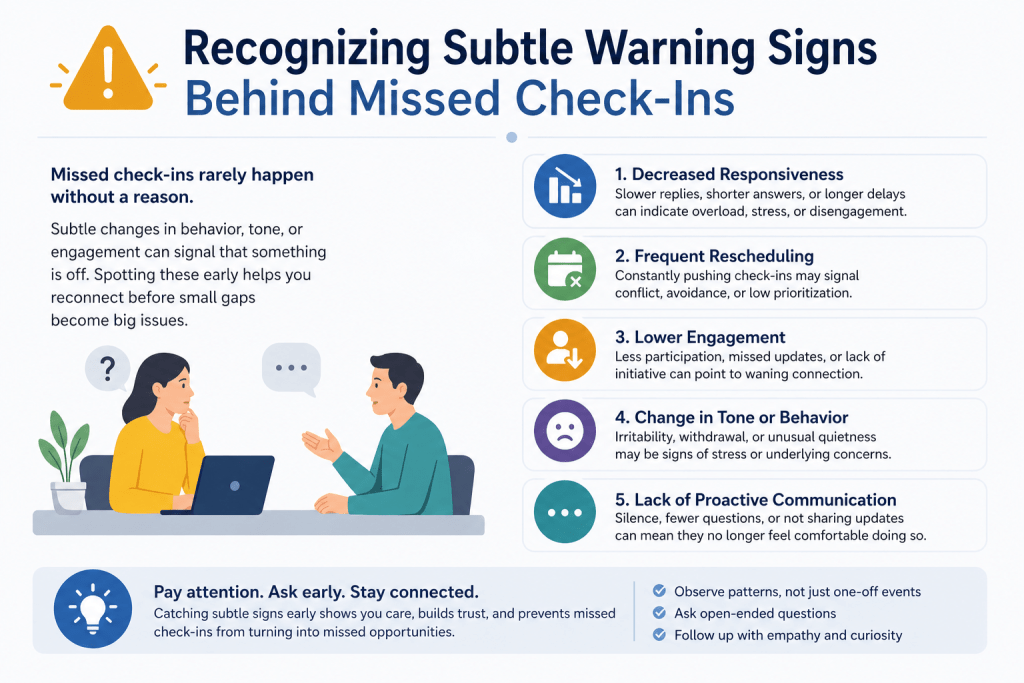
Not every missed check-in is random. Sometimes, it is the first visible sign of a deeper change—physical, cognitive, emotional, or environmental. The challenge is that these warning signs are often subtle. They do not appear as emergencies. They appear as small shifts that are easy to dismiss.
Families who learn to recognize these early signals can act sooner, prevent escalation, and support their parent in a more thoughtful way.
Look for Patterns, Not Isolated Incidents
A single missed check-in rarely tells you much. But patterns tell a story.
Start asking:
Is this happening at the same time of day?
Is it becoming more frequent?
Is it linked to certain activities (after meals, after medication, evenings)?
Is your parent slower to respond than before?
Are they forgetting to return calls entirely?
For example:
If missed check-ins happen mostly in the evening, fatigue or medication timing may be involved.
If they happen after outings, your parent may be overexerting themselves.
If they are increasing week by week, there may be cognitive or emotional changes.
Keep a simple log for a few weeks. You do not need anything complex—just note date, time, and possible context.
Patterns help you move from guessing to understanding.
Physical Health Signals That Often Go Unnoticed
Many physical health issues do not immediately appear as emergencies. Instead, they reduce responsiveness.
Watch for signs such as:
Slower movement or difficulty getting to the phone
Increased fatigue or daytime sleepiness
Dizziness or balance issues
Changes in appetite or hydration
New or worsening pain
Shortness of breath
Recent falls or near-falls
For example, a parent who used to answer quickly but now takes several attempts may not be ignoring calls—they may be physically struggling to respond.
In such cases, the solution is not “call more”—it is to reduce effort.
You may need to:
Move the phone closer
Use speakerphone or auto-answer features
Add wearable alert devices
Adjust check-in timing to when they feel strongest
Encourage a medical check-up
The key insight: missed check-ins can reflect physical difficulty, not lack of willingness.
Cognitive Changes and Memory-Related Signals
Memory and cognitive shifts are among the most common reasons for missed check-ins—and often the most sensitive to address.
Signs to watch for:
Forgetting agreed check-in times
Not recognizing missed calls
Confusion about day or time
Difficulty following simple routines
Repeating the same questions
Inconsistent responses (sometimes very sharp, sometimes confused)
A parent may say, “I didn’t hear the phone,” when in reality they forgot the routine entirely.
If you notice these signs, avoid confrontation. Instead, simplify.
Use the same check-in time every day
Add visual reminders near the phone
Use alarms with clear labels (“Call daughter now”)
Reduce the number of steps required to respond
Use more passive systems (like missed-call signals)
If concerns persist, consider a medical evaluation. Early recognition allows for better support and planning.
Emotional and Mental Health Factors
Missed check-ins are not always about physical or cognitive issues. Sometimes, they reflect emotional states.
Your parent may:
Feel lonely or withdrawn
Experience mild depression
Avoid calls when they feel low
Feel like they are a burden
Lose interest in routine communication
Feel irritated by repeated check-ins
These are not always obvious. A parent may still sound “normal” during conversations but gradually disengage.
Clues include:
Shorter conversations
Less enthusiasm
Avoiding calls at certain times
Delayed responses without clear reason
Reduced social activity overall
In these cases, increasing the number of check-ins may not help. Instead, focus on quality.
Ask open-ended questions
Encourage social interaction (friends, community, family visits)
Introduce light structure to the day
Consider professional support if needed
Sometimes, a missed check-in is not about the call—it is about how your parent is feeling.
Environmental and Lifestyle Triggers
Your parent’s environment can also affect their responsiveness.
Common factors include:
Poor lighting making it harder to see the phone
Background noise masking the ringtone
Clutter making the phone hard to find
Uncomfortable furniture limiting mobility
Extreme weather affecting energy and routine
Power outages or network issues
Changes in household setup (new furniture, repairs, visitors)
For example, a parent may stop answering calls simply because the phone is no longer in their usual place.
Walk through their living space (physically or mentally) and ask:
Is everything easy to reach?
Is the phone always visible?
Is the environment calm or chaotic?
Has anything changed recently?
Small environmental fixes often have a large impact.
Medication-Related Causes
Medications can significantly affect alertness, energy, and responsiveness.
Watch for:
Drowsiness after new medication
Confusion or forgetfulness
Changes in sleep patterns
Dizziness or weakness
Slower reaction times
If missed check-ins started after a medication change, do not ignore it.
Speak with your parent and, if needed, consult their doctor. Sometimes, adjusting dosage or timing can resolve the issue.
For example:
A medication taken in the morning may cause drowsiness during a scheduled check-in time. Moving the check-in or adjusting the medication schedule may help.
Technology Fatigue and Avoidance
Not all seniors are comfortable with constant phone use. Some may feel overwhelmed by:
Too many calls
Too many apps
Fear of pressing the wrong button
Scam calls and unknown numbers
Complex interfaces
As a result, they may avoid answering altogether.
If you sense this, simplify the system.
Use one primary method
Reduce unnecessary calls
Label contacts clearly
Avoid introducing too many new tools at once
Provide reassurance (“You can’t break anything by answering”)
Comfort with technology is just as important as access to it.
Social Isolation as a Hidden Risk
A parent who has limited social interaction is more vulnerable when something goes wrong—and may also be less responsive overall.
If your parent:
Rarely leaves the house
Has few regular visitors
Does not engage in community activities
Spends long hours alone
Then a missed check-in carries more weight.
In such cases, the solution is not only better monitoring—it is increasing connection.
Encourage:
Regular visits from family or friends
Participation in local groups or activities
Scheduled outings
Interaction with neighbors
Light daily routines that involve others
The more connected your parent is, the easier it becomes to notice when something is off.
When to Transition From Monitoring to Support
There is a point where repeated missed check-ins indicate that the current system is no longer enough.
Signs include:
Frequent missed check-ins despite reminders
Inability to follow simple communication routines
Increasing confusion or forgetfulness
Physical difficulty responding
Emotional withdrawal
Safety concerns (falls, missed medication, disorientation)
At this stage, the conversation should shift from “How do we improve check-ins?” to “What support would make daily life safer and easier?”
Options may include:
More frequent in-person visits
Part-time caregiving support
Simplified communication tools
Structured daily routines
Medical evaluation
Community or assisted living support (if appropriate)
This transition should be handled gently and respectfully. The goal is not to remove independence, but to sustain it safely.
How to Bring Up Concerns Without Causing Resistance
If you notice patterns or warning signs, the way you communicate matters.
Avoid:
“You never answer your phone.”
“You’re becoming forgetful.”
“This isn’t safe.”
Instead, try:
“I’ve noticed it’s been a little harder to reach you lately. Is everything okay?”
“I want to make sure our system is working for you. What feels difficult?”
“Would it help if we made this a bit easier?”
This approach keeps the conversation collaborative.
Turn Observations Into Small, Practical Changes
Once you identify a likely cause, act in small steps.
If the issue is physical → reduce effort (move phone, adjust timing)
If it is cognitive → simplify routine (same time, reminders)
If it is emotional → increase connection (short, friendly calls)
If it is environmental → improve setup (visibility, accessibility)
If it is medical → seek guidance (doctor, medication review)
Avoid making too many changes at once. Test one or two adjustments, observe the result, and refine.
The Bigger Perspective
A missed check-in is rarely just about the call itself. It is often a signal—a small one, but meaningful.
When you learn to read that signal correctly, you move from reacting to responding thoughtfully.
You stop asking:
“Why didn’t they answer?”
And start asking:
“What might be making it harder for them to answer?”
That shift changes everything.
It leads to better decisions, stronger trust, and more effective support—while still respecting your parent’s independence and dignity.
Creating a Calm Emergency Response System That Doesn’t Feel Like an Emergency
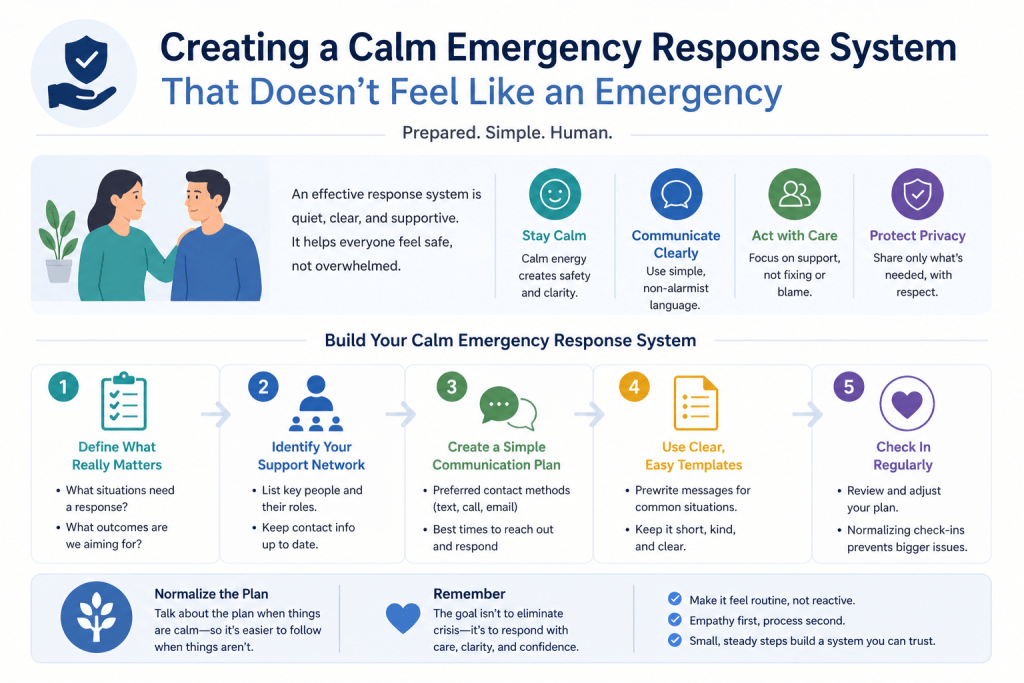
Even with strong habits and a solid recovery plan, there will be moments when a missed check-in feels serious. In those moments, what matters most is not just what you do—but how smoothly and calmly you are able to do it.
Many families struggle here. When concern rises, actions become rushed, communication becomes scattered, and decisions are made under stress. This can lead to confusion, delayed responses, or unnecessary escalation.
A well-designed emergency response system removes that chaos. It ensures that when something does feel urgent, you can act quickly, clearly, and confidently—without creating panic for yourself or your parent.
Define What “Emergency” Actually Means for Your Family
One of the biggest gaps in most families is the lack of a shared definition of urgency.
What feels like an emergency to one person may not feel the same to another.
For example:
One sibling may want to call emergency services after 30 minutes of no response.
Another may think waiting 2–3 hours is reasonable.
A parent may feel embarrassed if emergency services are called too quickly.
To avoid this mismatch, define it clearly.
Ask:
What situations require immediate action?
What situations allow time for checking with neighbors or family first?
What symptoms or signals change the situation from “concern” to “urgent”?
You might agree on rules like:
“If there is a known health concern that day, we escalate faster.”
“If two check-ins are missed in a row, we move to in-person verification.”
“If there is any mention of dizziness, chest pain, or confusion, we do not delay.”
Clarity removes hesitation. And in real situations, hesitation is what often causes delay.
Prepare a Ready-to-Use Emergency Information Sheet
In stressful moments, even simple details can be hard to recall. Phone numbers, addresses, medical history—things you know well—can slip your mind when you are anxious.
That is why every family should have a ready-to-use emergency information sheet.
This should include:
Full name and address of your parent
Nearby landmarks (helpful for emergency services)
Primary phone numbers (mobile, landline)
Emergency contacts (family, neighbors, caregivers)
Medical conditions (brief and relevant)
Current medications (if possible)
Doctor’s contact details
Preferred hospital (if applicable)
Any access instructions (gate code, apartment number, key location)
Keep this information:
Saved on your phone
Printed at your parent’s home
Shared with key family members
This is not about expecting emergencies—it is about removing friction if one occurs.
Assign Roles Within the Family
When multiple people are involved, lack of coordination can slow everything down.
Instead of everyone doing everything, assign simple roles.
For example:
One person handles direct calls and messages
One person contacts neighbors or nearby contacts
One person prepares emergency information if escalation is needed
One person stays available to coordinate next steps
These roles do not have to be fixed forever, but having a default structure helps in the moment.
It avoids situations like:
Three people calling the same neighbor
No one contacting a nearby contact
Confusion about who is taking the next step
Even a basic agreement like “I’ll call, you check with neighbors” can make a big difference.
Build Relationships With Nearby People Before You Need Them
In many cases, the fastest way to check on your parent is through someone physically nearby. But that only works if there is already some level of trust and familiarity.
Do not wait for an emergency to establish this.
Take time to:
Introduce yourself to neighbors
Share your contact information
Explain that your parent lives alone (if applicable)
Let them know they may be contacted occasionally if needed
You can keep it simple:
“Hi, I’m [Name], I’m [Parent’s name]’s son/daughter. I live in another area, so I just wanted to share my number in case there’s ever anything you notice or need.”
This creates a quiet support system.
It also makes it easier to ask for help without feeling like you are imposing.
Know When to Use a Wellness Check
Many families hesitate when it comes to calling for a wellness check. They worry about overreacting or causing unnecessary alarm.
But there are situations where it is the right decision.
Consider a wellness check when:
You cannot reach your parent through any method
No nearby contact is available or responsive
There are known health concerns or recent warning signs
Something feels clearly out of the ordinary
Time has passed beyond your agreed escalation window
A wellness check is not an extreme step—it is a precaution.
If your plan includes clear criteria for when to use it, the decision becomes easier and less emotional.
Avoid Creating Panic During the Process

While acting quickly is important, it is equally important to avoid spreading panic—especially to your parent.
If they eventually answer after a delay, how you respond matters.
Avoid:
“Why didn’t you answer?”
“We were about to call emergency services!”
“You scared everyone!”
Instead, say:
“I’m glad you’re okay. I was trying to reach you and just wanted to make sure everything was fine.”
This keeps the situation calm.
If escalation did happen (for example, a neighbor checked on them), explain it gently and frame it as care, not control.
Prepare for Situations Where Your Parent Cannot Respond
There may be rare situations where your parent is physically unable to answer a call—due to a fall, sudden illness, or other issue.
Your system should account for this possibility.
This is where layered safety becomes important.
Consider:
Wearable alert devices that can be triggered easily
Voice-activated assistants that can call for help
Auto-detection systems for falls (if appropriate)
Regular in-person visits or check-ins
Backup access (trusted person with a spare key)
The goal is not to assume the worst—but to ensure that if something does happen, your parent is not completely dependent on answering a phone.
Balance Speed With Judgment
One of the hardest parts of responding to a missed check-in is knowing how fast to move.
Move too slowly, and you risk delay in a real situation.
Move too quickly, and you may create unnecessary stress or resistance.
This is why your predefined plan matters so much.
It allows you to act with measured urgency.
You are not reacting emotionally—you are following a system that balances safety and respect.
After Any Incident, Do a Calm Review
If a situation required escalation—whether minor or serious—take time to review it afterward.
Keep the tone constructive, not critical.
Ask:
What worked well?
Where did we feel confused or delayed?
Was the escalation timing appropriate?
Did the communication feel clear?
What can we simplify or improve?
Involve your parent in this conversation if possible.
This reinforces that the system is collaborative and adaptable.
Keep Emergency Readiness Invisible but Effective
The best emergency systems are the ones that work quietly in the background.
They do not interfere with daily life.
They do not make your parent feel monitored.
They do not create tension.
But when needed, they activate smoothly.
This balance is important.
Your parent should feel:
Independent in daily life
Supported when needed
Respected in decisions
You should feel:
Prepared, not anxious
Clear about what to do
Confident in your response
The Real Outcome: Calm, Not Fear
The purpose of all this planning is not to prepare for worst-case scenarios every day. It is to remove fear from the unknown.
When a missed check-in happens, you do not want your first reaction to be panic.
You want it to be:
“I know exactly what to do next.”
That clarity changes everything.
It protects your parent.
It reduces your stress.
It strengthens trust on both sides.
And most importantly, it ensures that when something does need attention, you are ready—not rushed.
Prioritizing Safety and Respecting Independence
Finding the right balance between safety and independence feels like walking a tightrope. Your loved one’s well-being is paramount, yet their right to make choices deserves equal respect.

When communication becomes difficult, the root issue might be physical. Hearing loss affects many older adults, making it hard to hear ringing phones or understand conversations.
Evaluating Hearing Issues or Device Limitations
Schedule a hearing test with a trusted audiologist. Explore specialized phones with amplified sound and visual alerts. These tools address the real issue without being intrusive.
Sometimes resistance stems from emotional readiness rather than stubbornness. It takes patience to wait for the right moment. A minor fall or health scare often opens the door to solutions.
Balancing Concern with Your Loved One’s Right to Independence

Approach conversations with love, not control. Say, “I worry when I can’t reach you. Would you try a phone that shows who’s calling?” This respects their autonomy while addressing your concern.
Establish routines that don’t depend on answering devices. “I’ll visit every Tuesday” creates structure. This approach works well when older adults resist help initially.
Document your concerns in case the situation changes. Meanwhile, compare options like smartwatch versus phone check-ins to find the best fit. Your attention and patience make all the difference.
Leveraging Modern Tools and Alerts for Better Connectivity
The right tools can turn daily worry into confident reassurance. Today’s technology offers gentle solutions that respect independence while providing peace of mind.

Utilizing JoyCalls for Reliable Check-Ins
JoyCalls provides an AI companion that makes daily calls to your loved one. They simply answer their regular phone and have a friendly chat. You receive a text summary confirming their well-being.
The system requires no new equipment or app downloads. It works with existing landlines or cell phones. Busy family members appreciate the automated check-ins that free up precious time.
Set up takes minutes at the JoyCalls signup page. Customize call schedules to match your loved one’s routine. This approach works beautifully for long-distance caregivers using a daily check-in system.
Exploring Additional Communication and Alert Systems

Beyond JoyCalls, consider complementary alert systems. Medical alert devices can detect falls and notify family members. These tools create safety nets without constant supervision.
Video doorbells allow visual check-ins. Phones with large buttons simplify communication. These technologies support the communication tools that keep families connected.
For children juggling parenting responsibilities and elder care, these solutions reduce stress. They create multiple layers of safety while respecting independence.
Conclusion
The journey of caring for loved ones includes moments of quiet uncertainty. You are part of a large community navigating these waters with compassion and dedication.
Remember the balanced approach: ensuring safety while honoring independence. Modern tools like JoyCalls provide gentle check-ins that respect boundaries. They create meaningful conversation opportunities without pressure.
Your thoughtful response to missed connections demonstrates deep care. Whether through technology or personal networks, you’re building a safety net that supports everyone’s well-being. This approach maintains healthy communication patterns that benefit the entire family dynamic.
Trust your instincts. You know your loved one best. The solutions you choose today can evolve as needs change, creating lasting peace of mind for years ahead.