


Do you ever feel that nagging worry in the back of your mind? The one that whispers, “Did Mom take her pills today?” If your aging parents live alone, this concern can become a constant, heavy weight. You’re not alone in this feeling. So many families share this same quiet anxiety.
For busy loved ones, simple digital alerts have become a lifeline. They offer a way to help ensure a parent’s well-being and independence, providing peace of mind even from a distance. This guide will walk you through everything about using messages for health schedules. We’ll explore the real benefits and the potential challenges.
You’ll see how these straightforward tools can transform a family’s daily routine. They make managing health less stressful for everyone. This is true whether you’re a professional caring for parents from afar or a senior seeking an easier way to stay on track. Studies, like those from the National Center for Biotechnology Information, show that such prompts can positively influence health behaviors.
We’ll look at practical solutions that don’t need complicated tech. You’ll finish with a clear understanding of if this is the right choice for your family and how to start effectively. For those seeking a more personal touch, services like daily phone check-ins for seniors offer a compassionate alternative.
Key Takeaways
- Digital alerts can provide significant peace of mind for families concerned about a senior’s health routine.
- Understanding both the advantages and limitations is crucial before implementing a system.
- These tools are designed to be simple, often requiring no new devices or technical knowledge.
- They aim to support a senior’s independence while giving caregivers reassurance.
- Research indicates such reminders can effectively promote positive health-related habits.
- Alternatives, like personal phone calls, combine reminders with social connection.
- The goal is to find a sustainable solution that reduces stress for the entire family.
Introduction to Text Medication Reminders
That moment when you call to check on Mom and hear the uncertainty in her voice about whether she took her morning pills – it’s a feeling so many families know all too well.
Overview and Importance for Seniors
Research reveals a sobering truth about health management for older adults. Studies show that nearly half of all adults forget their prescribed treatments regularly. Medication delays occur in over 80% of cases.
These numbers aren’t just statistics. They represent real health risks for our loved ones. When seniors miss their health routines, it can lead to serious complications and hospital visits.

How Reminders Improve Medication Adherence
The power of simple digital alerts is truly remarkable. A 2017 study found that after receiving daily message prompts for two weeks, forgetfulness rates dropped from 46% to just 5%.
These systems work because they meet seniors where they are most comfortable – using the phones they already understand. No complicated apps or new devices are required.
For patients managing chronic conditions, these gentle nudges nearly double the likelihood of staying on schedule. This support helps maintain independence while giving families peace of mind. For those seeking additional companionship, AI companion services can provide both health support and social connection.
When implemented correctly, these simple tools transform health management from a source of stress into a manageable routine. They empower seniors to take control of their well-being with dignity.
Benefits of Text Medication Reminders
When simple technology meets compassionate care, something beautiful happens for families. These digital alerts create a warm bridge between your loved one and their healthcare team.

Enhanced Patient Engagement and Timely Interventions
Your parent feels more supported and less alone in managing their health. They become active participants in their own wellbeing journey.
Healthcare providers can respond quickly when concerns arise. Patients can simply reply to messages about side effects or questions. This leads to faster solutions and fewer complications.
Studies like those from PMC research show how these connections significantly improve adherence. Better adherence means better health outcomes for the people you love.
Convenience and Cost-Effectiveness
No more phone tag with doctors’ offices or unnecessary trips for simple questions. Everything happens through a device your loved one already carries.
The financial savings are meaningful for families. Better health management helps prevent expensive emergency visits. This brings quality support right to their fingertips, especially valuable for those in remote areas.
Drawbacks and Challenges of Medication Reminder Services
While digital alerts can be incredibly helpful, it’s wise to understand what challenges might come with them. Being prepared helps you choose the right system for your family’s unique situation.
Privacy, HIPAA Compliance, and Security Concerns
Your loved one’s health information deserves the highest protection. Not all messaging services meet healthcare privacy standards.
HIPAA-compliant platforms use encryption to keep communications secure. They require proper consent and authentication before sharing any health details. This protects patients from unauthorized access to their sensitive information.

Limitations in Customization and Message Timing
Some services lack flexible scheduling features. You might find alerts can only be set on the hour, not at the exact time your parent needs them.
Try JoyCalls Free
No app or new device needed. Start with a free 7-day trial.
When a doctor changes a treatment schedule, adjusting individual messages can be difficult. This technology should adapt to your loved one’s life, not the other way around.
Understanding these considerations helps you find a solution that truly supports your family’s journey. The right choice brings peace without adding new frustrations.
Are Text Medication Reminders Enough? How to Decide What Level of Support a Senior Actually Needs
Text message medication reminders can be helpful, but they are not automatically the right answer for every senior, every medication routine, or every family situation. This is where many caregivers get stuck. They understand the idea, they see the benefits, and they want something simple. But the real question is not, “Can text reminders work?” The better question is, “Will text reminders work well enough for this specific person, in this specific stage of life, with this specific medication routine?”
That distinction matters.
A reminder system should make life calmer, safer, and more manageable. It should not create false confidence, more confusion, or a routine that looks organized on paper but breaks down in real life. For some older adults, a text reminder is exactly the right amount of support. It offers a gentle prompt, preserves independence, and keeps the day moving. For others, a text is only one small piece of a larger system that may also need pill organizers, family check-ins, pharmacy support, or live follow-up.
The most helpful way to think about medication reminders is not as a single tool, but as part of a care strategy. The goal is not just to send a reminder. The goal is to help a senior remember the medicine, identify the correct medicine, take it at the right time, take the right dose, and maintain that routine consistently over time.
That is a much bigger job than a text alone.
If you are a senior reading this for yourself, or an adult child trying to support a parent, the next step is to honestly evaluate what kind of support is needed right now. Not six months ago. Not what used to work. Not what should work in theory. What works today.
Start With the Most Important Question: What Is the Reminder Supposed to Solve?
Before choosing any medication reminder system, pause and identify the actual problem. Families often rush into a solution without defining the real issue. That leads to systems that are technically set up but practically ineffective.
For example, one senior may simply lose track of time during the day. In that case, a text reminder could work beautifully. Another senior may remember it is time for medicine but forget which pill to take. A text alone may not be enough there. Someone else may see the message, intend to take the medicine, get distracted, and forget five minutes later. Another may take the medicine, but accidentally double-dose because they do not remember whether they already took it.
These are very different problems.
A useful way to assess the situation is to ask a few direct questions:
Is the problem forgetfulness, confusion, resistance, or routine disruption?
If the issue is simple forgetfulness, texts can be effective. If the issue is confusion about medications, then the routine likely needs better organization. If the issue is resistance, the solution may require a conversation rather than a reminder. If the issue is an unpredictable daily schedule, reminders must be tied to habits and not just clock times.
Does the senior reliably notice and read texts?
A message only helps if it is seen, understood, and acted on. Some older adults check every text immediately. Others ignore their phone for hours, keep it in another room, silence notifications, or struggle with small screens.
Is the medication schedule simple or complicated?
One morning pill is very different from a multi-dose routine involving food timing, insulin, blood pressure medication, or rotating prescriptions. The more complex the regimen, the more likely it is that reminders need backup systems.
Is there a caregiver who needs visibility too?
Sometimes the reminder is really for family peace of mind. If so, the system may need a way to confirm whether a dose was taken, not just whether a message was sent.
Once you identify the true problem, it becomes much easier to choose the right level of support.
Three Levels of Medication Support: Which One Fits Best?
A very practical way to think about reminder systems is to group them into three levels. This helps families avoid overcomplicating simple situations and, just as importantly, avoid under-supporting risky ones.
Level 1: A Simple Prompt Is Enough
This level works best for seniors who are generally independent, cognitively clear, and already motivated to follow their medication routine. They do not need someone to persuade them. They do not need detailed supervision. They just need a timely nudge.
These seniors usually:
- Know what each medication is for
- Can open and manage pill bottles independently
- Read and respond to text messages comfortably
- Have a relatively stable routine
- Rarely miss doses, but occasionally forget because the day gets busy
For this group, text reminders are often a strong fit. They are light-touch, respectful, and easy to maintain. The reminder serves as a cue, not a control system.
Level 2: A Prompt Plus Structure Is Needed
This level fits seniors who are still fairly independent but need more support around consistency and clarity. They may remember most days, but struggle when routines change, appointments run late, family visits interrupt the schedule, or multiple medications need to be sorted carefully.
These seniors often benefit from:
- Text reminders
- Weekly pill organizers
- Written medication schedules in large print
- Checklists or medication logs
- Refill tracking
- Occasional caregiver review
Here, the text reminder is still useful, but it cannot do all the work alone. It must sit inside a stronger system.
Level 3: A Prompt Is Not Enough Without Follow-Up
This level applies when medication adherence is fragile or high-risk. A senior may have memory issues, vision limitations, hearing loss, dexterity problems, confusion about pills, or health conditions where a missed or duplicated dose could have serious consequences.
In this situation, text reminders may still be part of the plan, but they should not be the primary safeguard.
Additional supports may include:
- Daily caregiver check-ins
- Automated calls with follow-up
- Pharmacy blister packs
- Smart dispensers
- In-home support
- Clinical care coordination
- Escalation if a dose is missed
This is where families sometimes make a costly mistake. They choose the simplest system because it sounds easy, but the senior’s actual needs are no longer simple. A text can feel reassuring while still leaving real gaps.
How to Tell When Text Reminders Are a Good Fit
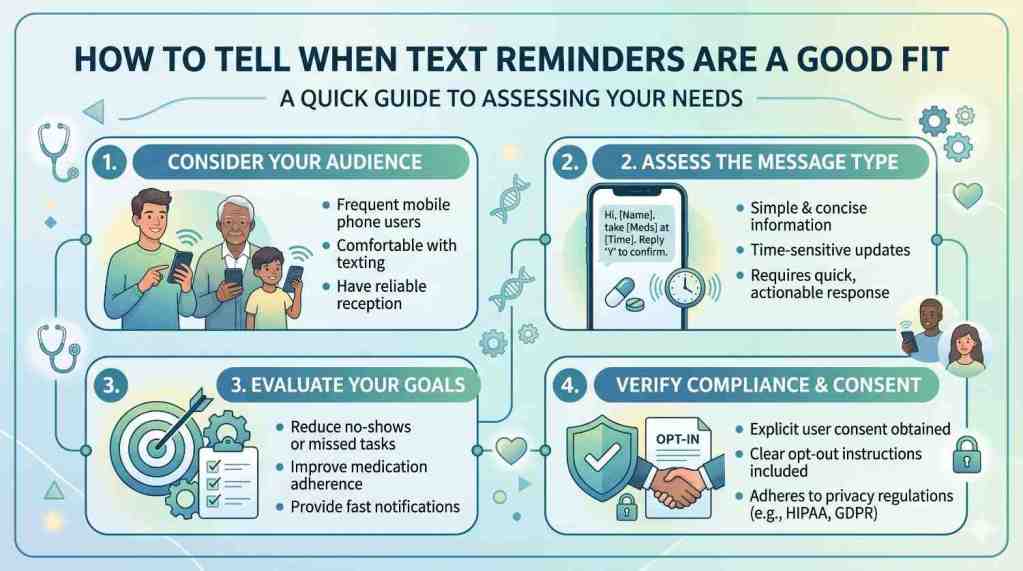
Text reminders tend to work best when the senior is already capable of following through but benefits from consistency. That means the reminder is supporting an existing ability, not replacing a missing one.
A good fit often looks like this:
The senior uses their phone comfortably
They do not need to be a tech expert. They just need to reliably notice messages, open them, and understand them without stress.
The medication routine is stable
There are not constant schedule changes, frequent dose adjustments, or complicated instructions that require ongoing reinterpretation.
The senior wants to stay independent
Many older adults appreciate support that does not feel intrusive. A simple message can preserve dignity because it helps without hovering.
The message can be tied to an established habit
Reminder systems work best when medication is anchored to something regular, like breakfast, brushing teeth, evening tea, or bedtime.
Missed doses are occasional, not constant
A text reminder is ideal for preventing slips, not rescuing a chronically broken system.
When these factors are present, text reminders can be practical, affordable, and sustainable.
Signs That a Text Reminder Alone May Not Be Safe Enough
Families sometimes continue using a reminder tool because it feels better than doing nothing. But “better than nothing” is not always the same as “good enough.”
Here are some signs the routine likely needs more support:
The senior forgets whether they already took the medication
This is a major warning sign because it creates double-dosing risk. A reminder can tell someone to take a pill, but it does not automatically confirm whether the pill has already been taken.
The senior reads the text but still delays action
Some people see the message, plan to handle it in a few minutes, and then forget. In those cases, the problem is not awareness. It is follow-through.
The phone is often misplaced, uncharged, muted, or ignored
The reminder system cannot work if the device is unreliable in daily life.
The senior has visual, cognitive, or dexterity limitations
A reminder may arrive perfectly on time and still fail at the point of action if the person cannot read the message clearly, distinguish medications, or open containers safely.
There have already been repeated medication mistakes
When there is an established pattern of missed doses, wrong doses, skipped refills, or confusion between medications, that is usually a sign that the family should step up the support system instead of just repeating the same reminder method.
The medication has a narrow margin for error
Some medications are more forgiving than others. For high-risk medications or tightly timed regimens, the reminder system needs a higher standard of reliability.
In these situations, use text reminders only as one layer, not the full plan.
A Smarter Way to Build the Reminder Around Real Life
One reason medication reminders fail is that families build them around the prescription label instead of the senior’s actual day. A medication routine should fit the person, not just the clock.
If a senior always sleeps late, a rigid 7:00 a.m. reminder may create frustration and be ignored. If mornings are chaotic, a breakfast-linked prompt may be more effective than a specific minute on the clock. If evenings are quieter and more predictable, that may be the right time for medication sorting or logging.
The most successful routines are not the most sophisticated. They are the most realistic.
Match reminders to lived habits, not ideal habits
Do not build the system around what the schedule should be. Build it around what usually happens.
Examples:
- “After breakfast” may work better than “8:00 a.m.”
- “When the evening news starts” may work better than “6:30 p.m.”
- “Right after brushing teeth” may work better than “9:00 p.m.”
This small shift makes reminders feel more natural and easier to follow.
Use plain language, not clinical wording
A medication reminder should be easy to understand at a glance. Avoid long, cluttered, or overly medical wording.
Better:
“Good morning. Time for your blood pressure medicine and a glass of water.”
Less helpful:
“Please administer prescribed antihypertensive dose as scheduled.”
The goal is calm clarity.
Avoid sending too many messages
More reminders do not always create better adherence. Too many notifications can cause seniors to tune out the system entirely. Keep reminders meaningful and limited to what truly helps.
Build in a missed-dose plan
Do not assume every reminder will work. Decide in advance what should happen if a dose is missed, delayed, or uncertain. This removes panic and guesswork.
Actionable Checklist for Families Before Choosing a Reminder System
If you want to make a strong decision quickly, use this checklist.
Step 1: Watch the current routine for one full week
Do not rely only on memory or assumptions. Observe what actually happens.
Notice:
- Which doses are most often delayed or missed
- Whether the phone is near the senior when reminders would arrive
- Whether confusion happens before, during, or after the medication moment
- Whether meals, naps, appointments, or fatigue affect timing
Patterns appear fast when you pay attention for a week.
Step 2: List every medication challenge separately
Do not combine all issues into one vague problem. Be specific.
Examples:
- “Forgets afternoon dose when out of the house”
- “Cannot remember if evening medicine was already taken”
- “Confuses two similar-looking pills”
- “Runs out before refill is ordered”
- “Ignores phone when resting”
This helps you match the tool to the problem.
Step 3: Test one reminder method before building a bigger system
Start simple. Run a 7- to 14-day test with one medication or one time of day. See whether the reminder actually changes behavior. A small test reveals much more than a long discussion.
Step 4: Decide what success looks like
Do not just ask, “Did we set it up?” Ask:
- Were doses actually taken on time?
- Did stress go down?
- Did confusion go down?
- Did the senior feel supported rather than controlled?
- Did the caregiver gain useful reassurance?
A reminder system is only successful if life improves.
Step 5: Reassess every month
Medication routines change. Health changes. Energy changes. Confidence changes. What worked three months ago may no longer be enough. A quick monthly check helps prevent the system from becoming outdated.
For Seniors Themselves: How to Know Whether This Will Help You
If you are a senior considering text reminders for yourself, the best approach is to be honest and kind with yourself. Needing support is not failure. In many cases, it is exactly what helps you stay independent longer.
Ask yourself:
- Do I usually see text messages soon after they arrive?
- Do I know what each medicine is and when I should take it?
- Do I sometimes get distracted and forget, even when I meant to take it?
- Do I want a reminder that feels private and simple?
- Would I feel calmer knowing I have a routine backing me up?
If the answer is yes, a text reminder may be a very smart support tool.
But if you often feel unsure whether you have already taken a pill, mix up medications, or avoid dealing with the routine because it feels overwhelming, then a text reminder should probably be paired with stronger support. That is not a sign that you are doing badly. It is a sign that the system should work harder for you.
The Best Reminder System Is the One That Reduces Risk Without Reducing Dignity
This is what families should keep coming back to.
A good medication support system should protect health and preserve dignity. It should reduce risk without making the senior feel watched, scolded, or incapable. It should create confidence, not dependence. It should be simple enough to maintain, clear enough to follow, and strong enough to match the real level of need.
Text medication reminders can absolutely be part of that solution. In the right situation, they are a practical and caring tool. But the smartest families do not stop at asking whether reminders are available. They ask whether reminders are sufficient.
That is the strategic question.
Because in medication management, the point is not just sending a message. The point is helping the right action happen, at the right time, in a way the senior can actually sustain.
And when you choose a system based on real life rather than wishful thinking, you give everyone something valuable: more safety, more clarity, and more peace of mind.
Why Medication Reminders Still Fail — and How Seniors and Families Can Fix the Real Problem
Setting up medication reminders can feel like a major step forward. And often, it is. A simple text arriving at the right time can reduce forgetfulness, lower stress, and make a health routine feel more manageable. But many families discover something frustrating after the first few days or weeks: the reminders are going out, yet the medication routine is still not fully working.
This is more common than people expect.
The problem is usually not that the idea of reminders is wrong. The problem is that a reminder only solves one part of medication adherence: it helps with remembering that something should happen. But medication routines can break down at many other points too. A senior may see the message but not act on it. They may act on it, but take the wrong pill. They may understand the message, but the phone is in another room when it arrives. They may take medicines correctly for a week, then slowly begin ignoring alerts because there are too many of them.
In other words, a reminder can be delivered perfectly and still fail in real life.
That is why families need to think beyond whether a reminder was sent. The better question is: what usually happens next?
This section is important because the existing article already explains the benefits of digital alerts, discusses timing and customization limits, and covers setup basics. What many readers still need is a practical guide to the hidden failure points that show up after the system is live.
If you are trying to support an older parent, spouse, or loved one, this is where you can make the biggest difference. Not by adding more noise, but by identifying the exact moment the system breaks down and fixing that part with intention.
The Biggest Mistake Families Make: Assuming the Reminder Equals the Result
A medication reminder is a prompt. It is not proof of adherence.
This sounds obvious, but it is one of the biggest practical misunderstandings in home caregiving. Families often feel relieved once a system is set up. That relief makes sense. It feels responsible, organized, and proactive. But a message landing on a phone does not guarantee that medication was taken correctly, on time, or at all.
The gap between reminder sent and medication taken safely is where many problems live.
For seniors, that gap may be caused by low energy, confusion, difficulty opening containers, poor eyesight, multiple prescriptions, or simple human distraction. For caregivers, that gap can create false reassurance. Everyone assumes the system is working because no one sees the quiet failures.
A more effective mindset is this:
Treat reminders as one layer of support, then test whether that layer is actually leading to action.
That shift immediately makes your system smarter. Instead of asking, “Did we set up reminders?” you start asking:
- Does the senior notice the reminder every time?
- Do they understand what to do when it appears?
- Can they physically complete the task easily?
- Do they remember later whether they took the dose?
- Does the system still work on busy, stressful, or unusual days?
Those are the questions that reveal whether the routine is truly dependable.
Failure Point #1: The Reminder Arrives at the Wrong Moment
This is one of the most common reasons text reminders stop being useful.
A reminder might technically be on time according to the prescription schedule, but still arrive at the wrong moment in the senior’s actual day. Maybe it comes during a nap. Maybe during breakfast cleanup. Maybe while they are in the bathroom, on a walk, watching television, at a doctor’s appointment, or simply away from the phone. When that happens repeatedly, the reminder begins to lose power.
The message is no longer connected to action. It becomes background noise.
How to fix it
The smartest timing is not always the most exact clock time. It is the time most closely attached to a real, repeatable habit.
Instead of building everything around ideal timing alone, anchor reminders to daily life:
- after waking up
- with breakfast
- after lunch
- before the evening news
- after brushing teeth
- before bed
If a medication truly must be taken at a highly specific time, then the routine around that time needs extra protection. But for many medications, practical consistency is more useful than theoretical perfection.
Action step
Spend one week observing when the senior is most reachable and most responsive. Then adjust reminders to those windows rather than guessing. A well-timed reminder that is slightly later but consistently acted on may be more effective than an exact reminder that is ignored half the time.
Failure Point #2: The Message Is Seen but Not Acted On
This happens all the time, especially with older adults who are still fairly independent.
They read the reminder. They fully intend to take the medication. Then something small interrupts the moment — the phone rings, the dog needs attention, someone knocks at the door, a TV segment catches their eye, or they decide to “do it in just a minute.” Five or ten minutes later, the intention is gone.
This is not stubbornness. It is normal human behavior.
A reminder works best when it creates immediate action. The longer the gap between seeing the message and taking the medicine, the higher the chance the routine breaks.
How to fix it
The goal is to shorten the distance between reminder and response.
That means:
- keeping medications in a safe but accessible place
- making water available nearby when appropriate
- reducing extra steps
- using simple wording that encourages action now, not later
A message that says “Time for your medicine” is fine. A message that says “Please take your evening blood pressure pill now with water” is more actionable. It gives a clear next step.
Action step
Ask the senior, gently and without judgment:
“When you miss a dose, what usually happened right before it?”
The answer often reveals a pattern. Once you see the pattern, you can design around it.
Failure Point #3: The Senior Remembers the Time but Confuses the Medicine
This is a major issue in households where multiple prescriptions are involved.
A senior may know it is time to take medication, but still face uncertainty:
- Which pill is this reminder for?
- Is it the white one or the blue one?
- Is this the one I take before food or after food?
- Did the doctor change this recently?
- Is this today’s dose or tomorrow morning’s?
This is where reminder systems can quietly fail. The timing may be right, but the clarity is not strong enough.
The article already mentions customization limits in some services. That matters even more here, because older adults often need reminders that are not just timely, but highly specific and easy to interpret.
How to fix it
Simplify the medication environment as much as possible.
Strong strategies include:
- using a clearly labeled weekly pill organizer
- separating morning, afternoon, and evening doses
- keeping a large-print medication list nearby
- using plain-language descriptions
- updating reminder wording when prescriptions change
For example, instead of:
“Take medication.”
Use:
“Please take your small white morning thyroid pill before breakfast.”
That kind of specificity reduces hesitation and second-guessing.
Action step
Do a “clarity audit.” Hand the senior their current medication setup and ask them to explain it back in their own words. If they hesitate, mix up names, or rely on bottle color alone, the problem is not reminders. It is system clarity.
Failure Point #4: The Reminder System Creates Alert Fatigue
More reminders do not always mean better adherence. In many cases, they do the opposite.
When seniors receive too many alerts — medication reminders, family texts, appointment notices, pharmacy messages, robocalls, weather alerts, and promotional notifications — everything begins to blur together. The mind starts filtering all of it out. Eventually the medication prompt becomes “just another notification.”
This is especially likely when:
- reminders repeat too often
- multiple systems are sending messages
- reminders are overly wordy
- the same medication generates several alerts in a short span
How to fix it
Keep the system calm and intentional.
The best reminder plan usually has:
- only the essential alerts
- one primary message per dose
- a single follow-up only when truly needed
- consistent wording
- no unnecessary clutter
A senior should feel supported, not bombarded.
Action step
Look at every alert the senior currently receives in a day. Not just medication alerts — all alerts. If the phone is noisy, the medication system is competing in a crowded space. Trim what you can.
Failure Point #5: The Routine Works Only on “Normal” Days
Many reminder systems work beautifully when life is predictable. Then one appointment, family visit, poor night of sleep, or skipped meal throws everything off.
That is because many medication plans are fragile. They are built for perfect days, not real life.
But seniors do not live in controlled environments. They have low-energy days, travel days, illness days, confusing days, and emotionally heavy days. Caregivers do too. A reminder system should be strong enough to survive those days.
How to fix it
Build a backup plan before you need it.
Ask:
- What happens if the senior is out of the house when the message arrives?
- What if breakfast is late?
- What if they sleep through the usual time?
- What if they are unsure whether they already took a dose?
- What if the phone battery is dead?
Once these situations are named, they become easier to manage.
Action step
Create a one-page “what to do if…” sheet for the most common disruptions. Keep it simple, visible, and written in large print if the senior will use it directly.
Failure Point #6: The Senior Does Not Want to Feel Managed
This is the emotional side of medication adherence, and it matters more than many families realize.
Some seniors resist reminders not because they dislike the technology, but because of what it represents. To them, repeated prompts can feel like surveillance, loss of independence, or a sign that their family no longer trusts them.
This emotional resistance can quietly sabotage the whole system.
A senior may ignore reminders simply because they do not want to feel controlled. They may say the messages are annoying. They may insist they “already know.” They may avoid the routine because it has become emotionally loaded.
How to fix it
Frame the system as support, not supervision.
Language matters. Instead of:
“We set this up so you don’t forget.”
Try:
“We wanted to make your routine easier and take one thing off your mind.”
Instead of:
“This helps us make sure you take your meds.”
Try:
“This is here so the day feels simpler and you do not have to keep track of everything mentally.”
Dignity is not a small issue. It is often the difference between cooperation and resistance.
Action step
Invite the senior into the design of the system. Let them choose wording, timing, and tone when possible. People are far more likely to use a routine they helped shape.
Failure Point #7: No One Reviews Whether the System Is Still Working
A medication reminder system is not something you set once and forget forever.
Health changes. Medications change. Doctors add new instructions. Energy levels shift. Vision changes. Sleep patterns change. Technology habits change. A system that worked two months ago may already be out of date.
The existing article correctly emphasizes choosing a sustainable solution and aligning it with routine. Sustainability depends on periodic review, not just initial setup.
How to fix it
Schedule regular check-ins on the process itself.
This does not have to be complicated. Once every few weeks, ask:
- Are the reminders still arriving at the right times?
- Is any message confusing?
- Are any doses still being missed?
- Have any prescriptions changed?
- Does the senior still find the system helpful?
- Does the caregiver still feel confident in it?
Action step
Set a recurring monthly review. Ten minutes is enough. The goal is not to make the system perfect. The goal is to catch small problems before they become health risks.
How to Build a Reminder System That Actually Holds Up
The strongest medication reminder systems share a few traits. They are not necessarily expensive or high-tech. They are simply realistic.
They are:
- easy to understand
- easy to act on
- tied to daily habits
- specific enough to reduce confusion
- quiet enough to avoid overload
- flexible enough for off-schedule days
- respectful of the senior’s autonomy
- reviewed often enough to stay current
That is what makes them durable.
Families sometimes search for the “best” reminder technology, but a better goal is to build the most usable system for the specific person involved. A basic system used consistently is far more effective than an impressive system that confuses or overwhelms the user.
A Practical 7-Day Reset Plan for Families
If your current reminder setup feels shaky, do not scrap everything immediately. Instead, run a focused reset for one week.
Day 1: Observe without changing anything
Watch what actually happens at each medication time.
Day 2: Identify the weak point
Is the problem timing, clarity, follow-through, resistance, or confusion?
Day 3: Simplify one piece
Rewrite the reminder, reorganize the pills, or change the timing.
Day 4: Reduce noise
Remove extra notifications or duplicate reminders.
Day 5: Add one backup
This could be a pill organizer, written checklist, or caregiver check-in.
Day 6: Ask the senior how it feels
Do they feel calmer, more annoyed, more confident, or still confused?
Day 7: Decide what to keep
Keep only what clearly helps.
That kind of reset is often more effective than downloading another app or sending more messages.
The Real Goal Is Reliability, Not Just Reminders
At the heart of all this is one simple truth: families do not just want reminders. They want reliability.
They want to know that the medicine routine will still hold together on ordinary mornings, tired afternoons, busy weekends, and stressful weeks. They want a system that protects health without creating more friction. They want a senior to feel supported, capable, and respected — not overwhelmed.
Text medication reminders can absolutely be part of that. They can be simple, gentle, and genuinely helpful. But the most effective use of them comes when families look beyond the alert itself and pay attention to the full chain of events that follows.
That is where the real improvement happens.
Because the strongest medication routine is not the one with the most reminders. It is the one that makes the right action easier to take, easier to repeat, and easier to trust.
How to Set Up and Manage Your Reminders
Taking that first step to set up a reliable system for your loved one’s daily health needs can feel overwhelming, but it doesn’t have to be. With the right approach, you can create a gentle support system that brings peace to your entire family.
Step-by-Step Instructions for Scheduling Reminders
If your parent uses an iPhone, the built-in Health app provides a straightforward solution. Open the Health app and tap on the Browse tab, then select Medications.
Tap “Add a Medication” to begin. You can type the name or use your phone’s camera to scan the pill bottle. Choose the type and strength, then set the schedule that matches your loved one’s routine.
The app offers flexible scheduling options. You can set different times for each day or create cyclical patterns. For critical pills, enable Critical Alerts—these will sound even when the phone is muted.

Practical Tips for Integrating Reminder Features
Align alert times with natural daily routines. Morning doses with breakfast, afternoon ones with lunch. This makes the system feel supportive rather than intrusive.
Enable the Follow Up feature for an extra safety net. It sends a second notification 30 minutes later if the pill hasn’t been logged. This gentle nudge can make all the difference on busy days.
Managing the system is simple. You can adjust schedules with a few taps and log whether doses were taken or skipped. Many families find setting up phone reminders becomes part of their caregiving routine.
| Reminder Type | Best For | Key Features | Setup Time |
|---|---|---|---|
| Built-in Health App | iPhone users | Camera scanning, critical alerts | 5-10 minutes |
| Third-Party Apps | Custom needs | Family sharing, detailed tracking | 10-15 minutes |
| Specialized Services | Comprehensive care | Personal follow-up, HIPAA compliance | Initial setup required |
Remember that consistency is key. Once established, this system becomes a reliable partner in your long-distance caregiving journey. The goal is creating a sustainable routine that supports independence while giving you reassurance.
How to Keep Medication Reminders Accurate When Health Needs Change
One of the most overlooked parts of medication reminders is this: setting them up is only the beginning.
Many families spend time choosing a system, entering the medication schedule, and making sure alerts go out on time. That part feels productive, and it is. But the real challenge often starts later, once life begins to change. A doctor adjusts a dosage. A new prescription is added. A senior starts taking one medication with food instead of before breakfast. A refill comes in with a different label. A caregiver who used to help daily is suddenly less available. The reminder system may still be running, but it may no longer match real life.
That is where small medication problems begin.
A reminder system is only useful when it reflects the current routine accurately. If it keeps sending outdated prompts, vague instructions, or incomplete information, it can quietly become part of the confusion instead of the solution. Families often do not notice this right away because the alerts are still arriving. On the surface, the system looks active. But behind the scenes, accuracy may already be slipping.
This is especially important for seniors because medication routines rarely stay fixed forever. Older adults are more likely to manage multiple prescriptions, temporary changes after appointments, seasonal changes in health, and shifting daily routines. A system that is not reviewed and updated can fall behind very quickly.
That is why the smartest medication reminder strategy is not just about sending reminders. It is about maintaining a reliable routine as circumstances change.
If you are a senior, caregiver, adult child, or family member trying to support someone’s independence, this is the section that helps you move from a one-time setup mindset to a long-term management mindset. That is where the real peace of mind comes from.
Reminders Fail Quietly When the Schedule Changes but the System Does Not
Most reminder breakdowns do not happen because the tool completely stops working. They happen because the system becomes slightly outdated and nobody catches it early.
For example, a senior may have been told to take a medication twice daily, and the text reminder reflects that. Then a physician changes the medication to once daily, but the reminder still arrives in the evening. Or the medication is meant to be taken after food now, but the reminder still comes before breakfast. Or the senior has stopped one medication entirely, yet the system continues to prompt them about it. These situations are not dramatic at first. They are easy to overlook. But over time, they create uncertainty, mistrust, and risk.
A senior may start wondering:
- “Am I still supposed to take this one?”
- “Did something change?”
- “Why is my phone telling me one thing and the doctor said another?”
- “Maybe I should just wait and ask later.”
That hesitation matters.
When medication instructions become even slightly unclear, adherence usually becomes less reliable. Seniors may skip doses out of caution, take old doses out of habit, or lose confidence in the system altogether. Once that trust breaks, the reminder tool becomes much harder to rely on.
Actionable principle
Every medication reminder system should be treated like a living routine, not a fixed checklist. If the care plan changes, the reminder plan should change too — ideally the same day.
The Best Time to Review Medication Reminders
Many people assume reminder systems only need to be updated when a major health event happens. In practice, they should be reviewed much more regularly than that.
There are five especially important times to review and update reminders:
1. After every doctor’s appointment
Even a routine appointment can lead to important adjustments. A dosage may change. A medication may be paused. Timing may shift. Instructions may become more specific.
2. After a hospital stay or urgent care visit
Transitions in care are one of the biggest times for medication confusion. Discharge instructions may differ from the previous routine, and some medications may be temporary while others are long term.
3. When a refill looks different
Sometimes the medication is the same, but the packaging, pill color, shape, or label changes. Seniors may become uncertain even when the prescription itself has not changed.
4. When daily routines change
A medication reminder built around breakfast at 8:00 a.m. may stop working well if the senior is now waking later, eating less, attending more appointments, or resting more during the day.
5. When missed doses start happening again
If a routine that used to work suddenly starts failing, that is a signal to review the setup rather than simply blaming forgetfulness.
Action step
Create a simple rule for the household:
Any medical change should trigger a reminder review.
That keeps the technology aligned with the actual care plan.
Build a Medication Update Routine, Not Just a Reminder Routine
A lot of caregiving stress comes from trying to remember too many moving parts mentally. One of the most practical things a family can do is create a simple update routine that makes medication changes easier to manage.
This does not have to be complicated or highly technical. It just needs to be consistent.
A good medication update routine usually includes four parts:
- confirm the change
- update the reminder
- update the written list
- communicate the change clearly
Each of those matters.
Confirm the change before updating anything
Sometimes seniors hear partial instructions, or family members relay information secondhand. Before changing reminders, make sure the updated medication instructions are correct. Check the after-visit summary, pharmacy instructions, or doctor’s office note.
Update the reminder immediately
Do not leave an outdated reminder running “for now.” Even a day or two of mixed instructions can create confusion.
Update the written medication list too
A text reminder should never be the only place medication details live. Keep a printed list in large, easy-to-read format somewhere accessible.
Communicate the change in simple language
Do not assume the senior fully understands the update just because the doctor explained it once. Repeat it calmly and clearly:
“Your evening dose is no longer needed. From now on, you only take this one in the morning after breakfast.”
Action step
Use a single master list for all current medications. Whenever something changes, update that list first and then match the reminder system to it.
Why “Same Time Every Day” Is Helpful — But Not Always Enough
Medication advice often emphasizes taking medicines at the same time every day. That is useful because consistency makes habits stronger and supports better adherence. The article already leans into this by recommending reminder times that fit natural daily routines.
But there is a subtle issue here: same time every day only works when the day itself is reasonably predictable.
Many seniors do not live on perfectly fixed schedules. Some wake up early on some days and late on others. Meal times vary. Energy levels fluctuate. Some days include appointments, tests, visitors, religious routines, or fatigue that disrupts the usual rhythm. That does not mean consistency is impossible. It means families need to think in terms of anchors, not just clock times.
An anchor is a repeatable event in the day:
- after breakfast
- with the first cup of tea
- after brushing teeth
- before the evening news
- before getting into bed
Anchors are often more dependable than exact minutes on the clock because they match how seniors actually live.
When to use clock-based timing
Use precise times when the medication truly requires it or when the senior responds well to clock-based routines.
When to use habit-based timing
Use daily anchors when exact times create friction, confusion, or missed alerts.
Action step
Look at the senior’s last seven days and identify what is more consistent: the hour, or the habit. Then design reminders around that pattern.
How to Prevent Outdated or Contradictory Instructions
One of the easiest ways to lose trust in a medication system is to let old instructions continue circulating in different places.
For example:
- the text message says one thing
- the pill bottle says another
- the handwritten note on the refrigerator says something else
- the caregiver remembers an older instruction
- the senior is trying to reconcile all of it
That is too much cognitive load, especially for an older adult already managing health concerns.
The solution is not just more reminders. It is fewer contradictions.
Keep one source of truth
Every family should decide where the most current medication information lives. That could be a printed medication chart, a digital medication list, or a caregiver-managed log. But it must be updated promptly and used consistently.
Remove outdated notes immediately
If the dose changes, throw away the old sticky note. If a medication stops, cross it off clearly. If reminder wording changes, make sure older versions are no longer visible.
Use plain-language wording everywhere
If the doctor uses a brand name and the family uses a generic name, confusion can grow fast. Choose a clear, familiar naming style and stick with it.
Action step
Do a “contradiction sweep” once a month. Check pill organizers, reminder texts, handwritten notes, printed schedules, and caregiver instructions for mismatches.
Seniors Need Clarity, Not Complexity
Families sometimes believe a more sophisticated reminder system is automatically better. In reality, the best reminder system is usually the one that is easiest to understand in the moment.
A senior should not have to decode the message.
Good reminder language is:
- short
- specific
- calm
- familiar
- consistent
For example:
Less helpful:
“Reminder: Administer medication according to current prescription schedule.”
Better:
“Please take your blue blood pressure pill now with water.”
Even better, when appropriate:
“It’s time for your blood pressure pill after breakfast.”
That feels human. It is clear. It reduces mental effort. And it makes the action easier to complete.
Action step
Review the wording of every medication reminder and ask:
“Could this be understood instantly by someone who is tired, distracted, or worried?”
If not, rewrite it.
When Family Roles Change, the Reminder System Must Change Too
Medication routines are not only affected by prescriptions. They are also affected by caregiving logistics.
A daughter who used to call every evening may return to work full time. A spouse who handled weekly refills may now be dealing with their own health issues. A sibling may start helping more. A home aide may come only certain days. These changes matter because reminder systems often depend on invisible human support around them.
Many routines appear independent on the surface, but they are actually being stabilized by someone behind the scenes:
- checking whether refills are ordered
- updating reminder times
- sorting the pill organizer
- noticing confusion
- following up when a dose is missed
If that caregiver role changes and the system is not adjusted, the routine may begin failing without warning.
Questions families should ask
- Who updates the medication list when something changes?
- Who checks whether reminders still match the prescription?
- Who notices if doses are being missed?
- Who handles refills?
- Who follows up if the senior seems confused?
Action step
Write down who owns each part of the process. Even a simple shared note can prevent responsibility gaps.
Travel, Holidays, and Appointments Can Disrupt Good Systems
Medication adherence often slips during special occasions, not because anyone is careless, but because ordinary routines temporarily disappear.
Travel days, family events, holidays, overnight stays, religious observances, medical appointments, or house guests can all interfere with medication timing. Seniors may feel embarrassed taking medication in front of others, lose track of time, or assume they will remember later.
That is why a strong reminder system needs a “variation plan” for days that are not typical.
A few ways to prepare
- pack medications in advance for outings
- use a written checklist for travel days
- adjust reminders temporarily when approved and necessary
- bring a copy of the current medication list
- decide who is checking in that day if the routine will be disrupted
Action step
Before any unusual day, ask one question:
“What part of the medication routine is most likely to break today?”
Then protect that part in advance.
A Monthly Medication Reminder Review That Takes Just 10 Minutes
Families often avoid reviewing medication systems because they imagine it will take a long time. It usually does not.
A useful monthly review can be done in about 10 minutes.
Minute 1–2: Check the medication list
Is every medication current? Has anything changed?
Minute 3–4: Check the timing
Do the reminder times still match the senior’s real routine?
Minute 5–6: Check the wording
Are the messages clear, specific, and easy to understand?
Minute 7–8: Check for problems
Were any doses missed recently? Was there any confusion?
Minute 9–10: Check future changes
Are there upcoming appointments, refills, travel plans, or routine changes that could affect adherence?
This kind of light review can prevent many of the issues that later grow into serious medication mistakes.
For Seniors: How to Speak Up When the Reminder System Stops Helping
Seniors sometimes stay quiet when a reminder system becomes confusing because they do not want to feel like a burden. They may think they should be able to manage it. They may worry about disappointing family members who worked hard to set the system up.
But speaking up early is one of the most helpful things a senior can do.
If the messages are confusing, mistimed, too frequent, too easy to miss, or no longer match the routine, say so. That is not complaining. That is valuable feedback. A reminder system should serve the senior, not frustrate them.
Helpful ways to say it:
- “These reminders are coming too early for how my mornings work.”
- “I keep seeing the message but forgetting later.”
- “I’m not sure which medicine this one means.”
- “The phone is not always near me at that time.”
- “This routine changed after my appointment.”
That kind of honesty makes the system safer.
Accuracy Creates Trust — and Trust Creates Better Adherence
At the end of the day, medication reminders work best when seniors trust them.
That trust is built when reminders are:
- current
- clear
- consistent
- easy to follow
- updated when life changes
And trust matters because seniors are more likely to act on a system that feels dependable.
A stale or outdated reminder system creates doubt. A well-maintained one creates confidence. That confidence reduces stress, supports independence, and makes the medication routine feel manageable rather than overwhelming.
That is why long-term success is not just about setting up reminders correctly. It is about keeping them correct.
Because when medication schedules shift — and they often do — families do not just need a reminder tool. They need a reminder process that can adapt.
And that is what turns a helpful feature into a truly dependable support system.
Implementing Text Medication Reminders: Best Practices
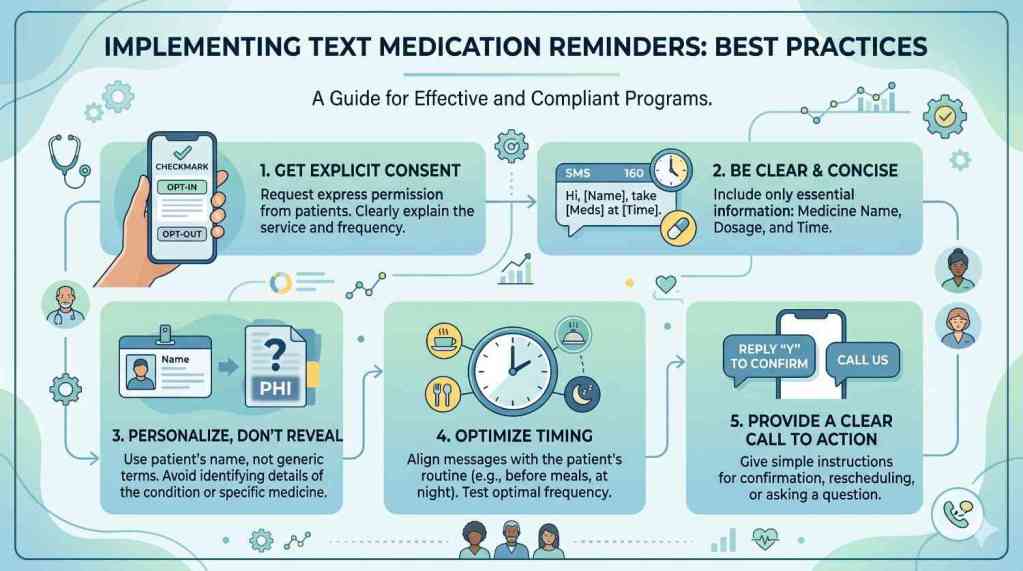
What if you could create a safety net that respects your loved one’s autonomy while giving you the reassurance you need? The right approach combines compassionate technology with practical safeguards.
Utilizing HIPAA Compliant Platforms Like JoyCalls
Privacy protection should be your first consideration. Choose a service that meets healthcare privacy standards to keep your parent’s information secure.
JoyCalls offers a compassionate alternative to basic alerts. This AI-powered companion makes daily check-in calls without requiring any app downloads. Your loved one receives gentle prompts through familiar phone conversations.

The JoyCalls platform sends you summary reports while providing companionship. It feels like a caring friend rather than an automated system.
Leveraging Healthcare Provider Insights and Secure Messaging
Healthcare teams appreciate platforms that allow proper monitoring. They can track adherence patterns and send timely support when needed.
Secure messaging enables patients to ask questions or report concerns easily. Research shows this approach significantly improves health outcomes. A pharmacy study confirms that simple prompts boost prescription fulfillment rates.
| Platform Feature | Family Benefit | Senior Experience | Privacy Level |
|---|---|---|---|
| Phone Call Reminders | Peace of mind reports | Familiar conversation | HIPAA Compliant |
| Custom Scheduling | Flexible timing | Natural routine fit | Encrypted Data |
| Two-Way Communication | Quick issue resolution | Easy question asking | Secure Messaging |
The best systems feel invisible in daily life. Your parent maintains independence while you gain confidence in their wellbeing.
Conclusion
Imagine ending your day with quiet confidence instead of lingering doubts about your parent’s wellbeing. Throughout this guide, we’ve explored how simple digital tools can transform health management from a source of stress into a reliable routine.
The evidence is compelling—research like the PMC study on automated message delivery shows these systems significantly improve adherence rates. Whether you choose basic alerts or a comprehensive service, the goal remains the same: supporting your loved one’s independence while giving you peace of mind.
Remember that the most effective solution is the one your parent will use consistently. For many families, combining gentle prompts with human connection creates the perfect balance. Services like JoyCalls bridge the gap between practical support and emotional care, as explored in their article on social connection for seniors.
Your journey toward better health management starts with a single step. The reassurance you’ll gain is worth every moment invested.
FAQ
What is a medication reminder service?
How can these alerts improve medication adherence for my parent?
Are there privacy concerns with using these reminder systems?
Can I customize the timing and frequency of the alerts?
What if my parent doesn’t use a smartphone or apps?
How do I get started with setting up reminders?

Ana Avila is a healthcare and technology writer with deep expertise in artificial intelligence, senior care innovation, and the practical use of AI in healthcare operations. Her work focuses on how emerging technologies can improve the daily experience of older adults, support overburdened care teams, and help senior living communities deliver safer, faster, and more personalized support.
Ana’s background includes health informatics, aging care systems, and applied artificial intelligence. Her work explores how digital health tools, predictive analytics, and AI-assisted communication systems can improve care coordination, reduce operational delays, and identify early signs of risk among older adults. She brings an understanding of both the technical side of AI and the human realities of healthcare delivery.
Over the years, Ana has developed a specialized body of work around AI in senior living. She writes about how senior care providers can use intelligent systems to manage resident requests, answer routine questions, support family communication, improve after-hours coverage, and detect patterns that may indicate loneliness, confusion, distress, or unmet needs. Her articles often examine the gap between what senior living teams are expected to deliver and what traditional staffing models can realistically support.
Ana’s healthcare expertise is especially focused on the operational side of care. She has written extensively about call handling, resident engagement, front desk workflows, triage systems, caregiver communication, care escalation, and the hidden administrative burden placed on senior living staff. Her work explains how AI can help reduce repetitive tasks, organize incoming requests, prioritize urgent issues, and give human caregivers more time for meaningful resident interaction.
At the same time, Ana is careful not to present AI as a replacement for human care. A consistent theme in her writing is that technology should support relationships, not weaken them. She argues that the best AI systems in healthcare are not the ones that simply automate the most tasks, but the ones that make care teams more responsive, families more informed, and residents more supported. Her perspective is grounded in the belief that senior living technology must be designed around dignity, trust, privacy, and compassion.
Ana has also written widely on the ethical use of AI in healthcare. Her work discusses the importance of human oversight, transparent escalation rules, resident consent, data minimization, and responsible use of sensitive health and behavioral information. She often emphasizes that AI systems used around older adults must be easy to understand, carefully monitored, and designed with the limitations and needs of real residents in mind, including those with memory loss, hearing challenges, mobility issues, or social isolation.
Her writing has been used as a reference point in discussions about aging, elder care technology, digital health, and AI-supported senior living. She has published 12 papers in journals including JAMA, The BMJ, and SSRN. Some of her articles have also been cited by Wikipedia editors as supporting references on topics related to healthcare, aging, and technology. This has helped position her work as a useful educational resource for readers looking to understand how AI can be applied in real care environments.
In addition to her long-form writing, Ana has contributed research-based commentary, professional explainers, and practical guidance for healthcare operators, senior living decision-makers, and technology teams building products for older adults. Her work combines research literacy with operational practicality. She is able to take complex subjects such as natural language processing, predictive analytics, conversational AI, and care automation, and explain them in a way that is accessible to executives, caregivers, families, and non-technical readers.
Ana’s strongest area of expertise is the intersection of artificial intelligence and senior living operations. She understands that senior care communities face a difficult combination of rising resident expectations, staffing pressure, family communication demands, and increasing care complexity. Her writing explores how AI can be used to ease those pressures through smarter communication systems, faster response workflows, proactive check-ins, and better visibility into resident needs.
Her approach is both evidence-informed and deeply human. She studies AI through the lens of real-world care delivery: whether a resident gets help faster, whether a family member receives a clearer update, whether a caregiver avoids unnecessary administrative work, and whether a senior living team can identify a concern before it becomes a crisis. This practical focus makes her work especially relevant for organizations that want to adopt AI responsibly rather than simply follow technology trends.
Ana Avila is regarded as a thoughtful voice on the future of AI in healthcare and senior living. Her expertise combines research-driven analysis, operational understanding, and a strong commitment to humane technology. Through her writing, she helps healthcare leaders and senior living communities understand not only what AI can do, but how it should be used to improve care, preserve dignity, and strengthen the human relationships at the center of aging support.