

What if that one silent phone call wasn’t a moment of panic, but a step in a clear, calm process?
You know the feeling. The clock hits your usual check-in time. You dial the number. It rings. And rings. Suddenly, your mind races through a hundred terrifying possibilities. Is everything okay? Are they safe?
This guide is for anyone who loves an older adult living independently. It’s about replacing that fear with confidence. We’ll show you how to build a simple, effective escalation framework. This isn’t about expecting the worst. It’s about being prepared, so you can act wisely instead of reacting from a place of worry.
Time is precious when you can’t get an answer. A pre-defined emergency plan for long-distance caregiving ensures you don’t waste a single second. We’ll also explore how modern tools can support your efforts, providing consistent check-ins and immediate alerts.
Key Takeaways
- A structured response turns panic into purposeful action.
- Being prepared is an act of love, not pessimism.
- Clear steps save critical time in uncertain moments.
- Understanding patterns helps you intervene appropriately.
- Technology can be a reliable partner in ensuring safety.
- This approach provides peace of mind for families.
- A good plan works whether you’re across town or the country.
Introduction: Navigating Daily Check-Ins with AI
For families supporting an independent senior, daily check-ins are more than a routine—they’re a reassurance. These regular calls provide a vital safety net. They help monitor well-being and offer precious companionship.

You might worry about your dad living alone. Is he eating well? Did he take his medicine? These thoughts can occupy your mind. Traditional methods rely on you remembering to call every single day.
Life gets busy. Work, kids, and other responsibilities pull your attention. This is where modern solutions make a profound difference.
Overview of Daily Check-Ins and Their Importance
Daily check-ins serve as a consistent touchpoint. They detect subtle changes in routine or health that might otherwise go unnoticed. This consistent support allows seniors to maintain their independence safely.
It’s not just about safety. These moments are genuine connections. Seniors can share their feelings and daily experiences. This regular contact provides immense emotional care.
The Role of AI-Powered Solutions in Caregiving
AI-powered tools, like JoyCalls, act as a reliable partner. They call your loved one at the same time every day, creating a comforting routine. The beauty is its simplicity.
It uses a regular telephone. There are no apps to download or new devices to learn. This saves everyone valuable time and reduces stress.
After each conversation, you receive a summary. This keeps you informed without being intrusive. It seamlessly works with others in your family who want to stay connected. Implementing a smart daily check-in system for long-distance caregivers provides peace of mind for the whole family.
| Method | Consistency | Ease of Use | Family Updates |
|---|---|---|---|
| Manual Family Calls | Variable | Familiar | Direct, but sporadic |
| AI Phone Companion | High | Very High (uses existing phone) | Automatic & Immediate |
Understanding the Escalation Cycle in Caregiving
When that familiar ring goes unanswered, your heart can start racing through possibilities. This emotional journey follows a predictable pattern that, when understood, can bring clarity instead of chaos.
Recognizing Early Warning Signs in Behavior
Subtle changes often appear before a major concern arises. Pay attention to small shifts in your loved one’s usual patterns.
These early signs might include increased tension during conversations or changes in their breathing patterns. Even minor physical complaints can signal underlying discomfort.

Understanding these behavior patterns helps you respond with care rather than panic. It’s about noticing the whispers before they become shouts.
The Seven Phases of Escalation Explained
Think of emotional escalation as a staircase with seven distinct steps. Each phase represents increasing levels of concern and appropriate response.
“The calm before the storm is often the most important time for intervention.”
| Phase | Emotional State | Typical Response |
|---|---|---|
| Calm | Normal, stable routine | Regular check-ins |
| Trigger | Initial concern | Single follow-up call |
| Escalation | Growing worry | Multiple attempts |
| Higher Escalation | Significant anxiety | Contact neighbors |
| Crisis | Confirmed emergency | Emergency services |
| De-escalation | Relief, resolution | Situation addressed |
| Recovery | Return to normalcy | Resume routine |
Different triggers affect people uniquely. Some seniors respond to weather changes, while others react to anniversary dates. Recognizing where you are on this staircase helps you apply the right support at the right time, maintaining healthy boundaries while providing appropriate care.
Creating a Caregiver Escalation Plan
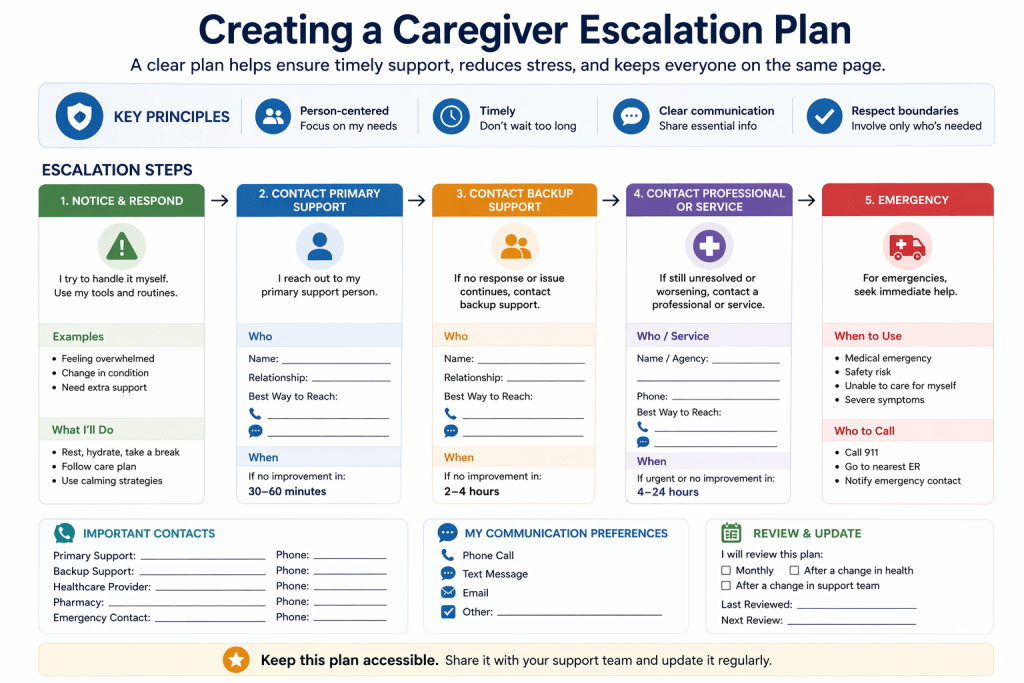
Having a clear roadmap for those moments when the phone goes unanswered transforms anxiety into action. Your structured approach should outline specific steps for different scenarios.
Start by writing down exactly what happens when your loved one doesn’t answer. Include emergency contact lists and designated timeframes for each level of response. This preparation saves precious minutes when every second counts.
Leveraging JoyCalls’ AI Daily Check-In Platform
JoyCalls’ AI platform handles daily calls at consistent times, eliminating the worry of forgotten check-ins. It immediately alerts you when something seems concerning or if your loved one doesn’t answer.
The beauty of this AI companion is its reliability. It never gets busy and provides detailed information about each conversation. This helps you spot patterns over time.
Try JoyCalls Free
No app or new device needed. Start with a free 7-day trial.

When you sign up, you can customize calling schedules and alert preferences to match your family’s unique needs. The platform works seamlessly with your existing routine.
Utilizing Immediate Alerts for Enhanced Safety
Your escalation strategy should include a local support network. Identify neighbors, friends, or nearby family members who can perform wellness checks. Keep all contact information in one accessible place.
Time becomes critical during a potential crisis. Having pre-planned steps means you’re not wasting minutes searching for phone numbers. Multiple family members can access the same alerts and information, ensuring coordinated responses.
This approach aligns with established de-escalation principles and provides the structured support needed for effective long-distance caregiving.
How to Turn a Daily Check-In Into a Better Doctor Visit

A daily check-in routine should not stop at home. One of its most important benefits is that it gives your doctor, nurse, or care team a clearer picture of what is happening between appointments.
For many seniors, doctor visits are short. It can be hard to remember every symptom, every reading, every missed dose, or every difficult day. By the time the appointment comes, many people simply say, “I’ve been okay,” even if the last few weeks were not truly okay.
That is why your check-in routine should also prepare you for better medical conversations.
Why Your Daily Notes Matter
Doctors make better decisions when they can see patterns.
A single high blood pressure reading may not explain much. But repeated high readings in the morning may suggest that timing, medication, sleep, stress, or diet needs review.
One low blood sugar episode may be treated quickly. But several episodes after breakfast or before dinner may show that meal timing or medication dosage needs attention.
One difficult breathing day may happen because of weather or exertion. But repeated shortness of breath, more coughing, or increased rescue inhaler use may signal that COPD management needs adjustment.
Your daily check-in notes help turn vague concerns into useful information.
Instead of saying:
“I don’t feel good sometimes.”
You can say:
“Over the last two weeks, I felt more breathless on five mornings, especially after poor sleep. I used my rescue inhaler more often on those days.”
That kind of detail helps your provider act more accurately.
Keep a Simple Appointment Summary
Before every appointment, prepare a one-page summary. Do not bring pages and pages of unorganized notes unless your doctor specifically wants them.
Your summary should include:
1. Your main concern
Write one sentence:
“My blood pressure has been higher in the morning.”
“My sugar has dropped twice before lunch.”
“My breathing has been worse after walking.”
2. Recent patterns
List only the most important trends from the last two to four weeks.
3. Medication questions
Mention missed doses, side effects, refill issues, confusion, or cost problems.
4. Lifestyle changes
Include appetite changes, sleep problems, stress, falls, new pain, reduced activity, or diet changes.
5. What you need from the visit
For example:
“Should I change when I take this medicine?”
“What symptoms mean I should call sooner?”
“Do I need a written COPD action plan?”
“What blood sugar level is too low for me?”
This keeps the visit focused and practical.
Ask for Personal Thresholds, Not General Advice
General health advice can be helpful, but seniors often need personalized instructions.
Ask your provider:
“What blood pressure number should make me call you?”
“What blood sugar level is too low for me?”
“When should I recheck instead of worrying?”
“What COPD symptoms mean I should use my action plan?”
“When should my family be alerted?”
“What symptoms mean emergency care is needed?”
Write the answers down clearly. These instructions should become part of your daily check-in routine.
This is especially important for older adults who have multiple conditions. A general online range may not match your medical history, medications, or risk level.
Bring Your Devices Once in a While
If you use a blood pressure monitor, glucometer, pulse oximeter, or other home device, ask whether you should bring it to an appointment.
This can help your care team check:
Whether the device is working properly
Whether the cuff size is correct
Whether you are using the device correctly
Whether your home readings match clinic readings closely enough
Small technique problems can lead to misleading results. For example, taking blood pressure while talking, sitting with unsupported feet, using the wrong cuff, or measuring immediately after activity can affect the reading.
A quick device check can prevent weeks of confusion.
Report What Is Hard, Not Just What Is Wrong
Many seniors hesitate to tell doctors when a routine is difficult. They may feel embarrassed about forgetting medication, struggling with diet, not exercising, or feeling lonely.
But these details matter.
Your doctor cannot help with problems they do not know about.
Tell your provider if:
You forget doses often
You cannot afford medication
You feel dizzy after taking medicine
You are afraid to walk because of falls
You avoid checking blood sugar because it makes you anxious
You cannot prepare healthy meals easily
You do not understand when to use an inhaler
You feel isolated or low
These are not failures. They are barriers. Once they are named, they can often be solved.
Use the Visit to Simplify Your Routine
A good care plan should be realistic.
Ask:
“Can we simplify my medication schedule?”
“Which checks are truly necessary every day?”
“Can I reduce duplicate tracking?”
“Which symptoms matter most for my condition?”
“What is the easiest way to share updates with you?”
For many seniors, the best routine is not the most detailed one. It is the one they can follow consistently.
Include a Caregiver When Helpful
If you have a trusted family member, friend, or caregiver, consider involving them in appointments, especially if:
You forget details easily
Your medications have changed
You recently had a fall, hospitalization, or flare-up
You manage more than one chronic condition
You feel overwhelmed by instructions
The caregiver does not need to speak for you. Their role can be to listen, take notes, ask one or two practical questions, and help update the home routine afterward.
This is especially helpful for families who live far away. Even joining by phone during part of the visit can help everyone understand the plan.
Update the Daily Check-In After Every Appointment
After each medical visit, revise your routine.
Update:
Medication names and doses
Check-in frequency
Warning signs
Call-the-doctor thresholds
Emergency instructions
Diet or activity guidance
Follow-up appointment dates
Old instructions can create mistakes. A routine that was correct six months ago may no longer be correct today.
How to Reduce False Alarms Without Missing Real Warning Signs
A good “no answer” escalation plan should do two things at the same time. It should help families respond quickly when something may be wrong, and it should prevent unnecessary panic when a missed call has a harmless explanation.
This balance matters deeply. Older adults deserve safety, but they also deserve trust, privacy, and independence. If every unanswered call turns into a family alarm, daily check-ins can start to feel stressful instead of comforting. The senior may feel watched, corrected, or treated like they are no longer capable. Over time, that can damage cooperation and make the check-in system less effective.
The goal is not to react less. The goal is to react better.
A false alarm is not just an inconvenience. It can lead to caregiver burnout, strained relationships, unnecessary emergency calls, and anxiety for the older adult. On the other hand, ignoring repeated missed calls can delay help when help is truly needed. The safest approach is a clear filtering system that helps families separate ordinary missed calls from meaningful warning signs.
Understand the Difference Between “No Answer” and “No Information”
A missed call does not always mean something is wrong. It simply means you do not yet have enough information.
That mindset is important because it keeps the first response calm. Instead of thinking, “Something terrible has happened,” think, “I need to gather more information.”
That small shift changes everything.
It helps you ask better questions:
- Is this missed call unusual for this time of day?
- Did they mention feeling unwell earlier?
- Is there a known reason they may not answer?
- Have they missed other check-ins recently?
- Is there another way to confirm they are okay?
- Is anyone nearby who can check gently?
This approach gives structure to worry. It also prevents emotional escalation in the family.
Identify Common Harmless Reasons for Missed Calls
Many seniors miss calls for ordinary reasons. These should be listed in the care plan so family members do not panic unnecessarily.
Common reasons include:
- Napping
- Bathing
- Cooking
- Watching television
- Attending a medical appointment
- Sitting outside
- Visiting a neighbor
- Phone battery died
- Phone left in another room
- Ringer turned down
- Hearing aid not being worn
- Landline unplugged accidentally
- Poor signal or service outage
- Feeling tired and choosing not to talk immediately
None of these should be dismissed, but they should be understood. For example, if your loved one often showers at 10:00 a.m., that is not the best time for a safety call. If they usually nap after lunch, avoid scheduling check-ins during that window.
A strong plan works with the senior’s life, not against it.
Create a “Normal Missed Call Pattern” List
Families often remember emergencies but forget patterns. Start tracking missed calls for a few weeks.
Write down:
- Date and time of missed call
- How many attempts were made
- How long it took to reconnect
- Reason for missing the call
- Whether any follow-up was needed
- Whether the plan worked smoothly
After a short time, patterns will appear.
Maybe your mother misses calls on laundry day because she cannot hear the phone from the laundry room. Maybe your father misses Sunday morning calls because he attends religious services. Maybe your aunt misses evening calls because she turns the phone off early.
These patterns help you adjust the schedule and reduce unnecessary concern.
Use a Two-Step Confirmation Rule
One missed call should usually lead to confirmation, not immediate escalation.
A practical rule is:
Do not escalate based on one missed call alone unless there are added risk factors.
Instead, use a two-step confirmation process.
Step one: Try the primary contact method again after a short delay.
Step two: Use a backup method, such as text, landline, automated check-in, neighbor contact, or caregiver message.
Only after both steps fail should the family move to the next level, unless the senior has known high-risk conditions or there was an earlier warning sign.
This rule keeps the plan calm and fair. It also reduces the chance of overreacting when the senior simply did not hear the phone.
Define Risk Factors That Shorten the Waiting Time
Not every missed call deserves the same waiting period. Some situations require faster action.
Shorten the waiting time if the senior:
- Lives alone
- Has a history of falls
- Uses mobility aids
- Has dementia or memory concerns
- Recently felt dizzy, weak, confused, or breathless
- Recently changed medication
- Was discharged from hospital
- Has diabetes, heart disease, stroke history, or breathing problems
- Has had recent emotional distress
- Lives in extreme heat, cold, storm, or power outage conditions
For example, if your healthy, active parent misses one afternoon call, waiting 30 minutes may be reasonable. But if your parent has severe fall risk and missed a morning call after reporting dizziness the night before, the plan should move much faster.
The same missed call can carry different meaning depending on context.
Build a “Last Known Well” Habit
One of the most useful questions in any no-answer situation is:
When was the senior last known to be well?
This means the last time someone spoke with them, saw them, or received a reliable update.
Record this naturally during regular check-ins. You do not need a formal medical tone. Simply notice:
- Did they sound normal?
- Were they alert?
- Did they mention pain or discomfort?
- Were they eating and drinking?
- Did they say what they planned to do next?
- Were they expecting a visitor or appointment?
A simple note like “Spoke at 8 p.m.; sounded cheerful; planned to sleep early” can be very helpful the next morning if they do not answer.
This habit prevents confusion during stressful moments. It also helps emergency responders or local helpers understand the situation more clearly.
Avoid the “Call Again and Again” Trap
When worried, many families keep calling repeatedly. This feels productive, but it often is not.
Repeated calls can:
- Increase caregiver anxiety
- Drain the senior’s phone battery
- Make the senior feel overwhelmed when they return
- Delay more useful action
- Create confusion if multiple relatives are calling at once
A better approach is to limit call attempts.
For example:
- Call once at the scheduled time
- Wait 10–15 minutes
- Call once more
- Send a short message or try the backup number
- Then move to the next planned step
The plan should say exactly when to stop calling and start confirming through other means.
Use Neutral Language When Contact Is Restored
How you respond after a missed call matters. If the senior finally answers and hears panic, blame, or frustration, they may dread future check-ins.
Avoid saying:
- “Where were you?”
- “Why didn’t you answer?”
- “You scared everyone.”
- “You have to keep your phone with you.”
- “We almost called emergency services because of you.”
Instead, say:
“I’m glad I reached you. I just wanted to make sure everything was okay.”
Then ask calmly:
“Was this a bad time for our check-in?”
This turns the moment into problem-solving, not criticism.
If there is a repeated issue, discuss it later when everyone is calm. The first response should always be reassurance.
Create Different Plans for Different Times of Day
Risk changes throughout the day. A senior may be safer during active daytime hours and more vulnerable at night or early morning.
Your plan can reflect this.
For example:
Morning missed call
A missed morning call may be more concerning if the senior usually answers reliably after waking. It could mean they overslept, felt unwell, had a difficult night, or had trouble getting out of bed.
Suggested response: follow up sooner.
Afternoon missed call
This may be less concerning if the senior often naps, rests, attends appointments, or steps outside.
Suggested response: allow a wider callback window unless there are health concerns.
Evening missed call
This may require context. Some seniors turn in early, while others are usually available at that time. Evening missed calls may also matter more if medication, dinner, or nighttime safety routines are involved.
Suggested response: check backup contacts if the missed call is unusual.
Late-night missed call
Unless the check-in is scheduled or urgent, avoid creating unnecessary alarm at night. However, if the senior was expected to confirm safety and does not, escalation may need to happen quickly.
Suggested response: follow the written plan, not emotion.
Decide What Counts as a “Pattern Change”
One missed call may not mean much. A pattern of missed calls can mean a lot.
Watch for changes such as:
- Missing calls more often than before
- Taking longer to respond
- Sounding confused when finally reached
- Forgetting scheduled check-ins
- Giving unclear explanations
- Avoiding conversations
- Missing calls after medication changes
- Missing calls at unusual times
These changes may signal fatigue, hearing problems, cognitive changes, depression, illness, or simply that the current check-in routine is no longer convenient.
Do not jump to conclusions. But do not ignore patterns either.
A helpful question is:
“Has something changed, or is our system no longer fitting their routine?”
That question keeps the response practical and respectful.
Add a Local Observation Layer
For seniors living alone, a local support person can reduce false alarms dramatically.
This may be:
- A neighbor
- Building staff
- A nearby relative
- A friend
- A home aide
- A faith community member
- A regular delivery person who knows the household routine
The local person does not need to provide medical help. Their role may simply be to observe.
They can check:
- Are lights on?
- Is the car present?
- Is mail piling up?
- Are curtains usually open but now closed?
- Is the senior visible in the yard or common area?
- Is there any unusual sound, smell, or sign of distress?
This gives the family more information before deciding whether to escalate.
Make sure this is arranged with the senior’s permission wherever possible. Respect is part of safety.
Use “Concern Notes” After Each Check-In
A daily check-in should not only ask, “Did they answer?” It should also capture whether anything felt different.
Use simple notes:
- Normal
- Tired
- Sad
- Confused
- In pain
- Short of breath
- Dizzy
- Mentioned poor sleep
- Eating less
- Worried about something
- Needed follow-up
These notes help interpret the next missed call.
For example, a missed call after three normal days may be low concern. A missed call after two days of dizziness and poor appetite should be treated more seriously.
This is where services that provide call summaries can be useful. Families do not need to remember every detail from memory. They can look at recent trends and respond more intelligently.
Protect the Senior From Feeling Watched
False alarms are not only logistical problems. They affect emotions.
Some older adults may worry that missed calls will be used as proof that they can no longer live independently. Others may feel embarrassed if a neighbor or emergency responder comes to the door unnecessarily.
To prevent this, explain the plan clearly.
Say:
“This plan is not about taking away your independence. It is about making sure we respond in the right way if we cannot reach you.”
Also give them choices:
- What time should we call?
- Who should we contact first?
- Would you prefer a text before we call a neighbor?
- Which neighbor do you trust?
- When would you want us to call emergency services?
Choice reduces resistance. It also makes the plan more accurate.
Review False Alarms Without Blame
After a false alarm, do not treat it as a failure. Treat it as feedback.
Ask:
- Was the check-in time wrong?
- Was the phone setup difficult?
- Did family members wait too long or not long enough?
- Was the local contact reachable?
- Did the senior feel embarrassed or pressured?
- Should the decision tree change?
The best escalation plans improve with experience. Every false alarm can make the system sharper, kinder, and more reliable.
Know When “False Alarms” Are Actually Warning Signs
Sometimes repeated false alarms are not false at all. They may reveal a hidden problem.
For example:
- A senior who keeps missing calls may be sleeping excessively.
- A senior who forgets calls may need cognitive screening.
- A senior who cannot hear calls may need hearing support.
- A senior who avoids calls may be lonely, depressed, or overwhelmed.
- A senior who misplaces the phone often may need a simpler setup.
- A senior who regularly misses medication-related check-ins may need medication support.
The missed call itself may not be the emergency. But the pattern may point to a growing need.
That is why families should look beyond each isolated incident.
The Best Plan Is Calm, Clear, and Adjustable
Reducing false alarms is not about lowering concern. It is about improving accuracy.
A strong no-answer plan should help everyone understand:
- When to wait
- When to retry
- When to involve a local helper
- When to escalate urgently
- When to adjust the routine
- When to review deeper health or safety concerns
This protects the senior from unnecessary stress while still keeping real risks visible.
Building a Personalized “No Answer” Decision Tree Before You Need It
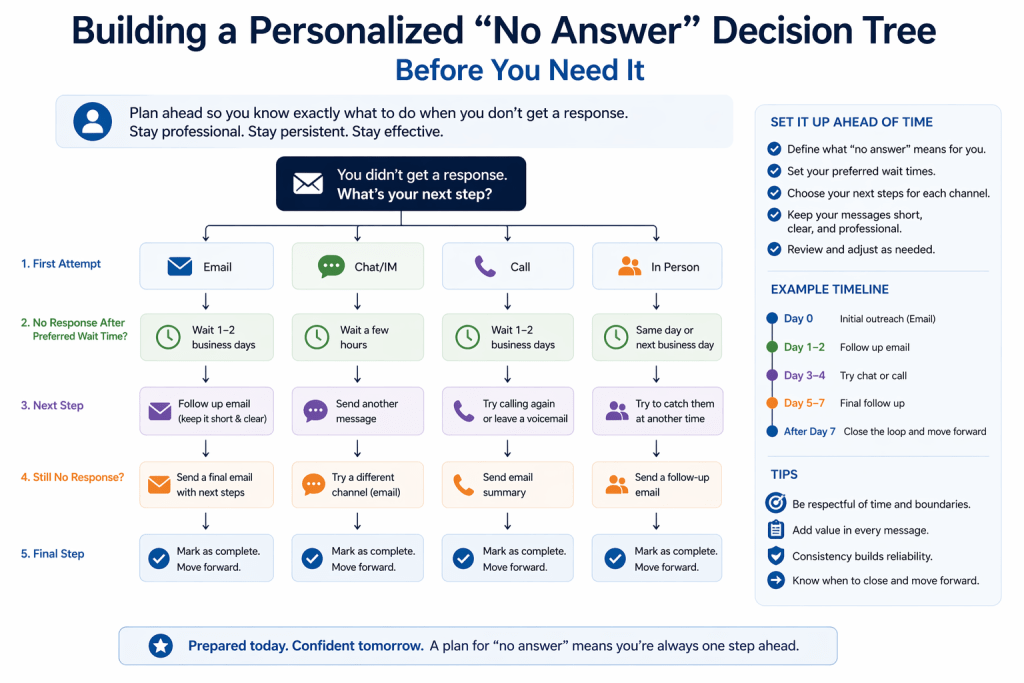
A no-answer plan works best when it is not treated like a generic emergency checklist. Every older adult has a different routine, health profile, comfort level, home setup, and support network. A missed call from a senior who regularly naps after lunch does not mean the same thing as a missed call from someone with fall risk, memory concerns, unstable blood pressure, or a recent hospital discharge.
That is why families should build a personalized “no answer” decision tree. This is a simple, written plan that tells everyone what to do based on the senior’s normal routine, known risks, and the exact situation. It removes guesswork. It also protects the older adult’s dignity because the family is not overreacting every time a call is missed.
Start With the Senior’s Normal Routine
Before deciding what counts as urgent, write down what “normal” looks like.
Include:
- Usual wake-up time
- Regular nap times
- Meal times
- Medication times
- Bathing or showering schedule
- Favorite TV, prayer, walking, or social times
- Times when they usually do not answer the phone
- Days when they may be out for appointments, worship, shopping, or senior center activities
This matters because many missed calls are harmless. Your mother may not answer at 2:00 p.m. because she always naps then. Your father may not pick up during his evening news program because he keeps the phone in another room. A strong plan respects these habits instead of assuming every silence means danger.
Once you understand the routine, divide missed calls into three levels.
Level One: Low Concern
This is when the missed call is unusual but not alarming.
For example, your loved one missed one check-in, but:
- They were well during the previous call
- There were no recent complaints of dizziness, pain, confusion, or weakness
- The missed call happened near a normal nap, meal, shower, or outing time
- They often forget to keep the phone nearby
- There are no other warning signs
In this case, the best response is calm follow-up. Call once more after 10 to 20 minutes. Send a simple message if they use texting. If they do not answer, try again later at a time that fits their routine.
The goal at this level is not to create pressure. It is simply to reconnect.
A helpful script is:
“Hi Mom, I just missed you during our usual check-in. No rush if you were resting or busy. Please call me when you can so I know you’re okay.”
This message avoids guilt. It does not say, “You scared me,” or “Why didn’t you answer?” Those phrases can make seniors feel controlled or blamed. Keep it warm and practical.
Level Two: Moderate Concern
This is when the missed call is not immediately an emergency, but it deserves faster action.
Move to this level if:
- They miss two or more calls in a short window
- They recently felt unwell
- They have a known fall risk
- They live alone and do not have visitors that day
- They seemed confused, weak, sad, or unusually quiet in recent check-ins
- They recently changed medication
- They were discharged from the hospital or had a procedure
- Bad weather, power outages, or extreme heat may affect safety
At this level, do not keep calling endlessly. Repeated calls can create panic for you and may not solve the problem. Instead, use the support network.
Call a nearby neighbor, family member, building manager, friend, or caregiver who has agreed to help. Ask for a simple wellness check, not a dramatic intervention.
A good script is:
“Hi, I’m having trouble reaching my dad after his usual check-in. This may be nothing, but could you please knock on his door or see if his lights are on? Please call me before going inside unless something looks clearly unsafe.”
This keeps the request respectful. It also prevents confusion about what the helper should do.
Level Three: High Concern
This level is for situations where waiting could be unsafe.
Move to high concern if:
- Your loved one has missed multiple check-ins and cannot be reached
- A neighbor sees something unusual, such as an open door, running water, mail piling up, or lights on at an odd time
- They mentioned chest pain, shortness of breath, severe dizziness, weakness, a fall, or confusion earlier
- They have dementia and may wander
- They recently had surgery, a stroke, a fall, or a medication change
- They use oxygen, insulin, blood thinners, or other high-risk treatments
- The missed check-in happens during a known danger window, such as after bathing, after taking sedating medication, or during extreme weather
At this point, call emergency services or request a formal wellness check through local authorities, depending on the situation. If possible, have one person contact emergency help while another person continues trying to reach the senior or local support person.
Do not let family members argue in a group chat while time passes. The decision tree should already say who makes the final call.
Assign One Decision-Maker
A common problem in caregiving is that everyone cares, but no one is clearly in charge. One sibling says, “Let’s wait.” Another says, “Call 911.” Someone else starts calling neighbors, while another person calls the senior repeatedly. This creates delay and stress.
Choose one primary decision-maker for no-answer situations. Choose a backup if that person is unavailable.
Write down:
- Who receives alerts first
- Who calls the senior again
- Who contacts local helpers
- Who contacts emergency services
- Who updates the rest of the family
- Who follows up after the situation is resolved
This avoids duplicate calls and mixed messages. It also protects the senior from feeling overwhelmed by five worried relatives calling at once.
Create a “Permission Before Crisis” Plan
The best time to ask for permission is before anything goes wrong.
Have a calm conversation with your loved one and say:
“We want you to stay independent, and we also want to know what to do if we can’t reach you. Can we agree on a simple plan so we don’t overreact or underreact?”
Then discuss:
- Who is allowed to check on them
- Whether a trusted neighbor has a spare key
- Whether family can contact the building manager
- When emergency services should be called
- What medical information can be shared
- Which hospital they prefer
- Where important documents are kept
This conversation may feel uncomfortable, but it is deeply respectful. It gives the senior a voice in their own safety plan. It also reassures them that the goal is not surveillance. The goal is calm, appropriate support.
Keep a One-Page Emergency Sheet
Every no-answer plan should include a one-page emergency sheet. Keep it printed and digital.
Include:
- Full name
- Date of birth
- Address
- Phone number
- Primary doctor
- Preferred hospital
- Medical conditions
- Allergies
- Current medications
- Mobility concerns
- Hearing or vision limitations
- Emergency contacts
- Local keyholder
- Pets in the home
- Door access instructions
- Any communication needs, such as “speaks slowly,” “hard of hearing,” or “may be confused when anxious”
This sheet saves time. It also helps emergency responders understand the person, not just the incident.
Review the Plan After Every Missed Check-In
A missed call is not only a stressful moment. It is also useful information.
After the situation is resolved, ask:
- Why was the call missed?
- Was the timing wrong?
- Was the phone out of reach?
- Was the ringer off?
- Was the senior sleeping, bathing, outside, or at an appointment?
- Did the family respond too quickly or too slowly?
- Was the local contact easy to reach?
- Did anyone feel confused about their role?
Then adjust the plan.
For example, if your father always misses calls during his afternoon nap, move the check-in time. If your mother often forgets to charge her phone, place a landline or charging station near her favorite chair. If the neighbor was unavailable, add a second local contact.
A good escalation plan should get smarter over time.
Balance Safety With Independence
The most caring no-answer plan is not the strictest plan. It is the one that protects safety while preserving independence.
Older adults do not want to feel like every missed call becomes an investigation. Many seniors already worry about becoming a burden. If the family reacts with panic, frustration, or blame, the senior may start avoiding check-ins altogether.
So when they finally answer, begin with relief, not anger.
Say:
“I’m glad to hear your voice. I just wanted to make sure you were okay.”
Then listen. Maybe they were resting. Maybe they were in the bathroom. Maybe they felt lonely and did not want to talk. Maybe the phone was in another room. The response should fit the reason.
If missed calls become frequent, treat it as a systems problem, not a character problem. The question is not, “Why don’t you answer?” The better question is, “How can we make this easier for you?”
That might mean adjusting the call time, using a louder ringtone, adding a second check-in method, involving a friendly neighbor, or using an automated daily call system that alerts family only when needed.
A no-answer plan should feel like a safety net, not a leash. When built thoughtfully, it helps seniors continue living with confidence while giving families a clear, calm way to respond when silence feels worrying.
Start With the Problem, Not the Tool
Before choosing any device or app, ask a simple question:
What problem are we trying to solve?
Common problems include:
- The senior forgets to keep the phone nearby
- They cannot hear the phone ringing
- They feel tired or unwilling to answer repeated calls
- They accidentally silence or misplace the device
- They struggle with complex interfaces
- Family members are in different time zones
- There is no reliable local person to check on them quickly
Each of these problems requires a different solution. Avoid the mistake of installing multiple apps or devices “just in case.” Too many tools create confusion and resistance.
Instead, match one solution to one problem.
Use Redundant Check-In Methods (Without Overcomplicating)

A strong system does not rely on a single point of failure.
If your plan depends only on phone calls, then a dead battery, a misplaced phone, or a missed ring can trigger unnecessary escalation.
Instead, create two simple, parallel check-in methods.
For example:
- Primary: Daily phone call at a fixed time
- Backup: Automated check-in call or app alert
Or:
- Primary: Voice call
- Backup: Missed call alert system or a “press 1 to confirm” automated call
The idea is not to add complexity, but to add certainty.
If the senior misses the first method, the second one acts as a confirmation step before escalation begins.
Automated Check-In Systems: When and How to Use Them
Automated daily check-in systems can be extremely useful, especially when:
- Family members are busy or live far away
- The senior prefers a quick, low-effort interaction
- There is a need for consistency at the same time every day
These systems typically:
- Call the senior at a scheduled time
- Ask them to press a button or respond verbally
- Trigger alerts if there is no response
When used correctly, they reduce emotional pressure on both sides. The senior does not feel like they are “bothering” anyone, and the family does not need to remember every check-in manually.
However, the key is simplicity.
Choose a system that:
- Uses clear, loud voice prompts
- Requires minimal steps (ideally one action)
- Works on both smartphones and landlines if needed
- Sends alerts to multiple family members
Before relying on it, test it together several times. Sit with your loved one and walk through the process until they feel comfortable.
Make Devices Senior-Friendly, Not Tech-Heavy
Many failures in check-in systems come from small usability issues, not big emergencies.
Focus on removing friction.
Adjust the Phone Setup
- Increase ringtone volume to maximum
- Use a simple, recognizable ringtone
- Enable vibration along with sound
- Turn off silent mode permanently if possible
- Place the phone in a consistent, visible location
- Use large-font display settings
- Add speed-dial buttons for key contacts
Use Physical Placement Strategically
Encourage your loved one to keep the phone:
- Near their favorite chair
- Next to the bed at night
- In the kitchen during meal prep
- In the bathroom area if safe and appropriate (especially if fall risk exists)
Consistency matters more than reminders. If the phone always “lives” in the same place, it is less likely to be missed.
Consider Wearables for High-Risk Situations
If your loved one has a higher risk profile—such as frequent falls, dizziness, or mobility issues—consider a wearable device.
These can include:
- Fall detection pendants
- Smartwatches with emergency SOS features
- Devices that automatically alert contacts if a fall is detected
The benefit of wearables is that they do not depend on the senior reaching the phone. They stay with the person.
However, adoption depends on comfort and trust.
To improve acceptance:
- Choose a lightweight, comfortable design
- Explain how it works in simple terms
- Emphasize independence, not surveillance
- Let them try it at home before making it permanent
Avoid forcing the device. If the senior feels controlled, they may stop wearing it.
Set Up Smart Alerts for the Family (Not Constant Monitoring)
Technology should reduce anxiety, not increase it.
Avoid systems that constantly stream data or create unnecessary alerts. These can overwhelm family members and create a false sense of urgency.
Instead, configure alerts to trigger only when something meaningful happens:
- Missed check-in after a defined time window
- No movement detected for a long period (if using motion sensors)
- Emergency button pressed
- Fall detected
Each alert should map directly to an action in your decision tree.
For example:
- Missed automated check-in → Try manual call
- No response after second attempt → Contact local helper
- No confirmation from helper → Consider emergency services
This keeps responses structured and calm.
Use Location Awareness Carefully and Respectfully
Location tracking can be helpful in certain cases, especially for seniors with memory challenges or wandering risk. However, it must be handled with sensitivity.
Before enabling any location-sharing feature:
- Discuss it openly with your loved one
- Explain when and why it would be used
- Clarify that it is not for constant monitoring
- Agree on boundaries
For example:
“We will only check your location if we cannot reach you and are concerned about your safety.”
This builds trust. Without consent and clarity, location tracking can feel intrusive and damaging to the relationship.
Build a Simple “Tech Backup” Plan
Even the best technology can fail. Devices lose power. Networks go down. Apps glitch.
That is why your plan should include a non-digital backup.
Ask:
- If the phone is dead, who can physically check on them?
- If the internet is down, how will alerts be received?
- If the automated system fails, who notices?
A strong system always has a human layer behind it.
Train Everyone—Not Just the Senior
Many families focus only on teaching the older adult how to use the device. But confusion often happens on the caregiver side.
Make sure everyone involved understands:
- How the system works
- What each alert means
- Who responds first
- What the escalation steps are
- How to avoid duplicate actions
If multiple family members receive alerts, create a simple rule:
“First to respond confirms in the group and takes lead.”
This prevents five people from acting at once—or worse, assuming someone else has acted.
Run Practice Drills (Without Creating Fear)
A plan is only as strong as its execution. Practice helps remove hesitation and confusion.
You can do this in a calm, non-threatening way.
For example:
- Simulate a missed check-in
- Trigger an alert intentionally
- Ask a neighbor to perform a planned check-in
- Walk through the escalation steps
After the drill, discuss:
- What worked well
- What felt confusing
- What took too long
- What can be simplified
These small rehearsals build confidence for both the senior and the family.
Watch for Signs That the System Needs Adjustment
Over time, needs change.
Pay attention to patterns such as:
- Increasing missed calls
- Confusion about how to respond to alerts
- Frustration from the senior
- Delays in response time
- Overreactions to minor issues
These are not failures—they are signals that the system needs to evolve.
For example:
- If calls are often missed → Adjust timing or add automation
- If the senior feels pressured → Simplify the process
- If alerts feel overwhelming → Reduce unnecessary triggers
A good system is flexible. It adapts to the person, not the other way around.
Keep the Human Connection at the Center
Technology can support safety, but it cannot replace emotional connection.
A daily check-in is not just a safety task—it is a moment of reassurance, familiarity, and care.
Even if you use automation, maintain regular human conversations:
- Ask how they are feeling, not just if they are okay
- Talk about their day, not just their health
- Listen without rushing
When the relationship is strong, the system works better. Seniors are more likely to participate, respond, and communicate openly.
Final Thought: Simplicity Builds Reliability
The most effective “no answer” systems are not the most advanced—they are the most reliable and easy to follow.
If a system is too complex, it will fail at the worst possible moment.
So aim for:
- One clear routine
- One backup method
- One defined escalation path
- One shared understanding among everyone involved
When technology is used this way, it does not create distance. It creates quiet reassurance—for the senior and for everyone who cares about them.
Communication Strategies: Body Language, Active Listening, and Empathy

Sometimes the most important messages aren’t spoken aloud—they’re conveyed through subtle cues and unspoken emotions. Understanding these silent signals helps you connect more deeply with your loved one.
Interpreting Body Language and Eye Contact Cues
Your parent’s posture, facial expressions, and eye movements reveal their true feelings. A relaxed stance suggests comfort, while tense shoulders might indicate pain or worry.
Pay attention to eye contact patterns. Steady gaze shows engagement, while avoiding eye contact could signal discomfort or sadness. These visual cues complement the words you hear during conversations.
Techniques for Active Listening and Verbal De-escalation
Active listening means truly hearing what’s being said—and what’s left unsaid. Use phrases like “tell me more” to encourage sharing. This approach builds trust and understanding.
When tensions rise, calm communication becomes essential. Simple de-escalation techniques like maintaining an even tone can prevent situations from worsening. Your empathy creates a safe space for honest dialogue.
| Method | Key Skill | Emotional Impact |
|---|---|---|
| Body Language Reading | Observation | Detects unspoken concerns |
| Active Listening | Attention | Builds trust and connection |
| Empathetic Response | Understanding | Creates emotional safety |
These skills enhance both in-person visits and phone check-ins. JoyCalls’ AI analyzes vocal tones and word choices, alerting you to emotional changes. This complements your own conversation strategies for maintaining meaningful connections.
Implementing Proactive Measures for Safety and Stability
The most powerful safety measures are the ones you put in place long before you ever need them. Preventive strategies focus on creating stability during calm times, making challenging situations less likely to occur.

Preventive De-escalation Interventions for Daily Routines
Think about your parent’s typical day. Are mornings chaotic, or does loneliness peak in the afternoon? Understanding these patterns helps you build support where it’s needed most.
Simple steps like encouraging daily walks or ensuring proper nutrition contribute significantly to emotional stability. These proactive techniques address root causes before challenging behaviors emerge.
Teaching coping skills during peaceful moments means your loved one has tools ready when needed. This approach reduces overall stress and gives everyone better control.
Establishing Consistent Check-In Schedules
Consistency creates comforting predictability. When your dad knows the phone rings at the same time every day, he organizes his routine around that connection.
This regularity makes it immediately obvious when something’s wrong. The same applies to fall prevention routines and medication schedules.
Building trust through routine is a powerful form of de-escalation. It creates a safety net that catches small concerns before they become emergencies.
Your proactive support during stable times provides the foundation for handling any situation that arises.
Attachment-Informed Techniques and CALMER Framework Insights
Difficult moments with aging parents often reveal deeper emotional needs beneath surface anger or resistance. When your mom gets upset about needing help, her frustration might actually signal fear about losing independence or grief over changing abilities.

Attachment-informed approaches recognize that challenging behavior usually stems from unmet needs for emotional safety. This perspective helps you respond with compassion rather than frustration.
Applying the CALMER Framework in Crisis Situations
The CALMER framework gives you six practical steps for tense moments. First, stay calm with deep breaths and relaxed body language. Your steady presence helps regulate your parent’s emotions.
Next, acknowledge their feelings without arguing. Say, “I understand this is frustrating.” Then listen actively and mirror emotions back: “It sounds like you’re feeling anxious about the doctor’s visit.”
Empower your loved one by offering specific choices. This restores their sense of control. Finally, respond by following through on solutions. These evidence-based techniques create emotional safety during difficult conversations.
When crisis situations arise, remember that anger often masks deeper emotions like fear or shame. Your calm, empathetic response can transform tension into understanding.
Conclusion
Peace of mind doesn’t come from eliminating worry, but from knowing you have reliable systems in place. Your proactive support creates a safety net that catches small concerns before they become emergencies.
Understanding behavioral signs and communication patterns helps you respond with empathy. This approach transforms anxious moments into opportunities for meaningful connection.
Technology works alongside your efforts. Consistent daily phone check-ins for seniors provide valuable information while maintaining your loved one’s independence.
Ready to build your safety net? Start today with JoyCalls’ AI companion. Visit app.joycalls.ai/signup to create consistent connections and receive immediate alerts.
FAQ
What is a caregiver escalation plan?
How can body language help during a difficult situation?
What role does time play in managing escalation?
How does JoyCalls help with daily safety?
What are some key de-escalation skills I can use?
Why is a consistent routine important for seniors?

Ana Avila, PhD, is a healthcare and technology writer with deep expertise in artificial intelligence, senior care innovation, and the practical use of AI in healthcare operations. Her work focuses on how emerging technologies can improve the daily experience of older adults, support overburdened care teams, and help senior living communities deliver safer, faster, and more personalized support.
Dr. Avila’s academic background is rooted in health informatics, aging care systems, and applied artificial intelligence. Her doctoral work focused on how digital health tools, predictive analytics, and AI-assisted communication systems can be used to improve care coordination, reduce operational delays, and identify early signs of risk among older adults. Her training gives her a rare ability to understand both the technical side of AI and the human realities of healthcare delivery.
Over the years, Ana has developed a specialized body of work around AI in senior living. She writes about how senior care providers can use intelligent systems to manage resident requests, answer routine questions, support family communication, improve after-hours coverage, and detect patterns that may indicate loneliness, confusion, distress, or unmet needs. Her articles often examine the gap between what senior living teams are expected to deliver and what traditional staffing models can realistically support.
Ana’s healthcare expertise is especially focused on the operational side of care. She has written extensively about call handling, resident engagement, front desk workflows, triage systems, caregiver communication, care escalation, and the hidden administrative burden placed on senior living staff. Her work explains how AI can help reduce repetitive tasks, organize incoming requests, prioritize urgent issues, and give human caregivers more time for meaningful resident interaction.
At the same time, Ana is careful not to present AI as a replacement for human care. A consistent theme in her writing is that technology should support relationships, not weaken them. She argues that the best AI systems in healthcare are not the ones that simply automate the most tasks, but the ones that make care teams more responsive, families more informed, and residents more supported. Her perspective is grounded in the belief that senior living technology must be designed around dignity, trust, privacy, and compassion.
Ana has also written widely on the ethical use of AI in healthcare. Her work discusses the importance of human oversight, transparent escalation rules, resident consent, data minimization, and responsible use of sensitive health and behavioral information. She often emphasizes that AI systems used around older adults must be easy to understand, carefully monitored, and designed with the limitations and needs of real residents in mind, including those with memory loss, hearing challenges, mobility issues, or social isolation.
Her writing has been used as a reference point in discussions about aging, elder care technology, digital health, and AI-supported senior living. She has published 12 papers on journals like JAMA (Journal of the American Medical Association), The BMJ (British Medical Journal), SSRN and more. Some of her articles have also been cited by Wikipedia editors as supporting references on topics related to healthcare, aging, and technology. This has helped position her work as a useful educational resource for readers looking to understand how AI can be applied in real care environments.
In addition to her long-form writing, Ana has contributed research-based commentary, professional explainers, and practical guidance for healthcare operators, senior living decision-makers, and technology teams building products for older adults. Her work combines research literacy with operational practicality. She is able to take complex subjects such as natural language processing, predictive analytics, conversational AI, and care automation, and explain them in a way that is accessible to executives, caregivers, families, and non-technical readers.
Ana’s strongest area of expertise is the intersection of artificial intelligence and senior living operations. She understands that senior care communities face a difficult combination of rising resident expectations, staffing pressure, family communication demands, and increasing care complexity. Her writing explores how AI can be used to ease those pressures through smarter communication systems, faster response workflows, proactive check-ins, and better visibility into resident needs.
Her approach is both evidence-informed and deeply human. She studies AI through the lens of real-world care delivery: whether a resident gets help faster, whether a family member receives a clearer update, whether a caregiver avoids unnecessary administrative work, and whether a senior living team can identify a concern before it becomes a crisis. This practical focus makes her work especially relevant for organizations that want to adopt AI responsibly rather than simply follow technology trends.
Ana Avila is regarded as a thoughtful voice on the future of AI in healthcare and senior living. Her expertise combines academic training, research-driven analysis, operational understanding, and a strong commitment to humane technology. Through her writing, she helps healthcare leaders and senior living communities understand not only what AI can do, but how it should be used to improve care, preserve dignity, and strengthen the human relationships at the center of aging support.