


What if the secret to your aging parent’s well-being wasn’t a complex medical treatment, but something far simpler and more powerful? Imagine replacing the quiet, uncertain hours between your visits with a gentle rhythm of connection and purpose.
You might see your mom or dad navigating their days with less structure, and it weighs on your heart. Are they eating well? Did they take their medication? Most importantly, are they feeling lonely? Research from the National Institute of Medicine confirms what many caregivers feel: older adults with a structured plan experience significantly better physical and emotional health.
Establishing a thoughtful schedule isn’t about rigid control. It’s about restoring joy and dignity. A predictable flow to the week reduces stress and anxiety, acting as a bridge to stability when memory or mobility feels uncertain. This approach is a cornerstone of good care, fostering confidence and independence.
This guide will help you build a personalized framework that honors your parent’s unique life and interests. With the right support, like daily check-in calls from JoyCalls, you can replace constant worry with peace of mind. You’re not just organizing their week; you’re actively extending their quality of life.
Key Takeaways
- A structured plan significantly improves both physical functioning and emotional well-being for older adults.
- Consistency helps reduce stress, improve medication adherence, and prevent feelings of isolation.
- The goal is to create a supportive framework that fosters independence, not impose rigid control.
- Personalizing the schedule around your parent’s abilities and interests is crucial for success.
- Simple reminders and predictable patterns can make daily tasks easier and less frustrating.
- Technology, like daily check-in calls, can provide caregivers with reassurance and reduce constant worry.
- Focusing on what your parent can do builds their confidence and sense of achievement.
Understanding the Needs of Your Aging Parent
Building a meaningful schedule starts with seeing your parent as the unique individual they’ve always been. The difference between someone in their mid-60s and someone who’s 90 is massive. This age group is as varied as any other.

The most underrated success factor is involving the older adult. When they feel heard, they’re more likely to engage and commit. This personalized approach builds trust and cooperation.
Assessing Health and Mobility
Start by honestly evaluating their current physical capabilities. Can they walk independently? Do they need a cane or walker? Chronic conditions like arthritis or diabetes require special considerations.
Understanding their physical abilities isn’t about limitations. It’s about building a realistic plan around what they can do safely. This approach actually builds confidence over time.
Pay attention to when their energy naturally peaks during the day. Scheduling activities during high-energy times makes everything more enjoyable. Don’t forget to consult their doctor about exercise limitations.
Identifying Social and Emotional Requirements
Social and emotional needs are just as important as physical health. Is your parent feeling isolated? Do they light up when discussing old hobbies or friends?
Memory changes matter significantly. If your parent experiences cognitive decline, they’ll need simpler routines. Activities should provide mental stimulation without causing frustration.
Take time to observe their natural habits without judgment. Notice what they gravitate toward naturally. This observation period reveals what truly matters to them.
Planning a Tailored Weekly Routine for Seniors
Creating a movement plan that respects your parent’s current abilities is key to sustainable health. The goal isn’t perfection—it’s consistency. Showing up for gentle activity regularly delivers far more benefits than intense workouts that never happen.

Integrating Exercise and Strength Training
Aim for 150 minutes of moderate aerobic activity spread across the week. This could mean 30 minutes five days a week or smaller 10-15 minute chunks twice daily. Walking is one of the best activities—it’s free, requires no equipment, and significantly reduces health risks.
Strength training twice a week is essential as muscle loss accelerates with age. Simple exercises using body weight work beautifully. Try wall pushups, seated knee lifts, or shoulder blade squeezes. These build functional strength safely at home.
According to the National Institute on Aging, regular physical activity helps maintain independence and reduces chronic disease risk.
Incorporating Balance and Flexibility Activities
Balance exercises can reduce fall risk by over 30%. Practice shifting weight from foot to foot or single-leg balance while holding a sturdy chair. These simple movements make walking on uneven surfaces safer.
Daily stretches keep the body limber. Gentle neck stretches, upper back reaches, and ankle rotations can all be done seated. Flexibility work makes everyday activities like reaching or dressing much easier.
Consider using our weekly care plan template to structure these activities around your parent’s preferences and energy levels.
Creating a Structured Social and Activity Schedule
Think of a daily schedule as a gentle framework that supports your parent’s well-being, weaving together essential needs with joyful moments. This structure brings peace of mind to you and a comforting rhythm to their day.
Scheduling Social Engagement and Cognitive Stimulation
Loneliness is a serious health risk, but regular connection is powerful medicine. Schedule a standing phone call with grandchildren or a coffee date with a friend. These planned activities provide vital social fuel.

Try JoyCalls Free
No app or new device needed. Start with a free 7-day trial.
Just as important is exercising the mind. Puzzles, card games, or learning a simple new skill keep memory sharp. This mental workout supports overall mental health and brings a sense of accomplishment.
Technology can be a wonderful ally here. Services like JoyCalls offer daily, conversational check-ins. This provides consistent social connection and cognitive stimulation, directly from their home phone.
Blending Nutrition, Medication, and Rest
Consistency is key for meals and medicine. Set specific times for breakfast, lunch, and dinner. A predictable sample daily schedule helps ensure medications are taken correctly with food or without, reducing dangerous mistakes.
Don’t forget the power of rest. A quiet time in the afternoon and a calming pre-bed routine signal the body to wind down. Quality sleep is when healing happens.
Utilizing Technology for Reminders and Safety
Simple tools can make a big difference. Pill reminder apps prompt medication times. Fitness trackers encourage movement.
For comprehensive support, a service like JoyCalls can also provide gentle reminders. It acts as a safety net, offering conversation and sending you peace-of-mind updates. This blend of technology supports independence and reduces stress for everyone involved.
uilding a Reliable Social Support System Around the Weekly Routine

A weekly social routine works best when it does not depend on one person doing everything. Many adult children begin with good intentions: they schedule calls, arrange visits, remind their parent about activities, and try to keep everyone informed. But over time, this can become emotionally and practically exhausting, especially if the caregiver has work, children, distance, or health responsibilities of their own.
That is why the routine should not only be a list of activities. It should become a small support system.
The goal is simple: your elderly parent should have regular, meaningful contact with different people throughout the week, and you should not have to personally carry every interaction. A good social routine spreads connection across family, friends, neighbors, community groups, faith circles, care professionals, and simple support tools like scheduled check-in calls.
This makes the routine more sustainable. It also protects your parent from becoming dependent on only one person for emotional connection.
Start by Creating a “Circle of Connection”
Before adding more activities, write down every person or group your parent already has some connection with. Do not limit the list to close family. Include anyone who could realistically provide a small but meaningful touchpoint.
This may include:
- Adult children
- Grandchildren
- Siblings
- Cousins
- Old friends
- Former coworkers
- Neighbors
- Faith community members
- Senior center staff
- Club members
- Home care aides
- Pharmacists they know well
- Volunteers
- Daily check-in services
Then divide this list into three groups.
The first group is the core circle. These are the people who can be involved every week or almost every week. This may be one adult child, a sibling, a close neighbor, or a trusted friend.
The second group is the occasional circle. These are people who may not be available weekly but can be part of the rhythm once or twice a month. A cousin who calls every other Sunday, a grandchild who visits after school once a month, or an old friend who sends a voice note can all fit here.
The third group is the support circle. These are not necessarily emotional companions, but they help keep the routine stable. This may include a driver, meal delivery volunteer, home aide, church coordinator, community center staff member, or a check-in call service.
This exercise prevents one of the biggest caregiving mistakes: assuming that “social connection” only means family visits. For many seniors, a friendly five-minute chat with a familiar neighbor or a regular call from someone kind can be just as valuable as a long family conversation.
Assign Small, Clear Roles Instead of Vague Expectations
Most people are willing to help an elderly loved one, but they do not always know how. A vague request like “Please check on Mom more often” often leads to inconsistency. A clear request works better.
Instead of saying:
“Can you call Dad sometimes?”
Try:
“Could you call Dad every Wednesday around 6 p.m. for 10 minutes? He enjoys talking about cricket and old family stories.”
Instead of:
“Please visit when you can.”
Try:
“Would you be able to stop by on the first Saturday of each month for tea? Even 30 minutes would mean a lot.”
Small roles are easier for people to accept. They also reduce disappointment because everyone knows what they are responsible for.
You can assign roles based on each person’s natural strengths. A talkative relative may be perfect for weekly phone calls. A practical neighbor may be better for checking whether your parent made it to a community activity. A grandchild may enjoy sending photos, jokes, or short video messages. A sibling may be good at accompanying your parent to a religious service or club meeting.
The key is to avoid making every helper responsible for everything. Give each person one simple job.
Build Variety Into the Week
A strong weekly social routine should not repeat the exact same kind of interaction every day. Seniors need different forms of connection, just like anyone else.
Try to include four types of social contact.
The first is family connection. This includes phone calls, meals, visits, video chats, or shared traditions. Family contact gives emotional security and continuity.
The second is peer connection. This includes friends, neighbors, senior groups, hobby circles, or faith groups. Peer connection is important because older adults often want to feel like equals, not just like someone being cared for.
The third is purpose-based connection. This includes volunteering, mentoring, helping with a family recipe, folding laundry, watering plants, preparing prayer lists, sorting photos, or giving advice. Purpose-based connection reminds your parent that they still contribute.
The fourth is light-touch daily connection. This includes brief check-in calls, morning greetings, reminder calls, or a quick conversation with a familiar person. These small interactions are especially helpful for seniors who live alone because they reduce the long silent gaps in the day.
A balanced week might look like this:
Monday: Friendly check-in call and light household task
Tuesday: Senior center activity or faith group call
Wednesday: Family phone call
Thursday: Neighbor visit or short walk with someone
Friday: Hobby-based activity
Saturday: Family meal, visit, or longer conversation
Sunday: Rest, prayer, reflection, or a call with extended family
The routine does not need to be busy. It needs to feel steady.
Match Social Activities to Your Parent’s Energy Level
Not every senior can handle long visits, group events, or noisy environments. Some older adults feel exhausted after too much interaction. Others become anxious before leaving the house. Some may want company but feel embarrassed about mobility, hearing loss, memory lapses, or needing help.
That is why every social activity should be matched to your parent’s energy level.
For a parent with high energy, you may include outings, classes, group meals, religious services, volunteer activities, or walking clubs.
For a parent with moderate energy, choose shorter activities such as a 30-minute visit, a weekly phone call, a small-group gathering, or a simple errand with someone they trust.
For a parent with low energy, focus on gentle connection: brief calls, familiar voices, music, looking through old photos, sitting outside with a neighbor, or a calm conversation after lunch.
For a parent with memory changes, keep social contact predictable. Use the same people, same times, and same simple format. Too many new people or changing plans can create stress.
A helpful rule is this: the activity should leave your parent feeling more settled, not more drained. If they are irritable, tired, confused, or withdrawn afterward, the activity may be too long, too loud, or too demanding.
Create a “Social Menu” for Good Days and Hard Days
A weekly routine should have options. Seniors have good days and difficult days. Weather, pain, sleep, mood, digestion, medication side effects, or unexpected fatigue can change what they are able to do.
Instead of canceling social contact completely on hard days, create a simple social menu.
For good days, the menu may include:
- Going to a senior center
- Visiting a friend
- Attending a class
- Going for tea
- Joining a religious service
- Taking a walk with someone
- Hosting a short family visit
For average days, the menu may include:
- A 15-minute phone call
- Sitting outside with a neighbor
- Doing a puzzle with someone
- Looking at family photos
- Listening to music together
- Calling a grandchild
- Sharing a meal at home
For hard days, the menu may include:
- A two-minute check-in call
- A comforting voice message
- A familiar prayer or song
- A short “thinking of you” call
- A family photo sent by text to a caregiver or device
- A calm reminder that no visit is required today
This approach keeps the routine flexible without breaking it. Your parent still receives connection, but the form of connection adjusts to their capacity.
Make Transportation Part of the Social Plan
Many social routines fail because transportation is treated as an afterthought. An elderly parent may want to attend an activity but stop going because arranging a ride feels stressful.
If the routine includes anything outside the home, plan transportation in advance.
Write down:
- Who will drive them
- What time they should be ready
- Whether they need help getting to the car
- Whether they use a cane, walker, or wheelchair
- Whether the destination has stairs
- Whether they need someone to walk them inside
- Who will bring them home
- What to do if the driver is late or unavailable
For seniors with mobility concerns, the social activity begins before they leave the house. Getting dressed, finding glasses, using the bathroom, gathering medication, locking the door, and getting into the car may all take time. Build this into the schedule so they do not feel rushed.
If transportation is unreliable, prioritize social activities that come to them: phone calls, porch visits, home visits, virtual religious services, check-in calls, or small family routines at home.
Use Conversation Themes to Avoid Awkward Calls
Sometimes family members avoid calling because they do not know what to say. Seniors may also get tired of repetitive questions like “How are you?” or “Did you eat?” These questions are useful, but they can make every conversation feel like monitoring.
Create weekly conversation themes to make calls warmer and easier.
For example:
Monday: “Memory Monday” — ask about childhood, school, festivals, first jobs, old neighborhoods, or family traditions.
Tuesday: “Taste Tuesday” — talk about favorite meals, recipes, snacks, or what they would like to eat this week.
Wednesday: “Wisdom Wednesday” — ask for advice about parenting, marriage, work, money, faith, or life decisions.
Thursday: “Throwback Thursday” — look at old photos or ask about relatives.
Friday: “Feel-Good Friday” — ask what made them smile this week.
Saturday: “Story Saturday” — invite them to tell one longer story.
Sunday: “Slow Sunday” — keep the call peaceful, reflective, or spiritual if that suits them.
This gives relatives and grandchildren an easy starting point. It also helps your parent feel valued for their memories, opinions, humor, and life experience, not just their health status.
Add a Backup Plan for Missed Calls or No-Shows
Every weekly routine should include a simple backup plan. This is especially important if your parent lives alone.
Decide in advance what should happen if:
- Your parent does not answer a scheduled call
- A visitor cannot come
- Transportation falls through
- Your parent refuses an activity
- A caregiver is unavailable
- Your parent sounds unusually confused or upset
- A social activity gets canceled
For missed calls, create a clear escalation path. For example:
First attempt: Call once.
Second attempt: Call again after 10–15 minutes.
Third attempt: Send a message or call the home phone.
Fourth step: Contact a neighbor, caregiver, or nearby family member.
Final step: Request an in-person wellness check if there is serious concern.
The goal is not to panic. The goal is to avoid confusion. Everyone involved should know what to do.
For canceled activities, keep a replacement option ready. If the senior center visit is canceled, schedule a friendly call. If a family visit falls through, ask another relative to send a voice message. If your parent is too tired for an outing, switch to a quiet home-based activity.
A routine becomes stronger when it can bend without collapsing.
Review the Social Routine Every Week
A social routine should be reviewed gently, not judged harshly. Once a week, take 10 minutes to ask what worked and what did not.
You can ask:
- Which activity did you enjoy most this week?
- Was anything too tiring?
- Did anyone call or visit at a bad time?
- Is there someone you wish you heard from more often?
- Would you like more quiet time or more company next week?
- Did any activity make you feel nervous, rushed, or left out?
- Is there anything you want to stop doing?
Pay close attention to patterns. If your parent repeatedly avoids a certain call, there may be a reason. Maybe the timing is wrong. Maybe the person talks too fast. Maybe the call feels like an interrogation. Maybe your parent is embarrassed about hearing difficulties.
Likewise, notice what brings visible improvement. If they seem brighter after a neighbor visit, keep it. If they talk about a certain grandchild for days after a call, make that connection more regular. If they sleep better after a calm evening conversation, protect that time.
The best routine is not the one that looks impressive on paper. It is the one your parent will actually accept, enjoy, and look forward to.
Keep Dignity at the Center of the Plan
The most important part of a weekly social routine is dignity. Your parent should not feel managed, scheduled, or watched. They should feel remembered, included, and respected.
Whenever possible, offer choices.
Instead of saying, “You need to go to the senior center on Thursday,” say, “Would you rather go to the senior center on Thursday or have tea with Mrs. Patel on Friday?”
Instead of saying, “You have to call your grandson,” say, “He was asking about you. Would you like to call him after lunch or in the evening?”
Instead of saying, “You are lonely, so we need to fix this,” say, “I thought it might be nice to add a few things to the week that feel enjoyable and familiar.”
This small shift matters. Older adults are more likely to accept support when it protects their independence rather than taking it away.
A thoughtful routine does not fill every empty hour. It creates dependable moments of connection, comfort, and purpose. And when that routine is shared across a circle of people, it becomes easier to maintain, less stressful for the caregiver, and far more meaningful for the parent.
Adding Emotional Safety Checks Into the Weekly Social Routine
Why Emotional Safety Matters as Much as Social Activity
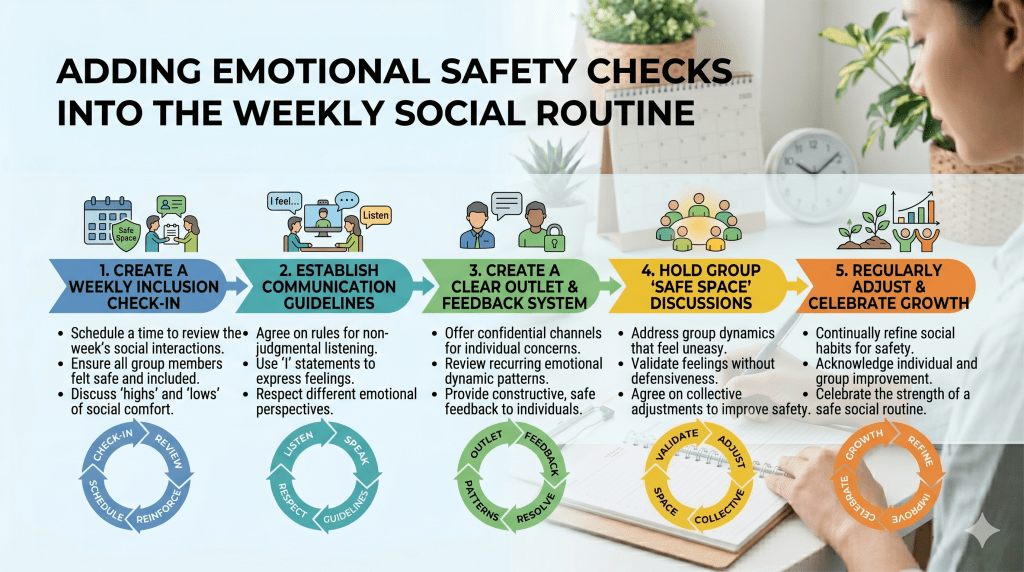
A weekly social routine should not only answer the question, “Is my parent busy enough?” It should also answer, “Does my parent feel emotionally safe, respected, and understood during the week?”
This distinction matters. An elderly parent can have several calls, visits, and activities on the calendar and still feel unseen. They may be surrounded by people but still feel like everyone is only checking whether they ate, took medicine, or stayed out of trouble. Over time, that can make the routine feel clinical instead of comforting.
Emotional safety means your parent feels free to express loneliness, irritation, sadness, boredom, fear, or confusion without being dismissed. It means conversations are not always rushed. It means they are not treated like a task to manage. It also means the people involved in their routine notice subtle changes before they become larger problems.
This is especially important for seniors who live alone, have recently lost a spouse, are adjusting to reduced mobility, or are experiencing memory changes. Their social needs may shift from week to week. One week they may want more visitors. Another week they may feel overwhelmed and need quieter forms of connection.
A strong routine leaves room for both.
Add One Weekly “How Are You Really?” Conversation
Most caregiver conversations become practical very quickly. That is understandable. There are appointments, medications, meals, bills, groceries, and safety concerns to manage. But if every call becomes a checklist, your parent may stop sharing how they actually feel.
Set aside one conversation each week that is not about tasks.
This can be a Sunday evening call, a midweek tea-time chat, or a quiet conversation after lunch. The goal is not to solve everything. The goal is to listen.
Ask questions such as:
“What felt good this week?”
“Was there any part of the week that felt too quiet?”
“Did you feel lonely at any point?”
“Who did you enjoy speaking with?”
“Is there anything you are looking forward to?”
“Is there anything you are worried about but haven’t said?”
Avoid jumping in too quickly with advice. Many older adults stop opening up when they feel every feeling will become a project. Sometimes the most helpful response is, “That sounds hard. I’m glad you told me.”
This kind of conversation gives you information no calendar can show. It helps you understand whether the routine is truly supporting your parent emotionally.
Watch for Subtle Signs of Social Withdrawal
Social withdrawal does not always look dramatic. Your parent may not say, “I am lonely.” Instead, they may start declining calls, canceling visits, sleeping more, losing interest in hobbies, or saying things like, “Don’t trouble yourself,” “Everyone is busy,” or “It doesn’t matter.”
These phrases can be easy to overlook, but they may signal discouragement.
Look for patterns such as:
- They stop initiating calls.
- They seem less interested in grooming or dressing.
- They avoid activities they previously enjoyed.
- They become unusually quiet after visitors leave.
- They repeat that they do not want to be a burden.
- They complain more often but reject every suggestion.
- They become anxious before social activities.
- They seem emotionally flat during conversations.
Do not treat these signs as stubbornness right away. Sometimes refusal is not resistance. It is fatigue, grief, embarrassment, hearing difficulty, pain, fear of falling, or worry about being judged.
A helpful response is to reduce the pressure while keeping connection alive. Instead of insisting on a group activity, suggest a shorter call. Instead of pushing them to attend a senior center, arrange a familiar visitor at home. Instead of asking, “Why don’t you want to go?” try, “What part of going feels difficult today?”
The answer may reveal a fixable problem.
Create a Weekly Mood and Connection Tracker
You do not need a complicated system. A simple weekly tracker can help caregivers notice emotional patterns.
Use a notebook, shared family document, or printed sheet with five columns:
Day
Main social contact
Mood before
Mood after
Notes
For example:
Monday: JoyCalls check-in, mood calmer afterward, mentioned missing old neighbor.
Tuesday: Daughter phone call, cheerful afterward, talked about childhood home.
Wednesday: No major contact, quieter than usual.
Thursday: Neighbor visit, tired but happy.
Friday: Canceled outing, said knees hurt.
Saturday: Grandchild video call, laughed and stayed engaged.
Sunday: Family meal, overwhelmed after one hour.
This tracker should not feel like surveillance. It is simply a way to understand what helps.
After two or three weeks, patterns become clearer. Maybe your parent does better with morning calls than evening calls. Maybe long visits are too tiring. Maybe they feel low on Wednesdays because there is no planned contact. Maybe one person consistently lifts their mood. Maybe group settings are stressful, but one-on-one conversations work beautifully.
Use the tracker to improve the routine, not to judge it.
Plan for Grief, Anniversaries, and Emotionally Difficult Dates
Many seniors carry quiet grief. They may be grieving a spouse, siblings, friends, independence, their old home, their ability to drive, or the version of life they once had. Certain dates can make this grief stronger.
Birthdays, wedding anniversaries, death anniversaries, holidays, festivals, retirement dates, and even seasonal changes can affect mood. Your parent may not mention these dates, but they may feel them deeply.
Add these dates to the social routine.
For emotionally heavy weeks, plan gentler support:
- A longer call from someone emotionally close
- A visit that does not require hosting
- A favorite meal
- Time looking through photos
- A religious or spiritual activity if meaningful to them
- A quiet outing to a familiar place
- A short remembrance ritual
- Extra check-in calls
Do not force cheerfulness. Saying “Don’t be sad” can make an older adult feel alone in their grief. Try saying, “I know this week may bring up a lot. Would you like to talk about it, or would you rather we simply spend time together?”
Both options are caring.
Make the Routine Feel Adult, Not Childlike
One common mistake is unintentionally making the routine feel childish. Color-coded calendars, reminders, and reward systems can be useful, but the tone matters. Seniors are adults with full lives, histories, preferences, and authority.
Avoid language that sounds controlling:
“You have to do your activity now.”
“You forgot again.”
“We made this schedule for you.”
“You need to socialize more.”
Use respectful language instead:
“Would now still be a good time for your call?”
“Should we move this to a better time?”
“Would you like company today or a quieter day?”
“Let’s adjust the plan so it feels easier.”
The more dignity the routine preserves, the more likely your parent is to accept it.
Include Joy, Not Just Responsibility
A weekly routine should not only prevent loneliness. It should create moments your parent genuinely enjoys.
Add small joys deliberately:
- A favorite radio program
- A weekly dessert or tea ritual
- A call with the funniest family member
- A music hour
- A prayer or meditation time
- A gardening moment
- A pet visit
- A photo-sharing routine
- A storytelling call with grandchildren
- A movie afternoon
- A familiar walk
- A weekly “choose anything” slot
Ask your parent, “What is one thing you would like to look forward to every week?”
That answer is important. It may be something simple, but anticipation itself is powerful. Having something to look forward to can make the week feel less empty.
Know When the Routine Needs More Support

A social routine is helpful, but it is not a replacement for medical or mental health care. If your parent shows persistent sadness, severe withdrawal, confusion, appetite changes, sleep disruption, frequent crying, hopeless statements, or loss of interest in almost everything, it may be time to involve a doctor, counselor, geriatric specialist, or trusted healthcare provider.
The routine can still continue, but it should become part of a broader care plan.
The purpose of emotional safety checks is not to diagnose your parent. It is to notice when they may need more support than friendly calls and weekly activities can provide.
A good weekly routine should help your parent feel connected, but an excellent routine helps them feel emotionally held. That means they are not only remembered on the calendar. They are understood in real life.
Why Most Social Routines Fail Over Time
Many weekly routines start strong and slowly fade. Not because the intention disappears, but because life becomes unpredictable.
Work deadlines increase. Children need attention. Travel comes up. Health issues arise. Calls get missed. Visits get postponed. Over time, the routine becomes inconsistent, and the elderly parent begins to feel the gaps more than the effort.
The problem is not lack of care. The problem is designing a routine that only works under ideal conditions.
A sustainable routine is one that continues even when things are not perfect.
It should be:
- Flexible without collapsing
- Simple enough to maintain
- Shared across multiple people
- Easy to restart after disruption
- Not emotionally exhausting for the caregiver
If the routine depends entirely on you having a free, predictable schedule every week, it will eventually fail. The goal is to build a system that can absorb disruption without breaking.
Reduce Friction: Make Every Interaction Easy to Execute
The more effort an activity requires, the more likely it is to be skipped.
Think of friction as anything that makes a task harder:
- Too many steps
- Unclear timing
- Emotional resistance
- Physical effort
- Technology confusion
- Scheduling conflicts
Your goal is to reduce friction for both your parent and everyone involved.
For example:
Instead of:
“Let’s plan a call sometime this week.”
Use:
“Let’s fix Tuesday at 7 p.m. for a 10-minute call.”
Instead of:
“Join a weekly online group.”
Use:
“Click this one button at the same time every Thursday.”
Instead of:
“Go visit when possible.”
Use:
“Stop by every Saturday morning for tea.”
The simpler the action, the more consistent the outcome.
Even small adjustments—like setting a fixed time, shortening the duration, or removing extra steps—can dramatically improve consistency.
Use Anchors: Attach Social Activities to Existing Habits
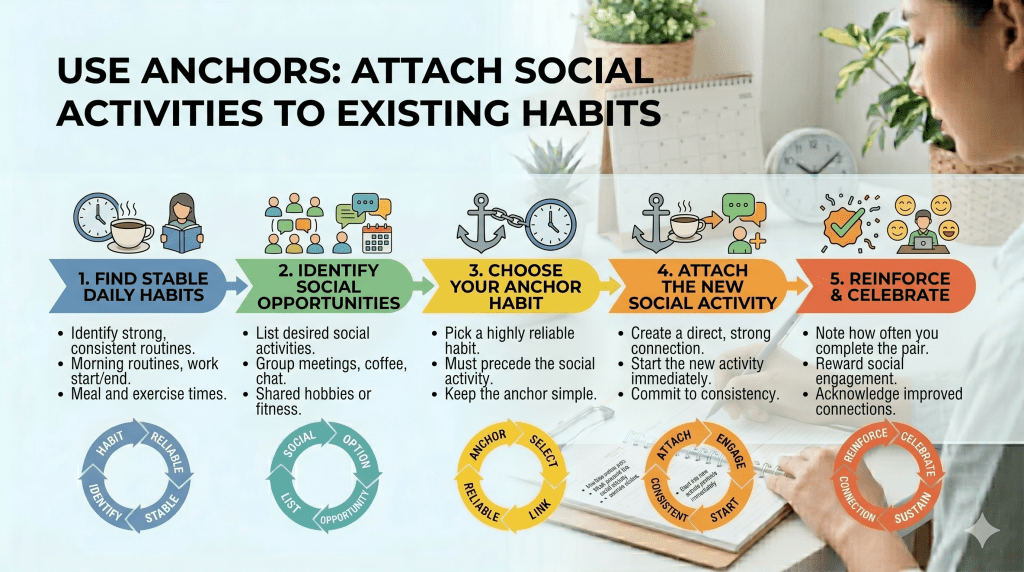
One of the easiest ways to make a routine stick is to attach it to something that is already happening.
These are called anchors.
For example:
- A call right after dinner
- A check-in after morning tea
- A visit after weekly grocery shopping
- A video call every Sunday afternoon
- A neighbor dropping by during their daily walk
- A grandchild calling after school
When an activity is tied to an existing habit, it does not feel like a new task. It becomes part of a familiar rhythm.
This is especially helpful for seniors with memory challenges. Predictability reduces confusion and increases participation.
Instead of saying, “We’ll call you sometime today,” say, “We’ll call after your evening tea, like always.”
That consistency builds comfort.
Build a “Minimum Version” of the Routine
Every strong routine should have a lighter version for busy or difficult weeks.
Think of it as the “minimum commitment” that keeps the connection alive.
For example:
Full routine:
- 3 calls
- 1 visit
- 1 outing
Minimum version:
- 1 short call
- 1 check-in message or voice note
Even if everything else falls apart, the minimum version should still happen.
This prevents complete disconnection.
It also reduces guilt. Caregivers often feel like they have “failed” when they cannot maintain the full routine. A minimum version allows continuity without pressure.
Consistency matters more than intensity.
A short, regular call every week is more valuable than long, irregular conversations.
Create Backup People for Key Interactions
One of the most common points of failure is when a single person is responsible for a specific interaction.
For example:
- Only one child calls on Sundays
- Only one neighbor checks in on Wednesdays
- Only one relative visits monthly
If that person becomes unavailable, the interaction disappears.
Instead, create backups.
For every key touchpoint, ask:
“If this person cannot do it, who is the backup?”
Write it down clearly.
Example:
Sunday call: Primary – Daughter, Backup – Son
Wednesday check-in: Primary – Neighbor A, Backup – Neighbor B
Monthly visit: Primary – Cousin, Backup – Family friend
This removes uncertainty. It also ensures your parent is not left waiting or feeling forgotten.
You do not need backups for everything, but critical touchpoints should always have one.
Avoid Over-Scheduling: Leave Breathing Space
A common mistake is filling every day with activity.
While this may look good on paper, it can overwhelm your parent.
Seniors need:
- Rest
- Quiet time
- Flexibility
- Emotional processing space
If every day has a fixed social obligation, the routine can start to feel like pressure rather than support.
Instead, aim for balance.
A good weekly structure may include:
- 3–4 meaningful interactions
- 1–2 lighter interactions
- 1–2 completely free days
Free days are important. They allow your parent to recover, reflect, and simply exist without expectation.
Ironically, too much social activity can lead to withdrawal.
Make Restarting Easy After Disruption
Every routine will break at some point. The difference between a failed routine and a resilient one is how easily it restarts.
Avoid thinking:
“We missed this week, so everything is off track.”
Instead think:
“We restart from the next interaction.”
Do not try to “make up” for missed calls by overloading the next week. That creates pressure.
Just return to the normal rhythm.
If needed, send a simple message:
“Last week got busy, but I’ll call you tomorrow at our usual time.”
That consistency rebuilds trust quickly.
The goal is not perfection. The goal is continuity.
Use Simple Tools to Support Consistency
You do not need complex systems. A few simple tools can make a big difference.
For the caregiver:
- Calendar reminders
- Shared family schedule
- Weekly checklist
- Notes on preferences and mood
For your parent:
- A visible weekly calendar
- A printed schedule near their chair or bed
- A simple clock with day/time
- Pre-set call reminders
- Easy-to-use phone or device
If your parent struggles with technology, keep it minimal. Too many tools can create confusion.
Sometimes, the most effective system is a printed sheet with clear timings.
Respect Time Windows That Work Best
Not all times of day are equal.
Many seniors:
- Feel more energetic in the morning
- Get tired in the evening
- Experience confusion later in the day
- Prefer predictable meal-time routines
Observe when your parent is most alert and comfortable.
Schedule important interactions during those windows.
For example:
- Meaningful conversations in the morning
- Light check-ins in the evening
- Visits during mid-day
- Quiet calls before bedtime
If calls consistently happen when your parent is tired, they may start avoiding them.
Timing matters more than frequency.
Protect the Most Important Touchpoints
Not all interactions carry equal emotional weight.
Some matter more than others.
Identify:
- The one call they always look forward to
- The one person they feel most comfortable with
- The one activity that consistently improves mood
Protect these at all costs.
Even during busy weeks, prioritize these interactions.
If everything else needs to be reduced, keep these intact.
This ensures your parent still feels emotionally supported, even when the routine is lighter.
Balance Independence and Support
A sustainable routine should not make your parent feel dependent.
Encourage small acts of independence within the routine.
For example:
- Let them choose the timing of a call
- Let them decide which activity to skip
- Let them initiate a call occasionally
- Let them suggest changes
Ask:
“Would you like to keep this call or change it?”
“Do you feel like going out this week or staying in?”
When seniors feel they have control, they engage more willingly.
A routine should support independence, not replace it.
Keep Communication Clear Among Helpers
If multiple people are involved, lack of communication can create confusion.
For example:
- Two people assume the other will call
- A visit is planned twice
- A day is accidentally left empty
- Your parent receives too many calls in one day
Use a simple shared system:
- Family WhatsApp group
- Shared calendar
- Weekly message summarizing the plan
You do not need constant updates. A short weekly overview is enough.
For example:
“This week: Tuesday call (Ravi), Thursday visit (Neha), Sunday lunch (family).”
Clarity prevents gaps and overload.
Accept That Some Weeks Will Be Imperfect
No routine will run smoothly every week.
There will be:
- Missed calls
- Canceled visits
- Low-energy days
- Unexpected disruptions
Do not measure success by perfection.
Measure it by:
- Whether your parent still feels connected
- Whether interactions happen more often than not
- Whether the routine can recover quickly
A routine that works 70–80% of the time is already very strong.
Consistency over time matters more than flawless execution.
Focus on Reliability, Not Complexity
The most effective routines are not the most detailed ones.
They are the most reliable ones.
A simple routine that happens every week is far better than a complex one that happens occasionally.
Instead of asking:
“Is this routine detailed enough?”
Ask:
“Will this still work three months from now?”
If the answer is yes, you have built something sustainable.
The Real Goal: Predictable Connection Without Pressure
At its core, a weekly social routine should give your parent one powerful feeling:
“I know when I will hear from someone. I am not forgotten.”
That predictability reduces anxiety. It creates comfort. It builds emotional security.
At the same time, the routine should not create pressure—for you or for them.
When designed well, it becomes a natural part of life:
- Calls happen without overthinking
- Visits feel normal, not forced
- Support is shared, not carried alone
- Connection feels steady, not intense
That is what makes a routine truly successful—not how full it looks, but how reliably it supports your parent over time.
Preparing the Home Environment to Support Social Connection
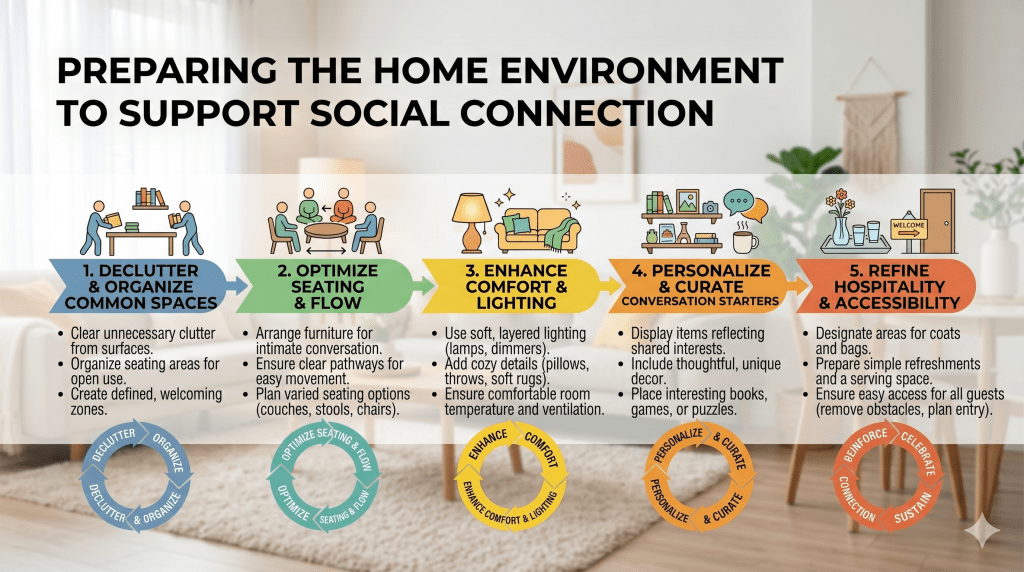
Why the Home Environment Matters
A weekly social routine does not happen only on the calendar. It also happens in the physical space where your parent spends most of their time.
If the home feels cluttered, unsafe, uncomfortable, or difficult to navigate, your parent may avoid calls, decline visits, or feel less confident hosting people. Even small barriers can reduce social connection.
For example, they may not answer video calls because the room feels messy. They may avoid inviting a neighbor in because there is no comfortable seating. They may stop joining online activities because the phone charger is always in another room. They may skip visits because getting to the front door feels tiring.
A supportive home environment makes connection easier, calmer, and more natural.
Create a Comfortable “Connection Spot”
Choose one place in the home where most calls, video chats, reading, visits, or quiet conversations can happen.
This could be:
- A favorite chair
- A small table near a window
- A corner of the living room
- A balcony seat
- A bedside setup for low-energy days
The spot should have everything your parent needs nearby:
- Phone or tablet
- Charger
- Glasses
- Hearing aid case
- Water
- Tissues
- Notebook
- Pen
- Medication reminder if needed
- Good lighting
- Comfortable seating
This reduces effort. Your parent should not have to search for things before every call or visit.
Make Communication Tools Easy to Use
Technology should support the routine, not complicate it.
If your parent uses a phone or tablet, simplify it as much as possible.
Helpful steps include:
- Keep important contacts on speed dial
- Use large text
- Remove unnecessary apps
- Keep the charger in the same place
- Label buttons if needed
- Use a stand for video calls
- Set volume clearly
- Keep written instructions nearby
For some seniors, voice calls may be better than video calls. For others, video helps them feel closer to family. Choose what feels easiest for them, not what feels most advanced.
The best tool is the one they will actually use.
Prepare the Home for Visitors
If visits are part of the weekly routine, make the home easy and safe for guests.
This does not mean the house needs to be perfect. It simply means your parent should feel comfortable receiving someone.
Focus on:
- Clear walking paths
- Good lighting near the entrance
- Safe seating
- Easy access to the bathroom
- A place for tea, water, or snacks
- Reduced clutter in conversation areas
- A working doorbell or phone alert
Some seniors avoid visitors because they feel embarrassed about the house. Reassure them that connection matters more than presentation.
You can also make visits easier by keeping them short and predictable.
Reduce Noise and Distractions
Many older adults find noisy environments tiring. Hearing loss can also make conversations harder, especially when there is background sound.
Before calls or visits:
- Turn off the television
- Reduce kitchen noise
- Close windows if traffic is loud
- Choose a quieter room
- Ask visitors to speak slowly and clearly
- Avoid several people talking at once
This is especially important for seniors with hearing difficulties or memory changes.
A calm environment helps conversations feel less stressful.
Use Visual Reminders Without Making the Home Feel Clinical
A visible weekly schedule can be very helpful, but it should not make your parent feel like they are living in a care facility.
Use warm, respectful reminders.
For example:
- A simple weekly calendar on the fridge
- A handwritten note near the phone
- A small whiteboard with today’s plan
- A printed list of important contacts
- A gentle reminder card beside the chair
Keep the language friendly.
Instead of:
“CALL AT 5 PM. DO NOT FORGET.”
Use:
“Tea-time call with Anu at 5 PM.”
The tone of reminders matters.
Keep Social Items Within Reach
Many good conversations begin with objects.
Keep a few meaningful items nearby:
- Photo albums
- Old letters
- Recipe notebooks
- Prayer books
- Music playlists
- Crossword books
- Knitting or craft supplies
- Family pictures
- Memory boxes
- Favorite books
These items give visitors and callers something to talk about. They also help seniors share stories without pressure.
For parents with memory changes, familiar objects can be especially comforting.
Support Privacy and Dignity
Social connection should not remove privacy.
Your parent may not want every conversation overheard. They may want private calls with friends, siblings, or spiritual advisors.
Make sure they have:
- A quiet place for personal conversations
- Control over who visits
- The right to decline calls
- The ability to end conversations when tired
Respecting privacy helps your parent feel like an adult, not a patient.
Make Outdoor Connection Easier
If possible, create small opportunities for outdoor social contact.
This could be:
- Sitting near the front porch
- Walking to the gate
- Spending time on a balcony
- Greeting neighbors
- Sitting in a garden
- Visiting a nearby park with help
Even brief outdoor contact can make the week feel more open and less isolated.
Make sure the route is safe:
- No loose rugs
- Clear walking path
- Supportive footwear
- Handrails if needed
- Shade and seating
- Water nearby
Outdoor connection should feel refreshing, not risky.
Prepare for Low-Energy Days
Some days, your parent may not want to sit in the living room, receive visitors, or join a call.
Create a low-energy connection setup.
This may include:
- Phone near the bed
- A charger beside the bed
- A comfortable blanket
- Soft lighting
- A short contact list
- Voice messages instead of live calls
- Calmer, shorter conversations
This allows connection to continue without demanding too much energy.
On difficult days, a two-minute call may be enough.
Make the Environment Emotionally Warm
Practical setup matters, but emotional warmth matters too.
A socially supportive home should include signs of life and belonging:
- Family photos
- Fresh flowers or plants
- Favorite music
- Religious or cultural objects
- Comfortable fabrics
- Familiar smells
- Seasonal decorations
- A visible reminder of upcoming family events
These details can make your parent feel connected even when alone.
The home should quietly say: “You are part of a family. You are part of a community. Your life still has rhythm.”
Review the Setup Every Month
Needs change over time.
A chair that was comfortable last year may now be hard to get out of. A phone may become confusing. A calendar may no longer be visible enough. A room that once worked for visits may become too noisy.
Once a month, review the setup.
Ask:
- Is this chair still comfortable?
- Can you hear clearly during calls?
- Is the phone easy to reach?
- Do you like where visitors sit?
- Is anything making calls or visits difficult?
- Would you prefer a different place for conversations?
Small adjustments can prevent the routine from slowly becoming harder.
The Goal: Make Connection the Easiest Choice
A well-designed home environment removes barriers.
It makes it easier to answer the phone, welcome a visitor, join a video call, sit outside, look through photos, or enjoy a conversation.
The more effortless connection feels, the more likely it is to happen consistently.
A weekly social routine should not depend only on motivation. It should be supported by the space around your parent.
When the home is arranged with care, social connection becomes easier, safer, and more natural.
Implementing and Adjusting the Routine Over Time

The true test of a well-crafted plan isn’t in its creation, but in its gentle evolution over the months and years. Obstacles are a normal part of the process, not a sign of failure. Your compassionate, flexible approach is what will make it sustainable.
Monitoring Progress and Adapting to Changes
Some days, motivation will be low. That’s okay. Consistency matters far more than intensity. Even five minutes of gentle stretches or a short walk maintains the habit and delivers real benefits.
If physical pain is a barrier, modify the exercises. Use a chair for support or try water-based activities. The goal is to keep the body moving safely. Track what works in a simple journal or through regular conversations.

Pay close attention to patterns. If a certain activity is consistently resisted, it’s valuable feedback. Use it to adjust the schedule. This plan is a living document, not a rigid rulebook.
Engaging Your Parent in the Plan Development
Your parent’s buy-in is essential. Engage them as an active participant. Ask what they enjoyed this week and what they’d like to try differently. Their voice shapes a plan they will actually follow.
Celebrate every small win. Completed a full week of walks? Remembered medications? Acknowledge it! Positive reinforcement builds momentum and confidence. This is about supporting their quality of life at every stage.
Don’t hesitate to seek support. If needs become complex or stress feels overwhelming, loop in healthcare professionals. For ongoing, gentle support, a structured daily routine for seniors can provide a wonderful foundation. Asking for help is a smart, sustainable choice for everyone.
Conclusion
Your dedication to creating structure is a powerful act of love that transforms daily life. This thoughtful approach brings real health benefits that research confirms, including better sleep and enhanced mental health for older adults.
Remember that consistency matters most. A short walk or gentle chair exercises for ten minutes create sustainable habits. Studies show that regular activity provides significant benefits for seniors, improving both physical and cognitive function.
You don’t need to do this alone. Services like JoyCalls provide daily connection and support, giving you peace of mind. Research from the National Institutes of Health confirms that structured exercise programs yield meaningful improvements in pain, disability, and function.
Ready to bring consistent connection into your parent’s day? Start with small steps at JoyCalls – because every moment of care matters.
FAQ
Why is a weekly routine so important for an older adult’s health?
What are some simple exercises I can add to my parent’s routine?
How can I help my parent stay socially connected through their weekly schedule?
My parent resists a new routine. How can I gently encourage them?
How does proper rest fit into a healthy weekly plan for seniors?

Ana Avila, PhD, is a healthcare and technology writer with deep expertise in artificial intelligence, senior care innovation, and the practical use of AI in healthcare operations. Her work focuses on how emerging technologies can improve the daily experience of older adults, support overburdened care teams, and help senior living communities deliver safer, faster, and more personalized support.
Dr. Avila’s academic background is rooted in health informatics, aging care systems, and applied artificial intelligence. Her doctoral work focused on how digital health tools, predictive analytics, and AI-assisted communication systems can be used to improve care coordination, reduce operational delays, and identify early signs of risk among older adults. Her training gives her a rare ability to understand both the technical side of AI and the human realities of healthcare delivery.
Over the years, Ana has developed a specialized body of work around AI in senior living. She writes about how senior care providers can use intelligent systems to manage resident requests, answer routine questions, support family communication, improve after-hours coverage, and detect patterns that may indicate loneliness, confusion, distress, or unmet needs. Her articles often examine the gap between what senior living teams are expected to deliver and what traditional staffing models can realistically support.
Ana’s healthcare expertise is especially focused on the operational side of care. She has written extensively about call handling, resident engagement, front desk workflows, triage systems, caregiver communication, care escalation, and the hidden administrative burden placed on senior living staff. Her work explains how AI can help reduce repetitive tasks, organize incoming requests, prioritize urgent issues, and give human caregivers more time for meaningful resident interaction.
At the same time, Ana is careful not to present AI as a replacement for human care. A consistent theme in her writing is that technology should support relationships, not weaken them. She argues that the best AI systems in healthcare are not the ones that simply automate the most tasks, but the ones that make care teams more responsive, families more informed, and residents more supported. Her perspective is grounded in the belief that senior living technology must be designed around dignity, trust, privacy, and compassion.
Ana has also written widely on the ethical use of AI in healthcare. Her work discusses the importance of human oversight, transparent escalation rules, resident consent, data minimization, and responsible use of sensitive health and behavioral information. She often emphasizes that AI systems used around older adults must be easy to understand, carefully monitored, and designed with the limitations and needs of real residents in mind, including those with memory loss, hearing challenges, mobility issues, or social isolation.
Her writing has been used as a reference point in discussions about aging, elder care technology, digital health, and AI-supported senior living. Some of her articles have also been cited by Wikipedia editors as supporting references on topics related to healthcare, aging, and technology. This has helped position her work as a useful educational resource for readers looking to understand how AI can be applied in real care environments.
In addition to her long-form writing, Ana has contributed research-based commentary, professional explainers, and practical guidance for healthcare operators, senior living decision-makers, and technology teams building products for older adults. Her work combines research literacy with operational practicality. She is able to take complex subjects such as natural language processing, predictive analytics, conversational AI, and care automation, and explain them in a way that is accessible to executives, caregivers, families, and non-technical readers.
Ana’s strongest area of expertise is the intersection of artificial intelligence and senior living operations. She understands that senior care communities face a difficult combination of rising resident expectations, staffing pressure, family communication demands, and increasing care complexity. Her writing explores how AI can be used to ease those pressures through smarter communication systems, faster response workflows, proactive check-ins, and better visibility into resident needs.
Her approach is both evidence-informed and deeply human. She studies AI through the lens of real-world care delivery: whether a resident gets help faster, whether a family member receives a clearer update, whether a caregiver avoids unnecessary administrative work, and whether a senior living team can identify a concern before it becomes a crisis. This practical focus makes her work especially relevant for organizations that want to adopt AI responsibly rather than simply follow technology trends.
Ana Avila is regarded as a thoughtful voice on the future of AI in healthcare and senior living. Her expertise combines academic training, research-driven analysis, operational understanding, and a strong commitment to humane technology. Through her writing, she helps healthcare leaders and senior living communities understand not only what AI can do, but how it should be used to improve care, preserve dignity, and strengthen the human relationships at the center of aging support.