


What if the very thing meant to help your parent could be causing them harm?
Picture this. You’re visiting your mom or dad. On the kitchen counter, you see a lineup of pill bottles. Not just a few, but a dozen or more. Your heart sinks. You feel that familiar knot of worry in your stomach. How can anyone keep track of all these medications?
You are not alone in this fear. Many families watch their older adults navigate prescriptions from different doctors. You wonder if they are taking everything correctly. You worry if some pills are interacting badly. The emotional weight is heavy. It’s the fear of a mistake happening when you’re not there. It’s the guilt of not being able to oversee every dose.
This guide is here for you. It’s a compassionate companion for worried adult children. Our goal is to help you protect your parent’s health while respecting their independence. Managing a complex medication routine doesn’t mean you’ve failed. It means you’re being proactive and loving in your approach to care.
We will walk you through practical steps and expert insights. You’ll learn how to build a safer strategy. This includes open communication with doctors and simple home adjustments. We’ll also explore supportive resources, like daily monitoring technology, that offer peace of mind. Let’s navigate this challenge together, with confidence.
Key Takeaways
- Managing multiple medications is a common and valid concern for families.
- Complex medication routines can increase risks like falls and adverse interactions.
- Being proactive about medication safety is an act of love, not a sign of failure.
- Open communication with healthcare providers is the first step toward safer management.
- Practical solutions, including technology, can provide daily support and peace of mind.
- A compassionate approach balances safety with respect for a loved one’s independence.
Introduction: The Growing Concern of Polypharmacy in Seniors
When you count the pill bottles on your parent’s counter, does your heart sink with worry? You’re witnessing a common reality for many families today.

Overview and Definition of Polypharmacy
Medical experts define this situation as taking five or more medications regularly. As our loved ones manage multiple health conditions, the number of prescriptions often grows.
Consider these sobering facts from recent studies:
- 83% of adults in their 60s and 70s use at least one prescription drug
- One-third take five or more medications
- Those taking 5-9 medications face a 50% chance of adverse interactions
While sometimes necessary, complex medication routines require careful management.
Why Medication Safety Matters for Older Adults
Medication safety becomes critically important as people age. The risks are real and can impact your parent’s daily life.
According to the National Institute on Aging, inappropriate medication combinations account for nearly 30% of hospital admissions. This isn’t just about prescriptions – over-the-counter drugs and supplements count too.
Many families have watched their parents experience confusion or falls that might connect to medication issues. Your concern is valid, and addressing it shows your loving care.
Understanding Polypharmacy: Definitions and Risks
The true concern isn’t simply how many pills your loved one takes, but whether each one truly serves their wellbeing. This distinction lies at the heart of understanding medication safety.
When prescriptions accumulate over time, they can create complex situations that require careful attention. Let’s explore what this really means for your family.
What Constitutes Polypharmacy in Current Practice
Many healthcare professionals use a simple benchmark: taking five medications or more regularly. However, the number alone doesn’t tell the full story.
What matters more is whether each drug remains appropriate for your parent’s current health needs. Some people with complex conditions genuinely require multiple treatments.

This situation affects various adults, not just seniors. Those managing multiple chronic conditions often have longer medication lists. The key question is always: “Do these medications work together safely?”
Common Risk Factors and Adverse Effects
Several factors increase medication risk. Seeing multiple specialists can lead to prescriptions piling up. Automated refills might continue unneeded medications.
Watch for these warning signs of problematic interactions:
- Increased falls or dizziness
- Unexplained confusion or memory changes
- New symptoms that don’t have a clear cause
Sometimes, one medication’s side effects get treated with another drug. This “medication cascade” can create a domino effect. The risk exists at both the patient and system level.
Understanding these adverse effects helps you become a more informed advocate for your loved one’s health.
Practical Guidelines for polypharmacy elderly Medication Assessment
What if a simple medication review could reveal hidden risks in your loved one’s daily routine? You don’t need medical expertise to start this important process. It begins with gathering information and asking the right questions with your parent’s healthcare team.
Try JoyCalls Free
No app or new device needed. Start with a free 7-day trial.
Evaluating Current Medication Regimens
Start by collecting every prescription bottle, over-the-counter drug, vitamin, and supplement. Bring them all to the next doctor’s appointment in their original containers. These containers tell a complete story.

The actual bottles show dosages, prescribing doctors, and refill dates. They also reveal medication adherence. A year-old bottle that’s still full speaks volumes about your parent’s use patterns.
Identifying Potential Drug Interactions and Duplications
Look for duplicate medications serving the same purpose. Check if prescriptions from different doctors might interact. Helpful tools like the Beers criteria identify medications that are often risky for older patients.
The Medication Appropriateness Index offers 10 practical questions. Is each drug necessary? Is the dose correct? Could it interact badly with other medications? These frameworks help guide discussions with primary care providers.
Consider this real example: one daughter discovered her father was taking both old and new prescriptions after a hospital stay. Nobody had told him to discard the originals, tripling his medication load unnecessarily.
Identifying drug interactions is crucial, especially for patients with cognitive impairment. They may struggle to communicate when something feels wrong. As research shows, comprehensive medication management requires careful coordination.
Remember, medications may need adjustment based on age-related changes. What worked at 65 might need modification at 80. This process of family coordination ensures everyone works together for your parent’s safety.
Step-by-Step Approach to Deprescribing and Medication Review
Have you ever wondered if some of your parent’s medications might be doing more harm than good at this stage of their life? Deprescribing is a thoughtful process of evaluating each treatment based on your loved one’s current needs and goals.

Preparing a Comprehensive Medication List
Start by sitting together during a clear-minded moment. Create a complete list of every prescription, vitamin, and supplement. Ask your parent to explain each one in their own words.
This simple exercise reveals their understanding of their medication regimen. It also builds trust for the conversation ahead.
Engaging Healthcare Providers in Shared Decision-Making
Bring your complete list to the next doctor’s appointment. Frame the discussion around quality of life rather than just disease management. Expert studies show that patients are more receptive when physicians recommend changes.
Only one-third of older adults discuss medication priorities with their doctors. Your initiative can bridge this gap through shared decision-making.
Establishing a Follow-Up Plan for Medication Adjustments
Deprescribing requires careful monitoring. Work with the healthcare team to create a specific follow-up plan. Watch for withdrawal effects or symptom changes.
Treatments should be viewed as trials rather than permanent solutions. Regular review ensures medications align with evolving health needs.
| Before Deprescribing | After Deprescribing | Key Benefits |
|---|---|---|
| Multiple medications without recent review | Streamlined regimen based on current needs | Reduced risk of interactions |
| Focus on disease management only | Emphasis on quality of life goals | Improved daily functioning |
| Automatic refills continuing indefinitely | Regular medication assessments | Personalized care approach |
This ongoing process respects your parent’s values while ensuring safety. Consider how regular check-ins can support medication adherence between medical visits.
Role of Primary Care and Specialists in Medication Management
When different doctors prescribe different treatments, who ensures they all work together safely? This coordination challenge affects many families managing complex health needs.
Coordinating Between Multiple Prescribers
Your parent might see a cardiologist, endocrinologist, and other specialists. Each focuses on specific conditions. But medication lists can grow with each visit.
A strong primary care physician acts as the team quarterback. They maintain oversight of all medications. This prevents dangerous interactions from slipping through the cracks.
Some patients worry about changing specialist-prescribed drugs. It’s not about overruling other doctors. It’s about collaborative health care with complete information.
Utilizing Evidence-Based Guidelines in Clinical Practice
Major medical organizations provide clear guidance. The American Geriatrics Society recommends regular medication reviews. They emphasize questioning new prescriptions and deprescribing when appropriate.
Doctors use tools like the Beers Criteria and STOPP/START guidelines. These help identify potentially inappropriate medications for older patients. They guide decisions about starting or stopping specific treatments.
“Medication management requires seeing the whole person, not just individual conditions.”
Electronic health records now help with medication reconciliation. But human oversight remains essential. Families can advocate by asking key questions during appointments.
| Without Coordination | With Primary Care Leadership | Patient Benefits |
|---|---|---|
| Specialists work in isolation | Team approach with shared information | Reduced medication risks |
| Duplicate or conflicting treatments | Streamlined, appropriate regimen | Better health outcomes |
| No comprehensive medication review | Regular assessment of all drugs | Improved quality of life |
Research shows that effective coordination significantly improves medication safety. It ensures each treatment serves your loved one’s current health goals.
The Most Dangerous Moments: How to Handle Medication Changes, Missed Doses, and Red Flags at Home
Even when a senior’s medication routine looks stable on paper, the real risks often show up during everyday disruptions.
Not during the doctor’s appointment.
Not while the prescription is being written.
But later, at home.
A hospital discharge. A new specialist visit. A refill that looks different from last month. A pill skipped by accident. A senior who says, “I already took that,” but no one is sure. A new symptom that seems minor at first, until it is not.
These are the moments when medication safety becomes real.
For many families, polypharmacy feels overwhelming because the danger is not just “too many medications.” The danger is confusion. It is poor communication between settings. It is assumptions. It is routine getting interrupted. And for older adults, even a small medication mistake can have a much bigger effect than families expect.
That is why one of the smartest things you can do is stop thinking only about the medication list itself and start thinking about the moments when the list changes or gets harder to follow.
If you prepare for those moments in advance, you reduce stress, improve safety, and avoid turning small medication problems into medical emergencies.
Why the “transition moments” matter so much
Most families focus on whether a loved one has the right medications. That matters, of course. But there is another equally important question:
Can your parent safely manage medication changes when life gets messy?
Because life always gets messy.
Appointments run long. Instructions get rushed. A discharge packet is confusing. A new medication is added, but an old one is not clearly stopped. Pharmacy labels are hard to read. A senior feels embarrassed to admit they do not understand what changed. Adult children assume the doctor explained everything. Doctors assume the family understood the instructions. Everyone is acting with good intentions, yet mistakes still happen.
This is especially common in older adults because medication routines are rarely simple. One pill may be taken in the morning, another with food, another at bedtime, another only “as needed,” and another on certain days of the week. Add vision changes, hearing loss, fatigue, memory concerns, arthritis, or anxiety, and suddenly even a “simple” update becomes harder to manage correctly.
So the goal is not perfection.
The goal is to build a system that still works when your loved one is tired, distracted, recovering, frustrated, or unsure.
That is what truly makes a medication routine safer.
Start with one rule: every medication change gets treated as important
One of the biggest reasons medication problems happen at home is that families do not always realize which changes deserve extra attention.
The answer is simple: all of them do.
A dose increase is important.
A reduced dose is important.
A pill that changes color is important.
A medication that moves from “take daily” to “take only if needed” is important.
A refill from a different manufacturer is important.
A hospital discharge list is important.
A specialist adding “just one more medication” is important.
That does not mean every change is dangerous. It means every change deserves a pause.
Teach your household this habit: whenever a medication is started, stopped, adjusted, switched, or renamed, someone should ask these five questions before moving on:
1. What exactly changed?
Be specific. “The doctor adjusted it” is not enough. Name the medication, the dose, the timing, and whether it is new, discontinued, or modified.
2. Why was this change made?
If no one in the family can explain the reason in plain language, there is a gap that needs to be closed.
3. What should we stop doing now?
This question is crucial. Many medication errors happen because families know what was added, but do not realize what should be removed, thrown away, or no longer taken.
4. What side effects should we watch for in the first few days?
Not every side effect requires panic, but families should know what is expected, what is concerning, and when to call.
5. Who should we contact if something feels off?
A medication plan is safer when there is no confusion about the next phone call.
When families get used to asking these five questions every single time, medication safety improves dramatically because fewer assumptions slip through.
Build a “medication change routine” for the first 72 hours
The first few days after a medication change are often the most important.
This is when side effects may appear. This is when timing mistakes happen. This is when duplicate dosing, skipped doses, or wrong assumptions are most likely. So instead of treating a new prescription as “business as usual,” treat it like a short observation period.
For the first 72 hours after any meaningful medication change, do the following:
Keep the new regimen visibly separate
If your parent uses a pill organizer, do not rush to reorganize everything in a confusing way. If needed, update the organizer carefully and double-check it against the written instructions. Remove discontinued medications from the active area so they do not get mixed back in by mistake.
Write down the start date
A surprising number of families later ask, “When did this start?” and no one is sure. Write down the exact date the change began. That makes it easier to connect symptoms, fatigue, dizziness, stomach upset, sleep changes, or confusion to the timing of the medication.
Watch for “subtle” changes, not just dramatic ones
Medication issues do not always look dramatic. Sometimes they look like:
- more sleepiness than usual
- less appetite
- a little more confusion
- a little more unsteadiness
- more irritability
- new bathroom issues
- slower speech
- “not acting like themselves”
These are easy to dismiss when they happen gradually. They are also exactly the kind of changes caregivers should take seriously.
Avoid introducing too many other changes at once
If possible, do not combine a medication change with a completely new supplement, a major schedule shift, or a drastic diet change unless medically necessary. When too many things change at once, it becomes much harder to tell what is causing what.
Check in more intentionally
A casual “How are you feeling?” may not get useful answers. Ask better questions:
- “Do you feel more sleepy, dizzy, or weak than usual?”
- “Any upset stomach, constipation, or diarrhea?”
- “Do you feel foggy or more forgetful today?”
- “Do you feel steady on your feet?”
- “Does anything about this medicine feel different from what you expected?”
These questions are simple, but they pull useful information into the open.
What to do when a dose is missed
Missed doses are one of the most common real-world medication problems in older adults, and they often create panic.
A daughter calls and hears, “I forgot my morning pills.”
A husband finds a tablet still sitting in the organizer.
A caregiver is not sure whether the medication was taken or not.
Someone notices the mistake hours later and wonders whether to “catch up.”
This is where families need a calm system, not guesswork.
Rule one: never create a habit of “doubling up” without instructions
Many people assume that taking two doses later will fix the problem. Sometimes it will not. In some cases, it can create more risk than the missed dose itself.
The safest household policy is this: if a dose is missed, do not improvise. Follow the medication-specific instructions given by the pharmacist or prescribing clinician.
Since families cannot memorize every medication rule, the practical approach is to make sure high-risk medications have clear instructions written down in advance.
Create a missed-dose note for important medications
For each essential medication, keep a plain-language note that says:
- what the medicine is for
- what time it is normally taken
- what to do if it is missed
- what not to do
- which number to call if unsure
This removes panic from the situation. It also helps paid caregivers, spouses, siblings, or adult children respond consistently.
If you are not sure whether the dose was taken, treat uncertainty seriously
“I think I took it” is not confirmation.
This is one reason medication tracking systems matter. A simple checkmark log, a dated pill organizer, a daily reminder call, or a shared family note can prevent the dangerous uncertainty that leads to accidental double dosing.
When in doubt, the safest next step is not confidence. It is verification.
The best families are not the ones who never have confusion. They are the ones who build systems that reduce the chance of confusion repeating.
Create a home red-flag plan before you need one
Many caregivers wait until something goes wrong before deciding what counts as an emergency. That is understandable. But it is also stressful, because in the moment, fear clouds judgment.
A stronger approach is to decide in advance what symptoms should trigger action.
Mild concerns: monitor and call during normal hours
These may include:
- mild stomach upset after starting something new
- slight drowsiness that is not worsening
- questions about timing or routine
- uncertainty about how to organize medications
- a non-urgent refill issue
These still matter. They just may not require immediate emergency care.
Urgent concerns: call the clinician or pharmacist promptly
These may include:
- new confusion
- increasing dizziness
- repeated missed doses of an important medication
- a visible rash after starting a new medicine
- sudden weakness
- trouble walking that seems new
- severe constipation or diarrhea after a medication change
- excessive sleepiness or unusual behavior
Emergency concerns: seek immediate help
These may include:
- trouble breathing
- swelling of the face or throat
- fainting
- chest pain
- severe allergic reaction signs
- collapse
- unresponsiveness
- a fall with injury after a medication-related episode
- major overdose concerns
Families do not need to become medical professionals. But they do need to remove the “Should we wait?” uncertainty as much as possible.
Write your home red-flag plan in plain language. Put it somewhere visible. Keep contact numbers next to it. Include the pharmacy, primary care office, specialist office if relevant, and emergency contacts.
When emotions are high, clarity is a gift.
The post-hospital medication reset: treat discharge as a full restart
Hospital discharge is one of the riskiest moments in medication management for older adults.
Why? Because the medication list often changes quickly. Some medications are paused in the hospital. Others are added temporarily. Some are meant to continue at home. Some are not. Instructions can be rushed. Families are tired. Seniors are recovering. Important details can get lost.
So here is the safest mindset:
After any hospital stay, do not assume the old home routine should simply continue. Treat discharge as a complete medication reset.
Step 1: Compare three lists, not one
You need to compare:
- the pre-hospital medication list
- the discharge medication list
- what is actually sitting at home in the cabinet
Do not trust memory alone. Put the lists side by side.
Step 2: Mark every medication as one of four categories
Use a pen and label each medication:
- continue
- stop
- changed
- temporary
This single step can prevent major confusion.
Step 3: Remove discontinued medications from the active area
Do not leave them sitting beside current medications “just in case.” That is how old routines accidentally restart.
Step 4: Clarify anything that is vague before the next dose if possible
If the family is confused, ask. It is much better to call and clarify than to make a silent assumption.
Step 5: Watch closely for the first week
After discharge, older adults are often weaker, more tired, less steady, and more vulnerable to medication effects. This is not the week to become casual.
This one transition plan alone can prevent a large number of avoidable home medication problems.
Simplify the physical environment so the right action is the easiest action
Medication safety is not only about knowledge. It is also about environment.
If the home setup is cluttered, poorly lit, inconsistent, or hard to use, mistakes become more likely. This is especially true for older adults with reduced vision, arthritis, tremor, hearing issues, or mild memory decline.
A safer setup does not need to be fancy. It needs to be clear.
Keep all active medications in one primary location
Not scattered across a bathroom, bedside table, purse, and kitchen drawer. One main medication station reduces searching, duplication, and forgetting.
Improve lighting
Tiny labels and similar-looking bottles become much harder to manage in poor lighting. Good lighting is one of the simplest safety improvements families overlook.
Reduce bottle crowding
If labels cannot be read without moving five other containers, the setup is too crowded.
Separate active medications from old medications
Do not store current and discontinued medications together.
Keep water, glasses, and the medication list nearby
The less friction involved in the routine, the better the consistency.
Make instructions easy to read
If your parent struggles with small print, create a clear medication sheet in larger font with:
- medication name
- purpose
- time taken
- special instruction
- prescriber name if useful
The goal is not beauty. The goal is fewer mistakes.
Talk to seniors in a way that protects dignity, not just safety

This part matters more than many families realize.
A medication routine can become emotionally loaded very quickly. Seniors may feel judged, controlled, watched, or treated like children. Adult children may feel scared, frustrated, or exhausted. Once that emotional tension builds, even helpful medication conversations can start sounding like criticism.
That is when resistance grows.
So if you want safer medication habits, protect dignity while you solve problems.
Replace blame with partnership
Instead of saying:
“You keep messing this up.”
Say:
“I want to make this easier and safer for you.”
Replace interrogation with curiosity
Instead of:
“Did you take it or not?”
Try:
“Let’s figure out what would make this easier to track.”
Replace control-focused language with support-focused language
Instead of:
“You can’t manage this yourself.”
Try:
“This is a lot for anyone to manage alone. Let’s build a system that feels less stressful.”
Older adults often respond better when the conversation is framed around reducing hassle, protecting independence, and making life easier, rather than monitoring or correcting them.
That tone shift can change everything.
A simple weekly medication safety routine that families can actually maintain
The best system is the one your family will realistically keep doing.
You do not need a complicated spreadsheet if no one will update it. You do not need a perfect binder if it never gets opened. You need a routine simple enough to stick.
Here is a practical weekly rhythm:
Once a week, do a 10-minute medication check
Use the same day each week.
Review:
- Are refills running low?
- Any new side effects?
- Any confusion this week?
- Any missed doses?
- Any changes after appointments?
- Any old bottles that should be removed?
Once a month, review the full medication list
Make sure it still matches reality.
After every appointment, ask one closing question
“Did anything about the medication plan change today?”
After every hospitalization or urgent care visit, do a full reset
Never assume the home system should remain unchanged.
Keep one shared source of truth
Whether it is a printed list on the fridge, a folder by the medication station, or a shared digital note among family members, make sure one current list exists and everyone knows where it is.
Consistency beats complexity almost every time.
The real goal is not just fewer medications. It is fewer avoidable mistakes.
When families hear the word polypharmacy, they often focus only on reducing the number of medications. That can be part of the solution. But safety is broader than that.
A senior can take several necessary medications safely if the regimen is clear, monitored, reviewed, and supported.
A senior can also have serious problems with a shorter list if instructions are confusing, routines are inconsistent, or nobody catches problems early.
So the bigger goal is not only “take fewer medications.”
The bigger goal is:
- fewer assumptions
- fewer duplicate doses
- fewer unclear instructions
- fewer dangerous transitions
- fewer silent side effects
- fewer rushed decisions
- fewer preventable mistakes at home
That is what truly protects older adults.
And that is where families can make a meaningful difference, even without medical training.
A calm system.
A simple routine.
A written plan.
A respectful conversation.
A pause before every medication change.
A clear response when something feels off.
These are not small things.
They are often the difference between a routine that looks manageable and one that is actually safe.
Building a Safer Long-Term Medication Routine That Seniors Can Actually Stick To
For many seniors and families, medication safety is not lost in one major emergency. It is lost slowly, in small daily moments that seem harmless at first.
A pill gets taken a little late.
A refill is picked up but not added to the routine properly.
A prescription changes, but the old instructions stay in someone’s head.
A senior starts feeling more tired but assumes it is just age.
A family member means to organize the medication cabinet “this weekend,” but never quite gets to it.
Over time, these little gaps become the real problem.
That is why safe medication management for older adults is not only about reviewing prescriptions or spotting harmful drug combinations. It is also about building a routine that works in ordinary life — on busy mornings, on tiring days, during stressful weeks, and through health changes that naturally come with aging.
The reality is simple: even a good medication plan can fail if it is too complicated to follow consistently.
And that is where many well-meaning families get stuck. They think medication safety means trying harder, paying closer attention, or reminding a loved one more often. But the better approach is usually not more effort. It is better design.
A medication routine should not depend on perfect memory, perfect hearing, perfect vision, perfect timing, or constant supervision. It should be built to support an older adult’s real daily life as it is — not as everyone wishes it were.
The safest routines are not the most advanced ones. They are the ones that reduce mental load, fit naturally into the day, and remain stable even when energy, attention, or health changes.
That is the long-term goal: not just a correct medication list, but a medication system that is realistic, repeatable, and sustainable.
Why so many medication routines fail over time
At the start, many medication routines seem manageable. A doctor explains the prescriptions. A family member writes things down. The pharmacy sends the bottles home. For a few days or weeks, everyone feels on top of it.
Then real life returns.
Schedules drift. New symptoms appear. Sleep is disrupted. There are follow-up appointments, refill questions, transportation issues, and days when the senior simply does not feel like eating, walking, reading labels, or dealing with one more thing.
This is when routines start to slip.
The reason is not usually laziness or lack of care. It is that many medication systems are far more fragile than they look. They may work only under ideal conditions. And older adults often do not live under ideal conditions every day.
Several common factors make medication routines harder to maintain over time:
The routine is too mentally demanding
If a person has to remember which pill goes before food, which one goes after, which one is every other day, which one is as needed, and which one changed last month, the system may already be too complex for long-term success.
The routine depends too much on memory
Even sharp older adults can forget details, especially when they are tired, stressed, recovering from illness, or juggling multiple health issues.
The routine does not match the senior’s natural day
A medication plan may look neat on paper but clash with how the person actually lives. If a senior wakes up late, skips breakfast, naps unpredictably, or has low energy in the evening, a rigid routine may keep failing.
The instructions are technically correct but practically unclear
“Take twice daily” sounds simple until someone asks: what time exactly? With food or without? How far apart? What if breakfast is late? What if lunch is skipped?
No one updates the system after changes
A medication routine often breaks not because it was bad at the beginning, but because it was never adjusted after new prescriptions, dose changes, hospital visits, or new symptoms.
The lesson here is important: medication adherence is not just about discipline. It is about whether the system itself is strong enough to support the person using it.
Make the routine fit the person — not the other way around
One of the most effective ways to improve medication safety is to stop designing the routine around the medication list alone and start designing it around the senior’s actual life.
That means asking practical questions such as:
- What time do they usually wake up?
- Do they reliably eat breakfast?
- When are they most alert?
- Do they rest in the afternoon?
- Are evenings usually calm or chaotic?
- Are mornings rushed because of appointments or caregivers arriving?
- Which part of the day is easiest for them to focus?
These questions matter because routines are easier to follow when they connect to something already stable.
For example, “take after breakfast” only works if breakfast happens consistently. If the senior often skips or delays breakfast, that instruction becomes less useful. In that case, the medication routine may need to be tied to another reliable anchor, such as brushing teeth, morning tea, a caregiver visit, or sitting down for the first meal of the day — whatever is more realistic.
This does not mean changing medications casually. It means working with the prescriber or pharmacist to understand whether timing can be simplified in a way that still remains safe and effective.
A medication routine is more likely to succeed when it is built around familiar daily anchors rather than around abstract instructions.
Look for routine anchors that already exist
These are small repeating moments that happen almost every day. Examples include:
- morning tea or coffee
- brushing teeth
- breakfast
- lunchtime
- evening prayer or quiet time
- dinner
- bedtime
When medications are connected to consistent daily anchors, they feel less like separate tasks and more like part of a normal rhythm.
That reduces forgetfulness and lowers stress.
Simplify wherever it is medically possible
Many families think simplifying a medication routine means changing medications. Sometimes that is true. But often, simplification can start with how the routine is presented and managed.
Even if the prescriptions stay the same, the experience of following them can become much easier.
Use plain-language labels for your own household system
A senior may not connect easily with a medication name alone. But they may remember:
- “the blood pressure pill”
- “the one for sleep”
- “the tablet for the heart”
- “the evening diabetes medicine”
Of course, the official medication names should still be kept in writing. But adding plain-language descriptions to your home medication sheet can make the routine easier to understand and follow.
Reduce unnecessary decision-making
Medication systems become harder when seniors must keep making small choices:
- “Should I take this now or later?”
- “Did I eat enough?”
- “Do I need this today?”
- “Was this the morning one or evening one?”
Wherever possible, reduce those questions in advance with clear instructions and routines.
Standardize the process
A routine feels safer when the same steps happen in the same order. For example:
- Sit down at the medication station
- Check the medication list or organizer
- Take the pills with water
- Mark them as taken
- Put everything back in the same place
This kind of repeated sequence may seem simple, but it is powerful. Familiar patterns reduce errors.
Keep “as needed” medications clearly separated
These medicines often create confusion because they are not part of the main daily routine. If they are mixed in with routine medications, seniors may accidentally take them too often, too rarely, or at the wrong time.
Separate them physically and label them clearly.
Simplification is not about making the situation childish. It is about reducing avoidable friction.
Set up a medication routine that still works on bad days
This is one of the most overlooked parts of medication safety.
Families often build routines for the good days — the days when the senior is feeling clear, cooperative, rested, and relatively strong.
But medication systems do not prove themselves on good days. They prove themselves on difficult days.
What happens when your parent is tired, irritated, constipated, dizzy, grieving, sleep-deprived, recovering from an infection, or simply “off” that day?
What happens when the caregiver is late? When the appointment runs over? When lunch is missed? When no one can remember whether the refill was opened?
A strong routine should still function reasonably well during these disruptions.
Create a minimum safe version of the routine
Ask yourself: if the day becomes unusually hard, what are the absolute essentials that must still happen safely?
For many seniors, the minimum safe version may include:
- the most important scheduled medications are still taken correctly
- no duplicate doses occur
- no discontinued medications get restarted
- someone can confirm what was or was not taken
- there is a clear number to call if symptoms appear
This mindset helps families focus on what matters most instead of spiraling when the day goes off track.
Make instructions easy for substitute helpers too
A medication system should not work only for one “expert” family member. If another relative, spouse, aide, or temporary caregiver steps in, they should be able to understand the routine without confusion.
That means the process should be written down clearly enough that a new person can safely follow it.
This is not just convenient. It is protective.
Watch for routine drift before it becomes dangerous
Medication errors often do not begin as dramatic mistakes. They begin as drift.
A senior starts taking something later than intended.
A refill stays in the bag for two days.
The written list is no longer current.
A caregiver “mostly knows” the routine but is not following the exact plan.
A bottle from an old prescription stays near the active medications.
A side effect becomes so normal that no one notices it anymore.
This slow drift is dangerous because it does not feel urgent. No single moment seems serious enough to stop everything. Yet together, these small changes create confusion and risk.
That is why families should learn to do routine drift checks.
Signs the medication routine may be drifting
- The medication list has not been updated in a long time
- Family members describe the routine differently
- Bottles do not match the written plan
- The senior has become vague about when medications are taken
- There are missed refills or extra unopened bottles
- The senior seems more fatigued, foggy, or unsteady, but no one has reviewed the medications recently
- There is visible clutter around the medication area
- “We need to reorganize this” has been said multiple times but not acted on
When you notice drift, do not wait for a crisis. That is the time to reset the system.
Help seniors notice side effects without making them anxious
One of the hardest parts of long-term medication use is that side effects can be subtle, gradual, and easily misattributed to aging.
A senior might say:
- “I’m just getting older.”
- “I think I’m slowing down.”
- “My balance isn’t what it used to be.”
- “I’ve been more tired lately.”
- “Maybe I’m just not sleeping well.”
Sometimes these changes are age-related. But sometimes they are medication-related, or medication-interaction-related, and deserve a closer look.
The challenge is to help seniors pay attention without making them fearful of every pill they take.
Encourage observation, not alarm
A good approach is to normalize noticing changes. For example:
- “If anything feels different after a medication change, let’s pay attention to it.”
- “You don’t need to panic — I just want us to notice patterns.”
- “If you feel more dizzy, sleepy, foggy, or weak than usual, that’s worth mentioning.”
This kind of language supports awareness without creating unnecessary anxiety.
Focus on function
Rather than asking only, “Do you have side effects?”, ask:
- “Do you feel steadier or less steady this week?”
- “Has your energy changed?”
- “Are you sleeping differently?”
- “Are you moving around the house the same way as usual?”
- “Do you feel clear-headed?”
- “Has your appetite changed?”
These are often more useful questions because seniors may not identify something as a “side effect,” but they can usually describe changes in daily functioning.
Keep a simple note of changes
You do not need a complicated symptom diary. A short weekly note can be enough:
- energy
- appetite
- bowel habits
- sleep
- balance
- confusion or clarity
- mood
- falls or near-falls
This helps patterns emerge over time and gives doctors better information.
Make refill management part of safety, not just convenience
Running out of medication is often treated like a logistical problem. But for many older adults, it is also a safety issue.
Missed refills can lead to:
- skipped doses
- inconsistent blood pressure or diabetes control
- sudden stopping of important medications
- confusion when emergency replacements are needed
- rushed pharmacy trips and avoidable stress
This is why refill management should be built into the medication safety plan.
Do not wait until the bottle is almost empty
A good household habit is to check refill levels at the same time every week. This gives enough buffer to handle pharmacy delays, insurance issues, doctor approval requirements, or transportation problems.
Know which medications are hardest to refill
Some prescriptions are straightforward. Others require more lead time, follow-up, or prescriber authorization. Families should know which medications tend to create delays and monitor those more closely.
Keep one refill system, not scattered reminders
Whether you use a calendar, a paper checklist, a phone reminder, or a family group note, use one main method and make it consistent.
Medication safety improves when families stop relying on memory for refill management.
Do not overlook how emotional stress affects medication adherence
Medication safety is often discussed as a technical issue, but it is also deeply emotional.
Seniors may feel:
- frustrated by dependence
- embarrassed by confusion
- tired of being told what to do
- discouraged by the number of pills
- fearful that needing more medication means worsening health
- stubborn because medication has become a symbol of lost independence
Caregivers may feel:
- anxious about making a mistake
- resentful that the burden falls on them
- exhausted from repeating reminders
- guilty for feeling impatient
- worried every time a symptom appears
All of this affects adherence.
If medication conversations become emotionally charged, seniors may avoid asking questions, hide confusion, skip doses quietly, or resist help even when they need it.
That is why the emotional environment matters.
Keep medication conversations calm and specific
Avoid broad, loaded statements like:
“You’re not taking this seriously.”
“You always forget.”
“This is why I worry about leaving you alone.”
Try instead:
“Let’s make this easier.”
“I think the system is getting too complicated, not that you’re doing anything wrong.”
“We may need a routine that puts less pressure on memory.”
This keeps the focus on solving the problem rather than blaming the person.
Respect independence where possible
Medication support does not always have to mean taking over completely. Sometimes seniors are more cooperative when they feel included in decisions and routines instead of managed by force.
Even small choices can help preserve dignity:
- choosing where the medication station is placed
- deciding whether to use paper or digital reminders
- reviewing the routine together instead of being “checked on”
- agreeing on when family support is helpful
Respect encourages cooperation. And cooperation improves safety.
A realistic long-term medication system for most families
If your family wants a medication routine that is practical, sustainable, and protective, focus on these core elements:
One current medication list
This should always match what is actually being taken.
One main medication station
Keep the active routine physically organized in one place.
One consistent timing structure
Use the same anchors each day whenever possible.
One way to confirm doses were taken
This could be a pill organizer, checklist, shared note, or another simple system.
One weekly review habit
Check refills, side effects, missed doses, and changes.
One clear response plan for problems
Know who to call and what symptoms matter.
Families often think they need a complicated medication management system. Usually, they need a simple one that they will actually maintain.
Good medication safety is built through routine, not panic
The most effective families are usually not the ones who react perfectly in emergencies. They are the ones who make emergencies less likely by building steady habits.
They review regularly.
They simplify early.
They remove confusion before it becomes dangerous.
They notice functional changes.
They ask better questions.
They keep the routine current.
They prepare for difficult days, not just ideal ones.
That is what long-term medication safety looks like.
For seniors, especially those managing multiple prescriptions, the goal is not to create a life that revolves around pills. It is to create a routine where medication supports health without taking over daily life.
That requires thoughtfulness.
It requires communication.
It requires systems that are clear, humane, and realistic.
And most of all, it requires remembering that the safest medication plan is not just the one that looks correct in a doctor’s chart. It is the one an older adult can follow safely, confidently, and consistently in the real world.
Implementing Practical Solutions and Tools
Modern technology offers gentle ways to support medication safety without overwhelming your loved one. These tools bridge the distance when you can’t be there for every dose.

Leveraging Digital Tools: JoyCalls and More
JoyCalls provides compassionate support through daily check-in calls. Your parent receives friendly reminders about their medications using their regular phone.
The AI companion asks natural questions about how they’re feeling. If concerns arise, you receive immediate alerts. This creates a daily check-in system that respects independence.
Other digital resources include Epocrates for checking drug interactions. MedStopper helps identify which prescriptions might need review.
Streamlining Medication Tracking and Communication
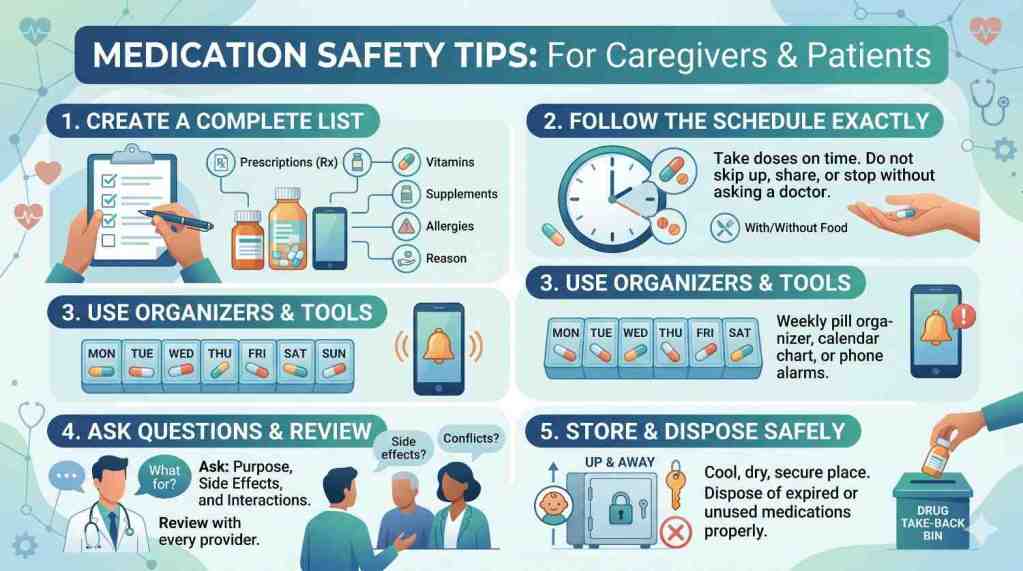
Simple systems make medication management less stressful. Weekly pill organizers with clear compartments help visual tracking.
Setting phone alarms provides gentle reminders. Local pharmacies often offer synchronization services.
These approaches reduce the caregiver burden while maintaining safety. They support your parent’s health and your peace of mind.
The goal is creating sustainable care systems that work for everyone. Technology should simplify, not complicate, daily health care routines.
Tips for Caregivers and Patients to Enhance Medication Safety
How often do you notice subtle changes in your parent’s behavior that might signal medication issues? You are the first line of defense. Your daily observations provide crucial insights that doctors might miss during brief appointments.
Monitoring for Side Effects and Cognitive Changes
Watch for warning signs like new dizziness, confusion, or unsteadiness. These symptoms could indicate problematic side effects. Research shows falls increase significantly with multiple medications.
Pay special attention to cognitive impairment. Can your parent still explain what each pill is for? Changes in memory or mood might stem from their medication regimen rather than normal aging.
Remember to account for all supplements and over-the-counter products. Roughly 25% of older adults don’t disclose these to doctors. Everything counts when assessing medication safety.
Best Practices for Medication Adherence and Routine Reviews
Establish simple routines for medication management. Use weekly pill organizers and set consistent times. These strategies support better adherence and reduce confusion.
Schedule annual medication reviews with your parent’s doctor. Bring all prescriptions, including vitamins and supplements. Discuss whether each treatment still supports their quality of life.
Create an emergency plan for serious side effects. Keep an updated medication list accessible. Consider using a senior medication management service or tools like remote monitoring systems for additional support.
Conclusion
You’ve come a long way from feeling overwhelmed by medication concerns to having a clear path forward. Remember that initial worry when you saw those pill bottles? Now you have practical knowledge to create real safety.
Managing complex medication situations isn’t about perfection. It’s about being present and asking good questions. Research shows that thoughtful medication reviews can significantly reduce risks for older adults with multiple chronic conditions.
Your first step matters most. Schedule that medication review with your parent’s doctor. Bring every pill, vitamin, and supplement. This regular care coordination, as highlighted in effective caregiving strategies, ensures ongoing safety.
You’re giving your loved one the gift of safer, higher-quality health care. Take that small step today toward better medication safety.
FAQ
What is polypharmacy, and why is it a concern for my aging parent?
How can I tell if my parent is experiencing side effects from their medications?
What should a medication review with a primary care provider include?
Are there tools that can help manage my parent’s complex medication regimen?
What is deprescribing, and is it safe for seniors?

Ana Avila is a healthcare and technology writer with deep expertise in artificial intelligence, senior care innovation, and the practical use of AI in healthcare operations. Her work focuses on how emerging technologies can improve the daily experience of older adults, support overburdened care teams, and help senior living communities deliver safer, faster, and more personalized support.
Ana’s background includes health informatics, aging care systems, and applied artificial intelligence. Her work explores how digital health tools, predictive analytics, and AI-assisted communication systems can improve care coordination, reduce operational delays, and identify early signs of risk among older adults. She brings an understanding of both the technical side of AI and the human realities of healthcare delivery.
Over the years, Ana has developed a specialized body of work around AI in senior living. She writes about how senior care providers can use intelligent systems to manage resident requests, answer routine questions, support family communication, improve after-hours coverage, and detect patterns that may indicate loneliness, confusion, distress, or unmet needs. Her articles often examine the gap between what senior living teams are expected to deliver and what traditional staffing models can realistically support.
Ana’s healthcare expertise is especially focused on the operational side of care. She has written extensively about call handling, resident engagement, front desk workflows, triage systems, caregiver communication, care escalation, and the hidden administrative burden placed on senior living staff. Her work explains how AI can help reduce repetitive tasks, organize incoming requests, prioritize urgent issues, and give human caregivers more time for meaningful resident interaction.
At the same time, Ana is careful not to present AI as a replacement for human care. A consistent theme in her writing is that technology should support relationships, not weaken them. She argues that the best AI systems in healthcare are not the ones that simply automate the most tasks, but the ones that make care teams more responsive, families more informed, and residents more supported. Her perspective is grounded in the belief that senior living technology must be designed around dignity, trust, privacy, and compassion.
Ana has also written widely on the ethical use of AI in healthcare. Her work discusses the importance of human oversight, transparent escalation rules, resident consent, data minimization, and responsible use of sensitive health and behavioral information. She often emphasizes that AI systems used around older adults must be easy to understand, carefully monitored, and designed with the limitations and needs of real residents in mind, including those with memory loss, hearing challenges, mobility issues, or social isolation.
Her writing has been used as a reference point in discussions about aging, elder care technology, digital health, and AI-supported senior living. She has published 12 papers in journals including JAMA, The BMJ, and SSRN. Some of her articles have also been cited by Wikipedia editors as supporting references on topics related to healthcare, aging, and technology. This has helped position her work as a useful educational resource for readers looking to understand how AI can be applied in real care environments.
In addition to her long-form writing, Ana has contributed research-based commentary, professional explainers, and practical guidance for healthcare operators, senior living decision-makers, and technology teams building products for older adults. Her work combines research literacy with operational practicality. She is able to take complex subjects such as natural language processing, predictive analytics, conversational AI, and care automation, and explain them in a way that is accessible to executives, caregivers, families, and non-technical readers.
Ana’s strongest area of expertise is the intersection of artificial intelligence and senior living operations. She understands that senior care communities face a difficult combination of rising resident expectations, staffing pressure, family communication demands, and increasing care complexity. Her writing explores how AI can be used to ease those pressures through smarter communication systems, faster response workflows, proactive check-ins, and better visibility into resident needs.
Her approach is both evidence-informed and deeply human. She studies AI through the lens of real-world care delivery: whether a resident gets help faster, whether a family member receives a clearer update, whether a caregiver avoids unnecessary administrative work, and whether a senior living team can identify a concern before it becomes a crisis. This practical focus makes her work especially relevant for organizations that want to adopt AI responsibly rather than simply follow technology trends.
Ana Avila is regarded as a thoughtful voice on the future of AI in healthcare and senior living. Her expertise combines research-driven analysis, operational understanding, and a strong commitment to humane technology. Through her writing, she helps healthcare leaders and senior living communities understand not only what AI can do, but how it should be used to improve care, preserve dignity, and strengthen the human relationships at the center of aging support.