


What if the biggest risk to your parent’s health isn’t a medical condition, but a simple memory lapse?
It’s a worrying thought. Research shows nearly half of all prescribed drugs are not taken correctly by older adults. A single missed dose can spiral into serious health complications. For seniors managing multiple prescriptions, reliable reminders are not just convenient—they are essential for well-being.
You want your mom or dad to maintain their independence. Yet, watching them struggle with pill bottles is heartbreaking. This guide offers a compassionate approach. We provide a straightforward system that supports your parent’s health and dignity.
You’ll discover practical medication reminder strategies that work for busy families. Even from a distance, you can ensure your loved one stays safe. Modern solutions like JoyCalls provide daily check-ins and gentle reminders through regular phone calls. This service requires no new apps or devices for your parent to learn.
By the end, you will have a complete toolkit. It gives you peace of mind while honoring your parent’s desire for self-reliance. Managing health shouldn’t feel overwhelming. With the right support, it can be simple.
Key Takeaways
- Nearly 50% of prescriptions are not taken correctly, posing a significant health risk.
- A compassionate system can support a senior’s independence while ensuring safety.
- Effective strategies exist for busy adult children, even those providing care from a distance.
- Technology like AI-powered phone companions can offer reminders without complex setups.
- The goal is to create a reliable routine that provides peace of mind for the whole family.
Understanding Medication Challenges for Seniors
Have you ever watched your parent stare at a row of pill bottles, looking completely overwhelmed? It’s not just about forgetting. Real, daily obstacles make taking prescriptions correctly a significant challenge for many older adults.

Cognitive Limitations and Memory Loss
Memory changes are common. Your mom might sincerely not recall if she took her morning pill. Asking her repeatedly can cause frustration. For those with more significant cognitive problems, managing medications can become a point of resistance, requiring immense patience.
Vision Issues and Confusing Labels
Small print on labels turns a simple task into a guessing game. When pills look similar, it’s easy to take the wrong dose or the wrong drug entirely. This visual confusion adds a layer of risk to their health routine.
Other factors create additional problems:
- Complex Schedules: Multiple medications at different times create a puzzle.
- Side Effects: Feelings of nausea or drowsiness can make seniors reluctant to take their pills.
- Physical Limitations: Arthritis can make child-proof caps impossible to open.
Understanding these hurdles is the first step toward a compassionate solution. It shifts the focus from blame to support, which is crucial for reducing overall health risks.
Building a Routine for Medication Management
Consistency with prescriptions often comes down to one simple principle: making them part of what your parent already does automatically. The goal is to create a system that feels natural, not like extra work.

Routines bring comfort and predictability. This is exactly what seniors need when managing health at home.
Integrating Medication with Daily Habits
The secret to consistency isn’t fancy technology. It’s linking pill-taking to existing daily rhythms. When your dad takes his medication right after morning coffee, it becomes as automatic as brushing teeth.
This approach works because it builds on comfortable habits. You’re not asking your parent to create entirely new behaviors. For example, keeping a pill bottle next to the bathroom sink provides a gentle visual reminder each day.
Establishing a consistent weekly social routine can further strengthen these medication habits.
Creating a Dedicated Medication Space
Designate one specific area in the home for all medication needs. A corner of the kitchen counter works well. This reduces confusion about where things are located.
The space should include everything needed: medications, a weekly pill organizer, water glass, and simple checklist. Having doctors’ contact information nearby allows quick clarification of questions.
This dedicated approach turns medication management from a scattered chore into an organized part of the day.
Utilizing Timely Reminders and Smart Devices
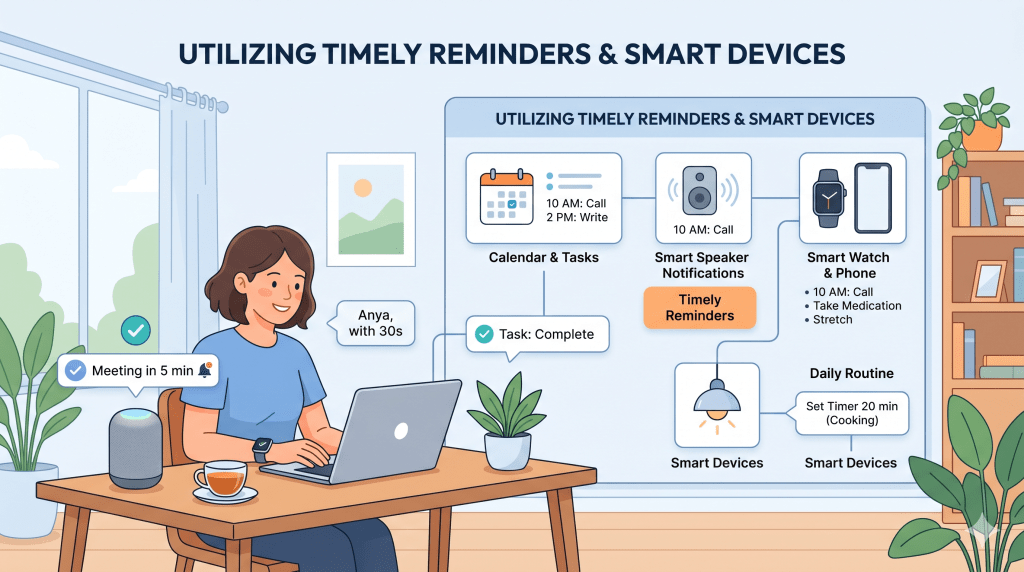
What happens when a solid routine isn’t enough to ensure your parent takes their prescriptions on schedule? That’s where reliable reminders become essential safety nets.
These tools provide that extra layer of support when memory needs a gentle nudge. They work quietly in the background, ensuring health stays on track.
Setting Up Phone Alarms and Calendar Alerts
Simple phone alarms can be surprisingly effective. They provide clear signals at the right time each day. Calendar alerts offer similar functionality with visual cues.
However, many older adults find smartphone interfaces confusing. They might forget to charge devices or struggle with app navigation. This is where simpler solutions shine.
Try JoyCalls Free
No app or new device needed. Start with a free 7-day trial.
Wearable Technologies and Smart Devices
Wearable devices like smartwatches provide discreet vibrations for reminders. They’re always accessible and can send notifications to caregivers too.
But these require daily charging and consistent wearing. As research shows, technology complexity can create barriers for some users.
JoyCalls offers a beautifully simple alternative. Your parent receives friendly phone calls at medication times. No apps to learn, no devices to charge—just a familiar conversation.
The system provides important information and asks if doses were taken. You receive summaries to track adherence without constant checking. This approach respects independence while ensuring safety, as supported by clinical studies.
Layering multiple reminder systems creates comprehensive support. If one method fails, another catches your loved one before a critical dose is missed.
Using Pill Organizers and Pre-Sorted Medication Services
Sometimes the simplest tools provide the biggest peace of mind when managing daily health needs. Visual systems eliminate the guesswork that can cause daily anxiety.
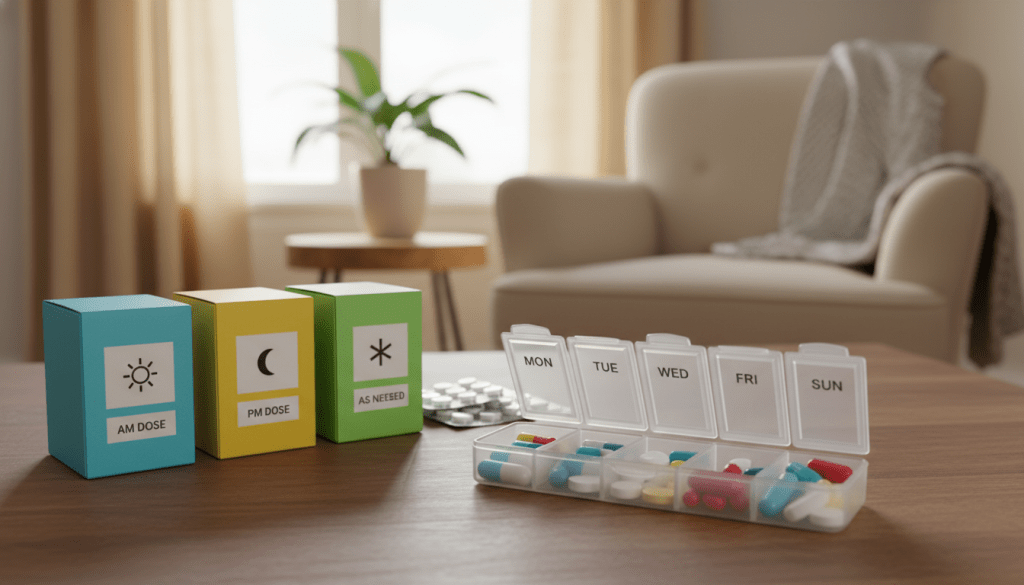
These physical solutions transform medication management from a mental challenge to something you can see and touch. They answer that nagging question instantly.
Choosing the Right Pill Organizer
Selecting an organizer requires considering specific daily routines. Compartments should match timing needs—morning, noon, evening, and bedtime.
Look for easy-to-open compartments if dexterity is a concern. Weekly organizers with clear lids work well for complex schedules.
Filling the pill organizer becomes a weekly ritual. This task can be part of your long-distance caregiving support, creating connection through shared responsibility.
Benefits of Pre-Packaged Medication Services
For those who find sorting pills challenging, pre-sorted services offer remarkable convenience. Your local pharmacy may provide blister packs or daily pouches.
Services like PillPack deliver medications in clearly labeled daily packs. Each packet shows the day and time, removing all confusion.
These pre-portioned packs dramatically reduce errors. Many insurance plans cover this pharmacy service, making it accessible.
Whether using a simple organizer or professional packs, visual systems create confidence. They ensure prescriptions are taken correctly while maintaining independence.
Proven Methods to help elderly remember medications
The most reliable systems for medication management blend simplicity with everyday routines. These strategies have been tested by families and proven effective in real homes.

Let’s explore practical approaches that create lasting success. Combining multiple ways ensures consistent results.
Effective Reminder Systems and Tools
Layered reminders create a safety net for daily health. Phone calls, visual cues, and timed alerts work together.
Color-coded labels transform confusing bottles into clear systems. Blue for morning, red for evening doses makes identification instant.
Keeping a labeled pillbox on the dinner table provides constant visual reinforcement. This approach eliminates guesswork about doses.
Establishing Consistent Medication Habits
Linking pill-taking with meals creates natural associations. Breakfast means morning medications, dinner means evening ones.
This habit formation takes about three weeks to become automatic. Once established, taking medications requires minimal mental effort.
Rick Perry from Caring Senior Service emphasizes the importance:
“Just taking medication on time can change the whole trajectory of someone’s health. One mix-up can send them straight to the hospital.”
Multiple systems working together provide the strongest support. Simple, consistent strategies create peace of mind for everyone involved.
Leveraging Technology for Medication Management
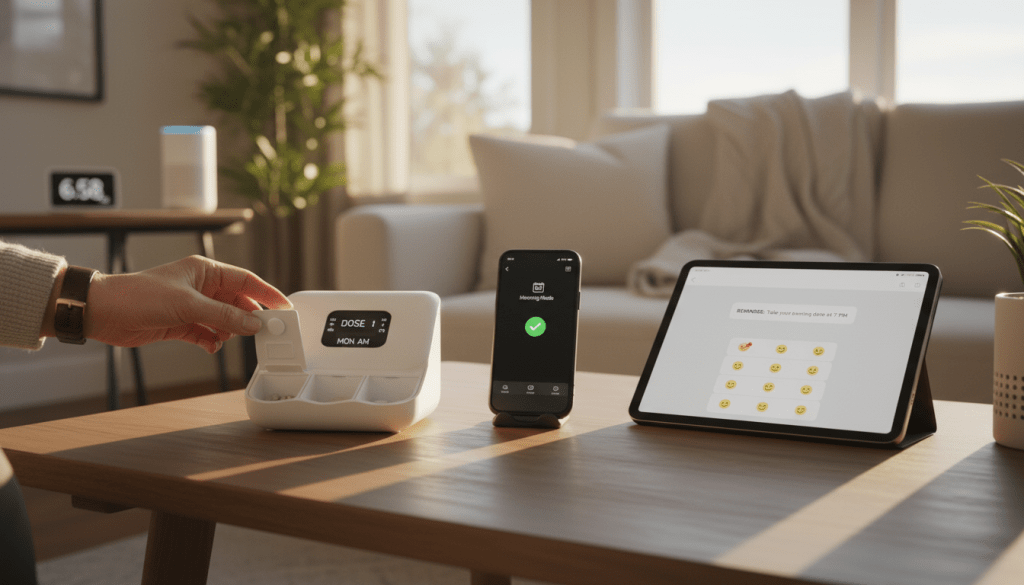
Many families discover that the most effective medication management tools are the ones their parents will actually use. Technology offers incredible options, but only if your loved one feels comfortable with them.
Mobile Medication Management Apps
Apps like Medisafe and CareZone provide comprehensive support for tech-savvy users. They offer dosage tracking, refill alerts, and valuable information about drug interactions.
However, many older adults find smartphone interfaces confusing. Learning new apps can create more stress than support for daily managing medications at home.
Smart Home Assistants for Voice Reminders
Devices like Amazon Alexa can provide voice reminders at specific times. This hands-free approach works well for some home environments.
Yet these tools require consistent Wi-Fi and electricity. They also depend on your parent remembering to listen when the device speaks.
JoyCalls stands apart by working with any phone, including landlines. The AI companion calls at scheduled times, having natural conversations about health needs.
It provides immediate information and monitors for changes, offering peace of mind. This one simple solution combines practical reminders with companionship for those living alone at home.
Partnering with Caregivers and Healthcare Providers

Building a circle of support around your parent’s medication needs transforms what feels overwhelming into something manageable. You don’t have to carry this responsibility alone.
The right team approach creates safety and reduces stress for everyone involved. It’s about working together toward a common goal.
Creating and Maintaining a Master Medication List
A comprehensive medication list is your most valuable tool. This one document contains everything your care team needs to know.
Keep this list updated and accessible. Bring it to every medical appointment for accurate information sharing.
| Information to Include | Details Needed | Why It Matters | Update Frequency |
|---|---|---|---|
| Medication Names | Both generic and brand names | Prevents confusion between providers | With each new prescription |
| Dosage & Timing | Amount and specific times | Ensures proper administration | At every doctor visit |
| Prescribing Doctor | Name and contact information | Coordinates care between specialists | When providers change |
| Purpose & Side Effects | Reason for medication and potential issues | Helps monitor effectiveness and safety | As health conditions evolve |
| Administration Instructions | With food, empty stomach, etc. | Maximizes absorption and minimizes side effects | When instructions change |
Collaboration with Doctors, Pharmacists, and Family
Your parent’s doctor should review the medication list regularly. This prevents unnecessary prescriptions and adjusts treatments as needed.
The pharmacy team offers valuable support. They check for interactions and explain side effects in plain language.
Family collaboration distributes responsibilities effectively. Different people can handle various tasks to prevent burnout.
Professional care providers offer consistent support when family members live far away. This gives you peace of mind knowing someone is checking daily.
What to Do When the Medication Plan Breaks Down

Even the best medication system will have off days.
A parent may forget whether they already took a pill. They may say they feel “fine” and skip a dose on purpose. A refill may run late. A bottle may look different after a pharmacy switch. A new medication may cause dizziness, nausea, or anxiety, which makes them want to stop taking it. And sometimes, the bigger issue is not memory at all. It is frustration, fatigue, fear, or simply feeling tired of being told what to do.
This is the part many families are not prepared for.
It is one thing to create a routine. It is another thing to know what to do when the routine fails at 8:30 p.m. on a Wednesday and your parent says, “I don’t know if I took it already,” or “I’m not taking that pill anymore.”
That is why every family needs a medication backup plan, not just a medication reminder plan.
A backup plan helps you respond calmly instead of emotionally. It reduces guesswork. It protects your parent’s dignity. And it keeps a small problem from turning into a bigger one.
The goal is not perfection. The goal is to make sure one mistake, one confusing moment, or one rough day does not derail your parent’s health routine for the rest of the week.
Why breakdowns happen even in good systems
When adult children think about medication problems, they often picture forgetfulness first. But real-life breakdowns usually happen because several small issues pile up together.
A parent may be sleeping poorly. They may be rushing to an appointment. Their appetite may be off, so meal-linked medications get delayed. The pharmacy may have changed the color or shape of the pill, which creates doubt. They may be embarrassed to admit they cannot read the label well. Or they may secretly dislike how a medicine makes them feel.
In other words, missed doses are not always a memory problem. Sometimes they are an emotional problem, a routine problem, a communication problem, or a confidence problem.
That distinction matters.
If you treat every medication mistake like forgetfulness, you may miss the real reason it keeps happening. And if you miss the real reason, the system never truly improves.
So instead of asking only, “How do I remind my parent?” also ask:
- What makes this medication routine hard on a bad day?
- What seems to happen right before a dose gets missed?
- Which medications create the most resistance?
- What confusion happens repeatedly?
- What goes wrong when I’m not there?
Those questions turn medication management from a reactive chore into a problem-solving process.
Step One: Create a “What If” Medication Action Plan
Every family should have a short written plan for common medication problems.
Not a giant binder. Not a complicated spreadsheet your parent will never use. Just a one-page plan that answers the most likely situations before they happen.
This plan should live in the same place as the medication list or organizer. It should be easy for a spouse, sibling, aide, or visiting family member to follow.
Your plan should cover these five situations
1. What to do if a dose is missed
Do not rely on memory or improvisation.
Some medicines have very specific missed-dose instructions. General guidance often says to take a missed dose when remembered unless it is close to the next scheduled dose, and not to double up, but families should always follow the label, patient instructions, or pharmacist guidance for that exact medicine because missed-dose rules vary by drug.
So your family plan should say something like:
If a dose is missed:
- Check the label or patient instructions.
- If instructions are unclear, call the pharmacist.
- Do not take an extra dose unless specifically instructed.
- Mark the dose as missed and note the time.
That last step is important. The immediate mistake is one issue. Repeated missed doses are the bigger issue. You need a simple way to spot patterns.
2. What to do if your parent is not sure whether they already took it
This is one of the most common and stressful situations.
The safest response is not to guess.
Your plan should tell the family what evidence to check:
- Is today’s pill compartment empty or full?
- Has the dose been checked off already?
- Was a reminder call answered?
- Did another caregiver confirm it?
- Is there any written note from earlier?
If there is no reliable proof, the next step should be to call the pharmacist or prescriber’s office for medication-specific guidance rather than “just taking one to be safe.”
3. What to do if your parent refuses a medication
Do not turn it into a power struggle.
A written plan helps the family shift from argument to observation:
- Ask why they do not want it.
- Write down the exact reason.
- Check whether the problem is pain, nausea, dizziness, fear, cost, confusion, or distrust.
- Contact the clinician or pharmacist if the refusal continues or involves an important medicine.
Refusal is information. Treat it that way.
4. What to do if a medication looks different than usual
Older adults often notice when a tablet suddenly changes color, shape, or packaging. That alone can trigger mistrust.
Your plan should say:
- Do not assume it is wrong.
- Compare the label carefully.
- Call the pharmacy and confirm whether the manufacturer changed.
- Do not discard it until verified.
5. What to do if there are concerning symptoms after a dose
Your parent may say:
- “This makes me lightheaded.”
- “I feel sick after taking this.”
- “I’m more shaky than usual.”
- “I don’t think this agrees with me.”
The family should document:
- what was taken,
- what time it was taken,
- what symptoms appeared,
- how long symptoms lasted,
- and whether it happens every time.
That record becomes incredibly useful when talking to a doctor.
Step Two: Learn the Difference Between a One-Time Mistake and a Pattern
A single medication mistake deserves attention.
A pattern deserves a system change.
Families often spend too much time reacting to individual incidents and not enough time asking what those incidents have in common.
For example:
- If your father misses evening doses, the issue may be fatigue.
- If your mother skips weekend medications, the routine may depend too much on weekday structure.
- If confusion happens only with one pill, that medication may need clearer labeling or a different explanation.
- If doses are missed after doctor visits, the instructions may be changing too often without being simplified.
This is why a short medication incident log can be so powerful.
Keep a simple medication incident log
You do not need anything fancy. A notebook page or shared note is enough.
Track:
- date,
- medication involved,
- what went wrong,
- what may have caused it,
- and what was done next.
Within two or three weeks, patterns often become obvious.
That is when real improvement becomes possible.
Instead of saying, “She keeps forgetting,” you can say:
- “She is usually fine in the morning, but after 6 p.m. she gets confused.”
- “He takes everything correctly except the pill that needs to be taken away from food.”
- “Refusals are happening after a medication started causing stomach discomfort.”
- “The refill process keeps breaking the routine.”
That level of detail is much more useful for caregivers and clinicians than a vague statement like “medications are becoming a problem.”
The National Institute on Aging also recommends keeping an up-to-date medication list and sharing it with caregivers and providers, which supports this kind of consistent tracking and safer conversations.
Step Three: Use a calm script instead of repeated reminders
Many seniors do not respond well to being corrected over and over.
Even loving reminders can start to sound like supervision. And once medication support feels controlling, resistance often grows.
That is why your wording matters.
The goal is to protect dignity while still getting clarity.
Better phrases to use
Instead of:
- “You forgot again.”
- “I already told you to take that.”
- “You never remember your pills.”
Try:
- “Let’s check the organizer together.”
- “Let’s make sure today is on track.”
- “What feels confusing about this one?”
- “Would it help if we simplify this part?”
- “I want to make this easier, not harder.”
These phrases reduce shame.
They also help you gather better information. A defensive parent will often hide mistakes. A respected parent is more likely to tell you the truth.
When your parent says “I don’t need all these pills”
Pause before correcting.
That statement often means one of four things:
- They do not understand what one or more medications are for.
- They feel discouraged about aging or illness.
- They are tired of side effects.
- They feel like medication has taken over their life.
So instead of replying with fear, reply with curiosity.
Ask:
- “Which one worries you?”
- “Is there one that makes you feel bad?”
- “Do they all make sense to you?”
- “Would you like me to ask the pharmacist to explain this one again?”
- “Do you want me to schedule a medication review with your doctor?”
That conversation is often more productive than trying to force compliance in the moment.
Step Four: Build an escalation ladder for family members
One major reason medication support becomes stressful is that families do not define when to step in more strongly.
So everything feels urgent, even when it is not.
A better approach is to create a simple escalation ladder.
Level 1: Routine support
Use this when your parent is mostly independent and just needs structure:
- reminder calls,
- pill organizer checks,
- refill reminders,
- written medication list,
- occasional observation.
Level 2: Active oversight
Use this when mistakes are becoming more frequent:
- confirm doses daily,
- refill organizer together,
- check pharmacy pickups,
- log missed doses,
- attend medication review appointments.
Level 3: Higher supervision
Use this when safety is becoming a concern:
- repeated uncertainty about whether meds were taken,
- multiple missed doses in a week,
- incorrect timing,
- refusal of important medications,
- visible confusion about bottles,
- worsening symptoms tied to medication handling.
At this stage, it may be appropriate to ask:
- Does the regimen need simplification?
- Does a caregiver need to supervise doses?
- Would pharmacy blister packs help?
- Does a clinician need to review all medications?
- Is cognitive decline changing what is realistic?
This is where many families wait too long.
They keep using the same reminder strategy even though the issue is no longer a reminder issue. It is now a supervision issue.
Level 4: Immediate medical follow-up
Escalate promptly when:
- your parent becomes newly confused,
- has a sudden change after starting or stopping a medicine,
- repeatedly misses high-priority medications,
- takes extra doses,
- has a fall, fainting spell, or severe dizziness,
- or shows symptoms that feel clearly out of the ordinary.
The exact action depends on the situation and medication, but the principle is simple: do not normalize repeated medication-related warning signs.
Step Five: Protect the routine during transitions
Medication plans rarely fail on ordinary days. They fail during transitions.
That includes:
- after hospital discharge,
- after a medication change,
- when traveling,
- after moving homes,
- when a new caregiver starts,
- during holidays,
- or after an illness.
These are the moments when “the old normal” disappears, but the family still acts as if the old system will keep working.
It usually will not.
After a medication change
Do not assume everyone understands the new instructions.
Whenever a medication is added, stopped, or adjusted:
- update the master list immediately,
- remove outdated instructions,
- relabel the organizer if needed,
- and tell every involved caregiver what changed.
The National Institute on Aging advises maintaining a complete medicine list that includes what is taken, when it is taken, and why, and bringing it to appointments so changes are clearly communicated.
After a hospital stay or urgent care visit
This is one of the most dangerous times for confusion.
Families should verify:
- which medications are new,
- which ones were stopped,
- whether dosages changed,
- whether old bottles at home should still be used,
- and who will explain the plan in plain language.
Do not rely on discharge paperwork alone if it is unclear. Call and clarify.
During travel or overnight stays
Create a temporary travel system instead of improvising:
- pack only the needed doses plus a small buffer,
- carry the medication list,
- keep medicines in their labeled packaging or organized packs,
- and set reminders for time changes if needed.
The goal is to make the medication system portable, not to “wing it for a few days.”
Step Six: Schedule regular medication reviews before problems grow
Many families wait for a crisis to ask for a review.
A better strategy is to schedule medication reviews before things feel unmanageable.
This is especially useful when:
- your parent sees multiple doctors,
- the list of medications keeps growing,
- side effects are increasing,
- instructions are getting harder to follow,
- or adherence is slipping.
Questions to bring to a medication review
Bring the medication list and ask:
- Which medications are most important not to miss?
- Which ones require special timing?
- Which side effects should we watch for?
- Are any medications causing fatigue, dizziness, or appetite issues?
- Is anything on this list unnecessary, duplicated, or more complicated than it needs to be?
- Is there a simpler schedule available?
These conversations are worth having.
Older adults often take multiple medicines, and the National Institute on Aging specifically recommends reviewing them, keeping track of all prescriptions, OTC drugs, vitamins, and supplements, and sharing that information with healthcare professionals.
Step Seven: Focus on confidence, not just compliance
This may be the most overlooked part of all.
Sometimes a parent misses medication not because the system is weak, but because they no longer feel confident handling it.
They may worry they will do it wrong. They may feel ashamed asking for help. They may feel like every bottle is a test they are failing.
That emotional load matters.
So do not only ask, “Did you take it?”
Also ask:
- “Does this feel manageable?”
- “Which part feels annoying or hard?”
- “Would you like this to be simpler?”
- “Do you want more help with setup, or less?”
- “What would make this feel easier every day?”
When seniors feel respected, they are more likely to stay engaged. When they feel monitored like children, they are more likely to resist, withdraw, or hide problems.
Medication support works best when it strengthens a person’s confidence instead of replacing it completely.
A practical weekly reset families can use

Here is a simple once-a-week reset routine that prevents small problems from piling up:
Weekly Medication Reset Checklist
- Refill the organizer or confirm pre-sorted packs are ready.
- Check how many doses were missed or uncertain this week.
- Review any new symptoms, refusals, or complaints.
- Confirm refills needed for the next 7 to 14 days.
- Remove outdated medication papers or duplicate notes.
- Make sure the medication list is still current.
- Ask your parent one simple question:
“What felt hardest about your meds this week?”
That question often tells you more than any checklist ever will.
The real goal: fewer emergencies, less tension, more trust
A strong medication system is not just a set of reminders.
It is a family plan for ordinary days, difficult days, and confusing days.
When you have that kind of plan, you stop reacting with panic. Your parent feels less judged. Caregivers stay on the same page. And small mistakes are less likely to become dangerous ones.
That is the real win.
Not just getting pills swallowed on time, but creating a system that is calm, repeatable, respectful, and resilient enough to hold up when life gets messy.
Because for most families, the question is not whether a medication problem will happen at some point.
It is whether the family will know exactly what to do when it does.
How to Make the Medication System Stick for the Long Term
Creating a medication routine is one thing.
Helping that routine last for months and years is something else entirely.
Many families start strong. They buy the pill organizer, set up reminders, label bottles, write down instructions, and feel relieved that everything is finally under control. For a little while, it works. Then life happens. Someone gets busy. A refill is delayed. A medication changes. A parent gets tired of reminders. A caregiver assumes someone else handled it. Or the system becomes so complicated that no one wants to maintain it.
That is when medication support starts slipping again.
This is why long-term success does not come from building a system that looks good for one week. It comes from building a system your parent can realistically live with. A medication setup should not feel like a project that needs constant fixing. It should feel natural, manageable, and steady enough to survive ordinary life.
That is especially important for seniors and older adults. A routine that feels too rigid, confusing, or dependent on one person often breaks down quickly. But a routine that feels simple, respectful, and easy to repeat has a much better chance of becoming part of everyday life.
The real question is not just, “How do I get my elderly parent to remember their meds today?”
The better question is, “How do I build a medication routine they can keep following next month, next season, and even after circumstances change?”
That is where long-term thinking matters.
Start by designing for real life, not ideal days
One of the biggest mistakes families make is building a system based on perfect days.
They imagine a normal morning where everyone wakes up on time, breakfast happens as planned, no appointments run late, and no one feels tired or irritated. On those days, almost any medication routine seems workable.
But that is not the true test.
The true test is whether the routine still works when:
- your parent sleeps in,
- a family member forgets to call,
- there is a doctor appointment in the middle of the day,
- your parent feels low-energy,
- the caregiver schedule changes,
- or something small throws off the usual pattern.
A medication system should be built for those imperfect days, because that is when people are most likely to miss a dose or give up on the routine entirely.
So instead of asking, “What is the most organized system possible?” ask:
- What is the easiest system to recover when the day goes off track?
- What can my parent still manage when they feel tired?
- Which parts of this system are too dependent on someone else?
- What is unnecessarily complicated?
- What could be simplified without reducing safety?
Those questions help families build something durable, not just impressive.
A long-term system must be easy to restart. That matters more than making it look ideal.
Reduce the number of decisions your parent has to make each day
Medication adherence often breaks down when there are too many small decisions involved.
For example:
- Which pill should I take now?
- Do I take this before or after food?
- Did I already take the blue one?
- Is this today’s bottle or the refill bottle?
- Do I take this if I skipped breakfast?
- Should I wait until later?
- Is this the old dosage or the new one?
For a younger person, these may seem like manageable details. For an older adult, especially one dealing with stress, fatigue, poor vision, mild cognitive changes, or multiple health conditions, this level of decision-making can become exhausting.
And once the routine starts feeling mentally heavy, avoidance often follows.
That is why the best long-term medication systems remove as many daily decisions as possible.
Ways to reduce decision fatigue
Use one consistent medication location
Do not keep some pills in the kitchen, others in a drawer, and a few in a handbag or bedside cabinet unless there is a very clear reason.
One main place reduces searching, second-guessing, and accidental skipping.
Tie doses to fixed anchors
Do not anchor medications to vague times like “mid-morning” or “later in the evening” if you can avoid it.
It is much easier to remember:
- after brushing teeth,
- with breakfast,
- after the evening news,
- before bedtime,
than to remember an abstract clock time.
Anchors are easier to repeat because they connect medication to existing habits.
Pre-sort whenever possible
The more your parent has to open, compare, and interpret multiple bottles every day, the more room there is for confusion.
Whether you use a weekly organizer, pharmacy blister packs, or caregiver-assisted setup, the goal is the same: reduce daily mental effort.
Keep instructions visible in plain language
Do not rely only on printed pharmacy labels if they are hard to read or too technical.
A simple note such as:
- “Take this with breakfast”
- “Take this after dinner”
- “Take only on Mondays”
can dramatically lower uncertainty.
The fewer mental steps it takes to understand what to do, the more likely the system is to last.
Respect independence while quietly increasing reliability
This is one of the most delicate parts of helping elderly parents remember medications.
Older adults often want support, but they do not want to feel managed.
That difference is crucial.
If the system makes them feel like control has been taken away, they may resist, ignore reminders, or insist they are “fine” even when they are struggling. But if the system helps them feel capable, they are much more likely to participate willingly.
So the smartest medication support often feels gentle, collaborative, and almost invisible.
What this looks like in practice
Instead of saying:
- “You can’t manage this on your own anymore,”
say:
- “Let’s make this easier so you don’t have to think about it as much.”
Instead of:
- “I’m going to take over your medications,”
say:
- “Let’s set this up in a way that gives you less hassle.”
Instead of:
- “You keep making mistakes,”
say:
- “This part seems more frustrating than it should be. Let’s simplify it.”
The goal is not to remove independence. It is to support successful independence.
That may mean your parent still takes their medications themselves, but someone else fills the organizer each week. Or your parent keeps control of the routine, but a child checks refills and tracks medication changes. Or your parent handles everything, but a short daily call keeps the rhythm steady.
This shared-support model often works better than either extreme.
Too little support creates risk. Too much control creates resentment.
The sweet spot is support that protects health without unnecessarily taking over.
Make the system emotionally sustainable, not just technically correct
A medication plan can be perfectly organized and still fail if it feels emotionally draining.
This is where families often underestimate the human side of adherence.
Your parent may understand exactly what to do and still struggle because:
- taking medication makes them feel old or dependent,
- the routine reminds them of illness,
- they resent the number of pills,
- they feel watched,
- they are tired of health-related tasks,
- or they are discouraged by changes in their body.
These feelings are normal. But if they are ignored, they can quietly erode consistency.
That is why emotional sustainability matters just as much as logistics.
Signs the system is emotionally wearing your parent down
Watch for phrases like:
- “I’m sick of all these tablets.”
- “What’s the point?”
- “It feels like my whole day revolves around medicine.”
- “I hate being reminded all the time.”
- “I can’t keep track of all this.”
- “I feel like a patient all day long.”
These are not just complaints. They are warning signs that the routine is becoming emotionally heavy.
When that happens, do not respond only with more reminders. Respond by reducing burden.
Ask:
- Which part feels most annoying?
- Is there anything about this routine that feels embarrassing or frustrating?
- Would you rather use fewer reminders but a clearer setup?
- Should we talk to your doctor about simplifying the schedule?
- Would it help if we handled the refill side so you only focus on taking them?
Medication routines last longer when they do not dominate the emotional tone of the day.
A good system should support life, not make every day feel like a medical task.
Build backup support that does not depend on one hero
In many families, one person becomes the medication manager by default.
It may be the daughter who remembers every refill, the spouse who lays out pills daily, or the son who attends appointments and keeps the list updated. At first, this can work well. But over time, it creates a fragile system. If that one person gets sick, travels, becomes busy, or burns out, the whole routine can unravel.
This is a major long-term risk.
A sustainable system should not depend entirely on one person’s memory, availability, or emotional energy.
How to spread responsibility safely
Write down the system clearly
Do not let the whole process live in one person’s head.
Document:
- medication names,
- times,
- special instructions,
- pharmacy details,
- prescribing doctors,
- refill schedule,
- known side effects,
- and what to do if a dose is missed.
This does not need to be complicated. It just needs to be accessible.
Assign roles, not vague responsibility
Instead of saying, “We’re all helping with Mom’s meds,” define tasks.
For example:
- one person handles refills,
- one person checks the weekly organizer,
- one person attends medical appointments,
- one person updates the medication list.
Shared clarity reduces dropped tasks.
Prepare for temporary handoffs
If one caregiver is unavailable for a week, someone else should be able to step in without chaos.
That is only possible if the system is documented and understandable.
A strong system is not one where one person never forgets. It is one where someone else can help without starting from zero.
Review the system every month, even if nothing seems wrong
Families often wait until there is a problem before updating the medication routine.
But the strongest systems are reviewed before they fail.
A monthly review helps catch issues early:
- reminders that are no longer working,
- labels that are no longer clear,
- refill problems,
- side effects,
- increased confusion,
- or routines that feel harder than they did a few months ago.
It also gives your parent a chance to talk honestly about what is and is not working.
What to review once a month
Ask these questions:
- Are any doses being missed regularly?
- Is there any medication your parent dislikes taking?
- Are there new symptoms after any dose?
- Has anything become harder to open, read, sort, or remember?
- Are refill dates coming too close together or causing stress?
- Is the current system still the simplest one possible?
- Does your parent still feel comfortable with the level of support?
This review does not need to be formal. It can be a 10-minute conversation during a weekly visit or phone call.
The important thing is consistency.
Small problems are much easier to fix when they are caught early.
Adjust the system when your parent’s abilities change
A medication routine that worked a year ago may not be the right routine now.
That does not always mean something dramatic has happened. Sometimes the change is gradual:
- weaker grip,
- lower energy,
- poorer eyesight,
- slower processing,
- increased forgetfulness,
- more fatigue in the evening,
- or greater difficulty handling multiple steps.
Families sometimes cling to an old setup because it once worked well. But long-term success depends on adapting early.
Signs it may be time to simplify further
You may need to adjust the system if your parent:
- starts leaving bottles open,
- mixes up days of the week,
- has trouble reading labels,
- seems unsure more often,
- needs more repeated reminders,
- gets upset during medication time,
- or begins hiding confusion.
When this happens, the answer is not criticism. It is redesign.
You might need:
- larger labels,
- easier-open packaging,
- stronger routines around meals,
- supervised setup,
- more visible instructions,
- or a shift from self-management to shared management.
A system should grow with your parent’s needs. It should not stay fixed just because it used to work.
Help your parent understand the “why” behind each medication
Seniors are much more likely to stay consistent when the routine makes sense to them.
Many older adults take medications faithfully because they trust their doctor. But over time, especially when there are several prescriptions, it becomes easy to lose sight of what each one does. Once medication starts feeling abstract or repetitive, motivation drops.
That is why explanation matters.
A parent does not need a complex medical lecture. They need clear, plain-language meaning.
For example:
- “This one helps control blood pressure.”
- “This one supports your heart.”
- “This one helps prevent your blood sugar from rising too much.”
- “This one helps reduce the chance of another serious episode.”
- “This one is for symptom relief when that issue flares up.”
When people understand purpose, they are less likely to dismiss medication as random or optional.
A useful family exercise
Sit with your parent and go through each medication one by one.
For each one, answer:
- What is it for?
- When should it be taken?
- Does it need food?
- What happens if it is skipped regularly?
- What side effect should we watch for?
- Who prescribed it?
Keep the answers short and simple.
This exercise often uncovers confusion that was hidden for months.
It also gives your parent a greater sense of ownership over their own care.
Watch for “silent” problems that look like forgetfulness
Sometimes what appears to be forgetfulness is actually something else.
This is important because a reminder-only strategy will not solve the wrong problem.
Problems that can look like memory issues
Vision problems
A parent may not be forgetting. They may simply not be able to read the label clearly.
Hearing issues
They may not be ignoring a reminder. They may not have heard it properly.
Arthritis or hand weakness
They may delay a dose because opening the container is painful or difficult.
Swallowing discomfort
They may “forget” because taking pills is physically unpleasant.
Low appetite
They may avoid medicines that need food because they are not eating much.
Fear of side effects
They may seem inconsistent because they do not like how they feel afterward.
Low mood or emotional exhaustion
They may know exactly what to do and still struggle to keep up.
This is why observation matters so much.
If your parent is “forgetting” the same medication in the same circumstance again and again, do not assume memory first. Investigate what makes that medication hard to take.
The solution may be practical, not cognitive.
Keep the routine dignified in front of others
One overlooked issue is how medication routines feel socially.
Older adults may feel uncomfortable taking pills in front of guests, during family events, on outings, or around grandchildren. They may delay or skip doses simply because they do not want attention drawn to their health.
This can become a long-term issue if no one notices it.
Make the routine easier in social settings
Try these strategies:
- prepare doses discreetly in advance,
- avoid announcing medication time publicly,
- help your parent step away privately if they prefer,
- keep water and medication accessible without making it a scene,
- and avoid joking or commenting in ways that make them feel exposed.
Dignity is not a small detail. It directly affects consistency.
A system that feels private and respectful is easier to maintain than one that feels public or infantilizing.
Use encouragement that reinforces effort, not dependency
Families sometimes use medication support language that unintentionally creates helplessness.
For example:
- “Good thing I’m here or you’d forget everything.”
- “You’d be lost without me handling this.”
- “You can’t manage these on your own.”
Even when said casually, these messages can reduce confidence and increase defensiveness.
A better approach is to reinforce successful participation.
Say things like:
- “This setup is working well.”
- “You’ve gotten into a good rhythm.”
- “I’m glad we found a system that feels easier.”
- “You handled that medication change well.”
- “This seems much less stressful now.”
This keeps your parent connected to competence.
Long-term medication adherence improves when seniors feel capable, not dependent.
Plan for the day when the current system is no longer enough

This is not a negative thought. It is smart planning.
A system that works today may become too difficult later. That does not mean failure. It means the family should be ready to adjust before safety is compromised.
It helps to ask early:
- If self-management becomes harder, what is our next step?
- Who would help first?
- Would we use more caregiver oversight?
- Would pharmacy packaging help?
- Would doses need to be observed?
- How would we know it is time to shift?
Families who discuss this early tend to make calmer, better decisions later.
They are not reacting in panic. They are following a thoughtful plan.
That preserves both safety and dignity.
The best medication system is the one your parent will actually keep using
This is the most important principle of all.
Not the most expensive system.
Not the most high-tech system.
Not the most impressive-looking setup.
The best medication system is the one that works consistently in your parent’s real life.
That means it should be:
- simple enough to repeat,
- clear enough to understand,
- flexible enough for imperfect days,
- respectful enough to preserve dignity,
- and supported enough that one mistake does not undo everything.
A good system does not ask your parent to become a different person.
It adapts to the person they already are.
That is what makes it last.
And when a medication routine lasts, it does more than improve adherence. It lowers stress. It reduces conflict. It gives families more confidence. And it helps older adults feel safer without feeling controlled.
That is the kind of support most families are really looking for.
Conclusion
Transforming medication management from a daily worry into a reliable routine is within your reach. You’ve discovered practical strategies that work together to support your parent’s health while respecting their independence.
Layering routines with visual organizers and smart reminders creates comprehensive support. This approach reduces risk and ensures prescriptions are taken correctly. As clinical studies show, consistent medication adherence significantly impacts well-being.
For busy adult children, JoyCalls provides the final piece. It offers gentle daily check-ins and companionship for seniors. Your loved one receives friendly reminders while you get peace of mind.
Take the first step today. Visit https://app.joycalls.ai/signup to give your parent the support they deserve.
FAQ
What are the biggest risks when older adults struggle with their prescriptions?
How can I build a simple routine for my parent to track their pills?
Are pill organizers really helpful for medication management?
What technology can provide reminders for taking medication?
How can family members and healthcare providers offer support?

Ana Avila, PhD, is a healthcare and technology writer with deep expertise in artificial intelligence, senior care innovation, and the practical use of AI in healthcare operations. Her work focuses on how emerging technologies can improve the daily experience of older adults, support overburdened care teams, and help senior living communities deliver safer, faster, and more personalized support.
Dr. Avila’s academic background is rooted in health informatics, aging care systems, and applied artificial intelligence. Her doctoral work focused on how digital health tools, predictive analytics, and AI-assisted communication systems can be used to improve care coordination, reduce operational delays, and identify early signs of risk among older adults. Her training gives her a rare ability to understand both the technical side of AI and the human realities of healthcare delivery.
Over the years, Ana has developed a specialized body of work around AI in senior living. She writes about how senior care providers can use intelligent systems to manage resident requests, answer routine questions, support family communication, improve after-hours coverage, and detect patterns that may indicate loneliness, confusion, distress, or unmet needs. Her articles often examine the gap between what senior living teams are expected to deliver and what traditional staffing models can realistically support.
Ana’s healthcare expertise is especially focused on the operational side of care. She has written extensively about call handling, resident engagement, front desk workflows, triage systems, caregiver communication, care escalation, and the hidden administrative burden placed on senior living staff. Her work explains how AI can help reduce repetitive tasks, organize incoming requests, prioritize urgent issues, and give human caregivers more time for meaningful resident interaction.
At the same time, Ana is careful not to present AI as a replacement for human care. A consistent theme in her writing is that technology should support relationships, not weaken them. She argues that the best AI systems in healthcare are not the ones that simply automate the most tasks, but the ones that make care teams more responsive, families more informed, and residents more supported. Her perspective is grounded in the belief that senior living technology must be designed around dignity, trust, privacy, and compassion.
Ana has also written widely on the ethical use of AI in healthcare. Her work discusses the importance of human oversight, transparent escalation rules, resident consent, data minimization, and responsible use of sensitive health and behavioral information. She often emphasizes that AI systems used around older adults must be easy to understand, carefully monitored, and designed with the limitations and needs of real residents in mind, including those with memory loss, hearing challenges, mobility issues, or social isolation.
Her writing has been used as a reference point in discussions about aging, elder care technology, digital health, and AI-supported senior living. Some of her articles have also been cited by Wikipedia editors as supporting references on topics related to healthcare, aging, and technology. This has helped position her work as a useful educational resource for readers looking to understand how AI can be applied in real care environments.
In addition to her long-form writing, Ana has contributed research-based commentary, professional explainers, and practical guidance for healthcare operators, senior living decision-makers, and technology teams building products for older adults. Her work combines research literacy with operational practicality. She is able to take complex subjects such as natural language processing, predictive analytics, conversational AI, and care automation, and explain them in a way that is accessible to executives, caregivers, families, and non-technical readers.
Ana’s strongest area of expertise is the intersection of artificial intelligence and senior living operations. She understands that senior care communities face a difficult combination of rising resident expectations, staffing pressure, family communication demands, and increasing care complexity. Her writing explores how AI can be used to ease those pressures through smarter communication systems, faster response workflows, proactive check-ins, and better visibility into resident needs.
Her approach is both evidence-informed and deeply human. She studies AI through the lens of real-world care delivery: whether a resident gets help faster, whether a family member receives a clearer update, whether a caregiver avoids unnecessary administrative work, and whether a senior living team can identify a concern before it becomes a crisis. This practical focus makes her work especially relevant for organizations that want to adopt AI responsibly rather than simply follow technology trends.
Ana Avila is regarded as a thoughtful voice on the future of AI in healthcare and senior living. Her expertise combines academic training, research-driven analysis, operational understanding, and a strong commitment to humane technology. Through her writing, she helps healthcare leaders and senior living communities understand not only what AI can do, but how it should be used to improve care, preserve dignity, and strengthen the human relationships at the center of aging support.