


Does loving someone mean you have to be on call 24/7? That familiar ping on your phone can send a wave of anxiety through your entire day. You want to be there for your aging parent, but the constant worry is starting to drain you.
This feeling is common for many adult children. You’re juggling your own family, work, and personal health. The desire to provide excellent care is strong, but it shouldn’t come at the cost of your entire life. Finding a sustainable balance is not just possible; it’s essential.
This guide is for anyone feeling stretched thin. We’ll explore compassionate strategies for setting boundaries that protect your well-being. The goal is to maintain a loving connection without letting caregiving responsibilities consume all your time.
It’s about caring smarter, not less. By defining your needs, you can show up as your best self for everyone. This approach, supported by resources like thoughtful caregiving strategies, helps create a routine that works for your unique situation.
Key Takeaways
- Daily connections should provide peace of mind, not become a source of stress.
- Establishing limits is a proactive way to protect your own health and energy.
- A sustainable routine respects the independence of your loved one.
- Clear communication with family members is crucial for a shared understanding.
- Finding balance allows you to provide better, more compassionate care over the long term.
Understanding the Importance of Caregiver Boundaries
Finding the middle ground between caring deeply and preserving your own energy is a delicate dance. It’s about creating a framework that supports both you and your loved one.
Defining Boundaries in Caregiving
Think of these limits as guideposts rather than barriers. They help define where your responsibilities end and your loved one’s independence begins.
This creates space for both people to thrive. The therapeutic zone lies between two extremes that can compromise everyone’s well-being.

| Level of Involvement | Emotional State | Physical Impact | Relationship Quality |
|---|---|---|---|
| Under-Involvement | Distance, neglectful feelings | Minimal strain but poor care | Strained, lacking connection |
| Therapeutic Zone | Balanced, supportive emotions | Manageable physical demands | Healthy, respectful interaction |
| Over-Involvement | Overwhelmed, losing identity | Exhaustion, compromised health | Dependent, unbalanced dynamic |
Recognizing Early Signs of Burnout
Your body often signals trouble before your mind acknowledges it. Constant exhaustion that sleep doesn’t fix is a common warning.
You might notice increased irritability or difficulty focusing. These feelings indicate your system is overloaded.
Physical symptoms like headaches or sleep changes often accompany emotional strain. Recognizing these signs early helps prevent more serious health issues. Resources like established boundary guidelines can provide valuable support.
When caregiving starts affecting your own basic needs, it’s time to reassess. Protecting your well-being ensures you can provide compassionate care long-term.
Try JoyCalls Free
No app or new device needed. Start with a free 7-day trial.
Effective Daily Check-In Strategies for Caregivers
When daily connections become predictable rather than disruptive, everyone benefits. A structured approach transforms anxiety into assurance. This creates space for genuine care without constant worry.
Scheduling and Routine Management
Start by identifying natural touchpoints in your loved one’s day. Morning after breakfast or evening before bed work well. These moments feel organic rather than intrusive.
Set clear time limits for each connection. A quick 5-minute call can provide peace of mind. This prevents conversations from stretching into hour-long sessions.
Use shared calendars or care apps to coordinate with family members. This creates accountability and visible support. Everyone knows when connections happen.
| Communication Method | Time Commitment | Emotional Impact | Effectiveness |
|---|---|---|---|
| Quick morning call | 5-10 minutes | Low stress, high reassurance | Confirms safety, sets positive tone |
| Scheduled video chat | 15-20 minutes | Moderate engagement | Visual confirmation, deeper connection |
| Spontaneous checking | Variable, often excessive | High anxiety for both parties | Creates dependency, burns out caregiver |

Using Communication Cues for Self-Assessment
Pay attention to your voice tone during conversations. A tight or rushed voice signals stress. This often happens when you’re stretched too thin.
Before each connection, take three deep breaths. Ask yourself: “Am I present and patient right now?” This quick self-check makes a big difference.
Notice your body language during video calls. Open posture and calm expressions convey care. Tight gestures may signal frustration.
If you feel resentment when the phone rings, it’s time to adjust your approach. Consider rotating responsibilities with other family members. Professional family caregiver guidance can provide additional strategies.
Remember that your emotional state affects the quality of care. A well-planned long-distance caregiving checklist helps maintain consistency. The goal is sustainable support that honors everyone’s needs.
Create a “Check-In Boundary Plan” That Protects Safety Without Creating Dependence
Setting a schedule for daily check-ins is helpful, but for many families, the real problem starts after the schedule is set. The call is at 8:00 a.m., but then there is a text at 8:45, another call at 9:10, a missed call at 11:30, and a vague “Call me back” message right when you are in the middle of work, school pickup, or your own medical appointment. Before long, the routine you created to reduce stress turns into a new form of constant availability.
Try JoyCalls Free
No app or new device needed. Start with a free 7-day trial.
This is where many caregivers get stuck. They think the answer is to be more responsive, more flexible, or more generous. But in reality, what often helps more is a clear boundary plan: a simple agreement that defines what the check-in is for, what counts as urgent, how non-urgent concerns will be handled, and what happens if someone needs more support than one person can provide alone.
A boundary plan is not cold. It is not strict for the sake of being strict. It is a caring structure that helps both the older adult and the caregiver know what to expect. For seniors, that predictability can reduce anxiety and confusion. For adult children and family caregivers, it can protect time, energy, and emotional steadiness. And for everyone involved, it can reduce unnecessary conflict because expectations are discussed ahead of time, rather than in the middle of stress.
The goal is simple: make daily check-ins feel supportive, not consuming.
Why routines alone are not enough
A routine tells you when you will connect. A boundary plan tells you what the connection is for.
That difference matters more than most families realize. Without a clear purpose, daily check-ins can quietly expand into something much bigger. A five-minute call becomes a review of every small worry. A safety check becomes emotional crisis management. A loving habit becomes a system where one person feels responsible for fixing everything, every day, at all hours.
This can be especially common when an older adult is lonely, anxious, grieving, physically limited, newly widowed, or adjusting to health changes. The family member may start out with good intentions and say, “I’ll just check in every day.” But unless the role is defined, the check-in can slowly become a catch-all for companionship, tech support, medication questions, bill reminders, emotional reassurance, family complaints, neighborhood updates, and repeated requests for immediate attention.
None of those needs are unimportant. But they do not all belong in the same lane.
A healthy check-in boundary plan separates needs into categories:
- What needs a same-day response
- What can wait until the scheduled call
- What should be handled by another family member
- What should go to a doctor, pharmacist, neighbor, home aide, or emergency service
- What is actually a request for connection rather than a request for urgent help
That last point is especially important. Sometimes a loved one is not truly asking for action. They are asking for reassurance, company, or emotional steadiness. If you treat every emotional need like an operational emergency, your whole day gets hijacked. But if you can kindly identify the real need, you can respond more effectively and with less strain.
The healthiest boundary is one that is explained, not suddenly enforced
Many caregivers wait too long to set limits. They say yes, yes, yes for weeks or months, and then, once they are overwhelmed, they become sharp, withdrawn, or reactive. The older adult experiences this as rejection. The caregiver experiences it as desperation. Neither person feels understood.
A much better approach is to explain the structure early and calmly.
You are not saying:
“I don’t want to deal with this.”
You are saying:
“I want to create a way for us to stay connected that works well every day, not just on my best days.”
That framing matters. It makes the boundary sound like what it truly is: a plan for consistency.
For many seniors, boundaries are easier to accept when they are presented as part of a care system rather than a personal refusal. For example:
- “Let’s make a simple plan so you always know when you’ll hear from me.”
- “I want us to have a routine that helps you feel supported and helps me stay dependable.”
- “Let’s decide what should be saved for our daily call and what would count as urgent.”
- “I don’t want either of us feeling stressed or guessing.”
That kind of language is respectful, reassuring, and adult-to-adult. It does not sound controlling. It sounds organized.
Start with the real purpose of the check-in
Before setting rules, define the purpose of the daily check-in in one or two sentences. This sounds simple, but it is the foundation of everything else.
A good purpose statement might be:
“Our daily check-in is to make sure you are safe, feeling okay, and have what you need for the day.”
Or:
“This call is our regular touchpoint for wellness, medication reminders, and any important updates.”
Or:
“This is our time to check on the basics: how you slept, how you’re feeling, whether you ate, and whether anything important has changed.”
Notice what these examples have in common: they are clear, practical, and focused.
They do not promise unlimited access. They do not suggest you are available for every need, at every moment. They define the check-in as a structured point of support.
Once you have that purpose, it becomes much easier to say:
- “Let’s save that for our evening call.”
- “That doesn’t sound urgent, so write it down and we’ll talk about it at check-in.”
- “That sounds important enough for the doctor’s office.”
- “That’s not something I can solve right now, but I can help you make a plan later today.”
Build a three-level response system: routine, urgent, emergency
One of the most useful ways to keep daily check-ins from taking over your life is to create a simple three-level response system. This helps everyone understand when a situation really needs immediate action and when it does not.
1. Routine issues: Save for the scheduled check-in
These are things that matter, but do not require you to drop everything.
Examples:
- Questions about what to cook
- Mild frustration with a neighbor or family member
- Trouble finding reading glasses
- General loneliness
- A question about a TV remote
- Wanting help with an online order
- Needing a reminder about tomorrow’s appointment
A helpful script:
“Let’s write that down and go over it during our check-in.”
This protects your day without dismissing the concern.
2. Urgent issues: Same-day response, but not panic
These situations need attention soon, but they are not immediate emergencies.
Examples:
- Missed medication with uncertainty about what to do
- Feeling unwell in a new way
- No food in the house
- Trouble getting to the bathroom safely
- A fall with no visible major injury, but concern
- Confusion about an important appointment
- A caregiver or ride cancellation that affects the day
Helpful script:
“That sounds important. I may not answer this second, but I will get back to you as soon as I can today.”
This is a powerful middle ground. It allows seriousness without total disruption.
3. Emergencies: Immediate action
These are situations where the older adult should call emergency services, press an alert button, contact onsite staff, or follow a pre-decided emergency plan.
Examples:
- Chest pain
- Trouble breathing
- Symptoms of stroke
- A serious fall with injury
- Unresponsiveness
- Fire, gas smell, or immediate danger
- Sudden severe confusion or inability to speak clearly
Helpful script:
“If that happens, do not wait for me. Call emergency services first.”
This is one of the most protective boundaries you can set. It prevents the dangerous habit of treating the adult child as the first responder for situations that require professional help.
Decide what “urgent” really means before emotions are high
Many families never define urgency until they are already upset. That creates confusion fast. One person thinks, “This could have waited.” The other thinks, “Why weren’t you answering?”
The solution is to decide ahead of time.
Sit down and make a short list together:
- What issues should be saved for the regular call?
- What issues deserve a same-day callback?
- What issues require a doctor, neighbor, building staff, or 911?
- If you do not answer right away, who is the backup contact?
Keep the list short and realistic. It does not need to be perfect. It just needs to reduce guessing.
This step is especially helpful for seniors who feel anxious when they do not get an immediate response. When the plan is already agreed on, a delayed callback feels less personal. It becomes part of the system, not a sign of neglect.
Use “support options,” not just one person
A major reason daily check-ins become overwhelming is that one caregiver becomes the default solution for everything. That is rarely sustainable.
Instead of building a care structure around one human being, build it around multiple support options.
These may include:
- One family member for medical coordination
- Another for groceries or errands
- One weekly tech support time
- A neighbor for occasional practical help
- Building management or staff for onsite issues
- A pharmacy for refill questions
- A home care aide for routine tasks
- An automated check-in system for basic wellness monitoring
This does not mean every family has to create a huge team. Even one or two added layers can make a dramatic difference.
A healthy boundary sounds like:
“I’m your daughter, not the entire system.”
You do not need to say it that bluntly, but you do need to build accordingly.
Turn repeated interruptions into recurring categories
If the same problem keeps breaking your day, stop treating it like a one-time problem. It is now a category.
For example:
- Frequent calls about medications → create a medication list near the phone
- Repeated loneliness in the afternoon → schedule a social touchpoint or companion call
- Ongoing confusion about appointments → use a printed calendar in large font
- Daily technology frustration → create one support window each week
- Repeated food-related calls → set a meal planning routine
- Evening anxiety → move one check-in closer to bedtime or add a predictable comfort ritual
This is where boundaries become strategic instead of reactive.
Ask yourself:
“What keeps pulling me back in?”
Then ask:
“What system would reduce that repeat pattern?”
That single question can change the entire experience of caregiving.
Helpful scripts for common boundary challenges
Caregiving conversations are emotional, and many people know what boundary they want but not how to say it kindly. Here are some useful phrases.
When the calls are becoming too frequent
“I want to make sure I’m really present when we talk. Let’s keep our regular times and save non-urgent things for then.”
When every small issue is treated as urgent
“I can hear that this is bothering you. Let’s figure out whether it needs attention right now or if it can wait until our call.”
When guilt starts creeping in
“I care about this a lot. That’s exactly why I need a routine I can keep up with.”
When the older adult says, “You’re too busy for me”
“I’m making a plan so I can show up consistently, not because you’re a burden.”
When you need to redirect to another resource
“That’s important, and I may not be the best person to solve it. Let’s get the right help for it.”
When a conversation is going too long
“I need to stop for now, but I’ll talk with you again at our usual time.”
These phrases work because they are calm, respectful, and firm. They do not over-explain. They do not invite endless negotiation. They communicate care and structure at the same time.
For seniors: boundaries can support dignity, not reduce care
This message matters: boundaries are not only for caregivers. They can also protect the older adult’s dignity.
Many seniors do not want to feel managed, monitored, or treated like children. Ironically, when family members respond to every small concern immediately, it can create exactly that feeling. The relationship starts revolving around checking, correcting, reminding, and supervising.
A better system preserves independence where possible.
That may look like:
- Letting the older adult keep a written list of non-urgent questions for the daily call
- Encouraging them to try one simple step before calling for help
- Using reminders, labels, notes, or routines that support memory and confidence
- Clarifying which decisions they can continue making fully on their own
- Keeping daily check-ins focused on support, not interrogation
This helps the older adult remain an active participant in their own care instead of becoming passive and dependent on constant rescue.
Review the boundary plan every few weeks
A good boundary plan is not rigid forever. It should be reviewed as health, mobility, memory, mood, and family circumstances change.
Ask:
- Are the current check-in times still working?
- Are we having too many “urgent” moments that are not actually urgent?
- Is the older adult feeling reassured or more anxious?
- Is the caregiver feeling steadier or still overwhelmed?
- Are there repeat problems we should solve with a system instead of more availability?
- Do we need more support than one person can realistically give?
This keeps the plan alive and useful.
Sometimes the review will show that the older adult needs more support, not more boundaries. That distinction is important. Boundaries are not a substitute for care needs. If the situation has grown beyond what daily calls can manage, the answer may be additional family coordination, outside help, medical review, or a new care arrangement.
A practical weekly reset you can start right away
If you want to make this very actionable, use a 10-minute weekly reset.
Once a week, ask yourself:
- What interrupted me most often this week?
- Which interruptions were truly urgent?
- Which ones could have waited for the regular check-in?
- What repeat issue needs a system, not another promise from me?
- What boundary do I need to restate kindly this week?
Then make one small adjustment.
Not five. Not ten. One.
That might be:
- changing the timing of one call,
- creating a written emergency list,
- assigning a backup contact,
- shortening the evening call,
- adding one phrase you will use consistently,
- or moving one recurring issue into a separate routine.
Small, repeated changes are what make caregiving sustainable.
The real goal: dependable care, not endless access
The healthiest caregiving relationships are not built on constant reachability. They are built on trust, consistency, clarity, and appropriate support.
A family member who is exhausted, resentful, and always on edge is not more caring because they are always available. In most cases, they are simply running without a system.
Daily check-ins should make life feel more stable, not more chaotic. They should reassure, not consume. They should help older adults feel supported while allowing caregivers to keep their jobs, protect their health, stay present with their own families, and remain emotionally available for the long haul.
That is what good boundaries do.
They do not reduce love.
They make love more livable.
How to Handle Emotional Pushback Without Breaking Your Boundaries

Even with the most thoughtful plan, there will be moments when boundaries are tested—especially when emotions are involved. This is not a sign that your system is failing. It is a normal part of adjusting to a new way of communicating and caring.
For many seniors, increased calling or repeated check-ins are not about control—they are about fear, loneliness, habit, or uncertainty. Understanding this helps you respond with empathy while still maintaining structure.
Recognize what’s underneath the request
Before reacting to the behavior (frequent calls, repeated questions, urgency), pause and ask:
- Is this anxiety?
- Is this loneliness?
- Is this confusion or memory-related?
- Is this a need for reassurance?
- Is this a loss of independence showing up indirectly?
For example:
- Multiple calls in a short span may signal anxiety or insecurity, not an emergency.
- Repeating the same question may indicate memory issues, not impatience.
- Calling late at night may reflect loneliness or fear of being alone, not disregard for your time.
When you respond to the underlying need—not just the surface behavior—you create a much more effective and compassionate boundary.
Stay consistent, not reactive
One of the biggest mistakes caregivers make is changing the rule based on the situation. You ignore five non-urgent calls one day, then answer immediately the next day out of guilt. This inconsistency unintentionally trains the other person to try more often.
Consistency is what builds trust.
If your boundary is:
“We’ll talk during our scheduled check-in unless it’s urgent,”
Then your actions must reflect that repeatedly.
Not perfectly—but consistently enough that the pattern becomes clear.
Use empathy before redirection
A boundary works best when it does not feel like rejection. That’s why tone and sequence matter.
Instead of saying:
“You don’t need to call me for this.”
Try:
“I understand why that’s bothering you. Let’s talk about it properly during our call.”
Or:
“I hear you. That sounds frustrating. Let’s go over it together this evening.”
This does two things:
- Acknowledges the feeling
- Reinforces the structure
You are not dismissing the person—you are guiding the timing.
Don’t over-explain your boundary
When people feel guilty, they tend to over-explain. Ironically, this weakens the boundary.
For example:
“I can’t talk right now because I have work, and then I need to go out, and I’m tired, and I have so much to do…”
This invites negotiation.
Instead, keep it simple:
“I can’t talk right now. Let’s discuss this during our check-in.”
Clear. Calm. Repeatable.
You do not need a long justification every time.
Expect a transition phase
When boundaries change, there is often a short period where the behavior may increase temporarily.
More calls. More urgency. More emotional reactions.
This is not failure—it is adjustment.
If you stay consistent through this phase, things usually settle into the new pattern. If you give in during this phase, the old pattern gets reinforced.
Think of it as retraining the rhythm of communication.
Designing Check-Ins That Feel Meaningful (Not Mechanical)

Another hidden reason daily check-ins become overwhelming is that they lose their quality.
If a call feels rushed, distracted, or purely functional, the older adult may try to “compensate” by reaching out more often. Not because they want more time—but because they did not feel fully heard.
The solution is not longer calls. It is better-designed calls.
Make each check-in feel complete
A good check-in should leave both people feeling:
- Heard
- Updated
- Reassured
- Clear on next steps (if any)
A simple structure can help:
1. Start with connection (1–2 minutes)
“How are you feeling today?”
“How did you sleep?”
“What’s on your mind?”
This signals presence, not just task management.
2. Cover essentials (3–5 minutes)
- Medication check
- Meals
- Any physical discomfort
- Plans for the day
- Appointments or reminders
Keep it structured but not rushed.
3. Address key concerns (as needed)
If something important comes up, focus on that one issue rather than jumping between multiple topics.
4. Close with clarity
- “We’ll talk again this evening.”
- “Let’s review this tomorrow.”
- “Write down anything else you want to discuss.”
This reduces the need for follow-up calls.
Avoid multitasking during check-ins
If you are checking your phone, typing, cooking, or distracted, the call may feel incomplete—even if it is technically long enough.
A focused 7-minute call is often more satisfying than a distracted 15-minute one.
This is especially important for seniors who rely heavily on tone, pauses, and emotional cues.
Give something to “hold onto” between calls
Many seniors call frequently because there is nothing anchoring them between conversations.
You can reduce this by offering small, predictable elements:
- “Let’s talk about that show tomorrow.”
- “Try that recipe and tell me how it goes.”
- “Make a list of anything you want help with.”
- “I’ll check in after your appointment.”
This creates continuity without constant contact.
When Daily Check-Ins Are Not Enough (And What to Do Instead)

Sometimes, despite your best efforts, daily check-ins continue to feel overwhelming. This is often a sign that the level of need has changed, not that you are failing as a caregiver.
Recognizing this early is crucial.
Signs that more support is needed
- Frequent anxiety-driven calls throughout the day
- Increasing confusion or memory lapses
- Repeated missed medications or meals
- Declining physical safety (falls, mobility issues)
- Emotional distress that does not settle with reassurance
- Dependence on one person for all needs
If these patterns are becoming regular, daily check-ins alone may no longer be enough.
Shift from “person-based” care to “system-based” care
Instead of asking:
“How can I manage this better?”
Ask:
“What support system would make this manageable for both of us?”
This might include:
- Hiring part-time in-home support
- Using structured check-in services
- Coordinating with multiple family members
- Adding medical or mental health support
- Using reminders, alerts, or assistive tools
The goal is not to do more—it is to distribute care more intelligently.
Redefine your role
You are not stepping back from care—you are stepping into a more sustainable version of care.
That might mean:
- Being the coordinator instead of the responder
- Being the emotional anchor instead of the problem-solver
- Being part of a system instead of the system
This shift protects both your well-being and the quality of care your loved one receives.
A Simple Boundary Checklist You Can Use Today

If you want to apply everything in this section immediately, start with this checklist:
- Have I clearly defined the purpose of the daily check-in?
- Have we agreed on what counts as urgent vs non-urgent?
- Do we have a backup plan for emergencies?
- Am I responding consistently to non-urgent interruptions?
- Are repeated issues being turned into systems?
- Do our check-ins feel complete and focused?
- Am I relying on a support system—or trying to do everything alone?
- Have I communicated boundaries calmly and clearly (not reactively)?
If even 2–3 of these are addressed, you will start to feel a noticeable difference.
How to Build Predictability Into Daily Check-Ins So They Don’t Spill Into the Entire Day
One of the most effective ways to prevent daily check-ins from expanding uncontrollably is to build predictability around them—not just in timing, but in structure, expectations, and follow-through.
Unpredictability creates anxiety. Anxiety creates more outreach. More outreach leads to overwhelm.
When seniors know exactly when, how, and what to expect, they feel less need to “check again” or “just confirm one more thing.” Predictability, in this sense, becomes a quiet but powerful boundary.
Anchor your check-ins to fixed points in the day
Instead of vague timing like:
“I’ll call you sometime in the morning,”
Use fixed anchors:
- “I’ll call you after breakfast, around 9:00.”
- “We’ll speak after your evening tea, around 7:00.”
- “I’ll check in right after your doctor’s appointment.”
This reduces uncertainty. It also reduces the likelihood of pre-call anxiety, which often leads to extra calls or messages.
For older adults, especially those dealing with memory or time perception challenges, anchoring to daily habits (meals, medication times, TV programs, walks) is far more effective than relying on abstract time.
Keep start and end boundaries clear
Most people think about when a call starts—but not when it ends.
If you do not define a natural endpoint, the call may stretch, drift, or reopen multiple times.
You can gently set expectations like:
- “Let’s take 10 minutes to go over everything.”
- “I have about 15 minutes right now—let’s focus on the important things.”
- “We’ll keep this short and talk again later today.”
And when ending:
- “I’m going to go now, but we’ll talk again this evening.”
- “Write anything else down and we’ll go over it tomorrow.”
Ending clearly reduces the need for “just one more thing” follow-ups.
Create a “parking space” for non-urgent thoughts
A simple but powerful tool is encouraging the older adult to write things down as they come up.
Many repeated calls happen because:
- The person is afraid they will forget
- The thought feels urgent in the moment
- There is no place to “store” the concern
Introduce a small notebook or notepad near the phone:
“Anytime something comes to mind, just write it here and we’ll go through it together.”
This does two things:
- Reduces interruption frequency
- Gives the older adult a sense of control
Over time, this becomes a habit—and significantly reduces scattered communication.
Managing “Just One More Thing” Conversations Without Feeling Rude

One of the most common boundary challenges in caregiving is the extended conversation loop.
You’re about to hang up—and suddenly:
“Wait, one more thing…”
Then:
“Oh, and also…”
Then:
“Actually, I forgot to tell you…”
This can turn a short call into a long one, or lead to multiple callbacks.
Why this happens
This behavior is rarely intentional. It often comes from:
- Fear of forgetting
- Desire for more connection
- Difficulty prioritizing thoughts
- Habit formed over time
Understanding this helps you respond with patience—but still maintain structure.
Use gentle but firm closure techniques
Instead of abruptly ending the call, try structured closure:
- “Let’s pause here. Write the rest down and we’ll go over it next time.”
- “That sounds important—let’s start with that tomorrow so we give it proper time.”
- “I need to step away now, but we’ll pick this up later.”
If needed, repeat once calmly. Avoid reopening the full conversation.
Introduce a “last topic” signal
You can also build a shared signal:
“Okay, let’s do one last thing before we wrap up.”
This prepares the other person mentally and reduces sudden extensions.
Reducing Anxiety-Driven Calls Without Ignoring Emotional Needs
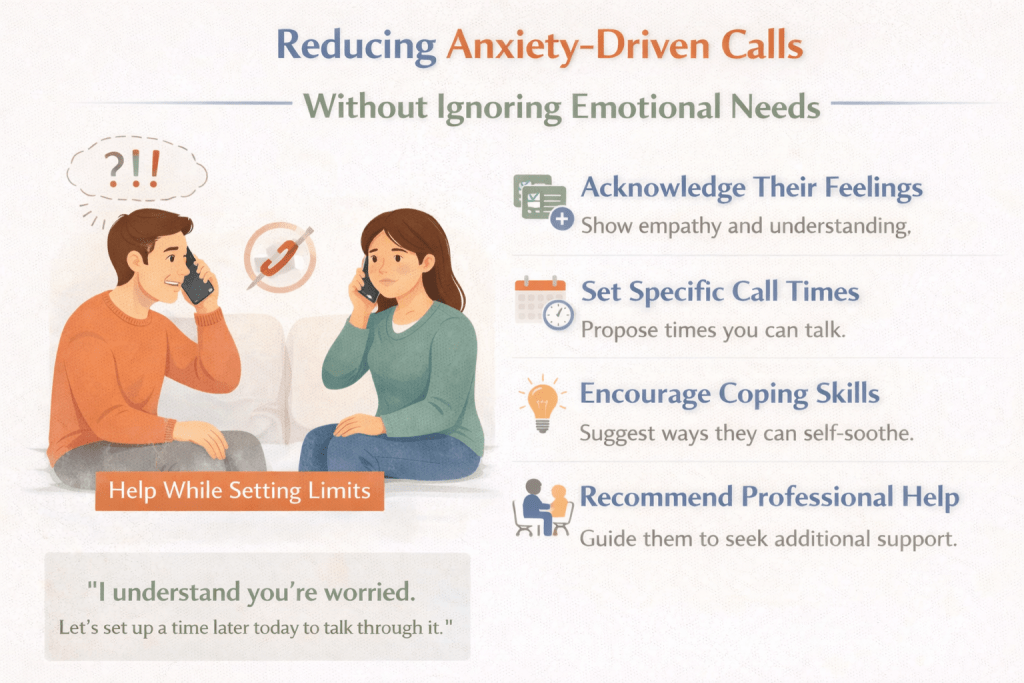
Not all frequent check-ins are practical. Some are driven by anxiety, fear, or emotional dependency.
If you try to solve these with stricter boundaries alone, it may backfire. The key is to pair boundaries with reassurance strategies.
Provide reassurance proactively
Instead of waiting for anxiety to trigger a call, build reassurance into your system:
- “I’ll call you every evening—no matter what.”
- “If anything changes, I’ll let you know.”
- “You don’t need to worry—I’ll check in after your appointment.”
This reduces the need for “just checking” calls.
Use repetition intentionally
For some seniors, especially those with memory concerns, reassurance needs to be repeated regularly.
This is not inefficiency—it is support.
Simple, repeated phrases like:
“You’re okay. Everything is on track. We’ll talk again soon.”
can significantly reduce anxiety-driven outreach.
Create calming routines between calls
If anxiety tends to spike at certain times (e.g., late afternoon or night), introduce predictable calming activities:
- Listening to familiar music
- Watching a specific show
- Calling a friend or neighbor
- Light physical movement or stretching
- Guided relaxation or prayer routines
These are not replacements for connection—but they reduce dependence on one person as the only source of comfort.
Handling Technology Without Letting It Create More Work
Technology is often introduced to simplify caregiving—but without boundaries, it can actually increase interruptions.
Notifications, missed calls, alerts, and multiple communication channels can quickly become overwhelming.
Limit communication channels
Instead of:
- Calls + texts + WhatsApp + video + voice notes
Choose one or two primary methods.
Example:
“Let’s use calls for check-ins and messages only if something important comes up.”
This reduces scattered communication.
Set expectations around response times
Clarify:
- When you are available
- When you are not
- What happens if you don’t respond immediately
Example:
“If I don’t pick up, I’ll call you back within a few hours.”
This prevents repeated attempts in a short span.
Use technology to support structure—not replace it
Tools like reminders, alerts, or automated check-ins should reinforce your system—not create new obligations.
If a tool is causing more notifications, confusion, or dependency, simplify it.
When You Feel Guilty for Setting Boundaries (And How to Move Through It)

Guilt is one of the biggest reasons boundaries fail—not because they are wrong, but because they feel uncomfortable.
Understand where the guilt comes from
Common sources:
- “I should be doing more”
- “They depend on me”
- “What if something happens?”
- “They took care of me—I owe them”
These thoughts are natural—but they are not always accurate reflections of what is sustainable.
Reframe what good care looks like
Good care is not:
- Constant availability
- Immediate response to everything
- Sacrificing your own health or responsibilities
Good care is:
- Consistent
- Thoughtful
- Sustainable
- Supported by systems
Ask yourself one grounding question
“Can I realistically continue this pattern for the next 6–12 months?”
If the answer is no, the boundary is not selfish—it is necessary.
Creating a Long-Term Rhythm That Works for Everyone
The ultimate goal is not to “manage” daily check-ins—it is to create a rhythm that feels natural, balanced, and sustainable.
A healthy rhythm often includes:
- 1–2 structured check-ins per day
- Clear guidelines for urgency
- Minimal interruptions between calls
- Backup support systems
- Emotional reassurance built into the routine
- Flexibility for genuine needs (not constant exceptions)
What this looks like in practice
A typical day might look like:
- Morning call: health, medications, daily plan
- Evening call: reflection, reassurance, next-day preparation
- Notes taken throughout the day for discussion
- Only urgent issues handled in between
This is simple—but powerful.
What to Do When Boundaries Keep Getting Crossed (Even After You’ve Set Them Clearly)
There will be situations where, despite your best efforts, boundaries continue to be tested or crossed. This does not automatically mean the other person is being unreasonable. It often means the system is incomplete, the need is deeper, or the boundary is not yet reinforced consistently enough.
Instead of repeating the same explanation over and over, it helps to step back and diagnose the pattern.
Step 1: Identify the exact pattern—not just the frustration
Instead of saying:
“They keep calling too much,”
Break it down:
- When are the calls happening?
- What is the trigger?
- What is being asked each time?
- What happens right before the call?
For example:
- Calls always happen around 4 PM → possible loneliness or fatigue
- Calls happen after watching the news → anxiety trigger
- Calls happen when trying to complete a task → confidence gap
- Calls happen after you don’t answer once → reassurance loop
When you identify the pattern, you stop reacting emotionally and start responding strategically.
Step 2: Strengthen the system—not just the boundary
If a boundary is repeatedly crossed, ask:
“What support or structure is missing?”
Examples:
- Repeated medication questions → add a printed medication schedule
- Frequent “Are you coming today?” → create a visible weekly plan
- Anxiety-driven calls → add a second short reassurance touchpoint
- Confusion about tasks → simplify instructions or reduce complexity
A boundary without support can feel like withdrawal.
A boundary with structure feels like clarity.
Step 3: Reinforce calmly, not emotionally
If you find yourself becoming irritated or sharp, pause. That reaction is understandable—but it often weakens the boundary.
Instead, repeat your structure in a calm, steady tone:
“We’ll go over this during our check-in.”
No escalation. No argument. No long explanation.
Consistency is more powerful than intensity.
Handling Special Situations: Memory Loss, Loneliness, and Health Decline
Not all boundary challenges are behavioral. Some are rooted in cognitive or health-related changes, and they require a slightly different approach.
When memory issues are involved
If the older adult forgets:
- When the next call is
- What was already discussed
- What counts as urgent
Then repetition is not optional—it is part of care.
What helps:
- Writing down the check-in schedule in a visible place
- Using large-font notes near the phone
- Repeating the same phrases consistently
- Avoiding frustration when things are forgotten
In these cases, boundaries should be paired with memory support tools, not just verbal reminders.
When loneliness is the primary driver
If frequent calls are driven by loneliness, stricter boundaries alone may increase distress.
Instead, ask:
“Where else can connection come from?”
Options might include:
- Scheduled calls with other family members
- Community groups (in-person or virtual)
- Faith-based or social circles
- Companion services
- Regular neighbor interactions
The goal is not to reduce connection—it is to diversify it.
When health is declining
If needs are increasing due to physical or mental health changes, daily check-ins may no longer be enough.
In these cases, boundaries should shift alongside care needs.
This might involve:
- Increasing structured support
- Adding professional care
- Moving from reactive to proactive monitoring
- Reassessing living arrangements
Boundaries are not meant to limit necessary care—they are meant to ensure care remains effective and sustainable.
Protecting Your Own Energy Without Feeling Like You’re “Stepping Back”
Many caregivers hesitate to fully implement boundaries because it feels like they are stepping back from responsibility.
In reality, they are stepping into a more durable role.
Understand the difference between availability and reliability
- Availability = always reachable
- Reliability = consistently present when it matters
You do not need to be constantly available to be deeply reliable.
In fact, reliability is what creates real trust.
Create non-negotiable “off” windows
If your entire day is open-ended, boundaries will constantly be tested.
Instead, define:
- Work hours
- Family time
- Rest periods
- Personal commitments
You don’t need to share every detail—but you should protect these windows.
Example:
“I won’t be available in the afternoon, but we’ll talk in the evening.”
Over time, this becomes part of the rhythm.
Watch for early signs of burnout
Many caregivers only act when they are already overwhelmed.
Look for early signals:
- Irritation during calls
- Avoiding calls altogether
- Feeling mentally exhausted before the day starts
- Resentment building quietly
These are not signs of failure—they are signals that your system needs adjustment.
Turning Daily Check-Ins Into a Long-Term Habit That Actually Works
The most successful caregiving routines are not the most flexible or the most intensive—they are the most repeatable.
What makes a system repeatable?
- It fits into your real life (not an ideal version of it)
- It does not rely on constant decision-making
- It reduces uncertainty for both people
- It can adapt gradually without collapsing
Build habits, not one-time fixes
Instead of constantly adjusting:
- Fix the time → then keep it
- Fix the structure → then follow it
- Fix the response system → then reinforce it
Small, stable habits outperform large, inconsistent efforts.
Accept that “perfect balance” doesn’t exist
Some days will feel smooth. Others will not.
The goal is not perfection—it is overall stability over time.
If most days feel manageable, your system is working.
A Practical Example: Before and After Boundaries
To make this more concrete, here is what a shift might look like:
Before
- Calls happen at random times
- Every issue is treated as urgent
- Caregiver feels constantly interrupted
- Older adult feels unsure when they’ll hear back
- Emotional tension builds over time
After
- Two fixed check-ins per day
- Clear distinction between urgent and non-urgent
- Notes used to track questions
- Backup support in place
- Calls feel focused and complete
- Both people feel more settled
This transformation does not happen overnight—but it starts with small, consistent changes.
Final Perspective: Boundaries Are an Act of Care, Not Distance
At the heart of this entire approach is a simple but often misunderstood truth:
Boundaries are not about creating distance—they are about creating stability.
Without boundaries:
- Care becomes reactive
- Stress becomes constant
- Relationships become strained
With boundaries:
- Care becomes structured
- Stress becomes manageable
- Relationships remain respectful and steady
For seniors, this means knowing they are supported in a reliable, predictable way.
For caregivers, it means being able to show up fully—without feeling stretched beyond capacity.
And for the relationship itself, it means preserving something incredibly important:
Connection that feels calm, consistent, and sustainable over time.
Implementing caregiver boundaries check-ins
Implementing healthy limits doesn’t mean caring less—it means caring smarter with the right support. Technology can be your greatest ally in creating sustainable routines.
Utilizing Tools Like JoyCalls Signup
JoyCalls offers an AI-powered phone companion that makes daily conversations feel natural. Your loved one needs only a regular phone—no apps or complicated devices.
After each call, you receive a summary and alerts if anything concerns arise. This gives you peace of mind without making every connection personally.

You can sign up easily to set up automated daily conversations. The system asks about medications, mood, meals, and general wellbeing.
This approach helps family members share the emotional load. Everyone stays informed without one person carrying all the responsibility.
Navigating Emotional and Practical Challenges
The emotional challenges often center around guilt. You might feel you’re not doing enough, even when stretched thin.
When implementing limits, use clear language like: “I can call at 8am and 6pm each day.” Explain that these boundaries help you provide better support when truly needed.
Ask yourself honestly: Am I doing things my parent can handle independently? This reflection helps identify where limits need rebuilding. A well-structured daily check-in system creates consistency that benefits everyone.
Practical Tips for Balancing Caregiving and Self-Care
Putting your own oxygen mask on first isn’t just for airplanes—it’s the foundation of sustainable caregiving. When you’re running on empty, you can’t truly be present for anyone else.

Prioritizing Your Time and Needs
Start by honestly assessing your capacity. What time of day do you have the most energy? How many tasks can you handle before feeling overwhelmed?
Schedule self-care like you would a medical appointment. Block time for exercise, coffee with friends, or quiet moments. Protect this time fiercely.
When family members ask for more help, pause. Think about what you can do versus what you feel you should do. Stretching too thin helps no one.
Learning to say no is a skill. Try phrases like “I can’t take that on now, but I could help with…” This protects your health while maintaining support.
Establishing a Support Network
You don’t have to carry everything alone. Reach out to other family members, friends, or neighbors. Sharing responsibilities eases the burden.
Consider connecting with formal support groups through organizations like Caregiver Action Network. These spaces understand the unique challenges you face.
Regular self-assessment helps maintain balance. Ask yourself: Am I eating and sleeping well? Am I making time for joy?
Acknowledge feelings of guilt when they arise. Remember that maintaining boundaries actually makes you a better supporter.
True balance isn’t about perfect time splits. It’s about creating enough space for both your life and care responsibilities so neither consumes you completely.
Conclusion
Creating a sustainable rhythm for care means honoring both your capacity and your loved one’s independence. This balance protects your health while ensuring consistent support.
Remember that control is not the same as caring. Your parent’s needs may differ from what you think is best. Accepting this distinction benefits everyone in the relationship.
Start with one small change this week. Clear communication with family members about realistic expectations makes a big difference. Tools like consistent connection systems can help maintain peace of mind without overwhelming your schedule.
You deserve a life beyond care responsibilities. Protecting your energy ensures you can show up as your best self for the people you love.