


Have you ever considered that the daily struggle to give your loved one their pills might be doing more harm than good? The constant reminders, the searching for misplaced bottles, the worry that a missed dose will accelerate their decline—it’s a heavy weight for any family to carry.
When a condition like Alzheimer’s disease affects the brain, it directly impacts memory. Simple, life-sustaining tasks, like taking prescribed medication, become monumental challenges. This creates a cycle of stress for the person and their entire support system.
But what if it didn’t have to be this way? This guide is your companion. We believe that with the right strategies, this part of care can become a source of calm, not conflict. We’ll walk you through practical routines that protect your loved one’s health and give you back your peace of mind.
Understanding how dementia changes daily life is the first step. Research, such as the study detailed in this analysis of caregiver interventions, shows that structured support can significantly reduce these daily pressures. Let’s build a system that works for your unique situation.
Key Takeaways
- The stress of ensuring medication is taken correctly is a common and significant challenge for families.
- Memory changes caused by conditions like dementia make adhering to a medication schedule difficult.
- Establishing simple, consistent routines can transform this daily task from a battle into a manageable part of care.
- Reducing stress around medication time benefits both the person receiving care and their family.
- Structured support and problem-solving strategies have been proven to lessen medication-management problems.
- The goal is to create a calm, reliable system that protects your loved one’s health and your well-being.
Understanding Dementia and Its Impact on Medication Use
When familiar routines become confusing territory, it’s a sign that brain changes are affecting daily life. Conditions like Alzheimer’s disease alter how a person processes information. This makes even simple tasks challenging.

Common Dementia Symptoms Affecting Memory and Routine
Memory issues are often the first symptoms families notice. Your loved one might forget whether they took their pills. They may lose track of time or not recognize familiar objects.
Different types of dementia affect thinking in unique ways. Some people struggle more with routines than others. This happens even at similar stages of disease progression.
The Challenges of Managing Multiple Medications
As conditions like Alzheimer’s disease advance, various therapies and treatments become necessary. Doctors may prescribe cholinesterase inhibitors to help with symptoms.
This creates the complex task of coordinating multiple prescriptions. The person with cognitive changes needs increasing support. Understanding these challenges helps you build better routines.
The Role of Daily Routines in Reducing Medication Stress
What if the most stressful part of your day could become the most predictable and peaceful? Consistent patterns create comfort when memory becomes uncertain. Building reliable habits around pill-taking transforms anxiety into assurance.
Establishing Consistent Medication Schedules
Anchor pill times to existing daily activities. Morning coffee or evening news can serve as natural cues. This approach feels less like a medical task and more like part of the day’s rhythm.
Your pharmacist can guide optimal timing based on food requirements. Some prescriptions work better with meals while others need empty stomachs. Finding the right schedule may need some experimentation.
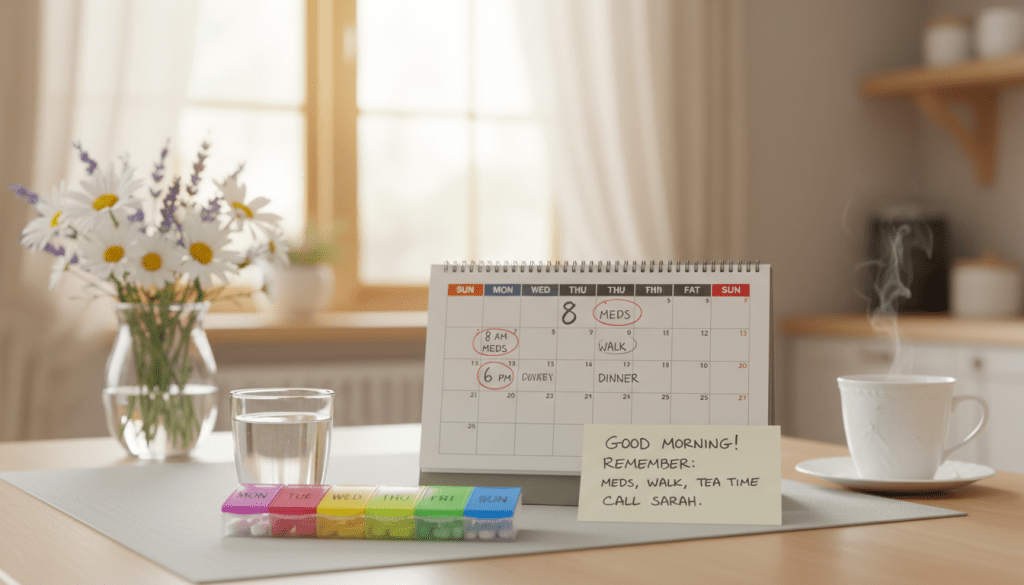
Integrating Reminders into Everyday Life
Simple prompts bridge memory gaps gracefully. A note on the mirror or a gentle phone alarm can make all the difference. These small supports maintain independence while ensuring safety.
Different ways work for different people. The goal is finding what feels natural for your loved one’s lifestyle. When routines become second nature, stress decreases for everyone.
| Reminder Type | Best For | Ease of Use | Effectiveness |
|---|---|---|---|
| Phone Alarms | Tech-comfortable individuals | Very Easy | High |
| Written Notes | Visual learners | Extremely Easy | Medium |
| Activity Linking | Routine-oriented people | Natural | Very High |
| Daily Check-in Calls | Those needing social connection | Simple | Excellent |
Consistency in these activities helps build muscle memory. Even as other memories fade, familiar patterns remain. This approach also helps reduce fall risk by creating predictable movement patterns throughout the day.
Practical Strategies for Taking Medications as Prescribed
Visual cues can transform confusion into clarity when memory becomes uncertain. Simple tools create a system that works independently, reducing daily stress for everyone involved.
Utilizing Pill Organizers and Calendars
A weekly pill organizer becomes your silent partner in care. Each compartment clearly shows what needs to be taken and when. This visual system removes guesswork and provides instant reassurance.
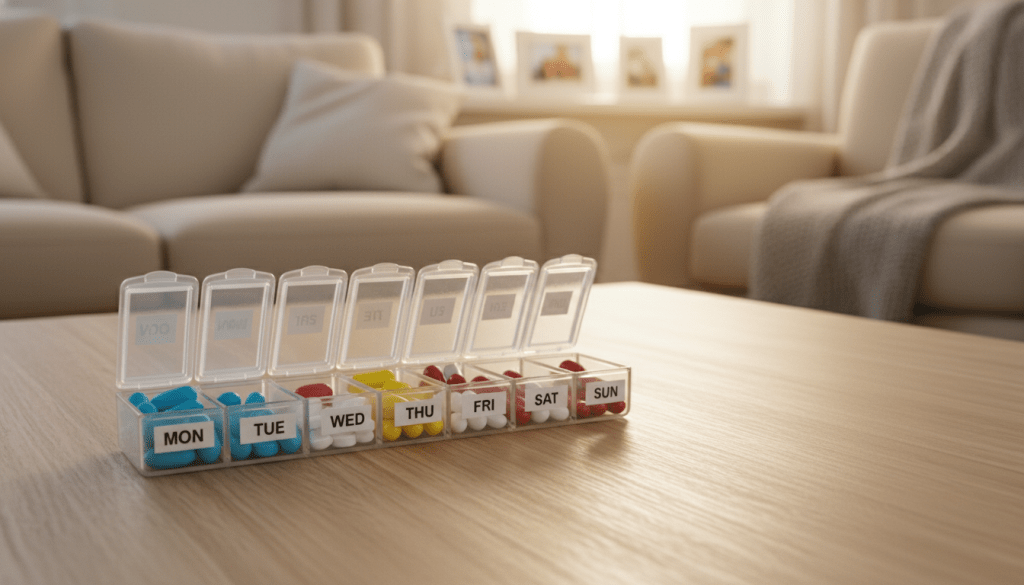
Setting up the organizer together creates meaningful connection time. This Sunday ritual ensures all medications are properly prepared for the week ahead. The person simply opens the correct compartment at the right time of day.
Remember that organizers work best for tablets and capsules. Liquid prescriptions or skin patches need different approaches. Having complete information about all prescribed treatments is essential.
When dementia may cause uncertainty about whether doses were taken, a check-off calendar provides clear confirmation. This simple method prevents problems and offers peace of mind.
Pairing these tools with consistent routines creates reliable success. This approach is especially helpful for long-distance caregiving, where visual confirmation matters most.
Try JoyCalls Free
No app or new device needed. Start with a free 7-day trial.
Overcoming Side Effects and Managing Drug Interactions
When your loved one can’t tell you something feels wrong, how do you become their voice? Watching for treatment side effects becomes your crucial role as an advocate.
Identifying Common Side Effects
Pay close attention to subtle changes. Dizziness, nausea, or increased confusion might signal side effects from prescribed therapies. Some drug side effects may also increase fall risk.
Your loved one might not connect feeling unwell with their prescriptions. Keep notes about sleep patterns, appetite, or behavior shifts. These details help identify potential problems.

Coordinating with Healthcare Providers
Always ask about drug interactions when new prescriptions are added. Question your doctor directly: “Will this interact with other medications?”
Maintain a current medication list and share it with all health professionals. Report any concerning side effects promptly. Proper medication safety requires this teamwork.
Remember, some effects from treatments like cholinesterase inhibitors can mimic worsening symptoms. Your observations help the medical team make informed adjustments. This vigilance also supports overall well-being, which can help with issues like emotional health concerns.
Building a Medication-Administering Routine for Caregivers
What if the key to smoother medication times wasn’t just about your loved one’s routine, but your own? Creating a system that works for you reduces the constant worry. It transforms a stressful task into a calm, predictable part of your day.
Effective Communication with Doctors and Pharmacists
Your loved one may see several doctors. It is vital that all care providers have the same information. Bring a complete list of every prescription to each appointment.
This list should include over-the-counter drugs and supplements. Even treatments like galantamine prescribed by others must be shared. This coordination prevents dangerous interactions.
When giving a pill, use clear, simple instructions. Say, “Here is your pill for your heart. Please swallow it with this water.” Avoid long explanations that can confuse the person.
If the person refuses, do not force it. Pause and try again in fifteen minutes. This approach avoids conflict and keeps the moment calm.
Ask your doctor or pharmacist to review the schedule during visits. They can often simplify it, making your care routine easier to manage for everyone involved.
Implementing Technology and Reminder Tools for Better Adherence
Imagine a gentle beep that brings peace of mind instead of panic when it’s time for your loved one’s pills. Modern tools can handle the remembering so you can focus on the caring.
Using Smartphone Apps and Automatic Pill Dispensers
Automatic dispensers become your silent partner. At the right time each day, they beep and release the correct pill dose.
This works beautifully for prescriptions like galantamine or blood pressure medications. The device takes over the management while maintaining your loved one’s independence.

Smartphone reminders offer another simple solution. They send alerts when it’s time for important activities like taking medications. Some apps even track whether doses were taken.
Leveraging Digital Calendars and Timetables
A visual timetable posted near the pill station provides clear guidance. Pair it with a large digital clock for easy time orientation.
This approach helps someone with dementia understand what activities happen when. Research shows that structured support systems significantly improve daily routines.
Choose tools that match current abilities. A simple phone alarm might work for early-stage dementia. Later stages may need automatic dispensers.
Technology works best with human connection. While devices handle reminders, you provide the reassurance no machine can match. This balance creates a supportive environment that complements other support like an AI companion for senior loneliness.
When Medication Time Gets Difficult: How to Handle Refusal, Fear, and Confusion Without Creating More Stress
Even with the best routine, the calmest voice, and the most organized pill box, there will be days when medication time does not go smoothly. A loved one may say, “I already took that.” They may insist the medicine is not theirs. They may become suspicious, angry, tired, embarrassed, or simply overwhelmed. Sometimes the issue is memory. Sometimes it is fear. Sometimes it is a physical problem like nausea, dry mouth, pain, or trouble swallowing. And sometimes there is no obvious reason at all.
This is one of the hardest realities for families caring for someone with dementia: success is not only about having the right tools. It is also about knowing how to respond in the moment without turning medication into a daily struggle. Communication changes caused by Alzheimer’s disease and other dementias can make explanations harder to process, especially when the person is already anxious or fatigued. Caregiving guidance from the National Institute on Aging and the Alzheimer’s Association consistently emphasizes that simple language, reassurance, reduced distractions, and a calm emotional tone are often more effective than reasoning, correcting, or arguing.
The goal is not to “win” the interaction. The goal is to protect dignity, preserve trust, and increase the chances that medication can be taken safely. For many families, that mindset shift changes everything. If every refusal feels like a confrontation, stress builds quickly for both people. But if refusal is treated as information instead of defiance, medication time becomes easier to troubleshoot. A “no” may mean “I’m scared,” “I don’t understand,” “My stomach feels off,” “This tastes bad,” “I’m too tired,” or “Please slow down.” That is why the most effective caregivers learn to read the moment before reacting to it.
Start by assuming there is a reason, even if it is not obvious
When a person with dementia refuses medication, it is easy to assume they are being difficult. In reality, refusal often has a practical cause. The pill may be too large. The timing may clash with fatigue. The room may be noisy. The instruction may feel rushed. The person may not recognize the bottle, the caregiver, or the purpose of the dose. They may also have developed swallowing difficulty or an aversion after experiencing side effects earlier. Guidance from dementia care organizations notes that refusal often softens when caregivers address the cause behind the behavior instead of reacting only to the behavior itself.
A helpful first step is to pause and quickly scan for triggers:
Check the environment
Is the television loud? Are several people talking at once? Is the room cluttered? Is the person being interrupted in the middle of another activity? Dementia can make it much harder to filter stimulation, so medication time often goes better in a quiet, familiar setting.
Check the body
Are they tired, nauseated, constipated, in pain, or short of breath? Are they hungry? Are they more cooperative at a different time of day? If someone is not physically comfortable, medication time may become the point where that discomfort shows up.
Check the task itself
Is the pill large, bitter, chalky, or hard to swallow? Is the water cup too full or too heavy? Does the person have arthritis making it hard to grip a cup? Are you offering too many pills at once? Swallowing difficulties are a real adherence barrier in older adults, and the safest response is not improvisation but checking with the pharmacist or prescriber for alternatives such as liquid, dispersible, patch, or other licensed formulations when appropriate.
Check the emotional tone
Did the interaction begin with pressure? Were you already worried or rushed? People living with dementia often respond more to emotional energy than to the exact words being used. A strained, urgent approach can unintentionally signal danger. Communication guidance recommends approaching from the front, using a calm tone, speaking slowly, and keeping sentences short.
What to say when a loved one resists medication
One of the most practical changes a caregiver can make is to stop overexplaining. Long explanations often increase confusion. Instead, use one-step cues and warm, respectful language.
For example, instead of:
“Mom, you need to take these now because the doctor said your blood pressure medicine has to be taken before breakfast and if you skip doses it can cause bigger issues later.”
Try:
“Here’s your morning medicine. Let’s take it with a sip of water.”
Instead of:
“You already forgot again. You have to take this every day.”
Try:
“It’s time for this one now. I’m here with you.”
These kinds of phrases work better because they reduce cognitive load and lower the emotional temperature. Dementia communication guidance recommends short, clear sentences, a reassuring tone, and avoiding criticism or correction whenever possible.
It also helps to offer gentle choices, but only choices that still move the task forward. Too many options can overwhelm. Good examples include:
- “Would you like water or juice with it?”
- “Would you like to sit at the table or by the window?”
- “Do you want to take this now or after two bites of breakfast?”
These choices preserve autonomy without turning medication into a negotiation with no end point.
If they say no, do not force the moment
One of the most useful caregiver habits is learning that a refusal does not always need an immediate showdown. The existing article briefly recommends pausing and trying again later; that is excellent advice, and it deserves expansion because it is one of the most effective de-escalation techniques in dementia care. When a person refuses, arguing usually hardens the refusal. Taking a short break often works better.
A simple sequence looks like this:
- Pause.
- Validate without debating.
- Step away for 10 to 15 minutes.
- Re-approach calmly with less language.
- Try again in a quieter or more comfortable setup.
You might say:
“That’s okay. We’ll come back to it in a little bit.”
That one sentence protects dignity and prevents the interaction from becoming adversarial. It also gives you time to rethink the setup. Maybe the room needs to be quieter. Maybe the person needs the bathroom first. Maybe the medication should be paired with a snack, if medically appropriate. Maybe the issue is that you are asking them to swallow four pills at once.
Use a “medication reset” routine for difficult moments
Families often do better when they have a repeatable mini-plan for refusals instead of improvising every time. A medication reset routine can be very simple:
Step 1: Lower stimulation
Turn off background noise. Sit down. Put only the needed medicine and a drink on the table. Remove clutter.
Step 2: Reconnect first
Make eye contact. Use the person’s name. Offer a comforting touch if they usually respond well to touch.
Step 3: Give one instruction
Avoid multi-step commands. Keep it short and familiar.
Step 4: Reduce the physical burden
Offer one pill at a time if possible, with adequate fluid, unless the prescriber or pharmacist has instructed otherwise.
Step 5: Stop before tension escalates
If distress rises, pause again rather than pushing harder.
Over time, a reset routine helps the caregiver stay steady. It also makes the interaction more predictable for the older adult, which can reduce anticipatory stress.
Watch for patterns, not just single incidents
Many medication struggles look random until you write them down. Then a pattern appears. Maybe refusal happens mostly in the evening, when the person is tired or more confused. Maybe it happens with one specific medication that tastes unpleasant. Maybe it happens on days when breakfast is delayed. Maybe it happens after a poor night of sleep.
A short medication behavior note can be extremely valuable. You do not need a complicated chart. Track:
- time of dose
- whether it was accepted, delayed, or refused
- mood or behavior before the dose
- any physical complaints
- what helped
- any side effects afterward
This kind of note-taking helps families and clinicians identify whether the barrier is cognitive, behavioral, physical, or medication-related. It also creates more useful doctor conversations than saying, “Some days it just doesn’t work.” The CDC’s medication list materials also reinforce the value of keeping an updated medication record and bringing it to healthcare visits.
Do not assume every problem is a behavior problem
Sometimes a medication issue is actually a prescribing issue. Older adults with multiple medications are at higher risk of burden from complex regimens, interactions, sedation, dizziness, and other medication-related harms. That means adherence may improve not only through better reminders, but through a better medication plan. Reviews on polypharmacy and deprescribing in older adults emphasize that simplifying regimens and reassessing ongoing need can reduce harm and improve overall medication use.
This is where families should be very proactive. Ask the clinician or pharmacist:
- Can any medication be stopped, reduced, or changed?
- Can dosing times be consolidated?
- Is there a once-daily version?
- Is this medicine still clearly beneficial?
- Could this side effect be making adherence harder?
- Is there a liquid, dissolvable, or patch option?
- Does this medicine need to be taken at this exact time?
These questions are especially important when the person is on several medications or when pill time has become one of the most stressful parts of the day.
Be extremely careful with crushing or hiding medication

Many caregivers wonder whether it is okay to crush a tablet into food. This is an area where families should not guess. Some medicines should not be crushed because altering them can change how the drug is released or absorbed, reduce effectiveness, increase side effects, or create safety risks. Extended-release, enteric-coated, and certain other formulations are common examples. Pharmacist guidance and medication safety resources are clear that the prescriber or pharmacist should be consulted before crushing, splitting, or opening any medication.
Similarly, giving medication covertly raises ethical and sometimes legal concerns. Dementia guidance generally frames this as a decision that should not be made casually or privately out of desperation. It should involve the prescribing clinician and follow applicable local laws, professional guidance, and capacity/best-interest decision processes where relevant. The safer starting point is always to explore less restrictive options first, including alternative formulations and better communication approaches.
Make swallowing easier when that is the real barrier
For some older adults, the biggest issue is not memory or resistance. It is swallowing. Dry mouth, weak swallowing muscles, fear of choking, poor dentition, and fatigue can all make pills daunting. If swallowing appears to be the issue, do not simply keep urging the person to “try harder.” Ask for a medication review and a swallowing-informed solution. Professional pharmacy guidance recommends assessing whether the medication is still needed and whether a more suitable formulation is available, such as a licensed liquid, dispersible product, or another route of administration when appropriate.
Actionable adjustments that may help while you seek clinical advice include:
- offering medication when the person is most alert
- ensuring they are fully upright
- giving one pill at a time
- using the beverage they tolerate best, if clinically acceptable
- avoiding rushing
- checking whether dry mouth is making swallowing harder
- requesting a formal medication or swallowing review if coughing, pocketing, or repeated refusal occurs
If swallowing trouble is new, worsening, or paired with coughing or choking, tell the clinician promptly.
Protect the relationship, not just the schedule
A subtle but important truth in dementia caregiving is that medication adherence improves when the person still feels respected. That means caregivers should avoid language that sounds parental, scolding, or deceptive. It also means not turning every dose into a test of obedience.
You are far more likely to preserve cooperation when medication time feels like support rather than control. This can look like sitting beside the person rather than standing over them. It can mean using familiar routines and friendly phrases. It can mean acknowledging feelings even when the facts are confused:
- “I know this feels frustrating.”
- “You’re safe. I’m here with you.”
- “Let’s do this slowly.”
These responses are not fluff. They are practical regulation tools. A person with dementia may forget the words later, but they are still likely to retain the emotional imprint of how the interaction felt.
Know when to stop managing it alone
If medication refusal is becoming frequent, if doses are repeatedly missed, if swallowing problems are emerging, or if the person is increasingly distressed at medication time, it is time to involve professionals rather than carrying the full burden yourself. The current article already encourages collaboration with pharmacists and healthcare professionals, and that advice becomes even more important when the issue is refusal or complexity.
Reach out sooner rather than later if you notice:
- repeated missed doses
- new confusion after a medication change
- increased sleepiness, dizziness, or falls
- nausea, vomiting, constipation, or appetite loss
- suspicion that a medicine is no longer tolerated
- difficulty swallowing pills
- caregiver burnout around medication time
A medication plan that works on paper but fails in real life is not a good plan yet. That is not a caregiver failure. It is a signal that the plan needs to be adapted.
A calmer standard for success
Families often set an unrealistic standard: every dose, every time, no resistance, no delays, no mistakes. In dementia care, a better standard is calmer and more humane. Success means building a system that is safe, respectful, and adaptable. It means knowing how to respond without panic when a dose is refused. It means noticing when the problem is the environment, the formulation, the timing, or the medication itself. And it means remembering that preserving trust is part of good medication care, not separate from it.
When medication time gets difficult, the answer is rarely more pressure. More often, the answer is less noise, less language, more observation, more flexibility, and more partnership with the care team. That is what reduces stress in a lasting way for seniors, older adults, and the people who love them.
Effective medication management dementia Practices
What if the most overlooked safety step could prevent the biggest medication mistakes? Proper organization creates a safety net that protects your loved one when memory fails. This system brings peace of mind to everyone involved.
Good management starts with meticulous record-keeping. Keep a complete list of every prescribed medicine. Include both the brand and generic name for each one.
Maintaining Updated Medication Records
Create a detailed Patient’s Medication List. This document should include your loved one’s full name, chronic conditions, and all allergies. Record each prescription’s strength, dose, and specific instructions.
Carry this list everywhere. In an emergency, having complete information prevents serious problems. Share updated versions with all healthcare providers.
Ensuring Safe Storage and Administration
Safe storage becomes crucial at all stages of cognitive change. Keep all medicine in a locked cabinet or drawer. This prevents the person from accidental overdose.
Check expiration dates monthly. Dispose of outdated prescriptions properly. This includes old bottles of inhibitors no longer in use.
Follow administration instructions carefully. Some medicine works best with food, others need empty stomachs. Getting the dose timing right maximizes effectiveness.
For comprehensive guidance on treatment options, consult this resource on dementia medications. Proper management protects your loved one’s health and your peace of mind.
How to Adjust Medication Routines as Dementia Progresses: A Stage-by-Stage Approach for Families and Caregivers
One of the most emotionally difficult parts of dementia care is realizing that a routine that once worked beautifully may suddenly stop working. A loved one who used to take medication independently may start forgetting doses. Someone who once accepted gentle reminders may become suspicious or distressed. A person who could follow a simple sequence like “take this pill with water after breakfast” may later struggle with the meaning of the words, the purpose of the medicine, or the act of swallowing itself.
This change can feel deeply discouraging for families. Many caregivers assume that when a medication routine breaks down, they must have done something wrong. In most cases, that is not true at all. Dementia is progressive, which means the brain’s ability to process instructions, form habits, understand time, and tolerate unfamiliar or uncomfortable tasks changes over time. The medication system must evolve alongside those changes. The most effective caregiving approach is not to create one “perfect” routine and hope it lasts forever. It is to build a medication plan that can be simplified, adapted, and supported as the condition changes.
That is where a stage-by-stage approach becomes so useful. It helps families stop expecting the same solution to work forever. Instead, it encourages them to ask better questions: What is my loved one still able to do safely? What part of the medication process is becoming harder? Where can I support independence, and where do I need to step in more directly? When medication adherence is approached this way, families are less likely to wait until a crisis forces change. They can make practical adjustments early, while preserving dignity and reducing stress for everyone involved.
This kind of flexible planning is especially important because dementia rarely affects medication use in just one way. The challenge may begin with forgetting, but later involve confusion, resistance, poor judgment, fatigue, coordination problems, swallowing difficulties, or reduced insight. A calm, compassionate caregiver who adapts the system step by step can often reduce many of these problems before they become daily battles.
Why medication routines must evolve over time
Many caregiving articles focus on how to create a routine, but fewer explain that routines must be reviewed regularly. A medication system that fits early-stage dementia often becomes too complicated in the middle stage and too demanding in the later stage. That does not mean the system failed. It means the person’s needs have changed.
Think of medication management as a set of tasks, not a single activity. Taking medicine may involve:
- recognizing the medication
- remembering the time
- understanding the purpose
- opening the container
- choosing the right dose
- swallowing safely
- remembering whether the dose was already taken
- reporting side effects or discomfort
A loved one may manage some of these tasks well and struggle with others. For example, they may remember medication time when reminded but no longer be able to sort pills correctly. Or they may be able to swallow the dose without difficulty but become anxious when they see several bottles on the table. Looking at the process this way allows the caregiver to support only the steps that now need support, instead of rushing to take over everything at once.
That distinction matters. Older adults living with dementia often do better when they can keep doing the parts of a routine that still feel familiar and manageable. Preserving participation can reduce shame, resistance, and helplessness. At the same time, caregivers must honestly recognize when safety is becoming an issue. The goal is not maximum independence at any cost. The goal is the right level of support at the right time.
Early-stage dementia: support memory without taking over too soon
In the earlier stage, many people still want and expect to manage their own medicines. They may understand what each medication is for, remember longstanding habits, and strongly value their independence. The main challenge at this point is usually inconsistency rather than total inability. They may forget whether they took a dose, lose track of time, or miss medication when the day becomes disrupted.
At this stage, the smartest approach is often guided independence. That means creating supports that help the person succeed without making them feel controlled.
What usually works well in the early stage
A good early-stage routine is simple, respectful, and low-friction. It often includes:
1. Linking medication to a stable daily event
The routine works better when medication is anchored to a consistent event such as breakfast, brushing teeth, morning tea, or the evening news. The brain may struggle with clock-based memory while still responding well to familiar life patterns. The more natural the cue, the less the task feels like an interruption.
2. Using visible and easy-to-read systems
A weekly pill organizer, a written schedule in large print, or a clearly marked medication station can reduce mental strain. The person does not have to remember everything internally because the routine is supported by the environment.
3. Using one reminder style consistently
Some people do well with a phone alarm, others with a kitchen note, and others with a verbal reminder from family. What matters more than sophistication is consistency. Too many reminder methods can become noisy and confusing.
4. Involving the person in routine setup
When possible, let them participate in deciding where the medicines will be kept, what reminder feels easiest, and which daily cue makes the most sense. People are more likely to stick with routines they had a role in shaping.
Early warning signs that more support is needed
Caregivers should watch gently for signs that the current system is no longer enough. These may include:
- missed doses happening more than occasionally
- confusion about whether medicine was already taken
- pills found in the wrong place
- difficulty opening containers
- increasing frustration about reminders
- repeated mistakes with the day or time
- taking extra doses by accident
These signs do not automatically mean full supervision is needed. But they do suggest that the routine should be reviewed now, not months later.
Middle-stage dementia: shift from reminders to hands-on structure
In the middle stage, medication problems often become less about memory alone and more about judgment, sequencing, cooperation, and emotional response. The person may no longer reliably understand instructions like “Take the blue one after lunch.” They may become overwhelmed by multiple pills. They may insist they already took them. They may not understand why medication is necessary. Even a previously reliable person may become inconsistent when tired or distracted.
This is usually the stage where caregivers need to shift from a “remember to take it” model to a “we take it together” model.
That change can be emotionally significant. Families often hesitate because it feels like a loss of independence. But in many cases, this shift actually reduces distress. Instead of leaving the older adult to carry a task that now feels confusing or impossible, the caregiver provides structure, companionship, and calm.
What works better in the middle stage
1. Move from passive reminders to active assistance
Instead of saying, “Don’t forget your medicine,” bring the medication at the usual time, sit nearby, and guide the process gently. The person may no longer be able to bridge the gap between remembering and actually completing the task.
2. Reduce visible complexity
Do not place several medication bottles in front of the person if they only need one or two pills at that moment. A cluttered setup invites confusion and mistrust. Present only what is needed right now.
3. Use short, familiar phrases
Long explanations often backfire. The goal is not to give a full medical reason every time. It is to help the person complete a necessary task without overload. Calm, repetitive phrases such as “It’s time for this now” or “Here’s your morning medicine” often work better than detailed reasoning.
4. Build in more time than you think you need
Medication time becomes much more difficult when rushed. A hurried caregiver often unintentionally turns a manageable task into a stressful interaction. Build extra minutes into the day so you are not asking the person to perform under pressure.
5. Expect variability from day to day
Some days will go smoothly. Other days will not. That does not always mean the system is wrong. Dementia can fluctuate with fatigue, sleep, pain, overstimulation, constipation, infection, appetite changes, or general emotional state. A flexible routine recognizes that consistency in approach matters even when the response varies.
Later-stage dementia: focus on comfort, safety, and essential medications
In the later stage, medication management may need a very different philosophy. The person may no longer understand the task at all. They may need complete assistance. They may have swallowing difficulty, reduced alertness, or much less tolerance for repeated prompting. At this point, caregivers and clinicians often need to ask not only how to administer medication, but also which medications remain truly necessary and beneficial.
This can be a hard shift for families, especially if they have spent years working so hard to maintain adherence. But in advanced illness, the best medication plan is not always the fullest one. Sometimes the most appropriate plan is the simplest, safest, and least burdensome one.
Priorities in later-stage medication care
1. Reassess the medication list regularly
Families should ask the healthcare team whether each medicine is still clearly helping in the current stage. Preventive medications that were reasonable years ago may need review if they now add burden without meaningful near-term benefit.
2. Minimize physical and emotional strain
If medication time causes repeated distress, gagging, coughing, or exhaustion, this is not a minor inconvenience. It is a care issue that should prompt discussion with the medical team. The caregiver should not be left to struggle through difficult administration without support or alternatives.
3. Consider formulation changes
Some people may do better with liquid forms, patches, or other alternatives when appropriate and clinically approved. This must always be checked with the prescriber or pharmacist rather than improvised.
4. Keep the moment calm and dignified
Even when the person cannot fully understand the process, emotional tone still matters. Gentle pacing, a familiar voice, eye contact, and a respectful posture continue to make a difference.
5. Recognize when comfort outweighs strict timing
Not every medication issue in later-stage care should be handled like a strict compliance problem. The care team can help distinguish between medications that truly require precise timing and those that can be adjusted more flexibly.
How caregivers can tell the routine needs to be upgraded
Many families wait too long to change the routine because they assume occasional problems are normal. Some inconsistency is normal, yes. But certain patterns signal that the existing system is no longer a good fit.
A routine likely needs to be upgraded when:
- the same medication problem keeps repeating each week
- the person becomes upset almost every time medicine is offered
- the caregiver feels dread before every dose
- the person is no longer able to follow even a simple cue
- doses are missed or duplicated often enough to create risk
- the system depends too heavily on memory alone
- the current routine works only when one specific caregiver is present
- medication administration is taking an unreasonable amount of time and energy every day
When these patterns appear, the answer is rarely “try harder.” The better answer is usually “make the system simpler, safer, and more supported.”
A practical framework for deciding what to change
Caregivers often know something is wrong but are not sure what exactly to change. A useful way to think through the issue is this four-part review:
1. Is the problem memory?
If the person forgets the dose but cooperates once reminded, the answer may be stronger prompts, better visual systems, or closer timing support.
2. Is the problem understanding?
If the person no longer understands what the medicine is or why it is being offered, the answer may be shorter language, more modeling, and hands-on support rather than repeated explanation.
3. Is the problem physical?
If swallowing, nausea, dry mouth, fatigue, or pain are driving resistance, a clinical review is needed. The routine alone will not solve it.
4. Is the problem emotional?
If the person becomes fearful, embarrassed, angry, or suspicious, the caregiver may need to adjust tone, timing, setting, and approach. The emotional experience around medication matters more than many families realize.
This framework can quickly clarify whether the next step should be a better reminder, a simpler routine, a medication review, or a communication adjustment.
How to preserve dignity while increasing supervision
One of the biggest caregiver concerns is how to step in more without making the person feel diminished. This is especially sensitive when the older adult has always valued independence or privacy.
A helpful principle is to avoid framing support as correction. Instead of saying, “You can’t manage this anymore,” the caregiver can normalize teamwork:
- “I’ll do this with you.”
- “Let’s keep this simple.”
- “I’ve set it out for us.”
- “I’ll help make this easier.”
These phrases feel supportive rather than controlling. They also reduce the chance that the person will experience medication help as criticism.
Another helpful strategy is to make support look like routine rather than surveillance. For example, bringing medication with breakfast every day feels more natural than suddenly checking whether pills were taken. Quiet, dependable assistance is often better tolerated than obvious monitoring.
Prepare for transitions before they become crises
Families are often reactive with medication routines. They wait until multiple doses have been missed or until conflict becomes daily. A more strategic approach is to plan for transitions before they become emergencies.
Ask yourself every few months:
- Is the current system still working reliably?
- Which part of the process now seems hardest?
- Has the person’s vision, hearing, mobility, or swallowing changed?
- Is the medication schedule more complex than it needs to be?
- Would a different form of support reduce stress?
- Does another family member or professional need to be involved more regularly?
This kind of review prevents slow decline in the routine from going unnoticed. It also gives caregivers a chance to act while they still have energy and options.
Medication routines should fit the person, not the other way around
It is tempting to look for a universal dementia medication system, but in reality, the best routines are personalized. One person may be calmer with visual prompts. Another may respond best to a familiar caregiver’s voice. One may accept medication only with breakfast. Another may do better mid-morning after waking fully. One may be reassured by consistency, while another needs more flexibility due to fatigue or mood fluctuations.
That is why caregivers should judge the routine by outcomes, not by appearances. A medication setup is not successful because it looks organized on paper. It is successful because it is realistic, repeatable, and gentle enough to work in ordinary life.
The most helpful mindset shift for families
Perhaps the most important mindset shift is this: medication management in dementia is not a fixed task you solve once. It is an ongoing caregiving skill that needs reassessment as the disease changes. Families who accept this early are often less shocked by setbacks and more willing to adapt without guilt.
You are not failing when a previously effective routine stops working. You are responding to a new stage of care. That response may involve more hands-on help, a simplified regimen, new communication strategies, closer supervision, or a serious conversation with the care team about what still makes sense medically.
That is not giving up. It is good care.
Closing thought for this section
As dementia progresses, medication adherence becomes less about perfect memory and more about thoughtful adaptation. What works best is rarely the most complicated system. It is the system that matches the person’s current abilities, protects their dignity, and reduces daily strain on both the older adult and the caregiver. Families do not need a rigid plan that never changes. They need a compassionate framework for adjusting support as needs evolve.
Utilizing Professional and Community Support for Medication Adherence
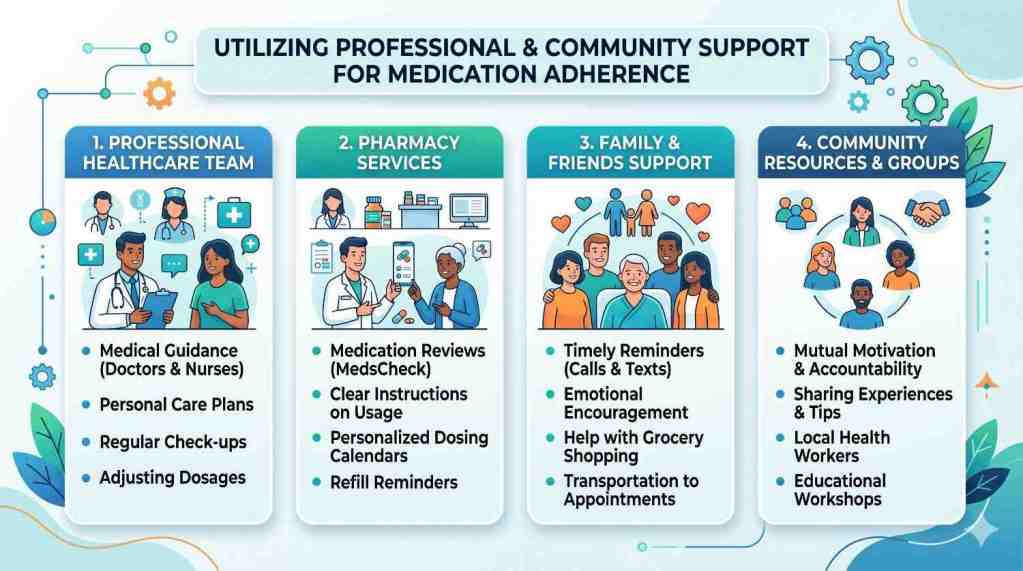
You’ve built routines and systems, but what happens when your loved one needs more than you can provide alone? Professional support exists to fill these gaps in your caregiving journey.
Working Collaboratively with Health Care Professionals
Your care team extends beyond family. Pharmacists and specialized services offer crucial help. They can pack prescriptions, supervise administration, and even deliver treatments.
This becomes essential as conditions progress. During later stages, many people need complete assistance with their daily regimens. Professional providers ensure safety when family cannot be present.
Regular medication reviews with your health team are vital. They check for interactions and adjust therapies as needs change. This collaborative approach prevents problems and optimizes care.
| Service Type | Best For | Frequency | Cost Level |
|---|---|---|---|
| Medication Packing | Multiple prescriptions | Weekly/Monthly | Low |
| Administration Support | Later stage needs | Daily | Medium |
| Delivery Services | Mobility challenges | As needed | Low |
| Compliance Monitoring | Living alone situations | Ongoing | Medium-High |
Explore JoyCalls for Ongoing Support
JoyCalls provides daily check-ins through familiar phone calls. No apps or devices are needed for your loved one. The service offers gentle reminders and friendly conversation.
You receive summaries so you know your person is safe. This consistent support brings peace of mind when you cannot be there. Research shows that structured support systems significantly improve daily routines for people with cognitive changes.
Ready to add this layer of care? Explore JoyCalls and sign up here. Everyone deserves care that combines professional reliability with genuine warmth.
Conclusion
As you walk this journey with your loved one, remember that every small routine you establish is an act of profound care. The ways you adapt to changing needs show your deep commitment to their well-being.
These strategies work because they respect how conditions like Alzheimer’s disease affect thinking and memory. Research shows that involving people in discussions about their treatments promotes safer use, as detailed in this analysis of medication information needs.
Your patience and adaptability make all the difference. What works today may need adjustment tomorrow, and that’s perfectly normal. You’re not just managing schedules—you’re preserving dignity and creating moments of peace.
FAQ
What are some common side effects of treatments for dementia?
How can I help my parent remember to take their pills?
What should I do if a drug doesn’t seem to be working?
How can JoyCalls assist with daily care for someone with Alzheimer’s disease?
Why is it crucial to coordinate with all health providers?

Ana Avila is a healthcare and technology writer with deep expertise in artificial intelligence, senior care innovation, and the practical use of AI in healthcare operations. Her work focuses on how emerging technologies can improve the daily experience of older adults, support overburdened care teams, and help senior living communities deliver safer, faster, and more personalized support.
Ana’s background includes health informatics, aging care systems, and applied artificial intelligence. Her work explores how digital health tools, predictive analytics, and AI-assisted communication systems can improve care coordination, reduce operational delays, and identify early signs of risk among older adults. She brings an understanding of both the technical side of AI and the human realities of healthcare delivery.
Over the years, Ana has developed a specialized body of work around AI in senior living. She writes about how senior care providers can use intelligent systems to manage resident requests, answer routine questions, support family communication, improve after-hours coverage, and detect patterns that may indicate loneliness, confusion, distress, or unmet needs. Her articles often examine the gap between what senior living teams are expected to deliver and what traditional staffing models can realistically support.
Ana’s healthcare expertise is especially focused on the operational side of care. She has written extensively about call handling, resident engagement, front desk workflows, triage systems, caregiver communication, care escalation, and the hidden administrative burden placed on senior living staff. Her work explains how AI can help reduce repetitive tasks, organize incoming requests, prioritize urgent issues, and give human caregivers more time for meaningful resident interaction.
At the same time, Ana is careful not to present AI as a replacement for human care. A consistent theme in her writing is that technology should support relationships, not weaken them. She argues that the best AI systems in healthcare are not the ones that simply automate the most tasks, but the ones that make care teams more responsive, families more informed, and residents more supported. Her perspective is grounded in the belief that senior living technology must be designed around dignity, trust, privacy, and compassion.
Ana has also written widely on the ethical use of AI in healthcare. Her work discusses the importance of human oversight, transparent escalation rules, resident consent, data minimization, and responsible use of sensitive health and behavioral information. She often emphasizes that AI systems used around older adults must be easy to understand, carefully monitored, and designed with the limitations and needs of real residents in mind, including those with memory loss, hearing challenges, mobility issues, or social isolation.
Her writing has been used as a reference point in discussions about aging, elder care technology, digital health, and AI-supported senior living. She has published 12 papers in journals including JAMA, The BMJ, and SSRN. Some of her articles have also been cited by Wikipedia editors as supporting references on topics related to healthcare, aging, and technology. This has helped position her work as a useful educational resource for readers looking to understand how AI can be applied in real care environments.
In addition to her long-form writing, Ana has contributed research-based commentary, professional explainers, and practical guidance for healthcare operators, senior living decision-makers, and technology teams building products for older adults. Her work combines research literacy with operational practicality. She is able to take complex subjects such as natural language processing, predictive analytics, conversational AI, and care automation, and explain them in a way that is accessible to executives, caregivers, families, and non-technical readers.
Ana’s strongest area of expertise is the intersection of artificial intelligence and senior living operations. She understands that senior care communities face a difficult combination of rising resident expectations, staffing pressure, family communication demands, and increasing care complexity. Her writing explores how AI can be used to ease those pressures through smarter communication systems, faster response workflows, proactive check-ins, and better visibility into resident needs.
Her approach is both evidence-informed and deeply human. She studies AI through the lens of real-world care delivery: whether a resident gets help faster, whether a family member receives a clearer update, whether a caregiver avoids unnecessary administrative work, and whether a senior living team can identify a concern before it becomes a crisis. This practical focus makes her work especially relevant for organizations that want to adopt AI responsibly rather than simply follow technology trends.
Ana Avila is regarded as a thoughtful voice on the future of AI in healthcare and senior living. Her expertise combines research-driven analysis, operational understanding, and a strong commitment to humane technology. Through her writing, she helps healthcare leaders and senior living communities understand not only what AI can do, but how it should be used to improve care, preserve dignity, and strengthen the human relationships at the center of aging support.