


What if you could lift the weight of constant worry from your shoulders by this evening? That nagging feeling about your mom or dad living alone—did they eat? Are they okay?—doesn’t have to be your normal.
Many people believe creating a structure for home care takes weeks of stressful planning. But you can build a supportive framework for your loved one in a single day. This isn’t about adding more rigid tasks to your life. It’s about creating a flexible system that brings a sense of calm and consistency to you both.
Whether you’re nearby or miles away, a consistent connection ensures nothing important gets missed. This guide will show you practical steps to map out essential tasks. You’ll learn how to leverage simple tools, like a solid morning routine checklist for caregivers, and discover solutions that handle the heavy lifting.
For instance, services like daily phone check-ins for seniors provide automated, friendly calls. This gives you peace of mind without adding to your to-do list. The goal is simple: sustainable support for your loved one‘s wellbeing that also protects you.
Key Takeaways
- Establishing a daily check-in structure can be achieved quickly, bringing immediate relief from worry.
- A consistent routine creates predictability and reduces stress for both you and the person you care for.
- The focus is on building a flexible framework, not a rigid schedule that adds more pressure.
- Digital tools can automate check-ins, providing reliable updates without constant effort from you.
- This approach is effective for local and long-distance care situations.
- The ultimate aim is to support your loved one’s health while preventing your own burnout.
- You can have a clear plan in place by the end of the day.
Introduction: Embracing the Caregiving Journey
There’s no rulebook that prepares you for the moment you realize your parent needs daily support. This caregiving journey often begins quietly, with small signs that gradually become undeniable needs.

The emotional landscape of providing care is complex. It brings deep fulfillment alongside significant challenges. Each day presents new uncertainties that can create stress for everyone involved.
Understanding the Need for a Routine
When every day feels unpredictable, both caregivers and their loved one experience heightened anxiety. Establishing consistency isn’t about rigid control. It’s about creating safety through predictability.
This approach respects your loved one‘s independence while ensuring their essential needs are met. A thoughtful routine reduces the mental load of constant decision-making.
Benefits for Caregivers and Loved Ones
The advantages of a structured approach flow in both directions. Your parent gains comforting stability, especially important for health management. You gain confidence knowing critical tasks won’t be overlooked.
This mutual support system transforms the caregiving experience from overwhelming to manageable. It creates space for meaningful connection beyond basic care tasks.
| Benefit Type | For Caregivers | For Loved Ones |
|---|---|---|
| Emotional | Reduced anxiety and decision fatigue | Increased sense of security and comfort |
| Practical | Better time management and organization | Consistent medication and meal schedules |
| Relational | More energy for quality interactions | Clear expectations reducing confusion |
Whether you’re nearby or managing long-distance caregiving, establishing rhythms brings peace to your life. This foundation allows you to focus on what matters most—the relationship itself.
Planning Your Daily Schedule and Setting Priorities
The secret to reducing daily stress lies in transforming overwhelming responsibilities into manageable chunks of time. This approach turns chaos into comforting predictability.

Mapping Out Essential Care Tasks
Begin by creating a comprehensive list of all necessary tasks. Include medications, meals, personal hygiene, and medical appointments. These become your anchor points.
Your loved one‘s preferences matter greatly. Favorite foods and preferred bathing times make the routine feel natural rather than forced.
Integrating Appointments, Meals, and Hygiene
Break your day into three segments: morning, afternoon, and evening. This makes each block feel achievable. Pay attention to energy levels throughout the day.
Schedule important activities during peak energy times. A well-structured strategic schedule respects natural rhythms while ensuring essential care happens consistently.
Start Caregiving Routine Fast: Quick Setup & Essential Tools

Imagine having a reliable partner that handles the daily questions while you focus on meaningful moments. Modern tools can transform how you provide support without adding extra hours to your day.
Leveraging Digital Tools and JoyCalls Signup
Digital solutions make consistent check-ins feel effortless. JoyCalls serves as an AI phone companion that automatically calls your loved one’s home phone. No special devices needed on their end.
The system sends you summaries about medication times, meals, and overall wellbeing. This eliminates constant worrying about daily tasks.

Setting up takes minutes at JoyCalls signup. Answer a few questions about preferences and needs. The calls begin based on your chosen schedule.
Establishing Time Blocks for Key Activities
Create predictable windows for important activities each week. Designate Monday, Wednesday, and Friday mornings for exercises. Reserve Tuesday afternoons for social engagement.
Try JoyCalls Free
No app or new device needed. Start with a free 7-day trial.
Consistent time blocks help everyone involved. Your loved one knows what to expect. You can plan other responsibilities around these set periods. This approach reduces mental load throughout the day.
Simple tools like shared calendars coordinate family involvement. Smartphone reminders track medication times. These digital helpers provide crucial routines and reminders for effective home care.
Whether managing local or long-distance caregiving, technology offers practical help. The goal is sustainable support that protects your energy.
What a Good Daily Check-In Should Actually Include
Starting a daily check-in routine quickly is helpful. But once the system is in place, the next question becomes even more important: what should happen during the check-in itself? This is where many families get stuck. They may set a time, choose a tool, and commit to consistency, but the conversation ends up sounding rushed, repetitive, or too focused on tasks. Over time, that can make the routine feel flat, intrusive, or easy to ignore.
A strong daily check-in is not just a reminder to “call every day.” It is a small, reliable rhythm that helps an older adult feel supported, respected, and noticed. It should make it easier to spot concerns early, reinforce healthy habits, and preserve dignity. For seniors living alone, especially those who value their independence, the way a check-in feels matters just as much as what it covers.
The goal is not to turn each conversation into an interview. It is to create a structure that is warm, brief, and useful. A good check-in helps answer a few simple questions: Are they safe? Are they feeling okay? Are essential routines happening? Has anything changed since yesterday? Do they need practical help today? When those questions are answered consistently, families get clarity, and older adults get steady support without feeling smothered.
Shift the Mindset: From Monitoring to Support
One reason check-ins fail is that they can unintentionally sound like surveillance. If every call begins with “Did you take your meds?” or “Why didn’t you answer earlier?” the routine may start to feel controlling. Many older adults push back not because they dislike support, but because they want to preserve choice and self-respect.
A better approach is to frame the check-in as a shared routine that supports independence. Instead of making the conversation about compliance, make it about daily wellbeing. That small shift changes the emotional tone immediately.
For example, instead of saying:
“Did you eat yet?”
you might say:
“What’s been on the menu for you today?”
Instead of:
“Did you remember your pills?”
you might say:
“How did your morning routine go today?”
Instead of:
“Are you okay?”
you might say:
“How are you feeling in yourself this morning?”
These kinds of questions invite fuller answers. They are less likely to trigger defensiveness, and they give you more useful information. They also sound more human. That matters. A daily check-in routine should feel like a caring touchpoint, not a daily inspection.
This is especially important for seniors who are proud, private, or adjusting to needing more support than they did before. A respectful tone protects the relationship. It also increases honesty. When older adults do not feel judged, they are much more likely to mention concerns early, including fatigue, dizziness, confusion, skipped meals, or low mood.
The Five Things Every Check-In Should Quietly Confirm
A practical daily check-in does not need to be long, but it should quietly cover five core areas. You do not need to ask the same five questions in the same order every day. In fact, it is often better not to. But by the end of the interaction, you should have a sense of these five categories.
1. Safety
Start with immediate wellbeing. Is the person alert, responsive, and generally sounding like themselves? If this is a phone-based routine, listen carefully to voice tone, pace, clarity, and energy. A person may say “I’m fine” while sounding unusually weak, breathless, confused, or disoriented.
Useful prompts include:
- “How’s your morning going so far?”
- “How did you sleep last night?”
- “What have you been up to already today?”
- “Anything feel off today?”
These openers help you assess orientation, alertness, and emotional state without sounding dramatic. If something feels different, follow gently rather than jumping straight into panic mode.
2. Food and hydration
A great many small health setbacks begin with too little food, too little water, or an irregular routine around both. Older adults may skip meals because they are tired, forgetful, uninterested, low on groceries, or simply not in the mood to cook.
Try asking:
- “What did you have for breakfast?”
- “Have you had anything to drink this morning?”
- “Do you feel like eating today?”
- “Do you have enough easy meals in the house for the next few days?”
This gives you both a same-day snapshot and an early signal of a bigger issue. If the answer is vague or repetitive across several days, you may be looking at a nutrition, mood, memory, shopping, or mobility problem rather than just a one-off missed meal.
3. Medication and health routines
Medication questions are necessary, but they should be woven in naturally. The point is to reduce stress and confusion, not create a daily test.
Better prompts include:
- “How did your medication routine go this morning?”
- “Did anything about your meds feel confusing today?”
- “Are you running low on anything?”
- “Any side effects, dizziness, or stomach upset?”
This does two things at once. It confirms whether the routine happened, and it invites discussion of friction points. That second part is crucial. A person may skip medication not because they are careless, but because the bottle is hard to open, the instructions are unclear, the timing clashes with meals, or the side effects feel unpleasant.
4. Mobility and physical comfort
A person may technically be safe at home and still be struggling physically. Joint pain, weakness, imbalance, shortness of breath, constipation, poor sleep, and fatigue all affect how the day will go.
Helpful prompts include:
- “How is your body feeling today?”
- “Any pain or stiffness bothering you more than usual?”
- “Have you been able to get around the house comfortably?”
- “Do you feel steady on your feet today?”
These questions are especially important after illness, medication changes, recent falls, or periods of isolation.
5. Emotional state and social connection
This is the area families often skip because it feels less concrete. But loneliness, frustration, grief, boredom, and anxiety can quietly shape every other part of the day. A senior who feels low may eat less, move less, forget more, or lose motivation for basic self-care.
Useful prompts include:
- “What are you looking forward to today?”
- “Have you talked to anyone yet today?”
- “How’s your mood been this week?”
- “Anything weighing on your mind?”
Not every check-in has to become a deep emotional conversation. But making room for feeling, not just logistics, helps the routine stay humane and relational.
Keep the Conversation Short, but Never Mechanical
Families sometimes assume a good check-in has to be long to be meaningful. It does not. In fact, for many older adults, shorter and more predictable is better. What matters is quality, not duration.
A well-designed daily check-in can often be completed in five to ten minutes. The secret is to avoid two extremes: rushing through a checklist so fast that the person feels brushed aside, or letting the call become so unstructured that it is difficult to repeat consistently.
A simple rhythm works well:
- Warm opening
- Quick sense of wellbeing
- Essential routine questions
- One practical next step
- Warm close
That rhythm makes the conversation feel complete. It also helps the senior know what to expect. Predictability builds comfort.
For example:
“Good morning. I wanted to check in and hear how your morning is going.”
Pause and listen.
“Have you been able to eat something and get started with your routine?”
Pause again.
“Anything you need help with today?”
Then close with:
“Alright, I’m glad we spoke. I’ll check in again tomorrow. Call me sooner if anything changes.”
This is simple, but it is not mechanical. It leaves room for the person to speak, reflect, and mention something real.
Use a “Same Time, Same Style” Approach
Consistency helps older adults feel secure, especially if they live alone, manage health conditions, or feel anxious about changes. The more predictable the check-in feels, the less mental effort it takes to participate.
That does not mean every conversation should sound identical. But the broad shape should stay familiar. Same general time. Same tone. Same expectation that this is a calm, supportive moment in the day.
This works especially well when the routine is tied to an anchor point such as:
- after breakfast
- before lunch
- after morning medication
- early evening before dinner
- before bedtime
Choosing the right anchor matters. If the person is groggy first thing in the morning, a slightly later check-in may be more effective. If evenings are when they feel loneliest, that may be the better daily slot. The “best” time is not abstract. It is the time most likely to produce a calm, useful interaction.
Personalize the Check-In Around the Older Adult’s Actual Life
A strong routine reflects the person’s habits, preferences, and personality. This is where generic caregiving advice often falls short. Seniors do not need one-size-fits-all scripts. They need check-ins that feel relevant to their day.
Think about what matters most for that individual.
If they have diabetes, the check-in may need to consistently cover meals, energy level, and medication timing.
If they are recently widowed, emotional tone and isolation may matter just as much as physical routine.
If they are fiercely independent, language should be especially autonomy-preserving.
If they have mild memory issues, questions should be simple, concrete, and easy to answer without shame.
You can also use personal hooks to keep the conversation engaging:
- Ask about a favorite TV show
- Mention the weather and whether they got outside
- Refer to a grandchild, neighbor, garden, or pet
- Follow up on a small thing they mentioned yesterday
These details make the routine feel relational rather than clinical. That increases participation over time.
Watch for Patterns, Not Just Single Answers
A lot of families focus on whether today’s check-in went well. That matters, but what matters more is the pattern across several days. A missed breakfast once is not always a concern. Three vague answers about eating in a week may be. One tired day may mean little. A week of low energy is different.
Pay attention to repetition in areas such as:
- eating less
- sounding more confused
- increasing fatigue
- irritability or withdrawal
- poor sleep
- trouble moving around
- not leaving the house
- forgetting appointments
- running out of essentials
- saying “I’m fine” but sounding unlike themselves
This is where a simple note after each check-in can be powerful. Nothing elaborate is needed. Just a few lines capturing any concerns, changes, or follow-up tasks. Over time, patterns become much easier to spot.
Build a Gentle Escalation Plan Before You Need One

Many families make the mistake of creating the check-in routine but not deciding what happens when something seems off. That creates panic and inconsistency. A much better approach is to agree in advance on what different situations require.
Think in three levels:
Green: normal day
The person sounds like themselves. They have eaten or plan to eat. Medication is on track. No urgent concerns. The check-in ends normally.
Yellow: needs follow-up
Something is not quite right. They sound unusually tired. They skipped a meal. They feel dizzy. They mention being low on groceries. They seem confused about medication timing. In these cases, the next step should be clear: another call later, contact with a family member, checking supplies, or booking an appointment.
Red: urgent concern
The person cannot be reached after repeated attempts, sounds severely confused, reports chest pain, trouble breathing, a fall, or another major issue. In these moments, the plan should already be established. Who is contacted first? Which neighbor or relative is nearby? When is emergency help needed?
Having this structure does not make the routine alarmist. It makes it responsible. It reduces hesitation when quick action matters.
Make the Check-In Easier to Answer
Older adults are more likely to engage consistently when the check-in feels easy, not tiring. That means reducing friction wherever possible.
A few practical ways to do that:
- Ask one question at a time
- Avoid long multi-part questions
- Use familiar language rather than medical wording
- Keep background noise low
- Do not interrupt
- Pause after asking
- Repeat calmly if needed
- Confirm important details without sounding impatient
For example, instead of:
“Did you have breakfast, take your blood pressure medication, drink water, and check the appointment note I left?”
say:
“How did breakfast go this morning?”
Pause.
“And how about your morning medication?”
Pause.
“Do you need help remembering anything for later today?”
This style respects processing time and preserves dignity.
End Every Check-In With One Clear Next Step
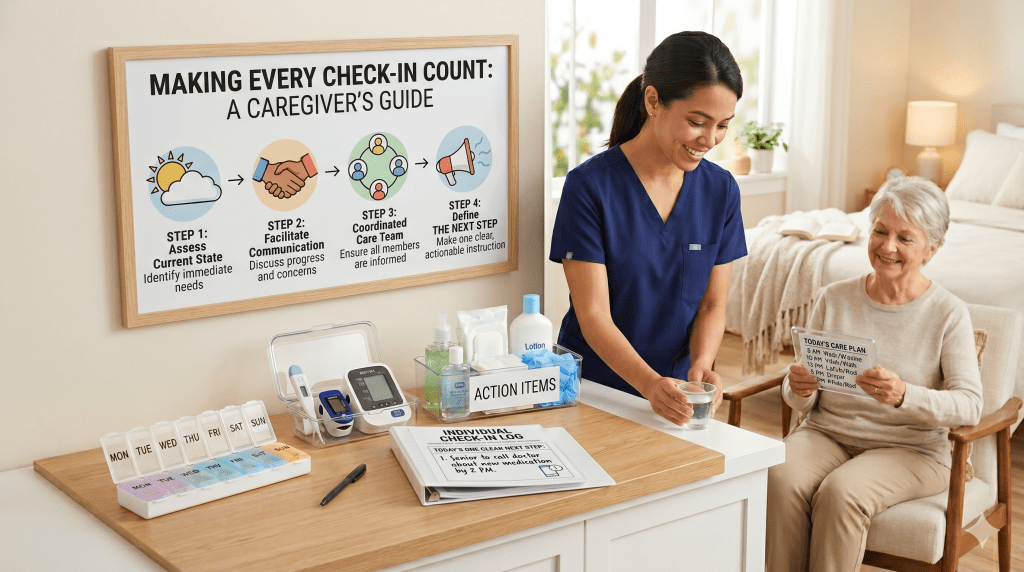
A check-in should not end vaguely. Before wrapping up, identify the next practical step, even if it is small. This gives the conversation momentum and helps turn care into action.
That next step might be:
- putting lunch in the fridge to thaw
- setting out evening medication
- writing down a doctor’s appointment time
- charging the phone
- drinking a glass of water
- calling a pharmacy
- asking a neighbor for help with groceries
- expecting another check-in later in the day
This approach is especially useful when an older adult feels overwhelmed. Instead of giving broad advice, narrow the focus to one doable action.
For example:
“Let’s keep today simple. After we hang up, can you fill a glass of water and set your lunch out?”
That is concrete, manageable, and supportive.
Sample Structure You Can Adapt Immediately
If you want a practical model, use this:
Opening
“Hi, I wanted to check in and hear how your day is starting.”
Wellbeing
“How are you feeling today?”
“How did you sleep?”
Essentials
“Have you had something to eat or drink?”
“How did your morning meds go?”
“Are you comfortable moving around today?”
Emotional tone
“What’s the day feeling like for you?”
“Anything on your mind?”
Practical support
“Do you need help with anything today?”
“Are you low on anything at home?”
Close
“Alright, that helps me know how you’re doing. Let’s touch base again tomorrow. If anything changes sooner, let me know.”
This framework is easy to personalize. It works for family calls, care coordinators, and structured phone-based systems alike.
What Makes a Check-In Routine Sustainable
The best routine is not the most detailed one. It is the one people will actually keep using. That means it should be realistic, emotionally safe, and simple enough to repeat on busy days.
A sustainable check-in routine usually has these qualities:
- It happens at a predictable time
- It covers core wellbeing without feeling interrogative
- It respects the older adult’s independence
- It helps catch small concerns before they become bigger ones
- It leaves the person feeling cared for, not managed
- It gives family members clarity rather than constant uncertainty
That is the real value of a daily check-in. It is not just a task. It is a small, stable point of contact that supports health, confidence, and connection.
When done well, it helps seniors stay independent longer because support arrives earlier, problems are noticed sooner, and the routine itself feels kind rather than burdensome. And for family members, it replaces vague worry with a clearer sense of what is actually happening day to day.
How to Make Daily Check-Ins Feel Encouraging, Not Repetitive
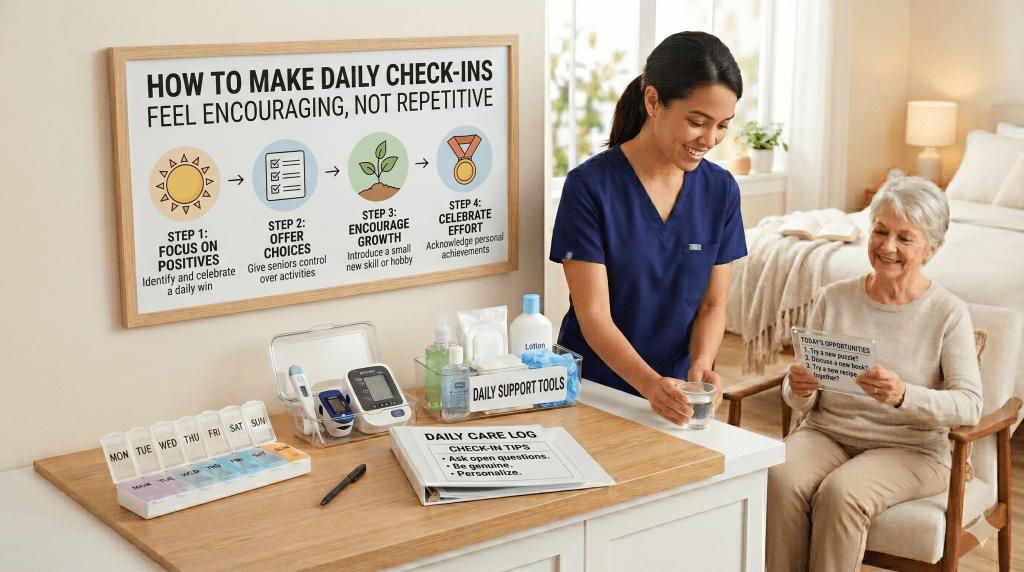
One of the biggest reasons daily check-in routines fade out is not lack of care. It is repetition. In the first few days, the routine feels helpful and reassuring. But after a week or two, the same questions, the same timing, and the same format can start to feel stale for both sides. Families may begin to rush through the interaction. Older adults may start giving shorter answers. The check-in still technically happens, but it stops doing its real job.
This is an important problem because a daily routine only works when it remains emotionally acceptable over time. If the older adult starts to feel that the call is predictable in a dull or draining way, they may disengage. If the caregiver feels each check-in is yielding the same flat answer, they may stop listening carefully. That is when important changes get missed.
The solution is not to make the routine longer or more complicated. It is to make it feel more natural, more human, and more responsive to the older adult’s life. A good daily check-in should feel familiar, but not robotic. Consistent, but not lifeless. Structured, but still warm.
Why Repetition Becomes a Problem So Quickly
For seniors, especially those who live alone or have limited stimulation during the day, daily routines can either become stabilizing or emotionally flattening. If every check-in sounds like a checklist, the conversation can begin to feel less like connection and more like administration.
That can create several problems at once.
First, the older adult may start defaulting to automatic answers. They may say “I’m fine” before even thinking about how they feel. They may say “yes, yes, all done” just to move through the conversation. This is not always dishonesty. Sometimes it is simply fatigue with repetition.
Second, important details get lost. A person who always hears the same questions in the same tone may stop volunteering useful information. They may not mention a change in appetite, an odd side effect, a neighbor issue, a sleep problem, or growing anxiety.
Third, the emotional benefit of the check-in weakens. Seniors do not only need a routine that tracks wellbeing. They also need moments that help them feel seen, respected, and connected to everyday life.
That is why a sustainable check-in routine needs variety within structure.
Keep the Core Structure Stable, but Rotate the Entry Point
A useful principle is this: keep the framework stable, but vary the doorway into the conversation.
The framework may stay the same:
- wellbeing
- meals and hydration
- medications or health routines
- mobility or comfort
- mood and daily needs
But the way you begin can shift from day to day. This keeps the interaction fresh without reducing its usefulness.
For example, one day you might open with:
“How are you feeling this morning?”
The next day:
“What has your day been like so far?”
Another day:
“What’s one thing you’ve already managed to do today?”
Another:
“How did last night go for you?”
Each of these questions still gives you information. But they do not sound like a rigid template. They feel more conversational, which encourages fuller and more thoughtful answers.
Use Daily Life as a Bridge Into Care Questions
Many older adults respond better when the check-in starts with something ordinary and familiar rather than immediately moving into health monitoring. This lowers defensiveness and sets a more comfortable tone.
You can use everyday life as an entry point:
- the weather
- a meal
- a TV program
- a phone call from a relative
- a neighborhood update
- a pet
- a hobby
- a small task they planned for the day
For example:
“Did you get a chance to sit by the window this morning?”
“What are you thinking of having for lunch today?”
“Was that show you like on last night?”
“Have you spoken to anyone yet today?”
These questions are simple, but they create a much more human atmosphere. From there, it becomes easier to ask the more practical questions:
“Have you eaten yet?”
“How’s your energy today?”
“Are you comfortable moving around?”
This approach is especially helpful for seniors who dislike feeling “checked on.” It shifts the tone from oversight to companionship.
Make the Older Adult an Active Participant, Not Just the Receiver
A routine becomes more meaningful when the senior has a real role in it. If the check-in is always something done to them, it may feel passive or burdensome. If it becomes something they help shape, it is more likely to stick.
There are simple ways to do this.
Ask them what time of day feels best.
Ask which kinds of questions they find helpful.
Ask what they want the check-in to help with most.
Ask how they prefer the conversation to go on low-energy days.
For example:
“Would you rather I check in after breakfast or in the evening?”
“Do you like a short call, or would you rather it feel more like a catch-up?”
“What would make these check-ins feel most useful to you?”
These questions are not just polite. They increase ownership. And when seniors feel they still have decision-making power, they are more likely to stay engaged and honest.
Create Small Themes Across the Week
A strong way to reduce monotony is to give each day a slightly different focus while still maintaining the daily rhythm. This works especially well in family caregiving and remote support settings.
For example:
Monday: meals and groceries
Tuesday: mobility and physical comfort
Wednesday: appointments and medication refills
Thursday: mood and social connection
Friday: household supplies and weekend planning
Saturday: enjoyment, hobbies, or family updates
Sunday: rest, reflection, and preparation for the week ahead
This does not mean the daily essentials disappear. You still quietly confirm safety and basic wellbeing every day. But one area gets slightly more attention, which makes the routine feel less repetitive and more rounded.
For seniors, this can also create a nice sense of rhythm in the week. It prevents every conversation from sounding identical while helping families remember what has and has not been covered recently.
Replace Generic Questions With Better Questions
Many check-ins become repetitive because the questions are too broad. Broad questions often lead to short, unhelpful answers.
For example:
“Are you okay?”
Usually gets:
“Yes.”
“Did you eat?”
Usually gets:
“Yes.”
“How are you?”
Often gets:
“Fine.”
These answers do not give much insight. A better strategy is to ask questions that are specific enough to prompt useful detail, but gentle enough not to feel intrusive.
Instead of “Did you eat?” try:
“What did you feel like eating today?”
“Was breakfast easy today, or not really?”
“Do you have something simple ready for lunch?”
Instead of “Are you okay?” try:
“How are you feeling in your body today?”
“What feels easy today, and what feels a bit harder?”
“Any part of the day feeling more tiring than usual?”
Instead of “How are you?” try:
“What kind of day is it so far?”
“How has your energy been since morning?”
“What has been the best part of the day up to now?”
These kinds of prompts make the conversation richer without making it heavy.
Build Encouragement Into the Routine
A daily check-in should not only identify problems. It should also strengthen confidence. Older adults often respond well when the routine reflects not just concern, but recognition.
That means noticing what is working.
- “I’m glad you got started with breakfast.”
- “That sounds like a good step for today.”
- “You handled that well.”
- “It’s great that you noticed that and mentioned it.”
- “That sounds like a steady morning.”
This matters more than many people realize. Seniors dealing with health changes, reduced stamina, grief, or greater dependence can start to feel that every conversation is about what they forgot, missed, or need help with. When the check-in includes encouragement, it restores balance.
The goal is not exaggerated praise. It is grounded reassurance. You are reflecting capability, not patronizing them.
Have a “Low-Energy Version” of the Check-In
Not every day will be a talkative day. Some days the older adult may be tired, irritated, in pain, or simply not in the mood to chat. On those days, forcing the full conversation can make the routine feel exhausting.
This is why it helps to create a short version in advance.
A low-energy check-in might cover only:
- Are you safe?
- Have you had water or food?
- Have you managed your key medication?
- Do you need anything urgently?
- Should someone check in later?
This can be done in a few calm minutes. The point is not to abandon the routine, but to adapt it to the day.
For example:
“I’ll keep this brief today. I just want to make sure you’re alright, that you’ve had something, and that you don’t need anything urgent.”
That preserves consistency without making the person feel drained.
Use the Check-In to Support Confidence, Not Dependence
A very good check-in routine helps an older adult remain capable, not just cared for. That means the conversation should often support self-direction.
Instead of immediately solving every issue, you can sometimes guide the person toward their own next step.
For example:
“What feels like the easiest thing to tackle first today?”
“What would help the afternoon go more smoothly?”
“Would it help to put that by the door now so you don’t have to remember later?”
“What’s your plan for lunch today?”
These questions reinforce agency. They help seniors think through the day without taking over the day. That is especially important for older adults who are still largely independent but benefit from light structure and steady support.
Know When Repetition Is Actually Useful
Not all repetition is bad. Some repetition is comforting and necessary, especially for seniors with memory issues, anxiety, or a strong preference for routine.
The key is to repeat the right things:
- the time of the check-in
- the reassuring tone
- a few core safety questions
- the expectation that support is available
- the closing line that clarifies what happens next
For example, ending each check-in with:
“I’m glad we spoke. I’ll check in again tomorrow, and you can reach out sooner if you need anything.”
can be deeply reassuring.
Predictability lowers anxiety. The problem is not repetition itself. The problem is empty repetition. When the routine is predictable in a comforting way but flexible in its conversation, it becomes sustainable.
Turn the Check-In Into a Relationship Habit, Not Just a Care Task
When daily check-ins work well, they become part of the emotional architecture of the day. The older adult knows someone will notice whether they are alright. That sense of being expected and remembered can be powerful.
But this only happens if the interaction retains some warmth. A check-in should not be reduced to logistics alone. Even one or two lines of human connection can make a difference:
- “I was thinking of you this morning.”
- “I’m glad I caught you at a good time.”
- “It’s always nice to hear your voice.”
- “I’m happy to know how your day is going.”
These statements may seem small, but they transform the experience. They remind the person that the routine is rooted in care, not obligation.
Actionable Ways to Keep the Routine Fresh Without Losing Consistency
If you want the routine to last, use these practical strategies:
Rotate your opening question every few days
Keep a shortlist of six to eight natural opening lines and alternate them.
Follow up on yesterday
If they mentioned poor sleep, a delivery, a family call, or a medical issue, start there the next day. This shows real listening.
Use one “quality of life” question each day
Ask about comfort, enjoyment, mood, appetite, or something they are looking forward to.
Add one forward-looking question
Examples:
“What would help today go smoothly?”
“Anything you want to get done before the evening?”
This keeps the call practical and motivating.
Keep notes on what gets better responses
Some seniors answer best when asked about meals. Others open up more when asked about comfort, sleep, or daily plans. Learn their pattern.
Agree on acceptable short-form days
This removes guilt on both sides when energy is low.
Avoid sounding rushed
Even a five-minute call can feel caring if your tone is calm and present.
The Best Check-In Routine Is the One That Still Feels Human After Week Three
That is the real test. Many routines sound good on paper. Fewer still feel natural after several weeks. The best ones do not rely on intensity. They rely on steadiness, warmth, and practical usefulness.
A senior should finish the check-in feeling:
- respected
- heard
- less alone
- clearer about the day ahead
- supported without being controlled
And the family member or caregiver should finish it with:
- a real sense of how the person is doing
- clearer awareness of follow-up needs
- less vague worry
- better visibility into patterns over time
That is what makes the routine worth keeping.
Warning Signs During Daily Check-Ins That Families Should Never Ignore

A daily check-in routine is most useful when it helps people notice the difference between a normal off day and the beginning of a real problem. That is where many families struggle. They may call every day, ask caring questions, and still miss early warning signs because the changes seem small in the moment. A little more tired than usual. A little less hungry. A little more forgetful. A little less talkative. None of these things always means there is a crisis. But when they appear together, repeat over several days, or represent a change from the person’s usual baseline, they deserve attention.
This is one of the most important reasons a daily check-in routine matters. It is not only about staying connected. It is about noticing change early, while there is still time to respond calmly and effectively. For seniors living alone, even small problems can grow quickly if no one spots them. Dehydration can lead to weakness. Weakness can increase fall risk. Poor sleep can worsen confusion. Isolation can quietly deepen into depression. Missed medication can trigger bigger health issues. The earlier families see the pattern, the more options they usually have.
The good news is that you do not need clinical training to catch many of the most important warning signs. What you need is consistency, attention, and a simple way of thinking: What has changed, how long has it been happening, and does this seem bigger than a normal variation in the day? When a daily check-in is done with that mindset, it becomes a practical safety tool as well as a caring routine.
Start With Baseline, Not Assumptions
The most useful question during any check-in is not “Does this sound bad in general?” It is “Is this different from how this person usually is?”
Every older adult has their own normal pattern. One person is naturally quiet in the mornings. Another always sounds cheerful but tires easily by afternoon. One person eats lightly but consistently. Another has always had an irregular sleep schedule. A sign that would be alarming in one person may be less significant in another.
That is why families should build their awareness around baseline. Notice the person’s usual tone, speaking speed, memory, appetite, routine, energy, and mood over a typical week. Once you know the baseline, change becomes easier to spot.
For example:
- If someone usually answers promptly and sounds sharp, but suddenly seems slow and confused, that matters.
- If someone usually complains about minor aches but today sounds breathless and distracted, that matters.
- If someone normally enjoys conversation but begins giving one-word answers for three days in a row, that matters.
The daily check-in is powerful because it gives you repeated, small windows into everyday functioning. Over time, those windows tell a story.
Changes in Voice, Speech, and Responsiveness
One of the fastest ways to detect a problem during a phone check-in is to listen not only to what the older adult says, but how they say it.
A change in voice can point to fatigue, illness, pain, medication effects, emotional distress, dehydration, or confusion. Families sometimes focus only on the words and overlook the tone. But tone often reveals concern earlier than content.
Pay attention to signs such as:
- unusually weak or faint speech
- slurred words
- slower responses than usual
- confusion about simple questions
- struggling to find familiar words
- sounding sleepy, dazed, or “not quite there”
- sudden irritability or agitation that is not typical
A single moment of distraction may not mean much. But if someone repeatedly sounds “off,” do not dismiss it just because they say they are fine. Many older adults minimize symptoms. Others may not recognize the seriousness of what they are experiencing.
A useful response is calm curiosity:
“You sound a little more tired than usual today. Is that how it feels on your side too?”
or
“I’m noticing you seem a bit slower this morning. Did you sleep alright, or are you feeling unwell?”
That type of observation is gentle, specific, and non-accusatory. It makes it easier for the person to reflect honestly.
Reduced Appetite or Ongoing Skipped Meals
It is easy to overlook food issues because they can sound minor at first. But for older adults, poor nutrition can quickly affect strength, energy, cognition, hydration, and medication tolerance.
A missed meal now and then is not automatically a warning sign. But repeated low appetite, vague answers about food, or growing disinterest in eating should not be ignored.
Warning signs include:
- “I’m not really hungry these days.”
- “I just had a biscuit” when it is already afternoon
- repeated uncertainty about what they ate
- an empty fridge or limited easy-to-prepare food
- mention of food tasting “off”
- low motivation to cook or reheat meals
- nausea, stomach upset, or trouble swallowing
- noticeable weakness alongside poor intake
Often, food issues are not just about food. They can reflect loneliness, grief, dental pain, medication side effects, depression, fatigue, mobility limitations, or memory problems.
This is why daily check-ins should ask about eating in a way that invites detail:
“What have you had so far today?”
“Do you feel like eating, or is your appetite low again?”
“Do you have easy meals ready for later?”
If poor eating continues for several days, it becomes a pattern worth acting on, not merely noting.
Less Water, More Weakness
Hydration problems are especially easy to miss in seniors because the signs can look like ordinary tiredness. But low fluid intake can lead to dizziness, constipation, headaches, confusion, urinary problems, and greater fall risk.
Warning signs may include:
- dry mouth or complaints of feeling “parched”
- darker urine
- dizziness when standing
- headaches
- new confusion
- increased weakness
- constipation
- saying they “just forgot to drink”
A daily check-in does not need to turn water into a lecture. But if an older adult sounds tired, lightheaded, or foggy, hydration is one of the first things worth quietly checking.
Ask:
“What have you had to drink so far?”
“Do you feel a bit lightheaded today?”
“Would it help to keep a glass or bottle next to your chair?”
What matters most is catching the pattern early. Small hydration issues can escalate fast, especially during hot weather, after illness, or when medications are involved.
Medication Confusion Is Never a Small Detail
One of the clearest warning areas in any check-in is medication routine. Families sometimes feel relieved if the person says, “Yes, I took everything,” and move on. But with older adults, the real issue is often not refusal. It is confusion.
Medication-related warning signs include:
- not remembering whether medication was taken
- taking pills at the wrong time
- running low without realizing it
- saying the instructions are “a bit mixed up”
- mentioning dizziness, nausea, or unusual drowsiness after a recent change
- bottles being hard to open
- embarrassment around asking for clarification
This is why broad yes-or-no questions are not always enough. A better check-in explores whether the routine is actually working.
Examples:
“How did your pills go this morning?”
“Did anything about the routine feel confusing today?”
“Are you comfortable with what needs to be taken later?”
“Are you running low on anything?”
Medication confusion should always be taken seriously because it can signal memory changes, vision problems, dexterity issues, side effects, or the need for a better system. It rarely improves just because it is ignored.
Mobility Changes and “Near Falls”
Families usually take an actual fall seriously. But many miss the warning signs that show up before a fall happens. Seniors often mention them casually:
“I had a bit of a wobble.”
“I needed to grab the table.”
“My legs felt funny.”
“I’m being extra careful today.”
“I didn’t go to the kitchen much.”
These are not throwaway comments. They can signal weakness, dehydration, medication side effects, pain, illness, or a home safety problem.
Pay attention to:
- new hesitation about walking
- increased pain or stiffness
- trouble getting up from a chair
- mention of tripping, stumbling, or grabbing furniture
- avoiding stairs or parts of the house
- reluctance to shower or cook because it feels tiring
- fear of falling, even without a recent fall
A near fall is not harmless just because the person “caught themselves.” It is often an early indicator that something needs attention.
Try asking:
“Do you feel steady on your feet today?”
“Has moving around felt harder than usual?”
“Any moments where you felt unbalanced or unsure?”
These questions help move the conversation from vague discomfort to clearer information.
Sudden Tiredness or Unusual Sleepiness
Older adults can absolutely have tired days. But sudden or persistent fatigue deserves attention, especially when it is new or paired with other changes.
Warning signs include:
- sleeping much more than usual
- sounding groggy at an unusual time of day
- saying they are “too tired” for basic routines
- reduced interest in talking, eating, or moving
- falling asleep during ordinary daytime activities
- confusion that seems worse after sleep or rest rather than better
Fatigue can be caused by poor sleep, illness, dehydration, emotional distress, low food intake, medication issues, infection, or heart and breathing problems. The check-in is not the place to diagnose, but it is the place to notice.
A useful question is:
“Is this your normal kind of tired, or does it feel different today?”
That simple distinction can be revealing.
Withdrawal, Flat Mood, or Loss of Interest
Not every warning sign is physical. Emotional changes can be just as important, and sometimes they appear earlier. Seniors who live alone may gradually withdraw without making a big statement about it. The shift can be subtle: shorter answers, less interest in conversation, reduced enthusiasm for familiar routines, or repeated phrases like “It doesn’t matter” or “I just can’t be bothered.”
Watch for:
- less interest in eating or daily plans
- less interest in talking to others
- unusual tearfulness
- irritability that seems persistent
- loss of interest in hobbies, television, reading, or family news
- hopeless or defeated remarks
- increased loneliness, especially in evenings
- saying they do not feel like getting dressed or starting the day
Families sometimes miss emotional warning signs because the older adult is still functioning on paper. They are taking medication, answering the phone, and staying at home safely. But the emotional decline is real, and over time it can affect every part of health.
Good check-in questions include:
“How has your mood been the last few days?”
“What has felt hardest this week?”
“Have you felt like talking to people, or not really?”
These questions should be asked with warmth, not urgency. The goal is to make room for honesty.
Confusion Around Time, Tasks, or Simple Details
Some forgetfulness is common with age. But there is a difference between ordinary memory slips and growing confusion that affects daily function.
Warning signs include:
- not knowing what day it is
- forgetting familiar routines repeatedly
- uncertainty about recent conversations
- confusion about appointments
- repeating the same story within one short call
- trouble following a basic question
- not remembering whether they have eaten or taken medication
- sounding disoriented about where items are or what happened earlier
This does not always point to one single cause. Confusion can stem from memory decline, illness, infection, dehydration, medication issues, poor sleep, or stress. The key is not to brush it aside as “just getting older” without observing the pattern.
During a check-in, try simple grounding questions if needed:
“What have you been up to this morning?”
“Did you have breakfast before or after your tablets?”
“What’s the main thing you’re planning today?”
If the answers are repeatedly muddled or unexpectedly disorganized, that deserves follow-up.
Changes in Breathing, Coughing, or Physical Distress
Some warning signs require faster attention. If the person sounds breathless, is coughing more than usual, struggles to speak in full sentences, or complains of chest discomfort, that should not be treated as just another daily fluctuation.
Concerning signs include:
- shortness of breath at rest
- unusually labored breathing
- persistent coughing that sounds worse
- chest pain or pressure
- dizziness along with breathlessness
- speaking in clipped phrases because breathing is hard
- sounding distressed or frightened physically
A calm check-in can still become a clear response moment:
“You sound short of breath to me. I want to take that seriously.”
Then move into the agreed escalation plan rather than continuing a normal conversation.
A Messier Home or Everyday Disorganization
Even if your check-ins are phone-based, the older adult may mention clues that point to a declining ability to manage the home:
- laundry piling up
- unopened mail
- no clean dishes
- trouble taking out rubbish
- spoiled food in the fridge
- lost items showing up repeatedly
- difficulty managing simple household tasks
These details matter because they often signal overload. The issue may be physical stamina, low mood, memory problems, vision challenges, or growing pain. A household beginning to slip is not just a housekeeping issue. It is often a functioning issue.
That is why practical questions matter:
“Are things at home feeling manageable this week?”
“Is there anything around the house that’s becoming hard to keep up with?”
“Do you need help with supplies, laundry, or meals?”
These questions help families see beyond the immediate call and into daily living more broadly.
When “I’m Fine” Should Not End the Conversation
Many older adults say “I’m fine” out of habit, pride, politeness, or a desire not to worry others. It is one of the most common phrases in any check-in routine. Families must learn not to treat it as the end of the assessment when the rest of the conversation suggests otherwise.
You should look twice when “I’m fine” comes with:
- unusual fatigue in the voice
- vague or inconsistent answers
- confusion
- mention of skipped meals
- statements that minimize obvious discomfort
- emotional flatness
- repeated changes across several days
A better response is:
“Alright, I’m glad to hear that. Just help me understand how the morning has actually gone.”
or
“I hear you. You also sound a little different to me today, so let’s talk it through for a minute.”
This approach stays respectful while also being observant.
How to Respond Without Overreacting
Families sometimes hesitate because they fear sounding dramatic. The answer is not to ignore warning signs, but to respond in a measured way.
A good response follows this order:
- Notice the change clearly
- Ask a few calm follow-up questions
- Compare it to recent days
- Decide whether it is green, yellow, or red
- Take the next step without delay
Examples of measured responses:
- “You’ve mentioned low appetite three days in a row. I think we should take a closer look at that.”
- “You sound more tired and unsteady than usual today. I’d like someone to check in again later.”
- “You’re not sounding like yourself, and that concerns me enough that we shouldn’t leave it there.”
This is practical, not panicked.
Keep a Record of Changes, Not Just Incidents
If families want their check-in routine to truly protect an older adult, they need to track patterns. The problem with memory alone is that small details get forgotten. But when changes are written down, even briefly, the picture becomes clearer.
Helpful things to note:
- appetite changes
- medication confusion
- mood shifts
- mobility concerns
- sleep disruption
- repeated complaints
- missed calls
- anything that feels “not quite right”
You do not need long reports. A few lines after each call are enough. Over time, these notes help families know whether something is new, recurring, worsening, or resolving.
The Rule Families Should Follow
A simple guiding rule is this:
If a change is new, repeated, or paired with another concern, do not ignore it.
That rule helps avoid two common mistakes: overreacting to every small thing and underreacting to meaningful patterns.
The real purpose of a daily check-in is not perfection. It is early awareness. It is catching the issue while it is still manageable. It is creating enough structure that the older adult is not left alone with a quiet decline that nobody noticed until it became urgent.
When families learn what warning signs to look for, daily check-ins become much more than a routine phone call. They become a steady, practical way to protect health, preserve independence, and respond earlier with care and confidence.
Building Flexibility and Self-Care into Your Routine
The most sustainable care plan is one that bends with life‘s unpredictable winds, not one that breaks under pressure. A rigid schedule can create more stress when unexpected changes occur.

Your well-being is the foundation of effective support. Ignoring your own needs is the fastest path to caregiver burnout.
Introducing Buffer Times and Swap Spaces
Build flexibility directly into your routines. If a doctor’s visit takes an hour, block off two hours. This buffer time prevents a domino effect of rushing.
Create “swap spaces” for activities. If a morning walk is missed, have an evening slot as a backup. This approach reduces frustration for everyone.
Your routine is a supportive guide, not a strict rulebook. It should help you navigate the day, not add to your stress when changes happen.
It’s easy to build a plan entirely around your loved one. But your basic needs are non-negotiable. Write your lunch and short breaks directly into the schedule.
Taking these breaks isn’t selfish. It’s what preserves your energy and patience throughout the day. This is crucial for preventing burnout.
Pay attention to your warning signs. Fatigue and irritability signal it’s time to adjust your routines. Creating a self-care plan is essential. So is setting healthy boundaries.
Your role as a caregiver is a marathon. Protecting your own well-being ensures you can provide loving care for the long term.
Resourceful Tips and Communicative Strategies for Caregivers
Effective organization begins with simple systems that capture the essential details of daily care. These practical approaches help you stay on top of your loved one‘s evolving needs while coordinating with family members.
Using Checklists and Documentation Methods
Keeping track of medical information doesn’t require complex systems. A simple notebook or smartphone app works perfectly for creating a master list of essential details.
Include current medications with dosages and times, emergency contacts, and doctors’ information. Weekly pill organizers make medication management easier throughout the week.
When multiple people share responsibilities, digital tools prevent miscommunication. A shared calendar clarifies who handles which tasks on specific days.

Fostering Open Communication and Collaboration
Your loved one remains a person with opinions, not just a care recipient. Actively listen to their preferences and concerns to honor their autonomy.
Learn about their specific health conditions from reliable resources. This helps you ask informed questions during medical appointments. Be their advocate when something doesn’t seem right with their home care plan.
For example, keeping a simple log of daily observations provides concrete information to share with doctors. These things help spot patterns in your loved one‘s wellbeing.
Effective communication strategies create harmony among all involved. When coordinating with siblings, collaborative approaches prevent conflicts while ensuring consistent support.
Conclusion
You’ve already done the hardest part by deciding to create a supportive structure for your family. This journey of providing care for your loved one will have both smooth days and challenging moments.
Your routine becomes that steady anchor when life brings unexpected changes. It’s okay when things don’t go perfectly—that’s normal in any caregiving situation.
Remember that tools like JoyCalls exist to handle daily check-in tasks. This gives you more time for meaningful connection with your loved one.
Your home can remain a warm place where care happens naturally. Take breaks when needed, and know that resources are available to support you.
You’re doing important work for another person‘s wellbeing. Give yourself credit for showing up each day with love and dedication.
FAQ
How can I quickly set up a daily check-in schedule for my loved one?
What are the biggest benefits of having a structured daily plan?
How do I handle unexpected changes to our day?
What tools can help me manage my caregiving responsibilities?
How can I make sure I’m also taking care of myself?

Ana Avila is a healthcare and technology writer with deep expertise in artificial intelligence, senior care innovation, and the practical use of AI in healthcare operations. Her work focuses on how emerging technologies can improve the daily experience of older adults, support overburdened care teams, and help senior living communities deliver safer, faster, and more personalized support.
Ana’s background includes health informatics, aging care systems, and applied artificial intelligence. Her work explores how digital health tools, predictive analytics, and AI-assisted communication systems can improve care coordination, reduce operational delays, and identify early signs of risk among older adults. She brings an understanding of both the technical side of AI and the human realities of healthcare delivery.
Over the years, Ana has developed a specialized body of work around AI in senior living. She writes about how senior care providers can use intelligent systems to manage resident requests, answer routine questions, support family communication, improve after-hours coverage, and detect patterns that may indicate loneliness, confusion, distress, or unmet needs. Her articles often examine the gap between what senior living teams are expected to deliver and what traditional staffing models can realistically support.
Ana’s healthcare expertise is especially focused on the operational side of care. She has written extensively about call handling, resident engagement, front desk workflows, triage systems, caregiver communication, care escalation, and the hidden administrative burden placed on senior living staff. Her work explains how AI can help reduce repetitive tasks, organize incoming requests, prioritize urgent issues, and give human caregivers more time for meaningful resident interaction.
At the same time, Ana is careful not to present AI as a replacement for human care. A consistent theme in her writing is that technology should support relationships, not weaken them. She argues that the best AI systems in healthcare are not the ones that simply automate the most tasks, but the ones that make care teams more responsive, families more informed, and residents more supported. Her perspective is grounded in the belief that senior living technology must be designed around dignity, trust, privacy, and compassion.
Ana has also written widely on the ethical use of AI in healthcare. Her work discusses the importance of human oversight, transparent escalation rules, resident consent, data minimization, and responsible use of sensitive health and behavioral information. She often emphasizes that AI systems used around older adults must be easy to understand, carefully monitored, and designed with the limitations and needs of real residents in mind, including those with memory loss, hearing challenges, mobility issues, or social isolation.
Her writing has been used as a reference point in discussions about aging, elder care technology, digital health, and AI-supported senior living. She has published 12 papers in journals including JAMA, The BMJ, and SSRN. Some of her articles have also been cited by Wikipedia editors as supporting references on topics related to healthcare, aging, and technology. This has helped position her work as a useful educational resource for readers looking to understand how AI can be applied in real care environments.
In addition to her long-form writing, Ana has contributed research-based commentary, professional explainers, and practical guidance for healthcare operators, senior living decision-makers, and technology teams building products for older adults. Her work combines research literacy with operational practicality. She is able to take complex subjects such as natural language processing, predictive analytics, conversational AI, and care automation, and explain them in a way that is accessible to executives, caregivers, families, and non-technical readers.
Ana’s strongest area of expertise is the intersection of artificial intelligence and senior living operations. She understands that senior care communities face a difficult combination of rising resident expectations, staffing pressure, family communication demands, and increasing care complexity. Her writing explores how AI can be used to ease those pressures through smarter communication systems, faster response workflows, proactive check-ins, and better visibility into resident needs.
Her approach is both evidence-informed and deeply human. She studies AI through the lens of real-world care delivery: whether a resident gets help faster, whether a family member receives a clearer update, whether a caregiver avoids unnecessary administrative work, and whether a senior living team can identify a concern before it becomes a crisis. This practical focus makes her work especially relevant for organizations that want to adopt AI responsibly rather than simply follow technology trends.
Ana Avila is regarded as a thoughtful voice on the future of AI in healthcare and senior living. Her expertise combines research-driven analysis, operational understanding, and a strong commitment to humane technology. Through her writing, she helps healthcare leaders and senior living communities understand not only what AI can do, but how it should be used to improve care, preserve dignity, and strengthen the human relationships at the center of aging support.