


Sarah hung up the phone, her heart sinking. Her mom had forgotten their lunch date again. Between work deadlines and her own family, Sarah felt a familiar wave of worry. How could she ensure her mom was safe and happy without being there every moment?
That feeling of being pulled in different directions is something many of us understand. Realizing a parent needs more support is a profound moment. It’s filled with love and concern.
This is where a structured approach can bring immense peace. Think of a weekly schedule not as a restriction, but as a practical tool that organizes support. It brings everything together in one clear place.
This guide is designed to walk you through creating a compassionate framework. It addresses health appointments, daily routines, and social connection. The goal is to honor your loved one’s independence while providing the right help.
As senior living expert Leslie Fuller explains, a family member often becomes the “general contractor” of caregiving. You coordinate a team—doctors, friends, home health aides. A clear plan is your blueprint, keeping everyone aligned and reducing stress for the entire family.
We believe this process is about empowering your senior parent to live their best life. It turns overwhelming worry into manageable steps. Let’s begin this journey together.
Key Takeaways
- A structured schedule brings peace of mind by organizing a parent’s needs.
- This approach acts as a central communication tool for everyone involved.
- The goal is to support independence, not take it away.
- You become the coordinator of a caring team for your aging parent.
- Planning helps ensure safety and improves overall quality of life.
- Breaking the process into steps makes it feel less overwhelming.
Understanding the Importance of a Senior Care Plan
You might worry that creating a formal structure signals a loss of independence. In truth, a thoughtful senior care approach does the opposite. It builds a framework that honors your loved one’s dignity and choices.
This process brings clarity to what can feel like chaos. It helps everyone understand their role, reducing the guilt and confusion you may experience.

Benefits for Both Seniors and Caregivers
For your parent, having preferences documented means their voice is always heard. Consistency in daily routines provides comfort. They gain security knowing a supportive framework exists.
For you, the benefits are profound. This organization reduces stress and improves time management. It builds your confidence in providing excellent quality of life support. You regain the ability to balance your responsibilities.
Enhancing Communication and Coordination
A documented strategy becomes a single source of truth. It prevents misunderstandings between family members. You won’t have to repeat details to every health provider.
Coordination becomes seamless. Everyone—from family to professionals—stays aligned. Following clear guidelines for this teamwork is essential.
“A care plan helps the primary caregiver understand that they don’t have to be the only resource for their loved one. It can defuse anxiety and a sense of overwhelm.”
This preparation gives you the confidence to handle unexpected situations. The planning process itself can even strengthen family bonds as you unite with a shared purpose.
Assessing Your Loved One’s Needs and Daily Routines
Before creating any schedule, take time to observe and learn about your loved one’s current rhythm. This assessment isn’t about finding faults—it’s about understanding where support can enhance their quality of life.

Evaluating Health, Mobility, and Daily Activities
Start by gently discussing daily activities like bathing, dressing, and meal preparation. Notice if mobility needs extra attention around the home.
Watch for a few days to see patterns. Are nutritious meals being eaten regularly? Is medication management consistent?
This observation helps identify where assistance would be most helpful. It reveals gaps in support without judgment.
Documenting Personal Preferences and Medication Management
Your loved one’s preferences matter most. Document their favorite meal times, social activities, and daily routines.
Create a comprehensive medication list. Include prescriptions, dosages, and timing. Note any allergies or swallowing difficulties.
This information ensures their voice guides every decision. It honors their autonomy while providing necessary support.
Remember, needs change over time. Regular check-ins keep your approach current and compassionate.
Creating Your Weekly Elder Care Plan
Rather than seeing this as one enormous project, think of it as creating manageable weekly segments. This approach makes the entire process feel less overwhelming.
Try JoyCalls Free
No app or new device needed. Start with a free 7-day trial.
Step-by-Step Process for a Comprehensive Plan
Start by reviewing the assessment you completed. Organize your loved one’s needs into clear categories like medical, daily living, and social activities.

Next, identify where current support falls short. Compare what’s happening now with what’s actually needed. This gap analysis reveals where additional help is required.
Determine the right mix of support. Consider when family can help versus when professional services might be better. Your parent’s preferences about receiving assistance at home are crucial here.
Finally, develop your written framework. Prioritize health and safety while documenting who handles each task. Creating a comprehensive strategy means including contact information, medication schedules, and emergency protocols.
Use shared digital tools to keep everyone coordinated. Start with a draft and refine it over time. Having something in place is better than waiting for perfection.
Engaging Your Care Team Effectively
Bringing everyone together requires thoughtful planning and a focus on what matters most – your loved one’s wellbeing. Family dynamics can be complicated, but the goal remains clear: create a supportive network that works harmoniously.

Coordinating Family and Professional Support
Your support team includes both family members and professionals. Start by identifying who can help. This might include close family, friends, neighbors, and professional caregivers.
Have honest conversations about willingness and availability. Respect boundaries while exploring possibilities. Each person brings unique strengths to the support system.
Organizing Productive Care Plan Meetings
Schedule a meeting with all team members. Create an agenda and share a draft beforehand. Choose a comfortable setting or video conference option.
During the meeting, keep your loved one’s voice central. As Leslie Fuller suggests, ask open-ended questions like, “What would make your days better?” Then truly listen to their response.
Assign clear responsibilities based on each person’s strengths. This prevents misunderstandings and ensures everyone understands their role. Regular check-ins keep the team aligned and responsive to changing needs.
Utilizing Digital Tools for Care Coordination

Technology might seem like another complication in an already busy life. But the right digital tools can actually simplify caregiving significantly. They bring everyone together in one organized place.
Incorporating Platforms like JoyCalls
Various digital solutions exist to streamline family support. Shared calendars keep appointments organized. Medication reminder apps prevent missed doses. Communication tools keep distant family members informed.
These platforms solve common challenges. They reduce miscommunication between care providers. They track changes in your loved one’s condition over time.
JoyCalls offers a unique solution for busy families. It’s an AI-powered phone companion that makes daily check-in calls. Your parent needs no special app—just their regular phone.
The system has natural conversations about wellbeing. It then sends summaries and alerts to family caregivers. This provides consistent connection when you’re short on time.
JoyCalls integrates seamlessly into your care strategy. It serves as the daily check-in, freeing you for other tasks. Families can get started quickly with this valuable support.
Combining JoyCalls with other digital tools creates a comprehensive system. It addresses both practical needs and emotional connection. This approach brings peace of mind to everyone involved.
Organizing Daily Care Tasks and Schedules
Turning your comprehensive strategy into daily action is where real peace of mind begins. This practical step transforms overwhelming lists into manageable routines that support your loved one’s wellbeing.

Start by breaking down larger goals into specific tasks. Medication management becomes “9 AM pill reminder” and “afternoon dose.” Meal preparation transforms into “Tuesday grocery delivery” and “Thursday soup making.”
Building a Care Calendar and Setting Priorities
Create a visual calendar that shows everything at a glance. Color-coding works beautifully—blue for medical appointments, green for social activities, yellow for household needs.
Prioritize what matters most. Health-related tasks like medication and doctor visits come first. Enjoyable activities like walks or visits can flex based on energy levels.
| Category | Sample Tasks | Priority Level | Best Time of Day |
|---|---|---|---|
| Medical | Medication administration, blood pressure check | High | Morning/Evening |
| Personal Care | Assistance with dressing, bathing support | Medium | Late morning |
| Social & Mental | Phone calls with friends, puzzle time | Flexible | Afternoon |
| Household | Light tidying, meal preparation | Low | When energy permits |
Assigning Responsibilities and Tracking Progress
Divide responsibilities according to each person’s strengths and availability. The neighbor who loves cooking might handle Tuesday dinners. Your sister who’s great with paperwork manages medication lists.
Establish a simple communication system. A shared notebook or group text works perfectly. Note important observations like appetite changes or mood shifts.
Remember that flexibility is key. Some days will flow smoothly while others need adjustment. Your schedule serves as a guide rather than a rigid script.
How to Turn a Weekly Care Plan Into a Real-Life Support System
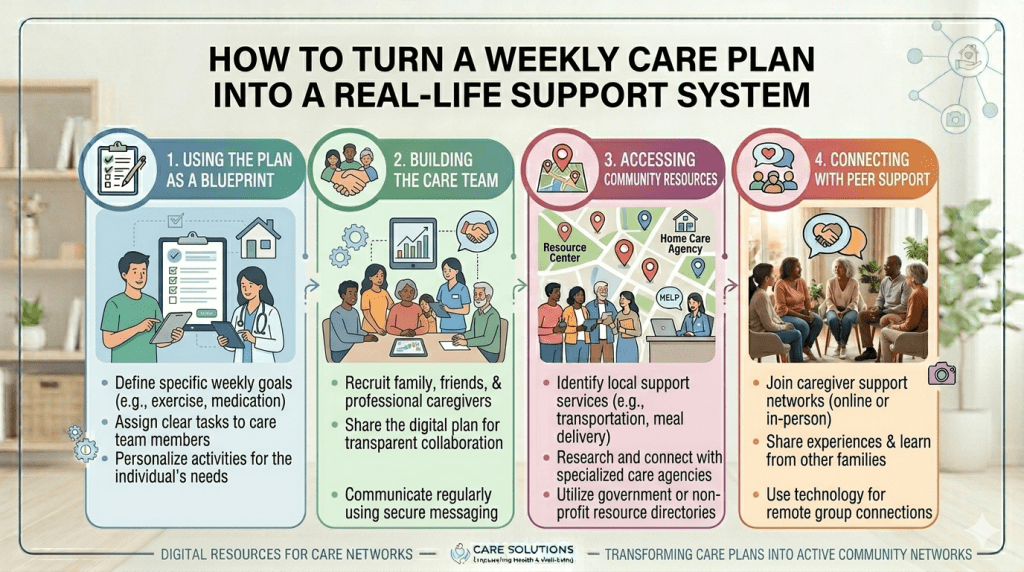
A weekly care plan is only helpful if it works on an ordinary Tuesday afternoon, during a rushed Monday morning, or on a weekend when everyone is tired. Many families create a thoughtful schedule, but then struggle because the plan remains too general. It says “check medications,” “help with meals,” or “call Mom,” but it does not clearly explain what success looks like, who confirms it, or what should happen when something is missed.
That is why the next step is turning the weekly care plan into a simple operating system for your parent’s day-to-day support. This does not need to feel cold or complicated. In fact, the best system is usually calm, respectful, and easy enough for everyone to follow. It gives your parent more predictability. It gives family members fewer last-minute surprises. And it helps caregivers notice small changes before they become urgent problems.
Start Each Week With a 15-Minute Care Review
Before the week begins, choose one consistent time for a short care review. Sunday evening or Monday morning often works well. This does not need to be a formal meeting. It can be a phone call, video call, shared note, or quick family group chat.
The goal is to answer five practical questions:
- What appointments, deliveries, refills, or visitors are scheduled this week?
- What tasks must happen every day, no matter what?
- Where is extra support likely to be needed?
- Who is responsible for each important task?
- What should we watch more closely this week?
For example, if your father has a cardiology appointment on Wednesday, the weekly review should not simply say “doctor appointment.” It should clarify who will drive him, whether lab reports are needed, what questions should be asked, whether medication changes need to be written down, and who will update the rest of the family afterward.
This small habit prevents confusion. It also helps avoid the common problem of everyone assuming someone else has handled the task.
Separate “Must-Do” Tasks From “Good-to-Do” Tasks
Not every care task has the same level of importance. A strong weekly care plan should separate non-negotiable tasks from flexible ones.
Must-do tasks are the items that affect safety, health, or essential daily functioning. These may include medications, hydration, meals, blood pressure checks, wound care, mobility support, hygiene, transportation to medical appointments, and fall-risk precautions.
Good-to-do tasks improve quality of life but can move if needed. These may include organizing drawers, watching a favorite show together, sorting old photos, watering plants, or planning a longer social visit.
This distinction matters because caregiving rarely goes perfectly. Some days your parent may feel tired. A family member may get stuck at work. A professional caregiver may be delayed. When that happens, the plan should make priorities obvious.
For instance, if your mother has low energy on Friday, it may be fine to postpone laundry. But skipping lunch, missing medication, or ignoring dizziness should never be treated as optional. A clear priority system helps everyone make better decisions without panic.
Build the Week Around Energy, Not Just Time
Many care plans are organized by the clock, but older adults often function better when the plan also considers energy levels. A task that looks simple at 4 p.m. may be much easier at 10 a.m. Some seniors feel strongest after breakfast. Others need a slower start and do better after late morning.
Instead of asking, “When can we fit this in?” ask, “When is this easiest and least stressful for my parent?”
Personal care tasks like bathing, dressing, grooming, or physical therapy may require more energy. These should usually be scheduled during the part of the day when your parent feels most alert and steady. Quiet activities such as phone calls, music, reading, puzzles, or light conversation may work better later in the day.
Meal planning should also follow real habits. If your parent eats well at breakfast but loses interest in dinner, the plan may need a more nourishing morning meal and simpler evening options. If they forget to drink water, hydration prompts can be linked to existing routines, such as after brushing teeth, before medication, or during a daily check-in call.
The best weekly plan respects your parent’s natural rhythm instead of forcing them into a schedule that only works for the caregiver.
Create a Simple “If This Happens, Do This” Guide
A weekly care plan should include basic response instructions for common situations. This helps family members, neighbors, and caregivers respond consistently.
You can create a small section called “If This Happens, Do This.” Keep it simple and specific.
For example:
If Mom does not answer the phone:
Call once more after 10 minutes. If there is still no answer, call the neighbor. If the neighbor cannot reach her, contact the assigned family member.
If Dad says he feels dizzy:
Ask if he is sitting down. Encourage him not to walk alone. Check whether he has eaten, had water, or taken new medication. Contact the primary caregiver if dizziness continues or feels unusual.
If medication was missed:
Do not guess or double the next dose. Check the medication instructions and call the pharmacist or doctor if unsure.
If there is a fall:
Do not rush to lift the person immediately. Check for pain, confusion, bleeding, or difficulty moving. Call emergency services if there is any concern.
This guide is not a replacement for medical advice. It is a practical decision-support tool. It reduces hesitation during stressful moments and keeps everyone from improvising differently.
Assign One Person to Own the Weekly Plan
A care plan can involve many people, but one person should be responsible for keeping the plan updated. This does not mean that person does all the caregiving. It simply means they maintain the “single source of truth.”
This person should update medication changes, appointment notes, caregiver schedules, emergency contacts, dietary changes, and any new concerns. Without one owner, care information can become scattered across text messages, notebooks, emails, and memory.
The plan owner should also remove outdated information. Old instructions can be risky. If a medication dose changes, the previous dose should not remain visible in a way that causes confusion. If a caregiver is no longer available on Thursdays, the schedule should reflect that immediately.
A clean, current plan is safer than a detailed but outdated one.
Use a Weekly Observation Log
A weekly care plan should not only list tasks. It should also help you notice patterns. Many important changes in older adults happen gradually. A parent may not suddenly stop eating; they may slowly eat less over several days. They may not announce that walking is harder; they may simply avoid moving around as much.
Create a simple observation log with a few categories:
- Appetite
- Mood
- Sleep
- Mobility
- Medication completion
- Hydration
- Pain or discomfort
- Social engagement
- Memory or confusion
- Unusual incidents
The log should be quick to fill out. A few words are enough: “ate half lunch,” “seemed cheerful,” “more tired than usual,” “complained of knee pain,” or “forgot morning call.”
At the end of the week, review the notes. One difficult day may not mean much. But repeated changes deserve attention. If your parent has eaten poorly four days in a row, skipped social activities, or seemed more confused in the evenings, the care plan may need to change.
This type of tracking is especially helpful when speaking with doctors. Instead of saying, “She seems worse lately,” you can say, “Over the last two weeks, she has eaten less at dinner, slept more during the day, and seemed confused after 6 p.m. on five different evenings.” That gives professionals clearer information.
Make Meals and Hydration Easier to Complete
Food and fluids are often included in care plans, but many families underestimate how much planning they require. A senior may skip meals because cooking feels tiring, groceries are low, chewing is uncomfortable, appetite is reduced, or eating alone feels unpleasant.
A more useful weekly plan should specify exactly how meals will happen.
For example:
- Who checks groceries?
- Which meals are already prepared?
- What easy foods are available if cooking feels too hard?
- Are there snacks near the chair or bedside?
- Does the parent need reminders to drink water?
- Are there dietary restrictions from the doctor?
- Are meals enjoyable, or just technically “healthy”?
Try creating a weekly meal support plan instead of only a meal plan. This means thinking beyond the menu. If your parent enjoys soup, prepare small portions that are easy to heat. If they forget lunch, schedule a midday call. If they dislike drinking plain water, ask the doctor whether suitable alternatives like herbal tea, infused water, or broth are appropriate.
The goal is not to control every bite. The goal is to remove barriers so eating and drinking become easier, safer, and more pleasant.
Add Social Connection as a Planned Care Task
Social connection should not be treated as an optional extra. For many older adults, loneliness can affect mood, motivation, appetite, and overall quality of life. A weekly care plan should include meaningful interaction, not just medical and household tasks.
This does not always require long visits. Short, predictable moments can be powerful. A daily phone call, a neighbor stopping by twice a week, a grandchild sharing a photo, a faith community visit, or a regular conversation about a favorite topic can all help your parent feel remembered and included.
Make the plan specific. Instead of writing “social time,” write:
- Monday: call with daughter after lunch
- Tuesday: neighbor visit for tea
- Wednesday: church group call
- Friday: video call with grandchildren
- Sunday: family meal or longer check-in
Also consider your parent’s personality. Some seniors enjoy group activities. Others prefer one-on-one conversations. Some like structured activities, while others simply want someone to listen. A respectful plan should reflect what connection feels like to them, not what others assume they should enjoy.
Plan for Caregiver Backup Before It Is Needed
Every weekly care plan should include backup coverage. Even the most committed caregiver can become sick, delayed, overwhelmed, or unavailable. Without a backup plan, one missed visit can create unnecessary risk.
For each essential task, identify a backup person or backup method. If your sister usually handles grocery delivery, who handles it when she is traveling? If a neighbor checks in on Tuesday, who covers if they are unavailable? If you usually call every evening, what happens when work runs late?
Backup planning is especially important for:
- Medication reminders
- Meal support
- Transportation
- Mobility assistance
- Post-hospital care
- Overnight concerns
- Emergency response
- Daily check-ins for seniors living alone
Keep backup instructions visible and simple. Include names, phone numbers, availability, and what each person is comfortable doing. Do not assume relatives, friends, or neighbors can help in every situation. Ask clearly and document their role.
This protects your parent, but it also protects caregivers from feeling trapped or guilty.
Keep the Plan Respectful and Collaborative
A care plan should never make your parent feel managed like a project. Even when support is necessary, dignity matters. Include your parent in decisions as much as possible. Ask what routines they want to keep. Ask what kind of help feels comfortable. Ask what feels intrusive.
For example, your parent may resist a daily “safety check” but welcome a daily call to talk about the weather, a favorite show, or what they had for breakfast. They may dislike being reminded about medication in a commanding tone but respond well to a gentle routine: “I’m making tea now. Is this a good time for your evening pills too?”
Language matters. Replace “You have to” with “Would it help if…” or “Let’s make this easier.” Replace “checking up on you” with “checking in with you.” Replace “care tasks” with “support for the week” when speaking directly with your parent.
The plan should support independence, not erase it.
Review What Worked at the End of the Week
At the end of each week, take a few minutes to review the plan. This is where the system improves.
Ask:
- Which tasks happened smoothly?
- Which tasks were missed or delayed?
- Did anything feel stressful for your parent?
- Did any caregiver feel overloaded?
- Were there changes in mood, appetite, mobility, or memory?
- Does next week need more support, less support, or different support?
Keep the review practical, not judgmental. The point is not to blame anyone. The point is to learn from real life.
For example, if morning medication was missed twice, the answer may not be “try harder.” A better solution may be using a pill organizer, changing the reminder time, connecting the dose with breakfast, asking the pharmacy about packaging options, or adding a daily phone reminder.
If your parent skipped bathing because it felt exhausting, the answer may not be more pressure. It may be adjusting the time of day, adding bathroom safety equipment, warming the room, simplifying clothing, or asking whether pain or fear of falling is involved.
A good weekly care plan becomes stronger because the family keeps learning.
Use the Plan to Reduce Guilt, Not Increase It
Caregiving often comes with guilt. Adult children may feel they are not doing enough. Siblings may disagree about responsibilities. Long-distance family members may worry they are less useful. A clear weekly plan can reduce that emotional burden.
When tasks are written down and assigned, everyone can see what is being handled. When gaps appear, they can be discussed calmly. When one person is doing too much, the imbalance becomes visible. This makes it easier to ask for help, hire support, or adjust expectations.
Most importantly, the plan reminds everyone that good care does not mean one person doing everything. Good care means the right support is organized, reliable, and respectful.
Your parent does not need a perfect week. They need a safer, calmer, more connected week. And you need a system that helps you care without constantly feeling one step behind.
A weekly care plan works best when it becomes part of family life: reviewed regularly, updated honestly, and used with compassion. It should make each day easier to navigate, not heavier to manage.
Integrating Professional Care, Technology, and Community Resources Into Your Weekly Plan
As caregiving needs grow more complex, relying only on family members can become overwhelming and, in some cases, unsustainable. A well-designed weekly care plan should not operate in isolation—it should actively integrate professional services, smart use of technology, and trusted community resources. This is not about replacing family care. It is about strengthening it, reducing risk, and ensuring that your parent receives consistent, high-quality support even when circumstances change.
This section will help you strategically expand your weekly care plan beyond the immediate household, making it more resilient, scalable, and supportive for everyone involved.
When and How to Introduce Professional Care Support
One of the most common mistakes families make is waiting too long to bring in professional help. Many assume that hiring external support is only necessary in extreme situations. In reality, early integration of professional care can prevent burnout, reduce medical risks, and improve overall quality of life.
Start by identifying tasks that are physically demanding, time-sensitive, or emotionally draining. These are often the best candidates for professional support. Examples include:
- Bathing and hygiene assistance
- Mobility support and fall prevention
- Medication administration or monitoring
- Post-surgery or post-hospitalization care
- Managing chronic conditions like diabetes or Parkinson’s
- Overnight supervision
Once you identify these areas, your weekly plan should clearly specify:
- Which tasks are handled by professionals
- On which days and times they are scheduled
- What their exact responsibilities are
- How they communicate updates to the family
Avoid vague entries like “caregiver visit.” Instead, write:
“Tuesday, 10 a.m. – caregiver assists with bathing, checks skin condition, updates log.”
Clarity ensures accountability and reduces confusion between family members and professionals.
Choosing the Right Type of Caregiver for Specific Needs
Not all caregivers provide the same level of support. Your weekly care plan should reflect the type of care required, not just the availability of help.
Broadly, you may consider:
Companionship caregivers
Best for seniors who are mostly independent but need emotional support, reminders, and light assistance.
Home health aides
Suitable for seniors who need help with daily activities like bathing, dressing, and mobility.
Skilled nurses or therapists
Necessary for medical care such as wound dressing, injections, physical therapy, or monitoring serious conditions.
Your plan should match the task with the right level of expertise. For example, do not assign medication adjustments to a general caregiver if medical supervision is required.
Also, document escalation protocols. If a caregiver notices something unusual—such as swelling, confusion, or pain—what is the next step? Who should they inform first? This ensures that concerns are not overlooked or delayed.
Structuring Communication Between Family and Professionals
A strong weekly care plan depends on clear communication. Without it, even the best caregiving team can become fragmented.
Set up a simple communication system that includes:
- A shared logbook (digital or physical)
- A primary point of contact for updates
- A standard format for reporting changes
For example, caregivers can follow a short daily update format:
- Tasks completed
- Observations (mood, appetite, mobility)
- Concerns or incidents
- Follow-up needed
This avoids long, inconsistent messages and ensures that important details are not missed.
Additionally, schedule a weekly or bi-weekly check-in with professional caregivers. This allows you to:
- Review patterns and concerns
- Adjust care routines
- Clarify expectations
- Strengthen trust and coordination
Good communication transforms caregivers from task-doers into active partners in your parent’s well-being.
Using Technology to Strengthen Daily Care Without Overcomplication
Technology can be a powerful addition to your weekly care plan, but only if it is used thoughtfully. The goal is not to introduce complexity but to reduce effort and improve consistency.
Start with simple, high-impact tools:
Medication reminders
Use pill organizers with alarms or apps that notify both the parent and a family member.
Daily check-in systems
A scheduled call, automated message, or smart device reminder can confirm safety without being intrusive.
Emergency alert devices
Wearable alert buttons or fall detection systems provide immediate access to help if needed.
Shared care apps or calendars
These help multiple caregivers stay aligned on schedules, appointments, and updates.
When introducing technology, consider your parent’s comfort level. A complicated app may create frustration instead of support. Choose tools that feel intuitive and require minimal effort.
Also, include clear instructions in the weekly plan. For example:
- “Morning medication alarm at 8 a.m.—confirm taken via app”
- “Emergency button worn at all times except during bathing”
- “Evening check-in call at 7 p.m.—if missed, follow escalation steps”
This ensures that technology becomes part of the routine, not an afterthought.
Leveraging Community Resources for Additional Support
Many families overlook community-based support systems that can significantly ease caregiving responsibilities. Your weekly care plan should actively include these resources where appropriate.
Depending on your location, consider:
- Local senior centers for social engagement
- Meal delivery services for consistent nutrition
- Transportation services for medical appointments
- Faith-based or volunteer groups for companionship
- Support groups for both seniors and caregivers
- Government or nonprofit programs offering home assistance
Instead of listing these resources separately, integrate them into the weekly schedule. For example:
- “Wednesday afternoon – senior center activity”
- “Friday – meal delivery (lunch and dinner)”
- “Sunday – community volunteer visit”
This turns passive resources into active parts of your parent’s routine.
Planning Financial Sustainability Alongside Care Needs
A weekly care plan is not only about tasks—it also has financial implications. Professional care, medical needs, transportation, and support services can add up over time.
To avoid stress later, include a simple financial tracking component within your care system.
Start by identifying:
- Fixed weekly or monthly care costs
- Variable expenses (medications, supplies, transportation)
- Emergency reserves
Then assign responsibility for monitoring these expenses. This could be one family member or a shared system.
You do not need a complex financial plan within the weekly schedule. However, having visibility ensures that:
- Care decisions remain sustainable
- Costs are shared fairly among family members (if applicable)
- Adjustments can be made before financial strain occurs
Financial clarity is a form of care—it protects both the senior and the caregivers.
Preparing for Transitions and Unexpected Changes
Even the best weekly care plan must be flexible. Health conditions can change quickly, and life circumstances can shift without warning.
Your plan should include a transition strategy for situations such as:
- Hospitalization
- Sudden illness or injury
- Caregiver unavailability
- Increased mobility limitations
- Cognitive decline
For each scenario, define:
- Immediate actions
- Key contacts (doctor, hospital, family members)
- Temporary care adjustments
- Decision-making responsibilities
For example, if your parent is hospitalized, the plan should already outline:
- Who accompanies them
- Who informs other family members
- How medications and medical history are shared
- What happens after discharge
Preparation reduces panic and ensures continuity of care during critical moments.
Balancing Independence With Safety
One of the most delicate aspects of caregiving is maintaining a balance between independence and safety. A weekly care plan should support your parent’s ability to live with dignity while minimizing risks.
Start by identifying areas where your parent can safely remain independent. This may include:
- Choosing their daily routine
- Preparing simple meals
- Managing personal hobbies
- Deciding social interactions
At the same time, introduce subtle safety measures:
- Removing tripping hazards
- Installing grab bars or non-slip mats
- Keeping emergency contacts easily accessible
- Monitoring high-risk activities without constant supervision
Avoid making changes that feel restrictive unless absolutely necessary. Instead, frame adjustments as ways to make life easier and safer.
For example, instead of saying, “You shouldn’t cook anymore,” try, “Let’s keep your favorite meals simple and safe so you can enjoy cooking without stress.”
The goal is to empower, not control.
Creating Emotional Support for Caregivers Within the Plan
A strong care system also considers the well-being of caregivers. Without this, even the most detailed weekly plan can collapse under emotional strain.
Include small but meaningful support structures for caregivers:
- Rotating responsibilities to prevent burnout
- Scheduled breaks or “off days”
- Open communication about stress and limitations
- Access to caregiver support groups or counseling
Your weekly plan should not assume unlimited capacity from any one person. Instead, it should distribute responsibilities in a way that feels fair and sustainable.
Caregiving is not just about tasks—it is about emotional resilience. Supporting caregivers ultimately leads to better care for your parent.
Continuously Strengthening the System Over Time
As your weekly care plan evolves, it should become more refined, not more complicated. The goal is to build a system that feels natural, reliable, and responsive.
Every few weeks, ask:
- Is the plan easier to follow than before?
- Are fewer things being forgotten or missed?
- Does your parent seem more comfortable and supported?
- Do caregivers feel less stressed and more confident?
If the answer is no, simplify. Remove unnecessary steps. Clarify responsibilities. Focus on what truly matters.
A successful care plan is not the most detailed one. It is the one that works consistently in real life.
Building a Weekly Safety, Comfort, and Independence Checklist for Aging Parents
A weekly care plan should do more than organize tasks. It should also help your parent feel safe, comfortable, respected, and capable inside their own home. Many older adults want to remain independent for as long as possible, but independence becomes easier when the environment supports them quietly in the background. That is where a weekly safety and comfort checklist becomes useful.
This section should be added after the section on professional care, technology, and community resources if you use that section, or after “Organizing Daily Care Tasks and Schedules” if you only want to add one new section.
Why a Weekly Checklist Matters
Small issues in a senior’s home can quickly become serious if they are missed. A loose rug, poor lighting, expired food, an empty pill organizer, a cluttered hallway, or a phone left uncharged may seem minor. But for an older adult, these small gaps can increase the risk of falls, missed medication, poor nutrition, anxiety, or isolation.
A weekly checklist gives families a practical way to prevent problems before they become emergencies. It also removes guesswork. Instead of asking, “Does everything seem okay?” caregivers can review specific areas of the home, routine, and emotional well-being.
The goal is not to inspect your parent’s life or take control away from them. The goal is to make the home easier to live in, reduce avoidable risks, and support independence with dignity.
Review Fall Risks Room by Room
Falls are one of the biggest concerns for aging adults, so the weekly plan should include a quick room-by-room safety scan. This does not have to be time-consuming. A caregiver, family member, or trusted visitor can walk through the home and check for obvious hazards.
Start with walkways. Make sure hallways, bedroom paths, and bathroom routes are clear. Remove shoes, bags, cords, newspapers, and small furniture that could block movement. Check rugs and mats to ensure they do not slide or curl at the edges.
In the bathroom, look for wet floors, unstable towel racks, loose bath mats, and poor lighting. If your parent uses grab bars, confirm they are secure. If they use a shower chair, make sure it is stable and positioned correctly.
In the bedroom, check that commonly used items are within reach. Glasses, water, phone, tissues, medications, and a lamp should be accessible without forcing your parent to stretch, twist, or get up in the dark.
In the kitchen, make sure frequently used dishes, pans, and food items are easy to reach. Heavy objects should not be stored too high or too low.
A useful checklist item could be: “Are the main walking paths clear, dry, and well-lit?” This one question can prevent many common accidents.
Check Lighting and Nighttime Safety
Nighttime can be especially risky for older adults. Many falls happen when someone gets up to use the bathroom, answer the phone, or get water in low light.
Add a weekly lighting check to the care plan. Confirm that bedside lamps work, hallway lights are functional, and nightlights are placed along the path from the bedroom to the bathroom. Replace weak bulbs quickly. Make sure light switches are easy to reach.
If your parent wakes often during the night, consider whether the weekly plan needs evening adjustments. For example, placing water nearby, reducing clutter near the bed, checking that slippers have good grip, and keeping a mobility aid within reach can all reduce risk.
Also check whether your parent’s phone or emergency device is charged before bedtime. A safety device only helps if it is nearby, powered, and easy to use.
Make Medication Areas Simple and Error-Proof
Medication routines can become confusing, especially when there are multiple prescriptions, supplements, or changing instructions. A weekly care plan should include a medication-area check, not just a reminder to take pills.
Once a week, review the medication storage area. Remove expired medicines. Separate current medicines from old ones. Make sure labels are readable. Confirm that the pill organizer is filled correctly if one is being used.
If more than one person helps with medication, avoid informal systems like “I think she already took it.” Use a clear tracking method. This can be a paper checklist, a medication log, a shared app, or pharmacy-packed medication strips.
The weekly plan should also include a rule: no one should change doses, stop medication, or double a missed dose without guidance from a qualified healthcare professional.
A good checklist question is: “Can any caregiver clearly tell what medicine is due, when it is due, and whether it has already been taken?” If the answer is no, the system needs to be simplified.
Inspect Food, Hydration, and Kitchen Readiness
Nutrition is not only about planning healthy meals. It is also about making sure food is available, safe, appealing, and easy to prepare.
Each week, check the refrigerator, pantry, and commonly used snacks. Remove expired food. Look for spoiled produce, leftovers that have been sitting too long, or items your parent can no longer open or chew comfortably.
Then check whether the kitchen supports your parent’s current abilities. Are meals easy to heat? Are containers easy to open? Is there enough protein, fiber, and fluid-friendly food available? Are favorite foods included, not just “healthy” foods chosen by others?
Hydration deserves special attention. Many older adults do not drink enough water because they forget, dislike the taste, fear bathroom trips, or do not feel thirsty. Place drinks where they naturally spend time, such as near a favorite chair, bedside table, or dining area.
Instead of simply writing “drink more water,” the weekly plan can say: “Place two filled water bottles near the recliner every morning and check by evening.” That turns a vague goal into an actionable routine.
Keep Important Documents Easy to Find
In an emergency, families often lose valuable time searching for information. A weekly care plan should include a simple document check, especially if your parent has multiple doctors, medications, or conditions.
Create one easy-to-find folder, binder, or digital note with:
- Emergency contacts
- Doctor names and phone numbers
- Medication list
- Allergy information
- Insurance details
- Recent hospital discharge instructions
- Caregiver contacts
- Preferred hospital or clinic
- Copies of important identification where appropriate
Review this information monthly, and after every major medical appointment or medication change.
The point is not to create a complicated filing system. The point is to make sure the right information is available when someone needs it.
Check Mobility Aids and Daily Equipment
If your parent uses a cane, walker, wheelchair, hearing aid, glasses, dentures, blood pressure monitor, or emergency alert device, these items should be included in the weekly checklist.
Ask simple questions:
- Is the walker stable?
- Are cane tips worn out?
- Are wheelchair brakes working?
- Are hearing aid batteries charged or replaced?
- Are glasses clean and easy to find?
- Is the blood pressure monitor working?
- Is the emergency alert device charged and worn regularly?
Equipment problems can quietly reduce independence. A senior who cannot find their glasses may stop reading. Someone with a poorly adjusted walker may move less. A hearing aid with weak batteries can make conversations frustrating and isolating.
Checking these items weekly helps your parent stay active and confident.
Look for Signs of Changing Needs
A weekly checklist is not only about the home. It should also help families notice when care needs are changing.
Pay attention to patterns such as:
- More frequent fatigue
- Reduced appetite
- Missed medication
- Increased confusion
- New bruises
- Avoiding stairs
- Wearing the same clothes repeatedly
- Less interest in hobbies
- Unopened mail
- Poor sleep
- Increased irritability or sadness
One sign alone may not mean there is a serious problem. But repeated signs deserve attention. Write observations down and discuss them with the appropriate healthcare professional when needed.
This helps families move from reactive caregiving to proactive caregiving. Instead of waiting for a crisis, you can adjust support early.
Protect Emotional Comfort and Personal Dignity
Safety is important, but comfort and dignity matter just as much. A weekly care plan should not make your parent feel watched, corrected, or managed. It should help them feel respected.
When reviewing the home, avoid speaking as though everything is a problem. Instead of saying, “This place is unsafe,” try, “Let’s make this easier for you to move around.” Instead of saying, “You forgot again,” try, “Let’s set this up so you do not have to remember everything alone.”
Ask for preferences. Which chair feels best? Which foods sound appealing? What time of day feels easiest for bathing? Which family member do they prefer for certain conversations? What kind of help feels uncomfortable?
When your parent is included in the plan, they are more likely to accept support.
Create a Simple Weekly Checklist Format
The best checklist is short enough to use consistently. A long checklist may look impressive, but if no one uses it, it fails.
Here is a practical format:
Home safety: walking paths, lighting, bathroom safety, rugs, cords
Medication: refills, organizer, expired medicine, tracking system
Food and hydration: groceries, prepared meals, water access, expired food
Equipment: walker, cane, glasses, hearing aids, phone, alert device
Appointments: upcoming visits, transport, questions for doctor
Emotional well-being: mood, social contact, hobbies, loneliness
Family follow-up: who needs an update, what changed, what needs action
Assign one person to complete or review the checklist each week. If different people visit on different days, divide the checklist into smaller parts.
For example, the person visiting Monday can check medication and groceries. The person visiting Thursday can check equipment and home safety. The person calling daily can track mood and energy.
The checklist should support the care plan, not become another burden.
Make the Checklist Part of a Calm Routine
The most effective safety checks feel natural. They happen while making tea, putting away groceries, helping with laundry, or chatting in the living room.
A caregiver does not need to announce, “I am inspecting the house now.” They can simply notice whether the hallway is clear, whether the fridge has fresh food, whether the phone is charged, and whether their parent seems steady while walking.
This approach feels less intrusive and more respectful. It also helps preserve trust.
Over time, the weekly checklist becomes a quiet safety net. It helps the family stay organized, helps caregivers act with confidence, and helps older adults remain comfortable in their homes for longer.
A weekly care plan is strongest when it combines structure with sensitivity. It should protect your parent’s health, but also protect their confidence, privacy, and independence. When the home, routine, and support system are reviewed regularly, care becomes less reactive and more reassuring for everyone involved.
Adapting Your Care Strategy Over Time
The true strength of any support framework lies in its ability to adapt when circumstances shift. Your loved one’s requirements will naturally change, and your approach should evolve alongside them.

Making adjustments doesn’t mean your original strategy failed. It shows you’re responding compassionately to new realities. This flexibility is exactly what good support looks like.
Adjusting for Health Changes and New Needs
Schedule regular reviews of your approach, even when things seem stable. Monthly or quarterly check-ins help catch small changes before they become significant challenges.
Some situations demand immediate reassessment. Health events like falls or new diagnoses require prompt attention. Changes in mobility or family availability also signal it’s time to adapt.
| Change Trigger | Assessment Focus | Recommended Action |
|---|---|---|
| New health condition | Medication needs, daily limitations | Consult doctor, adjust support level |
| Mobility decline | Home safety, assistance requirements | Install safety features, increase help |
| Caregiver availability change | Coverage gaps, backup options | Coordinate new team members |
| Cognitive shifts | Memory support, supervision needs | Implement reminders, adjust routines |
Use the same assessment framework you started with, focusing on what’s different now. Sometimes needs increase, requiring more support. Other times, proper care leads to improvement.
Watching needs grow can be emotionally challenging. Acknowledge these feelings while remembering that providing appropriate support is an act of love. For comprehensive guidance on this process, explore elder care planning resources.
Update your written document and communicate changes to all team members. Adaptation is ongoing—your strategy should remain a living document throughout the journey.
Exploring Templates and Community Care Resources

Many families discover that they don’t need to start from scratch when creating a supportive framework for their loved ones. There’s a wealth of tools and local support available to guide you.
Leveraging Elder Care Plan Templates and Examples
Using a template saves time and ensures you cover all essential elements. Look for comprehensive formats that include medical history, daily routines, and emergency contacts.
A quality template provides flexibility while maintaining structure. It should be easy to customize for your parent’s unique situation. Starting with a proven elderly care plan template gives you a solid foundation to build upon.

Accessing Local Services and Expert Guidance
Your community offers valuable support through Area Agencies on Aging. Every state has these agencies with trained staff who understand local resources.
Don’t hesitate to consult professionals when needed. Geriatric care managers can coordinate complex situations. Elder law attorneys help with legal documents like power of attorney.
As Leslie Fuller notes, “It can really help to talk with an expert about these things. Not many people have been in this place before, so trying to do it on your own is a little like doing research without the internet.”
Remember, seeking guidance shows wisdom, not weakness. You’re leveraging specialized knowledge to make the best decisions for your family.
Conclusion
Creating a framework for your loved one’s daily life is an act of profound respect. This journey requires courage and reflects deep commitment to their wellbeing.
A thoughtful approach brings structure that reduces stress for everyone. It ensures quality support while honoring your parent’s dignity. Remember the key steps: assessing needs, building your strategy, engaging your team, and adapting over time.
This process evolves as needs change—that’s exactly how it should work. Start with what you have today. Even simple preparations make a significant difference.
You don’t have to navigate this alone. Between community resources and tools like JoyCalls, help exists at every step. JoyCalls provides daily connection through regular phone check-ins. Learn how it can support your family.
For deeper guidance on creating effective care plans, explore comprehensive resources. Your preparation today creates confidence for whatever tomorrow brings.
FAQ
What is the main purpose of creating a weekly plan for my aging parent?
How do I start assessing my parent’s needs for the plan?
Who should be included in the care team?
How can technology like JoyCalls help with caregiving?
What should I do if my parent’s health conditions change?
Are there templates available to help create a care plan?
What legal documents, like a power of attorney, are important?

Ana Avila, PhD, is a healthcare and technology writer with deep expertise in artificial intelligence, senior care innovation, and the practical use of AI in healthcare operations. Her work focuses on how emerging technologies can improve the daily experience of older adults, support overburdened care teams, and help senior living communities deliver safer, faster, and more personalized support.
Dr. Avila’s academic background is rooted in health informatics, aging care systems, and applied artificial intelligence. Her doctoral work focused on how digital health tools, predictive analytics, and AI-assisted communication systems can be used to improve care coordination, reduce operational delays, and identify early signs of risk among older adults. Her training gives her a rare ability to understand both the technical side of AI and the human realities of healthcare delivery.
Over the years, Ana has developed a specialized body of work around AI in senior living. She writes about how senior care providers can use intelligent systems to manage resident requests, answer routine questions, support family communication, improve after-hours coverage, and detect patterns that may indicate loneliness, confusion, distress, or unmet needs. Her articles often examine the gap between what senior living teams are expected to deliver and what traditional staffing models can realistically support.
Ana’s healthcare expertise is especially focused on the operational side of care. She has written extensively about call handling, resident engagement, front desk workflows, triage systems, caregiver communication, care escalation, and the hidden administrative burden placed on senior living staff. Her work explains how AI can help reduce repetitive tasks, organize incoming requests, prioritize urgent issues, and give human caregivers more time for meaningful resident interaction.
At the same time, Ana is careful not to present AI as a replacement for human care. A consistent theme in her writing is that technology should support relationships, not weaken them. She argues that the best AI systems in healthcare are not the ones that simply automate the most tasks, but the ones that make care teams more responsive, families more informed, and residents more supported. Her perspective is grounded in the belief that senior living technology must be designed around dignity, trust, privacy, and compassion.
Ana has also written widely on the ethical use of AI in healthcare. Her work discusses the importance of human oversight, transparent escalation rules, resident consent, data minimization, and responsible use of sensitive health and behavioral information. She often emphasizes that AI systems used around older adults must be easy to understand, carefully monitored, and designed with the limitations and needs of real residents in mind, including those with memory loss, hearing challenges, mobility issues, or social isolation.
Her writing has been used as a reference point in discussions about aging, elder care technology, digital health, and AI-supported senior living. She has published 12 papers on journals like JAMA (Journal of the American Medical Association), The BMJ (British Medical Journal), SSRN and more. Some of her articles have also been cited by Wikipedia editors as supporting references on topics related to healthcare, aging, and technology. This has helped position her work as a useful educational resource for readers looking to understand how AI can be applied in real care environments.
In addition to her long-form writing, Ana has contributed research-based commentary, professional explainers, and practical guidance for healthcare operators, senior living decision-makers, and technology teams building products for older adults. Her work combines research literacy with operational practicality. She is able to take complex subjects such as natural language processing, predictive analytics, conversational AI, and care automation, and explain them in a way that is accessible to executives, caregivers, families, and non-technical readers.
Ana’s strongest area of expertise is the intersection of artificial intelligence and senior living operations. She understands that senior care communities face a difficult combination of rising resident expectations, staffing pressure, family communication demands, and increasing care complexity. Her writing explores how AI can be used to ease those pressures through smarter communication systems, faster response workflows, proactive check-ins, and better visibility into resident needs.
Her approach is both evidence-informed and deeply human. She studies AI through the lens of real-world care delivery: whether a resident gets help faster, whether a family member receives a clearer update, whether a caregiver avoids unnecessary administrative work, and whether a senior living team can identify a concern before it becomes a crisis. This practical focus makes her work especially relevant for organizations that want to adopt AI responsibly rather than simply follow technology trends.
Ana Avila is regarded as a thoughtful voice on the future of AI in healthcare and senior living. Her expertise combines academic training, research-driven analysis, operational understanding, and a strong commitment to humane technology. Through her writing, she helps healthcare leaders and senior living communities understand not only what AI can do, but how it should be used to improve care, preserve dignity, and strengthen the human relationships at the center of aging support.