


Have you ever found yourself with all the time in the world, yet feeling more alone than ever? Retirement often brings this surprising paradox. You finally have the freedom you’ve dreamed of, but it can sometimes feel empty.
The right pastime can change everything. It becomes more than just a way to fill the hours. A meaningful activity adds joyful structure to your days. It sparks a sense of purpose and helps you feel connected to something bigger.
This is backed by reassuring research. Studies show that people who engage in enjoyable leisure activities tend to live longer, healthier lives. They experience better well-being and feel more fulfilled.
We’ve chosen these options specifically for their ease. They require low energy and are perfect for those who prefer gentler pursuits. It’s never too late to discover a new passion or revisit an old one. This chapter of your life is your time to finally do what brings you joy.
This guide is organized into simple sections. You’ll find ideas for indoor, outdoor, creative, and social activities. There are even budget-friendly and tech options. Our goal is to help everyone find something that feels just right.
And if you’re an adult child reading this for a parent, we understand your concern. Finding ways to help a loved one stay engaged is a beautiful act of care.
Key Takeaways
- Retirement can bring unexpected feelings of loneliness, even with more free time.
- Engaging hobbies provide daily structure, spark joy, and create a sense of connection.
- Enjoyable activities are linked to longer, healthier, and more fulfilling lives.
- The selected pastimes are gentle, easy to start, and require minimal energy.
- It’s never too late to explore new interests or rediscover old passions.
- This guide offers a variety of options to suit different preferences and abilities.
Embracing New Beginnings: Introduction to Hobbies for Seniors
The transition from a structured career to open-ended days can feel both liberating and uncertain. After years of following work schedules, suddenly having wide-open time requires adjustment. This change is completely normal and many people experience it.
Feeling a bit lost during this period is understandable. The right activities can help create new routines and bring a renewed sense of purpose. They offer more than just entertainment—they provide joyful structure to your days.
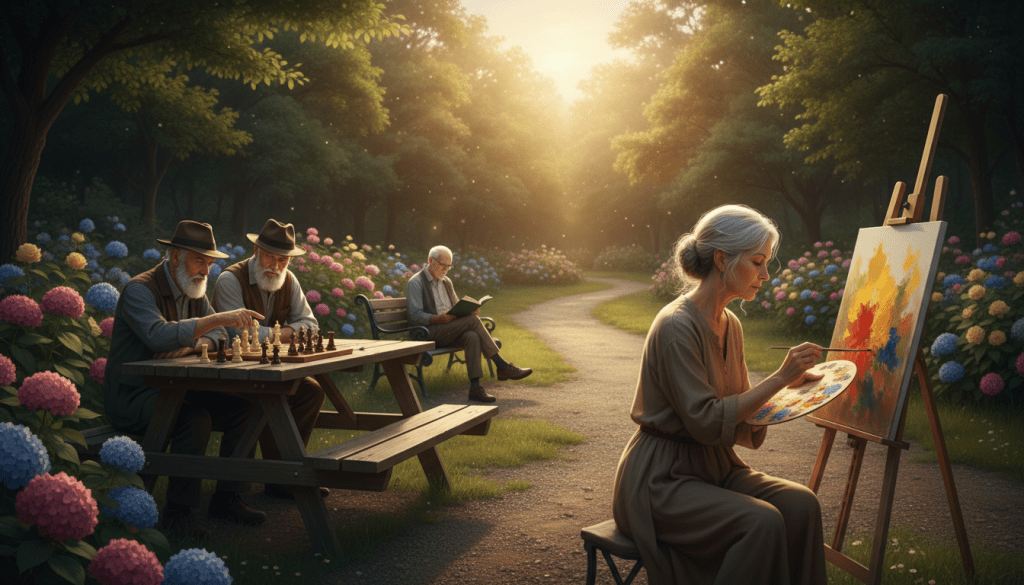
This is your time for new beginnings. Whether pursuing long-held dreams or discovering fresh interests, the journey matters most. There’s no pressure to be perfect—it’s about finding what feels good and brings you joy.
| Aspect of Life | Before Finding Activities | After Engaging in Meaningful Pursuits |
|---|---|---|
| Daily Structure | Open, unstructured time | Purposeful routines and anticipation |
| Social Connections | Potential isolation | Opportunities to meet people and build community |
| Mental Engagement | Less mental stimulation | Continuous learning and cognitive vitality |
| Sense of Accomplishment | Fewer achievement moments | Regular feelings of progress and fulfillment |
Approach this chapter with curiosity and openness. The right pursuits can help you stay mentally sharp while building meaningful connections. Whether deepening existing interests or exploring something completely new, this guide will help you find activities that fit comfortably into your life.
Simple Indoor Hobbies for Comfort and Creativity
Sometimes the most comforting days are the ones spent quietly indoors, wrapped in the warmth of a familiar space. These gentle pursuits require little setup but offer rich rewards for your mind and spirit.

Getting lost in a good book is a classic way to pass the time. It’s a gentle escape that also gives your brain a healthy workout. Whether it’s a novel, magazine, or articles online, reading opens new worlds.
Writing and journaling can be deeply therapeutic. You don’t need to write a novel. Simply jotting down thoughts or memories in a private journal creates a peaceful activity. It’s a fulfilling way to reflect.
Reading, Writing, and Journaling
Putting pen to paper is a powerful practice. It helps process feelings and preserves precious stories. This private space is just for you, a simple act of self-care.
Music, Coloring, and Crafting
Have an old instrument tucked away? Making music is a relaxing and expressive outlet. Learning something new like a harmonica can be joyful. There’s no pressure to perform.
Adult coloring books have become wonderfully popular. They let you create beautiful art without any pressure. It’s a peaceful, meditative hobby that calms the mind.
Hands-on crafting like knitting keeps your hands active. The repetitive motions are soothing. You get a tangible result you can love or share, giving a wonderful sense of accomplishment.
Cooking is another creative indoor pursuit. It combines learning new skills with the satisfaction of a delicious meal. You can explore a vast world of creative ideas for adults right from your kitchen.
Enjoying the Outdoors: Easy, Low-Energy Activities
Nature has a remarkable way of soothing the spirit, offering gentle activities that ask for little but give so much in return. Stepping outside provides immediate benefits for your mood and overall well-being.

Gardening and Nature Walks
Gardening connects you to the earth’s natural rhythms. You can work at your own pace with container plants or raised beds. This rewarding activity yields beautiful flowers or fresh vegetables to enjoy.
Gentle walking through neighborhoods or parks offers wonderful exercise. There’s no pressure to move quickly. You set the pace that feels comfortable for you.
Try JoyCalls Free
No app or new device needed. Start with a free 7-day trial.
Bird Watching and Light Hiking
Bird watching invites peaceful observation of wildlife. You can enjoy this experience from your window or during short park visits. Each outing brings opportunities to spot new species.
Light hiking provides gentle adventure on flat, accessible trails. Start with shorter paths and build stamina gradually. This way of exploring nature supports both physical and mental health.
Time spent outdoors reduces stress and improves mood. These gentle pursuits offer the perfect balance of activity and relaxation. Discover more outdoor activities for seniors that fit your energy level.
Creative and Intellectual Pursuits to Spark the Mind
Intellectual curiosity doesn’t retire – it simply gets more time to flourish and explore. Keeping your mind active is one of the best gifts you can give yourself. It maintains cognitive vitality and keeps you connected to the world.
Adult Coloring and DIY Projects
Adult coloring books offer a peaceful way to create beautiful art without pressure. This gentle activity has shown real benefits for reducing anxiety and improving focus.
Simple DIY projects provide the satisfaction of making something new with your own hands. You’ll experience a wonderful sense of accomplishment that brightens your day.
Learning a New Language or Exploring History
Learning a new language keeps your brain remarkably sharp. Modern apps make this surprisingly accessible, letting you practice at your own pace.
Exploring history through documentaries or genealogy research connects you to fascinating stories. You might discover your own family’s journey while developing new skills.
These intellectual pursuits feed your natural curiosity. They’re about the joy of discovery, not proving anything. Consider exploring various learning options for adults that match your interests.
Whether you’re rediscovering old passions or trying something new, these activities offer meaningful engagement. They provide comfort and connection, much like the support found through services like JoyCalls for senior care.
Social Hobbies for Seniors: Building Meaningful Connections
Connection is a fundamental human need that doesn’t diminish with age – in fact, it often becomes more essential. When familiar faces move away or circumstances change, that empty feeling can settle in. But it doesn’t have to stay that way.
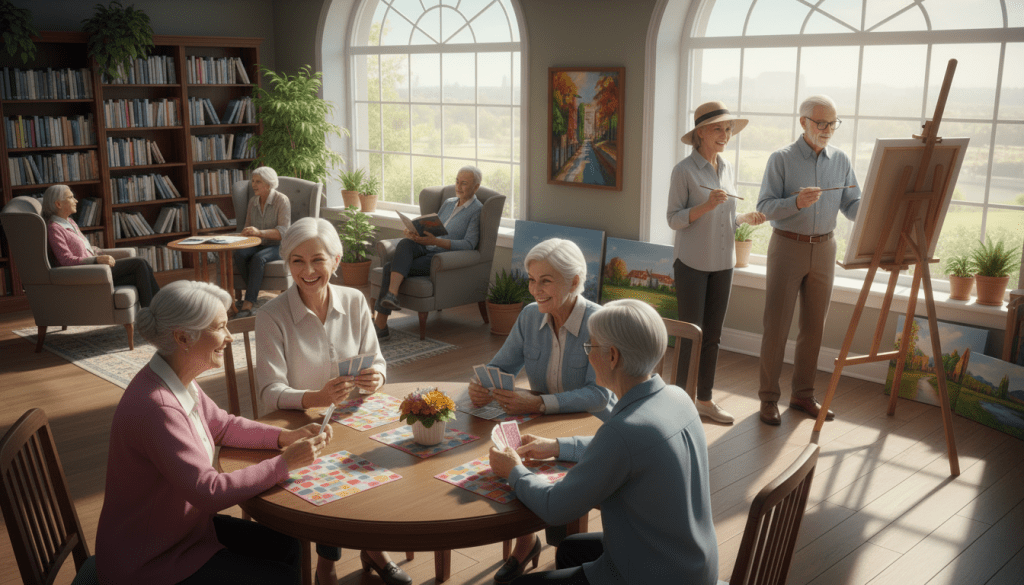
Shared interests create natural opportunities to meet people who understand your passions. These gatherings feel comfortable, not forced. Friendships grow organically when you’re doing something you love together.
Joining Clubs and Group Classes
A book club combines your love of reading with meaningful conversations. You’ll meet like-minded people who enjoy the same stories. The shared experience of discussing characters and plots builds bonds.
Food and wine clubs offer relaxed social settings. You can explore new restaurants or sample different flavors. The focus on good company makes connecting effortless.
Game nights bring people together for laughter and friendly competition. Whether cards, board games, or bingo, these activities create instant camaraderie. You’ll find many wonderful social activities for seniors that fit your interests.
Virtual Gatherings and Community Meetups
Technology bridges distance for those who prefer connecting from home. Virtual book clubs or cooking classes allow participation regardless of mobility. You can still build meaningful relationships online.
If you can’t find the right group, consider starting your own. Many people are looking for the same connections. Your initiative could create a wonderful community for others.
Hobbies for Seniors on a Budget: Fun Without Breaking the Bank
Living on a fixed income doesn’t mean your days have to be empty or lonely – in fact, some of the most rewarding activities cost nothing at all.
Your local library is a treasure chest waiting to be explored. It offers free access to books, audiobooks, and even online learning resources. Many libraries also host community events and clubs that bring people together.
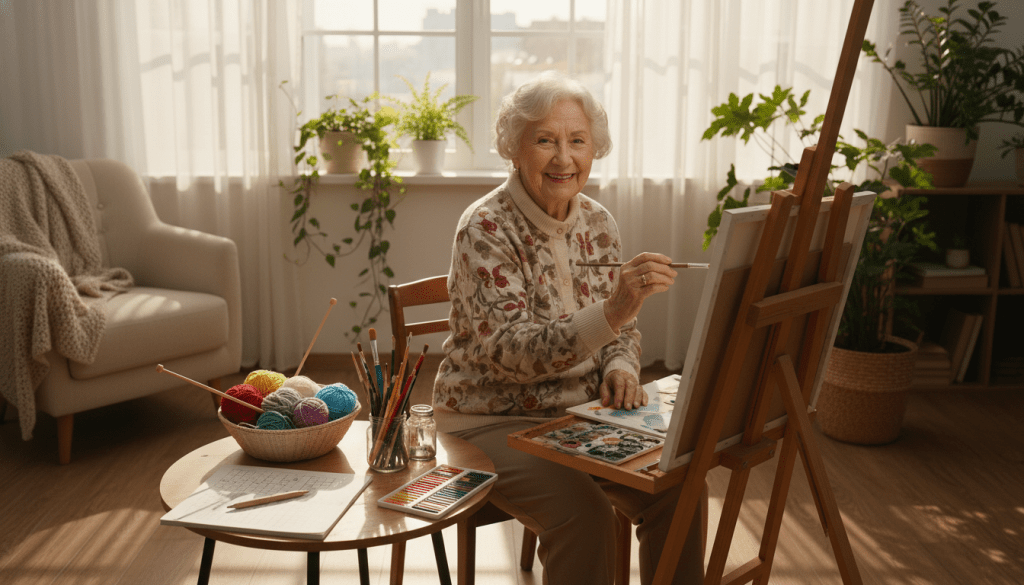
Community centers provide wonderful options for social engagement. They often have game nights, exercise classes, and creative workshops designed specifically for older adults. These gatherings create natural opportunities to meet new friends.
Outdoor pursuits like walking in parks or bird watching are completely free. They offer fresh air and gentle exercise. Gardening can be surprisingly affordable when you start with seeds or share cuttings with neighbors.
Consider exploring this comprehensive list of inexpensive pastimes for more inspiration. You’ll discover that meaningful engagement doesn’t require a big budget.
Swapping supplies with friends is another smart way to keep costs down. Share puzzle books, craft materials, or gardening tools. This approach builds community while saving money.
Remember, the richest experiences often come from simple pleasures. Your golden years can be filled with joy and connection without financial worry.
Tech-Savvy Hobbies: Exploring the Digital World
Your smartphone or tablet can become a gateway to fascinating worlds and meaningful relationships. Technology doesn’t have to feel complicated or scary. Many digital pastimes are surprisingly easy to pick up.
These tools can help you feel more connected to the world around you. They’re especially valuable for those with limited mobility. You can enjoy rich experiences right from home.
Podcasts, Online Games, and Digital Photography
Digital photography is a creative outlet right at your fingertips. Your smartphone makes it easy to capture beautiful moments. Research shows creative pursuits like this can reduce anxiety and improve cognition.
Podcasts offer endless entertainment on any topic imaginable. From true crime to gardening tips, there’s something for everyone. They’re free and available whenever you want to listen.
Online games are more than just entertainment. They’re brain exercises that keep your mind sharp. Playing with distant friends and family reduces stress and builds connections.
Genealogy Research and Social Media Engagement
Genealogy research has become incredibly accessible through online databases. You can trace your family history from home. Discover fascinating stories about your ancestors with simple searches.
Social media helps you stay connected with loved ones. You can join groups for your specific interests. Find communities of people who share your passions.
| Digital Activity | Primary Benefit | Skill Level Required |
|---|---|---|
| Digital Photography | Creative expression & mindfulness | Beginner-friendly |
| Podcast Listening | Continuous learning & entertainment | No experience needed |
| Online Games | Cognitive exercise & social connection | Various difficulty levels |
| Genealogy Research | Family discovery & historical connection | Basic computer skills |
| Social Media | Community building & relationship maintenance | Easy to learn |
Many communities offer free technology classes specifically for older adults. These supportive environments help you learn at your own pace. Digital tools complement other support systems, much like the reassurance provided by services that help with choosing quality care from a distance.
Low-Energy Hobbies for Relaxation and Mindfulness
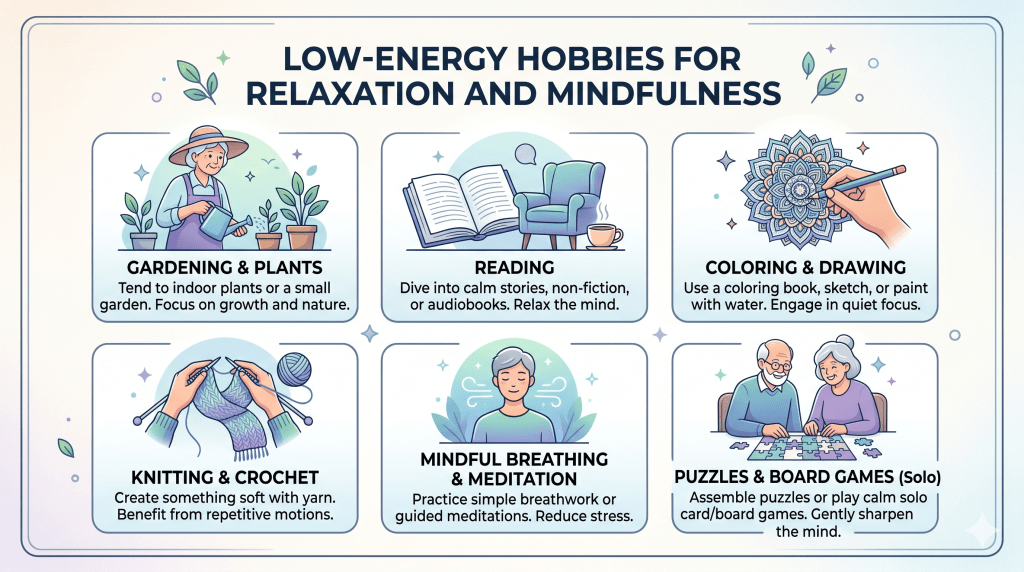
Some days call for quiet restoration rather than active engagement. When your energy reserves feel low, gentle pursuits offer perfect refuge. These calming activities restore rather than drain.
Gentle yoga provides wonderful low-energy movement. Simple stretches enhance flexibility and reduce aches. This peaceful practice creates wellbeing in body and mind.
Meditative Practices and Easy Crafts
Meditation requires no special equipment or abilities. Just a quiet moment to breathe deeply. Center yourself and let go of stress and worry.
Repetitive crafts like knitting have therapeutic quality. The rhythmic movements become almost meditative. This gentle activity keeps hands active and creative energy flowing.
Adult coloring has emerged as a trendy way to pass the time. It creates beautiful art without pressure. The process reduces anxiety and improves focus.
These restorative hobbies provide real health benefits. They help with sleep and reduce blood pressure. Many find they create peaceful rituals that add comfort to their days.
Low-energy doesn’t mean low-value. This gentle hobby meets you where you are. It gives a wonderful sense of peace that enhances quality of life.
Boosting Health with Hobbies for Seniors
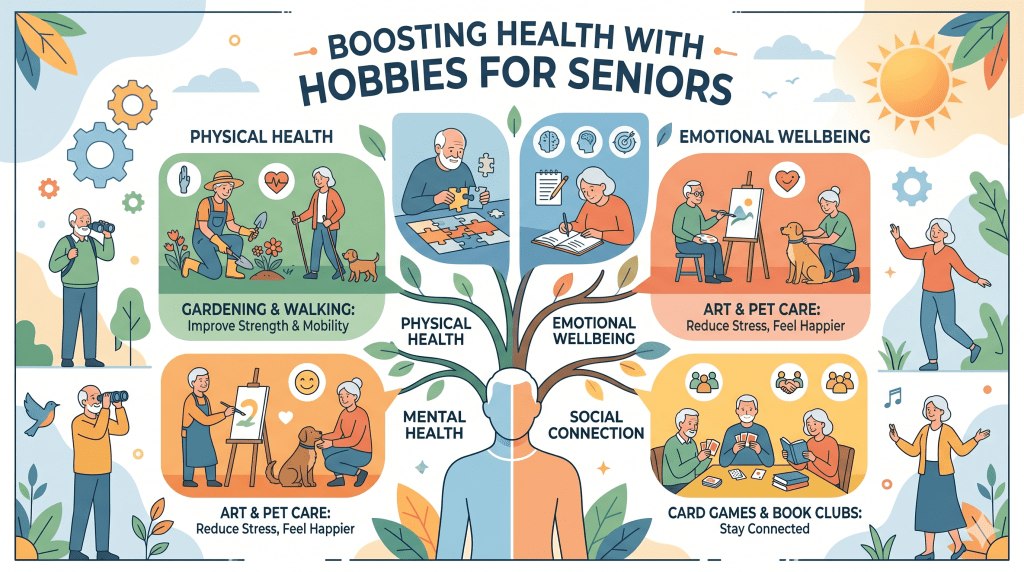
The activities we enjoy do more than just fill our days—they can transform our health. Gentle pursuits offer real physical and mental benefits that enhance your quality of life.
Gentle Exercise such as Yoga and Pickleball
Yoga builds strength and flexibility while being kind to your body. The gentle movements reduce stress and improve mobility.
Pickleball has become incredibly popular. It’s social, fun, and easier on joints than tennis. This active game provides great cardiovascular exercise.
Dancing combines joyful movement with heart-healthy benefits. Whether in classes or at home, it strengthens muscles and bones.
Creative Expression for Mental Wellness
Art, music, and crafts reduce anxiety and keep your mind sharp. These activities provide a wonderful sense of purpose.
Creative expression combats depression and isolation. It’s a peaceful way to process emotions and stay engaged.
Even gentle participation offers measurable health benefits. The right activities help you feel better and live well.
Turning a Hobby Into a Gentle Weekly Routine
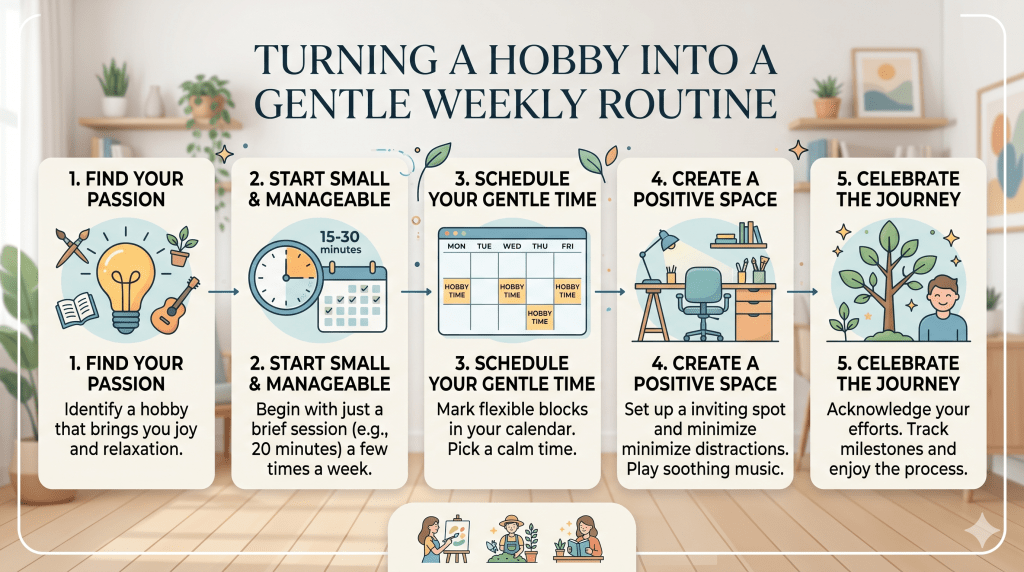
Starting a hobby is one thing. Staying with it is another. For many seniors, the hardest part is not choosing an activity. It is finding a simple way to make that activity feel natural, comforting, and easy enough to repeat.
This matters because loneliness often grows in empty spaces. A long afternoon with no plan can feel heavier than it should. A quiet morning can become a time for worry. Even a pleasant hobby can be forgotten if it does not have a clear place in the day.
That is why one of the most helpful things an older adult can do is turn a hobby into a small routine. Not a strict schedule. Not a busy calendar. Just a gentle rhythm that gives the week a little shape.
A hobby routine gives you something to look forward to. It helps you wake up with a small plan. It also makes it easier for family members, friends, or caregivers to support you because they know what you enjoy and when you usually do it.
The goal is not to become “productive.” The goal is to feel more connected, more settled, and more in charge of your day.
Start With a “Tiny Version” of the Hobby
Many people give up on hobbies because they begin too big.
They decide to paint, so they buy a large canvas and many supplies. They decide to walk, so they plan a long route. They decide to read again, so they choose a thick book. At first, it feels exciting. But then it becomes tiring, and the hobby quietly disappears.
A better approach is to begin with the smallest possible version.
If you want to start reading, begin with five pages. If that feels like too much, read one poem, one short article, or one page from a familiar book.
If you want to garden, begin with one small potted plant. Do not try to manage an entire balcony, yard, or vegetable bed right away.
If you want to write, begin with three sentences. You can write about what you ate, what the weather is like, or one memory from childhood.
If you want to listen to music, choose one song after breakfast. Sit comfortably, listen fully, and notice how it makes you feel.
If you want to reconnect with people, begin by sending one short message or making one short phone call each week.
The tiny version works because it removes pressure. It allows the hobby to feel friendly instead of demanding. Once the activity becomes familiar, you can naturally do more if you feel like it.
A helpful rule is this: choose a version of the hobby that still feels possible on a low-energy day. If you can do it even when you are tired, it has a better chance of becoming part of your life.
Attach the Hobby to Something You Already Do
A new habit is easier when it is connected to an old habit.
Instead of saying, “I will start journaling,” try saying, “After my morning tea, I will write three lines.”
Instead of saying, “I will do puzzles,” try saying, “After lunch, I will spend ten minutes on a crossword.”
Instead of saying, “I will stretch more,” try saying, “After I turn on the evening news, I will do three gentle seated stretches.”
This method works because your day already has anchors. Meals, medication times, tea, prayer, television, phone calls, and bedtime routines are already familiar. A hobby becomes easier when it sits beside one of these existing moments.
Here are a few gentle examples:
After breakfast, water one plant.
After lunch, read for ten minutes.
After afternoon tea, call one friend or relative.
Before dinner, listen to one favorite song.
Before bed, write one thing you appreciated that day.
The activity does not need to be long. In fact, shorter is often better in the beginning. What matters is repetition. A small hobby done three or four times a week can bring more comfort than a big hobby done once and then forgotten.
Create a Comfortable Hobby Spot

A hobby becomes easier when everything you need is within reach.
For seniors with low energy, limited mobility, joint pain, poor eyesight, or memory challenges, setup can become the biggest barrier. If supplies are in another room or stored too high, the activity may never happen.
Create one simple hobby spot. It could be a side table, a basket near your chair, a drawer beside your bed, or a tray that can be moved easily.
For reading, keep your book, glasses, bookmark, and a small lamp nearby.
For writing, keep a notebook and pen in the same place every day.
For coloring, keep pencils sharpened and pages ready.
For puzzles, keep the puzzle book open with a pen tucked inside.
For knitting or crochet, keep yarn, needles, and scissors in a soft bag.
For phone-based connection, keep a written list of names and numbers near the phone.
The easier it is to begin, the more likely you are to continue.
This is especially useful for adult children and caregivers. Instead of simply suggesting a hobby, help set up the environment. A parent may like the idea of painting, but if they have to search for supplies, clear the table, find good lighting, and clean everything afterward, it may feel like too much. A ready-to-use hobby tray can make the difference.
Comfort also matters. Choose a chair that supports the back. Make sure lighting is bright enough. Keep water nearby. Use large-print books or magnifying tools if needed. Choose easy-grip pens, thick-handled brushes, or lightweight supplies if hands feel stiff.
A hobby should not feel like a test of endurance. It should feel inviting.
Use Hobbies as Conversation Starters
One of the most powerful benefits of a hobby is that it gives you something to talk about.
Loneliness can become harder when every conversation begins with health, appointments, or problems. Those topics matter, but they can make life feel smaller. A hobby gives you a fresh subject. It creates stories, questions, and small updates to share.
For example, instead of saying, “Nothing much happened today,” you might say:
“I planted basil this week.”
“I heard a beautiful old song today.”
“I started a puzzle and finally solved the top corner.”
“I wrote down a memory about my first job.”
“I watched a documentary about birds.”
These small updates can make phone calls warmer and more meaningful. They also help family members see you as a full person with interests, not just someone who needs care.
If you are an adult child, ask specific hobby-based questions. Instead of only asking, “How are you?” try:
“What did you read today?”
“Did your plant grow any new leaves?”
“What song did you listen to this morning?”
“Did you work on your puzzle?”
“What memory did you write about this week?”
These questions are gentle, but they open the door to richer conversation.
Seniors can also use hobbies to reconnect with old friends. If you enjoy cooking, ask someone for an old recipe. If you enjoy music, ask a sibling or friend what songs they loved growing up. If you enjoy family history, call a relative and ask about a memory.
A hobby does not have to be social at first. But over time, it can become a bridge to people.
Make a Weekly “Connection Hobby”
Some hobbies are enjoyable alone. Others become more powerful when they include another person. For lonely seniors, it can help to choose one hobby each week that involves some form of connection.
This does not have to mean joining a large group. Many older adults feel nervous about groups, especially after a long period of isolation. A connection hobby can be very small.
You could read the same short story as a friend and talk about it by phone.
You could exchange recipes with a neighbor.
You could watch the same television program as a family member and discuss it afterward.
You could mail a handwritten note once a week.
You could share one photo of a plant, craft, or meal with a loved one.
You could play a simple word game over the phone.
You could ask a grandchild to teach you one new word, song, or fact each week.
The key is to make the hobby shared in some way.
For seniors who do not use smartphones, this can still be done through regular phone calls, letters, printed photos, or in-person visits. The point is not technology. The point is having a reason to connect that feels natural.
This also takes pressure off relationships. Instead of forcing a deep emotional conversation every time, the hobby provides a relaxed topic. People often bond more easily when they are doing or discussing something together.
Track Progress in a Kind and Simple Way
Progress can bring a quiet sense of pride. But tracking should never feel like homework.
Use a simple calendar, notebook, or checklist. Each time you do your hobby, make a small mark. That is enough.
You might write:
“Read 5 pages.”
“Watered plant.”
“Called Meera.”
“Listened to old songs.”
“Did 10 minutes of stretching.”
“Finished one crossword.”
These notes create proof that your days are not empty. They show that you are doing small things for yourself. On difficult days, looking back at the list can be reassuring.
For seniors who struggle with motivation, this can be especially helpful. Loneliness can make time feel blurry. A simple record helps restore a sense of movement.
Adult children can also use this gently. Avoid turning it into monitoring or pressure. Instead of saying, “Did you do your hobby today?” say, “I saw you worked on your puzzle this week. That’s wonderful.” Encouragement should feel warm, not corrective.
If writing is difficult, use stickers, check marks, or a large-print calendar. If memory is a concern, a caregiver or family member can help keep the record.
The purpose is not perfection. Missing a day is not failure. The purpose is to notice effort.
Prepare for Low-Energy Days
Every senior has days when energy is lower. Pain may be worse. Sleep may be poor. The weather may feel gloomy. Mood may dip without a clear reason.
A good hobby plan makes room for those days.
Create three levels for your hobby: easy, easier, and easiest.
For reading:
Easy: read one chapter.
Easier: read two pages.
Easiest: listen to an audiobook or ask someone to read aloud.
For gardening:
Easy: water and trim plants.
Easier: check the soil and remove dry leaves.
Easiest: sit near the plant and enjoy looking at it.
For writing:
Easy: write one full page.
Easier: write three sentences.
Easiest: write one word that describes the day.
For movement:
Easy: take a short walk.
Easier: do seated stretches.
Easiest: take three slow breaths and gently move your ankles or hands.
For social connection:
Easy: call a friend.
Easier: send a short message.
Easiest: ask someone to call you or schedule a check-in.
This approach protects confidence. It reminds you that doing less still counts. A low-energy version keeps the routine alive without pushing your body too hard.
This is important because seniors may stop a hobby completely after one difficult week. But if the hobby has a very gentle backup version, it remains part of life.
Choose Hobbies That Match Your Real Life
A hobby should fit the person you are today, not the person you feel pressured to be.
If you have always disliked group activities, you do not need to force yourself into a busy club. Try one-on-one activities instead.
If your hands hurt, choose hobbies that do not require fine finger movements for long periods.
If your eyesight is weaker, use audiobooks, large-print materials, music, or tactile activities.
If you tire easily, choose hobbies that can be done while seated.
If you live alone and worry about safety, choose outdoor activities in familiar, public, accessible places.
If you feel shy, begin with hobbies that create indirect connection, such as writing letters, joining a phone-based group, or sharing recipes.
The best hobby is not the most impressive one. It is the one you can return to with ease.
Ask yourself:
Does this activity calm me or drain me?
Can I do it safely?
Can I begin without too much setup?
Does it give me something pleasant to look forward to?
Can I share it with someone if I want to?
Does it still work on a low-energy day?
These questions help you choose wisely. A hobby should support your life, not complicate it.
Build a Small “Hobby Menu”
Instead of relying on one activity, create a small hobby menu. This gives you choices without overwhelming you.
Divide the menu into simple categories:
For quiet days: reading, music, coloring, prayer, journaling.
For restless days: walking, stretching, light gardening, tidying a drawer.
For lonely days: calling someone, writing a letter, joining a group activity, sharing a memory.
For curious days: documentaries, podcasts, history, language learning, genealogy.
For creative days: crafting, cooking, drawing, photography, arranging flowers.
Keep this list somewhere visible. When you feel bored or low, you do not have to think too hard. You can simply choose from the menu.
This is useful because loneliness can make decision-making harder. A prepared list gives the mind a gentle prompt.
Family members can help create this menu during a visit. Sit together and ask, “What feels enjoyable? What feels easy? What did you love years ago? What would you like to try again?” Write the answers down.
The menu should be personal. It should reflect the senior’s tastes, energy, culture, memories, and lifestyle.
Let the Hobby Give You Purpose
The most meaningful hobbies often include a small sense of purpose.
Purpose does not have to be grand. It can be simple and personal.
A senior who knits may make scarves for family members.
Someone who enjoys writing may record memories for grandchildren.
Someone who likes plants may grow herbs for the kitchen.
Someone who enjoys music may create a list of favorite songs from each decade of life.
Someone who enjoys cooking may write down family recipes.
Someone who likes conversation may call another lonely friend once a week.
Purpose makes a hobby feel deeper. It reminds you that your time, memories, skills, and attention still matter.
This is especially important for older adults who once had strong roles as parents, workers, caregivers, teachers, business owners, or community members. Retirement or physical limitations can sometimes make people feel less needed. A purposeful hobby gently restores that feeling of contribution.
But purpose should never become pressure. The hobby does not need to serve anyone else every time. Joy itself is enough. Still, when a hobby can be shared, gifted, or remembered, it often becomes more meaningful.
Know When to Change the Hobby
Not every hobby will fit, and that is perfectly fine.
Sometimes a hobby sounds good but feels boring. Sometimes it is too tiring. Sometimes the group is not welcoming. Sometimes the supplies are frustrating. Sometimes the timing is wrong.
Stopping one hobby does not mean you failed. It means you learned something.
Try asking:
What part did I enjoy?
What part felt difficult?
Would it be better alone or with someone?
Would a simpler version work?
Should I try something completely different?
For example, if painting feels too messy, try coloring. If walking outside feels unsafe, try indoor seated movement. If a book club feels too demanding, try listening to audiobooks and discussing them with one friend. If gardening is physically difficult, try caring for one indoor plant.
The right hobby may take a little experimenting. Give yourself permission to adjust.
A Simple 7-Day Hobby Starter Plan
Here is an easy way to begin without feeling overwhelmed.
Day 1: Choose one hobby that feels gentle and interesting.
Day 2: Set up a small hobby spot with everything you need.
Day 3: Try the hobby for only ten minutes.
Day 4: Write down how it felt. Was it calming, tiring, boring, or enjoyable?
Day 5: Try the hobby again, but make it easier if needed.
Day 6: Tell someone about it. Share one small detail.
Day 7: Decide whether to continue, simplify, or try a different hobby.
This plan keeps things realistic. It gives the hobby a fair chance without forcing a long commitment.
For adult children, this is also a helpful way to support a parent. Instead of saying, “You need to get a hobby,” help them take one small step. Bring supplies. Set up the space. Call and ask about it. Celebrate the effort.
Loneliness rarely improves through one big change. More often, it improves through small, repeated moments of connection, comfort, and purpose. A gentle hobby routine can create those moments one day at a time.
Using Technology to Make Hobbies Easier, Not Harder
For many seniors, technology can feel overwhelming at first. Small screens, unfamiliar apps, passwords, and constant updates can create frustration. But when used in a simple and intentional way, technology can quietly support hobbies instead of complicating them.
The key is not to “learn everything.” The goal is to learn just enough to make one or two hobbies easier, more enjoyable, or more connected.
Technology should feel like a helpful assistant, not a burden.
Start With One Device and One Purpose
Many seniors feel discouraged because they try to do too much at once. They get a smartphone, a tablet, maybe even a laptop—and then feel unsure about where to begin.
A better approach is to choose one device and one clear purpose.
For example:
If you enjoy reading → use a tablet or phone for large-print reading apps.
If you enjoy music → use a phone or simple speaker to play favorite songs.
If you want connection → use a phone for video or voice calls.
If you enjoy learning → use a tablet for watching educational videos.
If you like puzzles → use a tablet for simple brain games.
By linking the device to a single hobby, it becomes less confusing. You are not “using technology.” You are simply reading, listening, or connecting—with a little help.
Over time, confidence grows naturally.
Make the Screen Comfortable and Senior-Friendly
Many seniors stop using devices because the experience feels physically uncomfortable.
Small text, dim screens, and complicated layouts can make even simple tasks tiring. A few small adjustments can make a big difference.
Increase the text size. Most devices allow you to enlarge fonts so reading feels natural.
Use high contrast. Dark text on a light background is easier on the eyes.
Turn up brightness (but not too harsh). A well-lit screen reduces strain.
Use voice commands if available. Speaking instead of typing can reduce effort.
Simplify the home screen. Keep only a few important apps visible.
Use large icons and avoid clutter.
Adjust volume settings so audio is clear without being too loud.
If needed, use accessories like a tablet stand, larger headphones, or a stylus pen for easier control.
These changes are simple but powerful. They remove friction. When something feels physically easy, it becomes emotionally easier too.
Use Technology to Reconnect With Old Interests
One of the most meaningful ways to use technology is to reconnect with things you already loved.
You do not need to discover a brand-new hobby. You can return to something familiar in a modern way.
If you loved music in your younger years, you can now access thousands of songs from your favorite era. You can create playlists of songs from your 20s, your wedding, or special life moments.
If you enjoyed reading but find books physically difficult now, audiobooks allow you to listen comfortably while resting.
If you used to cook or collect recipes, you can watch simple cooking videos or store recipes digitally.
If you enjoyed learning, there are short educational videos on history, travel, nature, and more.
If you loved photography, even a basic smartphone camera can help you capture daily moments—flowers, meals, sunlight, or family visits.
If you liked writing letters, you can still write messages—either by typing or using voice-to-text features.
Technology becomes powerful when it brings back something familiar rather than forcing something completely new.
Keep Communication Simple and Predictable
One of the biggest benefits of technology is connection. But too many apps or unclear systems can make communication stressful.
Instead, create a simple communication routine.
Choose one or two methods only:
Phone calls
Video calls
Messaging apps (like WhatsApp)
Do not try to manage too many platforms.
Set predictable times:
Call a friend every Tuesday afternoon.
Video call family every Sunday evening.
Send a short message every morning or every few days.
Predictability reduces anxiety. You do not have to wonder when you will hear from someone. It also helps family members stay consistent.
For seniors who feel hesitant about video calls, start with voice calls first. Once comfortable, video can be introduced gradually.
Adult children can help by:
Saving important contacts clearly (with names and photos if possible)
Setting up one-touch calling (speed dial)
Writing simple instructions on paper
Being patient and consistent rather than correcting repeatedly
Technology should make connection feel closer, not more complicated.
Use Technology for “Guided Hobbies”
Some hobbies become easier when guided step-by-step.
Instead of trying to remember instructions or learn from books, guided formats can reduce effort and confusion.
Examples include:
Follow-along exercise videos designed for seniors
Guided meditation or relaxation audio
Simple art tutorials
Cooking videos with clear steps
Language learning apps with short lessons
Memory games with built-in instructions
These formats are especially helpful for seniors who feel unsure about starting something alone.
The guidance removes guesswork. You do not have to plan. You simply follow along at your own pace.
It is important to choose content that is calm, slow-paced, and easy to follow. Avoid fast, complicated, or overly technical videos.
Short sessions (5–15 minutes) work best.
Balance Screen Time With Offline Comfort
While technology is helpful, it should not replace all offline activities.
Too much screen time can lead to eye strain, fatigue, or even a sense of disconnection if it replaces real-world experiences.
A healthy balance looks like this:
Use technology to start or support the hobby
Then continue offline when possible
For example:
Listen to music online → then sit and reflect quietly
Watch a cooking video → then try a simple recipe
Join a call → then write down something you discussed
Play a digital puzzle → then switch to a physical one later
Read on a screen → then rest your eyes and think about the story
This balance keeps the experience grounded. It ensures that technology remains a tool, not the center of the day.
Stay Safe and Avoid Unnecessary Stress
Safety is an important part of using technology, especially for seniors who may not be familiar with online risks.
Keep things simple:
Do not share personal or financial information with unknown people
Avoid clicking on unfamiliar links
Ignore messages that create urgency or fear (“Act now,” “Your account is at risk”)
Only use trusted apps recommended by family or caregivers
Keep passwords written in a safe, private place if needed
If something feels confusing, pause and ask someone you trust
It is better to move slowly and safely than to feel pressured.
Family members should avoid overwhelming seniors with too many warnings. Instead, focus on a few clear, practical guidelines.
Confidence grows when the environment feels safe.
Turn Technology Into a Shared Experience
Technology becomes more meaningful when it is shared.
Instead of using it alone, turn it into a connection tool.
Watch a short video together during a visit.
Listen to music with a family member and talk about memories.
Play a simple game together, even if one person is remote.
Share photos and talk about them.
Ask a grandchild to teach you something small—this creates bonding and gives them a sense of contribution.
This approach transforms technology from something “cold” into something warm and social.
It also reduces fear. When learning happens together, it feels lighter.
Keep Learning Gentle and Pressure-Free
Some seniors feel embarrassed about not understanding technology. This can create resistance or withdrawal.
It is important to remove that pressure completely.
Learning does not need to be fast. It does not need to be perfect.
Even learning one small thing per week is enough.
For example:
Week 1: Learn how to open and close an app
Week 2: Learn how to make a call
Week 3: Learn how to play music
Week 4: Learn how to send one message
Slow progress is still progress.
Adult children and caregivers should:
Avoid correcting in a harsh or impatient way
Repeat instructions calmly when needed
Celebrate small successes
Focus on usefulness, not technical knowledge
The goal is comfort, not mastery.
When Technology Is Not the Right Fit
It is also important to recognize that technology is not necessary for everyone.
Some seniors feel happier with completely offline hobbies. That is perfectly valid.
If using devices causes stress, confusion, or fatigue, it is better to step back.
Hobbies like reading physical books, gardening, knitting, walking, or writing can be just as meaningful without any digital support.
Technology is a tool—not a requirement.
The right choice is always the one that feels calm, simple, and sustainable.
A Gentle Reminder
At its best, technology can:
Bring back old joys
Make hobbies more accessible
Help you stay connected
Add variety to your day
But it should never feel like pressure.
You do not need to keep up with trends. You do not need to understand everything. You only need to find what works for you.
A single song, a single call, a single message, or a single short video can be enough to brighten a day.
And when combined with simple offline hobbies, these small moments can slowly reduce loneliness and bring back a sense of connection—both with others and with yourself.
Tips for Choosing Your Ideal Senior Hobby
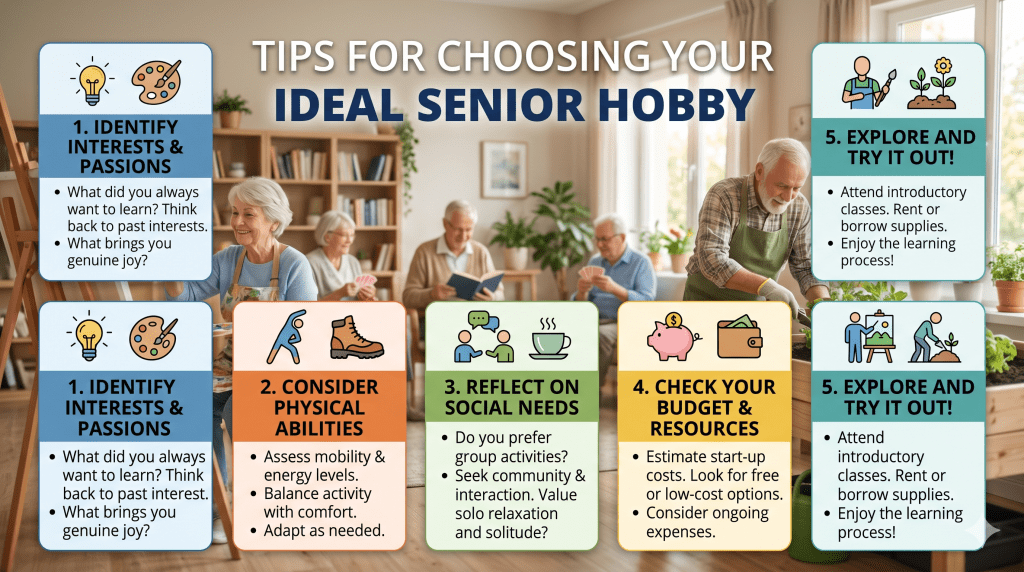
The journey to discovering meaningful activities starts with honest self-reflection about your preferences and capabilities. Finding the right fit makes all the difference between a chore and a cherished pastime.
Assessing Your Interests and Energy Levels
Begin by asking yourself simple questions. Do you prefer active movement or quiet relaxation? Enjoy company or value alone time? Curious about learning new skills?
Your answers will help narrow the overwhelming list of options. Start small without pressure to commit. Try different activities to discover what truly resonates.
Research shows that choosing the right pursuit can reduce stress and improve your health. It’s about finding what brings you joy and purpose.
Leveraging Local Resources and JoyCalls Signup
Explore community resources like libraries with free classes and materials. Senior centers offer wonderful programs designed for your needs.
Many places provide low-cost classes in supportive environments. These gatherings help you build skills while meeting new friends.
For daily connection support, consider JoyCalls. This AI-powered phone companion makes check-in calls using your regular phone—no app needed.
It provides conversation and companionship while you explore new interests. Family members receive wellbeing updates for peace of mind.
Visit JoyCalls to add this supportive resource to your routine. The right activities combined with daily connection create a fulfilling life experience.
Why Most Advice on Loneliness Fails in Real Life

Many articles talk about “staying social” or “joining activities.” While well-intentioned, this advice often fails because it is:
- Too vague (“be more social” is not a plan)
- Emotionally demanding (hard to act on during low-energy days)
- Dependent on others (which creates inconsistency)
- Not adapted to aging-related limitations (mobility, health, energy)
For seniors, loneliness is not just about lack of people—it’s about lack of structure, purpose, and predictable connection points.
What works better is a system, not motivation.
A system removes decision fatigue and ensures that—even on difficult days—you remain connected to the world in small, meaningful ways.
This section gives you exactly that: a simple, repeatable framework.
The 4 Pillars of a Loneliness-Proof Retirement Routine
To reduce loneliness sustainably, your routine should include four core elements:
1. Human Connection (Direct Interaction)
Even small interactions matter:
- A 5-minute call
- A conversation with a neighbor
- A regular chat with a familiar voice
Consistency matters more than duration.
2. Purposeful Activity (Something That Feels Meaningful)
Without purpose, days blur together.
Purpose can be:
- Helping someone
- Learning something new
- Completing a small personal goal
3. Mental Engagement (Keeping the Mind Active)
Idle time often amplifies loneliness.
Mental engagement includes:
- Reading
- Problem-solving
- Creative hobbies
4. Emotional Anchors (Things That Bring Comfort and Familiarity)
These are routines or habits that make you feel grounded:
- Listening to favorite music
- Revisiting memories
- Spiritual or reflective practices
A strong daily routine touches at least 3 out of these 4 pillars.
Designing Your Ideal Daily Routine (Simple and Realistic)

The goal is not to fill every hour—but to create intentional touchpoints throughout the day.
Morning: Start With Connection and Direction
Mornings are crucial because they set the emotional tone for the day.
Suggested routine:
- Wake up at a consistent time
- Do a light physical activity (stretching, walking)
- Have a short conversation (call, voice note, or even greeting someone nearby)
Action Tip:
Keep a “morning contact list” of 3–5 people you can rotate calls with.
Midday: Focus on Activity and Engagement
This is the best time for:
- Social outings (if possible)
- Hobby time
- Learning or volunteering
Examples:
- Cooking a new recipe
- Gardening
- Attending a community group
- Joining an online class
Action Tip:
Plan one meaningful activity per day, not more. Overloading leads to burnout.
Evening: Reduce Isolation Before It Peaks
Loneliness often intensifies in the evening.
This is when structure matters most.
Suggested activities:
- Scheduled phone or video calls
- Watching something interactive (like a show you discuss with someone)
- Light reflection (journaling or gratitude practice)
Action Tip:
Avoid long periods of passive TV watching without interaction—it can increase feelings of isolation.
Night: End With Emotional Comfort
Before bed:
- Listen to calming music
- Reflect on one positive interaction from the day
- Prepare a simple plan for tomorrow
This builds emotional stability over time.
Creating a Weekly Social Rhythm (Instead of Random Interaction)
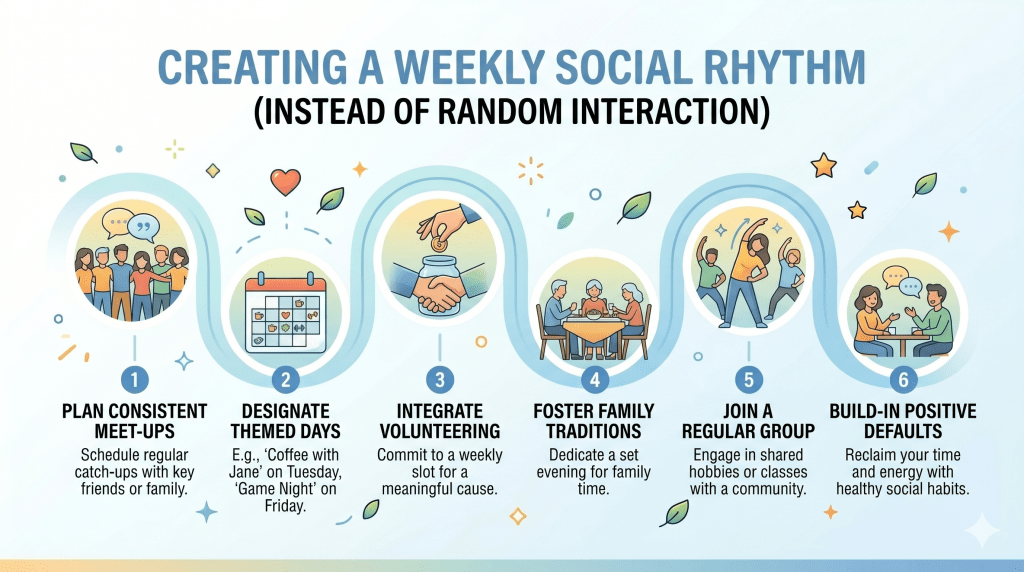
Random social activity is unreliable. A weekly rhythm ensures consistency.
Here’s a simple structure:
Fixed Social Days
Assign specific days for connection:
- Monday: Family call
- Wednesday: Friend or neighbor interaction
- Friday: Group activity or community engagement
- Sunday: Reflective or spiritual connection
This creates something to look forward to.
Anchor Activities (Non-Negotiable Weekly Events)
These are activities you commit to regardless of mood:
- Weekly club or group
- Religious or spiritual gathering
- Volunteer role
- Regular scheduled calls (like with services such as Joycalls)
Why this matters:
Consistency builds relationships naturally over time.
Flexible Days (Low-Energy Backup Plan)
Not every day will feel easy—and that’s okay.
Have a backup plan for low-energy days:
- Short 5-minute call instead of long conversation
- Listening to a familiar voice recording
- Watching something meaningful instead of passive content
The key is: never let a day go completely disconnected.
How to Build and Maintain Meaningful Relationships in Retirement

Making connections is one thing—maintaining them is another.
Here’s how to do both effectively:
1. Shift From Quantity to Quality
You don’t need many people.
You need:
- 2–5 consistent, reliable connections
Focus on:
- Regularity
- Emotional comfort
- Ease of communication
2. Make Interaction Predictable
Uncertainty creates hesitation.
Instead of saying:
“I’ll call you sometime…”
Say:
“Let’s talk every Thursday at 6 PM.”
This removes friction.
3. Be the Initiator (Without Pressure)
Waiting for others often leads to disappointment.
Instead:
- Reach out first
- Keep it light and pressure-free
- Accept that not everyone will respond consistently
Consistency beats perfection.
4. Use Technology as a Bridge, Not a Barrier
Technology can feel intimidating—but it can also reduce loneliness significantly.
Simple tools:
- Phone calls (still the most effective)
- WhatsApp voice notes
- Video calls with family
Action Tip:
Focus on mastering just one or two tools, not everything.
Overcoming Common Barriers That Stop Seniors From Taking Action
Even with the best plan, certain challenges can get in the way.
Let’s address them directly.
“I Don’t Feel Like Talking to Anyone”
This is common—and often temporary.
What to do:
- Start small (2–3 minutes of conversation)
- Choose someone familiar and safe
- Don’t aim for deep conversations every time
Action creates motivation—not the other way around.
“I Don’t Want to Burden Others”
Many seniors hesitate because they don’t want to inconvenience others.
Reality:
- Most people appreciate being reached out to
- Short conversations are rarely a burden
Reframe:
You’re offering connection—not asking for help.
“I Don’t Have Anyone to Talk To”
This is where structured services and communities help.
Options:
- Community groups
- Senior clubs
- Volunteer programs
- Scheduled conversation services (like Joycalls)
Consistency matters more than familiarity at first.
“My Health or Mobility Limits Me”
Physical limitations can increase isolation—but they don’t eliminate connection.
Solutions:
- Phone-based interactions
- Online communities
- At-home hobbies with social elements
The goal is adaptation, not withdrawal.
Micro-Actions That Make a Big Difference (Even on Difficult Days)

On days when everything feels heavy, focus on small actions.
Examples:
- Smile and greet someone nearby
- Send a voice message instead of calling
- Step outside for a few minutes
- Listen to a familiar voice
These may seem small—but they prevent complete isolation.
Tracking Your Progress Without Pressure
You don’t need complex tracking.
A simple system works:
At the end of each day, ask:
- Did I talk to someone today?
- Did I do one meaningful activity?
- Did I engage my mind?
Even 2 out of 3 is progress.
How Family Members Can Support This System
If family members are reading this, their role is crucial.
They can:
- Help create a weekly schedule
- Set recurring call times
- Encourage participation without forcing it
- Introduce simple technology gradually
Most importantly:
Consistency matters more than long conversations.
Building a Life That Feels Connected Again
Loneliness in retirement doesn’t disappear overnight.
But with:
- Structure
- Small daily actions
- Consistent human connection
…it becomes manageable—and often significantly reduced.
The goal is not to eliminate solitude completely.
The goal is to ensure that:
You never feel completely alone in your day-to-day life.
Conclusion
Rediscovering what brings you joy is one of the greatest adventures retirement offers. This chapter of your life is truly your time—a gift you’ve earned.
Loneliness doesn’t have to define your golden years. The right activities open doors to connection and purpose. Studies show people who engage in meaningful pursuits live longer, healthier lives with sharper minds.
Take that first step today. Visit your library, call a friend, or try something new. There’s no “right” hobby—only what resonates with you personally.
For adult children reading this, supporting your aging parents in finding meaningful engagement is a beautiful act of love. Resources like JoyCalls provide daily companionship as they explore new interests.
Retirement isn’t an ending—it’s your opportunity to rediscover yourself and fill your days with meaning. It’s never too late to find unexpected joy.
FAQ
What are some good activities for older adults who feel isolated?
How can hobbies benefit my health in retirement?
I have limited mobility. What are some low-energy pastimes I can try?
Are there budget-friendly hobbies for seniors?
How can I find local groups or classes to join?
Can technology be a good hobby for someone new to it?

Ana Avila is a healthcare and technology writer with deep expertise in artificial intelligence, senior care innovation, and the practical use of AI in healthcare operations. Her work focuses on how emerging technologies can improve the daily experience of older adults, support overburdened care teams, and help senior living communities deliver safer, faster, and more personalized support.
Ana’s background includes health informatics, aging care systems, and applied artificial intelligence. Her work explores how digital health tools, predictive analytics, and AI-assisted communication systems can improve care coordination, reduce operational delays, and identify early signs of risk among older adults. She brings an understanding of both the technical side of AI and the human realities of healthcare delivery.
Over the years, Ana has developed a specialized body of work around AI in senior living. She writes about how senior care providers can use intelligent systems to manage resident requests, answer routine questions, support family communication, improve after-hours coverage, and detect patterns that may indicate loneliness, confusion, distress, or unmet needs. Her articles often examine the gap between what senior living teams are expected to deliver and what traditional staffing models can realistically support.
Ana’s healthcare expertise is especially focused on the operational side of care. She has written extensively about call handling, resident engagement, front desk workflows, triage systems, caregiver communication, care escalation, and the hidden administrative burden placed on senior living staff. Her work explains how AI can help reduce repetitive tasks, organize incoming requests, prioritize urgent issues, and give human caregivers more time for meaningful resident interaction.
At the same time, Ana is careful not to present AI as a replacement for human care. A consistent theme in her writing is that technology should support relationships, not weaken them. She argues that the best AI systems in healthcare are not the ones that simply automate the most tasks, but the ones that make care teams more responsive, families more informed, and residents more supported. Her perspective is grounded in the belief that senior living technology must be designed around dignity, trust, privacy, and compassion.
Ana has also written widely on the ethical use of AI in healthcare. Her work discusses the importance of human oversight, transparent escalation rules, resident consent, data minimization, and responsible use of sensitive health and behavioral information. She often emphasizes that AI systems used around older adults must be easy to understand, carefully monitored, and designed with the limitations and needs of real residents in mind, including those with memory loss, hearing challenges, mobility issues, or social isolation.
Her writing has been used as a reference point in discussions about aging, elder care technology, digital health, and AI-supported senior living. She has published 12 papers in journals including JAMA, The BMJ, and SSRN. Some of her articles have also been cited by Wikipedia editors as supporting references on topics related to healthcare, aging, and technology. This has helped position her work as a useful educational resource for readers looking to understand how AI can be applied in real care environments.
In addition to her long-form writing, Ana has contributed research-based commentary, professional explainers, and practical guidance for healthcare operators, senior living decision-makers, and technology teams building products for older adults. Her work combines research literacy with operational practicality. She is able to take complex subjects such as natural language processing, predictive analytics, conversational AI, and care automation, and explain them in a way that is accessible to executives, caregivers, families, and non-technical readers.
Ana’s strongest area of expertise is the intersection of artificial intelligence and senior living operations. She understands that senior care communities face a difficult combination of rising resident expectations, staffing pressure, family communication demands, and increasing care complexity. Her writing explores how AI can be used to ease those pressures through smarter communication systems, faster response workflows, proactive check-ins, and better visibility into resident needs.
Her approach is both evidence-informed and deeply human. She studies AI through the lens of real-world care delivery: whether a resident gets help faster, whether a family member receives a clearer update, whether a caregiver avoids unnecessary administrative work, and whether a senior living team can identify a concern before it becomes a crisis. This practical focus makes her work especially relevant for organizations that want to adopt AI responsibly rather than simply follow technology trends.
Ana Avila is regarded as a thoughtful voice on the future of AI in healthcare and senior living. Her expertise combines research-driven analysis, operational understanding, and a strong commitment to humane technology. Through her writing, she helps healthcare leaders and senior living communities understand not only what AI can do, but how it should be used to improve care, preserve dignity, and strengthen the human relationships at the center of aging support.