


You made the difficult decision. You found a beautiful community for your parent, hoping they’d be surrounded by people and activity. Yet, the phone calls are still quiet. The worry creeps back in. Is Mom or Dad feeling alone, even now?
This feeling is more common than you might think. A former U.S. Surgeon General has called it an “invisible epidemic.” Moving to a new place is a major life change. Even with the best intentions, building new, meaningful bonds takes time and the right support.
This article is your guide. We’ll explore why this sense of isolation can persist in a community setting. More importantly, we’ll share real, practical strategies that work. You’ll learn how to help your loved one feel genuinely connected, not just physically present.
From the power of simple daily routines to innovative solutions like daily companion calls, you’ll find a clear path forward. Our goal is to help your family member thrive, finding joy and purpose in their new chapter.
Key Takeaways
- Loneliness can persist even after a move to a supportive community due to the challenge of building new relationships.
- Meaningful connection, not just proximity to others, is the key to well-being.
- Structured activities in senior living are designed to combat isolation and promote health.
- Practical solutions, including technology and simple companionship, can make a significant difference.
- Helping your loved one build a social life preserves their sense of purpose and improves their quality of life.
- Explore a variety of tips for staying connected to find what works best for your family.
Understanding Loneliness in Assisted Living
That quiet worry in your chest when your parent says everything is ‘fine’? It’s a signal you shouldn’t ignore. This feeling of isolation is a significant health concern, not just a passing mood. It affects nearly half of all older adults.
The Scope and Impact on Senior Health
Studies show almost 50% of people over 60 are at risk for social isolation. A quarter are considered socially isolated. This isn’t just about feeling sad.
When seniors feel profoundly alone, their bodies can react as if they are under constant threat. This stress response has real consequences for their physical health.

Research Findings and Social Isolation Risks
Research links this state to a staggering increased risk of serious conditions. This includes a 29% higher risk of heart disease and a 32% greater risk of stroke.
The connection to cognitive decline is particularly alarming. Isolation can increase the risk of dementia by over 50%. Chronic loneliness is as damaging to health as smoking 15 cigarettes a day.
This is why a practical strategies to combat this issue are so vital. For a deeper understanding of why this happens, the cycle of withdrawal and depression must be addressed with compassion and action.
Strategies for Enhancing Social Connections and Engagement
Imagine your parent walking into a room full of people who share their love for gardening or classic films. That’s the power of well-designed engagement strategies. The right approach can transform a residence into a vibrant community where meaningful bonds form naturally.
Group Activities and Social Events
Quality communities understand that one-size-fits-all activities don’t work. Research from Wellington Estates shows tailored programs—like arts and crafts, book clubs, and garden walks—effectively build social connections. These events create natural opportunities for residents to form friendships.

Highgate Senior Living uses a life enhancement interview to match residents with shared interests. This intentional approach helps older adults find their people. As one study notes, structured social engagement provides multiple opportunities throughout the week.
Technology Interventions for Connection
Technology bridges gaps for residents with mobility challenges. About 60% of communities now offer virtual programs. Videoconferencing keeps adults connected to family and community events.
These tools address isolation by maintaining connection even when physical presence is difficult. For those wondering how to distinguish between different types of social, technology provides practical solutions. It’s about creating consistent opportunities for meaningful interaction.
The goal is helping your loved one build the social life they deserve. With the right mix of in-person activities and technological support, every day can offer genuine connection.
Assisted Living Community Initiatives and Support Systems

Quality communities understand that moving day is just the beginning of building genuine connections. The right support systems turn a residence into a true home where every individual feels valued.
Staff Training and Effective Communication
Exceptional care starts with exceptional communication. Staff members receive specialized training in active listening and empathy skills. This helps them form authentic bonds with each resident.
Many communities offer training for working with hearing-impaired individuals. They use assistive technologies like amplified phones and visual alert systems. These tools ensure everyone feels heard and understood.

Welcoming New Residents and Personalized Care
The first 48 hours are critical for creating a sense of belonging. Quality communities have thoughtful welcoming protocols in place. Staff help new residents meet neighbors in comfortable settings.
Personalized care means knowing each person’s unique story. As one family member shared, “She was here 48 hours and could tell me 15 people’s names and where they were from. They are besties.” This happens when staff intentionally introduce people with shared interests.
Try JoyCalls Free
No app or new device needed. Start with a free 7-day trial.
These community initiatives create an environment where friendships form naturally. Staff can also provide meaningful conversation starters to help break the ice. The goal is living with people, not just around them.
Financial and Health Benefits of Combatting Loneliness in Assisted Living
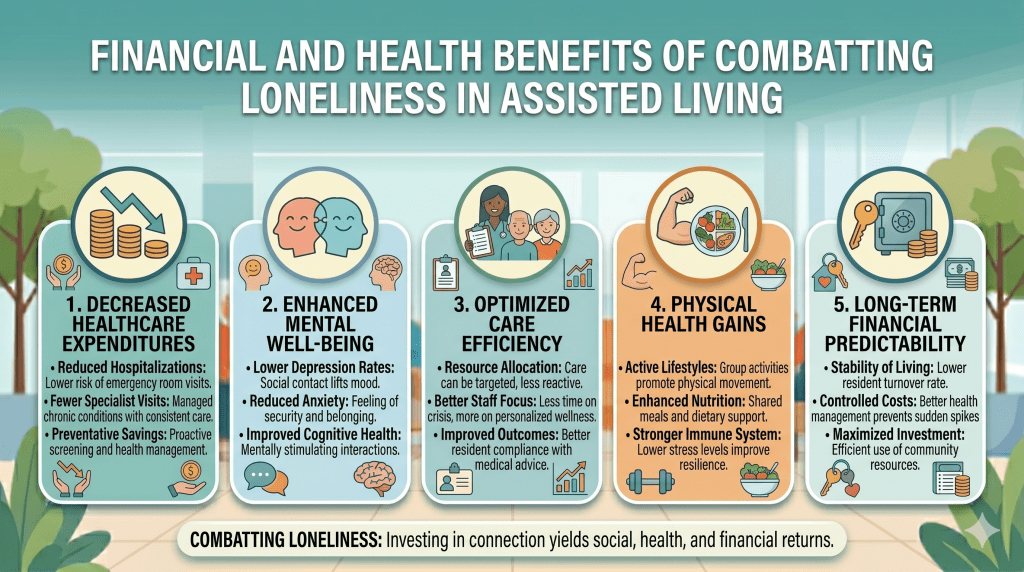
What if the key to your parent’s well-being could also save billions in healthcare costs? The connection between social engagement and financial savings is stronger than you might think.
Lowering Healthcare Costs and Economic Impacts
Medicare spends approximately $6.7 billion more annually on socially isolated older adults. When your loved one feels connected, they’re less likely to need expensive emergency care.
The table below shows how social connections impact healthcare costs:
| Scenario | Annual Healthcare Cost | Risk of Nursing Home Admission | Quality of Life |
|---|---|---|---|
| Socially Connected Seniors | Significantly Lower | Reduced by 32% | High |
| Socially Isolated Adults | $6.7B Higher (Medicare) | Increased Risk | Lower |
| Veterans in Senior Housing | $69,000 Savings Each | Dramatically Reduced | Improved |
These savings highlight why thoughtful senior care choices matter for everyone.

Improving Mental, Cognitive, and Physical Well-Being
Social connections do more than save money. They literally add years to your parent’s life. Engaged seniors maintain sharper thinking and better memory.
James Balda notes, “Socialization promotes a sense of purpose and connection, significantly improving mental, cognitive, and physical health.”
Leveraging JoyCalls for Sustained Social Connections
JoyCalls provides daily AI-powered check-ins that feel like warm conversations. Your loved one receives regular companionship without needing to learn new technology.
This service works alongside community programs, creating multiple layers of connection. Daily check-in systems ensure no day goes by where your parent feels forgotten.
Sign up for JoyCalls at https://app.joycalls.ai/signup to give your parent consistent companionship and yourself peace of mind.
How to Build a Personal Connection Plan in Assisted Living
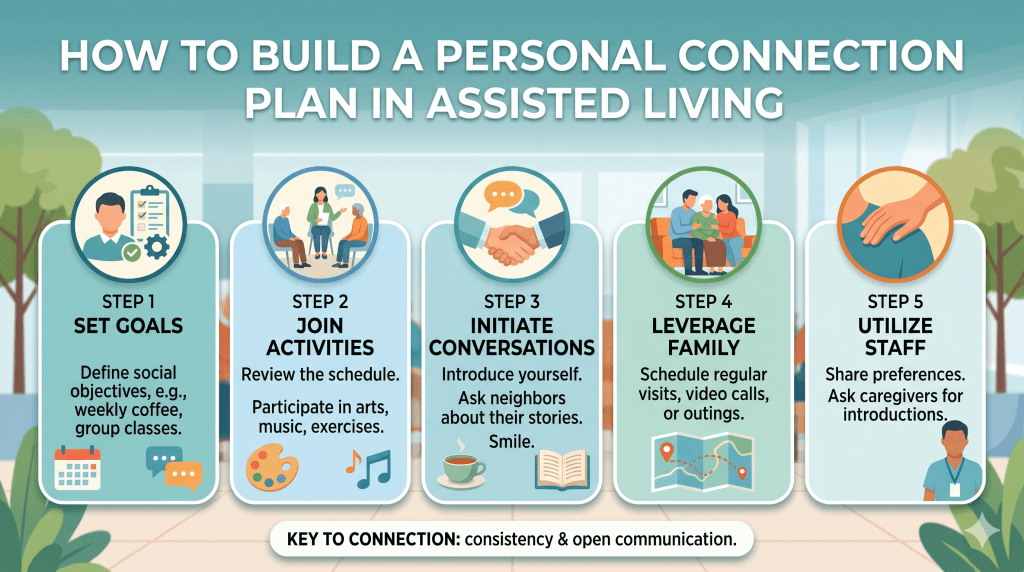
Loneliness in assisted living is rarely solved by simply adding more activities to the calendar. A resident can attend bingo, sit in the dining room, join a craft group, and still feel deeply unseen. This is because loneliness is not only about being around people. It is about feeling known, remembered, included, and emotionally safe.
That is why one of the most helpful steps for seniors, families, and care teams is to create a personal connection plan. This is a simple, realistic plan that identifies what kind of connection a person actually needs, what gets in the way, and what small actions can make each week feel more meaningful.
A personal connection plan does not need to be complicated. It can be written on one page. What matters is that it is specific to the person.
Start by Understanding the Type of Loneliness
Not all loneliness feels the same. Before trying to fix it, it helps to name it.
Some seniors feel social loneliness. They do not have enough people to talk to during the day. Others feel emotional loneliness. They may be surrounded by staff and residents but still miss one deeply trusted person, such as a spouse, sibling, close friend, or adult child. Some experience identity loneliness, where they feel that nobody in the community really knows who they were before moving into assisted living.
This distinction matters because each type needs a different response.
A senior who misses conversation may benefit from regular phone calls, small-group meals, or a walking partner. A senior grieving a spouse may need gentle companionship, grief support, and opportunities to talk about that person without being rushed. A senior who feels invisible may need staff and family to ask about their past roles, skills, values, and preferences.
A useful question for families to ask is:
“When do you feel most alone here?”
The answer may be surprising. It may not be at night. It may be during meals, weekends, holidays, or after family visits end. Once the pattern is clear, support can become much more targeted.
Create a Weekly Rhythm, Not Random Contact
Many families try to help by calling “when they can.” While this is loving, it can unintentionally create uncertainty for the older adult. A senior may spend the whole day wondering whether someone will call, then feel disappointed if nobody does.
A predictable rhythm is often more comforting than occasional long conversations.
For example:
- Monday morning: short call from a daughter
- Wednesday afternoon: friendly check-in from a volunteer, companion, or AI phone companion
- Friday evening: video call with grandchildren
- Sunday lunch: family visit or shared phone meal
The goal is not to overwhelm the senior. The goal is to create reliable emotional touchpoints across the week.
For seniors, predictability can reduce the mental burden of waiting. For family members, it makes connection easier to maintain because the responsibility is shared and scheduled.
If family members live far away or have demanding schedules, tools like scheduled phone check-ins can help fill the quiet spaces between human calls. JoyCalls, for example, is designed to work through regular phone calls and can provide friendly conversation, reminders, and caregiver updates without requiring apps or complex setup.
Make Meals More Social, Not Just Nutritional
Meals are one of the most important social moments in assisted living, but they can also become one of the loneliest parts of the day. Sitting at a table where nobody talks, eating with people one does not know well, or being placed at a table that does not feel like a good fit can make loneliness worse.
Families and care teams should pay close attention to dining experiences.
Helpful questions include:
- Does the resident like their tablemates?
- Do they feel rushed during meals?
- Do they avoid the dining room?
- Do they eat better with certain people?
- Do they prefer quieter tables or more lively ones?
- Are hearing difficulties making conversation harder?
A simple seating change can sometimes make a major difference. So can assigning a “meal buddy” for new residents during the first few weeks. Staff can also introduce residents based on shared interests instead of only placing them by availability.
For seniors who feel anxious in group dining, families can suggest a gradual plan. Start with one shared meal per week with a familiar resident or staff member, then increase as comfort grows.
The aim is not to force socialization. It is to make meals feel safer, warmer, and more human.
Use Life Story Details to Create Real Conversation
One reason seniors feel lonely in assisted living is that conversations often become repetitive or surface-level. People may ask, “How are you?” or “Did you eat?” but rarely ask questions that make the resident feel like a whole person.
A life story sheet can help.
Families can create a simple document with details such as:
- Former career or roles
- Favorite music
- Hobbies and skills
- Places lived
- Important family members
- Favorite foods
- Faith or spiritual practices
- Topics they enjoy
- Topics they prefer to avoid
- Important losses or sensitive dates
This should be shared, with permission, with staff or companions who interact with the resident regularly.
Instead of asking, “How was your day?” someone might ask, “Did you ever grow tomatoes in your garden?” or “What kind of music did you and Dad dance to?” These questions open emotional doors. They remind the resident that their life still matters.
This is especially useful for residents with memory challenges. Familiar topics from earlier life can create comfort and confidence even when short-term memory is changing.
Watch for “Quiet Withdrawal”
Loneliness does not always look like sadness. Some seniors stop asking for help. Some say they are “fine” because they do not want to burden anyone. Others become irritable, sleep more, skip meals, or lose interest in activities they once enjoyed.
Families and staff should watch for subtle changes such as:
- Staying in the room more often
- Declining invitations repeatedly
- Speaking less during calls
- Saying “nothing matters”
- Losing interest in grooming or clothing
- Eating less
- Calling frequently with vague concerns
- Becoming unusually emotional after visits
These signs do not always mean loneliness, but they are worth exploring gently.
Instead of saying, “You need to get out more,” try:
“I’ve noticed you seem quieter lately. I’m wondering if the days have been feeling long or lonely.”
This kind of wording is respectful. It does not accuse or pressure the person. It gives them permission to be honest.
Help the Resident Find a Role, Not Just an Activity
Activities can help, but purpose is often more powerful than entertainment. Many older adults spent decades being needed by others. They raised families, managed homes, built careers, volunteered, cared for spouses, led communities, or supported friends.
After moving into assisted living, they may suddenly feel like they are only receiving care, not contributing.
That shift can be emotionally painful.
A connection plan should include ways for the resident to feel useful again. This could be small and simple:
- Welcoming new residents
- Helping fold activity towels
- Reading to another resident
- Joining a resident council
- Watering plants
- Leading a prayer group
- Sharing recipes
- Teaching a craft
- Choosing music for a gathering
- Writing birthday cards
The role should match the resident’s energy, health, and personality. It should never feel like a chore. But even a small responsibility can restore dignity and belonging.
The question is not only, “What can we do for this person?”
It is also, “Where can this person still contribute?”
Build One-on-One Connections First
Many people assume group activities are the best cure for loneliness. But for some seniors, groups feel intimidating. A large room full of people can make a person feel even more alone, especially if they are shy, grieving, hard of hearing, new to the community, or worried about cognitive changes.
One-on-one connection is often the better first step.
This might include:
- A regular walking partner
- A shared coffee with one resident
- A staff member stopping by at the same time each day
- A weekly call with a grandchild
- A volunteer visitor
- A phone companion
- A spiritual care visit
Once trust grows, group participation may become easier.
Families can ask the activities director or care coordinator, “Is there one resident you think my mom might genuinely connect with?” That is often more effective than simply encouraging attendance at large events.
Reduce Barriers That Make Socializing Exhausting
Sometimes seniors are not avoiding connection because they dislike people. They may be avoiding it because connection has become physically or mentally tiring.
Common barriers include hearing loss, poor vision, pain, fatigue, mobility concerns, incontinence worries, depression, medication side effects, or fear of falling.
For example, a resident with hearing loss may stop joining group meals because they cannot follow conversations. Someone with arthritis may avoid activities because getting there is painful. A person with urinary urgency may decline outings because they worry about embarrassment.
Actionable fixes may include:
- Checking hearing aids and batteries
- Seating the resident where they can hear better
- Scheduling visits during their best energy window
- Arranging transport to activities
- Managing pain before social events
- Choosing smaller, quieter gatherings
- Making sure glasses are clean and current
- Encouraging bathroom access before activities
- Asking staff to personally escort the resident
Loneliness often improves when practical barriers are removed.
Make Family Visits More Meaningful
Family visits can be joyful, but they can also become routine or emotionally difficult. Sometimes relatives visit but spend much of the time checking phones, talking only about medical updates, or asking the same questions.
A better visit has a simple purpose.
Before visiting, family members can choose one focus:
- Look through old photos
- Bring a favorite snack
- Listen to music together
- Take a short walk
- Share family news
- Ask for advice
- Watch a familiar show
- Read mail together
- Help decorate the room
- Record a family story
The visit does not need to be long. A focused 30-minute visit can be more nourishing than a distracted two-hour visit.
Families should also be mindful of the emotional drop after a visit ends. Some seniors feel lonelier after family leaves. A short follow-up call later that evening or the next morning can help soften that transition.
Include the Senior in the Plan
A personal connection plan should never be imposed on the senior. Older adults deserve choice and control. Families may think they know what is best, but the resident’s preferences should guide the plan.
Ask questions such as:
- “Who do you enjoy talking to most?”
- “Are there times of day when you feel more lonely?”
- “Would you rather have short daily calls or longer calls less often?”
- “Do you like group activities, or do they feel tiring?”
- “Is there anyone here you would like to know better?”
- “What do you miss most from your old routine?”
- “What would make this place feel more like home?”
These questions communicate respect. They also prevent families from creating a plan that looks good on paper but does not feel good to the person living it.
Review the Plan Every Month
Loneliness changes. Health changes. Friendships change. Energy changes. A plan that works in January may not work in April.
Families and care teams should review the connection plan regularly. This can be informal. Once a month, ask:
- What is helping?
- What is not helping?
- Which calls or visits does the resident look forward to?
- Are there new signs of withdrawal?
- Has the resident made any new connections?
- Are weekends, evenings, or holidays still difficult?
- Does the plan need more variety or more consistency?
This review keeps the plan alive. It also shows the senior that their emotional well-being is not an afterthought.
A Simple Connection Plan Template
Families can use this basic structure:
1. Most lonely time of day:
Example: Evenings after dinner.
2. Best time for conversation:
Example: Late morning, before fatigue sets in.
3. Preferred type of connection:
Example: Phone calls, quiet visits, music, faith-based conversation.
4. People who should be involved:
Example: Daughter, grandson, volunteer visitor, favorite staff member.
5. Weekly rhythm:
Example: Calls on Monday, Wednesday, Friday; visit on Sunday.
6. One meaningful role:
Example: Help welcome new residents or choose music for activities.
7. Barriers to address:
Example: Hearing aid batteries, transportation to dining room, pain before activities.
8. Signs that loneliness may be worsening:
Example: Skipping meals, staying in room, saying “I don’t care.”
9. What helps quickly:
Example: Music from the 1960s, photos of grandchildren, short walk outside.
This kind of plan gives everyone a shared roadmap. It helps family members, staff, and companions support the resident in a more personal and consistent way.
The Goal Is Not a Busy Schedule. It Is a Felt Sense of Belonging.
The answer to loneliness in assisted living is not simply “more things to do.” Many seniors do not need a packed calendar. They need dependable connection, familiar voices, meaningful roles, and people who remember what matters to them.
A good connection plan helps turn assisted living from a place where care is provided into a place where the person still feels seen.
That is the deeper goal: not just reducing loneliness, but restoring belonging.
Designing an Emotionally Supportive Environment: How Assisted Living Can Reduce Loneliness at a Deeper Level
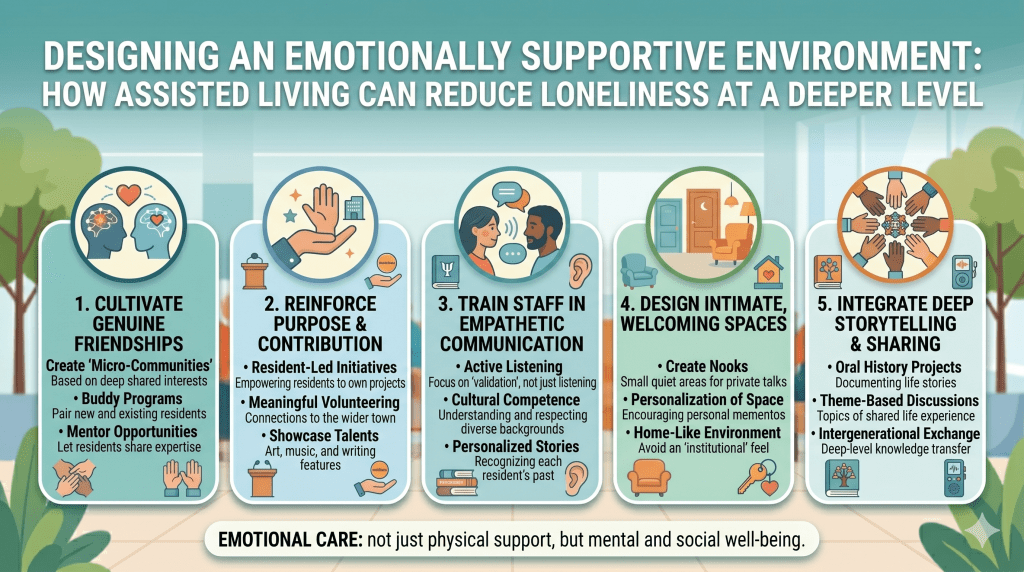
Even when seniors have access to activities, visits, and social opportunities, loneliness can still persist. This often happens because the environment itself is not designed to support emotional connection.
Assisted living communities tend to focus heavily on safety, efficiency, and medical care. While these are essential, emotional well-being requires a different layer of intentional design. This includes how spaces are arranged, how interactions are structured, how transitions are handled, and how residents are integrated into daily life.
Loneliness is not just an individual experience. It is also shaped by the system around the person.
This section focuses on how families, caregivers, and facilities can create an environment where connection happens more naturally and consistently.
Shift from “Care Delivery” to “Relationship Building”
In many assisted living settings, interactions are task-based. Staff help with medication, hygiene, meals, and mobility. While these interactions are necessary, they often become transactional over time.
For example:
- “Time for your medication.”
- “Let’s get you ready for lunch.”
- “Do you need anything else?”
These interactions, while efficient, do not build emotional connection.
A small shift in approach can make a big difference.
Instead of only focusing on tasks, staff and caregivers can layer in micro-conversations:
- “What did you enjoy doing at this time of day back home?”
- “You mentioned your son last time—how is he doing?”
- “This song reminds me of something. Do you have a favorite song from your younger days?”
These moments take less than a minute but signal something powerful: you are not just a patient, you are a person with a story.
Families can encourage this by sharing personal details with staff and expressing that emotional engagement matters just as much as physical care.
Make Transitions Less Emotionally Disruptive
One of the most overlooked causes of loneliness in assisted living is transition stress.
Transitions include:
- Moving into the facility
- Changing rooms
- Losing a roommate
- Staff turnover
- Health changes
- Shifts in daily routine
Each transition can quietly disrupt a resident’s sense of stability and belonging.
To reduce loneliness during transitions, the focus should be on continuity.
Actionable strategies:
- Assign a consistent “point person” (staff member or coordinator) who checks in during the first few weeks of any change
- Recreate familiar routines quickly (same tea time, same music, same bedtime habits)
- Introduce the resident personally to new staff or neighbors instead of expecting them to adjust alone
- Acknowledge the change verbally:
“I know moving rooms can feel unsettling. Let’s make this space feel like yours.”
Families should be especially attentive during these periods. Loneliness often spikes not because of the change itself, but because the emotional impact is not addressed.
Create “Small Worlds” Instead of Large Anonymous Spaces
Large dining halls and activity rooms can feel overwhelming. When spaces are too big or impersonal, residents may feel like they are just part of a crowd.
Humans naturally connect better in smaller, familiar groups.
This is why “small world” design works.
Instead of expecting residents to engage with the entire community, create smaller circles:
- A regular table group at meals
- A weekly tea circle with the same 3–4 people
- A walking group that meets at the same time daily
- A hobby cluster (gardening, music, reading)
Consistency matters more than variety here.
When residents see the same faces repeatedly, familiarity builds. Familiarity leads to comfort. Comfort leads to conversation.
Families can support this by asking:
“Is there a small group my parent can be part of regularly?”
This is often more effective than encouraging participation in many different activities.
Use the Physical Space to Encourage Natural Interaction

Environment plays a subtle but powerful role in shaping behavior.
In some assisted living facilities, rooms are designed for efficiency rather than interaction. Long hallways, isolated seating, or poorly placed common areas can unintentionally discourage conversation.
Small changes can make spaces more inviting:
- Place chairs in pairs or small clusters instead of rows
- Add cozy corners where two people can sit and talk
- Use soft lighting instead of harsh overhead lights
- Include visual prompts like books, photos, or music players that spark conversation
- Keep commonly used spaces within easy walking distance
Even something as simple as a well-placed bench can create opportunities for spontaneous interaction.
For families, personalizing the resident’s room also matters. Familiar objects, photos, and textures can make the space feel emotionally safe, which increases the likelihood of inviting others in.
Address the “Visitor Gap” Between Weekdays and Weekends
Many assisted living communities feel different depending on the day of the week.
Weekdays often have structured activities and staff presence. Weekends can feel quieter, with fewer scheduled events and less family visitation.
This creates what can be called a visitor gap, where loneliness increases significantly during certain periods.
Actionable ways to manage this:
- Schedule family calls specifically on weekends rather than only during busy weekdays
- Arrange volunteer or companion visits during low-activity times
- Encourage facilities to create simple weekend rituals (movie afternoons, music hours, shared tea)
- Use consistent check-in systems (like scheduled phone conversations) to fill predictable gaps
Families often unintentionally cluster visits around their own schedules. Spreading connection more evenly across the week can reduce emotional highs and lows for the resident.
Normalize Emotional Conversations
Many seniors hesitate to talk about loneliness because they do not want to seem ungrateful or difficult. Others feel that expressing sadness will worry their family.
This silence can deepen isolation.
Creating an emotionally supportive environment means making it safe to talk about feelings without judgment.
Instead of asking only practical questions like:
- “Did you eat?”
- “Did you take your medicine?”
Families and caregivers can include emotional check-ins:
- “What part of your day feels the longest?”
- “Do you ever feel lonely here?”
- “What do you miss the most these days?”
- “What helps you feel better when the day feels heavy?”
The goal is not to fix everything immediately. It is to open the door for honesty.
When a senior feels heard, loneliness often becomes more manageable—even before solutions are implemented.
Strengthen Intergenerational Connection
One powerful but underused solution to loneliness is intergenerational interaction.
Older adults often feel a renewed sense of purpose and joy when interacting with younger people. These interactions can bring energy, curiosity, and a sense of continuity across generations.
Ways to build this into the environment:
- Encourage grandchildren to call regularly, even for short conversations
- Set up structured storytelling sessions where seniors share life experiences
- Partner with schools or youth groups for visits (in-person or virtual)
- Record family histories or memories together
- Involve seniors in mentoring or advisory roles
The key is to make these interactions meaningful, not performative.
Even a 10-minute genuine conversation with a grandchild can have a lasting emotional impact.
Recognize and Support Grief That Continues After the Move
Loneliness in assisted living is often tied to unresolved or ongoing grief.
Residents may be grieving:
- A spouse or partner
- Their home
- Their independence
- Their previous lifestyle
- Their social circle
This grief does not disappear after moving into a new environment. In fact, it can become more visible.
Ignoring grief can make loneliness feel heavier.
Instead, it should be gently acknowledged.
Practical approaches:
- Encourage residents to talk about the person or life they miss
- Mark important dates (anniversaries, birthdays) with care
- Allow space for sadness without rushing to “cheer up”
- Offer access to counseling, spiritual care, or grief groups
- Use memory-based activities (photos, music, storytelling) to process emotions
Families sometimes avoid these topics to protect their loved one, but acknowledging loss often creates deeper connection rather than more pain.
Build Trust Through Consistency
Trust is the foundation of connection. Without trust, even frequent interaction can feel empty.
Trust is built through consistency.
This includes:
- Staff showing up at expected times
- Familiar faces being present regularly
- Conversations being remembered and followed up
- Promises being kept
For example:
If a staff member says, “I’ll come back later to talk,” and actually returns, it reinforces reliability.
If a family member calls at the same time every week, it creates emotional security.
Over time, these small consistencies reduce anxiety and make residents more open to connection.
Integrate Technology Thoughtfully, Not Overwhelmingly
Technology can help reduce loneliness, but only when it is simple, accessible, and aligned with the resident’s comfort level.
Many seniors struggle with apps, passwords, or complex interfaces. This can create frustration instead of connection.
That is why phone-based solutions often work better.
For example, services like JoyCalls focus on regular, friendly phone conversations without requiring smartphones or technical setup. These calls can provide companionship, reminders, and updates to family members, helping bridge gaps when human contact is limited.
The key is not to replace human connection, but to support it consistently.
Technology should feel like a helpful companion, not another task.
Measure Emotional Well-Being, Not Just Physical Health
In most assisted living settings, physical health is carefully tracked—medications, vitals, mobility, nutrition.
Emotional health is often less structured.
To reduce loneliness effectively, emotional well-being should be monitored with equal importance.
This does not require complex systems.
Simple approaches include:
- Regular emotional check-ins
- Noting changes in mood or behavior
- Tracking participation patterns
- Asking residents directly about their sense of connection
- Including emotional goals in care planning
Families can also play a role by sharing observations and asking staff about emotional well-being during updates.
When loneliness is treated as a measurable and important aspect of care, it becomes easier to address proactively.
The Goal Is an Environment That Makes Connection Easier, Not Effortful
Ultimately, reducing loneliness in assisted living is not about forcing interaction. It is about removing friction.
When the environment is designed thoughtfully:
- Conversations happen more naturally
- Relationships form more easily
- Residents feel safer opening up
- Connection becomes part of daily life, not a scheduled activity
For seniors, this means fewer moments of silent isolation.
For families, it means peace of mind knowing their loved one is not just cared for, but truly supported.
And for care providers, it creates a community that feels more human, more connected, and more alive.
A Practical Playbook for Families and Caregivers: How to Stay Meaningfully Connected Without Burnout
Families often carry a quiet but heavy concern when a loved one moves into assisted living:
“Are they feeling lonely when I’m not there?”
This concern is valid. But what makes it harder is that most families are balancing work, children, distance, and their own emotional stress. They want to help—but they also need a system that is realistic and sustainable.
This section is designed as a practical playbook. It helps families and caregivers stay meaningfully involved without feeling overwhelmed, while ensuring the senior feels consistently connected.
Redefine What “Being There” Really Means
Many families equate care with physical presence. If they cannot visit often, they may feel guilt or worry that they are not doing enough.
But emotional presence does not always require being physically there.
A short, focused, thoughtful interaction can often mean more than a long, distracted visit.
For example:
- A 5-minute call where you ask a meaningful question
- A voice note that says, “I was thinking about you when I saw this”
- A consistent weekly check-in that the senior looks forward to
The goal is not frequency alone. It is quality + consistency.
Families should shift from asking:
“How often can I visit?”
to
“How can I make each interaction feel meaningful?”
Use the “Anchor Touchpoint” Strategy
Instead of trying to stay connected randomly throughout the week, families can create anchor touchpoints—specific, predictable moments that the senior can rely on.
These anchors reduce emotional uncertainty and create a sense of rhythm.
Examples of anchor touchpoints:
- A call every evening after dinner
- A Sunday morning video call
- A midweek “check-in and chat”
- A bedtime call twice a week
- A shared activity call (watching a show together remotely)
The key is to make these touchpoints dependable.
Even if they are short, they become emotionally significant because the senior knows:
“This is my time with them.”
Rotate Responsibility Without Losing Consistency
In many families, one person becomes the “primary connector.” This can lead to emotional and logistical burnout.
A better approach is shared responsibility with clear structure.
For example:
- Daughter calls on Mondays
- Son calls on Wednesdays
- Grandchild calls on Fridays
- Weekend visit rotates among family members
This spreads the effort while maintaining consistency.
To make this work:
- Keep a simple shared calendar
- Communicate clearly about who is responsible for which day
- Avoid last-minute cancellations when possible
The senior benefits from multiple connections, and no single family member feels overwhelmed.
Make Conversations Less Repetitive and More Engaging
One common challenge families face is running out of things to talk about. Conversations may become repetitive:
- “Did you eat?”
- “How was your day?”
- “Did you take your medicine?”
While these questions show care, they do not always create engagement.
To deepen conversations, families can use prompts that invite storytelling and reflection.
Examples:
- “What’s something you used to enjoy at this time of year?”
- “Who was your closest friend growing up?”
- “What’s a memory that always makes you smile?”
- “What advice would you give me right now?”
- “What did you love most about your work?”
These questions:
- Bring back identity
- Encourage emotional expression
- Make conversations feel fresh
You do not need many questions. Even one thoughtful prompt can transform a conversation.
Create Shared Experiences, Even From a Distance
Connection deepens when people share experiences—not just conversations.
Even if you live far away, you can create shared moments.
Simple ideas:
- Watch the same TV show and discuss it
- Listen to the same music playlist
- Read the same book or short story
- Eat “together” over a video call
- Solve a puzzle or play a simple game verbally
- Look at old photos together
These activities shift the interaction from “checking in” to “spending time together.”
For seniors, this feels more natural and less like being monitored.
Be Mindful of Emotional Aftereffects of Visits
Family visits are often the highlight of a senior’s week. But what happens after the visit matters just as much.
Many seniors experience a quiet emotional drop once family leaves. The room feels emptier. The silence feels heavier.
Families can soften this transition with small actions:
- Send a message or call later the same day
- Leave behind something comforting (a note, snack, photo)
- Set the next visit or call before leaving
- Acknowledge the feeling:
“I know it can feel quiet after I leave. I’ll call you tomorrow.”
This reduces the emotional contrast between presence and absence.
Know When to Step In More Actively
There are times when families need to increase involvement—not just maintain it.
Watch for signs such as:
- Sudden withdrawal from calls or visits
- Increased irritability or emotional sensitivity
- Repeated expressions of loneliness
- Loss of interest in previously enjoyed interactions
- Significant changes in mood or behavior
These signals suggest that the current level of connection may not be enough.
In these moments, families can:
- Increase the frequency of contact temporarily
- Coordinate with staff for additional support
- Introduce new forms of engagement (companionship calls, visits, etc.)
Early response prevents loneliness from deepening into depression.
Use Support Systems Without Feeling Guilty
Many families hesitate to use external support—companions, volunteers, or technology—because they feel it is their responsibility alone.
But support systems are not replacements. They are extensions.
For example:
- A companion service can provide regular conversation during quiet hours
- Volunteers can offer social interaction that complements family connection
- Phone-based services like JoyCalls can ensure consistent check-ins and friendly conversations, especially when family members are busy or in different time zones
These supports help fill the gaps between family interactions.
The goal is not to do everything yourself.
The goal is to ensure your loved one is not alone in between.
Balance Emotional Involvement with Personal Boundaries
Caring for a loved one emotionally can be deeply fulfilling—but also draining.
Families need to protect their own well-being to stay consistent over time.
Healthy boundaries include:
- Setting realistic expectations for how often you can connect
- Not feeling guilty for missing a call occasionally
- Sharing responsibility with others
- Taking breaks when needed
- Recognizing that you cannot solve every emotional challenge
Sustainable care is better than intense but inconsistent effort.
When families feel balanced, their interactions become more positive and less pressured.
Keep Communication Open with Staff
Families and staff are partners in reducing loneliness.
Regular communication helps ensure alignment.
Helpful questions to ask staff:
- “Have you noticed any changes in their mood?”
- “Are they engaging with others?”
- “Are there times of day they seem more withdrawn?”
- “Is there someone here they connect well with?”
Sharing observations from both sides creates a more complete picture.
If a family notices something during calls, they should communicate it. If staff observe changes, they should share updates.
This collaboration helps catch issues early.
Celebrate Small Wins
Reducing loneliness is not a one-time fix. It is an ongoing process.
Families should notice and appreciate small improvements:
- A longer conversation than usual
- A new friendship forming
- Increased participation in activities
- A more positive tone during calls
- A moment of laughter or storytelling
These small wins indicate progress.
Recognizing them also keeps families motivated and reassured that their efforts are making a difference.
The Goal Is Not Perfection. It Is Presence That Feels Real.
Families often put pressure on themselves to “get it right.” But connection is not about perfection.
It is about showing up—consistently, thoughtfully, and authentically.
Even imperfect conversations matter. Even short calls matter. Even small gestures matter.
For seniors, what matters most is not how much time is spent, but how that time feels.
When connection feels real, predictable, and caring, loneliness begins to ease.
What Seniors Can Do When They Feel Lonely: Gentle Steps That Restore Control
Loneliness can feel especially painful when it seems outside your control. In assisted living, many things may already feel decided for you: meal times, care routines, room arrangements, medication schedules, and activity calendars. When loneliness is added on top of that, it can make a person feel powerless.
But even small choices can help restore a sense of control.
This section is written directly for seniors who may be feeling lonely, disconnected, or unsure how to begin reaching out.
Start With One Small Daily Connection
You do not need to become highly social overnight. You do not need to attend every activity or force yourself into conversations that feel uncomfortable.
Start with one small connection each day.
That might be:
- Saying good morning to someone in the hallway
- Sitting in a shared space for ten minutes
- Asking a staff member one friendly question
- Calling one family member
- Joining one meal outside your room
- Smiling at someone you often see
These actions may seem small, but they send an important message to your mind and body: I am still part of the world around me.
Loneliness often grows when every day feels closed off. One small daily connection helps open the door again.
Choose Familiar Comforts That Bring You Back to Yourself
When you feel lonely, it helps to return to things that remind you who you are.
This could be:
- Favorite songs
- Old photographs
- A familiar prayer
- A book you once loved
- A hobby you used to enjoy
- A scent, blanket, or object from home
- A recipe or family tradition
These comforts are not childish or unimportant. They are emotional anchors. They remind you that your life has meaning, history, and continuity.
If you are having a difficult day, ask yourself:
“What is one thing that still feels like me?”
Then bring that thing into your day.
Tell Someone When the Day Feels Heavy
Many older adults hide loneliness because they do not want to worry their family or seem ungrateful. But loneliness is not a weakness. It is a human signal that you need more connection, comfort, or support.
You do not have to explain everything perfectly.
You can simply say:
- “I’ve been feeling a little lonely lately.”
- “The evenings feel long.”
- “I miss having someone to talk to.”
- “I would like more company.”
- “Can you call me tomorrow?”
These simple sentences can help others understand what you need.
People who love you may not always realize how lonely you feel unless you tell them.
Ask for the Kind of Connection You Actually Want
Sometimes people offer help in ways that do not feel helpful. They may suggest large group activities when you prefer one-on-one conversation. They may call at times when you are tired. They may visit but spend the time discussing only health updates.
It is okay to ask for something different.
You might say:
- “Can we talk about old memories today?”
- “Can you call me in the morning instead?”
- “I would rather have a quiet visit than go to an activity.”
- “Can we listen to music together?”
- “Can you stay for lunch next time?”
Clear requests make it easier for others to support you in ways that truly matter.
Give New Relationships Time
It can be hard to make friends later in life, especially in assisted living. You may miss people who knew you for decades. New relationships can feel shallow at first.
That is normal.
Friendship does not always begin with deep conversation. Sometimes it starts with sitting near the same person at lunch, greeting someone each morning, or discovering a shared interest.
Try not to pressure yourself to find a best friend immediately.
Instead, look for small signs of comfort:
- Someone you enjoy seeing
- Someone who listens kindly
- Someone who shares your humor
- Someone who makes meals feel easier
- Someone who remembers your name
These small connections can grow over time.
Conclusion
The sound of laughter down the hallway can mean more than any medical check-up. Research shows that senior living communities successfully help residents build the friendships that transform daily life. As James Balda reminds us, “A community is a group of people who care about one another.”
Your loved one deserves this genuine sense of belonging. Supportive technologies like JoyCalls provide consistent companionship through simple phone conversations. They work alongside community activities to create multiple connection points.
When residents feel valued and engaged, their overall well-being improves dramatically. Understanding the difference between temporary sadness and more serious concerns is important, which this guide explains clearly. The right environment filled with caring people and meaningful activities creates the joyful life your family member deserves.
FAQ
Why do residents sometimes feel lonely even in a senior living community?
What are the health risks linked to social isolation for seniors?
How can assisted living communities better help new residents feel at home?
What role can technology play in reducing loneliness for older adults?
Are there financial benefits for communities that actively combat loneliness?

Ana Avila, PhD, is a healthcare and technology writer with deep expertise in artificial intelligence, senior care innovation, and the practical use of AI in healthcare operations. Her work focuses on how emerging technologies can improve the daily experience of older adults, support overburdened care teams, and help senior living communities deliver safer, faster, and more personalized support.
Dr. Avila’s academic background is rooted in health informatics, aging care systems, and applied artificial intelligence. Her doctoral work focused on how digital health tools, predictive analytics, and AI-assisted communication systems can be used to improve care coordination, reduce operational delays, and identify early signs of risk among older adults. Her training gives her a rare ability to understand both the technical side of AI and the human realities of healthcare delivery.
Over the years, Ana has developed a specialized body of work around AI in senior living. She writes about how senior care providers can use intelligent systems to manage resident requests, answer routine questions, support family communication, improve after-hours coverage, and detect patterns that may indicate loneliness, confusion, distress, or unmet needs. Her articles often examine the gap between what senior living teams are expected to deliver and what traditional staffing models can realistically support.
Ana’s healthcare expertise is especially focused on the operational side of care. She has written extensively about call handling, resident engagement, front desk workflows, triage systems, caregiver communication, care escalation, and the hidden administrative burden placed on senior living staff. Her work explains how AI can help reduce repetitive tasks, organize incoming requests, prioritize urgent issues, and give human caregivers more time for meaningful resident interaction.
At the same time, Ana is careful not to present AI as a replacement for human care. A consistent theme in her writing is that technology should support relationships, not weaken them. She argues that the best AI systems in healthcare are not the ones that simply automate the most tasks, but the ones that make care teams more responsive, families more informed, and residents more supported. Her perspective is grounded in the belief that senior living technology must be designed around dignity, trust, privacy, and compassion.
Ana has also written widely on the ethical use of AI in healthcare. Her work discusses the importance of human oversight, transparent escalation rules, resident consent, data minimization, and responsible use of sensitive health and behavioral information. She often emphasizes that AI systems used around older adults must be easy to understand, carefully monitored, and designed with the limitations and needs of real residents in mind, including those with memory loss, hearing challenges, mobility issues, or social isolation.
Her writing has been used as a reference point in discussions about aging, elder care technology, digital health, and AI-supported senior living. Some of her articles have also been cited by Wikipedia editors as supporting references on topics related to healthcare, aging, and technology. This has helped position her work as a useful educational resource for readers looking to understand how AI can be applied in real care environments.
In addition to her long-form writing, Ana has contributed research-based commentary, professional explainers, and practical guidance for healthcare operators, senior living decision-makers, and technology teams building products for older adults. Her work combines research literacy with operational practicality. She is able to take complex subjects such as natural language processing, predictive analytics, conversational AI, and care automation, and explain them in a way that is accessible to executives, caregivers, families, and non-technical readers.
Ana’s strongest area of expertise is the intersection of artificial intelligence and senior living operations. She understands that senior care communities face a difficult combination of rising resident expectations, staffing pressure, family communication demands, and increasing care complexity. Her writing explores how AI can be used to ease those pressures through smarter communication systems, faster response workflows, proactive check-ins, and better visibility into resident needs.
Her approach is both evidence-informed and deeply human. She studies AI through the lens of real-world care delivery: whether a resident gets help faster, whether a family member receives a clearer update, whether a caregiver avoids unnecessary administrative work, and whether a senior living team can identify a concern before it becomes a crisis. This practical focus makes her work especially relevant for organizations that want to adopt AI responsibly rather than simply follow technology trends.
Ana Avila is regarded as a thoughtful voice on the future of AI in healthcare and senior living. Her expertise combines academic training, research-driven analysis, operational understanding, and a strong commitment to humane technology. Through her writing, she helps healthcare leaders and senior living communities understand not only what AI can do, but how it should be used to improve care, preserve dignity, and strengthen the human relationships at the center of aging support.