


Long-distance caregiving is less about doing everything yourself and more about building a reliable system around an aging parent. The best plan combines regular connection, local help, shared information, clear family roles, and an emergency response everyone understands.
If you live an hour or more away from the person you support, the National Institute on Aging considers you a long-distance caregiver. You may coordinate appointments, finances, supplies, home care, paperwork, or long-term care even when you cannot provide hands-on help.
If you are checking on elderly parents remotely, consistency matters more than trying to supervise every detail from afar. This guide explains how to check on elderly parents with a practical daily, weekly, and monthly rhythm you can adapt to their needs.
Start with your parent’s permission

Remote care can feel like surveillance when the older adult is not involved in the plan.
Begin with:
“I want to help you stay independent and make emergencies less stressful. What kind of support would feel useful—and what would feel intrusive?”
Agree on:
- How often to call
- What information family members may share
- Who can speak with clinicians or service providers
- Which reminders are welcome
- What happens after a missed call
- Which nearby people may be contacted
- What the parent considers an urgent situation
The plan should protect both safety and dignity.
Create a one-page care snapshot
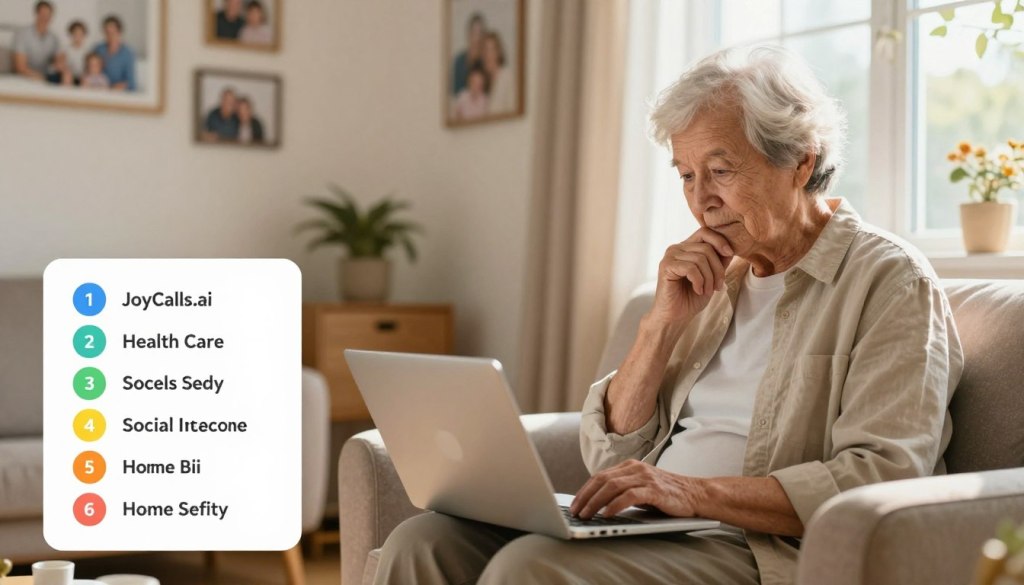
Keep essential information in one secure, shared place. Include only what authorized family members need.
Basic information
- Full name, address, and preferred phone number
- Date of birth
- Preferred language
- Important routines and communication preferences
Key contacts
- Primary-care clinician
- Pharmacy
- Nearby family, friends, or neighbors
- Home-care agency or paid caregiver
- Building manager or assisted-living contact
- Preferred hospital
- Emergency contacts in priority order
Care information
- Current medication list maintained with the appropriate clinician or pharmacist
- Upcoming appointments
- Mobility, hearing, vision, or memory considerations
- Home services and delivery schedules
- Relevant legal documents and where they are stored
Do not scatter updates across multiple text threads and private notes. Choose one source of truth and assign one person to keep it current.
A daily check-in plan

A daily check-in should feel like connection, not an inspection.
Use a three-part structure:
- Connection: “What kind of day are you having?”
- Well-being: “Is anything harder than it was yesterday?”
- Plan: “What is one thing you want to do today?”
Depending on the parent’s needs, the call may also include a meal, medication, hydration, or appointment reminder.
Keep ordinary calls light. If every conversation is about problems, the parent may begin to avoid them or say “I’m fine” automatically.
For additional structure, see AI Check-In Calls for Seniors.
Use a green, yellow, and red response system

Decide what different answers mean before anyone is anxious.
Green: normal day
- Parent answers as expected
- Routine seems typical
- No new concern
- Continue the normal plan
Yellow: follow up
- Repeatedly missed meals or medications
- Noticeable change in energy, mood, speech, or mobility
- Near fall or new difficulty with ordinary tasks
- Several missed calls without a known reason
- Unusual confusion or concern that is not an immediate emergency
The response may be a longer family call, contact with a nearby person, or communication with an appropriate professional.
Red: urgent or emergency response
- Immediate danger
- Serious fall or injury
- Difficulty breathing, severe pain, or other urgent medical concern
- Sudden severe confusion
- Talk of self-harm
- A situation that meets the family’s agreed emergency threshold
Contact local emergency services when there is immediate danger. A phone companion or family check-in system is not an emergency-response provider.
A weekly caregiving review

Choose one day and keep the review short. Look for patterns rather than reacting to every isolated comment.
Review five areas:
- Meals and daily routines: Is anything being missed repeatedly?
- Mobility and home function: Is the parent moving confidently and using the home safely?
- Mood and connection: Are they engaged, withdrawn, or unusually anxious?
- Appointments and medication: Is the current plan still manageable?
- Family workload: Is one person carrying too much?
End with one action, one owner, and one deadline.
Example:
| Observation | Next action | Owner | Due |
|---|---|---|---|
| Groceries were low twice | Set up a recurring delivery | Maya | Friday |
| Parent sounded lonely at night | Add Wednesday evening call | David | This week |
| Bathroom light is unreliable | Ask local contact to replace it | Luis | Saturday |
A monthly care review
Once a month, zoom out.
- Are daily calls still welcome?
- Are local contacts reliable?
- Does the home need maintenance?
- Have medications or appointments changed?
- Are bills, mail, and insurance tasks current?
- Is caregiver stress increasing?
- Does the parent need more in-person support?
- Are legal and emergency documents accessible?
Use a monthly video walkthrough if the parent is comfortable. Focus on practical function rather than judging housekeeping.
Look at:
Try JoyCalls Free
No app or new device needed. Start with a free 7-day trial.
- Clear walking paths
- Lighting, especially bedroom-to-bathroom routes
- Food and household supplies
- Working phone and chargers
- Heating, cooling, smoke detectors, and obvious repair needs
When a concern requires professional assessment, arrange the appropriate local service rather than trying to diagnose it by video.
Build a local support circle

One nearby person can make a major difference, but no one should receive a vague assignment to “keep an eye on things.” Give each person a defined role.
Possible roles:
- Primary local contact: Responds when the parent cannot be reached
- Neighbor: Notices mail, lights, weather problems, or an unusual routine
- Family friend: Visits or provides companionship
- Paid caregiver: Handles agreed in-home tasks and reports changes
- Care manager: Coordinates services when needs become complex
- Family coordinator: Maintains the shared plan and contact list
Ask each person what they can realistically do. Build backups for critical tasks.
The U.S. Eldercare Locator connects families with local transportation, meals, home care, caregiver training, and respite resources.
Coordinate siblings without creating conflict
Divide work by skill, location, and availability—not by an assumption that everyone must contribute in the same way.
Examples:
- One person manages appointments.
- One handles bills and insurance.
- One is the main local responder.
- One schedules family calls and visits.
- One manages home repairs and deliveries.
Define what “done” means. “Handle appointments” could mean scheduling, arranging transportation, attending remotely when permitted, recording follow-up tasks, and updating the shared calendar.
Use a brief weekly family update:
- What stayed stable?
- What changed?
- What needs action?
- Who owns the next step?
Share observations before opinions. “Mom missed two deliveries” is easier to discuss than “Mom cannot cope anymore.”
Keep connection calls separate from care calls
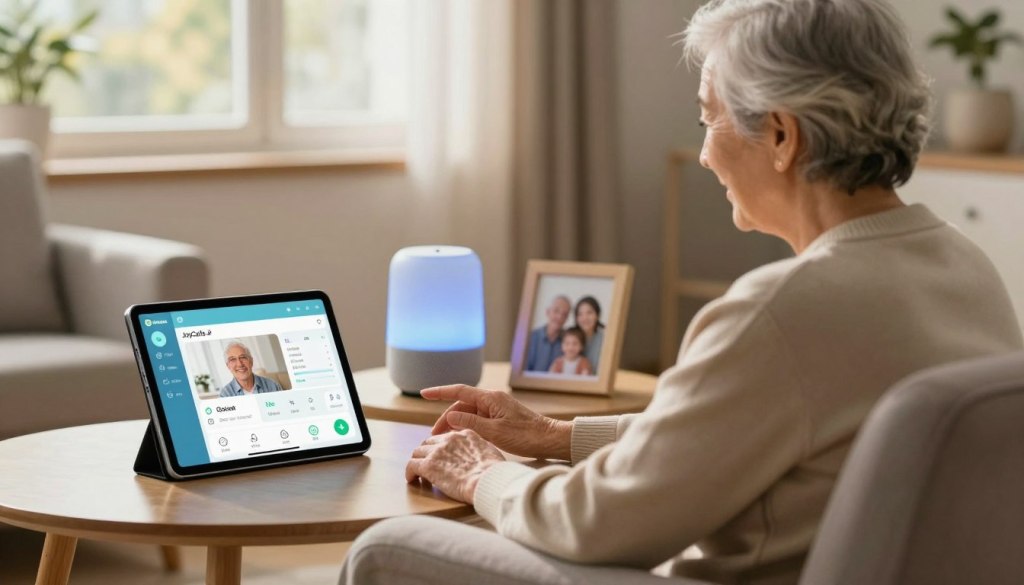
An aging parent should not lose their relationship with you because every conversation becomes administrative.
Use two types of contact:
- Connection calls: Family stories, hobbies, jokes, shared activities, and ordinary life
- Care calls: Appointments, services, paperwork, safety, and decisions
Some calls can include both, but do not let care coordination consume every interaction.
Hiring a paid caregiver from far away
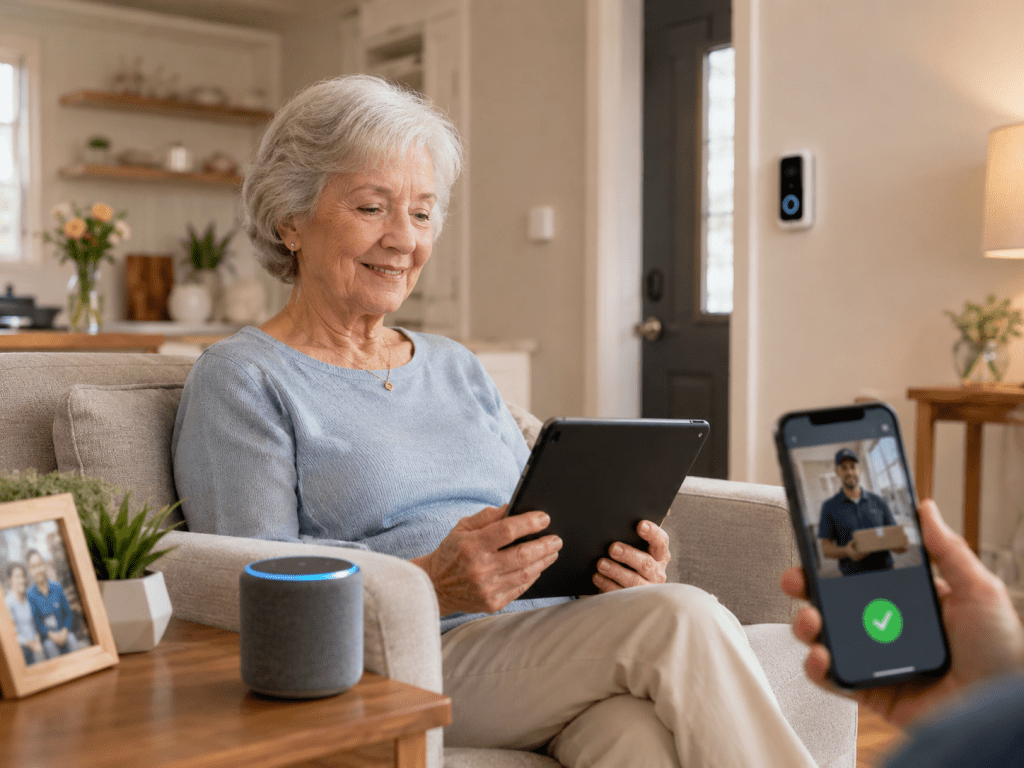
Start by defining the need. Companionship, housekeeping, personal care, transportation, and skilled home health are different services.
When evaluating a provider:
- Use a trusted referral source.
- Verify licensing or credentials when applicable.
- Ask about screening, supervision, insurance, and backup coverage.
- Put duties and reporting expectations in writing.
- Protect the parent’s financial and personal information.
- Involve the parent in the decision.
- Begin with a trial period and review the fit.
Keep a local backup contact involved. A remote caregiver should not depend entirely on reports from one paid person.
Prepare for emergencies before traveling is necessary

Create a written plan for:
- No answer after repeated calls
- Fall or injury
- Severe weather or power outage
- Hospital admission
- Medication or supply interruption
- Caregiver absence
- Sudden need for more supervision
The plan should specify who calls whom, who can enter the home, which hospital is preferred, where documents are stored, and who will travel if needed.
Review the plan with the parent and local contacts. Do not wait for a crisis to discover that no one has a key or the phone list is outdated.
Make visits about planning and relationship
Before traveling, ask the parent and local caregiver what matters most. Choose a few realistic priorities.
A visit might include:
- Attend an appointment with permission
- Review the home and supplies
- Update paperwork and contacts
- Meet local helpers
- Test the emergency plan
- Handle one or two repairs
Also protect time for a meal, music, a drive, photographs, or another activity unrelated to caregiving. The NIA specifically advises long-distance caregivers not to let every visit become a task list.
Watch for signs the plan needs more support
Increase local or professional support when patterns show that the current system is no longer enough.
Examples include:
- Repeated missed meals or medications
- Increasing falls or mobility problems
- Unsafe driving
- Unpaid bills or financial vulnerability
- Noticeable decline in personal care
- Repeated emergencies
- Wandering or serious confusion
- Exhaustion in the local caregiver
- The parent no longer being able to use the plan safely
One difficult day does not always require a major change. Repeated patterns, worsening function, and inability to recover are stronger signals.
Protect the caregiver from burnout
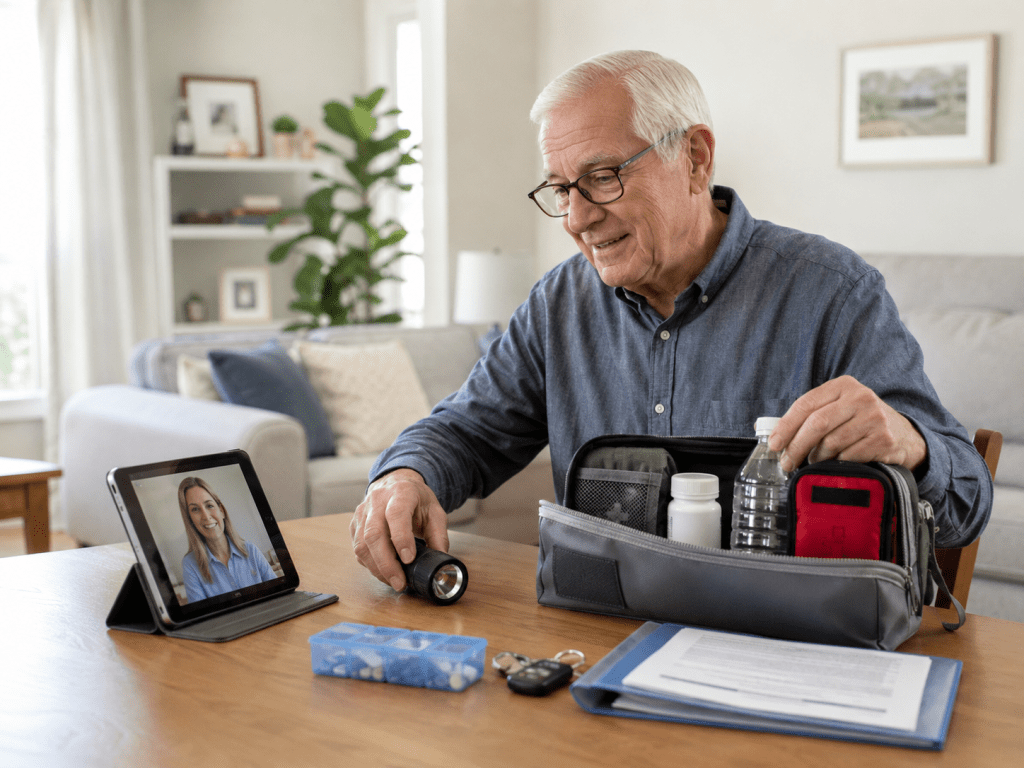
Long-distance caregiving creates guilt because the work is real but often invisible. The goal is dependable care, not endless availability.
Set boundaries:
- Define normal call times.
- Decide what counts as urgent.
- Share responsibility.
- Use respite or paid help before a crisis.
- Keep time for your own health and family.
- Join a caregiver support group or seek counseling when needed.
The National Institute on Aging recommends that caregivers watch for exhaustion, anxiety, sleep problems, irritability, sadness, and loss of interest—and seek help before they are completely overwhelmed.
How JoyCalls can support a long-distance care plan
JoyCalls provides scheduled AI phone calls for wellness checks, reminders, or friendly conversation. The older adult answers an ordinary phone, and the caregiver can receive summaries and alerts.
This can add a dependable contact between family calls and reduce the number of routine check-ins one person must manage. It does not replace emergency services, home care, clinicians, or the local support circle.
Hear a sample JoyCall or start a free trial.
Frequently asked questions
How often should I check on an elderly parent who lives far away?
The right schedule depends on the parent’s preferences, health, routine, local support, and recent changes. Start with a predictable rhythm and review it monthly.
What can a long-distance caregiver do effectively?
A remote caregiver can coordinate services, manage information and paperwork, arrange supplies and appointments, support local caregivers, plan emergencies, and maintain regular connection.
What should I do if my parent does not answer?
Follow the agreed no-answer plan: retry, check the schedule, contact the local responder, and escalate when the situation is unusual or there are additional reasons for concern.
How do siblings divide elder-care responsibilities?
Assign clear roles based on ability and availability, define what completion means, and use a short weekly review with one owner for every action.
Can an AI companion help with long-distance caregiving?
It can provide additional scheduled calls, reminders, and caregiver updates. It should remain one layer in a broader plan that includes people and professional services.
Sources
- National Institute on Aging: What Is Long-Distance Caregiving?
- National Institute on Aging: Taking Care of Yourself—Tips for Caregivers
- Administration for Community Living: Finding Help for Yourself or a Loved One
- Eldercare Locator

Ana Avila is a healthcare and technology writer with deep expertise in artificial intelligence, senior care innovation, and the practical use of AI in healthcare operations. Her work focuses on how emerging technologies can improve the daily experience of older adults, support overburdened care teams, and help senior living communities deliver safer, faster, and more personalized support.
Ana’s background includes health informatics, aging care systems, and applied artificial intelligence. Her work explores how digital health tools, predictive analytics, and AI-assisted communication systems can improve care coordination, reduce operational delays, and identify early signs of risk among older adults. She brings an understanding of both the technical side of AI and the human realities of healthcare delivery.
Over the years, Ana has developed a specialized body of work around AI in senior living. She writes about how senior care providers can use intelligent systems to manage resident requests, answer routine questions, support family communication, improve after-hours coverage, and detect patterns that may indicate loneliness, confusion, distress, or unmet needs. Her articles often examine the gap between what senior living teams are expected to deliver and what traditional staffing models can realistically support.
Ana’s healthcare expertise is especially focused on the operational side of care. She has written extensively about call handling, resident engagement, front desk workflows, triage systems, caregiver communication, care escalation, and the hidden administrative burden placed on senior living staff. Her work explains how AI can help reduce repetitive tasks, organize incoming requests, prioritize urgent issues, and give human caregivers more time for meaningful resident interaction.
At the same time, Ana is careful not to present AI as a replacement for human care. A consistent theme in her writing is that technology should support relationships, not weaken them. She argues that the best AI systems in healthcare are not the ones that simply automate the most tasks, but the ones that make care teams more responsive, families more informed, and residents more supported. Her perspective is grounded in the belief that senior living technology must be designed around dignity, trust, privacy, and compassion.
Ana has also written widely on the ethical use of AI in healthcare. Her work discusses the importance of human oversight, transparent escalation rules, resident consent, data minimization, and responsible use of sensitive health and behavioral information. She often emphasizes that AI systems used around older adults must be easy to understand, carefully monitored, and designed with the limitations and needs of real residents in mind, including those with memory loss, hearing challenges, mobility issues, or social isolation.
Her writing has been used as a reference point in discussions about aging, elder care technology, digital health, and AI-supported senior living. She has published 12 papers in journals including JAMA, The BMJ, and SSRN. Some of her articles have also been cited by Wikipedia editors as supporting references on topics related to healthcare, aging, and technology. This has helped position her work as a useful educational resource for readers looking to understand how AI can be applied in real care environments.
In addition to her long-form writing, Ana has contributed research-based commentary, professional explainers, and practical guidance for healthcare operators, senior living decision-makers, and technology teams building products for older adults. Her work combines research literacy with operational practicality. She is able to take complex subjects such as natural language processing, predictive analytics, conversational AI, and care automation, and explain them in a way that is accessible to executives, caregivers, families, and non-technical readers.
Ana’s strongest area of expertise is the intersection of artificial intelligence and senior living operations. She understands that senior care communities face a difficult combination of rising resident expectations, staffing pressure, family communication demands, and increasing care complexity. Her writing explores how AI can be used to ease those pressures through smarter communication systems, faster response workflows, proactive check-ins, and better visibility into resident needs.
Her approach is both evidence-informed and deeply human. She studies AI through the lens of real-world care delivery: whether a resident gets help faster, whether a family member receives a clearer update, whether a caregiver avoids unnecessary administrative work, and whether a senior living team can identify a concern before it becomes a crisis. This practical focus makes her work especially relevant for organizations that want to adopt AI responsibly rather than simply follow technology trends.
Ana Avila is regarded as a thoughtful voice on the future of AI in healthcare and senior living. Her expertise combines research-driven analysis, operational understanding, and a strong commitment to humane technology. Through her writing, she helps healthcare leaders and senior living communities understand not only what AI can do, but how it should be used to improve care, preserve dignity, and strengthen the human relationships at the center of aging support.