


Have you ever hung up the phone after talking to your mom or dad, feeling more worried than when you called? That familiar phrase, “I’m fine,” can hide a world of concerns. You notice small changes—a quieter voice, a missed appointment, a home that’s not quite as tidy. It leaves you carrying a heavy emotional weight, caught between love and concern.
This resistance often isn’t about being difficult. For many older adults, frequent calls can feel like a reminder that they’re losing their hard-earned independence. They fear becoming a burden. The challenge isn’t about forcing compliance; it’s about creating a system of care that respects their autonomy while giving you genuine peace of mind.
This guide offers practical, compassionate strategies. We’ll move from a dynamic of tension to one of collaboration. You’ll learn how to transform daily check-ins from a source of friction into a bridge for stronger connection. We’ll explore communication techniques and even modern solutions that make support feel natural, not like a chore.
You are not alone in this journey. With patience and the right approach, you can build a routine that strengthens your relationship. It starts with understanding the subtle signs of the “I’m fine” syndrome and responding with empathy.
Key Takeaways
- Resistance to check-ins often stems from a fear of losing independence, not from stubbornness.
- The goal is to build a routine based on mutual respect and connection, not control.
- Effective communication focuses on listening and using “I” statements to express concern.
- Modern tools, like AI companions, can provide daily support without feeling intrusive.
- A successful check-in routine strengthens your relationship and provides real peace of mind.
Understanding the Dynamics of Seniors Refusing Help
Seeing small changes in your parent’s daily life often sparks a quiet alarm that’s hard to ignore. These subtle shifts aren’t about stubbornness—they’re protective responses to deep emotional concerns.

Recognizing Common Signs and Behaviors
When a parent refuses assistance, look for patterns. Dishes piling up, missed meals, or withdrawn social habits signal unspoken struggles. Your loved one might become defensive or insist everything is fine.
This resistance manifests as protection. They’re guarding their dignity and the independence that defines them. Research shows these behaviors often stem from fundamental aging-related concerns that need gentle understanding.
Identifying Underlying Fears and Concerns
Four core fears typically drive this dynamic. Understanding them transforms frustration into empathy.
| Fear Type | Common Expressions | Underlying Emotion |
|---|---|---|
| Loss of Control | “I’ll decide when I need help” | Protecting autonomy |
| Aging and Change | “I hate discussing getting frail” | Denial of aging process |
| Financial Burden | “Care sounds too expensive” | Worry about resources |
| Perceived Incapability | “I manage my affairs fine” | Identity protection |
For many older adults, accepting support feels like admitting loss. This is especially true when social activities decline. Recognizing these fears helps you approach check-ins with compassion rather than control.
When you understand what drives the resistance, you can build routines that honor your parent‘s need for dignity while ensuring their safety.
Tips for Building a Sustainable Check-In Routine
Building a check-in routine that feels supportive, not suffocating, starts with a foundation of mutual respect. This approach requires patience and a willingness to adapt. It’s about creating a system that works for both of you over time.
Try JoyCalls Free
No app or new device needed. Start with a free 7-day trial.
Establishing Clear and Compassionate Expectations
Conversations about care can be delicate. Avoid power struggles by picking your battles. Not every issue needs immediate attention.
Timing is critical. Never initiate these talks when you or your parent are stressed or tired. Choose a calm moment for better receptiveness.
Frame your concerns with “I” statements. Instead of “You need to eat more,” try, “I’m worried because I noticed you haven’t been eating much.” This approach expresses care without accusation. For more context, explore these tips for when your elderly parent resists.

Personalizing the Approach for Older Adults
True support is personalized. Ask open-ended questions about their daily routines. “What tasks do you find most challenging?” This involves them in the decisions.
Give them control by presenting options. “Would you prefer assistance two days a week or three?” This respects their autonomy while moving forward.
Break big decisions into small steps. Propose a trial period of 2-3 weeks for any new assistance. Then, regroup and let your parent provide feedback. This shows that decisions aren’t permanent and reduces fear.
This personalized approach, built with patience, helps your parent see care as a partnership. It transforms resistance into collaboration over time.
Creating Connection and Trust Through Conversation
The tone of your daily conversations can either build bridges or create walls between you and your loved one. True connection happens when your parent feels heard, not just monitored.
Using Empathy and Open-Ended Questions
Empathy transforms defensive responses into honest dialogue. When your parent feels understood, they’re more likely to share their true concerns.
Replace yes/no questions with open-ended ones. Instead of “Did you eat today?” try “What did you enjoy for lunch?” This way invites conversation rather than triggering defensiveness.
Try JoyCalls Free
No app or new device needed. Start with a free 7-day trial.

Strategies to Validate Their Emotions
Validation shows respect for your parent as a person. Phrases like “I understand this feels like a loss of control” acknowledge their feelings without agreement.
Another effective way is reframing your concerns. “I’m having trouble sleeping because I worry—would a daily check-in help my peace of mind?” This approach preserves their sense of purpose.
Building trust means becoming an ally against challenges. “Let’s figure this out together” positions you as partners. This one shift changes the entire dynamic.
| Approach | Example Phrase | Likely Outcome |
|---|---|---|
| Empathetic Listening | “I hear how frustrating this must be” | Increased openness |
| Open-Ended Questions | “What’s been challenging lately?” | Deeper conversation |
| Validation Strategy | “It makes sense you’d feel that way“ | Reduced defensiveness |
Remember, establishing caregiving boundaries helps maintain this delicate balance. Each conversation should leave your loved one feeling valued and respected.
Overcoming Resistance and Enhancing Home Care Support

When one-on-one approaches fail, a strategic team approach often succeeds. Building the right support network can make all the difference in gaining acceptance for needed care.
Leveraging Family, Friends, and Professionals
Start by mobilizing your family. Schedule a meeting with siblings to present united concerns. Identify which relative has the strongest relationship with your parents to lead difficult conversations.
Sometimes a trusted outsider can say exactly what you’ve been saying, and your loved one will actually listen. A close friend, neighbor, or spiritual advisor often carries influence outside the immediate family dynamic.
Medical professionals carry significant authority. Contact your parents’ doctor to share your observations. A physician’s recommendation for home care may be the turning point that overcomes resistance.
For complex situations, consider a geriatric care manager. These specialists provide objective assessments and often succeed where families have struggled. Their professional distance can neutralize emotional issues.
Addressing Financial and Independence Concerns
Financial worries are common among elderly parents. Involve a financial planner to show concrete numbers demonstrating affordability. A simple graphic can prove they can afford services for years without hardship.
Reframe independence concerns by emphasizing that accepting support actually preserves autonomy. Proper assistance allows them to stay safely at home, while refusing help may lead to crisis situations requiring institutional care.
| Support Strategy | Key Advantage | Best For Addressing |
|---|---|---|
| Family Meeting | United front presentation | Communication issues |
| Trusted Friend Involvement | Neutral perspective | Emotional resistance |
| Medical Professional Input | Authority and credibility | Health-related concerns |
| Financial Planner Consultation | Concrete affordability data | Cost worries |
Remember that emotional barriers often underlie resistance. A multi-pronged approach combining personal connections and professional guidance creates the best chance for success. This strategic support system ensures your loved ones receive the care they need while maintaining dignity and independence.
When navigating these challenges, understanding loneliness factors can provide additional insight into your parents’ perspective.
Utilizing Technology and Services to Support Check-Ins
Technology has quietly transformed the landscape of family care, offering new ways to stay connected across distances. Modern services provide consistent support that respects independence while ensuring safety.

Introducing JoyCalls: A Modern Care Solution
JoyCalls represents a breakthrough in daily check-in support. This AI-powered companion calls your loved one on their regular phone—no apps or new devices required.
The service makes friendly, conversational calls at scheduled times. It naturally discusses their day, health, and mood. You receive detailed summaries and alerts when attention is needed.
Many older adults appreciate these calls as genuine connection rather than monitoring. They use familiar technology without barriers. Families can start immediately with customized scheduling.
Digital Tools and Apps for Daily Check-Ins
Various digital options exist for tech-comfortable older adults. Video calling apps enable face-to-face connection from home. Medication reminders and shared calendars keep everyone coordinated.
When introducing technology, focus on benefits over features. Say “This lets us see each other when we talk” rather than explaining technical details. Start with one simple tool and allow adjustment time.
| Technology Type | Primary Benefit | Best For |
|---|---|---|
| AI Phone Companion | No learning curve | All older adults |
| Video Calling | Visual connection | Tech-comfortable adults |
| Medication Apps | Health management | Memory support |
| Health Monitors | Automatic data sharing | Medical care needs |
Proper technology enhances human connection rather than replacing it. Research shows that technology adoption improves quality of life for many older people. A good daily check-in system provides peace of mind while respecting independence.
The right tools make consistent care sustainable for busy families. They provide meaningful support that fits seamlessly into daily life at home.
Strategies for Establishing Independence and Safety
Finding the sweet spot between safety and independence can feel like walking a tightrope with your heart in your hands. The goal isn’t to take over, but to create a supportive environment where your loved one thrives. This delicate balance requires thoughtful strategies that honor their autonomy while ensuring their well-being.

Integrating Routine Assistance Without Compromising Autonomy
Start by framing every safety measure as something that enhances independence. Instead of “You need this medical alert system,” try “This lets you garden safely without me worrying.” This subtle shift changes the entire conversation.
Begin with small, non-intrusive tasks. A neighbor bringing meals or a monthly cleaning service feels less like caregiving. As trust builds, you can gradually expand assistance based on evolving needs.
Sit down together and create priority lists. What matters most about their life at home? What are your top safety concerns? Finding overlapping ground creates natural solutions. This collaborative way respects their role in decision-making.
Consider options like medical alert systems or telemedicine visits with their doctor. These tools provide security without feeling restrictive. They’re perfect first steps toward balancing support and independence.
Even as needs increase, preserve their choices. Let them direct schedules and select which tasks they want support with. The right balance means they continue living in their familiar place, maintaining community connections and daily routines.
This approach creates independence with a safety net, not dependence. It’s an ongoing process that adapts to health changes and aging needs. Regular check-ins help maintain this delicate equilibrium while preventing social isolation.
How to Make the Check-In Routine Stick Without Making It Feel Like Supervision
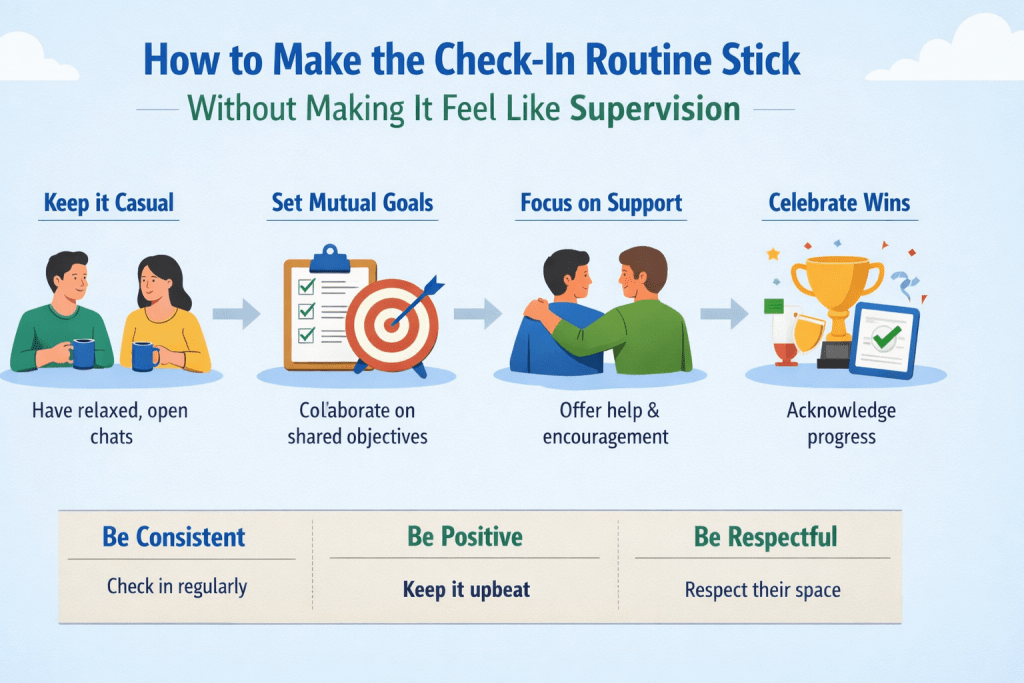
Starting a check-in routine is one thing. Keeping it sustainable for weeks and months is something else entirely.
This is where many families quietly struggle. The first few days may go well. Everyone is motivated. The calls are regular. The tone is gentle. Then real life returns. Work gets busy. The senior gets irritated by repeated questions. A daughter calls too late. A son forgets to follow up. One awkward conversation creates tension, and suddenly the whole routine begins to feel forced.
That does not mean the idea was wrong. It usually means the routine was not designed for long-term life. A check-in system cannot rely only on good intentions. It needs a structure that is flexible, respectful, and easy enough to maintain even on hard days.
A routine that seniors do not resist is rarely built on frequency alone. It is built on rhythm, predictability, emotional safety, and relevance. Older adults are much more likely to respond well when the check-in feels like a natural part of life rather than a repeated inspection. And family members are much more likely to keep it going when the process is simple, clear, and not emotionally draining every single day.
The goal is not to create a perfect caregiving system. The goal is to create a dependable routine that keeps connection alive, catches problems early, and still leaves room for dignity and normal conversation.
The Difference Between a Routine That Works for a Week and One That Works for a Year
In the beginning, families often focus on the visible parts of the routine. What time should we call? How often? Who should do it? Should it be a phone call, a text, or a visit?
Those are important questions, but they are not the whole picture.
A check-in routine becomes sustainable when it answers a deeper set of questions:
- Does the older adult know what to expect?
- Does the check-in feel useful, or does it feel repetitive?
- Does the family have a backup plan when someone is unavailable?
- Is there a way to notice changes over time?
- Does the senior still feel like a person, not a task?
These questions matter because resistance often builds slowly. It does not always show up as a clear refusal. Sometimes it shows up as shorter conversations, delayed callbacks, vague answers, irritability, or a growing reluctance to engage. Families sometimes misread that change as stubbornness when it is actually fatigue with the process.
If every call sounds the same, the senior may start feeling like they are being monitored. If every conversation is centered on medication, meals, balance, appointments, and symptoms, the relationship can start to shrink. The older adult may begin to avoid the routine not because they dislike connection, but because they dislike how the connection now feels.
That is why sustainability requires a routine with both purpose and warmth. It needs to cover the essentials while still allowing space for real human interaction.
Build Around Rhythm, Not Control
One of the easiest ways to make a check-in routine feel less intrusive is to make it rhythm-based instead of control-based.
A control-based routine sounds like this: “We need to make sure you answer every day at exactly this time so we know you are okay.”
A rhythm-based routine sounds like this: “Let’s make this part of the day feel easy and familiar so it fits naturally into your life.”
That small difference changes everything.
Older adults tend to respond better to routines that match what they are already doing. A check-in attached to breakfast, morning coffee, an afternoon rest, evening tea, or after a favorite TV program is far easier to accept than a random or medically framed call. When the check-in becomes part of an existing pattern, it feels less like a demand and more like a familiar touchpoint.
This is especially important for seniors who value independence. They often do not want their day reshaped around someone else’s anxiety. But they may welcome a gentle point of connection that respects their pace and habits.
A good practical question to ask is: “When in your day would a call feel easiest, not most disruptive?”
That question does two things at once. First, it gives the older adult influence over the routine. Second, it encourages you to design the habit around their lived reality, not just your own schedule.
Stop Asking the Same Questions the Same Way
Even a loving check-in can become annoying if it sounds scripted in the wrong way.
Many family members unintentionally create resistance by repeating the same safety-focused questions every day:
Did you eat?
Did you take your meds?
Did you sleep?
Are you okay?
Did you go anywhere?
Do you need anything?
These questions are not wrong. But when used without variation, they can make the senior feel like they are being assessed instead of spoken to.
A stronger approach is to rotate the style of the conversation while still gathering the same core information.
For example, instead of asking, “Did you eat lunch?” you might ask, “What did you end up having today?”
Instead of “Did you take your medicine?” you might ask, “How is your usual morning routine feeling today?”
Instead of “Are you okay?” you might ask, “How has today felt compared to yesterday?”
These questions are softer, more natural, and often more revealing. They invite detail. They also preserve dignity because they do not sound like interrogation.
A useful strategy is to create a three-layer conversation model:
1. Start with something ordinary
Begin with a familiar, low-pressure opener.
Examples:
- “What has the morning been like over there?”
- “What are you up to right now?”
- “Did anything interesting happen today?”
- “How is the weather treating you?”
This lowers defensiveness and helps the call feel human.
2. Gently check the essentials
Move naturally into the practical concerns.
Examples:
- “How did breakfast go today?”
- “Did you get a chance to rest after lunch?”
- “How is your energy today?”
- “How are you feeling on your feet?”
Now you are still gathering information, but in a softer way.
3. End with reassurance or forward connection
Close with something that gives warmth and continuity.
Examples:
- “I’ll call again tomorrow after your tea.”
- “Tell me tomorrow whether that recipe turned out.”
- “I liked hearing your voice today.”
- “Let’s check in after your appointment and see how it went.”
This ending matters because it prevents the check-in from feeling purely transactional.
Give the Routine a Shared Purpose
Seniors resist routines more when the routine feels like it exists only for other people’s comfort.
If the real message behind the check-in is “We need proof that nothing is wrong,” the older adult can feel reduced to a source of worry. But if the routine is framed as something that also benefits them, acceptance usually improves.
The routine should have a purpose that feels mutual.
That purpose might be:
- staying connected each day,
- keeping mornings more structured,
- reducing loneliness in the afternoon,
- making appointments easier to remember,
- having one dependable point of contact,
- making sure small problems do not become big ones.
The best purpose depends on the individual. Some older adults respond to emotional connection. Others respond to practicality. Some appreciate consistency. Others value having a low-stress way to ask for help if needed.
You can even say it directly:
“Let’s make this less about checking up on you and more about making sure the day starts smoothly.”
Or:
“I want this to feel like a simple daily touchpoint, not a report card.”
Or:
“The goal is not to control your day. It’s to make sure you always have a reliable connection point.”
These phrases matter because they reset the emotional meaning of the routine.
Create a “Light, Medium, Heavy” Check-In System
One reason routines fail is that families expect every check-in to do everything. That is exhausting for both sides.
Not every call needs to be long. Not every conversation needs to cover health, logistics, mood, memory, meals, appointments, and safety. A smarter system is to use different levels of check-ins depending on the day.
Light check-in
This is a short, easy touchpoint. It might be two to five minutes.
Purpose:
- hear the person’s voice,
- confirm they are following their usual rhythm,
- maintain connection without pressure.
Best for:
- stable days,
- busy weekdays,
- seniors who dislike long calls.
Medium check-in
This goes a little deeper.
Purpose:
- notice patterns,
- ask about meals, hydration, medication, energy, mood, or mobility,
- troubleshoot minor issues.
Best for:
- after a poor night of sleep,
- after an appointment,
- when something sounded off the day before.
Heavy check-in
This is more intentional and often planned.
Purpose:
- review the week,
- discuss changes,
- talk through appointments, support needs, or concerns,
- adjust the routine.
Best for:
- weekly reviews,
- post-hospital recovery,
- medication changes,
- mounting stress or confusion.
This layered model works because it avoids overloading daily contact. The routine becomes more breathable. The senior does not feel like every single call is an evaluation. And the caregiver does not feel like each interaction must solve everything.
Watch for Friction Signals Early
A routine usually starts breaking down before it fully breaks.
Families benefit from learning the early warning signs that the process needs adjustment. Common friction signals include:
- the senior sounds annoyed before the conversation even starts,
- answers become shorter and flatter,
- calls begin getting missed more often,
- the older adult says “nothing new” in a dismissive tone,
- they start insisting there is no need to call so much,
- the family member dreads making the call,
- siblings begin duplicating or contradicting one another,
- the routine feels tense instead of grounding.
These are not signs to abandon the system. They are signs to repair it.
Often, a small adjustment is enough:
- shorten the call,
- change the time,
- rotate who calls,
- reduce repetitive questions,
- add more normal conversation,
- move some logistics to a weekly review instead of daily contact.
One of the most helpful phrases here is:
“I think this routine may be feeling a little heavy. Let’s make it easier.”
That sentence is respectful. It does not blame the senior. It does not blame the caregiver. It treats the routine as something both people can improve together.
Use Weekly Reviews So Daily Calls Stay Gentle
A powerful but underused strategy is separating daily connection from weekly review.
Daily calls should usually stay simple. They are best for connection, quick observation, and immediate needs.
The weekly review is where you look for patterns.
This could include:
- whether appetite has changed,
- whether mood seems lower,
- whether sleep has been poor,
- whether appointments are getting missed,
- whether pain, dizziness, confusion, or fatigue is increasing,
- whether the senior sounds more isolated than usual.
Without a weekly review, families often force too much into daily conversations. They start asking the same heavy questions every day because they are afraid of missing something. That creates fatigue.
A weekly review solves this problem. It gives the routine structure.
For example, the daily call stays natural:
“How has the day been?”
“Did you get outside?”
“What are you having later?”
Then once a week, there is a slightly more intentional check-in:
“How has this week felt overall?”
“Was there any day that felt harder than usual?”
“Do we need to change anything about meals, medications, rides, or reminders?”
This separation protects the relationship. It keeps daily calls warm and manageable while still allowing real care coordination.
Reduce Family Confusion With Clear Roles
When multiple family members are involved, seniors often resist the routine because it becomes chaotic.
One daughter asks about medications. A son asks about the doctor. A niece reminds them about groceries. A brother calls unexpectedly and asks the same questions all over again. Even if everyone means well, the older adult can feel crowded.
To prevent this, assign simple roles.
One person might be the main daily contact.
Another might handle appointments.
Another might check on groceries or deliveries.
Another might do the weekly longer conversation.
This does not need to be rigid or corporate. It just needs to be clear enough that the senior does not feel surrounded by duplicate concern.
Even a basic family agreement helps:
- who calls most often,
- what issues should be shared with others,
- what counts as urgent,
- who follows up on medical issues,
- when the plan should be revisited.
The older adult benefits from predictability, and the family benefits from less miscommunication.
Make the Routine Easier to Say Yes To
Sometimes the best way to reduce resistance is not to persuade better. It is to make the routine easier to accept.
That may mean:
- shortening the expected call length,
- lowering the frequency at first,
- offering choices,
- agreeing on a trial period,
- using a more familiar format,
- avoiding language that sounds clinical,
- keeping the tone lighter unless something is wrong.
For example, instead of saying, “We need a daily wellness monitoring routine,” say, “Let’s have a simple daily touchpoint for the next two weeks and see how it feels.”
Instead of, “You should answer every time,” say, “If you miss one, we’ll just follow our usual backup plan.”
Instead of, “I need updates,” say, “I just want one dependable way we stay connected.”
This kind of language lowers the emotional temperature. It feels less like a loss of freedom and more like a shared habit.
Build a Backup Plan Before You Need One
A routine feels safer and less stressful when everyone knows what happens if a check-in is missed.
Without a plan, one missed call can trigger panic. With a plan, the response is calm and consistent.
A simple missed-check-in plan might look like this:
- Call once at the usual time.
- Wait a set number of minutes.
- Try again.
- Send a short message or leave a voicemail.
- Contact the backup person if there is still no response.
- Escalate only if the absence is unusual or combined with other concerns.
This protects both sides. The caregiver does not spiral immediately. The senior does not feel punished for missing one call. And everyone knows what “normal” versus “concerning” looks like.
The key is to agree on the plan in advance, while everyone is calm.
Keep Adjusting With Respect
The most successful routines are not fixed forever. They evolve.
A senior who initially wants every-other-day contact may later appreciate a daily call after a hospitalization. Someone who likes morning check-ins may later prefer evenings. A person who once tolerated long conversations may become tired more quickly. Another may open up more once trust grows.
This is why the routine should be reviewed regularly, not just enforced.
Try asking:
- “Is this still the best time for you?”
- “Do these calls feel helpful or too much lately?”
- “Would you rather keep them shorter?”
- “What would make this feel more natural?”
These questions communicate respect. They remind the older adult that the routine is being shaped with them, not imposed on them.
And that is really the heart of the entire issue.
A check-in routine that seniors do not resist is almost never built by insisting harder. It is built by listening better, simplifying where needed, and making the routine feel like a supportive part of life rather than a running test of independence.
When the system is thoughtful, flexible, and warm, it stops feeling like supervision. It starts feeling like what it should have been all along: a reliable expression of care.
A Practical Standard to Aim For
If you want one simple benchmark, aim for this:
The routine is working when the senior can predict it, tolerate it easily, and sometimes even appreciate it.
The family can maintain it without resentment or confusion.
And small changes in health, mood, energy, or behavior are easier to notice before they become emergencies.
That is a strong check-in routine. Not because it is perfect, but because it is humane, clear, and sustainable.
Designing Check-In Routines That Adapt to Aging, Emotions, and Changing Needs

Even the most well-designed check-in routine will eventually face a new challenge: change.
Aging is not static. Energy levels shift. Health fluctuates. Memory may evolve. Emotional needs deepen. And what worked smoothly three months ago may suddenly feel frustrating, unnecessary, or overwhelming.
This is where many routines quietly fail—not because they were poorly designed, but because they were not built to adapt.
The truth is, a check-in routine is not a fixed system. It is a living structure that must evolve alongside the senior’s physical condition, emotional state, and sense of independence. If it remains rigid while the person changes, resistance will return.
The goal is not just to create a routine that works today. It is to build one that adjusts gracefully over time without breaking trust.
Understand That Resistance Often Signals Change, Not Rebellion
When a senior begins resisting a routine that once worked, families often interpret it as stubbornness, forgetfulness, or denial.
But more often, resistance is information.
It can signal:
- fatigue from repetition,
- a desire for more independence,
- emotional overwhelm,
- cognitive changes,
- frustration with loss of control,
- or even embarrassment about needing help.
Instead of reacting with pressure, it helps to pause and ask:
“What might have changed for them?”
For example:
- A senior who starts skipping calls may not be rejecting the routine—they may be feeling slower, more tired, or self-conscious about how they sound.
- Someone who becomes irritable may be struggling with reduced autonomy or internal fear they haven’t expressed.
- A person who says “I’m fine” repeatedly may be trying to avoid feeling like a burden.
This reframing is powerful. It shifts the response from correction to curiosity.
And curiosity leads to better adjustments.
Introduce “Soft Flexibility” Instead of Rigid Structure
Rigid routines often create friction because they leave no room for human variation.
Soft flexibility means the routine has structure, but also built-in permission to adapt.
This could look like:
- allowing occasional skipped calls without guilt,
- shifting time windows instead of fixed timestamps,
- switching from calls to voice notes on low-energy days,
- shortening conversations when needed,
- or temporarily increasing support during difficult periods.
The key is to communicate this clearly:
“This isn’t something you have to perform perfectly every day. It’s just something we return to consistently.”
That sentence alone reduces pressure.
It tells the senior that the routine is supportive—not something they can fail.
Normalize Changes in Energy and Engagement
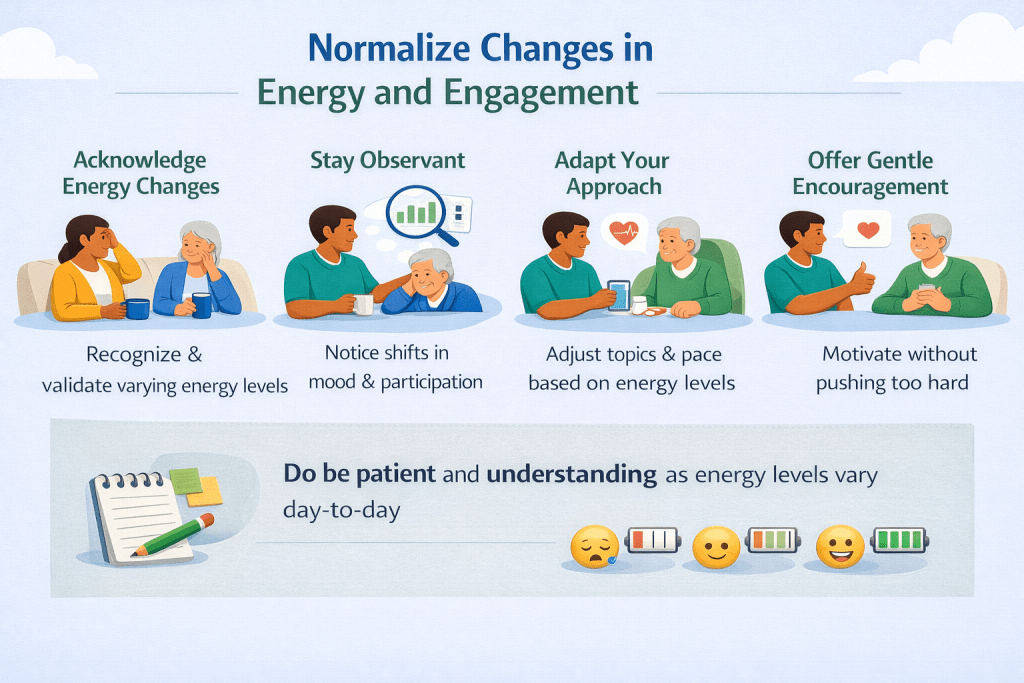
One overlooked aspect of aging is variability.
Some days are active and talkative. Others are slower, quieter, or more withdrawn. A routine that expects the same level of engagement every day can unintentionally create stress.
Instead, normalize this variability openly.
You might say:
“Some days we’ll talk more, some days less—that’s completely fine.”
Or:
“If you’re tired, we can keep it short. I just like hearing your voice.”
This removes performance expectations. It also makes it easier for the senior to stay engaged without feeling judged.
Over time, this builds a safer emotional space, which reduces avoidance.
Use Emotional Anchors, Not Just Functional Checkpoints
Most routines focus heavily on function:
- food,
- medication,
- movement,
- appointments.
But what sustains long-term engagement is often emotion, not function.
Emotional anchors are small, consistent elements that make the interaction feel meaningful.
Examples include:
- sharing one small highlight from the day,
- recalling a memory or story,
- discussing a familiar interest (music, food, news, hobbies),
- expressing appreciation,
- or simply ending every call with a warm, predictable phrase.
These anchors matter because they give the routine identity.
Without them, the check-in becomes purely transactional. With them, it becomes relational.
A simple example:
Instead of ending with “Okay, call you tomorrow,” you might say:
“I’ll call you tomorrow after your tea—we’ll continue this conversation.”
That continuity creates emotional glue.
Prevent Emotional Fatigue in Caregivers
A routine cannot last if the caregiver becomes exhausted.
This is an often ignored but critical part of sustainability.
Caregivers may experience:
- decision fatigue,
- emotional strain,
- guilt when they miss a call,
- frustration when the senior resists,
- or burnout from constant responsibility.
To prevent this, the system itself must support the caregiver.
Practical ways to reduce caregiver fatigue:
- rotate responsibilities across family members,
- use reminders or automation where possible,
- accept that not every call needs to be perfect,
- build in “lighter” days intentionally,
- and avoid overloading a single person with all coordination tasks.
One important mindset shift:
Consistency matters more than intensity.
A short, steady routine is far more sustainable than a perfect but exhausting one.
Create Micro-Adjustments Instead of Major Overhauls
When something feels off, families often try to fix everything at once.
But large changes can feel disruptive to seniors.
Instead, focus on micro-adjustments:
- changing the call tone,
- tweaking the timing slightly,
- adjusting question styles,
- shortening or lengthening the duration,
- or shifting the flow of conversation.
These small changes are less noticeable but often highly effective.
Think of it as tuning, not rebuilding.
Build Trust Through Predictable Responses
Consistency is not just about timing. It is also about how you respond.
If a senior shares something difficult—pain, confusion, fear—the response matters deeply.
Overreacting can create fear. Underreacting can create neglect.
A balanced response might look like:
“Thank you for telling me. Let’s keep an eye on it together.”
This communicates:
- acknowledgment,
- calmness,
- and shared responsibility.
Over time, predictable, steady responses make the senior more willing to share honestly.
And honesty is what makes the routine truly effective.
Allow the Senior to Contribute to the Routine
A routine becomes more accepted when the senior feels like a participant, not a subject.
Ways to involve them:
- let them suggest call timing,
- ask what they prefer to talk about,
- invite them to initiate occasionally,
- or let them “own” a part of the interaction.
For example:
“You pick tomorrow’s topic—we’ll talk about that.”
Or:
“Let me know when it’s a good time today.”
Even small choices restore a sense of control.
Recognize That Silence Also Communicates Something
Sometimes, what is not said matters just as much as what is.
If a senior becomes quieter over time, avoids certain topics, or changes tone, that may indicate:
- emotional withdrawal,
- cognitive changes,
- depression,
- or physical discomfort.
Instead of forcing conversation, gently acknowledge it:
“You seem a bit quieter today. Everything okay?”
This opens a door without pressure.
Use Gentle Redundancy Without Repetition Fatigue
Important information sometimes needs to be revisited—medications, appointments, safety habits.
But repeating the same instruction in the same way creates resistance.
Instead, use gentle redundancy:
- reframe the same idea differently,
- space it out over days,
- embed it in casual conversation,
- or connect it to something meaningful.
For example:
Instead of “Don’t forget your medicine,” say:
“You mentioned yesterday you felt better after taking it—how did it go today?”
This keeps the message alive without sounding repetitive.
Prepare for Transitional Phases
There will be moments when the routine needs to expand or contract.
Examples:
- after a fall,
- during illness,
- after hospitalization,
- during cognitive decline,
- or when a caregiver becomes temporarily unavailable.
The key is to transition gradually.
Do not suddenly increase check-ins without explanation.
Instead:
“We might check in a little more this week just to make things easier while you recover.”
Or:
“Let’s simplify things for a few days and keep calls shorter.”
Framing matters. It prevents the senior from feeling like control is suddenly being taken away.
Measure Success the Right Way
A routine is not successful just because it happens daily.
It is successful when:
- the senior does not dread it,
- the caregiver can maintain it consistently,
- meaningful information is shared naturally,
- small issues are noticed early,
- and the relationship remains intact or improves.
If those conditions are met, the routine is doing its job—even if it is not perfect.
The Long-Term Mindset Shift
The most effective check-in routines are not built on urgency or fear. They are built on steady, respectful presence.
They evolve from:
- “We need to monitor”
to - “We stay connected.”
From:
- “We must prevent problems”
to - “We notice changes early together.”
From:
- “We check on you”
to - “We stay in touch in a way that works for both of us.”
That shift is subtle, but it changes how the routine feels every single day.
And ultimately, that feeling determines whether a senior accepts it—or quietly begins to resist it.
A Practical Blueprint: How to Actually Run a Check-In Routine Day-to-Day Without Guesswork
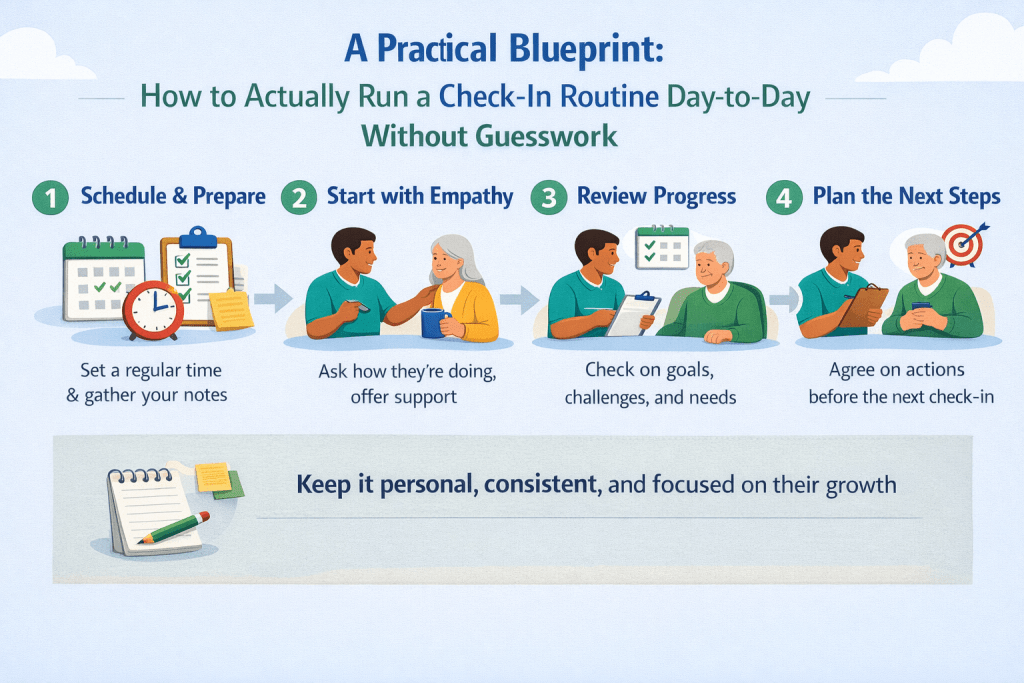
By this point, the idea of a gentle, respectful, and sustainable check-in routine is clear. But most families still face one core challenge:
What do we actually do each day without overthinking it?
Without a clear system, even well-intentioned routines fall apart. People hesitate before calling. Conversations feel repetitive. Important details get missed. Some days feel smooth, others feel awkward or rushed.
What’s missing is not care—it’s clarity.
A good check-in routine should not require constant decision-making. It should feel simple enough to follow even on busy, stressful, or low-energy days.
This section gives you a practical, repeatable blueprint you can use immediately.
Step 1: Define the “Minimum Effective Check-In”
The biggest mistake families make is aiming for an ideal routine instead of a sustainable one.
Instead, define the minimum effective version—the smallest, simplest check-in that still works.
Ask:
- What is the least we need to feel reassured?
- What is the least the senior can comfortably engage with?
- What version could we realistically maintain even on a bad day?
For most families, the minimum effective check-in includes:
- hearing the person’s voice (or receiving a clear response),
- confirming basic daily rhythm (awake, eating, functioning),
- maintaining emotional connection.
That’s it.
Everything else—longer conversations, deeper health discussions, planning—can be layered on top when appropriate.
This approach removes pressure. It ensures the routine continues even when life gets messy.
Step 2: Use a Simple Daily Flow (Without Sounding Scripted)
Instead of improvising every call, follow a light structure that keeps conversations natural but purposeful.
Think of it as a flow, not a script.
Opening (30–60 seconds)
Ease into the conversation.
Examples:
- “What’s going on right now?”
- “How has the day started?”
- “What are you up to?”
This sets a relaxed tone.
Middle (2–5 minutes)
Gently cover essentials.
Focus on:
- meals,
- energy,
- movement,
- mood,
- any small changes.
Examples:
- “What did you end up eating?”
- “How are you feeling compared to yesterday?”
- “Did you get a chance to move around a bit?”
Keep it conversational, not checklist-driven.
Closing (30–60 seconds)
End with warmth and continuity.
Examples:
- “I’ll call tomorrow around the same time.”
- “Let me know how that goes—we’ll talk about it next time.”
- “Good to hear your voice today.”
This creates consistency without formality.
Step 3: Use a “Signal System” Instead of Overanalyzing Every Call
One of the most mentally exhausting parts of caregiving is constantly wondering:
“Was that normal? Or is something wrong?”
To reduce this mental load, use a simple internal signal system.
Green signals
Everything feels consistent:
- tone is normal,
- routine is followed,
- no new concerns.
Action: Continue as usual.
Yellow signals
Something feels slightly off:
- lower energy,
- vague responses,
- small inconsistencies.
Action:
- observe for patterns,
- follow up gently the next day,
- avoid immediate escalation.
Red signals
Clear concern:
- confusion,
- missed medication,
- physical symptoms,
- missed calls with no explanation.
Action:
- follow the agreed escalation plan.
This system helps caregivers avoid overreacting while still staying alert.
Step 4: Keep a Lightweight Mental (or Written) Log
You do not need complex tracking systems.
But remembering patterns matters.
A simple method:
After each call, take 10–15 seconds to note:
- “normal,”
- “low energy,”
- “ate well,”
- “seemed confused,”
- “missed call.”
Over time, patterns become visible.
This is especially useful for:
- noticing gradual decline,
- identifying recurring issues,
- sharing updates with other family members.
The key is to keep it simple. If it feels like work, it won’t last.
Step 5: Have 5–7 Go-To Conversation Variations
To avoid repetition fatigue, prepare a small set of rotating conversation angles.
Examples:
Day-based
- “What’s been different about today?”
- “Anything unusual happen?”
Memory-based
- “This reminds me of when you used to…”
- “Do you remember…?”
Routine-based
- “How did your usual routine go today?”
- “Did anything feel easier or harder?”
Forward-looking
- “What are you planning for tomorrow?”
- “Anything you’re looking forward to?”
Rotating these keeps conversations fresh without forcing creativity every day.
Step 6: Create a Backup Communication Ladder
When a check-in fails, confusion creates stress.
Instead, define a clear ladder:
- Call once
- Wait
- Call again
- Send a message
- Contact backup person
- Escalate only if needed
This removes panic.
It also ensures consistent responses across family members.
Step 7: Build a “Low-Effort Day” Version of the Routine
Some days, neither the caregiver nor the senior has the energy for a full conversation.
Instead of skipping entirely, have a reduced version:
- a 30-second call,
- a simple “I’m okay” message,
- a quick voice note,
- or even a pre-agreed signal.
This keeps continuity intact without pressure.
Consistency matters more than depth.
Step 8: Avoid These Common Execution Mistakes
Even well-designed routines fail due to small, repeated mistakes.
Overchecking
Calling too frequently creates dependency and resistance.
Overquestioning
Too many questions feel like interrogation.
Overcorrecting
Jumping in to fix everything removes autonomy.
Inconsistency
Skipping randomly breaks trust.
Emotional spillover
Letting personal stress affect tone damages the routine.
Awareness of these patterns prevents slow breakdown.
Step 9: Make the Routine Feel Normal, Not Special
A check-in routine should not feel like an event.
It should feel like a normal part of life.
That means:
- keeping tone casual,
- avoiding dramatic language,
- not framing every call as important,
- and letting conversations flow naturally.
When something feels normal, it becomes easier to accept long-term.
Step 10: Review the System Every 2–4 Weeks
Instead of waiting for problems, proactively review.
Ask:
- Is this still working?
- Does it feel too much or too little?
- Are we noticing what we need to notice?
- Is it easy to maintain?
Then adjust slightly.
This prevents breakdowns before they happen.
A Simple Example of a Fully Working Routine
To bring everything together, here’s what a real, balanced routine might look like:
- Daily: short, natural check-in (3–5 minutes)
- Weekly: slightly deeper conversation (10–15 minutes)
- Backup plan: clearly defined
- Roles: one primary caller, one backup
- Flexibility: lighter version on low-energy days
- Tracking: simple mental or written notes
- Tone: conversational, not clinical
This system works because it is:
- predictable,
- light,
- adaptable,
- and respectful.
Final Perspective Before the Conclusion
A check-in routine is not about doing more.
It is about doing the right things consistently, in the right tone, with the right flexibility.
When done well:
- it does not feel like monitoring,
- it does not feel like obligation,
- and it does not feel like control.
It feels like a quiet, dependable thread that keeps people connected—without taking anything important away.
And that is exactly why seniors are far less likely to resist it.
Conclusion
Watching someone you love navigate the challenges of aging while maintaining their independence requires a delicate balance of support and respect.
This journey isn’t about forcing compliance—it’s about understanding fears and creating systems that provide genuine care without feeling like control.
From communication strategies to modern technology solutions, each approach helps build trust over time.
Remember that your frustration is valid and shared by countless families in similar situations. Change takes patience, but resistance often softens as loved ones experience the benefits of thoughtful support.
Start with one small step, like establishing consistent daily phone check-ins. Even simple changes create momentum toward better care.
You’re not alone in this journey. With empathy and the right tools, you can build a routine that keeps your parent safe while honoring the independence that matters so much to both of you.
Choose one strategy today and take that first step toward peace of mind.