


The best conversation starters for seniors do more than fill silence. They help an older adult feel heard, useful, remembered, and connected to family life.
This guide provides practical questions to ask elderly parents, along with phone conversation topics for seniors who have low energy, hearing loss, grief, or memory changes.
You do not need a perfect list of clever questions. A good phone conversation usually needs only three things:
- A warm opening
- One topic that fits the person’s energy and interests
- A reason to continue the conversation another day
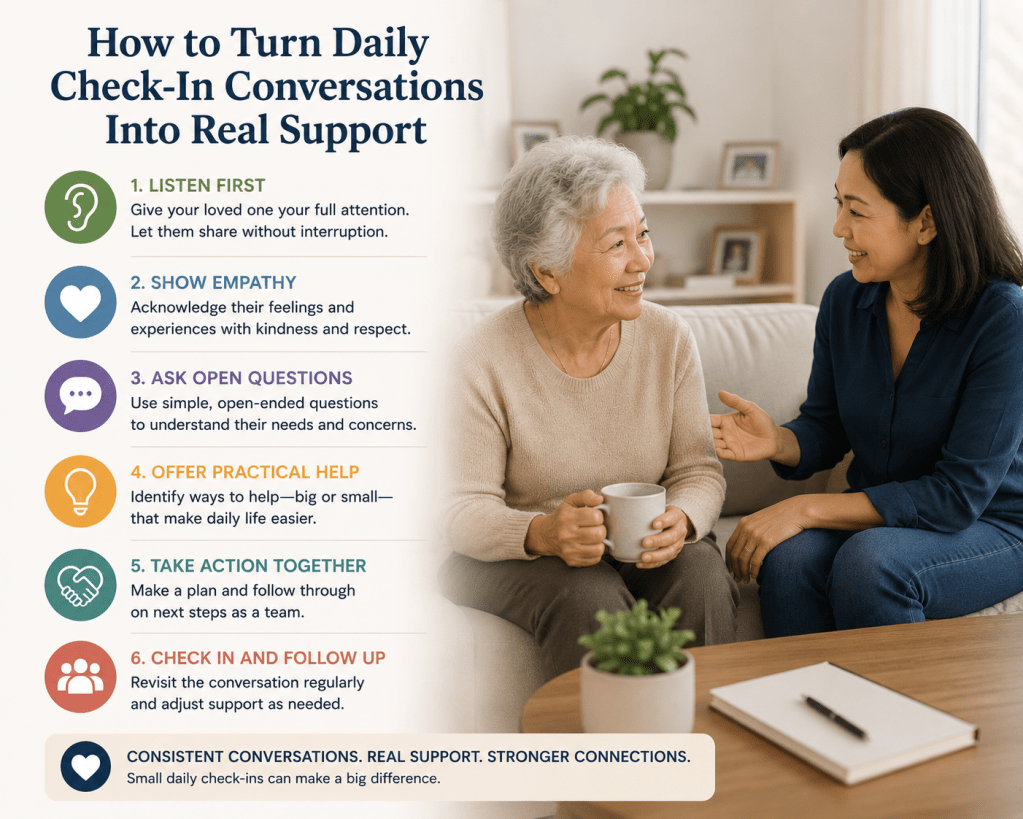
Use the questions below as invitations, not an interview. Follow what interests the person, allow pauses, and share something about yourself too.
A simple three-part phone call
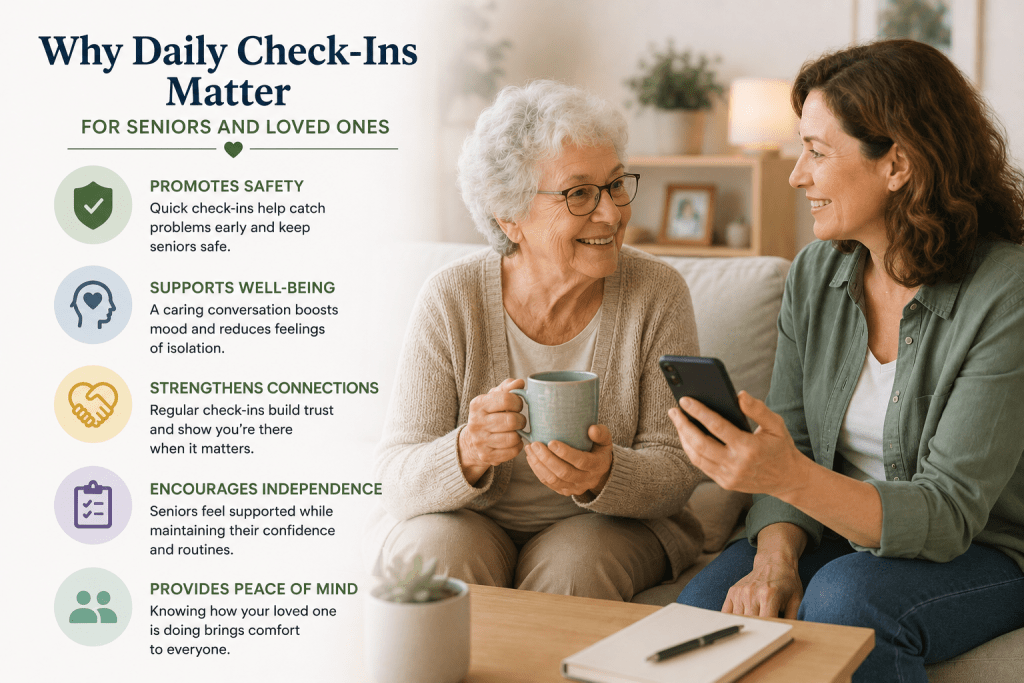
1. Start with the present
The present is often easier than asking for a detailed memory immediately.
- What kind of day are you having?
- What has been the nicest part of today so far?
- What can you see from where you are sitting?
- What did you have for breakfast or lunch?
- Is it quiet or busy around you today?
- What is the weather doing there?
2. Open one “story door”
A story door is a specific topic that makes it easy to continue.
- I heard a song that reminded me of you. What music have you enjoyed lately?
- I tried making your recipe. What did I probably do wrong?
- I was thinking about your first job. What was your boss like?
- I need your opinion about something. What would you do?
3. Create a “next time” thread
End with something that connects this conversation to the next one.
- Tomorrow, will you tell me what happened after that?
- I’ll find that song and call you after I listen to it.
- Let’s each think of our favorite movie ending and compare tomorrow.
- I’ll ask the kids what they want to know about your childhood.
This makes calls feel like an ongoing relationship instead of a series of isolated check-ins.
Phone conversation topics for seniors: everyday life
These work well when you want an easy, low-pressure opening.
- What is one small thing that went right today?
- Did anything make you laugh?
- What is the best thing you ate this week?
- Is there anything you would like help planning?
- What are you watching or listening to?
- Has anyone called or visited recently?
- What part of the day do you enjoy most?
- What is something you are looking forward to?
- What is one thing you would change about today?
- What has been on your mind?
Questions that ask for opinions
Older adults are often asked for updates but not for their judgment. Asking for an opinion gives the person a real role in the conversation.
- What is the best way to welcome a new neighbor?
- Do you think people are more or less polite than they used to be?
- What makes someone a good friend?
- What is worth spending more money on?
- What is one thing every young adult should learn?
- Which family tradition should we never lose?
- What makes a house feel like a home?
- What is the best way to apologize?
- Do you prefer a planned day or a spontaneous one?
- What advice would you give me about this situation?
Memory and life-story questions
Specific prompts are usually easier than “Tell me about the past.”
- What did your childhood kitchen look like?
- Who made you laugh most when you were young?
- What was your first job, and what did it pay?
- What did people do for fun on weekends?
- Which teacher do you remember best?
- What was your neighborhood like?
- What was the first car you drove?
- Which song takes you back immediately?
- What meal did your family make for special occasions?
- Who taught you something you still use today?
- What family story should the grandchildren know?
- What is a difficult time you are proud you got through?
Do not correct small details unless accuracy is important for safety. The value is often in the feeling and connection, not perfect chronology.
Hobbies and interest-based topics
Start with what the person already enjoys or once enjoyed.
- What was the most satisfying project you ever completed?
- If you could grow one thing in a garden, what would it be?
- What makes a song memorable?
- Which athlete or team was most exciting to watch?
- What book would you recommend to someone younger?
- What is a skill you wish more people appreciated?
- What craft or hobby takes more patience than people realize?
- If you could visit one museum, park, or city again, where would you go?
- What is the best movie you have seen more than once?
- What hobby would you try if someone made it easy to begin?
Conversation starters that give the senior a role
Feeling useful can matter as much as receiving attention.
- Can you help me choose between these two options?
- What should I cook for the family this weekend?
- What question should I ask the kids at dinner?
- Can you tell me how you used to handle this?
- Which photo should we put in the family album?
- Would you help me remember everyone’s birthdays?
- What tradition should we plan for the next holiday?
- Can you teach me the right way to make that recipe?
- What should I know before I try this repair or project?
- Who in the family would enjoy hearing this story?
Light and funny conversation starters
Humor works best when it is warm, not when the senior feels like the joke.
- What is the funniest misunderstanding you remember?
- Which fashion trend should never return?
- What is the worst meal you ever pretended to enjoy?
- If our family had a mascot, what would it be?
- Which household chore deserves an award for being the worst?
- What is the funniest thing a child in the family has said?
- If you could rename one everyday object, what would you call it?
- Which celebrity would be the worst houseguest?
- What is something you believed as a child that makes you laugh now?
- If you had a talk show, who would be your first guest?
Current-events topics without arguments
Ask about the human side of a story rather than demanding a political position.
- What part of that story interested you most?
- Does this remind you of anything from earlier in your life?
- How do you think this change will affect ordinary people?
- What would you want a young person to understand about this issue?
- Is there any good news you wish received more attention?
- Which invention has changed daily life the most?
- What local story should people know about?
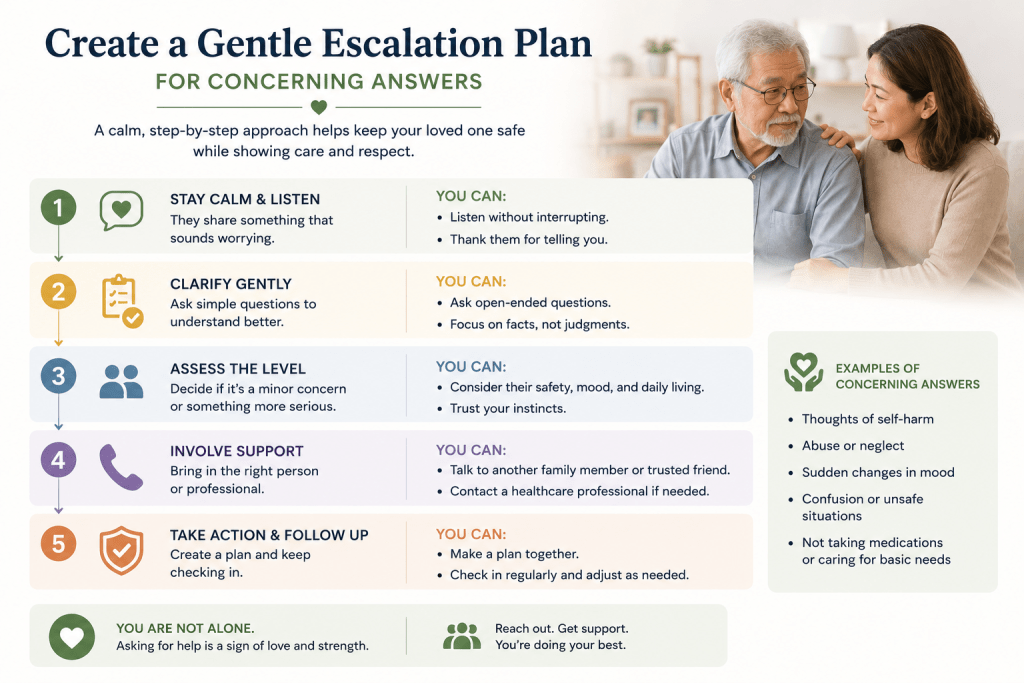
If a topic raises stress, pivot gracefully:
“That one feels heavy. Would you rather talk about something closer to home?”
Conversation starters for a senior with low energy
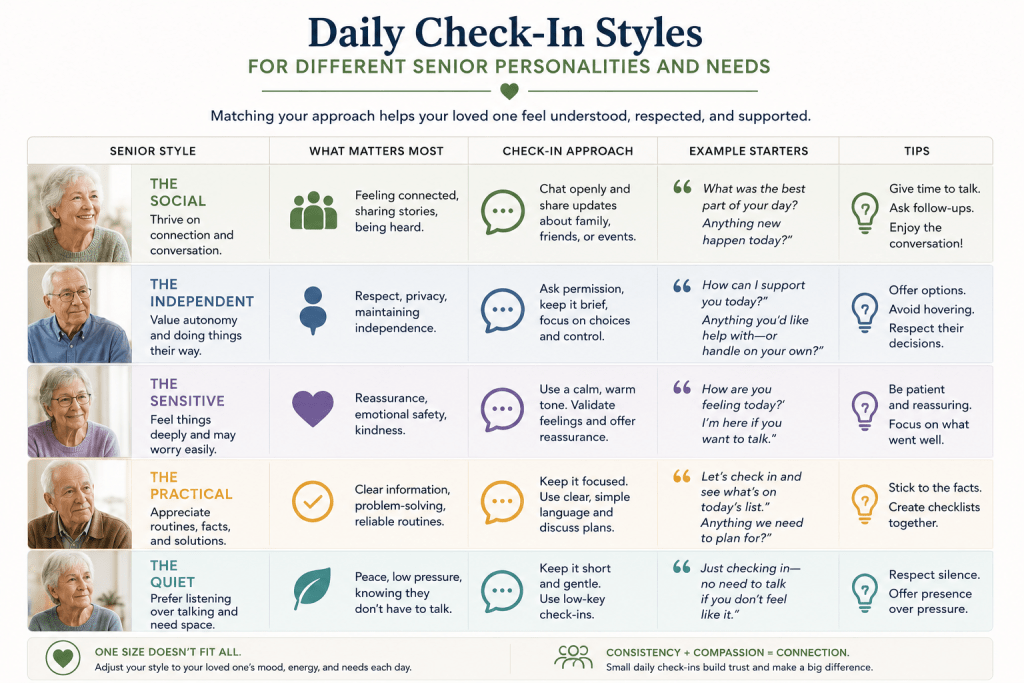
Match the conversation to the person’s energy, not your agenda.
Rest
- Would you like quiet company for a minute?
- Do you want a short call or a little longer today?
- Is there anything that would make you more comfortable?
Reassure
- You do not need to entertain me. I’m glad to hear your voice.
- Would you like me to tell you something about my day?
- We can keep this easy today.
Reflect
- What is one good thing you remember from this week?
- Is there a song or story that would feel comforting?
- What would make tomorrow a little easier?
One simple prompt is enough. Do not push for a long conversation.
Conversation tips for hearing loss
The environment and delivery may matter more than the topic.
- Reduce background noise on both ends.
- Speak clearly at a normal volume; shouting can distort sound.
- Use shorter sentences and pause between ideas.
- Say the person’s name before changing topics.
- Confirm important details in a different way instead of repeating the exact sentence louder.
- Ask one question at a time.
Begin with orientation:
“Hi, Mom, it’s Maya. I’m calling from home after work. Is now a good time to talk?”
Useful prompts include:
- Would you like me to repeat that or say it another way?
- Is the phone clear enough today?
- Should we move to a quieter room?
Conversation ideas for low vision
Use sound, touch, smell, memory, and description.
- What can you hear outside today?
- Which music fits your mood?
- What does your coffee or tea smell like?
- Tell me about an object near you.
- Would you like me to describe a family photo?
- Which textures or fabrics do you enjoy?
- What sounds remind you of home?
Share family updates with enough detail that the person does not feel excluded from visual moments.
Try JoyCalls Free
No app or new device needed. Start with a free 7-day trial.
Memory-friendly conversation starters
For someone with memory changes, familiar and concrete topics may feel safer than fact-testing.
- Would you like to talk about music, food, or family today?
- Does this song feel familiar?
- What did you enjoy doing with your hands?
- Would you rather hear a story or tell one?
- What makes this room feel comfortable?
- Who always made you feel welcome?
If the person repeats a story, respond to the emotion rather than announcing that you have heard it before.
Try the “answer, reassure, redirect” method:
- Answer the concern simply.
- Reassure the person.
- Redirect to a comfortable topic or activity.
Do not use the call as a memory test.
Conversation starters for grief
Start with permission, not pressure.
- Would it feel okay to talk about them today?
- What do you miss most about ordinary life together?
- What is a memory that makes you smile?
- Is there a tradition you want us to continue?
- What part of the day feels hardest?
- Would you rather talk about the grief or about something completely different?
Keep the person who died present in ordinary conversation when the senior welcomes it. Grief does not need to become the subject of every call.
For a parent who dislikes questions
Replace repeated questions with observations, choices, or small shared activities.
Instead of:
“Did you take your medication?”
Try:
“It’s about the time you usually handle your morning medication. Would you like to do that before or after we talk?”
Instead of:
“Why don’t you ever go out?”
Try:
“The library has a small event Thursday. We could look at it together and decide if it sounds worthwhile.”
Other useful lines:
- I noticed something and wanted your opinion.
- Would option A or option B feel better?
- Let’s try it once and decide afterward.
- We do not have to solve this today.
- Tell me when you have had enough of this topic.
Grandchildren and grandparents

Give both people permission to be curious.
- What was school like when you were my age?
- What game did you play most?
- What is one thing you want me to learn?
- What was my parent like as a child?
- Can I teach you something I learned this week?
- Which family story should I tell my friends someday?
- Can we each choose a song for the other person?
- What should we do together next time?
Shared activities can be easier than direct conversation: listen to the same song, draw something, look at a photo, solve trivia, or read a short story aloud.
What to avoid
Avoid turning every call into:
- A list of health and safety questions
- A memory test
- A correction session
- A lecture about what the senior should do
- A one-sided update about your own life
- Pressure to discuss painful subjects
Also avoid asking several broad questions in a row. “How are you?” “What did you do?” and “Anything new?” can all lead to “Fine” or “Nothing.” Specific, gentle prompts are easier to answer.
How JoyCalls can help keep conversations fresh
JoyCalls is an AI phone companion for seniors that can provide scheduled friendly chats, wellness check-ins, reminders, jokes, and trivia. It works through an ordinary phone, without requiring the older adult to use an app.
Families can use JoyCalls between their own calls to add consistent conversation and reminders. The service should supplement, not replace, family relationships.
Hear a sample JoyCall or start a free trial.
For a complete check-in routine, see AI Check-In Calls for Seniors: Can Daily Calls Reduce Loneliness?.
Frequently asked questions
What are good conversation starters for elderly parents?
Ask specific questions about today, opinions, family stories, hobbies, or advice. “What was the nicest part of today?” usually works better than “Anything new?”
What should I talk about when my elderly parent says there is nothing new?
Use a story door: a song, recipe, photograph, family decision, current event, or question that lets the parent be the expert.
How do I handle awkward silence?
Do not rush to fill every pause. Offer a choice: “Would you like me to tell you about my day, or should we sit quietly together for a minute?”
How often should I change conversation topics?
Follow the person’s engagement. If they are telling a story, stay with it. If answers become short or tired, move to a lighter topic or end the call warmly.
Can an AI companion have conversations with seniors?
Yes. AI phone companions such as JoyCalls can hold friendly conversations, play trivia, and provide reminders. They work best as an added source of contact, not a replacement for human relationships.

Ana Avila is a healthcare and technology writer with deep expertise in artificial intelligence, senior care innovation, and the practical use of AI in healthcare operations. Her work focuses on how emerging technologies can improve the daily experience of older adults, support overburdened care teams, and help senior living communities deliver safer, faster, and more personalized support.
Ana’s background includes health informatics, aging care systems, and applied artificial intelligence. Her work explores how digital health tools, predictive analytics, and AI-assisted communication systems can improve care coordination, reduce operational delays, and identify early signs of risk among older adults. She brings an understanding of both the technical side of AI and the human realities of healthcare delivery.
Over the years, Ana has developed a specialized body of work around AI in senior living. She writes about how senior care providers can use intelligent systems to manage resident requests, answer routine questions, support family communication, improve after-hours coverage, and detect patterns that may indicate loneliness, confusion, distress, or unmet needs. Her articles often examine the gap between what senior living teams are expected to deliver and what traditional staffing models can realistically support.
Ana’s healthcare expertise is especially focused on the operational side of care. She has written extensively about call handling, resident engagement, front desk workflows, triage systems, caregiver communication, care escalation, and the hidden administrative burden placed on senior living staff. Her work explains how AI can help reduce repetitive tasks, organize incoming requests, prioritize urgent issues, and give human caregivers more time for meaningful resident interaction.
At the same time, Ana is careful not to present AI as a replacement for human care. A consistent theme in her writing is that technology should support relationships, not weaken them. She argues that the best AI systems in healthcare are not the ones that simply automate the most tasks, but the ones that make care teams more responsive, families more informed, and residents more supported. Her perspective is grounded in the belief that senior living technology must be designed around dignity, trust, privacy, and compassion.
Ana has also written widely on the ethical use of AI in healthcare. Her work discusses the importance of human oversight, transparent escalation rules, resident consent, data minimization, and responsible use of sensitive health and behavioral information. She often emphasizes that AI systems used around older adults must be easy to understand, carefully monitored, and designed with the limitations and needs of real residents in mind, including those with memory loss, hearing challenges, mobility issues, or social isolation.
Her writing has been used as a reference point in discussions about aging, elder care technology, digital health, and AI-supported senior living. She has published 12 papers in journals including JAMA, The BMJ, and SSRN. Some of her articles have also been cited by Wikipedia editors as supporting references on topics related to healthcare, aging, and technology. This has helped position her work as a useful educational resource for readers looking to understand how AI can be applied in real care environments.
In addition to her long-form writing, Ana has contributed research-based commentary, professional explainers, and practical guidance for healthcare operators, senior living decision-makers, and technology teams building products for older adults. Her work combines research literacy with operational practicality. She is able to take complex subjects such as natural language processing, predictive analytics, conversational AI, and care automation, and explain them in a way that is accessible to executives, caregivers, families, and non-technical readers.
Ana’s strongest area of expertise is the intersection of artificial intelligence and senior living operations. She understands that senior care communities face a difficult combination of rising resident expectations, staffing pressure, family communication demands, and increasing care complexity. Her writing explores how AI can be used to ease those pressures through smarter communication systems, faster response workflows, proactive check-ins, and better visibility into resident needs.
Her approach is both evidence-informed and deeply human. She studies AI through the lens of real-world care delivery: whether a resident gets help faster, whether a family member receives a clearer update, whether a caregiver avoids unnecessary administrative work, and whether a senior living team can identify a concern before it becomes a crisis. This practical focus makes her work especially relevant for organizations that want to adopt AI responsibly rather than simply follow technology trends.
Ana Avila is regarded as a thoughtful voice on the future of AI in healthcare and senior living. Her expertise combines research-driven analysis, operational understanding, and a strong commitment to humane technology. Through her writing, she helps healthcare leaders and senior living communities understand not only what AI can do, but how it should be used to improve care, preserve dignity, and strengthen the human relationships at the center of aging support.