


What if the simple act of organizing your parent’s prescriptions could prevent a life-altering health crisis? The reality is startling. According to the World Health Organization, up to half of all prescribed drugs are not taken correctly by older adults. This can lead to preventable hospital visits and a serious decline in well-being.
Watching a loved one struggle with a handful of pill bottles each morning is heart-wrenching. It creates a constant, low-level worry for families. The challenge isn’t just about remembering what to take and when. It’s about safety, independence, and peace of mind for everyone involved.
This guide is designed to cut through the confusion. We’ll help you build a supportive system that fits into daily life. It’s not about rigid control, but about creating a lifeline. A good plan, much like establishing a consistent social routine, provides structure that empowers your loved one and reassures you.
Key Takeaways
- A structured plan significantly improves both physical health and emotional well-being.
- Personalizing the system around your parent’s abilities is crucial for success.
- Simple reminders and predictable patterns make daily tasks less frustrating.
- Involving the older adult in planning increases their engagement and adherence.
- Technology, like daily check-in calls, can offer caregivers reassurance and reduce constant worry.
- The goal is to create a supportive framework that fosters independence.
- Celebrating small wins builds confidence and reinforces positive habits.
Understanding the Challenges of Medication Management in Seniors

Watching a parent hesitate over a handful of pill bottles is more than a daily chore; it’s a moment filled with quiet worry. The struggle is real, and it’s layered. It’s not just about forgetfulness. It’s about a combination of factors that can make a simple task feel overwhelming.
Navigating Complex Medication Regimens
When an older adult manages conditions like heart disease or arthritis, their daily life can include several prescriptions. These complex medication schedules with different times and doses are confusing. Memory loss turns this routine into a guessing game. Did they take their morning pill or not?

Vision problems add another layer of risk. Small print on labels blurs. Similar-looking bottles become hard to tell apart. This makes distinguishing one pill from another a genuine safety concern. Physical limitations, like arthritis, can make opening a bottle a painful challenge.
Recognizing Potential Side Effects and Risks
Sometimes, the treatment itself creates hurdles. Unpleasant side effects, such as nausea or drowsiness, can be discouraging. It’s tempting to skip a dose to avoid feeling unwell, but this creates new health problems.
Taking multiple prescriptions increases the chance of dangerous drug interactions. This is a serious risk that families must understand. Managing these effects is a critical part of safety, much like reducing fall risk at home. Acknowledging these obstacles is the first step toward a plan that truly helps.
The Essentials of a Medication Schedule for Seniors
A well-designed medication calendar acts like a trusted guide, walking your loved one through each day with gentle certainty. It transforms overwhelming routines into manageable steps. This simple tool brings order to what can feel like chaos.

Breaking Down Daily Dose Times
Think of the day in clear blocks: morning, afternoon, evening, bedtime. This structure makes complex regimens understandable. Each time slot shows exactly what needs attention.
Try JoyCalls Free
No app or new device needed. Start with a free 7-day trial.
Visual organization by time of day improves adherence significantly. Your parent can see the pattern of their routine. Color coding helps with vision challenges.
A simple list with clear dose information keeps everyone aligned. Family members can step in confidently. The right doses at the right times become second nature.
Incorporating Refill Reminders and Detailed Notes
Running out of critical prescriptions creates serious setbacks. Built-in refill reminders prevent this stress. They ensure continuous care without gaps.
Space for notes turns the calendar into a communication tool. Track any side effects or reactions between doctor visits. This information helps healthcare providers understand real-life experiences.
The goal is creating a system that fits real life. One that gets used every single day. It’s about practical support, not perfection.
Building a Customized Plan for Medication Management

The real breakthrough comes when you move from a generic system to one shaped around your loved one’s life. This personalized approach transforms daily routines from stressful chores into manageable habits.
Creating a Detailed Medication Calendar
Start by mapping out your parent’s natural daily rhythm. When do they typically wake up, eat meals, and prepare for bed? This foundation helps build a calendar that flows with their life rather than fighting against it.
Choose a format that matches their comfort level. Some prefer the simplicity of paper they can check off with a pen. Others benefit from digital reminders that sync across devices. Printable templates offer a middle ground with structure and flexibility.

Personalizing Schedules to Individual Needs
Consider specific requirements like taking certain prescriptions with food or on an empty stomach. These details matter for both effectiveness and comfort. A personalized approach accounts for these individual needs.
Collaboration is key. Work together with your parent, other family members, and healthcare professionals. This team approach ensures the plan reflects current medical advice while being practical for daily use.
Try JoyCalls Free
No app or new device needed. Start with a free 7-day trial.
Regular updates keep the system relevant. Review the calendar weekly, especially after doctor visits or prescription changes. This maintenance prevents the plan from becoming outdated. It’s part of comprehensive long-distance caregiving strategies that provide peace of mind.
How to Keep a Medication Schedule Working When Real Life Gets in the Way
Creating a medication schedule is an important first step. But for many seniors and caregivers, the harder part is not making the schedule. It is keeping the schedule accurate when life becomes messy.
That is where even good systems often break down.
A doctor changes a dose after an appointment. A refill comes in with a new label. A senior wakes up late and misses breakfast, which affects morning medications. Someone starts taking an over-the-counter pain reliever but forgets to mention it. A caregiver assumes a pill was already taken because the bottle was moved. A loved one feels dizzy, skips a dose, and says nothing because they do not want to be a burden. None of these moments seem dramatic on their own. But this is exactly how a medication plan that looked “organized” on paper starts to drift in real life.
For older adults, that drift matters. The National Institute on Aging notes that many older adults take multiple medicines, and that taking medicines the wrong way or mixing medicines and supplements can be dangerous. It also recommends keeping an up-to-date list of everything being taken and sharing it with healthcare providers. The CDC’s medication list template makes the same point: include prescription medicines, over-the-counter medicines, vitamins, supplements, and update the list any time something changes.
So if you want a medication schedule that actually works, you need more than reminders. You need a maintenance system. You need a simple way to keep the schedule current, catch mistakes early, and handle disruptions calmly without turning every change into a family emergency.
This section is about building that layer.
A Working Medication Schedule Is Not Static
One of the biggest mistakes families make is treating the medication schedule like a finished document.
It is not.
It is a living care tool. It needs review, correction, and real-world adjustment. The schedule should change when the medication changes, when the routine changes, or when the older adult’s body responds differently than expected.
That does not mean changing things on your own. It means keeping the schedule aligned with current instructions. The FDA advises taking medicines exactly as directed, reading the label carefully, using only the suggested dose, and talking to a healthcare professional before stopping medicines. The National Institute on Aging similarly advises older adults not to stop a medicine because of side effects before speaking with a healthcare provider, and to write down those side effects so they can be discussed accurately.
This is a subtle but powerful shift in mindset:
- The schedule is not just for memory.
- The schedule is for accuracy.
- And accuracy must be protected.
That means the real goal is not “Did we make a chart?”
The real goal is “Can everyone involved trust that the chart is current, clear, and safe?”
When families focus on that question, their system becomes more resilient almost immediately.
Build One Master Medication Record and Treat It as the Source of Truth
Every senior should have one master medication record. Not three half-updated lists in different places. Not a pill organizer that gets filled from memory. Not a phone note that one family member updates but nobody else sees.
One master record.
This list should include:
- the name of each medication
- what it is for
- the exact dose
- when it is taken
- whether it should be taken with food, water, or on an empty stomach
- who prescribed it
- common side effects to watch for
- allergies or previous bad reactions
- all over-the-counter medicines, supplements, vitamins, inhalers, creams, eye drops, and “as needed” items
That level of detail is not overkill. It is what authoritative guidance recommends. The NIA says the list should include all medicines and supplements, the amount taken, the times they are taken, the prescribing doctor, and the reason it was prescribed. Health in Aging recommends including not only pills, but also patches, inhalers, injections, creams, and ointments, along with dosage and frequency, and bringing that list to healthcare visits.
The practical way to use this is simple:
Keep the master record in three places
- A printed copy near the medication station
- A copy in the senior’s wallet or bag
- A digital copy shared with the primary caregiver or family point person
That way, if there is a doctor visit, pharmacy question, urgent care visit, refill issue, or confusion at home, the same information is available everywhere.
Do not rely on memory, even if the routine feels stable. Stability is exactly what causes people to get casual.
Use a 15-Minute Weekly Medication Review

A medication schedule usually fails gradually, not suddenly. That is why a short weekly review is more useful than waiting for a big problem.
Pick one consistent time each week. Sunday evening often works well, but any quiet time is fine. The purpose is not to make the process feel clinical or exhausting. The purpose is to catch drift before drift becomes danger.
During that 15-minute review, check these seven items:
1. Did anything change this week?
Ask:
- Were any new medicines started?
- Was anything stopped?
- Did a dose change?
- Were there new instructions such as “take with food” or “take only as needed”?
If yes, update the master record immediately. The CDC’s medication list specifically advises updating the list any time what you take changes.
2. Were any doses missed, delayed, or doubled?
You are not looking for blame. You are looking for patterns.
A missed evening dose once may not mean much. Missing evening doses three times in one week tells you the schedule may not fit the person’s actual routine.
3. Are refills coming up?
Count how many doses are left. Do not wait until two pills remain. Build a refill buffer.
4. Has the senior mentioned anything unusual?
Listen for comments like:
- “That one upsets my stomach.”
- “I feel off after I take the blue pill.”
- “I don’t like taking this before breakfast.”
- “That one makes me sleepy.”
NIA and Health in Aging both emphasize monitoring side effects and reporting problems rather than quietly stopping the medicine.
5. Is the pill organizer still matching the written schedule?
Never assume it does. Verify it.
6. Is the routine still realistic?
Maybe the schedule says “8 a.m. with breakfast,” but breakfast is now at 10 a.m. Maybe bedtime has shifted. A working schedule respects the person’s real life.
7. Does anyone need clarification from a pharmacist or doctor?
Write those questions down now, while you remember them.
This weekly review can prevent a surprising number of medication mistakes because it catches small mismatches before they pile up.
Create a “Missed Dose Plan” Before a Dose Is Ever Missed
Most families wait until a dose is missed to decide what to do. That creates panic, guessing, and risky decisions.
Instead, create a simple missed-dose plan in advance.
This should not be a generic internet rule taped to the cabinet. It should be a medication-specific guide based on the patient information leaflet, pharmacist instructions, or prescribing clinician’s advice. That is important because missed-dose instructions vary by medication. The NHS Specialist Pharmacy Service recommends checking the patient information leaflet or medicine-specific guidance first. Individual MedlinePlus drug pages commonly advise taking the missed dose when remembered unless it is almost time for the next dose, then skipping the missed one and not doubling up, but that language is medicine-specific.
A safe caregiver rule is this:
Never guess. Never double up unless a clinician or the medication instructions explicitly say to do so.
The FDA says to use medicines only as directed and only in the suggested dose. MedlinePlus medicine guides often warn not to take a double dose to make up for a missed one.
Here is a practical way to set this up:
For each medication, make a one-line note:
- “If missed, call pharmacist”
- “If within X hours, take it; otherwise skip”
- “Never double”
- “Time-sensitive medication — get professional advice if missed”
Keep that missed-dose note on the master record, not just in a separate binder nobody opens.
This one step reduces fear. When someone misses a dose, they do not need to improvise. They follow the plan.
Design the Schedule Around Real Behavior, Not Ideal Behavior

Many medication schedules fail because they were built around a perfect day that does not exist.
A senior may not wake up at the same time every day. Appetite may vary. Some older adults eat lightly in the morning, nap unexpectedly, or become confused in the late afternoon. Others resist anything that makes them feel “managed.”
So the schedule must be built around anchors that are actually dependable.
Good anchors include:
- after brushing teeth
- with the first cup of tea
- right after breakfast is cleared
- during the evening news
- after changing into nightclothes
- when the caregiver arrives
- after the daily phone check-in
Bad anchors are vague:
- “sometime in the morning”
- “later”
- “after lunch maybe”
- “before bed” when bedtime changes widely
The NIA notes that some people use meals or bedtime as reminders, while others use charts, calendars, pill boxes, or reminder apps. The broader lesson is that the reminder has to connect to a real routine, not an abstract plan.
If the current schedule is not being followed, do not assume the older adult is careless. First ask whether the schedule was unrealistic.
A much better question is:
What is the most reliable moment in the day for this medication to happen correctly?
That question leads to workable systems.
Prepare for Four Common Schedule Disruptions
A medication system becomes much stronger when you plan for the situations that routinely throw people off.
Doctor Visits and Hospital Discharges
Medication errors often happen right after care transitions. A medication gets changed, but the old bottle stays in the cabinet. A specialist adds something, but the primary doctor does not know. A discharge summary says one thing while the home routine follows another.
Health in Aging recommends reviewing medications regularly, especially after a hospital stay or after seeing another provider, because that helps clinicians identify changes, side effects, and interactions.
Action step:
After every appointment, ask these five questions before leaving or calling later:
- What exactly changed?
- What stays the same?
- When does the change start?
- What should we watch for?
- Should the old medication be stopped, tapered, or kept as backup?
Then update the master list the same day.
Travel or Overnight Stays
The NIA advises asking a doctor or pharmacist about schedule changes before traveling across time zones, carrying medicines with you instead of checking them, bringing enough for delays, and keeping a full list of medicines and contact numbers.
Action step:
Create a travel medication packet with:
- one printed medication list
- doses packed for the trip plus extra
- pharmacy contact details
- prescribing doctor names
- special timing instructions
Do this even for short trips. Confusion increases when people sleep somewhere else.
Illness, Poor Appetite, or Stomach Upset
A senior who feels unwell may skip medications because eating is difficult or nausea makes the routine unpleasant.
This is not the moment for assumptions. Some medicines have food requirements. Some side effects should be reported quickly. NIA recommends writing down side effects and speaking with a healthcare provider rather than stopping medication without advice.
Action step:
Have a small “call if needed” note on the medication record:
- poor appetite for more than a day
- vomiting after taking medication
- new dizziness
- unusual sleepiness
- confusion
- rash or swelling
- new stomach upset after a recent medication change
New Over-the-Counter Medicines or Supplements
This is one of the most overlooked risks.
Older adults often add pain relievers, sleep aids, cold medicines, vitamins, or herbal products casually. But NIA and the CDC both emphasize that the medication list must include OTC products and supplements too, because interactions and duplicate ingredients matter. NIA specifically warns people to learn the active ingredients in their medicines so they do not accidentally take more than one product containing the same ingredient.
Action step:
Use one household rule:
Nothing new gets added without being written on the list first.
That rule alone can prevent a lot of confusion.
Know the Red Flags That Mean “Call Today”
A medication schedule is not just about timing. It is also about noticing when the schedule may no longer be safe.
Call the pharmacist or clinician promptly if:
- a medication change was made but the instructions are unclear
- the older adult has new side effects
- a medicine is being skipped because it causes discomfort
- multiple doses have been missed
- there is confusion about duplicate products
- the senior cannot read the label or open the container safely
- a bottle label does not match the written schedule
- the person has seen multiple providers and the lists do not agree
NIA advises calling the doctor right away about problems with prescription medicines, OTC medicines, or supplements, and not stopping treatment without guidance. Health in Aging similarly advises telling a healthcare professional as soon as possible about side effects or medication problems.
For caregivers, this is a helpful rule:
Do not wait for certainty. Call when the instructions are unclear, not only when the problem becomes serious.
That is safer and usually faster.
Make the Senior an Active Participant, Not a Passive Recipient
A medication system works better when the older adult understands it and feels respected by it.
Even seniors who need help often want control, dignity, and clarity. When a schedule is imposed without conversation, resistance becomes much more likely. But when the person is included, even modestly, cooperation improves.
Try language like:
- “Let’s make this easier on you.”
- “Which time of day feels most natural for this one?”
- “Would you rather check off a paper list or hear a reminder by phone?”
- “What part of this routine is the most annoying right now?”
This approach does something important: it surfaces friction early.
Maybe the real issue is not forgetfulness. Maybe the pills are hard to swallow. Maybe the labels are too small. Maybe the schedule is embarrassing when guests visit. Maybe the person dislikes being reminded by adult children but would accept a phone call or written cue.
Those details matter. They are often the difference between a schedule that looks excellent and one that actually gets followed.
The Best Medication Schedule Is the One That Can Recover
Perfection is not the standard.
The standard is recoverability.
Can the system recover from a late morning? A missed dose? A refill delay? A specialist visit? A new side effect? A weekend trip? A bad night’s sleep?
That is what makes a medication schedule durable.
A strong schedule is not one that never gets disrupted. It is one that has a calm process for getting back on track:
- one up-to-date master list
- one weekly review
- one medication-specific missed-dose plan
- one clear way to record changes
- one habit of calling for clarification instead of guessing
That is what gives seniors more safety without making life feel overly controlled. And it is what gives caregivers something even more valuable than a checklist: confidence.
Because in the end, the goal is not simply remembering pills.
It is protecting health, reducing preventable mistakes, and making daily life feel steadier for everyone involved.
Choosing the Right Tools and Technology for Medication Reminders
What if support for daily routines could come through the most familiar device in your parent’s home—their telephone? Modern tools have evolved beyond complicated gadgets. They now offer gentle, reliable support that feels natural.

Benefits of Digital Apps and Smart Devices
Smartphone apps provide precise reminders at the right time. They help track medications taken and can alert caregivers if a dose is missed. This remote monitoring brings significant peace of mind.
| Technology Type | Key Features | Best For | Caregiver Support |
|---|---|---|---|
| Smartphone Apps | Visual alerts, dosage tracking, pill identification | Tech-comfortable users | Remote monitoring alerts |
| Smart Speakers | Voice reminders, no screen interaction | Those preferring audio cues | Basic reminder confirmation |
| Wearable Devices | Vibration alerts, emergency features | Active individuals | Missed dose notifications |
| Phone-based Services | Human-like calls, conversation, emotional check-ins | All comfort levels | Detailed daily summaries |
For those who find apps overwhelming, smart home devices offer voice-based reminders. A simple announcement like “Time for your morning prescriptions” requires no button-pushing. This approach supports independence at home.
JoyCalls provides a uniquely compassionate solution. Our AI companion calls daily to remind about medications and check on well-being. Get started today with this phone-based service that doesn’t require new devices.
These tools improve adherence by meeting people where they are. As AARP highlights, the right support system makes effective medication management possible. This approach complements other daily check-in systems for comprehensive care.
Tips for Overcoming Medication Management Hurdles at Home
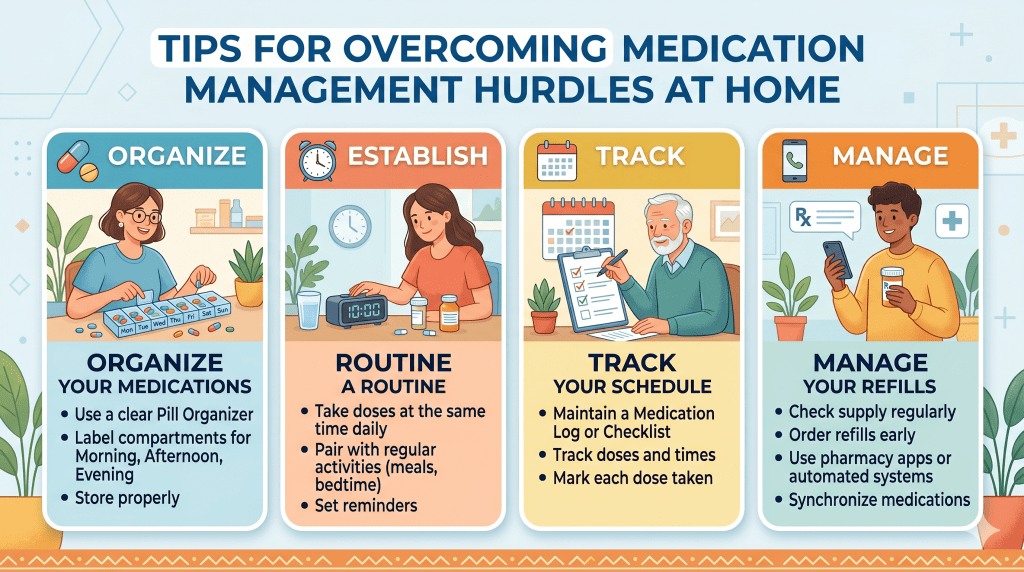
Sometimes the biggest breakthroughs in care come from small, practical changes right at home. These simple tips can turn a source of daily stress into a smooth, safe routine.
Organizing a Central Medication Station
Start by creating one dedicated spot for all prescriptions. A simple storage box or a specific drawer keeps everything together. No more searching the house for a missing bottle.
A weekly pill organizer is a game-changer. Large compartments for different times of day make it clear what dose is needed. This visual confirmation helps ensure pills are taken correctly.
Some pharmacies offer pre-sorted packs. These services deliver daily doses in labeled packets. It’s a fantastic option for managing medications without the fuss.

Utilizing Visual Cues and Symbol Labels
Color-coding is a powerful tool. Use bright tape on bottles—blue for morning, red for evening. This helps those who struggle with small print.
Keep a current list of all prescriptions and over-the-counter items. Post it inside the cabinet. This is vital for spotting potential drug interactions.
Always talk with the doctor about any changes you notice. Tracking even minor side effects helps healthcare professionals make adjustments. This is a key part of effective medication management.
Ensuring Clear Communication with Caregivers
When multiple people help, communication is safety. A central logbook prevents double-dosing or missed times.
Open dialogue among family members and other caregivers is essential. It ensures everyone is on the same page about the daily routine. This teamwork provides the best care and peace of mind.
Creating a Medication Communication System That Prevents Confusion, Mistakes, and Family Stress
A medication schedule can look perfect on paper and still fall apart in real life if communication is weak.
This is one of the biggest hidden reasons medication routines stop working. Not because the older adult does not care. Not because the caregiver is irresponsible. And not because the family failed to set reminders. The real problem is often much quieter than that. One person thinks the prescription changed. Another person assumes the dose stayed the same. A sibling buys an over-the-counter medicine without mentioning it. A caregiver notices a side effect but forgets to write it down. A doctor gives new instructions at an appointment, but by the time everyone gets home, half the details are already blurry.
That is how confusion grows.
And once confusion enters a medication routine, it creates a chain reaction. The older adult starts receiving mixed messages. Caregivers begin second-guessing one another. Family members feel worried but also defensive. Small mistakes start to feel personal. Everyone is trying to help, yet the system becomes harder to trust.
That is why a medication schedule should never exist by itself.
It needs a communication system around it.
A good communication system makes medication management calmer, safer, and far less emotionally draining. It ensures the right information reaches the right person at the right time. It reduces repeated questions, duplicate effort, and unspoken assumptions. Most importantly, it protects the senior from the kind of preventable errors that happen when care is fragmented.
If the first part of medication management is building the routine, this is the second part: making sure the routine stays coordinated when more than one person is involved.
Why Medication Problems Often Start With Communication Gaps
Many families assume medication mistakes happen because someone forgot something. But in practice, many mistakes happen because people were never fully aligned in the first place.
This usually looks like one of the following situations:
- A daughter thinks her father is still taking a medication that was stopped two weeks ago.
- A home aide gives the morning medicine based on an old note taped inside a cabinet.
- A son hears “take half a tablet now” at the doctor’s office but forgets whether that instruction was temporary or ongoing.
- A spouse says, “She already took it,” but means yesterday, not today.
- The senior starts skipping a medication because it makes them feel tired, but nobody else knows.
None of these scenarios sound dramatic. That is exactly why they are dangerous. Medication confusion often grows from ordinary moments that feel too minor to flag.
Families often focus on reminders, pill organizers, and calendars first, which makes sense. Those tools are useful. But reminders only solve one problem: remembering that something should happen.
They do not solve:
- who is responsible for checking
- how changes get communicated
- where updates are recorded
- what happens after appointments
- how side effects are documented
- how to avoid conflicting instructions from different people
Without those answers, the routine becomes fragile.
The senior may still be receiving reminders, but the actual plan behind the reminders may already be outdated or misunderstood.
That is why communication needs to be treated as part of the medication system, not as an extra layer added only when something goes wrong.
The Goal Is Not More Talk. It Is Clearer Talk.
When families hear the phrase “better communication,” they often imagine long discussions, group texts, or endless updates. That is not what is needed.
A strong medication communication system is not built on constant talking. It is built on clear, consistent, low-friction information sharing.
That distinction matters.
The goal is not to create more work. The goal is to make the right details easy to capture and easy to confirm.
A good system answers these questions quickly:
- What is the current medication plan?
- Has anything changed?
- Who knows about the change?
- Has today’s dose already been taken?
- Is there anything unusual to watch?
- Who needs to follow up?
When those answers are easy to find, the entire household feels more stable.
When those answers are unclear, everything starts relying on memory, assumptions, or scattered messages. That is when stress rises.
So instead of asking, “How do we communicate more?”
Ask:
“How do we make essential medication information easier to understand and harder to miss?”
That is the better question. And it leads to better systems.
Assign Clear Roles So No One Is Operating on Assumptions
One of the simplest ways to reduce medication confusion is to define roles.
This may sound formal, but it actually makes care feel lighter. Families become overwhelmed when everyone is vaguely involved but nobody knows exactly what they own.
You do not need a complicated hierarchy. You just need clarity.
For example, in many families, the following structure works well:
The Medication Point Person
This is the person responsible for keeping the master medication list current.
They are not necessarily the one giving every dose. They are the one making sure the official information is updated after appointments, refills, dose changes, or new instructions.
Their job includes:
- updating the master medication list
- recording changes after doctor visits
- confirming refill status
- making sure outdated instructions are removed
This person should be reliable, organized, and reachable.
The Daily Routine Support Person
This is the person most involved in the day-to-day schedule.
They may be a spouse, adult child, aide, or caregiver. Their role is to support actual adherence in the home environment.
Their job includes:
- checking whether doses were taken
- noticing difficulties with timing or side effects
- observing patterns like skipped doses, confusion, or resistance
- logging anything unusual
This person often sees the most real-world problems first.
The Medical Follow-Up Person
Sometimes this is the same as the point person, but not always.
This is the person who contacts the pharmacist, doctor, or clinic when clarification is needed.
Their role includes:
- asking follow-up questions after appointments
- confirming instructions when labels are confusing
- reporting side effects or changes in behavior
- bringing the medication list to visits
The Backup Person
Every family needs one.
If the main caregiver is unavailable, sick, traveling, or overwhelmed, the backup person should know where the medication record is, what the daily routine looks like, and who to call if questions come up.
This role is especially important in families that assume “someone will handle it.” That assumption is exactly what causes care gaps.
When roles are named, even informally, the medication routine becomes safer. It also becomes less emotional. People stop stepping on each other’s toes because expectations are clearer from the beginning.
Use One Shared Update Method and Stick to It
The biggest communication mistake families make is spreading medication information across too many places.
A change gets mentioned in a phone call.
A second detail gets sent in a text.
A third note gets written on paper.
A fourth update stays inside one person’s head.
That does not create a system. It creates fragmentation.
The solution is to choose one primary update method and use it consistently.
This can be:
- a shared notebook at home
- a printed medication log near the medication station
- a shared digital note
- a caregiver app
- a shared family spreadsheet
- a check-in service with summaries
The exact format matters less than consistency.
The rule should be simple:
If it affects the medication routine, it goes in the shared system.
That includes:
- dose changes
- new medications
- stopped medications
- side effects
- missed doses
- refill issues
- appointment notes
- questions for the doctor
- unusual symptoms after a medication is taken
Without this rule, people start relying on verbal updates. Verbal updates fade, get interrupted, or get remembered differently by different people.
A written shared record is what turns family involvement into coordinated care.
Document “Small” Problems Before They Become Big Problems
One reason medication confusion is hard to manage is that families often wait too long to record concerns.
They think:
- “It only happened once.”
- “I’ll remember it later.”
- “It is probably nothing.”
- “We can mention it at the next visit.”
But in medication management, small details matter. A skipped lunch can affect medication timing. A complaint like “this one makes me feel funny” may be the first sign of a pattern. A repeated delay in taking evening medication may reveal that the schedule no longer fits the person’s energy level or bedtime.
The point is not to overreact. The point is to capture useful information while it is still fresh.
A practical communication system should make it easy to record notes like:
- Took morning meds late because breakfast was delayed
- Refused one tablet, said it upset stomach
- Seemed more sleepy than usual after lunch meds
- Evening dose forgotten until 9:30 p.m.
- Refill requested, not yet picked up
- Mentioned dizziness when standing after medication
These kinds of notes are incredibly useful. They help caregivers notice patterns. They help family members stay aligned. And they help doctors get a clearer picture of what daily life actually looks like.
Without these notes, families often show up to medical visits saying, “Something has been off lately, but we’re not sure what.”
That is understandable, but not very actionable.
A few simple observations written consistently are often more valuable than a long emotional summary remembered imperfectly.
Create an Appointment Routine So Changes Do Not Get Lost
Doctor visits are one of the most common moments when medication confusion enters the system.
A provider may speak quickly. A senior may feel tired or overwhelmed. A family member may be trying to listen, ask questions, and manage transportation at the same time. By the end of the visit, everyone thinks they understood the plan, but nobody captured it clearly enough.
That is why appointments need a routine.
Before the appointment, prepare:
- the current medication list
- a list of any side effects or concerns
- a short summary of missed doses or schedule problems
- refill questions
- any recent changes in appetite, sleep, dizziness, confusion, or mood
During the appointment, focus on clarity. Do not leave with vague instructions.
Ask:
- What exactly changed?
- What stays the same?
- When should the new instructions begin?
- Does anything need to be stopped immediately?
- Are we watching for any side effects?
- When should we call if something feels off?
After the appointment, do not wait until later that evening to update the system. Do it as soon as possible.
A good post-appointment habit looks like this:
- Review the instructions while they are fresh
- Update the master medication list
- Remove or mark outdated instructions
- Tell all relevant caregivers what changed
- Write down when the change starts
This prevents one of the most common problems in family care: one person following the new plan while another is still following the old one.
Build a Daily Confirmation Habit That Is Simple, Not Intrusive
When multiple people are involved in medication care, families need a reliable way to confirm whether the day’s doses were actually taken.
This is where many families overcomplicate things.
They create elaborate systems that nobody can maintain. Or they avoid any system at all because they do not want to feel controlling.
There is a better middle ground: a daily confirmation habit that is easy, respectful, and fast.
Examples include:
- checking off a printed chart after each dose
- moving a marker from “not taken” to “taken”
- writing initials in a log
- sending one short message in a family thread
- using a digital tracker that shows completion
- relying on a phone-based reminder service that logs responses
The right method depends on the household, but the principle stays the same:
the system should make it obvious whether a dose happened without requiring detective work later.
This becomes especially important when the senior values independence.
In those situations, the confirmation system should feel supportive rather than supervisory. That may mean the older adult checks off their own doses. Or it may mean a reminder call gives them a private chance to confirm completion without feeling watched by family.
The best systems preserve dignity while still creating visibility.
Reduce Family Conflict by Agreeing on One Standard of Truth
Medication care becomes emotionally difficult when family members argue about what “really happened.”
One person says, “She definitely took it.”
Another says, “No, that was yesterday.”
A third says, “I thought the doctor changed that dose.”
These arguments are exhausting, and they rarely end well. They also drain attention away from the real issue: protecting the older adult.
The easiest way to reduce this conflict is to agree in advance on one standard of truth.
That might be:
- the written medication log
- the updated master list
- the caregiver app record
- the pharmacy label plus shared notes
- the daily check-in system
Whatever it is, the family should agree:
We do not settle medication questions based on memory when the record exists. We check the record.
This is a small shift, but it changes the emotional tone dramatically.
It stops conversations from becoming personal.
It lowers defensiveness.
It creates a neutral reference point.
Instead of saying, “You forgot to tell me,” people start saying, “Let’s check the log.”
That is healthier for families and safer for seniors.
Make Room for the Older Adult’s Voice
Families sometimes build communication systems around the senior without truly including them.
This usually happens with good intentions. People want to reduce burden, protect safety, and keep everything organized. But if the older adult feels excluded, they may start resisting the system quietly.
They may stop mentioning symptoms.
They may ignore reminders.
They may avoid asking questions because they feel decisions are being made around them rather than with them.
That is why the senior’s voice must stay in the loop.
A respectful medication communication system should ask:
- How do you prefer to be reminded?
- What part of this routine is frustrating?
- Is any medication difficult to swallow, open, or tolerate?
- Do any times of day feel rushed or confusing?
- Would you rather tell one person about side effects, or write them down?
- Do you want family informed about every change, or only major ones?
Even older adults who need significant support usually want some say in how the system works.
That is not just about dignity, although dignity matters. It is also practical. Seniors often know where the friction is long before caregivers do. If they feel comfortable speaking up, the schedule can be improved much earlier.
Create a Calm Escalation Plan for Unclear Situations
Not every medication question can be answered at home.
Sometimes the instructions are unclear. Sometimes the side effect is new. Sometimes a refill does not match what the family expected. Sometimes two providers appear to have given conflicting advice.
These moments need a calm escalation plan.
Without one, families often do one of two things:
- panic and overreact
- delay and hope it resolves itself
Neither response is ideal.
Instead, decide in advance:
- Who calls the pharmacist?
- Who contacts the doctor’s office?
- What issues should be flagged the same day?
- What symptoms should never be ignored?
- Where are the phone numbers kept?
- Who documents the answer once guidance is received?
This plan keeps the household from freezing during uncertainty.
It also protects the older adult from casual guesswork, which is one of the most dangerous habits in medication care.
A useful household rule is this:
If the medication instructions are unclear, the next step is not guessing. The next step is checking.
That one sentence can prevent a remarkable amount of avoidable confusion.
A Strong Medication System Makes Everyone Feel Less Alone
Medication schedules are often discussed like a technical problem. But for seniors and caregivers, they are also emotional.
For the older adult, medication routines can feel like a daily reminder of dependence, illness, change, or loss of control.
For caregivers, they can create constant low-level fear:
- What if something is missed?
- What if instructions changed?
- What if nobody told me?
- What if a mistake happens on my watch?
That is why communication matters so much.
A strong communication system does not just improve logistics. It reduces emotional strain.
It helps the older adult feel supported instead of monitored.
It helps caregivers feel organized instead of overwhelmed.
It helps families feel coordinated instead of reactive.
And it replaces quiet uncertainty with a clearer sense of shared responsibility.
That is not a small benefit. It is one of the biggest reasons medication routines become sustainable.
Because in the long run, what families need is not just a chart, a pill box, or an app.
They need a system that allows everyone involved to breathe a little easier.
The Most Reliable Medication Schedule Is One That Everyone Can Understand
At its heart, medication management is not just about accuracy. It is about shared clarity.
The schedule should be simple enough that:
- the senior understands it
- the caregiver can follow it
- the backup helper can step in
- the family can confirm it
- the doctor can review it
- the pharmacist can clarify it when needed
If the system is too complicated to explain clearly, it is probably too complicated to maintain safely.
That is why the best medication communication systems are usually not the fanciest ones. They are the clearest ones.
They rely on:
- one current medication list
- one shared update method
- one clear record of what changed
- one daily confirmation habit
- one escalation plan for uncertainty
- one commitment to checking the record instead of relying on memory
Put all of that together, and the medication schedule becomes more than a daily routine.
It becomes a dependable support system.
And that is what most families are really looking for: not perfection, but a way to make everyday care feel more coordinated, more trustworthy, and much less stressful.
Conclusion
Every family deserves the peace that comes from a well-organized approach to daily wellness. The statistics are sobering—research shows that proper adherence prevents countless hospital visits. But the solutions are within reach.
With the right combination of a clear calendar, gentle reminders, and supportive care, managing daily health needs becomes manageable. Your loved one can maintain their independence while staying safe.
Technology like JoyCalls bridges distances when you can’t be there. Our daily check-ins provide companionship and gentle prompts, helping combat isolation while supporting routines.
The goal remains constant: helping those we love live fuller, healthier lives. Small changes today create lasting safety and confidence for tomorrow. Start supporting your loved one today at https://app.joycalls.ai/signup.