


What if the most dangerous part of your loved one’s hospital stay happens after they come home?
You’ve just brought Mom back from the hospital. The discharge papers feel overwhelming. New pill bottles, changed dosages, and instructions that seem to contradict what she was taking before. Many families face this exact moment of uncertainty.
Hospital stays involve complex care with multiple providers. When your loved one comes home, prescriptions often change. Existing ones get adjusted. New ones are added for recovery. The instructions can be confusing.
Without proper organization, these changes can lead to serious mistakes. A recent study found that over 80% of patients experienced either provider errors or had no understanding of their medication changes. This transition time is incredibly vulnerable.
This guide will walk you through creating a clear plan that prevents confusion. We’ll cover common challenges families face and practical tools for safer home care. Whether you’re helping a parent recover from surgery or managing chronic conditions, understanding this process is essential for their safety and your peace of mind.
Coordinating prescriptions is just one part of comprehensive safety. As we explore in our guide on reducing fall risks, regular medication reviews are crucial for preventing dizziness and other side effects that can impact stability.
Key Takeaways
- Hospital discharge often brings confusing prescription changes that require careful management
- Proper organization of prescriptions prevents dangerous errors during the transition home
- Over 80% of patients experience either provider errors or lack understanding of their medication changes
- Creating a clear plan reduces confusion and gives caregivers confidence
- Regular prescription reviews are essential for comprehensive safety and fall prevention
- Practical tools and step-by-step processes make home care simpler and safer
- Understanding prescription coordination protects your loved one’s health during recovery
Understanding Medication Reconciliation
When multiple doctors prescribe different treatments, how do you know which ones to keep and which to stop? This is where medication reconciliation becomes your family’s safety net.
Definition and Scope
Medication reconciliation is the careful process of comparing every pill, vitamin, and supplement your loved one takes. It creates one accurate picture of their complete treatment plan.
This review goes far beyond just prescription drugs. It includes over-the-counter remedies, herbal supplements, and vitamins too. The goal is simple: ensure safety and prevent dangerous mix-ups.

| Before Hospital Stay | During Hospital Stay | After Discharge |
|---|---|---|
| Regular daily medications | New temporary treatments | Updated combination |
| Over-the-counter supplements | Hospital-specific drugs | Carefully reviewed list |
| Established routines | Changed dosages | Coordinated schedule |
Role in Patient Safety and Coordinated Care
This coordinated approach ensures every healthcare provider has the same accurate information. It prevents dangerous gaps in communication that could harm your loved one.
“Medication reconciliation isn’t just paperwork—it’s a critical safety measure that catches potential problems before they affect recovery.”
When done thoroughly, this process builds a protective network around your family member. It helps identify which treatments should continue, which should stop, and which need adjustment.
Try JoyCalls Free
No app or new device needed. Start with a free 7-day trial.
Understanding this medication reconciliation process empowers you to ask the right questions. It turns confusion into confidence during a vulnerable time.
This careful review is just one part of comprehensive care planning. Our long-distance caregiving checklist provides additional tools for managing your loved one’s health from afar.
Medication Reconciliation After Hospital: Ensuring Safe Transitions
Picture this: your loved one is finally home from the hospital, but the stack of new prescriptions feels more overwhelming than the recovery itself. This critical window between medical care and home life is when confusion most often creeps in.

Seamless Transition from Hospital to Home
The journey back to familiar surroundings brings unique challenges. Treatment plans often change during a hospital stay. When your family member returns home, these adjustments need clear understanding.
This transition period carries the highest risk for prescription mistakes. Multiple doctors may have adjusted the treatment plan. Those changes must be communicated clearly to everyone involved.
| Common Transition Challenges | Potential Risks | Protective Solutions |
|---|---|---|
| Unclear discharge instructions | Missed doses or wrong timing | Detailed medication schedule |
| Changed prescription dosages | Overmedication or undermedication | Pharmacist review before starting |
| New drugs added to existing regimen | Dangerous drug interactions | Complete list shared with all providers |
Communication Between Providers and Patients
Clear communication forms the foundation of safe care transitions. Hospital teams, primary doctors, and specialists all play roles. But families serve as the crucial connection point.
You ensure everyone has complete, accurate information. This coordination prevents dangerous gaps in understanding. Regular check-ins and support systems make recovery smoother.
Having daily support, whether through companionship services or family check-ins, provides essential safety nets. These resources align with comprehensive patient safety guidelines for optimal recovery.
Step-by-Step Process for Effective Medication Reconciliation
The moment you realize you’re responsible for coordinating complex treatment plans can feel overwhelming. But breaking it down into clear steps transforms confusion into confidence.
This systematic approach ensures nothing gets missed during this vulnerable transition period. Each phase builds on the last for complete safety.
Try JoyCalls Free
No app or new device needed. Start with a free 7-day trial.
Collecting a Complete Medication List
Start by gathering every single item your loved one takes. This includes prescriptions, vitamins, supplements, and over-the-counter remedies.
Bring all bottles to the pharmacy visit or create a detailed written record. Include names, amounts, frequencies, and purposes for each item.

Reviewing and Verifying Dosages
Next, carefully compare the complete list with discharge instructions. Identify what’s new, changed, or discontinued.
This comparison catches potential errors like duplicate prescriptions or unclear dosage adjustments. Even small changes can significantly impact well-being.
Ensuring Timely Follow-Up and Adjustments
The process continues beyond the initial review. Schedule a follow-up within 3-7 days to assess how the plan is working.
This allows for necessary tweaks to the treatment approach. Regular check-ins prevent problems before they escalate.
| Step | Key Actions | Timeline |
|---|---|---|
| 1. Gather Information | Collect all bottles and supplements | Before first appointment |
| 2. Compare & Verify | Match with discharge instructions | During pharmacy visit |
| 3. Follow-Up Review | Assess effectiveness and side effects | Within one week |
Overcoming Common Medication Challenges Post-Discharge
Imagine discovering your parent is taking two prescriptions that do the exact same thing—but under different names. This confusion is just one of the hurdles families face when managing treatment plans.
These situations create real safety concerns. Simple oversights can lead to serious complications. Being prepared helps you spot problems before they escalate.

Avoiding Duplications, Omissions, and Errors
Many patients encounter prescription errors during recovery. Common issues include missing essential drugs or dealing with incorrect dosages.
Preventing these mistakes requires careful checking. Verify that no treatment appears twice under different names. Ensure nothing from the previous regimen was forgotten.
Professional guidance makes this process safer. The American Society of Health-System Pharmacists offers valuable resources for families navigating these transitions.
Managing Side Effects and Drug Interactions
New prescriptions often bring unexpected side effects. Your loved one might feel dizzy, nauseous, or unusually tired. These effects could signal a problem needing attention.
Harmful interactions become more likely with multiple prescriptions. Some combinations reduce effectiveness or create dangerous drug interactions.
Watch for changes in behavior or comfort. Keeping open communication with healthcare providers helps manage these challenges effectively.
Tips for Successful Medication Management at Home
Creating a reliable system for managing your loved one’s health regimen transforms worry into confidence. Simple approaches make complex treatment plans feel manageable.
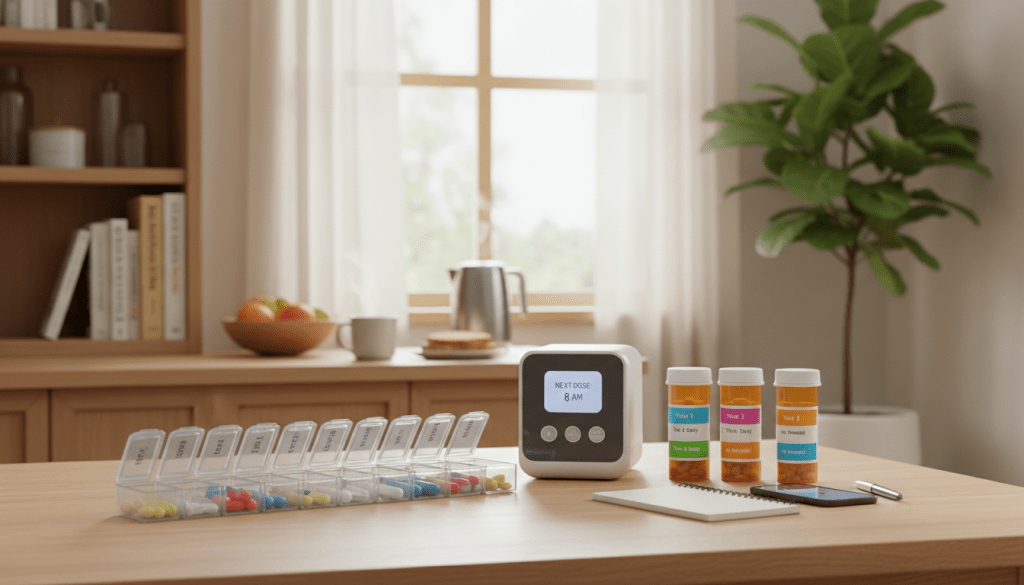
Start with a complete list of all items your family member takes. Include prescriptions, over-the-counter drugs, and supplements. This foundation supports safe medication management.
Utilizing Medication Management Tools and Apps
Modern tools simplify daily routines. Pill organizers provide visual confirmation of what’s been taken. Apps send reminders and track adherence.
| Tool Type | Key Benefits | Best For |
|---|---|---|
| Weekly Pill Organizers | Visual tracking, simple to use | Seniors comfortable with physical tools |
| Medication Apps | Remote alerts, dose tracking | Tech-savvy users and remote caregivers |
| Daily Check-in Calls | Personal reminders, companionship | Seniors preferring human connection |
For those who find technology challenging, services like JoyCalls offer daily phone check-ins. These calls provide gentle reminders while building connection.
Strategies for Patient Education and Adherence

Understanding leads to better adherence. Help your loved one grasp why each treatment matters. Create space for questions without rush.
“When patients understand their treatment plan, they become active partners in their health journey.”
Connect pills to daily routines like meals. Celebrate small successes in management. These strategies improve health outcomes significantly.
Proper medication management extends beyond pills. It supports overall wellness, much like tracking nutrition and hydration from afar.
The First 7 Days at Home: A Practical Medication Safety Plan for Seniors and Caregivers
Getting home from the hospital often feels like the hardest part is over. In reality, the first week after discharge is when many families realize just how much responsibility has suddenly shifted onto them. Hospital staff are no longer checking doses. Nurses are not there to notice missed pills. Doctors are not nearby to explain why one medication was stopped and another was added.
This is exactly why the first 7 days at home deserve a plan of their own.
For seniors, the medication routine after discharge is often more complicated than the routine before hospitalization. A blood pressure medicine may now have a new dose. A pain medicine may be temporary. A sleeping pill may have been added but only for a short period. A blood thinner may now matter more than ever. At the same time, the older adult may be tired, weak, confused, forgetful, or simply eager to get back to “normal” and restart old habits too quickly.
That combination creates risk.
A smart medication plan for the first week is not about making life overly clinical or stressful. It is about reducing decision fatigue. It is about making sure nobody has to rely on memory at the exact moment memory is least reliable. It is about helping seniors stay safe, helping caregivers feel more in control, and making it easier to catch problems early instead of reacting late.
The good news is that the first week can be managed much more smoothly when you treat it like a short-term transition period rather than expecting everything to fall back into place immediately.
Why the first week matters so much
The first few days at home are when routines are still unsettled. Sleep may be poor. Appetite may be off. There may be follow-up calls, medical equipment, home health visits, and a lot of fatigue. Even seniors who are usually independent may have trouble keeping track of timing, dose changes, refill needs, or side effects when they are recovering.
This is also the period when dangerous misunderstandings tend to show up, such as:
- restarting an old prescription that was supposed to be stopped
- taking both the old and new dose of the same medicine
- skipping a new medication because its purpose was not explained clearly
- using over-the-counter medicines that interfere with a new prescription
- taking medicines at the wrong time because the daily routine changed
- assuming a side effect is “normal recovery” when it actually needs medical attention
A strong first-week plan reduces those risks by turning vague instructions into a daily system.
The goal is not perfection. The goal is clarity.
Many families think medication management means never making a mistake. That is not realistic. Real life is messy. People get tired. Pill bottles look alike. Instructions are not always written in plain language.
The better goal is clarity.
If a senior or caregiver can answer these questions at any point in the day, the plan is working:
- What medicines are being taken right now?
- What was stopped?
- What is temporary?
- What must be taken at a specific time?
- What symptoms should trigger a call for help?
- Who should be contacted if something seems wrong?
When those answers are easy to find, confusion goes down dramatically.
Step 1: Create a 7-day “recovery medication sheet”
Instead of relying only on discharge papers, create a fresh one-page medication sheet specifically for the first week at home.
This should not be a complicated medical chart. It should be something any family member can understand quickly, even in the middle of a busy or stressful day.
What to include on the sheet
List each medication with:
1. The exact name
Write the full name as shown on the label.
2. What it is for
Use plain language. For example:
- “for blood pressure”
- “for infection”
- “for pain after surgery”
- “to prevent blood clots”
- “for sleep, temporary only”
This matters because seniors are much more likely to follow a plan they understand.
3. The dose
Write it clearly and exactly as prescribed.
4. The time it should be taken
Avoid vague notes like “twice daily” if possible. Write:
- 8:00 a.m.
- 2:00 p.m.
- bedtime
The more specific the schedule, the less room there is for hesitation.
5. Special instructions
Examples:
- take with food
- do not crush
- avoid alcohol
- take only if pain is moderate or severe
- hold and call doctor if blood pressure is too low
- finish the full course
6. Start date and stop date
This is especially important for antibiotics, pain medication, steroids, sleep medicines, and other short-term drugs. Many families get into trouble because a temporary medication quietly becomes part of the routine for too long.
7. Red-flag symptoms
Add a short warning beside each medication when relevant, such as:
- call if unusual bleeding
- call if severe dizziness
- call if rash or swelling
- call if extreme sleepiness
- call if no bowel movement for several days while taking pain medication
Keep the sheet visible and shareable
Put one copy:
- near the medication area
- in the senior’s bag or walker pouch for appointments
- on the refrigerator if appropriate
- in the caregiver’s phone as a photo
If more than one person helps with care, everyone should be using the same sheet. That one step alone prevents many communication problems.
Step 2: Separate “old medicines” from “current medicines”
One of the biggest sources of post-discharge confusion is simple physical clutter.
A senior comes home and the kitchen counter, bathroom cabinet, bedroom drawer, or bedside table may still contain pre-hospital medications, expired bottles, duplicate prescriptions, supplements, and as-needed products. Then the new hospital medications get added to the same space. That is when mix-ups happen.
Set up three clear groups
Create three categories immediately:
Current medications
These are the medicines the senior should be taking now.
Hold / stopped medications
These are medications the doctor paused, discontinued, or wanted reviewed before restarting.
Ask before using
This group is for anything unclear:
- vitamins
- herbal products
- sleep aids
- pain relievers bought without prescription
- digestive remedies
- leftover prescriptions from earlier illnesses
Do not leave all of these together in one basket and assume everyone will remember which is which. Use separate containers, zipper bags, or labeled bins.
Why this matters for older adults
Many seniors are used to trusting long-standing routines. If they have taken the same pill for five years, they may restart it automatically without realizing the hospital plan changed. That is not stubbornness. It is habit. A physical reorganization of the medication area helps interrupt that habit safely.
A simple rule that helps
If a medication is not on the current active list, it should not stay mixed in with the daily medications.
That rule protects both the senior and any family member helping out.
Step 3: Build the medication schedule around real life, not ideal life
Medication plans often fail because they are technically correct but practically unrealistic.
A schedule that looks neat on paper may not fit how the senior actually lives. Maybe mornings are slow because getting out of bed is hard. Maybe appetite is poor after discharge. Maybe the caregiver only visits in the evening. Maybe there is mild memory loss. Maybe the senior naps at unpredictable times.
The schedule should fit the person, not the other way around.
Match doses to reliable daily anchors
Instead of depending on memory alone, connect medications to things that already happen consistently, such as:
- after brushing teeth
- with breakfast
- after the lunch tray arrives
- with the evening news
- before bedtime prayers
- after checking blood sugar
- when the daily phone call comes in
Anchoring medication to familiar habits makes adherence feel more natural and less like a separate burden.
Do not overcomplicate the first week
During the transition home, simplicity matters. If the pharmacist or doctor says timing can be flexible, try to reduce unnecessary complexity. For example, if multiple morning medications can safely be taken together, that is usually easier than spacing them out unless there is a medical reason to do so.
Families should not make medical timing changes on their own, but they should absolutely ask whether the plan can be simplified.
That question is often overlooked:
“Is there a simpler way to take these safely?”
It is one of the most helpful questions a caregiver can ask.
Step 4: Watch for side effects that look like “just recovery”
Older adults do not always say, “This medication is bothering me.” More often, they say things like:
- “I just feel off.”
- “I’m not hungry.”
- “I’m more tired than usual.”
- “I’m a little shaky.”
- “I don’t feel steady.”
- “Something doesn’t seem right.”
That kind of language should not be brushed aside, especially during the first week.
Symptoms families should take seriously
Some side effects are obvious. Others are subtle. Watch closely for:
Increased sleepiness or confusion
This may happen with pain medications, sleep aids, anti-anxiety medications, or certain combinations of medications.
Dizziness or unsteadiness
This can raise fall risk quickly, especially when combined with weakness after hospitalization.
Nausea, vomiting, or poor appetite
These issues can make it harder to keep taking medications correctly and may also affect hydration.
Constipation
A common but often underestimated problem, especially after surgery or when pain medication is involved.
Diarrhea
This can affect hydration and strength and may also signal that a medicine does not agree with the senior.
Swelling, rash, or itching
These can suggest an adverse reaction.
Bleeding or bruising
This should never be ignored, especially if the senior is on a blood thinner.
Sudden mood or behavior changes
Agitation, withdrawal, unusual sadness, confusion, or restlessness can sometimes be linked to medication effects.
Keep a symptom log for 7 days
A short daily note is enough:
- what was taken
- what time
- any missed dose
- appetite
- bowel movement
- energy level
- unusual symptoms
This does not need to be elaborate. Even 3 to 5 lines a day can help a doctor or pharmacist spot patterns much faster than memory alone.
Step 5: Decide in advance when to call the doctor, the pharmacist, or emergency services
One reason families delay asking for help is uncertainty. They do not want to overreact, but they also do not want to miss something serious.
That is why it helps to make an escalation plan before a problem happens.
Call the pharmacist when:
- the instructions on the bottle seem different from the discharge paperwork
- two medications seem similar and you are not sure if they are duplicates
- you need help organizing timing
- the senior is refusing a medicine because they do not understand its purpose
- you want to check whether an over-the-counter medicine is safe to use
Pharmacists are often one of the fastest and most practical sources of help after discharge.
Call the doctor or discharge team when:
- a medication seems to be causing troubling side effects
- pain is not controlled even when medication is taken properly
- blood pressure, blood sugar, or another monitored reading is repeatedly abnormal
- the senior is too sleepy, too confused, too weak, or too nauseated to follow the plan well
- you are unsure whether a stopped medication should be restarted
Seek urgent or emergency help when:
- there is trouble breathing
- the senior cannot be awakened normally
- there is chest pain
- there are signs of stroke
- there is major bleeding
- there is a severe allergic reaction
- there is a sudden fall with injury or major change in alertness
Families cope better when they do not have to make these decisions from scratch under stress.
Step 6: Prepare for the first follow-up appointment before it happens
The first follow-up appointment is not just a routine check-in. It is one of the best opportunities to clean up confusion before it becomes a long-term problem.
But many families arrive without the information needed to get clear answers.
Bring these five things
1. The current medication sheet
Not just the discharge packet.
2. All pill bottles, if practical
This is especially useful when there is confusion about changes.
3. The symptom log
This helps the provider connect medication timing with problems.
4. A list of questions
Write them down ahead of time.
5. A list of what is hardest at home
For example:
- too many dosing times
- pill too hard to swallow
- too expensive
- causing constipation
- senior keeps forgetting
- no one available for midday dose
These practical barriers are just as important as the prescriptions themselves.
Smart questions to ask at follow-up
- Which of these medicines are temporary?
- Which ones are most important not to miss?
- Are any of these likely to cause dizziness or confusion?
- Can any dosing times be simplified?
- Should any old medications remain on hold?
- What side effects should prompt a call?
- What is the plan for refills?
- What should improve over the next week, and what would be concerning?
This kind of questioning helps families leave with a usable plan instead of more paperwork.
Step 7: Protect the senior’s confidence, not just their compliance
Medication management is not only a safety issue. It is also an emotional issue.
For many older adults, hospitalization is already unsettling. Coming home to find that other people are suddenly sorting pills, correcting routines, or taking over health decisions can feel like a loss of independence.
That emotional reality matters.
A senior who feels dismissed may become quiet, resistant, or less honest about what they are actually taking. A senior who feels respected is much more likely to cooperate, ask questions, and share concerns early.
Use language that supports dignity
Try saying:
- “Let’s go through this together.”
- “A lot changed in the hospital, so we’re just making it simpler.”
- “I want to make sure the instructions are clear for both of us.”
- “You know your body best, so tell me if something feels different.”
- “This is just for the recovery period while things are changing.”
Avoid language that sounds controlling or infantilizing.
Invite participation
Even if a caregiver is leading the process, involve the older adult as much as possible:
- ask them to explain what each pill is for
- let them help decide the best place to store medicines
- review the schedule together
- ask which reminders feel supportive rather than intrusive
The more ownership the senior feels, the more sustainable the plan becomes.
A practical reminder: good medication systems reduce stress for everyone

Families often think a medication system is only for safety. In reality, it also reduces tension at home.
When everyone knows what the plan is:
- fewer arguments happen
- fewer panicked phone calls happen
- fewer missed doses happen
- fewer assumptions happen
- fewer last-minute refill crises happen
That matters because recovery is not only physical. The emotional climate at home affects rest, confidence, and overall healing too.
A simple 7-day home medication checklist
For the first week after discharge, aim to do the following:
Day 1
- compare discharge instructions with actual pill bottles
- separate current, stopped, and unclear medications
- create the one-page medication sheet
- clarify at least one emergency contact number
Day 2
- confirm the timing routine is realistic
- check whether the senior understands what each medicine is for
- remove expired or confusing duplicate bottles from the active area
Day 3
- review for side effects
- check appetite, hydration, bowel movement, and sleep
- ask whether any pill is hard to swallow or causing discomfort
Day 4
- confirm refill needs for the next 1 to 2 weeks
- update the medication sheet if anything changed
- make sure all caregivers are using the same plan
Day 5
- prepare follow-up questions
- review symptom notes
- identify any medication that still feels confusing
Day 6
- reassess whether reminders are working
- notice if the senior is becoming more independent or needs more support
Day 7
- review the full week
- note what is now stable
- identify what still needs clarification at follow-up
This kind of structured first week often prevents the second week from becoming chaotic.
Final thought for this section
The safest post-hospital medication plan is not the one with the most paperwork. It is the one that makes daily life easier to follow.
For seniors and caregivers, success usually comes from a few simple principles: keep the active list current, make the timing realistic, watch for subtle changes, ask questions early, and treat the first week at home as a period that deserves extra care.
That approach is not dramatic. It is not complicated. But it is exactly what helps families move from uncertainty to confidence after discharge.
When Medications Become Too Much: How Seniors and Caregivers Can Prevent Overwhelm, Errors, and Burnout
For many seniors, the biggest medication challenge after discharge is not just remembering what to take. It is the feeling that the entire routine has suddenly become too much.
There may be new prescriptions, changed doses, new warning labels, follow-up appointments, refill timelines, side effects, and instructions that sound straightforward in the hospital but feel difficult at home. Some medications may need to be taken with food. Others may need to be spaced apart. Some may only be used “as needed,” which sounds flexible until someone has to decide in real time whether the symptom is serious enough to use them. On top of all this, the older adult may still be tired, in pain, emotionally shaken, or mentally foggy from the hospital stay.
This is where many families quietly struggle.
Not because they do not care. Not because they are careless. But because medication overload is real.
And it affects both the senior and the caregiver.
When people think of medication mistakes, they often imagine dramatic errors such as taking the wrong drug or missing an essential dose. But in real life, overwhelm usually begins in much smaller ways. A caregiver starts second-guessing the instructions. The senior gets frustrated and stops asking questions. The refill date sneaks up unexpectedly. The number of daily pills starts to feel discouraging. A medicine that causes a minor side effect is tolerated for too long because nobody has the energy to call and ask about it. A complicated system is kept going even though it is clearly not working well.
This kind of hidden strain deserves attention.
Because a medication plan that is too hard to live with will not stay safe for long.
Medication burden is more than a medical issue
Medication burden is the total physical, emotional, practical, and mental weight of managing a medicine routine.
For seniors, this burden can show up in many ways:
- feeling discouraged by the number of daily pills
- getting embarrassed about forgetting doses
- becoming nervous about side effects
- struggling to open bottles, read labels, or swallow tablets
- feeling dependent on others
- losing confidence in handling health decisions independently
For caregivers, it often looks different:
- feeling responsible for every detail
- worrying about making a mistake
- having to coordinate reminders around work or family duties
- repeating the same explanations every day
- arguing about medications with a loved one
- feeling guilty for being tired, impatient, or confused
When this burden builds up, even a good medication plan can begin to break down.
That is why families should not only ask, “Is this medically correct?”
They should also ask, “Is this manageable in real life?”
That second question is often what protects long-term safety.
The warning signs that the medication plan is becoming unmanageable
Overwhelm rarely starts with someone saying, “This plan is too much.” It usually appears indirectly.
Signs in the senior
The older adult may:
- start delaying doses
- say “I’ll do it later” more often
- become vague about what they already took
- avoid conversations about medication
- become irritable during medicine time
- complain that there are “too many pills”
- start skipping optional but important supportive medications
- seem less willing to attend follow-up care
Sometimes seniors also minimize their confusion because they do not want to appear incapable. They may nod during explanations without fully understanding what changed. That is why families should pay attention not only to agreement, but to actual ease and confidence.
Signs in the caregiver
The caregiver may:
- constantly check and recheck the instructions
- feel nervous every time it is time for a dose
- complain that the schedule is impossible to maintain
- forget whether they already helped with a medication
- start relying on memory instead of a written system
- feel resentful or emotionally worn down
- avoid leaving the house because they are afraid something will be missed
If this is happening, the problem is not necessarily a lack of effort. It is often a sign that the plan needs simplification, support, or clarification.
Why seniors are especially vulnerable to medication overload after discharge
Older adults do not manage medication in a vacuum. They manage it while also dealing with age-related realities that can make even ordinary tasks harder.
Physical limitations can make medication management harder than it appears
A senior may understand the instructions perfectly and still have trouble carrying them out because of:
- arthritis that makes bottles or blister packs hard to open
- reduced vision that makes labels difficult to read
- hearing loss that affects understanding during discharge teaching
- weakness after illness or surgery
- nausea that makes swallowing difficult
- tremors that make cutting pills hard
- fatigue that makes even simple organizing tasks feel exhausting
These are not minor issues. A medication plan that ignores them is not practical, no matter how accurate it looks on paper.
Cognitive strain increases during recovery
Even seniors who are normally very sharp may struggle after a hospital stay. Lack of sleep, new medications, pain, dehydration, infection, anesthesia, or the stress of being hospitalized can all affect attention, memory, and mental energy.
That means a person who was fully independent with medication before admission may temporarily need more structure and support afterward.
Families sometimes miss this because they assume:
“They were fine with their medicines before, so they should be fine now.”
But after discharge, “now” is different.
The goal is to reduce friction, not just improve compliance
Many medication routines become stressful because they contain too much friction.
Friction is anything that makes the next step harder than it needs to be.
Examples include:
- labels that are hard to read
- unclear timing
- medicines stored in multiple locations
- no written checklist
- frequent interruptions during dose times
- instructions that depend on memory
- refill dates that are not tracked
- medications that need food when meals are inconsistent
- family members giving different directions
When friction stays high, mistakes increase.
Instead of only reminding the senior to “be careful,” reduce the friction built into the routine.
That is the more strategic approach.
Make the medication system easier to follow than to ignore
This is one of the most useful principles for families.
A safe routine should be easier to follow than to skip.
That means creating an environment where the right action is the simplest action.
Put medications where they make sense
Do not store everything in a crowded or inconvenient location just because that is where it has always been kept. If morning medications are usually taken after breakfast, store them somewhere safe but closely connected to that part of the daily routine, if appropriate.
Use one central tracking method
Avoid having:
- one note on the fridge
- one list in a phone
- one set of instructions in a drawer
- verbal updates shared differently between family members
One plan is safer than several partial plans.
Make “taken” visible
Whether it is a printed checklist, pill organizer, or written initials on a daily chart, there should be one clear way to tell whether the dose was already given.
This is especially important when more than one person helps.
How to reduce daily decision fatigue around medications
Decision fatigue is a major but often invisible reason people make mistakes.
If the senior or caregiver has to repeatedly stop and think through the same questions every day, the system is too mentally expensive.
Questions like:
- Did this already get taken?
- Was this before food or after?
- Is this the one that changed?
- Can this be taken together?
- Do I give this now or wait?
- Is this only for bad pain or any pain?
These small decisions add up quickly.
Reduce the number of choices built into the day
Here are practical ways to do that:
Pre-decide the timing
Instead of “sometime in the morning,” choose a specific window.
Pre-decide the backup plan
For example:
- if breakfast is late, take morning meds with tea and toast
- if the caregiver is delayed, the senior calls before taking anything independently
- if nausea prevents a dose, call the doctor or pharmacist instead of guessing
Pre-decide what counts as “as needed”
One of the hardest categories for many families is PRN or “take as needed” medication. Clarify:
- what symptom should trigger it
- how much is too much
- how soon it can be taken again
- when using it means the doctor should be called
The fewer judgment calls left unclear, the safer the plan becomes.
Avoiding the emotional trap of “we should already have this figured out”
Many families become hard on themselves very quickly after discharge.
By day three or four, they may think:
“We should know this by now.”
“We keep asking the same questions.”
“Why does this still feel confusing?”
“Maybe we are just not organized enough.”
That mindset is unhelpful and unfair.
Post-discharge medication management is often difficult because the system itself is difficult. Confusion is not always a sign of failure. Sometimes it is a sign that the instructions were too dense, the changes were too many, or the recovery period is still affecting the senior’s capacity.
A more helpful mindset is:
“If this keeps feeling hard, the plan needs support.”
That keeps the focus on solving the problem, not blaming the people living through it.
How caregivers can support without taking over too aggressively
Medication support can easily slip into control. That is understandable, especially when a caregiver is scared of mistakes. But if the older adult feels managed rather than supported, tension grows fast.
Start with shared review, not immediate takeover
Instead of assuming full control, begin by seeing what the senior can still do confidently.
They may be able to:
- recognize familiar medications
- remember morning routines
- understand the purpose of each drug
- check off a written list
- report side effects clearly
Support should be built around actual needs, not blanket assumptions.
Preserve independence where it is still safe
Maybe the caregiver organizes the medications weekly, but the senior still takes them independently using a chart. Maybe the caregiver manages refills, but the senior keeps track of symptoms. Maybe the caregiver supervises new medications only until the routine becomes familiar.
This balanced approach helps seniors stay engaged rather than passive.
Focus correction on the system, not the person
If something is missed, avoid saying:
“You always forget.”
“I told you already.”
“You’re not paying attention.”
Instead say:
“This setup may not be working well.”
“Let’s make this clearer.”
“We need an easier system for this one.”
That protects dignity and keeps the relationship from becoming more strained than it already is.
The practical problem families forget: refills, cost, and access
A discharge plan is not safe if it only works for three days.
Many medication routines begin with urgency and attention, but then practical barriers show up:
- a refill runs out sooner than expected
- insurance does not cover a prescribed medication
- the copay is too high
- the pharmacy closes before someone can get there
- a medication is backordered
- the family delays asking for help because they assume the issue will resolve itself
These problems are more common than many people realize, especially for seniors on fixed incomes or families juggling several responsibilities.
Ask these questions early
Within the first few days at home, check:
- How many days of each medication are actually available?
- Which medications are new and may need a refill soon?
- Are any of them unusually expensive?
- Does the senior have transportation or pharmacy delivery support?
- Does anyone need to request authorization from insurance?
- Is there a preferred pharmacy that already has the full list on file?
Waiting until the last few tablets remain creates pressure, and pressure increases mistakes.
Cost-related nonadherence is often hidden
Some seniors quietly skip doses, split tablets improperly, or delay refills because they do not want to burden family members financially. Others may not mention that a medication seems “too expensive” because they assume nothing can be done.
That conversation should be invited directly and respectfully.
Try asking:
- “Are any of these difficult to afford?”
- “Would it help if we asked about a lower-cost option?”
- “Do you want me to check whether there is a generic or a simpler alternative?”
These are practical, caring questions, and they can prevent unsafe shortcuts.
Create a medication communication routine inside the home
Many errors happen not because nobody cares, but because the household has no clear communication rhythm.
One person assumes the dose was given. Another assumes the first person was handling it. The senior thinks a medication was postponed. The caregiver thinks it was refused. Everyone is operating with partial information.
A short daily check-in can prevent this
A two- to five-minute medication check-in can make a big difference.
It might include:
- what was taken successfully today
- what was delayed or skipped
- any symptoms or side effects
- refill reminders
- any questions to raise at follow-up
This is especially helpful in homes where more than one person is helping.
Keep the communication calm and routine
Medication discussions should not only happen during moments of frustration. When the only time people talk about medication is when something goes wrong, the whole topic becomes emotionally loaded.
A neutral daily review keeps the process steadier and less stressful.
What to do when the senior resists the medication plan
Resistance is not always about noncompliance. Often, it has a reason.
A senior may resist because:
- the medicines are causing discomfort
- they do not understand why a new drug matters
- they feel over-monitored
- they are tired of being told what to do
- the schedule feels disruptive
- they are afraid of side effects
- they do not want to admit confusion
Respond with curiosity first
Instead of pushing harder right away, ask:
- “What feels hardest about this one?”
- “Does this medicine make you feel different?”
- “Is the timing bothering you?”
- “Does it feel like too many pills?”
- “Are you unsure what this one is for?”
The answer often reveals a fixable problem.
Address the real barrier
If the issue is swallowing difficulty, forcing the issue emotionally will not solve it. If the issue is dizziness, reassurance alone is not enough. If the issue is lack of understanding, repeating the instruction louder is not the answer.
Find the actual barrier, then solve that barrier.
When it is time to ask for outside help
Families do not need to carry the full weight of medication management alone.
It may be time to ask for added support if:
- the medication list is long and keeps changing
- the senior has memory problems or frequent confusion
- there have already been missed doses or duplicate doses
- the caregiver is exhausted or overwhelmed
- medication times are interfering with work or sleep
- there is ongoing conflict about whether medicines are being taken correctly
- the senior has had a fall, near fall, or concerning side effect after discharge
Support may come from:
- the pharmacist
- the prescribing doctor
- a nurse case manager
- home health services
- a geriatric care team
- a trusted family coordination system
Needing support does not mean the family has failed. It means the medication routine has reached a level where extra structure is appropriate.
A sustainable medication plan should feel calm, not chaotic
This is an important benchmark.
A perfect system is not required. But a sustainable one usually feels calmer over time, not more frantic.
If every day still feels like a scramble, the plan should be reviewed. If the same confusion keeps returning, the instructions are not yet clear enough. If the senior or caregiver is dreading medication time, the routine may be technically functioning but emotionally failing.
A good post-discharge medication plan should gradually create more confidence, not more pressure.
Practical action steps families can take this week
To reduce medication overload after discharge, here are immediate actions that are both realistic and high-impact:
1. Identify the hardest part of the current routine
Do not just say “everything.” Pinpoint the main stress point:
- timing
- remembering
- understanding
- swallowing
- cost
- refills
- side effects
- resistance
Once the true pain point is identified, the solution becomes more obvious.
2. Simplify one thing today
Not five things. One thing.
Maybe it is organizing the active medications into one place. Maybe it is writing a plain-language list. Maybe it is clarifying one confusing prescription with the pharmacist.
Small improvements compound quickly.
3. Stop relying on memory
If the household is still depending on verbal reminders and mental tracking alone, add a visible system immediately.
4. Review “as needed” medications carefully
These are often the least understood and most inconsistently used.
5. Ask whether any part of the plan can be made easier
This includes dose timing, formulation, refill process, or side-effect management.
That is not “questioning the doctor.” It is advocating for real-life success.
6. Check the caregiver load honestly
If one person is carrying the full burden, that should be acknowledged early. Burnout leads to mistakes.
7. Reassure the senior that needing structure is normal
Support works better when it does not feel like punishment.
Closing thought for this section
After hospital discharge, medication safety is not only about the medicines themselves. It is also about whether the people at home can realistically manage the system around them.
When the routine becomes too heavy, too confusing, or too emotionally draining, risk increases. But when families focus on reducing friction, sharing responsibility, simplifying decisions, and preserving the senior’s dignity, medication management becomes far more sustainable.
That is the real goal.
Not just getting through the first few days, but creating a routine that seniors and caregivers can live with confidently, safely, and with much less stress.
Conclusion
As you watch your loved one settle back into their favorite chair, you realize this moment of homecoming carries both relief and responsibility. The careful medication reconciliation process you’ve implemented transforms potential confusion into confident care.
This systematic approach to managing medications creates a true partnership between families and healthcare providers. Resources like professional guidance on medication reconciliation combined with daily support systems ensure your loved one’s safety and wellbeing.
Remember, you’re not navigating this alone. Services like companionship and check-in support provide essential layers of protection. Together, these strategies help maintain independence while promoting lasting health outcomes.
Your active role in this reconciliation process demonstrates the loving, protective care that makes all the difference during recovery. Each careful step builds toward a safer, more confident future at home.