


You hear a parent repeat a story, or misplace their keys twice in one visit, and you start wondering whether crosswords or one of those brain-training apps would actually help. The honest answer: mentally demanding activities can keep certain thinking skills sharper, and they are a reasonable part of healthy aging — but they are not a shield against dementia. Here is what the research supports, what it doesn’t, and how to pick something your parent will actually keep doing.
What “brain training” actually means
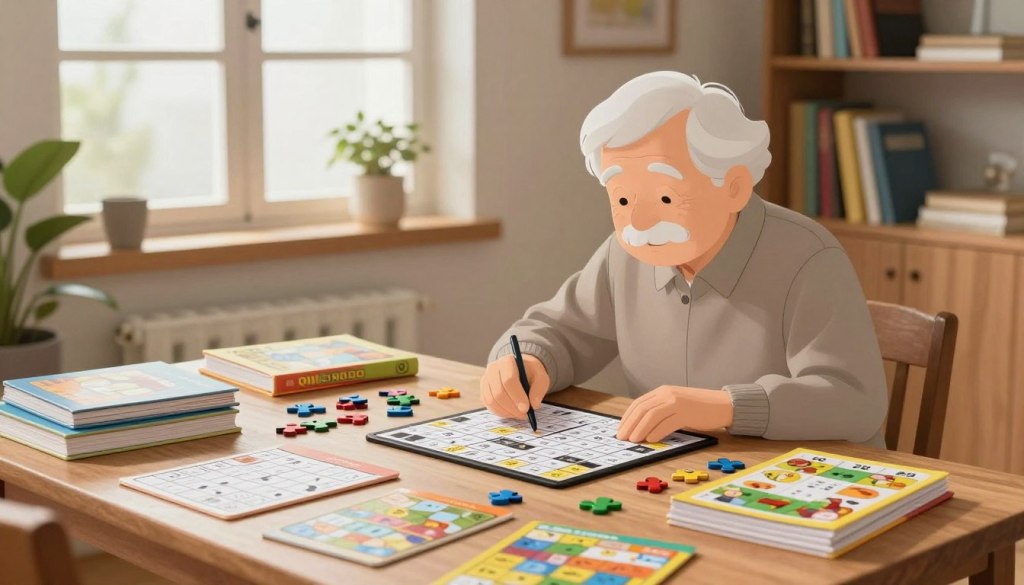
Brain training is short, structured tasks that ask a person to plan, react, remember, or ignore distractions. It can be a paper puzzle or a five-minute digital session. The common thread is small, repeatable challenges rather than long study sessions.
What the evidence supports — and what it doesn’t
What the evidence supports
Clinical reviews report measurable gains in executive function, processing speed, and verbal or working memory after regular training. In plain terms: better planning, faster response to new information, and clearer short-term recall. For a summary of the published work, see this review of published studies.
What we don’t yet know
Studies have not reliably shown improvements in attention control or spatial ability. They also leave open how often someone should train, how long a session should run, and how long any benefit lasts after stopping. Gains tend to be strongest on the exact task being practiced, and weaker when you look for transfer to unrelated everyday abilities.
How to read the headlines
You will see claims that crossword solvers hold off memory decline by years, or that frequent puzzle players perform like someone much younger. Those come from observational research, which shows that people who do puzzles tend to score better — not that the puzzles caused it. People who do crosswords every morning often also read more, sleep better, and see more friends. Worth doing? Yes. Proof that a puzzle book protects the brain? No.
What families can realistically expect
Expect gradual, modest improvements rather than a turnaround, and expect the benefits to show up in small everyday ways.
- Word recall. Word-based tasks like crosswords exercise vocabulary and name retrieval, which can make it a little easier to find the right word mid-conversation.
- Step-by-step reasoning. Structured puzzles train planning and sequencing, which is the same skill as following a recipe or working through an errand list.
- Confidence and calm. Finishing something brings a genuine sense of “I can still do this,” and an absorbing task gives a worried mind a break.
- Connection. Playing with another person adds conversation, listening, and motivation — which is often the part that keeps the habit alive.
That last point matters more than which puzzle you choose. Regular conversation is itself demanding mental work, which is part of why a standing phone call or a weekly card night tends to outlast any app. If you want ideas for the calls themselves, these conversation starters for phone calls are an easy place to begin, and there is a fuller look at the evidence in our piece on daily conversation and cognitive health.
Options worth trying
There is no single best activity. The one that helps is the one your parent will pick up again next week, so let taste lead.
Crosswords and word puzzles
Good for vocabulary and word retrieval. Pencil suits anyone who likes the quiet and the ritual; a tablet version helps if larger text or optional hints make the difference between finishing and giving up. Both count. UCLA Health has a short list of worthwhile word tasks if you want somewhere to start.
Number and logic puzzles
Sudoku, logic grids, and similar puzzles ask for sustained attention and pattern recognition. They suit people who were never fond of word games and want something with a clean right answer.
Jigsaw puzzles
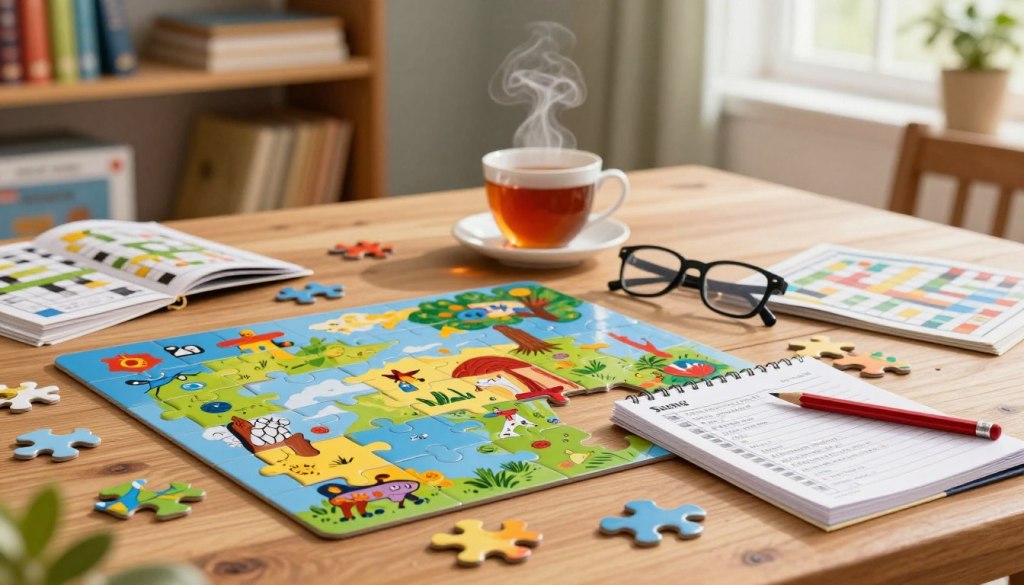
Visual-spatial reasoning and patience, with the advantage that a puzzle can live on the table for a week and invite anyone walking past to add a piece. That makes it one of the easiest shared activities during a visit.
Card games and chess
Bridge, rummy, and similar card games ask players to track what has been played, plan a move, and keep a steady pace — memory, strategy, and speed at once, with company built in. Chess suits someone who prefers a long, quiet strategic challenge.
Bingo and group games
Easy to dismiss, but bingo trains listening and quick recognition, and the community-hall version gives someone a reason to leave the house on a set day each week. For many families that attendance is worth more than the cognitive workout.
If you’re considering an app
Brain-training apps are the most heavily marketed corner of this whole subject, and the marketing runs well ahead of the evidence. Be skeptical of any app that implies it prevents dementia or makes your brain “years younger” — regulators in the United States have taken action against brain-training companies for exactly that kind of claim.
What a good app can do is make short daily practice easy: adaptive difficulty so the tasks stay in range, sessions that fit in five minutes, and progress you can see. When you are comparing options, the boring details decide whether it gets used.
- Large text, high contrast, and menus that don’t hide behind icons.
- Sessions short enough to finish — under five or ten minutes.
- A free tier you can try for two weeks before paying anything.
- No pressure tactics: streak guilt and countdown timers put a lot of people off entirely.
Set one up, leave it for two weeks, then ask whether your parent opened it without being reminded. If not, that is your answer — go back to the puzzle book or the card game.
Building a routine that lasts
Five to twenty minutes on most days beats one long session on a Sunday. Habit is the whole game here.
- Anchor it to something that already happens. “After breakfast, with the second cup of coffee” works better than a time of day.
- Aim for a little stretchy. Hard enough to require attention, easy enough to finish. If frustration shows up, step the difficulty back — nobody keeps doing something that makes them feel tested.
- Rotate two or three types a week. A word task, a number puzzle, and something social covers different skills and stops boredom.
- Watch the screen habits. Keep tablet sessions out of the hour before bed, turn the font up, and take a break every 20 to 30 minutes to spare tired eyes.
- Keep it in proportion. Walking, decent sleep, regular meals, and time with other people do at least as much for thinking as any puzzle, and they make the puzzle easier too.
If you are coordinating this from a distance, fold it into whatever contact rhythm you already have rather than adding a new obligation — our daily and weekly check-in plan shows one way to lay that out.
When puzzles are not the right answer
Brain games are for keeping a healthy mind engaged. They are not a treatment, and they are not a way to wait out something that is getting worse. Talk to their doctor if you notice memory lapses that interfere with daily life, sudden changes in thinking, persistent confusion, safety problems at home, or a marked shift in personality.
An early assessment is worth asking for, because some causes of confusion are treatable — medication interactions, thyroid problems, infections, dehydration, poor sleep — and the rest are easier to plan for when you know what you are dealing with.
A simple first week
If you want something to start on Monday, try this: buy one puzzle book in the format your parent already likes, leave a jigsaw out on a table where they sit, and put one shared activity on the calendar — a card night, a call where you do the crossword together over the phone, or a bingo afternoon at the senior center. Three things, none of them a project. In two weeks you will know which of the three stuck, and that is the one to keep.
For more gentle activity ideas, the Alzheimer Society has a short list of brain-boosting exercises worth browsing.
If it would help to have someone check in with your parent every day, JoyCalls makes a friendly phone call at the times you choose and sends you a short summary afterward. Learn how JoyCalls works or call 1-415-569-2439 to hear a sample call.

Ana Avila is a writer who covers the everyday challenges of supporting older adults: staying connected, checking in regularly, remembering medications, maintaining routines, and helping family caregivers stay informed without feeling overwhelmed.
Her work for the JoyCalls blog focuses on the practical side of aging at home and family caregiving. She writes about loneliness and social connection, wellness check-ins, medication reminders, memory support, caregiver stress, aging in place, and the ways AI companions and voice technology can provide consistent support between visits and phone calls. Most of her articles start with a simple question: what is a family caregiver worried about today, and what practical steps can make that situation easier?
Ana writes for people who are busy and often juggling caregiving with work, family, and their own responsibilities. Her guides are designed to be easy to understand, useful right away, and grounded in the realities of caring for an aging parent or loved one. She avoids jargon, explains technology in plain language, and is careful not to oversell what any tool, including AI, can do.
A consistent theme in her writing is that technology should strengthen human connection rather than replace it. The measure of a good system, in her view, is simple: does an older adult feel less alone, does a family member have greater peace of mind, and does a caregiver have more time and energy for the moments that matter most.
Try JoyCalls Free
No app or new device needed. Start with a free 7-day trial.