


Did you know adults with a steady older relative in their life report better emotional health? A short call can change a day. It can also rebuild a bridge after months apart.
Life gets busy. Distance, different routines, and video call awkwardness can make a simple chat feel strained.
This guide promises practical prompts that work in real life. You’ll get easy questions, quick follow-ups, and ways to move past one-word answers without pressure.
These prompts help adult children, too. They deepen family ties across the years and make visits richer over time.
How to use this guide: pick one prompt, listen for the little spark, and follow it. If daily check-ins are hard, Talk to Joy now: 1-415-569-2439 or sign up for JoyCalls for gentle support that keeps older adults connected and caregivers informed.
Key Takeaways
- Small, regular chats build warmth over years.
- Use one prompt and follow the answer, not a script.
- “Juicy” questions often restart a lull and reveal stories.
- These prompts help parents and kids feel closer across time.
- JoyCalls can supplement visits with friendly daily check-ins.
- Learn more prompts from practical guides like this list.
Why Conversation Starters Help Grandparents and Grandkids Bond in Real Life
A single open-ended question can shift a call from routine to meaningful.
Connection beats small talk when you’re trying to get to know each other
How was your day? often gets a one-word answer. Asking in a way that invites thought helps people share a story instead of a short update.
That shift changes time together. It moves from polite exchange to real interest. Over weeks, it builds trust and warmth across age gaps.

Why open-ended questions work better than yes-or-no questions
Open prompts lower pressure. Kids choose a tale, a feeling, or a funny detail. They don’t have to pick “good” or “fine.”
“Ask why after a preference question to deepen meaning.”
This tip, from DeeDee Moore via HuffPost, shows how asking questions helps you get to know your family on a deeper level.
How to keep the conversation going with prompts like “What makes you say that?”
Upgrade basic questions. Instead of “What’s your favorite color?” try: “Why do you like that color, and how does it make you feel?”
- Mini script: “Tell me more.”
- “What happened next?”
- Standout prompt: “What makes you say that?”
Normalize surprises. One question can lead somewhere unexpected — and that’s often where real bonding happens. For gentle daily practice, see this simple bonding guide and our two-minute check-in approach at JoyCalls.
Grandparent Grandchild Conversation Starters for Easy, Everyday Catch-Ups
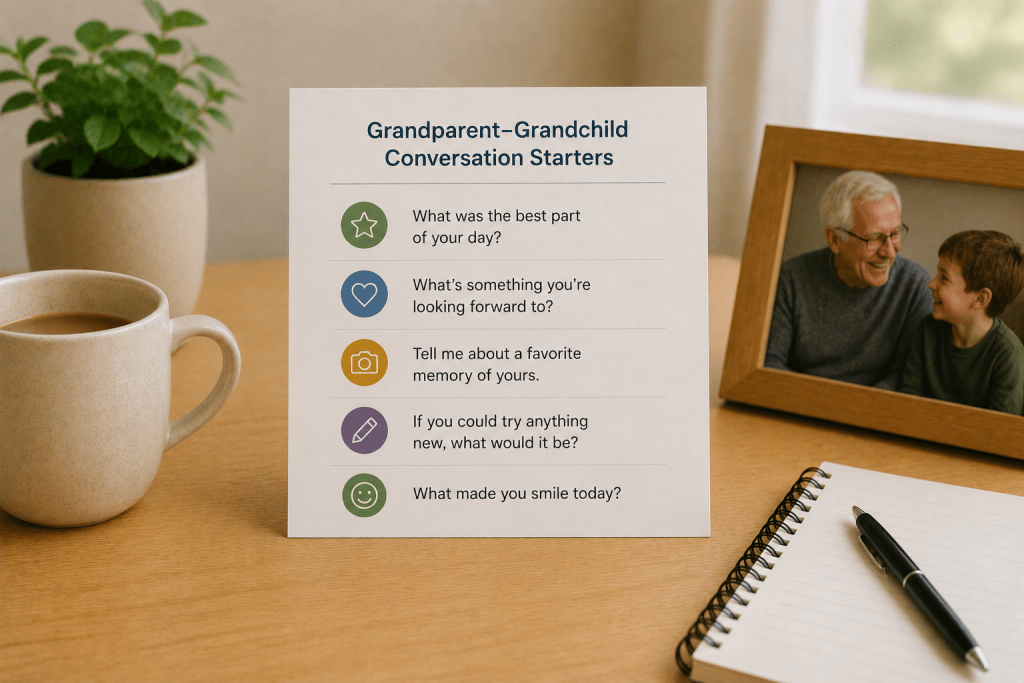
Simple daily questions can make a five-minute call feel like quality time.
Use these quick prompts after school or during a short visit. They help move from “fine” to real sharing without pressure.
School-day questions that get beyond “fine”
- What was the most interesting part of school today? Why did that stand out?
- What was the hardest part, and how did you handle it?
- Who did you sit with at lunch? What did you talk about?
Funny moments and the best part of the day
- What’s the funniest thing that happened today?
- What was the last thing that made you laugh?
- What was your favorite part of the day?
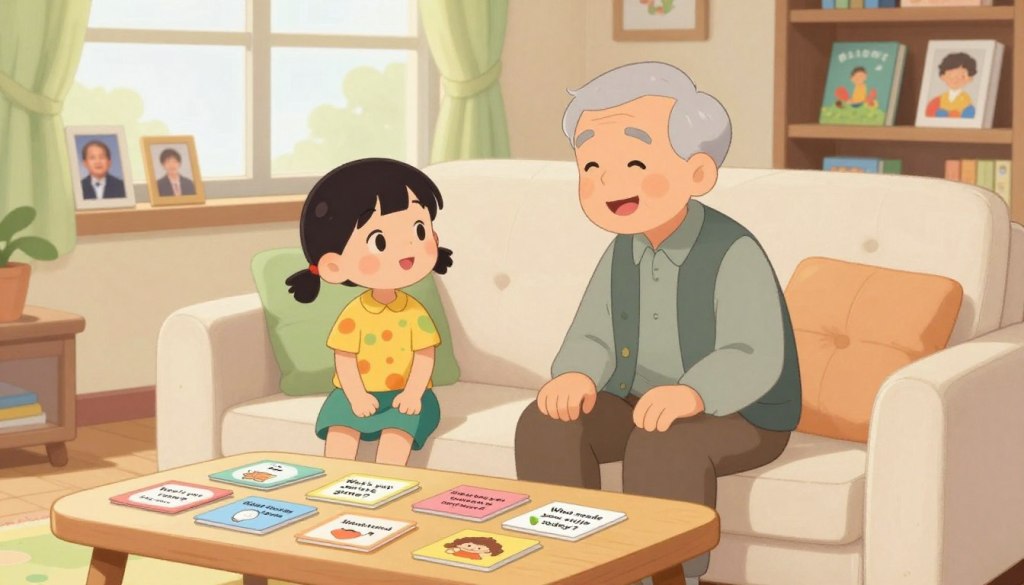
Friends, hobbies, and what they’re really into right now
Ask about hobbies and invite them to teach you. That turns talk into time together.
Weekend plans and what they would like to do together
Try: “If you could do anything with us this weekend, what would you want to do?” Let them pick a thing.
Room and “favorite thing” questions that reveal personality
Ask: “What’s your favorite thing in your room? Can you show me?” Visual cues spark stories and help parents and elders remember details.
| Prompt Type | Example | Why it works |
|---|---|---|
| School | Most interesting part of school? | Invites a short story, not a one-word answer |
| Funny | What made you laugh? | Warms up a quiet child fast |
| Weekend | If you could do anything this weekend… | Gives kids agency and helps plan real time together |
Caregiver note: These prompts create continuity between homes. For tips on keeping daily check-ins helpful, see our short guide on setting boundaries: setting boundaries with daily check-ins.
Imagination Boosters That Turn a Quiet Call Into a Fun Conversation
A few imaginative prompts can turn five quiet minutes into a mini adventure together. Use them when a call feels quiet or when screens make talk feel stiff.

Why try imaginative prompts: they are pressure-free and invite playful answers. They help shy kids open up. They also give elders a chance to laugh and learn what the child’s mind is like.
Try JoyCalls Free
No app or new device needed. Start with a free 7-day trial.
Superpowers and make-believe missions
- “If you could have any superpower, what would it be—why—and what would you do with it?”
- Follow-up: What does a day with that power look like?
Would-you-rather adventures
- “Fly like a bird or swim like a fish?” Ask what one would do first in that world.
- “Travel underwater or outer space?” Then ask how their day would look.
Talking animals, pets, and toys
- “If your toy could talk, what would it say?”
- “What do you think your pet is thinking right now?” These often spark the funniest answers.
Step into a book or movie
- “If you could walk into any book or movie, which would you choose?”
- Ask who they’d befriend and what rules they would change.
“Let them lead. Ask one simple follow-up like, ‘What makes you say that?’ and enjoy the ride.”
Gentle reminder for grandparents: don’t correct logic. Enjoy creativity. It shows you how their mind works across age and strengthens family time and life stories.
Questions That Help Kids Share Feelings, Build Trust, and Feel Heard
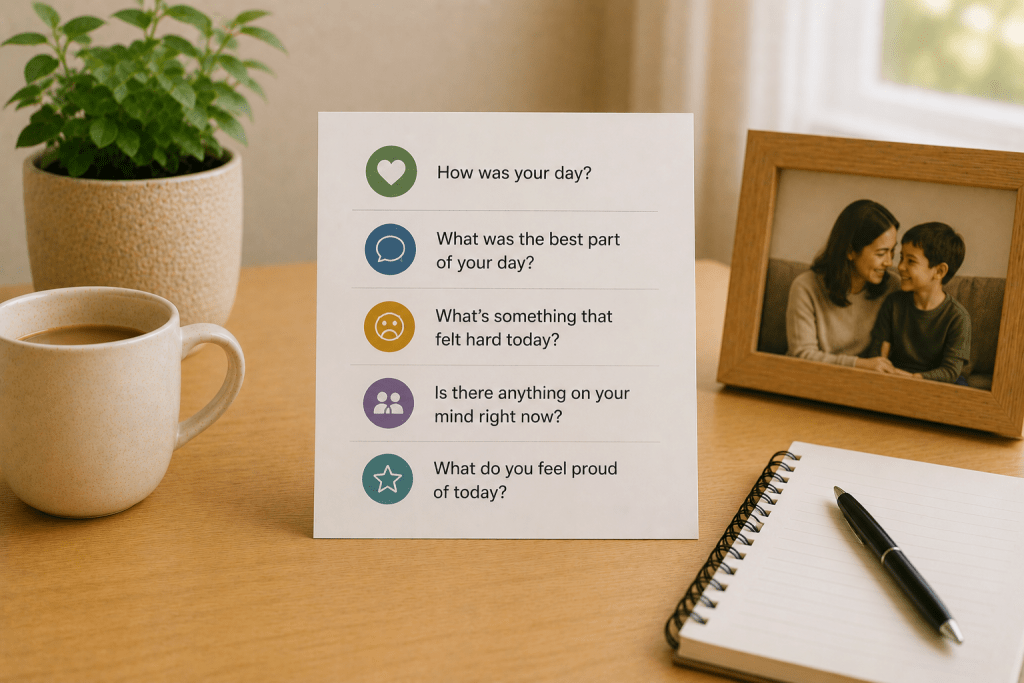
Small, gentle questions help kids name feelings and know you are a safe place. Not every child will open up at once. Steady listening and calm follow-ups build trust over time.
Happy, sad, frustrated, or amused: letting them name the emotion
Try simple prompts: What made you feel happy today? or What made you feel frustrated?
Offer a 1–5 feeling scale for kids who struggle with words. It gives quick answers and starts talk without pressure.
Kindness and gratitude prompts that lead to meaningful stories
Ask: What is something kind someone did for you? or Who helped you today?
These questions often turn into small stories. They teach empathy and show how family helps one another.
Bravery, fears they’ve outgrown, and confidence-building reflections
Try: What is something brave you did? or What used to scare you but doesn’t anymore?
These let children notice growth and build steady confidence about the future.
“Our job is to listen, not fix.”
Quick tip for parents and elders: avoid rushing to solve. Reflect back: “That sounds disappointing.” This shows respect and helps the child feel heard.
| Prompt Type | Example Question | Why it helps |
|---|---|---|
| Emotion Naming | What made you feel sad today? | Teaches emotional vocabulary and trust |
| Kindness/Gratitude | Who helped you today? | Encourages empathy and story-sharing |
| Bravery | What brave thing did you do? | Builds confidence and highlights growth |
End with a short ritual: one warm memory, one plan, or one laugh. It closes the call on love, respect, and a hopeful note for the next time.
Storytelling Prompts That Invite Grandparents to Share Life and Family History

Stories from a long life help children picture past years in a fresh, warm way.
Ask about nicknames, first jobs, or a school memory to open a small window into your life. These prompts make family history feel alive.
Nicknames, childhood memories, and “what it was like at your age” stories
Try: Did you have any nicknames growing up? How did you get them? Let one short tale unfold.
After 2–3 minutes, hand the talk back with a kid-centered question like, “What would you have done?”
The coolest invention in your lifetime and how it changed your life
Ask: What’s the coolest invention you remember, and why did it matter? Follow up about daily life—communication, travel, music, photos.
Traditions, values, and the people who shaped you
Invite stories about holidays, house rules, or the person who mattered most. Frame these as gifts that help kids know family roots.
Turning one question into a longer story without taking over the conversation
Tell a short story (2–3 minutes), then pause on purpose. Ask one simple follow-up and let the child lead next.
“Let them ask the next question.”

| Prompt | What to ask | Why it works |
|---|---|---|
| Nicknames | Did you have any nicknames growing up? | Reveals personality and sparks laughter |
| Invention | What’s the coolest invention you remember? | Makes history personal and relatable |
| Traditions | What did our family do on holidays? | Passes values and creates shared rituals |
Quick method: one memory → one question for them → one shared laugh. Repeat when you have time.
For more engaging prompts to keep stories two-way, see this list of engaging questions.
Food, Money, and “Dream Big” Questions That Get Surprisingly Deep
Some of the best talks start with what we eat and what we wish for.
Use food as an easy on-ramp. Ask: What’s your favorite food? or What’s the weirdest thing you’ve ever tasted? These prompts spark laughter and sensory memory.
Try a twist: If you had to eat the same thing every day, what would you choose? Or ask, What food would you bring to a picnic together? These reveal tastes across years and make shared plans feel simple and fun.
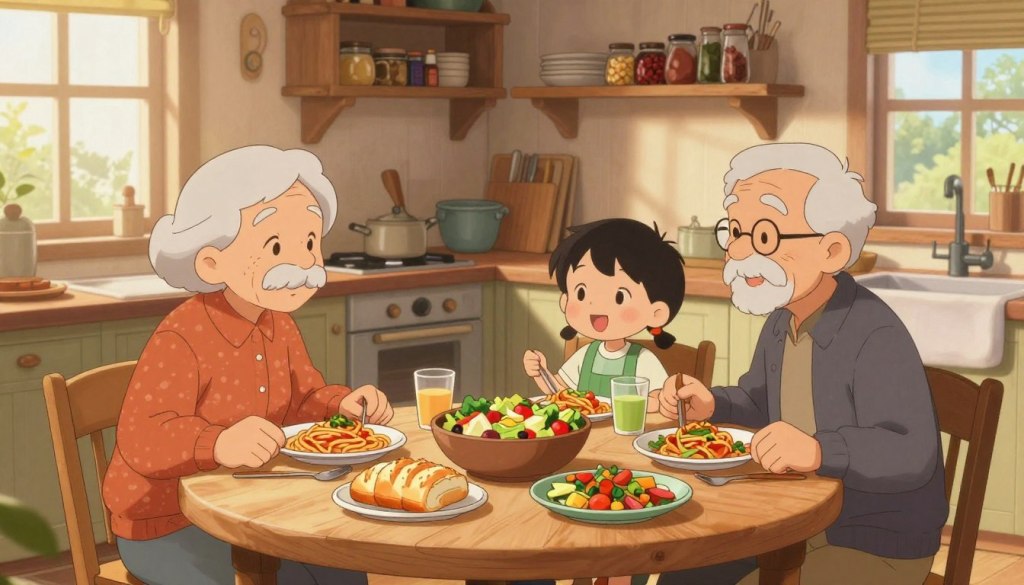
If you could invite anyone to dinner, who would it be?
Follow with: What do you admire about that person? or What would you ask them? The answers show values and who shapes their life.
What would you do with a thousand dollars?
Ask gently. Saving, sharing, or buying something fun all tell you what matters now and for the future.
What would you love to be famous for?
Invite specifics: What would your day look like, and who would you thank first? Then pick one small idea and plan a real-world version next time you spend time together.
- Caregiver tip: These prompts help parents spot motivations — belonging, creativity, fairness — without turning talk into a lesson.
- Good way to close: Choose one tiny plan from the dream question and try it next visit.
“Food and big questions reveal more than facts — they reveal heart.”
Turning Conversation Starters Into a Simple Grandparent–Grandchild Ritual

A good question can start a warm conversation. But a simple ritual is what helps that connection last.
Many grandparents and grandchildren do not struggle because they lack love. They struggle because there is no easy rhythm. Calls happen randomly. Visits depend on busy schedules. One person may not know what to ask. The other may not know how much to share. Over time, even caring families can slip into short updates, polite replies, and long gaps.
That is why conversation starters work best when they are not treated as one-time questions. They become more powerful when they are part of a small, predictable routine. A child knows what to expect. A grandparent feels prepared. Parents and caregivers can support the habit without forcing it. Everyone feels less pressure.
The goal is not to create a formal interview. The goal is to make connection easier.
Start With a Conversation Rhythm, Not a Long List of Questions
A long list of prompts can be helpful, but it can also feel overwhelming. Seniors may look at dozens of questions and wonder where to begin. Children may lose interest if the call feels like a quiz.
A better approach is to create a small rhythm that can be repeated.
Use this simple structure:
One warm opening. One real question. One follow-up. One closing ritual.
That is enough for most calls.
The warm opening can be familiar and comforting:
“Hi sweetheart, I was thinking about you today.”
“I’m glad I get to hear your voice.”
“I have one fun question for you today.”
Then ask one question. Not five. Not ten. Just one.
For example:
“What was one small thing that made today better?”
“What is something you learned this week that I probably do not know?”
“What is one thing you wish grown-ups understood better?”
After the child answers, ask one follow-up:
“What made that stand out?”
“How did you feel when that happened?”
“What do you think you will do next?”
Then close with a small ritual:
“I loved hearing that.”
“I’m going to remember that for next time.”
“Next time, I want to hear how it went.”
This structure is especially helpful for older adults who may feel nervous about keeping a conversation going. It removes the pressure to be entertaining. It also helps grandchildren feel that the call has a natural beginning, middle, and end.
Create a “Next Time” Thread So Every Call Builds on the Last One
One of the most powerful ways to build closeness is to remember something from the last conversation.
Children notice when adults remember details. Seniors notice it too. Remembering says, “What you told me mattered.” It turns a simple call into an ongoing relationship.
After each conversation, write down one small detail. It does not need to be private or complicated. It can be something simple:
A friend’s name.
A school project.
A favorite game.
A sports practice.
A pet’s funny habit.
A book they are reading.
A worry they mentioned.
A food they want to try.
Before the next call, look at the note and use it as the opening.
“Last time you told me about your science project. How did it go?”
“You said Mia made you laugh at lunch. Did she do anything funny this week?”
“You were practicing that song. Do you still like it?”
This is far more meaningful than starting from zero every time. It tells the grandchild, “I keep you in my mind even when we are not talking.”
For seniors, this can also make calls easier. You do not have to invent a new topic each time. You simply return to something already shared.
A good family habit is to keep a small “conversation notebook” near the phone. Grandparents can write the date, the child’s name, and one detail from the call. Adult children or caregivers can help set this up. It should not feel like homework. It is simply a memory aid that supports love.
Match the Question to the Child’s Age and Mood
Not every question works for every grandchild. A five-year-old, a teenager, and an adult grandchild will answer very differently. The best conversations happen when the question fits the person.
For younger children, keep questions concrete. Ask about things they can see, touch, show, or describe.
Try:
“What toy has been your favorite this week?”
“Can you show me something you made?”
“What sound made you laugh today?”
“If your stuffed animal could talk, what would it say?”
Young children often talk better when they are doing something. They may walk around, show a drawing, hold up a toy, or answer while playing. That is not disrespect. It is how many children communicate. A grandparent can say, “Show me while you tell me,” instead of expecting the child to sit still.
For school-age children, ask about choices, opinions, and small stories.
Try:
“What was the best part of your week?”
“What rule would you change at school if you could?”
“What is something you are getting better at?”
“What is something you want to learn next?”
This age group often enjoys feeling capable. Let them teach you something. Ask them to explain a game, a trend, a subject, or a hobby. Seniors do not need to pretend they already understand. A simple “Teach me how that works” can create a lovely conversation.
For teenagers, respect privacy. Teenagers may not want to answer direct emotional questions right away. Start with opinions, interests, or low-pressure topics.
Try:
“What is a song, show, or video you think I should know about?”
“What is something people your age care about that adults do not always understand?”
“What is one thing you wish school taught better?”
“What has been taking up most of your attention lately?”
Do not push if they give a short answer. Instead, stay steady and kind. Teenagers often open up over time when they do not feel interrogated.
For adult grandchildren, move toward mutual conversation.
Try:
“What has been giving you energy lately?”
“What is something you are trying to figure out right now?”
“What family memory has stayed with you?”
“What advice from your childhood do you understand differently now?”
Adult grandchildren may appreciate being treated as equals. Grandparents can share memories, but they should also ask about the grandchild’s real life today.
Use Shared Activities When Words Feel Hard
Some families put too much pressure on talking. Not every meaningful conversation starts with a question. Sometimes, the best conversations happen around a shared activity.
This is especially useful when a grandchild is shy, distracted, or tired. It also helps seniors who feel uncomfortable “just talking.”
Try building the call or visit around something simple:
Look at old photos together.
Cook the same recipe in different homes.
Read a short story aloud.
Watch the same movie and talk about one scene.
Work on a puzzle during a video call.
Compare weather outside each window.
Share one song from each generation.
Look at a family object and tell its story.
A grandparent might say:
“I found an old photo today. I want to show you and tell you who is in it.”
“I am making soup this week. What would you put in yours?”
“Let’s each choose one song for the other person.”
These activities remove pressure because the conversation has something to lean on. The question is no longer floating in the air. It is connected to a picture, a recipe, a song, or a memory.
For seniors with hearing difficulties, shared activities can also reduce frustration. A visual object gives context. If a word is missed, the conversation can still continue.
Make Space for the Grandchild to Ask Questions Too
Many intergenerational conversations become one-directional. Grandparents ask questions. Grandchildren answer. That can work for a while, but deeper connection grows when both sides are curious.
Invite grandchildren to ask questions back.
Say:
“Now you get to ask me one.”
“Is there anything you have always wondered about when I was young?”
“Do you want the funny answer or the honest answer?”
“You can ask me a question about school when I was your age.”
Some children need examples. Offer simple choices:
“You can ask me about my first job, my favorite childhood food, or a time I got in trouble.”
This gives the child control without making them invent a question from nothing.
For older grandchildren, invite more meaningful questions:
“Is there anything about our family you want to understand better?”
“Is there a story from my life you have never heard?”
“What do you think was most different when I was your age?”
These questions help preserve family history, but they also show respect. The grandchild is not just being entertained. They are being invited into the family story.
Handle Awkward Silence With Calm, Not Panic
Silence is not always a problem. Sometimes a child is thinking. Sometimes a senior needs a moment. Sometimes the call simply slows down.
The mistake is rushing to fill every pause.
Instead, make silence feel safe.
A grandparent can say:
“Take your time. I’m listening.”
“That is a good question to think about.”
“We do not have to answer quickly.”
“I can tell you my answer first if that helps.”
This is especially important with children who are quiet, neurodivergent, anxious, or slow to warm up. They may need extra time before speaking. If adults panic, joke too quickly, or ask three more questions, the child may shut down.
If the silence continues, switch to an easier format.
Try:
“Would you rather answer a silly question or a serious one?”
“Do you want to tell me something, show me something, or ask me something?”
“Should we do one quick question and then say goodbye?”
Giving choices can help both generations feel comfortable.
For seniors, this is also freeing. A quiet call is not a failed call. A short call can still be loving. The purpose is connection, not performance.
Use Gentle Boundaries So Conversations Stay Safe and Comfortable
Good conversations need warmth, but they also need boundaries. Some topics may be too personal, too tense, or too heavy for a child. Some seniors may accidentally ask questions that feel like pressure.
Avoid turning calls into interrogations about grades, weight, appearance, money, family conflict, or future plans. These topics may matter, but they should be handled with care and usually with the parent’s guidance.
Instead of asking, “Why are your grades lower?” try:
“What subject feels easiest right now, and what feels harder?”
Instead of asking, “Do you have a boyfriend or girlfriend?” try:
“Who are the people you enjoy spending time with lately?”
Instead of saying, “You never call me,” try:
“I’m happy whenever we get time to talk.”
Instead of asking, “What do you want to do with your life?” try:
“What is something you are curious about these days?”
The difference is tone. The better question leaves room. It does not corner the child.
Grandparents should also feel allowed to set boundaries. If a topic feels upsetting, they can say:
“That is a big subject. Let’s talk about something gentler today.”
“I want to answer that carefully. Can I think about it and tell you next time?”
“I can share some of that story, but not all of it today.”
Healthy boundaries teach children that conversations can be honest without becoming overwhelming.
Build a Small Family Conversation Plan
Families who want stronger grandparent-grandchild bonds can create a very simple plan. It does not need to be formal. It only needs to be clear.
Decide three things:
How often will the grandparent and grandchild connect?
What format works best?
What kind of prompt will they use?
For example:
Sunday evening phone call for ten minutes.
One photo-sharing text every Wednesday.
One video call each month with all grandchildren.
One voice note after school on Fridays.
One “question of the week” sent by a parent.
The plan should match real energy levels. A senior who gets tired easily may prefer shorter calls. A busy teenager may prefer voice notes. A younger child may do better with video. An adult grandchild may prefer a scheduled monthly call.
The best plan is the one people can actually keep.
Parents and caregivers can help by preparing both sides. They might text the grandparent:
“Ask Ava about her art project today.”
Or tell the child:
“Grandpa may ask about your soccer game. You can ask him what games he played as a kid.”
This small preparation reduces awkwardness. It also helps seniors feel confident before the call begins.
End Every Conversation With Warmth and a Clear Next Step
The ending matters. A rushed or uncertain ending can make the whole call feel unfinished. A warm ending helps both generations leave the conversation feeling valued.
Use a closing line that includes affection, appreciation, or a next step.
Try:
“I loved hearing about that.”
“Thank you for telling me.”
“I am proud of how you handled that.”
“I will ask you about it next time.”
“Next call, I want to hear what happened.”
“I’m going to think about what you said.”
For younger children, create a playful goodbye:
One joke.
One wave.
One blown kiss.
One silly word.
One shared phrase.
For older grandchildren, keep it sincere and respectful:
“I always enjoy hearing what you think.”
“I know you are busy, so this meant a lot.”
“I’m glad we got this time.”
A strong ending makes the next conversation easier. It leaves a small open door.
The Real Goal Is Familiarity, Not Perfect Conversation
Grandparents and grandchildren do not need perfect questions. They need repeated moments of care.
Some calls will be lively. Some will be short. Some will feel awkward. Some will be interrupted by homework, appointments, tiredness, or technology problems. That is normal.
What matters is the message underneath the conversation:
“I want to know you.”
“I remember what you tell me.”
“You are safe with me.”
“Our relationship matters.”
When conversation starters become a ritual, they do more than fill silence. They create continuity. They help seniors stay emotionally connected to family life. They help grandchildren feel rooted in something larger than their daily routine. They give parents and caregivers a practical way to support family bonds without making every interaction complicated.
Start small. Choose one day, one question, and one follow-up. Write down one detail. Bring it back next time.
That is how a simple conversation becomes a relationship that keeps growing.
Conversation Habits That Help Grandchildren Open Up Naturally
Many grandparents worry that conversations feel shorter than they used to.
A grandchild says “fine” to every question. A teenager seems distracted. A younger child runs off after two minutes. Adult grandchildren promise to call later but forget. Seniors often interpret this personally and quietly wonder:
“Did I say something wrong?”
“Why don’t they open up to me?”
“Are kids today just less connected?”
In reality, most grandchildren do want connection. But emotional closeness rarely comes from asking more questions alone. It comes from creating a feeling around the conversation — one that feels safe, relaxed, interesting, and emotionally easy to return to.
Children and younger adults naturally open up more when they feel:
- Accepted instead of evaluated
- Curious instead of pressured
- Warmly remembered instead of monitored
- Listened to instead of corrected
- Emotionally safe instead of emotionally responsible
This section is not about becoming a “perfect communicator.” It is about building conversation habits that quietly make grandchildren feel comfortable being themselves around you.
And often, the smallest habits create the biggest difference.
Stop Trying to “Get Information” and Start Trying to “Share Presence”
One of the most common mistakes in family conversations is treating the interaction like an update session.
Grandparents may ask:
- “How are your grades?”
- “Did you finish your homework?”
- “What are your plans?”
- “Are you eating properly?”
- “Did you apply for that thing yet?”
These questions usually come from care and concern. But to many grandchildren, especially teenagers and young adults, they can feel like performance checks.
The conversation becomes about proving something rather than sharing something.
A much better goal is emotional presence.
Instead of trying to collect information, focus on helping the other person feel:
- Seen
- Enjoyed
- Welcomed
- Relaxed
- Remembered
This subtle shift changes the entire tone of a relationship.
For example, instead of:
“What did you accomplish today?”
Try:
“What was the most interesting part of your day?”
Instead of:
“Are you studying enough?”
Try:
“What has been taking up most of your brain space lately?”
Instead of:
“What are your future plans?”
Try:
“What kind of life feels exciting to you right now?”
The second version invites reflection instead of defense.
That difference matters enormously.
Become a Grandparent Who Notices Small Things
Deep relationships are rarely built through dramatic speeches or perfect advice.
They are usually built through accumulated moments of noticing.
Grandchildren remember adults who notice things:
- Their favorite snack
- Their nervous habits
- Their hobbies
- Their changing interests
- Their sense of humor
- Their emotional patterns
- The things they casually mentioned once
This creates emotional security because it communicates:
“You matter enough for me to pay attention.”
For seniors, this is one of the most powerful ways to strengthen connection without forcing emotional conversations.
For example:
“You mentioned last month that you were nervous about that presentation. How did it go?”
“You were really excited about learning guitar last time we talked. Are you still enjoying it?”
“You sounded tired last week. How has your energy been lately?”
Notice how none of these questions are dramatic. But they feel deeply personal because they show memory and care.
A highly effective habit is to keep a “family detail list.”
This can include:
- Birthdays
- Upcoming events
- School activities
- Favorite foods
- Current hobbies
- Friends’ names
- Emotional milestones
- Challenges they mentioned
This is especially useful for older adults managing memory changes or busy family structures with multiple grandchildren.
You do not need a perfect memory to be emotionally attentive. Systems can support love.
Learn the Difference Between Listening to Respond and Listening to Understand
Many family conversations unintentionally become advice sessions.
A grandchild says:
“I’m stressed.”
And immediately hears:
“You should sleep earlier.”
Or:
“I had a bad day.”
And hears:
“That’s life.”
Or:
“My friends are being difficult.”
And hears:
“You need better friends.”
This happens because many adults were raised to solve problems quickly. But younger generations often want understanding before solutions.
One of the most emotionally intelligent habits a grandparent can develop is reflective listening.
This means briefly reflecting the feeling or meaning before offering advice.
For example:
“That sounds exhausting.”
“I can understand why that upset you.”
“That must have felt disappointing.”
“You really cared about that.”
“That sounds like a lot to carry.”
This does not mean agreeing with everything. It means acknowledging the experience.
And surprisingly, people often become more open to advice after they feel heard.
A useful rule:
Validate first. Advise second.
In many conversations, validation alone is enough.
Avoid the Habit of “Correcting the Story”
Sometimes grandchildren stop sharing because they feel constantly corrected.
This can sound like:
- “That’s not what happened.”
- “You’re exaggerating.”
- “You should be grateful.”
- “That’s nothing compared to what we went through.”
- “When I was your age…”
- “You kids have it easy.”
Even when factually true, these responses often shrink emotional openness.
Children and younger adults want room to experience their feelings without immediate comparison.
This does not mean grandparents should never share wisdom or perspective. It means timing matters.
Instead of minimizing their experience, try expanding the conversation.
For example:
“That sounds frustrating. What do you think made it feel so intense?”
“Things were different in my generation too, but stress still feels real when you’re inside it.”
“I may not fully understand your world, but I want to.”
These responses preserve dignity on both sides.
Share Stories Instead of Lectures
Many grandparents have valuable wisdom. The challenge is delivery.
Direct lectures often create distance. Stories create curiosity.
Instead of:
“You should save money.”
Tell a story:
“The first time I made a financial mistake, I bought something I absolutely could not afford…”
Instead of:
“Relationships require patience.”
Share:
“One thing I learned after many years of marriage is how often people misunderstand each other when they’re tired.”
Stories feel human rather than instructional.
They also help grandchildren see grandparents as full people rather than authority figures frozen in a family role.
This is especially meaningful for teenagers and adult grandchildren, who are beginning to understand complexity, struggle, regret, growth, and resilience.
A good story does not need to make you look perfect.
In fact, vulnerability often creates stronger connection.
Talk about:
- Mistakes you learned from
- Funny failures
- Embarrassing moments
- Unexpected life turns
- Times you changed your mind
- Moments you were afraid
- Lessons you learned slowly
These stories feel emotionally real.
And emotionally real conversations are memorable.
Respect the Emotional Energy of Modern Life
Many seniors unintentionally underestimate how mentally overloaded younger generations can feel.
Children today often juggle:
- School pressure
- Social media exposure
- Constant notifications
- Academic competition
- Social anxiety
- Identity pressure
- Information overload
- Burnout
- Economic uncertainty
Adult grandchildren may also carry:
- Career instability
- Parenting exhaustion
- Financial stress
- Loneliness
- Emotional fatigue
- Caregiving responsibilities
This does not mean grandparents should “walk on eggshells.” It simply means conversations become better when they include emotional generosity.
For example, instead of:
“You never call enough.”
Try:
“I know life gets busy. I’m always happy to hear from you whenever you can.”
Instead of:
“You seem distracted.”
Try:
“You sound like you’ve had a long week.”
This approach reduces guilt and increases emotional safety.
Ironically, people often reconnect more when they feel less emotionally pressured.
Create “Low-Pressure Connection Points”
Not every interaction needs to become a long emotional conversation.
In fact, one of the best ways to maintain closeness is through low-pressure contact.
These small moments communicate consistency without emotional demand.
Examples include:
- Sending one funny photo
- Sharing a memory
- Mailing a handwritten note
- Sending a voice message
- Sharing a recipe
- Asking one simple question
- Sending encouragement before exams or interviews
- Sharing weather updates or garden photos
- Sending a song recommendation
The key is consistency, not intensity.
A message that says:
“This flower bloomed today and reminded me of you”
Can strengthen connection more than a forced hour-long conversation.
Especially for teenagers and adult grandchildren, low-pressure warmth often feels easier to respond to.
Let Grandchildren Influence You Too
Strong relationships are mutual.
Sometimes grandparents unintentionally stay in “teacher mode” permanently. But grandchildren often feel closer when they see openness and adaptability.
Let them introduce you to things.
Ask them:
- What music they like
- Which apps they use
- What trends they find funny
- What they care about socially
- What entertainment they enjoy
- What they think is changing in the world
You do not need to pretend to understand everything instantly.
Curiosity itself creates connection.
Say things like:
“Explain that to me.”
“What do you like about it?”
“That’s interesting. I never thought about it that way.”
This communicates respect.
And respect is one of the fastest ways to deepen intergenerational trust.
Understand That Emotional Timing Matters
Some grandchildren open up immediately. Others open up slowly.
A child may ignore a question one week and answer deeply the next month.
A teenager may seem uninterested for years and suddenly become emotionally open during early adulthood.
This is normal.
One mistake many adults make is expecting immediate emotional payoff from effort.
But trust is cumulative.
Every warm conversation deposits emotional safety into the relationship.
Eventually, grandchildren begin associating the grandparent with:
- Calm
- Warmth
- Reliability
- Nonjudgment
- Encouragement
- Familiarity
And once that emotional association forms, conversations become naturally deeper.
Patience matters enormously.
Know Which Habits Quietly Push Grandchildren Away
Most grandparents do not intentionally create emotional distance. But certain habits consistently reduce openness over time.
These include:
- Interrupting frequently
- Turning every topic into advice
- Complaining constantly
- Criticizing modern culture nonstop
- Asking overly personal questions too quickly
- Making grandchildren responsible for adult emotions
- Comparing siblings or cousins
- Bringing guilt into every interaction
- Repeating negative stories constantly
- Dismissing emotional struggles
Even subtle guilt can create avoidance.
For example:
“You never have time for me anymore.”
“I guess everyone is too busy these days.”
“Well, I’ll just sit here alone.”
These statements may express real loneliness, but they can unintentionally make grandchildren associate calls with emotional pressure.
A healthier alternative is honesty without emotional burden.
For example:
“I always enjoy hearing from you.”
“I miss you and would love to talk more often.”
“You brighten my day when we connect.”
This communicates love without making the grandchild responsible for fixing loneliness.
Create Emotional Safety Around Difficult Topics
Eventually, meaningful families encounter difficult conversations:
- Illness
- Aging
- Mental health
- Failure
- Divorce
- Grief
- Identity struggles
- Family conflict
- Fear
- Regret
What matters is not avoiding these topics entirely. It is creating an environment where honesty feels possible.
A grandparent can model this by speaking calmly and openly.
For example:
“It’s okay if you don’t have everything figured out.”
“You don’t need to pretend with me.”
“Everyone struggles sometimes.”
“I may not understand everything immediately, but I want to listen.”
These phrases become emotional anchors.
And often, grandchildren remember them for years.
The Strongest Connections Usually Feel Ordinary
One of the most comforting truths about family connection is this:
The conversations grandchildren remember most are often surprisingly simple.
Not perfect speeches.
Not dramatic life lessons.
Not carefully planned moments.
Usually, they remember:
- Feeling accepted
- Laughing together
- Being listened to
- Hearing familiar phrases
- Repeating small traditions
- Feeling emotionally calm
- Being allowed to be themselves
This is especially important for seniors who worry:
“I’m not interesting enough.”
“I don’t know what to say.”
“I’m not good at conversations.”
You do not need to perform.
You simply need to remain emotionally available.
Warmth matters more than perfection.
Consistency matters more than brilliance.
Curiosity matters more than having the right words.
And often, the greatest gift a grandparent gives is not advice at all.
It is becoming one of the few people in the world a grandchild can talk to without feeling judged, rushed, corrected, or pressured.
How to Ask Better Questions and Listen in a Way That Strengthens the Relationship
Good questions shape moments into memories, and listening makes those memories stick. Ask with warmth. Listen with focus. That combo helps people feel seen and makes future calls easier.
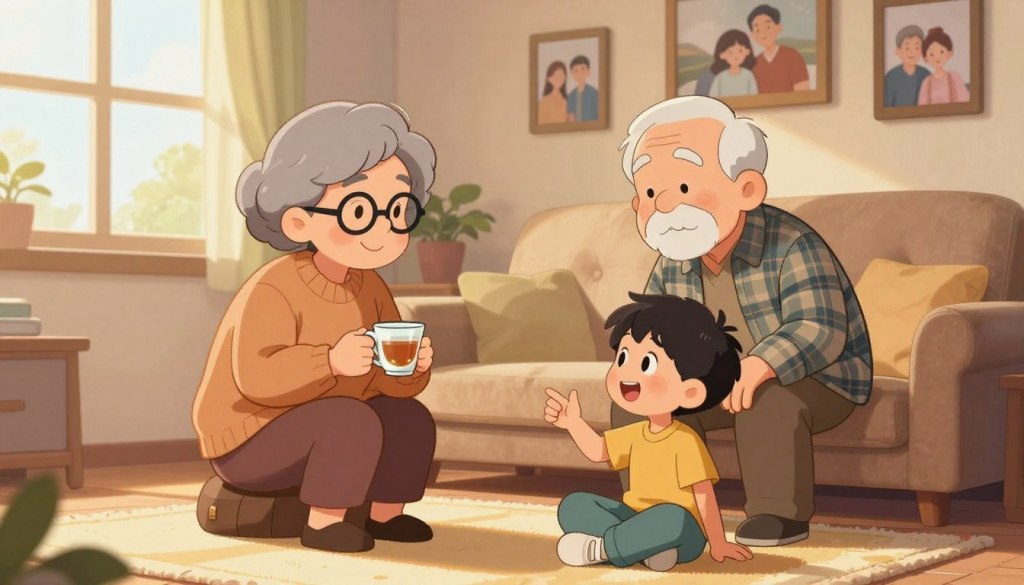
Active listening basics
Remove distractions. Put the phone down or close the door. In person, make eye contact. On video, look at the camera.
Respond to what they said, not what you hoped they’d say. DeeDee Moore calls careful listening “the greatest gift.” Remembering names and small details proves you were paying attention.
Follow-up prompts that help children elaborate
- “What happened next?”
- “How did that make you feel?”
- “What makes you say that?”
- “Can you show me?”
Making different formats work
Face-to-face offers body language. Phone and video still build connection when tone is warm and attention is real. Even a short letter can matter.
Simple pacing tips
Try Dr. John Delony’s idea: spend an hour on one deep question or cover five or six lighter ones. There’s no single right way to spend time together.
“Listening carefully is the greatest gift.”
Caregiver note: Text a short list of prompts ahead of calls to reduce awkwardness. If daily chats aren’t possible, Talk to Joy now: 1-415-569-2439. Sign up for JoyCalls: https://app.joycalls.ai/signup for friendly check-ins and helpful summaries that support family care.
Conclusion
One thoughtful question and genuine attention can turn a quick call into a memory.
Start with a small plan: pick one everyday prompt, one imagination prompt, and one feelings prompt as your “starter set.” Keep them on a note so parents and elders always have a thing to ask when time is short.
Remember the most important factor: how well you listen once a person starts talking. Meaningful connection is possible even when you can’t be there in person. A single answer, followed by a kind follow-up, repeated over time, builds trust and warmth.
Try this next step: choose one question for your next call. Write down one detail (a friend’s name or a favorite thing) and ask about it next time. Some days will be short, silly, or distracted—that’s part of life and still counts toward time together.
Need support? Talk to Joy now: 1-415-569-2439, or sign up for JoyCalls to bring gentle daily check-ins and helpful summaries to your family. For more prompts and tips, see this conversation ideas for seniors.
FAQ
How do I start a meaningful chat with a grandparent if we haven’t talked much before?
What are good everyday questions to ask a kid during a quick check-in call?
How can imaginative prompts make phone calls more fun for both generations?
What questions help kids express emotions and feel truly heard?
How do I invite a grandparent to share longer family stories without taking over?
Which food and “dream big” questions lead to surprising conversations?
FAQ
How do I start a meaningful chat with a grandparent if we haven’t talked much before?
Begin with a warm, simple question about their day or a memory. Try asking about a favorite meal, a childhood nickname, or the best part of their week. Keep it open-ended so they can choose how much to share. A gentle follow-up like “Tell me more about that” helps the story grow. These small openings build trust and make future calls easier.
What are good everyday questions to ask a kid during a quick check-in call?
Ask about school beyond “Are you okay?” Try: “What was the funniest moment today?” “Who did you sit with at lunch?” or “What project did you enjoy?” Pair a light question with something more reflective like “What made you proud today?” This mix gets both facts and feelings without pressure.
How can imaginative prompts make phone calls more fun for both generations?
Imagination prompts—superpowers, time travel, or favorite book worlds—are playful and low-stakes. They invite creativity and laughter, and often reveal values or dreams. Say, “If you could fly anywhere tomorrow, where would you go and who would you bring?” It sparks stories and keeps the tone upbeat.
What questions help kids express emotions and feel truly heard?
Use simple, specific emotion words: “What made you happy or frustrated today?” “Was there a moment you felt brave?” Offer gratitude prompts like “Who helped you this week?” Then listen without fixing—reflect back what you hear. That shows respect and builds confidence.
How do I invite a grandparent to share longer family stories without taking over?
Start with a focused prompt: “What was it like when you were my age?” or “Tell me about a holiday you loved as a kid.” Nod, pause, and ask one follow-up at a time: “Who else was there?” or “What happened next?” Let silence let them add details. Your role is curious listener, not director.
Which food and “dream big” questions lead to surprising conversations?
Ask about favorite and strangest foods, or “If you could invite anyone to dinner, dead or alive, who would it be?” Money prompts—“What would you do with
FAQ
How do I start a meaningful chat with a grandparent if we haven’t talked much before?
Begin with a warm, simple question about their day or a memory. Try asking about a favorite meal, a childhood nickname, or the best part of their week. Keep it open-ended so they can choose how much to share. A gentle follow-up like “Tell me more about that” helps the story grow. These small openings build trust and make future calls easier.
What are good everyday questions to ask a kid during a quick check-in call?
Ask about school beyond “Are you okay?” Try: “What was the funniest moment today?” “Who did you sit with at lunch?” or “What project did you enjoy?” Pair a light question with something more reflective like “What made you proud today?” This mix gets both facts and feelings without pressure.
How can imaginative prompts make phone calls more fun for both generations?
Imagination prompts—superpowers, time travel, or favorite book worlds—are playful and low-stakes. They invite creativity and laughter, and often reveal values or dreams. Say, “If you could fly anywhere tomorrow, where would you go and who would you bring?” It sparks stories and keeps the tone upbeat.
What questions help kids express emotions and feel truly heard?
Use simple, specific emotion words: “What made you happy or frustrated today?” “Was there a moment you felt brave?” Offer gratitude prompts like “Who helped you this week?” Then listen without fixing—reflect back what you hear. That shows respect and builds confidence.
How do I invite a grandparent to share longer family stories without taking over?
Start with a focused prompt: “What was it like when you were my age?” or “Tell me about a holiday you loved as a kid.” Nod, pause, and ask one follow-up at a time: “Who else was there?” or “What happened next?” Let silence let them add details. Your role is curious listener, not director.
Which food and “dream big” questions lead to surprising conversations?
Ask about favorite and strangest foods, or “If you could invite anyone to dinner, dead or alive, who would it be?” Money prompts—“What would you do with $1,000?”—reveal priorities and values. These questions combine light curiosity with deeper insight into tastes and life goals.
What’s the best way to keep a call going if the other person gives short answers?
Shift to a specific, vivid prompt. Instead of “How was school?” try “Tell me one silly thing that happened today.” Or share a short story from your day and ask, “Have you ever had something like that happen?” Modeling detail encourages them to open up.
How can I use follow-up questions without making the conversation feel like an interview?
Keep follow-ups gentle and conversational: “Oh, really? What was that like?” “Why did that stand out?” Use one follow-up at a time and add your own small comment or memory. That turns a Q&A into a shared exchange and makes both people feel seen.
What are simple listening tips for calls with older adults or kids?
Show attention: pause before replying, repeat key words, and ask one clarifying question. On video, use eye contact and nods. On phone, verbal cues like “I hear you” matter. These small habits deepen connection and help you remember details for future chats.
How often should we schedule these check-in conversations to build a stronger bond?
Aim for regular, manageable rhythms: brief daily check-ins or longer weekly calls. Consistency matters more than length. Even a 10-minute daily hello or a 30-minute weekend catch-up creates routine, trust, and a growing archive of shared moments.
,000?”—reveal priorities and values. These questions combine light curiosity with deeper insight into tastes and life goals.
What’s the best way to keep a call going if the other person gives short answers?
Shift to a specific, vivid prompt. Instead of “How was school?” try “Tell me one silly thing that happened today.” Or share a short story from your day and ask, “Have you ever had something like that happen?” Modeling detail encourages them to open up.
How can I use follow-up questions without making the conversation feel like an interview?
Keep follow-ups gentle and conversational: “Oh, really? What was that like?” “Why did that stand out?” Use one follow-up at a time and add your own small comment or memory. That turns a Q&A into a shared exchange and makes both people feel seen.
What are simple listening tips for calls with older adults or kids?
Show attention: pause before replying, repeat key words, and ask one clarifying question. On video, use eye contact and nods. On phone, verbal cues like “I hear you” matter. These small habits deepen connection and help you remember details for future chats.
How often should we schedule these check-in conversations to build a stronger bond?
Aim for regular, manageable rhythms: brief daily check-ins or longer weekly calls. Consistency matters more than length. Even a 10-minute daily hello or a 30-minute weekend catch-up creates routine, trust, and a growing archive of shared moments.
What’s the best way to keep a call going if the other person gives short answers?
How can I use follow-up questions without making the conversation feel like an interview?
What are simple listening tips for calls with older adults or kids?
How often should we schedule these check-in conversations to build a stronger bond?

Ana Avila, PhD, is a healthcare and technology writer with deep expertise in artificial intelligence, senior care innovation, and the practical use of AI in healthcare operations. Her work focuses on how emerging technologies can improve the daily experience of older adults, support overburdened care teams, and help senior living communities deliver safer, faster, and more personalized support.
Dr. Avila’s academic background is rooted in health informatics, aging care systems, and applied artificial intelligence. Her doctoral work focused on how digital health tools, predictive analytics, and AI-assisted communication systems can be used to improve care coordination, reduce operational delays, and identify early signs of risk among older adults. Her training gives her a rare ability to understand both the technical side of AI and the human realities of healthcare delivery.
Over the years, Ana has developed a specialized body of work around AI in senior living. She writes about how senior care providers can use intelligent systems to manage resident requests, answer routine questions, support family communication, improve after-hours coverage, and detect patterns that may indicate loneliness, confusion, distress, or unmet needs. Her articles often examine the gap between what senior living teams are expected to deliver and what traditional staffing models can realistically support.
Ana’s healthcare expertise is especially focused on the operational side of care. She has written extensively about call handling, resident engagement, front desk workflows, triage systems, caregiver communication, care escalation, and the hidden administrative burden placed on senior living staff. Her work explains how AI can help reduce repetitive tasks, organize incoming requests, prioritize urgent issues, and give human caregivers more time for meaningful resident interaction.
At the same time, Ana is careful not to present AI as a replacement for human care. A consistent theme in her writing is that technology should support relationships, not weaken them. She argues that the best AI systems in healthcare are not the ones that simply automate the most tasks, but the ones that make care teams more responsive, families more informed, and residents more supported. Her perspective is grounded in the belief that senior living technology must be designed around dignity, trust, privacy, and compassion.
Ana has also written widely on the ethical use of AI in healthcare. Her work discusses the importance of human oversight, transparent escalation rules, resident consent, data minimization, and responsible use of sensitive health and behavioral information. She often emphasizes that AI systems used around older adults must be easy to understand, carefully monitored, and designed with the limitations and needs of real residents in mind, including those with memory loss, hearing challenges, mobility issues, or social isolation.
Her writing has been used as a reference point in discussions about aging, elder care technology, digital health, and AI-supported senior living. She has published 12 papers on journals like JAMA (Journal of the American Medical Association), The BMJ (British Medical Journal), SSRN and more. Some of her articles have also been cited by Wikipedia editors as supporting references on topics related to healthcare, aging, and technology. This has helped position her work as a useful educational resource for readers looking to understand how AI can be applied in real care environments.
In addition to her long-form writing, Ana has contributed research-based commentary, professional explainers, and practical guidance for healthcare operators, senior living decision-makers, and technology teams building products for older adults. Her work combines research literacy with operational practicality. She is able to take complex subjects such as natural language processing, predictive analytics, conversational AI, and care automation, and explain them in a way that is accessible to executives, caregivers, families, and non-technical readers.
Ana’s strongest area of expertise is the intersection of artificial intelligence and senior living operations. She understands that senior care communities face a difficult combination of rising resident expectations, staffing pressure, family communication demands, and increasing care complexity. Her writing explores how AI can be used to ease those pressures through smarter communication systems, faster response workflows, proactive check-ins, and better visibility into resident needs.
Her approach is both evidence-informed and deeply human. She studies AI through the lens of real-world care delivery: whether a resident gets help faster, whether a family member receives a clearer update, whether a caregiver avoids unnecessary administrative work, and whether a senior living team can identify a concern before it becomes a crisis. This practical focus makes her work especially relevant for organizations that want to adopt AI responsibly rather than simply follow technology trends.
Ana Avila is regarded as a thoughtful voice on the future of AI in healthcare and senior living. Her expertise combines academic training, research-driven analysis, operational understanding, and a strong commitment to humane technology. Through her writing, she helps healthcare leaders and senior living communities understand not only what AI can do, but how it should be used to improve care, preserve dignity, and strengthen the human relationships at the center of aging support.