


When someone is lonely, the hard part usually isn’t finding a clever question. It’s asking the kind of question they can actually answer that day. This guide sorts conversation starters by what your parent seems able to give — tired, guarded, talkative, or quietly struggling — so a phone call feels like company instead of an interview.
Read the room before you ask anything

The same question can land completely differently on two days. A cheerful prompt about childhood may be comforting on Monday and painful on Thursday. So spend the first minute listening instead of asking. Are they alert or tired? Warm or withdrawn? Answering in full sentences, or only giving you three words?
A gentle opening works better than a planned one: “Hi, I just wanted to hear your voice. How is this part of the day feeling for you?” That gives them room to answer emotionally, practically, or casually — “It has been quiet,” “I’m tired,” “Nothing much.” Each answer tells you which lane to pick.
- Sounds tired → low-effort prompts.
- Sounds cheerful → invite a story.
- Sounds sad → comfort before curiosity.
- Sounds irritated → fewer questions, more company.
A lonely parent rarely says “I need connection.” They say “There’s nothing to talk about,” or “You must be busy.” That needs reassurance, not a better question: “You’re not bothering me. I wanted to spend a few minutes with you.” Once someone feels wanted rather than checked on, the conversation has a chance of becoming real.
Low-effort questions for tired or withdrawn days
“What is your happiest memory?” is beautiful in the right moment and exhausting in the wrong one. On low-energy days, use prompts that ask almost nothing:
- “What did you have with breakfast today?”
- “Is the room comfortable right now?”
- “Did anything small make the day a little better?”
- “What is something you can see from where you’re sitting?”
- “Would you rather talk for a few minutes, or just have me stay on the phone while you rest?”
A short answer isn’t a failure. Stay close to whatever they gave you:
Them: “I just had toast.”
You: “Toast sounds simple and comforting. Do you like it plain, or with butter or jam?”
Many older adults open up slowly, once they realize they don’t have to say anything impressive. If you want a set of these ready to go, our daily check-in conversation starters cover the everyday version.
Choice-based questions when they won’t answer “how are you feeling?”
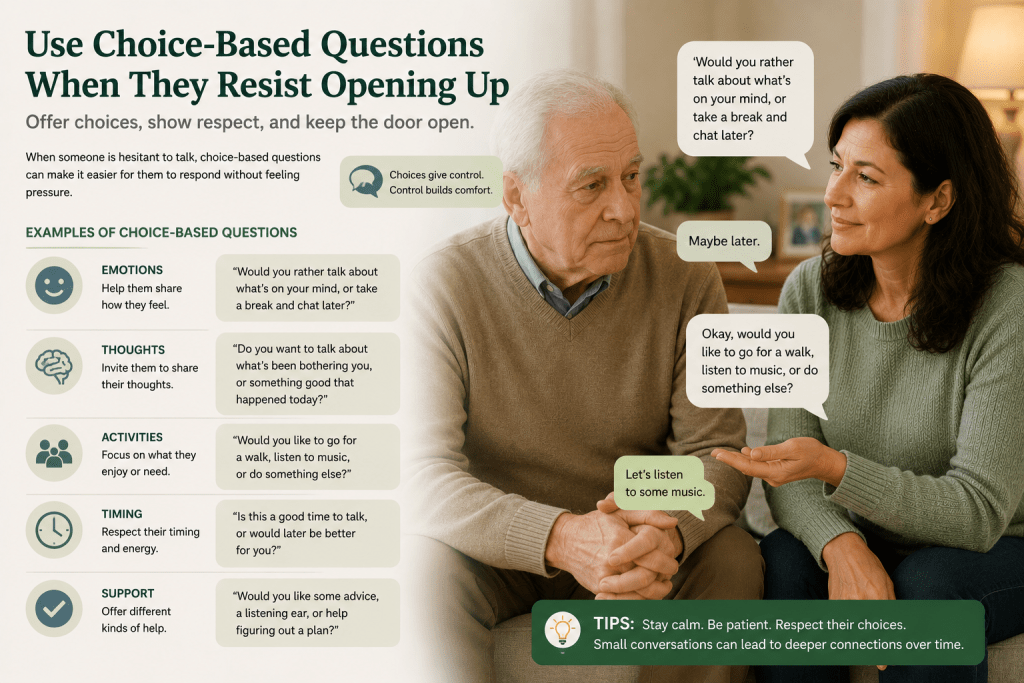
Some people simply do not do direct emotional questions. Ask “Are you lonely?” and you get “I’m fine” — every time. This is common among people raised to keep feelings private, and pushing harder only makes the door close faster.
Choice-based questions get around it. The person only has to pick an option, which feels far less exposing than volunteering a feeling. Once they choose, you can gently ask why.
- “Would you rather listen to music or watch an old movie today?”
- “Was your school life more strict or more fun?”
- “Do you prefer mornings or evenings now?”
- “Were you more of a quiet child, or a mischievous one?”
- “Would you rather talk about food, family, music, or old places today?”
Someone who would never answer a question about their emotions will happily explain why school was strict, or why music from a certain decade still matters. There is no wrong answer to pick, which is exactly why it works for a parent who says “I don’t know” or worries about giving the right answer.
You can hand over the whole call the same way: “What kind of call would feel good today — a cheerful one, a quiet one, or a memory one?” For someone who depends on others for rides, meals, and appointments, being in charge of something is its own small relief.
Purpose-based questions when they feel unneeded
Loneliness is not only the absence of people. It is often the feeling of no longer being needed. After retirement, widowhood, or reduced mobility, someone who spent decades solving problems for everyone else can feel like their usefulness has quietly expired.
Questions that ask them to advise, teach, or contribute push back on that:
- “I need your opinion on something. Can I ask what you think?”
- “What is one thing you learned with age that younger people often miss?”
- “What recipe, habit, or family tradition do you think we should keep?”
- “What did you learn about getting through hard times?”
Be sincere. Don’t ask for advice just to flatter someone — they can tell. If they offer something, acknowledge it properly: “That is a helpful way to think about it. I had not looked at it that way.” Being someone others still learn from can brighten the rest of the day.
Memory and sensory prompts when words are hard
When someone sounds relaxed and engaged, memory prompts are powerful — but keep them specific. Instead of “tell me about your life,” ask about a scene, an object, or a routine: “What was the kitchen like in the home you grew up in?” “Who in your family was the best storyteller?” “What did a normal Sunday look like?” “What was the first thing you bought with money you earned?”
The follow-up matters more than the question. Don’t jump to a new topic — go deeper into the same memory: “What do you remember most clearly about that?” “Who else was there?” “Did you enjoy that, or was it difficult?” That is the difference between a conversation and a list of prompts.
When recall is the problem, use something concrete
Memory changes, fatigue, hearing loss, or anxiety can make abstract questions feel impossible. A photo, a song, or a familiar object gives them something to respond to instead of searching for words from nothing. Old family photos, a favorite song, a recipe card, a familiar prayer or saying, a piece of jewelry, a seasonal smell like cinnamon or fresh bread — any of these can open a door.
Never turn it into a test. “Do you remember who this is?” can embarrass someone. Try “I like this photo — tell me what you notice” or “This song made me think of you.” The emotional connection matters more than factual accuracy.
Emotional questions — ask permission, then stop asking
Deeper questions are worth asking, but they need an exit. Start with permission: “Can I ask something a little more personal, or would you rather keep things light today?” That one sentence protects their dignity and puts them in control.
If they say yes: “What part of the day feels longest for you?” “Are there times when the house feels too quiet?” “What helps you feel less alone, even a little?” “Is there anything you have been carrying quietly?” Ask slowly, then let the silence sit. People need time to decide how honest they want to be.
If something painful comes out, resist fixing it. Not “you should join a club.” Try “That sounds very hard,” “I’m glad you told me,” or “You do not have to go through that feeling alone.” Practical help can come later.
Knowing when to stop is its own skill. If every pause gets filled with another question, the call starts to feel like an inspection — the same trap families fall into when calls turn into a checklist. Sometimes the most useful thing you can say is “We do not have to talk about anything big. I’m just happy to be here with you,” or “I can stay on for a few minutes while you have your tea.” Presence without pressure builds the safety that more questions never will. The National Institute on Aging’s guidance on talking with older patients makes the same point about pace and patience.
When sadness looks like a warning sign
Sad days are normal after loss, illness, or a big change. Repeated statements like “There is no point anymore,” “Nobody would notice if I was gone,” or “I have nothing left” are different. So are withdrawal from all contact, not eating, unusual confusion, neglecting basic care, or giving away important possessions.
Try JoyCalls Free
No app or new device needed. Start with a free 7-day trial.
If your parent talks about suicide or not wanting to live, call or text 988 (the Suicide and Crisis Lifeline in the U.S.), or call 911 if there is immediate danger. For patterns that worry you but aren’t urgent, say something clear and caring — “I’m really glad you told me this. I think we should get some extra support, because you should not have to carry this alone” — and talk to their doctor. Don’t treat every sad comment as an alarm either; people need room to express grief without being punished for honesty.
Keep a one-page conversation map
If you call regularly, keep a private list — not a clinical note, just what brings this person energy, comfort, or calm. After a call, jot down a few lines:
- Topics they enjoyed, and ones that made them go quiet
- Names and stories they seemed proud of
- Time of day when they had more energy
- Questions that worked — and questions that didn’t
It might read: “Loved talking about old train journeys.” “Went quiet about holidays since Dad died.” “More cheerful in the morning.” “Likes being asked for advice about family decisions.”
Then use it to start the next call where the last one ended: “Last time you mentioned the train trips you took when you were younger. What did you usually pack for those journeys?” For someone who feels unseen, being remembered is the whole point. It also helps when several family members are involved, so check-ins feel personal instead of random — especially if you are coordinating from a distance.
If you take one thing from this: ask less, notice more, follow better. If they mention a bird outside the window, talk about the bird. If they laugh at a small memory, stay there a little longer.
If it would help to have someone check in with your parent every day, JoyCalls makes a friendly phone call at the times you choose and sends you a short summary afterward. Learn how JoyCalls works or call 1-415-569-2439 to hear a sample call.

Ana Avila is a writer who covers the everyday challenges of supporting older adults: staying connected, checking in regularly, remembering medications, maintaining routines, and helping family caregivers stay informed without feeling overwhelmed.
Her work for the JoyCalls blog focuses on the practical side of aging at home and family caregiving. She writes about loneliness and social connection, wellness check-ins, medication reminders, memory support, caregiver stress, aging in place, and the ways AI companions and voice technology can provide consistent support between visits and phone calls. Most of her articles start with a simple question: what is a family caregiver worried about today, and what practical steps can make that situation easier?
Ana writes for people who are busy and often juggling caregiving with work, family, and their own responsibilities. Her guides are designed to be easy to understand, useful right away, and grounded in the realities of caring for an aging parent or loved one. She avoids jargon, explains technology in plain language, and is careful not to oversell what any tool, including AI, can do.
A consistent theme in her writing is that technology should strengthen human connection rather than replace it. The measure of a good system, in her view, is simple: does an older adult feel less alone, does a family member have greater peace of mind, and does a caregiver have more time and energy for the moments that matter most.