

Nearly one in three older adults report feeling isolated at least some of the time. That gap can turn a quick check-in into a fragile moment. You call after work. The silence feels heavy. You want a gentle way to connect.
This short guide offers a two-lane approach: quick, warm prompts for a daily hello and deeper, story-based questions when your loved one seems ready. Open-ended prompts help loved ones share real memories and feelings. They ease the pressure and invite richer talks over time.
We wrote this for busy adult children, caregivers, and older adults who want steady connection. If you need immediate, phone-based support, Talk to Joy now: 1-415-569-2439. To set up daily companion calls so check-ins don’t depend on your schedule, Sign up for JoyCalls.
For more sample prompts and tips on listening, see these helpful resources: engaging questions and a practical list from JoyCalls conversation ideas.
Key Takeaways
- Keep calls short and kind; small check-ins build trust.
- Use quick prompts for day-to-day connection and deeper prompts for memories.
- Open questions invite stories; follow-ups show you care.
- Loneliness is common — it’s not anyone’s fault.
- Call Joy at 1-415-569-2439 for a phone-based companion option.
Why meaningful conversation matters for lonely seniors
A steady, caring chat can be a quiet kind of medicine for older adults. Small, regular talks preserve a sense of identity after moves, retirement, or loss.
Discussion-style groups — at a community center, faith group, library, or senior living room — make it easier for quieter people to join. Shared topics and gentle turn-taking create “me too” moments that spark new friends.

How group formats build connection
Group formats let people exchange ideas and broaden their mind. Moderated or casual talks encourage critical thinking and mutual understanding.
What helps groups work: clear topics, brief speaking turns, and chances to say “I’ve done that too.” These patterns let friendships form naturally.
Mental health benefits
Social isolation raises depression and anxiety risk. Staying connected protects mood and strengthens confidence.
Even short, warm exchanges stimulate the mind and reduce stress. That makes regular communication a simple, effective wellness habit.
Light topics vs. deeper questions
Start light with hobbies, pets, or favorite meals when energy is low. Use deeper questions about proud moments once trust grows.
Practical cue: if they drift or show pain, switch to quick, familiar topics. If they reminisce freely, invite a fuller story.
- Tip for caregivers: you don’t need perfect words — be consistent, kind, and ready with a gentle follow-up.
- build a circle of care to make these talks regular and reliable.
Conversation starters for lonely seniors: supportive questions by topic
A gentle prompt can unlock a story that brightens someone’s whole day.

Childhood & growing-up memories
What do you remember about the place where you grew up? Tell me more about that street or neighbor.
Family, grandparents, and traditions
What holiday tradition do you most want our family to keep? What did your parents or grandparents do that mattered?
Family history & genealogy
Do you know the story behind our family name? We could explore it together using Ancestry or MyHeritage as a shared project.
Life lessons, proud moments, and hobbies
If you could give your younger self one piece of advice, what would it be?
What are you most proud of? What hobby keeps your mind active?
| Question Type | Example | How to follow up | Benefit |
|---|---|---|---|
| Memory | “What was your first job and what did it teach you?” | “Tell me more—what was a typical day like?” | Encourages detailed stories and pride |
| Family | “Which family recipe should we save?” | “Can you walk me through the steps?” | Creates shared rituals and keeps legacy |
| Life | “What invention amazed you most?” | “How did it change your daily life?” | Connects past to present and sparks curiosity |
- How to use: pick one topic, ask one open question, then say “What was that like for you?”
- Need ideas for deeper prompts? See a short list of great questions to ask.
- If distance makes calls hard, read practical tips on helping an elderly parent at support when far away.
How to talk to older adults with patience, respect, and active listening
Start with gentle presence: patience, eye contact, and a steady pace invite real exchange. Approach each moment with curiosity and respect. That makes it easier for your loved one to speak at their own speed.

Open-ended questions, eye contact, and reading nonverbal cues
Active listening checklist:
Try JoyCalls Free
No app or new device needed. Start with a free 7-day trial.
- Ask open-ended questions that can’t be answered with yes or no.
- Steady eye contact and a relaxed posture.
- Small reflections: “That sounds like it meant a lot.”
Slow your pace. Some adults need extra time to find words. Let pauses breathe. Pick calm moments—coffee, a short walk, or folding laundry—so the talk feels natural, not like an interview.
What to avoid when a loved one feels sensitive or emotional
Don’t correct details or argue about what happened. Don’t rush to fix sadness. Start with a gentle line like:
“I hear you. I’m here with you.”
If grief appears, give permission to pivot. Offer a grounding topic—music, a favorite recipe—and revisit the memory later. Emotional care is part of overall care. It matters as much as medical appointments and chores.
One tiny habit to try: end each call with a warm question for next time. It gives your aging loved one something to look forward to and keeps your communication steady and kind.
Need tips on how professionals frame these talks? See guidance on talking with older patients and ideas to build a steady check-in routine at how to build a check-in routine.
How to Match Conversation Starters to a Senior’s Mood, Energy, and Comfort Level

A good conversation starter is not only about the words you use. It is also about timing, tone, and emotional fit. The same question that opens up one senior may overwhelm another. A cheerful prompt about childhood memories may feel comforting on one day and painful on another. A question about health may be helpful when asked with care, but intrusive when asked too quickly. This is why families and caregivers should think less about “the perfect question” and more about choosing the right kind of question for the moment.
Lonely seniors often carry a mix of feelings that are not always visible. Some may be eager to talk but unsure where to begin. Some may want connection but fear becoming a burden. Others may feel tired, guarded, embarrassed, grieving, or simply out of practice with conversation. When someone has spent many hours alone, even a warm call can feel emotionally big. They may need a few minutes to settle into the exchange before they can share anything personal.
The goal is not to force openness. The goal is to create conditions where openness feels safe. That means paying attention to their mood, respecting their pace, and using conversation starters that match what they seem able to give that day. Some days, a light two-minute chat is a success. Some days, a deeper story may naturally unfold. Both matter.
Below is a practical way to choose conversation starters more thoughtfully, especially when speaking with an older parent, grandparent, neighbor, or loved one who feels lonely.
Start by Reading the Room Before Asking the Question
Before you ask anything meaningful, pause and notice how the senior sounds or appears. This first minute tells you a lot. Are they alert or tired? Warm or withdrawn? Talkative or brief? Do they sound sad, irritated, distracted, or relieved to hear from you? Are they answering in full sentences, or only giving short replies?
This does not mean you should analyze every word. It simply means you should begin with awareness instead of jumping straight into a planned question.
A gentle opening might sound like:
“Hi, I just wanted to hear your voice. How is this part of the day feeling for you?”
This is better than immediately asking, “What did you do today?” because it gives them permission to answer emotionally, practically, or casually. They can say, “It has been quiet,” “I’m tired,” “I’m doing alright,” or “Nothing much.” Each answer gives you a clue.
If they sound tired, choose a low-effort prompt. If they sound cheerful, you can invite a story. If they sound sad, begin with comfort before curiosity. If they seem irritated, avoid too many questions and offer companionship instead.
A lonely senior may not always say, “I need connection.” They may say, “There’s nothing to talk about,” “You must be busy,” or “I don’t want to bother you.” These statements often need reassurance more than a clever question. Try saying:
“You’re not bothering me. I wanted to spend a few minutes with you.”
That one sentence can lower the pressure. Once they feel wanted rather than checked on, the conversation has a better chance of becoming real.
Use Low-Effort Questions When They Seem Tired or Withdrawn
Not every call should begin with a deep, reflective question. If a senior is tired, lonely, unwell, or emotionally flat, big questions can feel like work. “What is your happiest memory?” may be beautiful in the right moment, but too demanding when someone has low energy.
On low-energy days, use simple prompts that require very little effort. These questions should be easy to answer, familiar, and non-threatening.
Try questions like:
“What did you have with your tea or breakfast today?”
“Is the room comfortable right now?”
“Did anything small make the day a little better?”
“What is something you can see from where you’re sitting?”
“Would you rather talk for a few minutes or just have me stay on the phone while you rest?”
These questions may seem ordinary, but that is the point. For someone who feels lonely, ordinary contact can be deeply comforting. You are not asking them to perform, entertain, remember, or explain. You are simply joining their day.
If they give a short answer, do not treat it as failure. A short answer may still mean they are glad you called. Instead of pushing for more, respond warmly and stay close to what they offered.
For example:
Senior: “I just had toast.”
You: “Toast sounds simple and comforting. Do you like it plain, or with butter or jam?”
This keeps the conversation easy. It also shows that small details are worth hearing. Many seniors open up slowly when they realize they do not have to say anything impressive.
Use Memory-Based Questions When They Sound Relaxed and Engaged
When a senior seems more alert, interested, or emotionally available, memory-based prompts can be very powerful. These questions allow older adults to reconnect with identity, pride, humor, and lived experience. For someone who may feel invisible in the present, being invited to share the past can feel deeply affirming.
The key is to ask memory questions that feel specific enough to answer, but not so intense that they become overwhelming. Instead of asking, “Tell me about your life,” ask about a scene, object, person, place, or routine.
Try prompts like:
“What was the kitchen like in the home you grew up in?”
“Who in your family was the best storyteller?”
“What did a normal Sunday look like when you were younger?”
“What was the first thing you bought with money you earned?”
“Was there a neighbor everyone knew?”
“What did people do for fun before television became common in your home?”
Specific questions help the senior enter a memory more easily. They can picture the kitchen, the street, the school, the shop, the bus ride, or the person. Once they begin describing one detail, more often follows.
The most important follow-up is not another unrelated question. It is a gentle invitation to go deeper into the same memory.
Use follow-ups like:
“What do you remember most clearly about that?”
“What was that like for you at the time?”
“Who else was there?”
“Did you enjoy that, or was it difficult?”
“What do you think that taught you?”
This approach turns a question into a conversation. It also prevents the exchange from feeling like a list of prompts. Seniors are more likely to open up when they feel you are truly following their story, not just moving through a script.
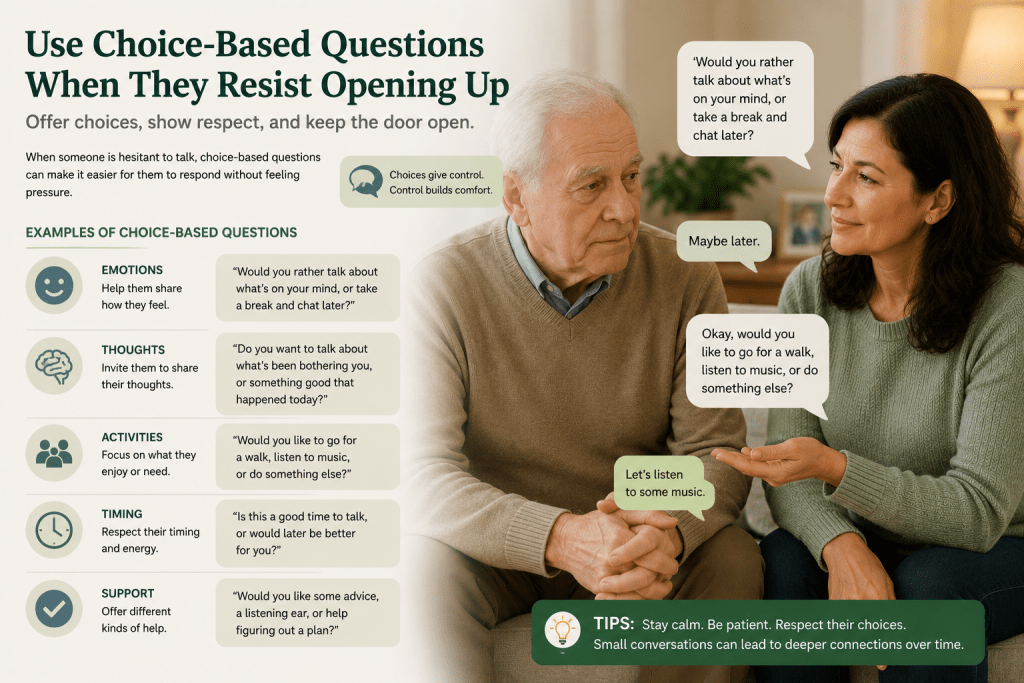
Use Choice-Based Questions When They Resist Opening Up

Some older adults do not like direct emotional questions. They may become uncomfortable if asked, “Are you lonely?” or “How are you feeling?” They may say they are fine even when they are not. This is common, especially among seniors who grew up in families or cultures where emotional privacy was valued.
In these moments, choice-based questions can help. They feel lighter and less exposing because the person only has to choose between options. Once they choose, you can gently ask why.
For example:
“Would you rather listen to music or watch an old movie today?”
“Was your school life more strict or more fun?”
“Do you prefer mornings or evenings now?”
“Were you more of a quiet child or a mischievous one?”
“Do you like a planned day, or do you prefer taking things as they come?”
“Would you rather talk about food, family, music, or old places today?”
These questions create a small doorway. A senior who would never answer “Tell me about your emotions” may happily explain why they prefer mornings, why school was strict, or why music from a certain decade still matters.
Choice-based questions are especially useful when a loved one tends to shut down, says “I don’t know,” or worries about giving the “right” answer. There is no wrong answer. They only need to pick what fits.
You can also use this method to give them control over the conversation. For many seniors, especially those who depend on others for transportation, medication, meals, or appointments, having control over a conversation can feel refreshing. Ask:
“What kind of call would feel good today—a cheerful one, a quiet one, or a memory one?”
That question respects their emotional state. It also shows that you are not calling only to extract information. You are calling to be with them.
Use Purpose-Based Questions When They Feel Unneeded
Loneliness is not only the absence of people. It can also be the feeling of no longer being needed. Many older adults have spent decades working, raising children, managing homes, solving problems, caring for others, or holding families together. After retirement, widowhood, illness, or reduced mobility, they may feel that their usefulness has disappeared.
Conversation can gently restore a sense of purpose when it invites seniors to advise, teach, guide, or contribute. This does not mean placing responsibility on them. It means making space for their wisdom.
Try questions like:
“I need your opinion on something. Can I ask what you think?”
“What is one thing you learned with age that younger people often miss?”
“How would you handle this situation?”
“What is a simple life skill everyone should know?”
“What recipe, habit, or family tradition do you think we should keep?”
“What did you learn about getting through hard times?”
These questions communicate respect. They say, “Your experience still matters.” That can be deeply meaningful for a senior who feels forgotten.
Be sincere when asking for advice. Do not ask just to flatter them. If they offer a suggestion, acknowledge it thoughtfully. You might say:
“That is a helpful way to think about it. I had not looked at it that way.”
Or:
“I can see why experience teaches that. Thank you for telling me.”
Small moments of usefulness can brighten the rest of the day. They remind the person that they are not only being cared for; they are still someone others can learn from.
Use Sensory Prompts When Memory or Words Are Difficult
Some seniors struggle to answer abstract questions because of memory changes, fatigue, hearing loss, anxiety, or cognitive decline. In these situations, sensory prompts can work better than direct questions. A photo, song, smell, object, or familiar phrase can help them connect without needing to search for words from nothing.
Instead of asking, “What do you remember about your wedding?” you might say:
“I found an old photo of you in that blue outfit. What do you notice when you look at it?”
Instead of asking, “What music did you like?” you might play a short piece of a familiar song and ask:
“Does this sound familiar?”
Sensory prompts reduce pressure. They give the senior something concrete to respond to. Even if they cannot recall names or dates, they may smile, hum, describe a color, recognize a voice, or share a feeling.
Useful sensory prompts include:
Old family photos
A favorite song
A recipe card
A familiar prayer, poem, or saying
A piece of jewelry or clothing
A seasonal smell such as cinnamon, flowers, soap, or fresh bread
A postcard, letter, or old household object
When using sensory prompts, avoid turning the moment into a test. Do not ask, “Do you remember who this is?” in a way that could embarrass them. Instead, say:
“I like this photo. Tell me what you notice.”
Or:
“This song made me think of you.”
This allows them to participate without fear of being wrong. The emotional connection matters more than factual accuracy.
Use Gentle Emotional Questions Only After Trust Is Established
Emotional questions can be meaningful, but they need care. A lonely senior may be carrying grief, regret, fear, or sadness that has not had many safe places to go. Asking too directly can make them retreat. But never asking at all can leave important feelings unspoken.
The best approach is to begin gently and give them full permission not to answer.
You might say:
“Can I ask something a little more personal, or would you rather keep things light today?”
This simple permission-based approach protects dignity. It tells the senior that they are in control.
If they are open to it, try questions like:
“What part of the day feels longest for you?”
“Are there times when the house feels too quiet?”
“What do you wish people understood better about this stage of life?”
“What helps you feel less alone, even a little?”
“Is there anything you have been carrying quietly?”
These questions should be asked slowly, with warmth. After asking, do not fill the silence too quickly. Many older adults need time to decide how honest they want to be. Silence can be part of trust.
If they share something painful, resist the urge to fix it immediately. Do not rush in with, “You should join a club,” or “Don’t think like that.” Practical help may come later, but first they need to feel heard.
Try responses like:
“That sounds very hard.”
“I’m glad you told me.”
“I did not realize that part felt so heavy.”
“You do not have to go through that feeling alone.”
These replies are simple, but they are powerful. They show that the conversation is not only about gathering information. It is about companionship.
Know When to Stop Asking and Simply Stay Present
One of the most important conversation skills is knowing when to stop asking questions. A senior may become tired, emotional, distracted, or overwhelmed. If every pause is met with another question, the conversation can start to feel like an interview.
Sometimes the most caring thing you can say is:
“We do not have to talk about anything big. I’m just happy to be here with you.”
This is especially helpful for seniors who are grieving, anxious, ill, or mentally exhausted. Companionship does not always require a full conversation. Sitting together, listening to music, watching the same show, folding laundry while on the phone, or sharing a quiet cup of tea can still reduce loneliness.
If you are on the phone, you might say:
“I can stay on for a few minutes while you have your tea.”
Or:
“Would you like me to read you something short?”
Or:
“Let’s just listen to this song together.”
Presence without pressure builds safety. Over time, that safety often leads to more openness than repeated questioning ever could.
Create a Simple Conversation Map for Future Calls

If you speak with a lonely senior regularly, keep a private conversation map. This is not a formal record or a clinical note. It is simply a small list of what brings them energy, comfort, laughter, or calm.
After a call, write down a few details:
Topics they enjoyed
Names they mentioned
Stories they seemed proud of
Subjects that made them sad
Times of day when they had more energy
Questions that worked well
Questions that did not work
For example:
“Loved talking about old train journeys.”
“Became quiet when discussing holidays after spouse’s death.”
“Enjoys food memories, especially mango pickle and Sunday lunches.”
“More cheerful in the morning than evening.”
“Likes being asked for advice about family decisions.”
This map helps you become more thoughtful over time. It also prevents conversations from starting from zero each time. You can return to meaningful threads with care.
For example:
“Last time you mentioned the train trips you took when you were younger. I was thinking about that. What did you usually pack for those journeys?”
This shows continuity. It tells the senior, “I remember what you said.” For someone who feels unseen, being remembered can feel deeply comforting.
A conversation map is also useful when several family members or caregivers are involved. With the senior’s privacy and dignity in mind, relatives can share gentle notes such as, “Dad likes talking about cricket in the evenings,” or “Mom seems to enjoy recipe questions more than health questions.” This makes every check-in feel less random and more personal.
Match the Question to the Relationship
Not every person should ask every question. A close daughter may be able to ask about grief, regrets, or fears. A neighbor may do better with garden, weather, food, or local community topics. A paid caregiver may focus on comfort, routine, hobbies, and daily preferences. A grandchild may bring out playful stories that adults never hear.
Before asking a deeper question, consider your relationship. Ask yourself: Have I earned enough trust for this question? Is this my place to ask? Would the senior feel respected, or exposed?
For lighter relationships, use warm but safe prompts:
“What kind of music do you enjoy?”
“Did you always live in this area?”
“What foods remind you of home?”
“Do you follow any sports or shows?”
“What was your favorite season when you were younger?”
For closer relationships, you can gradually ask more personal questions:
“What has been hardest to adjust to lately?”
“What do you miss most about earlier years?”
“What do you wish we talked about more often?”
“What helps you feel supported by the family?”
“Are there memories you want us to preserve?”
Respecting the relationship protects the senior from feeling cornered. It also helps the conversation feel natural rather than forced.
Build a Weekly Rhythm Instead of Searching for New Questions Every Day
Families often worry that they will run out of things to say. But seniors do not always need brand-new topics. In fact, a predictable rhythm can be comforting. It gives them something familiar to expect and reduces the pressure on both sides.
You can create a simple weekly pattern:
Monday: Ask about the weekend or the week ahead.
Tuesday: Share a memory prompt.
Wednesday: Ask for advice or a family story.
Thursday: Talk about food, music, books, faith, hobbies, or local news.
Friday: Ask what felt good, difficult, or surprising this week.
Saturday: Do a shared activity, such as a show, recipe, prayer, puzzle, or photo.
Sunday: Keep it gentle and reflective.
This structure does not need to be rigid. It simply gives you a place to begin. A lonely senior may find comfort in knowing that someone will call and ask about a familiar theme. Repetition can become a ritual, and rituals create emotional security.
You can also give the senior a role in shaping the rhythm. Ask:
“What would you enjoy talking about once a week?”
“Would you like a music day, a memory day, or a family story day?”
“Should we make Sunday our recipe story day?”
When seniors help shape the routine, they are more likely to look forward to it. The call becomes something they participate in, not something done to them.
Use Conversation Starters to Notice Needs Without Making the Call Feel Clinical
Many families use calls to check on safety, meals, medication, mood, or health. Those things matter. But if every conversation feels like a checklist, the senior may begin to resist the call. They may feel monitored rather than loved.
A better approach is to blend practical awareness into warm conversation.
Instead of asking:
“Did you eat? Did you take your medicine? Did you sleep?”
Try:
“What tasted good today?”
“How did your morning routine go?”
“Was last night restful, or was it one of those restless nights?”
“What would make tomorrow easier?”
“Is there anything in the house that has been annoying you or slowing you down?”
These questions still reveal useful information, but they feel more respectful. They invite the senior to describe their day rather than report compliance.
If you notice a concern, stay calm and collaborative. For example:
“It sounds like lunch has been difficult lately. Would it help if we thought of two easy options together?”
Or:
“You mentioned the hallway feels dark at night. Let’s see if there’s a simple way to make that safer.”
This keeps the senior involved in decisions. It also prevents the conversation from becoming parent-child in the wrong direction. Older adults deserve support without being spoken to as if they have lost all independence.
End With Warmth, Not Abruptness
How a conversation ends matters. A rushed ending can leave a lonely senior feeling dropped, even if the call itself was kind. Try to close in a way that gives reassurance and continuity.
You might say:
“I’m really glad we talked today.”
“I loved hearing that story.”
“I’ll remember what you said about your school days.”
“Let’s continue this next time.”
“I’ll call again soon, and maybe you can tell me more about that recipe.”
Ending with a future thread gives them something to hold onto. It tells them the conversation was not a one-time obligation. It also gives the next call a natural beginning.
If the senior shared something emotional, close gently:
“Thank you for trusting me with that. I’m here with you, and we can talk more another time.”
If the call was light, keep the ending cheerful:
“That was a lovely little chat. I hope your tea stays warm and your evening feels peaceful.”
The goal is to leave them feeling valued, not managed. A good ending can soften the return to quiet.
A Practical Rule: Ask Less, Notice More, Follow Better
The best conversation starters for lonely seniors are not always the most creative ones. They are the ones that fit the person in front of you. A thoughtful caller asks less, notices more, and follows better.
Ask less means you do not overwhelm them with question after question.
Notice more means you pay attention to tone, energy, hesitation, humor, and emotion.
Follow better means you stay with what they give you instead of jumping to the next topic.
If they mention a bird outside the window, talk about the bird. If they mention an old friend, ask about the friend. If they mention being tired, honor the tiredness. If they laugh at a small memory, stay there a little longer.
Loneliness often makes people feel that their inner world no longer matters to anyone. A well-matched conversation starter gently challenges that feeling. It says, “Your stories matter. Your comfort matters. Your choices matter. Your voice matters.”
That is what helps seniors open up—not pressure, not perfect wording, and not endless questions, but steady, respectful attention offered again and again.
Ways to keep conversations going day to day (even from a distance)
Turn calls into shared activities so talks feel like living, not a checklist. Pick a time to watch an old movie together and pause to chat. Cook the same recipe on a video call, or take a walk while on speakerphone. These small routines make a call feel safe and familiar.

Shared activities that spark talks
- Sync a movie or TV scene and talk during breaks.
- Cook together over video, step by step.
- Use short scripts like, “Tell me one good thing from today.”
Make keepsakes from regular check-ins
With permission, jot a line after each call or record a short audio memory. Create a shared family document that members can add to. These things build a gentle legacy and give many seniors a concrete reminder of connection.
Groups, clubs, and virtual travel
Group chats and senior living clubs help people open up. Try interest-based meetups at the local library or online. For vivid shared experiences, live virtual travel (Wowzitude-style) lets members explore London, Venice, Budapest, Marrakesh, St. Petersburg, or the Australian wilderness together.
When daily calls are hard to keep, JoyCalls can be the best thing to hold the routine. Talk to Joy now: 1-415-569-2439, or sign up for JoyCalls. For a simple check-in script, see the two-minute daily check-in.
How to Turn Simple Conversation Starters Into a Support System for Lonely Seniors

Conversation starters are not only useful for filling silence. When used with care, they can become part of a gentle support system for seniors who live alone, feel emotionally distant, or do not easily ask for help. A thoughtful question can reveal whether someone is bored, grieving, overwhelmed, physically uncomfortable, unsafe at home, or simply craving more human contact.
The important thing is to keep the conversation warm and human. Seniors should not feel like they are being interviewed, inspected, or managed. They should feel that someone is genuinely interested in their day, their comfort, their memories, and their opinions. When that happens consistently, everyday conversations become more than small talk. They become a way to build trust, notice changes, and offer support before problems become bigger.
For adult children, relatives, caregivers, and friends, this approach is especially useful because loneliness is often quiet. Many older adults will not directly say, “I feel lonely,” “I am struggling,” or “I need more help.” They may not want to worry their family. They may feel embarrassed. They may believe everyone is too busy. Some may even minimize their needs because they are used to being independent.
This is why the right conversation starters matter. Not because they force seniors to reveal private feelings, but because they create safe openings. Over time, those openings can help families understand what kind of support is needed.
Move From “Checking In” to “Checking With”
Many seniors dislike feeling checked on. Even when families mean well, a call that sounds like a checklist can make an older adult feel watched instead of valued. Questions like “Did you eat?” “Did you take your medicine?” “Did you sleep?” and “Did you go for a walk?” may be practical, but if they dominate every conversation, the senior may start giving short answers just to end the call.
A better approach is to shift from checking in to checking with.
Checking in can sound like supervision. Checking with sounds like companionship.
Instead of asking, “Did you eat lunch?” try:
“What tasted good today?”
Instead of asking, “Did you take your pills?” try:
“How did your morning routine go today?”
Instead of asking, “Are you lonely?” try:
“What part of the day felt longest today?”
Instead of asking, “Are you managing okay?” try:
“What would make tomorrow a little easier?”
These questions still help you understand what is happening, but they feel more respectful. They invite the senior to describe their life instead of reporting their behavior.
This small language shift matters. Older adults have spent decades making decisions, solving problems, caring for others, and managing responsibilities. Even when they now need support, they still deserve dignity. A conversation should not make them feel reduced to meals, medication, appointments, and safety risks.
A helpful rule is this: begin with the person before the problem.
Start with warmth. Ask about comfort, mood, interests, or something familiar. Then, if needed, gently move toward practical concerns. For example:
“I was thinking about you this morning. How has your day been so far?”
After they answer, you can ask:
“Was breakfast easy today, or was it one of those mornings where nothing sounded good?”
This feels natural. It also gives them room to be honest without feeling corrected.
Use Repeated Questions to Notice Patterns, Not to Pressure Them
Some of the best conversation starters are worth asking regularly. Not every day in the exact same way, but often enough that you can notice patterns.
For example:
“What was the best part of your day?”
“What felt difficult today?”
“Did you talk to anyone else today?”
“What helped you feel calm?”
“What are you looking forward to tomorrow?”
If a senior says “nothing” once, it may simply be an ordinary quiet day. If they say “nothing” every day for two weeks, that may tell you something important. If they used to enjoy talking about food but now say they are not hungry often, that may be worth noticing. If they repeatedly say evenings are hard, then evenings may be when loneliness feels strongest.
The goal is not to catch them out. The goal is to understand their real rhythm.
Keep a simple note for yourself after important calls. You do not need to record everything. Just write down small patterns:
“Feels lonely after dinner.”
“Brightens when talking about old neighbors.”
“Complains about sleep three times this week.”
“Has not mentioned going outside lately.”
“Seems more confused in evening calls.”
These notes can help you support them more thoughtfully. They also help you avoid asking random questions every time. You can return to what matters.
For example:
“You mentioned that evenings have felt long lately. Would it help if we made our calls after dinner instead of in the afternoon?”
That kind of follow-up shows real listening. It tells the senior that their words did not disappear after the call ended.
Ask About Their Environment Without Making It Sound Like an Inspection
For seniors who live alone, the home environment plays a major role in loneliness and wellbeing. A house can feel comforting, but it can also become quiet, difficult to manage, or full of small frustrations. However, many older adults do not like being asked directly whether the home is safe or clean. They may feel judged or worry that family members will try to take control.
Conversation starters can help you understand the home environment in a gentler way.
Try questions like:
“Where have you been spending most of your time in the house lately?”
“Is there a spot in the home that feels especially comfortable right now?”
“Is anything at home becoming more annoying than it used to be?”
“Does the house feel peaceful in the evening, or too quiet?”
“Is there a small thing that would make the kitchen, bedroom, or sitting area easier to use?”
These questions are practical without being intrusive. They also focus on comfort rather than failure.
If they mention something concerning, respond calmly. For example, if they say the hallway is too dark at night, avoid saying, “That is dangerous. Why didn’t you tell me?” Instead, say:
“That sounds frustrating. A small night light might make that easier. Would you like help arranging one?”
If they say the kitchen feels tiring, you might say:
“Maybe we can think of a few meals that are simple but still enjoyable.”
This keeps the conversation collaborative. Seniors are more likely to accept help when they feel included in the solution.
Create Questions That Help Seniors Name What They Need
Many older adults are not used to asking for help directly. They may say, “I’m fine,” even when they are not. They may wait until a problem becomes serious before mentioning it. One reason is that open requests like “Tell me if you need anything” can feel too broad. The senior may not know what to ask for, or they may not want to impose.
Better conversation starters make help easier to name.
Instead of saying, “Do you need anything?” ask:
“Would any of these help this week: groceries, a ride, a longer call, help with paperwork, or just some company?”
Instead of asking, “Are you okay?” ask:
“What is one thing that has felt harder than usual lately?”
Instead of asking, “Can I help?” ask:
“What is one task you wish someone else could handle for you this week?”
Instead of asking, “Do you want visitors?” ask:
“Would you enjoy a short visit this week, or would a phone call feel better?”
Specific options reduce the emotional work of asking. They also allow the senior to choose without feeling demanding.
This is especially helpful for seniors who are proud, private, or worried about burdening others. They may reject a vague offer but accept a specific one. For example, they may say no to “Do you need help?” but yes to “Would it help if I ordered groceries for Friday?”
When they do accept help, avoid making a big deal out of it. Respond naturally:
“Of course. I’m glad you told me.”
This reinforces that asking is safe.
Use Conversation to Protect Independence, Not Take It Away
One fear many older adults have is that if they admit difficulty, they will lose control. They may worry that family members will make decisions for them, restrict their choices, or treat them like children. Because of this, they may hide problems.
The way you ask questions can either increase this fear or reduce it.
Avoid questions that sound like judgment:
“Why didn’t you call me?”
“Why is this still not done?”
“Are you sure you can handle this?”
“You should not be doing that alone.”
Instead, use questions that protect their role in decision-making:
“How would you like to handle this?”
“What option feels most comfortable to you?”
“Would you prefer help now, or should we make a plan for later?”
“What would let you keep doing this safely?”
“Is there a way to make this easier without changing your whole routine?”
These questions show respect. They make it clear that support is not the same as control.
For example, if a senior says cooking has become tiring, the answer does not have to be, “You need someone to cook for you.” A more respectful response is:
“Would you rather simplify meals, get help with groceries, prepare food in batches, or have someone bring a meal once in a while?”
This gives choices. Choice is essential for dignity.
Build Emotional Safety Before Asking About Loneliness

Loneliness can be difficult to admit. Some seniors may feel ashamed of it. Others may not use the word “lonely” at all. They may say they are bored, tired, restless, forgotten, or that the house is too quiet.
Instead of beginning with “Are you lonely?” build toward the topic gently.
You can ask:
“What time of day feels the quietest?”
“Do weekends feel different from weekdays?”
“Do you miss having more people around, or do you enjoy the quiet most of the time?”
“Who do you enjoy hearing from?”
“What kind of company feels good to you these days?”
These questions make it easier to talk about loneliness without labeling it too quickly.
If they do admit loneliness, do not rush to solve it in the first sentence. Avoid saying, “You should join a club” or “You need to get out more.” Those suggestions may be valid later, but first they need to feel heard.
Start with:
“I’m sorry it has been feeling that way.”
Or:
“Thank you for telling me. I’m glad you said it.”
Then ask:
“What helps even a little when that feeling comes?”
This turns the conversation toward support without dismissing the feeling.
Use “Tiny Plans” at the End of the Conversation
A conversation can be comforting in the moment, but the hours after the call may still feel long. One useful habit is to end with a tiny plan. This gives the senior something small to expect, do, or look forward to.
A tiny plan should be simple. It should not feel like homework.
Examples include:
“I’ll call tomorrow after tea, and you can tell me if the new show was any good.”
“Let’s both listen to that song before our next call.”
“Next time, I want to hear more about your first job.”
“Tomorrow, maybe you can sit near the sunny window for a few minutes and tell me how it feels.”
“Let’s think of one easy dinner idea together next time.”
These small plans create continuity. They also give the next conversation a natural starting point. For lonely seniors, this can be surprisingly meaningful. It helps the day feel less empty because there is a thread connecting today to tomorrow.
The best tiny plans are personal. If they enjoy music, use music. If they enjoy food, use recipes. If they enjoy family stories, ask for one. If they like routine, keep the call time predictable. If they dislike pressure, make the plan optional.
You might say:
“No pressure if you forget. I just thought it might be nice to continue this next time.”
That keeps the plan light and caring.
Know the Difference Between Normal Sadness and Warning Signs
Conversations with lonely seniors may sometimes reveal deeper concerns. It is normal for older adults to have sad days, especially after loss, illness, retirement, or major life changes. But repeated signs of distress should be taken seriously.
Pay attention if a senior often says things like:
“There is no point anymore.”
“Nobody would notice if I was gone.”
“I am tired of being here.”
“I do not care what happens.”
“I have nothing left.”
Also notice major changes such as withdrawal from all contact, not eating, unusual confusion, neglecting basic care, giving away important possessions unexpectedly, or expressing hopelessness repeatedly.
If something feels urgent, do not treat it as just another conversation topic. Stay calm, keep them engaged, and contact appropriate family members, local emergency services, a doctor, or a crisis support line depending on the situation. If you believe they may harm themselves or are in immediate danger, seek emergency help right away.
For less immediate but still concerning patterns, say something clear and caring:
“I’m really glad you told me this. I think we should get some extra support, because you should not have to carry this alone.”
This is not about overreacting. It is about taking emotional pain seriously.
At the same time, avoid turning every sad comment into an alarm. Seniors need room to express grief and frustration without feeling punished for honesty. The goal is balanced care: listen deeply, notice patterns, and act when safety or wellbeing may be at risk.
Include Other People Without Making the Senior Feel Discussed Behind Their Back
If several family members care about the same senior, conversations can become more consistent when everyone shares responsibility. However, this must be handled with respect. Seniors should not feel like everyone is talking about them but not to them.
When possible, include the senior in the plan.
You might ask:
“Would you enjoy hearing from different family members on different days?”
“Who would you like to speak with more often?”
“Would a short Sunday family call feel nice, or would that be too much?”
“Is there anyone you miss but do not want to bother?”
These questions help families build a circle of connection around the senior. They also make the senior’s preferences central.
A simple family rhythm could look like this:
One person calls on Monday.
Another sends photos midweek.
A grandchild calls on Friday.
Someone visits or video calls on Sunday.
A companion call service fills the gaps on days when family is unavailable.
The purpose is not to overwhelm the senior. The purpose is to make connection reliable. For lonely older adults, predictable contact can be more comforting than occasional long conversations.
Let Seniors Contribute to the Family Through Conversation
Support should not flow only in one direction. Seniors need care, but they also need opportunities to give, advise, remember, bless, teach, and contribute. Conversation starters can help restore that sense of contribution.
Try asking:
“What family story should the younger ones know?”
“What is one value you hope we keep?”
“What did your parents teach you that still matters?”
“What should we remember during difficult times?”
“Is there a recipe, song, saying, or tradition you want passed on?”
“What advice would you give the children in the family?”
These questions position the senior as a source of wisdom, not just someone receiving care. This can be especially meaningful for older adults who feel sidelined.
You can take it one step further by turning their answers into something visible. Write down a recipe. Save a voice note. Share a story with the family. Print a photo with a caption from their memory. Mention later that someone enjoyed what they shared.
For example:
“I told the children what you said about your first job, and they loved it.”
That sentence can make a senior feel remembered and valued beyond the call itself.
Make the Conversation Supportive Even When They Do Not Want to Talk
There will be days when a senior does not want to talk much. This does not mean the conversation failed. It may mean they are tired, sad, distracted, or simply quiet by nature.
On those days, reduce the pressure.
You can say:
“We do not have to talk much today. I just wanted to be with you for a few minutes.”
Or:
“Would you like me to tell you something from my day instead?”
Or:
“Should we keep it short and gentle today?”
Sometimes sharing your own small update helps. Tell them about a meal, a child’s funny comment, a flower you saw, a small problem you solved, or something that reminded you of them. This gives them connection without requiring effort.
For example:
“I saw jasmine flowers today and thought of the ones near your old house.”
That may be enough to spark a memory. If it does not, it still communicates love.
Supportive conversation is not measured by length. A three-minute call that leaves someone feeling cared for is better than a thirty-minute call that feels forced.
Keep the Main Message Clear: “You Matter”

Every conversation starter should carry one quiet message: you matter.
Not because the senior gave a long answer. Not because they were cheerful. Not because they remembered every detail. Not because they accepted help. They matter because they are a person with a history, a voice, preferences, needs, and dignity.
When families approach conversation this way, the questions become warmer and more effective. You are no longer trying to get the senior to “open up” on command. You are building a relationship where opening up feels possible.
A simple question like “What did you enjoy today?” can become a mood check. “What would make tomorrow easier?” can become a support plan. “Tell me about that recipe” can become a legacy project. “What time of day feels longest?” can become a clue about loneliness. “What would you prefer?” can become a way to protect independence.
The words are simple. The consistency is what makes them powerful.
Lonely seniors do not always need perfect advice. Often, they need steady proof that someone is listening, someone remembers, and someone will come back again. Thoughtful conversation starters can provide that proof, one call at a time.
Conclusion
Short, regular check-ins build trust more than perfect wording ever will. You don’t need a script—just a few gentle questions and the willingness to listen. Active listening and open-ended prompts help a loved one share memories that matter.
Start light. Follow the thread that brings energy. Invite deeper life reflection only when it feels welcome. Small talks add up; familiar voices soften hard days over weeks and months.
Pick one topic for your next call and ask one open-ended question. If you want daily support without extra tech, Talk to Joy now: 1-415-569-2439 or sign up at https://app.joycalls.ai/signup. For extra prompt ideas see a helpful list of 15 questions to ask seniors and guidance on missed check-ins at missed check-ins.
These small, ordinary moments become the stories your family keeps.
FAQ
What are gentle ways to open a conversation with an older family member?
Why does meaningful talk matter for older adults who feel isolated?
When should I keep things light versus asking deeper questions?
What childhood prompts invite storytelling?
How can I encourage sharing family traditions and history?
What are respectful ways to talk about health and self-care?
Which topics spark ongoing chats and shared activities?
How can I involve distant relatives in regular check-ins?
What should I avoid when a loved one becomes emotional or sensitive?
How do I adapt my approach for someone with memory changes?
What are easy prompts about travel and favorite places?
How can I capture stories for future family records?
How do I show patience and respect during a call?
What topics connect across generations—music, sports, arts?
How can JoyCalls help families keep these daily check-ins consistent?

Ana Avila is a healthcare and technology writer with deep expertise in artificial intelligence, senior care innovation, and the practical use of AI in healthcare operations. Her work focuses on how emerging technologies can improve the daily experience of older adults, support overburdened care teams, and help senior living communities deliver safer, faster, and more personalized support.
Ana’s background includes health informatics, aging care systems, and applied artificial intelligence. Her work explores how digital health tools, predictive analytics, and AI-assisted communication systems can improve care coordination, reduce operational delays, and identify early signs of risk among older adults. She brings an understanding of both the technical side of AI and the human realities of healthcare delivery.
Over the years, Ana has developed a specialized body of work around AI in senior living. She writes about how senior care providers can use intelligent systems to manage resident requests, answer routine questions, support family communication, improve after-hours coverage, and detect patterns that may indicate loneliness, confusion, distress, or unmet needs. Her articles often examine the gap between what senior living teams are expected to deliver and what traditional staffing models can realistically support.
Ana’s healthcare expertise is especially focused on the operational side of care. She has written extensively about call handling, resident engagement, front desk workflows, triage systems, caregiver communication, care escalation, and the hidden administrative burden placed on senior living staff. Her work explains how AI can help reduce repetitive tasks, organize incoming requests, prioritize urgent issues, and give human caregivers more time for meaningful resident interaction.
At the same time, Ana is careful not to present AI as a replacement for human care. A consistent theme in her writing is that technology should support relationships, not weaken them. She argues that the best AI systems in healthcare are not the ones that simply automate the most tasks, but the ones that make care teams more responsive, families more informed, and residents more supported. Her perspective is grounded in the belief that senior living technology must be designed around dignity, trust, privacy, and compassion.
Ana has also written widely on the ethical use of AI in healthcare. Her work discusses the importance of human oversight, transparent escalation rules, resident consent, data minimization, and responsible use of sensitive health and behavioral information. She often emphasizes that AI systems used around older adults must be easy to understand, carefully monitored, and designed with the limitations and needs of real residents in mind, including those with memory loss, hearing challenges, mobility issues, or social isolation.
Her writing has been used as a reference point in discussions about aging, elder care technology, digital health, and AI-supported senior living. She has published 12 papers in journals including JAMA, The BMJ, and SSRN. Some of her articles have also been cited by Wikipedia editors as supporting references on topics related to healthcare, aging, and technology. This has helped position her work as a useful educational resource for readers looking to understand how AI can be applied in real care environments.
In addition to her long-form writing, Ana has contributed research-based commentary, professional explainers, and practical guidance for healthcare operators, senior living decision-makers, and technology teams building products for older adults. Her work combines research literacy with operational practicality. She is able to take complex subjects such as natural language processing, predictive analytics, conversational AI, and care automation, and explain them in a way that is accessible to executives, caregivers, families, and non-technical readers.
Ana’s strongest area of expertise is the intersection of artificial intelligence and senior living operations. She understands that senior care communities face a difficult combination of rising resident expectations, staffing pressure, family communication demands, and increasing care complexity. Her writing explores how AI can be used to ease those pressures through smarter communication systems, faster response workflows, proactive check-ins, and better visibility into resident needs.
Her approach is both evidence-informed and deeply human. She studies AI through the lens of real-world care delivery: whether a resident gets help faster, whether a family member receives a clearer update, whether a caregiver avoids unnecessary administrative work, and whether a senior living team can identify a concern before it becomes a crisis. This practical focus makes her work especially relevant for organizations that want to adopt AI responsibly rather than simply follow technology trends.
Ana Avila is regarded as a thoughtful voice on the future of AI in healthcare and senior living. Her expertise combines research-driven analysis, operational understanding, and a strong commitment to humane technology. Through her writing, she helps healthcare leaders and senior living communities understand not only what AI can do, but how it should be used to improve care, preserve dignity, and strengthen the human relationships at the center of aging support.