


One study found that more than half of older adults report a sharp drop in daily social contact after a partner dies. That shift can feel like your whole life changed overnight.
Quiet homes and new routines can make feelings deeper than simply being alone. Many widows say they feel disconnected even when people are around.
This short guide speaks to two readers directly: the senior who is grieving, and the adult child trying to help from a distance.
Our goal is simple: protect emotional health, reduce isolation, and rebuild steady connection without rushing anyone to “move on.”
We’ll show practical steps: recognize patterns, name triggers, try simple thought tools, and build a weekly structure that eases the hardest hours.
Support can be as light as a consistent check-in call when family can’t always be there. Call to talk now: Talk to Joy: 1-415-569-2439. Or sign up for JoyCalls: https://app.joycalls.ai/signup.
Key Takeaways
- Many seniors feel a deep shift after a spouse dies; this is common and real.
- Small routines and weekly structure can make hard hours easier.
- Light, consistent check-ins help when family cannot be present.
- Use simple tools to name triggers and gently rebuild connection.
- Needing companionship is human and doesn’t erase the love you still carry.
Why loneliness after losing a spouse feels so intense for seniors
Losing the person who shared your routines can make familiar places feel strange. That change is more than empty chairs. It shifts the threads that held daily life together.
Your spouse was “your person,” not just someone in the house
Your person listened to small stories and remembered inside details. They were the default teammate for tiny choices. When that role disappears, the heart notices first.
How grief changes identity, routines, and a sense of safety
Grief can erase familiar rhythms. Meals, errands, and evening rituals shift overnight. That alters who you are in daily life.
Without the person who always had your back, the world feels louder and less secure. The loss touches your sense of safety.
Why being surrounded by people can still feel isolating
You can sit in a room full of people and feel unseen. The missing piece is emotional safety, not company. Adult children may visit, call, and invite—but the ache can stay.
If you want ideas for support that actually helps, read what actually helps. It shows gentle steps to rebuild connection over time.
Recognizing widow loneliness in daily life
When daylight fades, the little rituals that held your day together become louder in their absence. Daytime may pass with tasks and light conversation. Then evenings arrive, and the quiet can sting.

The “end of the day” quiet
The debrief is missing. No one asks, “How was your day?” or shares a silly video. The usual jokes and the “I made it home safe” text are gone.
Those small things proved someone cared about ordinary time. Without them, ordinary things feel large and empty.
Feeling like you’re behind glass in a room full of others
You can be with people and still feel separate. Smiling politely while watching life move around you is common.
It can make you feel like a spectator instead of a person taking part.
Emotional signals to notice
Look for changes in sleep, appetite, or interest in work and hobbies. Pulling back from invitations or saying “I’m fine” more often can be a sign.
- Emotions: sadness, anxiety, hopeless thoughts.
- Behavior: withdrawing, irritability, numbness.
- Caregiver cues: fewer returned calls, canceled plans, or a different tone in voice.
If you want practical tips for widows, see practical tips for widows. Small checks and gentle questions help more than quick fixes.
What the research says about widowhood and loneliness over time
Research shows that grief’s effects on daily life often grow clearer with time. Studies give us concrete numbers so families can plan steady support.
Key findings at a glance
First year: About half of widows report feeling lonely often or always within twelve months, according to the University of Cambridge.
Longer-term: Research finds 72% still report loneliness years later. That shows this unfolds across time, not just weeks.
| Measure | Statistic | Source |
|---|---|---|
| Feeling lonely in year 1 | 50% often or always | University of Cambridge |
| Loneliness persisting for years | 72% report ongoing | Longitudinal studies |
| Social circle reduction | Up to 75% less contact | Health Psychology |
| Health impact | Higher depression/anxiety and ~26% increased mortality risk | National Institute on Aging |
Why this matters
Many people assume visits will “fix it,” but the data says otherwise. Losing a spouse often changes routines and who shows up.
Try JoyCalls Free
No app or new device needed. Start with a free 7-day trial.
That social shift can harm mood and physical health. So the guide’s number one goal is steady connection over time, not quick fixes.
- These numbers are common, not a private failing.
- Support should be ongoing, not a one-month burst.
- Resources like lived-experience podcasts and widowhood educators echo these facts.
How grief reshapes your social circle after a spouse dies
After a partner dies, your circle often feels much smaller overnight. This change is more than fewer invitations. It can feel like a second, quieter loss.

When your spouse was the anchor for shared friendships
In many couples, one person kept plans, called friends, or brought the energy that kept groups together. That anchor role matters.
Without it, regular get-togethers can fade. People drift when no one is coordinating.
How trauma changes you—and others may expect the old self back
Grief changes conversation stamina, humor, and daily priorities. Small talk can feel heavy. Topics that were once easy may now hurt.
Meanwhile, others may assume you’ll be the same person you were every time. That mismatch can feel unfair and isolating.
Why some people disappear and what that loss can mean
People leave for many reasons: discomfort, not knowing what to say, or their own busy lives. That absence isn’t a measure of your worth.
Still, it hurts. When friends vanish, it can feel like abandonment. That pain deserves acknowledgment and care.
Practical takeaway for adult children: don’t assume “Mom has friends.” Ask which people still show up consistently now. A simple question like “Who feels safe to talk to today?” matters more than asking who used to be close.
| Role | Before loss | After loss |
|---|---|---|
| Anchor person | Organized plans and calls | Responsibility shifts or goes unfilled |
| Social energy | Shared laughter and routines | Conversation stamina drops; fewer invites |
| Others’ expectations | See the familiar person | Expect return to “old” self; miss changed needs |
| What to do | Rely on old patterns | Ask who shows up; create new gentle routines |
If you want help spotting when grief shifts into deeper needs, see a short guide on the difference between deep emotional change and depression at spotting the difference. It can help families respond with the right kind of care.
Pinpoint the moments that amplify feeling lonely
There are certain hours in the week when memories seem louder and the house feels bigger. Naming those windows helps you plan ahead instead of reacting when the wave hits.
Evenings and weekends when distractions fade
Identify high-risk windows: evenings, weekends, and long stretches with little structure. Those are the times grief and loneliness often grow louder.
The house can feel different. Routines are missing. Small rituals that once filled the hours are gone, so memories show up with fewer distractions.
Holidays, anniversaries, and milestone days that hit harder
Milestone days matter: the wedding date, the day you met, illness anniversaries, and the date of death.
Caregivers: mark these on a shared calendar so check-ins happen before the wave hits, not after.
- Practical tip: schedule a short call before a hard evening or anniversary.
- How it sneaks up: you might be fine at 2 p.m., then start feel it at 7 p.m. when dinner ends and the TV feels too loud.
- Gentle phrase to use: “Nights are tough. Can we plan one call this week?”
Grief doesn’t follow a schedule. Even when nothing new happens, days can start feel heavy. Once you can name the moments, you can build a simple plan around them.
Start with compassion: loneliness doesn’t mean you’re broken
A missing voice in the house can make ordinary tasks feel like they carry extra weight.

Here’s a clear reassurance: feeling lonely after a loss doesn’t mean you are broken. It means you loved deeply and your body and mind are adjusting to change.
Loneliness as a normal part of the grief process
When grief is active, certain hours or sights can trigger a rush of memory. That is a normal part of the process.
What does loneliness mean in grief? Often it signals that the safety, routines, and shared meaning provided by your person are missing.
Separate feeling from prediction
Say it this way: “I feel lonely” names a moment. “I will be lonely forever” is a thought that predicts the future.
Those two are different. You can hold the feeling without believing the prediction.
A gentle voice and a small step
Try a kinder inner line: “You’re lonely. And you’re still here. Both can be true.”
Caregivers: avoid quick fixes like “Just get out more.” Validate the feeling, then offer one small next step.
Note: If you want more practical help on signs and support, see signs, causes, and what helps. The next section shows simple thought tools to reduce suffering without erasing grief.
Reframe thoughts that create loneliness using a simple thought model
One clear way to ease heavy hours is to notice the story your mind tells and gently change it. This is a skill you can practice. It helps grief feel less like an endless loop and more like a process that can work in your favor.
Clarify facts versus the story
Circumstance: the fact. Example: My spouse died.
Thoughts: the quick story your mind tells, like “No one cares.”
Feelings → actions → results: Those feelings push actions (canceling plans) and shape results (less contact), which then proves the thought true.
Common unhelpful thoughts and the loop they create
People in grief often think, “I’m all alone,” or “I’ve been forgotten.” These thoughts lead to withdrawing. Withdrawing reduces invites and contact. That result then creates loneliness every time the thought returns.
Reframe without fake cheer
Reframing is not forced joy. It’s choosing a thought that feels emotionally true and useful. Try: “This is hard, and I can take one small step.” Or say, “Let say I try calling one friend.”
Small shifts that help you move forward
Try short, doable moves: ask one person for company, schedule a 10-minute call, or try group coaching if social practice helps. Adult children can prompt gently: “Who could we text right now?”
Set up a weekly routine that supports emotional health
A gentle schedule takes the pressure off and gives the day a kind shape. A small plan for the week helps days feel predictable. That predictability eases heavy hours and restores tiny comforts to life.

Create gentle structure for days of the week
Map simple roles for each day week. Pick one grocery day. Pick one walk day. Pick one call day. Pick one appointment day. Pick one rest day.
Repeat that pattern. It is not packed. It is doable. The steady shape helps the nervous system settle.
Plan for the hardest hours: evenings and weekends
Evenings and weekends are high-risk time. When distractions fade, memories can feel louder and loneliness may spike.
Anchor evenings with consistent mealtimes, a short outing in the afternoon, a 10-minute evening call, or a favorite show with tea. These small things help you feel less overwhelmed.
Use small goals to rebuild confidence over time
Set tiny steps. Say, let say I’ll attend one class or I’ll call one friend. Those wins rebuild trust in yourself without pressure to fix your whole life.
Track what helps: which routines reduce lonely hours, which thoughts repeat, and which actions bring steadier connection.
- Caregiver tip: help set reminders, transport, or recurring check-ins. Keep it gentle so your parent feels supported, not managed.
- Extra resource: read a short guide on finding joy after loss or learn how to start a daily check-in routine.
Build connection on purpose when you’re an introvert or exhausted
People don’t always know when to act; naming a need helps others show up in simple ways. Waiting can backfire after a loss because others assume you want space, feel awkward, or think someone else is checking in.
Low-pressure outreach when you start feel anxious
It’s okay to want contact and still feel too tired to chase it. Try short scripts:
- “Could we do a 10-minute call this afternoon?”
- “Want to walk with me for 15 minutes?”
- “Can you sit with me for coffee?”
Small talk shortcuts that protect energy
Ask one simple question. Share one honest sentence. Then pivot to listening or a quiet activity. This keeps calls light but real.
Pick people who show up
Choose consistent, calm, emotionally safe people over charming ones who disappear. It’s fine to say no to draining gatherings and yes to one steady person.
“Some people will be glad I reached out.”
Adult children: identify 2–3 reliable neighbors, cousins, or faith leaders and coordinate support so your parent doesn’t do all the organizing. Small reframed thoughts change action—replace “No one will want to hear from me” with the sentence above—and connection becomes possible again.
For practical tips on finding steady friends, read how to make friends after loss.
Practical ways to ease loneliness without replacing your spouse
Short shared activities can change how an entire afternoon or evening feels. This is about adding small, reliable moments—not finding a replacement for the person you loved.

Create shared moments again
Schedule simple things: a 15-minute call, a neighborhood walk, a weekly coffee, or a class at the senior center. These plain acts rebuild connection slowly.
Make space for purpose
Helping others gives life new meaning. Try volunteering at a pantry, mentoring, or calling isolated people. Purpose links your day to the wider world.
Try supportive media and community
Listen to a grief-focused podcast on hard evenings. Join a local resource or faith group that offers steady company and practical support.
- Even 15 minutes with the right person can change the tone of a day.
- Pick activities that fit your energy and values.
- Adult children can help with transport, sign-ups, and gentle reminders.
“Start small. One call, one walk—one shared thing at a time.”
Support options that fit different comfort levels
Not every person wants the same kind of help after a major loss; choices should match comfort and energy. Below are clear options so seniors and families can pick what feels safe and doable right now.
Peer groups and communities where people feel understood
Peer groups and widow/widower communities offer steady listening. In these spaces you don’t have to explain the depth of the loss.
Groups reduce isolation by offering shared stories, simple rituals, and practical advice from people who get it.
Group coaching vs. one-on-one: how to choose
Group coaching gives momentum, shared exercises, and social practice. It suits people who gain energy from others.
One-on-one work is private and tailored. It fits people who need focused pacing and specific tools to reframe thoughts and try small habits.
When a life coach or grief counselor may help
A life coach helps you set goals, build routines, and create future steps. They often use thought work to move you out of withdrawal.
Seek a grief counselor when trauma, depression, or daily functioning are affected. Counselors are trained in complicated grief and therapy techniques.
“Getting help is not weakness — it’s a practical way to ease loneliness and rebuild life with care.”
- Check cost, schedule, faith fit, transport, and training.
- Ask if leaders are trauma-informed.
- Caregiver tip: ask your parent which option feels doable—group or one steady person.
- For more on community choices, read about senior centers vs community groups.
When loneliness becomes a safety or health concern
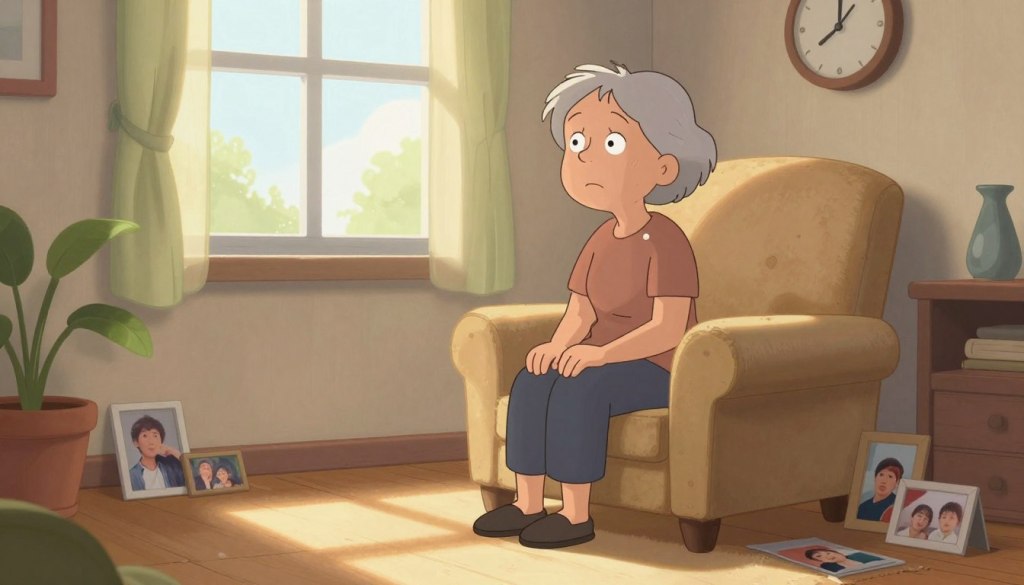
When daily routines stop holding the day together, risk signs can start to show in small, worrying ways. Grief and quiet hours are normal. But persistent changes in behavior can become a real health issue.
Warning signs to notice right away
Watch for clear changes in basic care. These are plain signals that someone needs more help.
- Not eating or losing weight; skipping meals.
- Not leaving the house for days or missing appointments.
- Missing medicines or using alcohol more often.
- Persistent panic, deep anxiety, or sleep falling apart.
- Repeated statements like “There’s no point” or “No one would notice.”
How caregivers and adult children can respond with kindness and follow-through
Take these things seriously. One kind talk matters, but steady follow-up changes day-to-day life.
- Ask directly: “How are you feeling today?” Listen without judgment.
- Stay with them if they are at immediate risk. Don’t leave them alone with intense despair.
- Make practical plans: set a daily check-in, help with meds, arrange meals or transport.
- Use a gentle script:
“I hear you. I’m staying with you in this. Let’s get you more support today.”
- Call a doctor, therapist, or grief counselor when functioning drops or hopeless thoughts persist.
Kindness breaks shame. People hide suffering when they fear judgment. Keep your voice calm, your follow-through steady, and involve professionals when needed. For related health signs like poor appetite, see this practical guide on low appetite in older adults: help for low appetite.
Talk to Joy now for companionship and support between hard moments
A short, friendly voice in the week can make evenings feel safer. It is a small step that does not demand leaving the house. It simply asks for one steady call when the day starts feel heavy.
Talk to Joy now: 1-415-569-2439
Talk to Joy now: 1-415-569-2439. Call for an immediate, warm check-in when evenings tighten. A live, gentle voice can change the moment.
Sign up for JoyCalls: https://app.joycalls.ai/signup
Sign up for JoyCalls: https://app.joycalls.ai/signup. Choose regular check-ins so support arrives on a predictable schedule.
How a consistent check-in can help you feel less alone over time
One call can calm a hard night. A predictable rhythm across the week helps reduce anxiety and build trust.
- Real gap: You can love your parent and still not be able to call at the exact moment they need company.
- Companionship between moments: JoyCalls fills the quiet gaps with steady, friendly check-ins.
- Caregiver benefit: Consistent calls support independence while keeping family in the loop.
“If you start feel the evenings closing in, this is a simple step that doesn’t require leaving the house.”
Conclusion
One small action each week can start to shift heavy thoughts into kinder ones.
Grief after the loss of a spouse is common and deep. It changes routines, feelings, and how you see the world. This does not mean you’ve failed. It means you loved.
Use practical steps: notice triggers, plan for hard evenings and weekends, rebuild connection on purpose, and try gentle thought changes that lead to small actions. Pick one thing this week—a short call, a walk, or a cozy podcast—and honor that step.
Adult children: steady check-ins and follow-through matter more than one grand gesture. Be kind in the waves. Find purpose in shared moments and safe people who see you.
Support is allowed. You can create future rhythms and feel less alone, one day at a time.
FAQ
After my spouse dies, why does the quiet feel so heavy?
I’m surrounded by family but still feel distant. Why does that happen?
What are common emotional signals that someone needs more support?
How long do these feelings typically last after a spouse dies?
Why do social networks shrink after a partner dies?
Which times of day or occasions tend to feel hardest?
How can I reframe thoughts that make me feel more alone?
What simple weekly routines help emotional health after loss?
I’m tired and introverted. How do I build connection without draining myself?
How can I create connection that doesn’t try to “replace” my partner?
What support options fit different comfort levels?
When should family or caregivers act because of health or safety concerns?
How can JoyCalls help between the hard moments?
How do I sign up or get more information about JoyCalls?

Ana Avila, PhD, is a healthcare and technology writer with deep expertise in artificial intelligence, senior care innovation, and the practical use of AI in healthcare operations. Her work focuses on how emerging technologies can improve the daily experience of older adults, support overburdened care teams, and help senior living communities deliver safer, faster, and more personalized support.
Dr. Avila’s academic background is rooted in health informatics, aging care systems, and applied artificial intelligence. Her doctoral work focused on how digital health tools, predictive analytics, and AI-assisted communication systems can be used to improve care coordination, reduce operational delays, and identify early signs of risk among older adults. Her training gives her a rare ability to understand both the technical side of AI and the human realities of healthcare delivery.
Over the years, Ana has developed a specialized body of work around AI in senior living. She writes about how senior care providers can use intelligent systems to manage resident requests, answer routine questions, support family communication, improve after-hours coverage, and detect patterns that may indicate loneliness, confusion, distress, or unmet needs. Her articles often examine the gap between what senior living teams are expected to deliver and what traditional staffing models can realistically support.
Ana’s healthcare expertise is especially focused on the operational side of care. She has written extensively about call handling, resident engagement, front desk workflows, triage systems, caregiver communication, care escalation, and the hidden administrative burden placed on senior living staff. Her work explains how AI can help reduce repetitive tasks, organize incoming requests, prioritize urgent issues, and give human caregivers more time for meaningful resident interaction.
At the same time, Ana is careful not to present AI as a replacement for human care. A consistent theme in her writing is that technology should support relationships, not weaken them. She argues that the best AI systems in healthcare are not the ones that simply automate the most tasks, but the ones that make care teams more responsive, families more informed, and residents more supported. Her perspective is grounded in the belief that senior living technology must be designed around dignity, trust, privacy, and compassion.
Ana has also written widely on the ethical use of AI in healthcare. Her work discusses the importance of human oversight, transparent escalation rules, resident consent, data minimization, and responsible use of sensitive health and behavioral information. She often emphasizes that AI systems used around older adults must be easy to understand, carefully monitored, and designed with the limitations and needs of real residents in mind, including those with memory loss, hearing challenges, mobility issues, or social isolation.
Her writing has been used as a reference point in discussions about aging, elder care technology, digital health, and AI-supported senior living. Some of her articles have also been cited by Wikipedia editors as supporting references on topics related to healthcare, aging, and technology. This has helped position her work as a useful educational resource for readers looking to understand how AI can be applied in real care environments.
In addition to her long-form writing, Ana has contributed research-based commentary, professional explainers, and practical guidance for healthcare operators, senior living decision-makers, and technology teams building products for older adults. Her work combines research literacy with operational practicality. She is able to take complex subjects such as natural language processing, predictive analytics, conversational AI, and care automation, and explain them in a way that is accessible to executives, caregivers, families, and non-technical readers.
Ana’s strongest area of expertise is the intersection of artificial intelligence and senior living operations. She understands that senior care communities face a difficult combination of rising resident expectations, staffing pressure, family communication demands, and increasing care complexity. Her writing explores how AI can be used to ease those pressures through smarter communication systems, faster response workflows, proactive check-ins, and better visibility into resident needs.
Her approach is both evidence-informed and deeply human. She studies AI through the lens of real-world care delivery: whether a resident gets help faster, whether a family member receives a clearer update, whether a caregiver avoids unnecessary administrative work, and whether a senior living team can identify a concern before it becomes a crisis. This practical focus makes her work especially relevant for organizations that want to adopt AI responsibly rather than simply follow technology trends.
Ana Avila is regarded as a thoughtful voice on the future of AI in healthcare and senior living. Her expertise combines academic training, research-driven analysis, operational understanding, and a strong commitment to humane technology. Through her writing, she helps healthcare leaders and senior living communities understand not only what AI can do, but how it should be used to improve care, preserve dignity, and strengthen the human relationships at the center of aging support.