


Surprising fact: over a third of adults who call an aging loved one say they feel an emptiness after the call — a sign that short, meaningful contact matters more than length.
If you’re juggling work and family, you want one calm, decent conversation with your parent without stress or tears. Talk to Joy now: 1-415-569-2439 or Sign up for JoyCalls if you need friendly phone companionship and caregiver summaries.
Communication stays meaningful even as dementia changes memory, words, and attention. A calm pace, simple language, and gentle non-verbal cues help reduce frustration for both of you.
This guide delivers simple, dementia-friendly conversation starters and a step-by-step way to talk someone through moments of confusion. It covers environment → language → non-verbal support → starters → what to do when it goes off-track → later stages.
You’re not failing if questions repeat or thoughts drift. Small moments of warmth count. If you want practical tips from experts, see the Alzheimer Society’s advice at communication tips.
Key Takeaways
- Short, calm chats beat long, confusing calls.
- Use simple phrases and pauses; watch non-verbal cues.
- Plan a quiet place and one clear topic per chat.
- Repeat gently and avoid arguing; presence matters most.
- JoyCalls offers daily phone companionship and caregiver summaries for extra support.
Why dementia changes conversation and what to expect as dementia progresses
At first it may be a missing name, then a sentence that trails off mid-thought. Families often notice these small shifts before a formal diagnosis.
Common challenges include short-term memory loss, word-finding difficulty, and moments of confusion about time or place. A person may forget a chat five minutes after it ends or mix up recent events.

It’s the disease, not intent
When a loved one snaps, withdraws, or insists on something untrue, it can feel personal. That reaction is usually a symptom, not willful behavior. Reframing helps families respond with calm and care.
What Alzheimer disease can change
Alzheimer disease often affects naming, sentence building, attention span, and processing time. Long pauses are common because the brain needs extra time to find words or follow information.
- Early stage: subtle trouble during fast conversations.
- Later stage: fewer words, more tone and emotion.
| Challenge | What you might see | Simple response | Goal |
|---|---|---|---|
| Memory loss | Forgets recent talk | Repeat key facts calmly | Reduce frustration |
| Word-finding | Pauses, halting speech | Offer a gentle cue or name | Keep flow |
| Confusion | Mixes time/place | Validate feelings, not facts | Provide comfort |
Simple takeaway: slow down, lower complexity, and give extra time. Every person dementia journey is unique; use what helps and let go of what doesn’t.
For a practical caregiver check-in plan, see our caregiver check-in schedule.
Set up a calm environment that supports communication
Start by shaping the room so the next chat feels safe and simple. A quiet, well-lit spot helps focus attention. Turn off TVs and radios. Tidy just enough to remove visual clutter.

Positioning and presence
Sit at the same level as the person. Keep your face well-lit and visible. Use natural eye contact that feels gentle and steady.
Comfort checklist
Before you begin, ask short questions: hungry? thirsty? in pain? tired? Too hot or cold? Small discomforts can derail a chat fast.
Voice, pace, and timing
Speak clearly in a calm voice and use a slower pace. Notice the best time of day for focus and plan important chats then.
- Quick room reset: off the TV, lower noises, pick a bright seat.
- Take 60 seconds to breathe if you’re rushed — your body sets the mood.
- Keep gestures open and avoid looming over the other person’s body.
| Step | What to check | Why it matters |
|---|---|---|
| Sound | Turn off background noise | Reduces distraction and helps processing |
| Light & Position | Face visible; sit at eye level | Supports recognition and steady eye contact |
| Comfort | Hunger, thirst, pain, fatigue | Prevents agitation and improves focus |
These simple strategies protect dignity and make care feel respectful. Small changes in the environment cut friction and help people stay connected.
How to talk to someone with dementia using simple, respectful language
A single simple sentence often opens the door to connection. Use calm, clear language and give space for a reply.

Use short sentences, one idea at a time, and a slower pace
Rule of one: one idea, one request, one sentence — then pause. That gives time to process and form an answer.
Avoid jargon, slang, and abstract phrases
Idioms may confuse. Plain words reduce worry. Think literal phrasing and steady pacing.
Ask fewer open-ended questions and offer simple choices
Instead of broad prompts, offer two options. For example: “Would you like tea or coffee?”
Keep dignity: avoid elderspeak and rephrase, don’t repeat verbatim
Speak adult-to-adult. If repeating doesn’t land, try a different phrasing that keeps meaning.
Try JoyCalls Free
No app or new device needed. Start with a free 7-day trial.
| Need | Simple phrase | Goal |
|---|---|---|
| Get moving | “I’m making lunch now. You can sit with me.” | Clear plan, calm transition |
| Medical visit | “We have an appointment at 2. I’ll drive.” | Reduce uncertainty |
| Offer choice | “Would you like tea or coffee?” | Easy decision, keeps control |
Quick resources: For practical communication tips see the Alzheimer Society guide and a caregiver script example at JoyCalls.
Non-verbal communication that helps when words are hard
When words slip away, your face and hands can speak kindness louder than phrases. Non-verbal communication often carries the feeling behind a message. A calm presence can steady a person when speech fades.

Active listening cues
Use slow nods, soft facial expressions, and steady eye contact. Let silence sit for a beat so the other person can respond.
Tip: Nod slowly rather than quickly. A gentle face signals safety and attention.
Body language basics
Open posture matters. Uncross arms, lean in slightly, and remove physical barriers like cluttered tables.
These small changes in body language make it easier for people dementia to feel seen and heard.
When touch helps
Touch can soothe. A reassuring hand on the forearm often comforts if it is welcome.
Watch the person’s body: if they tense or pull away, stop. If they relax, stay present and calm.
- Consistency builds trust—use the same warm cues each visit.
- Your relaxed voice and steady body help regulate feelings even when facts are confused.
- In a busy hallway, sitting at eye level and holding a hand (with consent) can bring safety.
Dementia-friendly conversation starters that feel simple and calm
Start with the senses — what they see or hear right now — and let the rest follow. Begin each visit like a gentle invitation, not a test. Your goal is comfort and connection.

Low-pressure questions that invite connection
- Present-focused prompts: “What feels nice right now?” or “Do you smell that soup?”
- Simple choices: “Tea or juice?” rather than open-ended quizzes.
- Reassuring openers: “I’m so happy to see you.”
Reminiscence and familiar prompts
Bring one photo, one song, or one object. A hat, recipe card, or a favorite tune often sparks warm memories.
Tip: Let the person hold the item while you listen. Memories may come in bits; celebrate each one.
Right-now topics and short visit plans
- Right-now: window view, a blanket, a warm cup, sounds in the room.
- Family visits: one photo + one song + one small snack keeps focus steady.
- Care homes: ask staff about best times and recent events before arriving.
- Hospital: shorten visits, reduce noise, and center on comfort.
Easy example sentences caregivers can use
- “I brought a photo — want to look at it with me?”
- “Would you like to listen to this song or sit quietly?”
- “Do you feel cozy, or would you like a blanket?”
Keep dignity: speak directly to the person and stay flexible. If a topic doesn’t land, switch gently — your loved one isn’t rejecting care; they may just be tired.
For quick caregiver scripts and a two-minute check-in example, see this communication guide and the 2-minute check-in script.
How to Choose the Right Conversation Starter Based on Mood, Energy, and the Moment

Not every dementia-friendly conversation starter works at every time. A question that feels lovely in the morning may feel tiring in the evening. A memory prompt that brings joy one day may create confusion another day. This does not mean you said the wrong thing. It usually means the person’s energy, comfort, mood, or ability to process language has shifted.
That is why the best conversation starter is not always the most creative one. It is the one that fits the moment.
When speaking with someone living with dementia, try to think less like an interviewer and more like a calm companion. Your job is not to “get a good answer.” Your job is to create a feeling of safety, familiarity, and connection. Some days that may lead to a sweet conversation. Other days it may simply mean sitting together, naming what is happening, or offering one comforting choice.
A helpful rule is this: observe first, then speak. Before beginning a conversation, take a few seconds to notice the person’s face, body language, breathing, posture, and surroundings. Are they alert or sleepy? Relaxed or tense? Curious or withdrawn? Restless or calm? These small clues can help you choose a starter that supports them instead of overwhelming them.
Start With a “Mood Check” Before You Choose a Topic
A dementia-friendly conversation should begin before the first sentence. Look for signs that tell you what kind of conversation may be easiest.
If the person looks peaceful, alert, and engaged, you may be able to use a gentle memory prompt, a simple story, or a photo. If they seem tired, use fewer words. If they seem anxious, avoid questions at first and begin with reassurance. If they seem distracted, use something visible or sensory in the room.
For example:
- If they are smiling and looking at you, try: “I’m happy to sit with you today. Would you like to look at this picture?”
- If they look tired, try: “You can rest. I’ll sit here with you.”
- If they seem worried, try: “You’re safe. I’m here with you.”
- If they are looking out the window, try: “The light looks soft today.”
- If they are holding a blanket, try: “That blanket looks warm.”
This approach removes pressure. Instead of asking the person to enter your topic, you gently enter their present experience.
Match the Starter to Their Energy Level
Energy level matters more than many families realize. Dementia can make conversation mentally tiring. Even a simple question may require the person to hear the words, understand them, search for an answer, organize language, and respond. That is a lot of work.
So, choose conversation starters based on how much energy the person seems to have.
When Energy Is High: Use Gentle Story Prompts
When the person is awake, comfortable, and interested, you can invite a little more conversation. Keep it calm, but allow room for expression.
Try prompts like:
“What was your favorite thing to cook?”
“Did you like music when you were young?”
“This photo feels special. What do you like about it?”
“Tell me about a place that made you happy.”
Notice that these prompts do not demand exact dates, names, or facts. They invite feeling, preference, and memory without turning the conversation into a test.
If the person gives a short answer, accept it warmly. Do not push for more. A one-word answer can still be meaningful.
You can respond with:
“That sounds lovely.”
“I can see that made you smile.”
“I like hearing that.”
“That must have felt nice.”
The goal is not to collect information. The goal is to help the person feel heard.
When Energy Is Medium: Use Choice-Based Starters
If the person seems somewhat alert but not ready for a long exchange, offer two simple choices. Choices give the person control without requiring too much language.
Try:
“Would you like tea or water?”
“Should we sit here or near the window?”
“Would you like music or quiet?”
“Do you want to look at a photo or hold this blanket?”
“Would you like to talk for a little while or just sit together?”
Keep the choices real and manageable. Avoid offering too many options. “What do you want to do today?” may be too broad. “Music or quiet?” is easier.
If they do not answer, you can gently simplify:
“Music?”
Then pause.
If they still do not answer, make a calm supportive choice:
“I’ll put on something soft. We can turn it off if you don’t like it.”
This keeps the moment moving without making them feel like they failed.
When Energy Is Low: Use Comfort Statements, Not Questions
When the person is tired, unwell, overstimulated, or quiet, questions may feel like pressure. In these moments, statements often work better than conversation starters.
Use short, comforting lines:
“I’m here with you.”
“You can rest.”
“It’s a quiet afternoon.”
“You look comfortable.”
“I brought your soft sweater.”
“There’s no rush.”
These lines still create connection. They tell the person they are not alone, without requiring them to perform conversation.
You can also narrate gentle actions:
“I’m sitting beside you.”
“I’m opening the curtains a little.”
“I’m placing your tea here.”
“I’ll stay for a while.”
This style is especially helpful in later stages, but it can also help on any difficult day.
Choose Starters That Do Not Test Memory
One of the most important rules is to avoid turning conversation into a memory quiz. Families often ask questions like, “Do you remember who visited yesterday?” or “Do you know what day it is?” These questions may seem natural, but they can create embarrassment, frustration, or fear if the person cannot answer.
Instead of asking, “Do you remember this photo?” say:
“I found this photo of us at the beach. It made me smile.”
Instead of asking, “Do you remember your sister?” say:
“Your sister loved wearing bright colors.”
Instead of asking, “Do you remember when we lived in that house?” say:
“That old house had such a sunny kitchen.”
This gives the person information instead of demanding it from them. They can join if they want to, but they do not have to prove anything.
A good dementia-friendly prompt often includes the context inside the sentence. Think of it as gently placing stepping stones in front of the person.
For example:
Harder: “Who is this?”
Gentler: “This is your brother, Arun. He always had a big smile.”
Harder: “Where did we go last week?”
Gentler: “We went to the garden last week. The flowers were bright.”
Harder: “What did you eat for lunch?”
Gentler: “You had soup at lunch. It smelled warm and nice.”
These small changes protect dignity.
Use the “One Object” Method
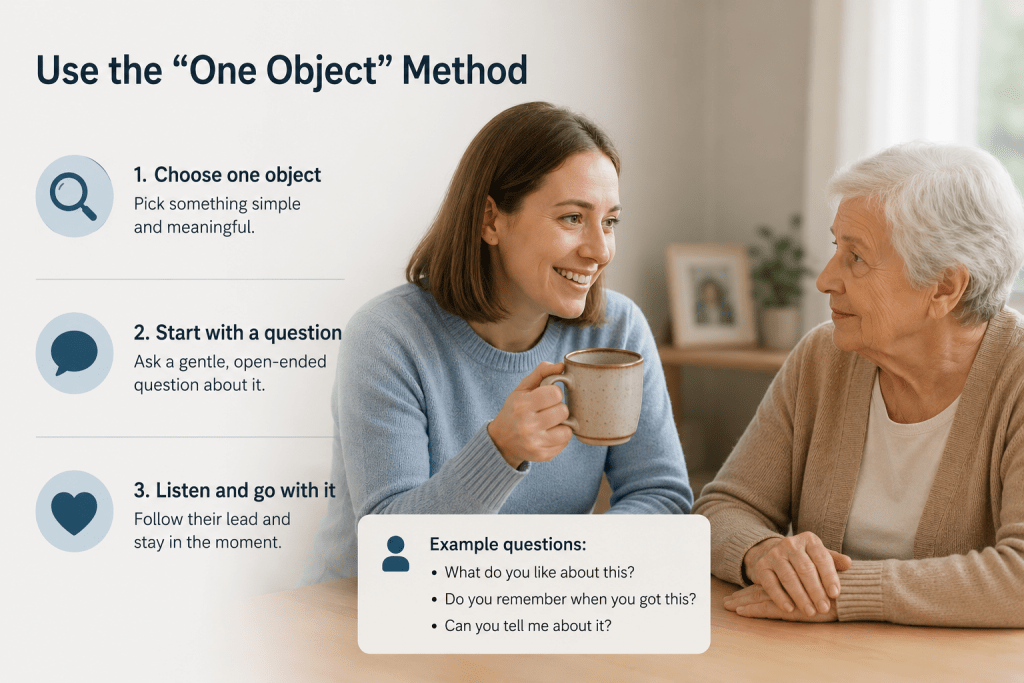
If you are unsure what to talk about, bring one simple object into the conversation. One object gives the person something concrete to look at, touch, smell, or listen to. It can reduce the pressure of direct eye contact and make the conversation feel more natural.
Good objects include:
A family photo
A soft scarf
A favorite cup
A recipe card
A flower
A familiar book
A piece of music
A holiday ornament
A safe household item from their past
The object should be simple, safe, and not visually overwhelming. Avoid bringing a large pile of photos or too many keepsakes at once. Too many items can create confusion.
Start with a statement:
“I brought this scarf. It feels soft.”
Then pause.
If they respond, follow their lead. If they do not, continue gently:
“It has a nice color.”
“You wore something like this often.”
“It reminds me of winter mornings.”
The object becomes the anchor. You do not need to force a full conversation. The person may simply hold it, smile, or relax. That still counts as connection.
Build a Small Personal Conversation Menu
Families often feel stuck because they try to invent new topics every time. A better approach is to create a small “conversation menu” of reliable, familiar themes that usually feel safe for the person.
This menu can include:
Favorite foods
Childhood home
Music they enjoyed
Work they felt proud of
Gardening
Pets
Festivals or holidays
Faith or spiritual routines, if meaningful to them
Favorite colors
Weather
Family roles they valued
Daily comforts such as tea, blankets, sunlight, or flowers
Write down which topics bring warmth and which topics create stress. This is especially useful if multiple family members, caregivers, or companions speak with the person. Over time, the menu becomes a practical guide.
For example:
Topics that usually help:
Old songs
Her rose garden
Morning tea
Photos of grandchildren
Soft blankets
Topics to avoid:
Money
Driving
Medical appointments
Arguments between relatives
Questions about recent events
This kind of list prevents accidental distress. It also helps new caregivers or callers connect faster and more respectfully.
Follow Their Emotional Lead, Not the Original Plan
You may begin with a photo, but the person talks about the weather. Follow the weather. You may ask about music, but they focus on the color of your shirt. Follow the shirt. You may plan a cheerful call, but they seem sad. Follow the sadness gently.
A dementia-friendly conversation is not a straight road. It is more like walking beside someone and matching their pace.
If they say something unrelated, resist the urge to pull them back immediately. Instead, respond to the feeling or the visible cue.
If they say, “I need to go home,” you might say:
“You want to feel settled. I’m here with you.”
If they say, “Where is my mother?” you might say:
“You’re thinking about your mother. She must have been important to you.”
If they point to a window and say, “Look,” you might say:
“Yes, I see it. The trees are moving.”
This makes the person feel accompanied, not corrected.
Keep a Few “Rescue Starters” Ready
Sometimes a conversation becomes strained, repetitive, or confusing. Having rescue starters ready can help you shift the mood without panic.
Use rescue starters that are sensory, simple, and present-focused:
“Let’s take a sip of water.”
“Listen, that song is soft.”
“This chair feels comfortable.”
“Your hands are warm.”
“Look at the light on the wall.”
“Let’s breathe slowly together.”
“Would you like to sit by the window?”
These starters work because they bring attention back to the body and the present moment. They are not arguments. They are gentle invitations.
You can also use activity-based rescue lines:
“Help me fold this towel.”
“Let’s look at this card.”
“Can you hold this for me?”
“Let’s smooth this blanket.”
Small tasks can be grounding. They offer purpose without pressure.
Know When Silence Is the Best Conversation Starter
Families sometimes feel guilty when there is silence. But silence is not failure. For many people with dementia, a quiet shared moment can feel safer than constant talking.
If the person closes their eyes, looks peaceful, or gives short replies, allow silence. Sit nearby. Smile gently. Hold their hand if welcomed. Play soft music if it helps. Let the visit be calm rather than busy.
You can say:
“We don’t have to talk. I’m happy just sitting with you.”
This gives permission to relax.
In many cases, the emotional memory of your presence may matter more than the words. They may not remember the conversation later, but the feeling of being safe, respected, and loved can remain.
Use a Simple After-Conversation Review
After a visit or call, take one minute to note what worked. This helps you improve future conversations and avoid repeating stressful patterns.
Ask yourself:
What time of day was best?
Which topic made them smile?
Which question seemed too hard?
Did they respond better to choices or statements?
Did music, photos, touch, or quiet help?
Was there a sign of pain, hunger, fatigue, or overstimulation?
What should I try next time?
You do not need a complicated journal. A short note is enough:
“Tuesday morning: liked old songs, smiled at garden photo, got tired after 10 minutes, avoid asking about lunch.”
These notes are extremely useful for families. They help everyone communicate with more consistency and less guesswork.
A Practical Formula for Any Dementia-Friendly Conversation
When you do not know what to say, use this simple formula:
Notice + Name + Offer
First, notice what is happening. Then name it gently. Then offer one simple next step.
Examples:
“I see you looking at the window. The sky is bright. Would you like to sit closer?”
“You’re holding the blanket. It looks soft. Should I tuck it around you?”
“You seem quiet today. That’s okay. I can sit with you.”
“You smiled at this song. It sounds familiar. Shall we listen a little longer?”
This formula works because it begins in the person’s current reality. It does not demand memory. It does not rush them. It gives them a small, respectful way to participate.
The Real Goal: A Calm Feeling, Not a Perfect Conversation
The best dementia-friendly conversation starter is not the one that produces the longest answer. It is the one that helps the person feel safe, included, and respected.
Some conversations will be full of words. Some will be quiet. Some will repeat. Some will drift. Let that be okay.
Instead of measuring success by how much the person remembers, measure it by the emotional tone you create. Did they seem calmer? Did they smile? Did their body relax? Did they feel less alone? Did you protect their dignity?
That is meaningful communication.
A simple sentence, a familiar object, a gentle choice, or a peaceful silence can all become conversation when they are offered with patience and care.
Conversation Starters That Help Reduce Anxiety, Restlessness, and Agitation
One of the hardest parts of communicating with a person living with dementia is knowing what to say during moments of anxiety, confusion, or agitation. Many families feel pressure to “fix” the situation quickly. They try explaining, correcting, reasoning, or asking more questions. Unfortunately, this often increases distress instead of reducing it.
In dementia care, emotional comfort matters more than factual accuracy.
A person living with dementia may forget recent events, misunderstand the environment, or repeat worries many times. What they are usually expressing is not simply confusion — it is an emotional need. They may be seeking safety, reassurance, familiarity, comfort, or control.
That means the most effective conversation starters during difficult moments are not logical explanations. They are calming emotional bridges.
The good news is that you do not need perfect words. You only need a calm approach, gentle pacing, and emotionally safe responses.
This section focuses on practical conversation techniques that can help reduce tension and create emotional stability during difficult moments.
First: Understand What Agitation Often Really Means
Agitation is usually communication.
A person with dementia may not always be able to clearly say:
“I’m uncomfortable.”
“I’m scared.”
“I’m overstimulated.”
“I’m tired.”
“I’m lonely.”
“I don’t understand what’s happening.”
Instead, those feelings may appear as:
- Repeated questions
- Pacing
- Irritability
- Refusing help
- Restlessness
- Anger
- Calling out
- Wanting to “go home”
- Suspicion
- Withdrawal
- Sudden emotional shifts
Before speaking, pause and ask yourself:
“What feeling might they be trying to express?”
This mindset changes the entire conversation. Instead of correcting behavior, you begin supporting emotions.
For example:
If someone repeatedly says, “I need to go home,” the real meaning may be:
“I want safety.”
“I want familiarity.”
“I feel uncertain.”
“I want comfort.”
Responding emotionally instead of literally often works better.
Instead of:
“But you are home.”
Try:
“You want to feel comfortable and safe.”
That response acknowledges the feeling without starting an argument.
Lower Your Own Stress Before Starting the Conversation
People living with dementia are highly sensitive to emotional tone. Even if they cannot fully process words, they often notice tension, impatience, rushed energy, or frustration.
Before speaking:
- Slow your pace
- Relax your shoulders
- Lower your voice slightly
- Take one slow breath
- Sit instead of standing over them
- Make eye contact gently
- Remove distractions if possible
Your calmness becomes part of the conversation.
If you sound hurried, anxious, or irritated, even kind words may feel stressful. But if your tone feels safe, even simple words can bring comfort.
A useful reminder is:
Connection first. Correction later.
And in many cases, correction is not needed at all.
Use Reassurance Before Questions
During moments of anxiety, avoid beginning with too many questions.
Questions require mental effort. Reassurance reduces pressure.
Start with calming statements like:
“You’re safe.”
“I’m here with you.”
“We have time.”
“You’re not alone.”
“We’ll figure this out together.”
“It’s okay.”
“Nothing bad is happening right now.”
These statements create emotional grounding before conversation begins.
After reassurance, you can gently redirect attention.
For example:
“You’re safe. Let’s sit near the window for a minute.”
Or:
“I’m here with you. Would some water help?”
The order matters:
- Calm first
- Direction second
Not the other way around.
Avoid “Why” Questions During Stressful Moments
“Why” questions often increase frustration because they require reasoning and self-awareness that dementia may affect.
Avoid:
“Why are you upset?”
“Why did you do that?”
“Why don’t you remember?”
“Why are you angry?”
Instead, use observational conversation starters.
Try:
“You seem uncomfortable.”
“You look worried.”
“That felt upsetting.”
“This seems frustrating.”
“You want things to feel calmer.”
These statements feel supportive instead of demanding.
They also reduce shame.
Use Validation Instead of Correction
One of the most powerful dementia communication tools is validation.
Validation means responding to the emotion instead of arguing about the facts.
For example:
If someone says:
“My mother is coming soon.”
Correcting them with:
“Your mother passed away years ago.”
may create grief all over again.
Instead, validate the feeling underneath:
“You’re thinking about your mother today.”
“She sounds important to you.”
“You miss her.”
This approach reduces emotional shock.
Validation does not mean lying or pretending. It means prioritizing emotional comfort over factual correction.
Gentle Conversation Starters for Moments of Anxiety
When someone seems nervous, unsettled, or overwhelmed, use short calming prompts.
Helpful examples include:
“Let’s sit together for a moment.”
“You’re okay here.”
“I’ll stay with you.”
“Would holding this blanket help?”
“Let’s listen to something soft.”
“You don’t need to rush.”
“We can take this slowly.”
“Would you like some tea?”
“Let’s look outside together.”
Notice the pattern:
- Short sentences
- Calm rhythm
- No pressure
- Present-focused language
Avoid long explanations.
The Power of Present-Moment Conversation
People with dementia often respond better to what they can currently see, hear, touch, or feel.
The present moment is usually safer than abstract thinking.
Instead of discussing complicated plans or recent events, focus on immediate sensory experiences.
Examples:
“The sunlight feels warm.”
“This music sounds peaceful.”
“The flowers smell nice.”
“That blanket looks soft.”
“The rain sounds gentle today.”
These simple observations reduce mental strain and create calm connection.
This technique works especially well during:
- Sundowning
- Confusion
- Repetitive questioning
- Waiting periods
- Restlessness
- Emotional overwhelm
What to Say During Repetitive Questions
Repeated questions are extremely common in dementia.
A person may ask the same thing many times because:
- They forget the answer
- They are anxious
- They are seeking reassurance
- They are trying to regain orientation
- They feel insecure
Families often become exhausted and start responding with irritation.
But usually, the repeated question is emotional rather than informational.
For example:
“Where are we going?”
may actually mean:
“Am I safe?”
“What’s happening?”
“Am I being left alone?”
Instead of giving longer explanations each time, try calm repetitive reassurance.
Examples:
“We’re staying here together.”
“Everything is okay.”
“We have plenty of time.”
“I’m with you.”
Then gently redirect:
“Would you like to look at this photo?”
“Can you help me fold this towel?”
“Let’s sit for a moment.”
Consistency matters more than perfect wording.
Calming Conversation During Sundowning
Many people with dementia become more confused, anxious, or restless in the late afternoon or evening. This is often called sundowning.
During these hours:
- Keep language simpler
- Reduce stimulation
- Lower noise levels
- Avoid complicated decisions
- Use familiar routines
- Speak more slowly
Helpful evening conversation starters include:
“It’s evening now. We can relax.”
“The day is winding down.”
“Let’s make things cozy.”
“Would soft music feel nice?”
“You can rest now.”
“I’ll stay nearby.”
Avoid introducing stressful topics late in the day, such as:
- Appointments
- Finances
- Corrections
- Family conflicts
- Complex decisions
Evening conversations should focus on comfort and predictability.
Redirecting Without Making the Person Feel Controlled
Redirection is useful, but it should feel natural — not forceful.
Bad redirection often sounds dismissive:
“Stop worrying about that.”
“Don’t think about it.”
“You already asked that.”
“You’re confused.”
Gentle redirection acknowledges the feeling first.
For example:
“That sounds important.”
Pause.
“Let’s sit down while we talk.”
Or:
“I can see this is on your mind.”
Pause.
“Would it help to have some tea first?”
This approach feels respectful.
The person does not feel ignored or managed.
Conversation Starters That Encourage Relaxation Through Familiarity
Familiar routines are calming because they reduce uncertainty.
Use conversation tied to familiar rhythms:
“It’s almost tea time.”
“Let’s listen to your favorite song.”
“Your chair is ready.”
“I brought your sweater.”
“We always enjoyed quiet evenings.”
“Would you like your usual blanket?”
Familiarity creates emotional stability even when memory changes.
This is why repeated comforting conversations are not “pointless.” Repetition itself can feel reassuring.
How to Respond When Someone Wants to “Go Home”
This is one of the most emotional situations families face.
The person may already be home, yet still say:
“I want to go home.”
Usually, “home” represents:
- Safety
- Identity
- Childhood comfort
- Emotional security
- Familiarity
- Control
Avoid arguing.
Instead of:
“But this is your home.”
Try emotional acknowledgment:
“You want to feel comfortable.”
“You miss that feeling of home.”
“You want things to feel familiar.”
Then redirect gently toward comfort:
“Let’s sit somewhere cozy.”
“Tell me what you loved about home.”
“Would tea help right now?”
“You’re safe here with me.”
Sometimes the emotional need matters more than the literal words.
Use Activities as Conversation Supports

Conversation becomes easier when paired with gentle activity.
Activities reduce pressure because the focus is shared.
Helpful calming activities include:
- Folding towels
- Watering plants
- Looking through photos
- Listening to music
- Holding a warm drink
- Brushing a pet
- Sorting cards
- Sitting outdoors
- Simple baking tasks
- Touching textured fabrics
Conversation can then happen naturally around the activity.
Examples:
“This towel feels soft.”
“These flowers are beautiful.”
“This song has a peaceful rhythm.”
“This reminds me of old kitchens.”
The activity becomes the bridge.
Words and Phrases That Often Increase Stress
Certain phrases unintentionally create shame or defensiveness.
Try to avoid:
- “Don’t you remember?”
- “I just told you.”
- “That never happened.”
- “You’re wrong.”
- “Calm down.”
- “Stop that.”
- “You already asked.”
- “You know better than that.”
Even if factually correct, these phrases can make the person feel unsafe or criticized.
Replace them with:
- “Let’s figure it out together.”
- “That sounds difficult.”
- “I’m here.”
- “We have time.”
- “You’re safe.”
- “It’s okay.”
Use Your Voice Like a Comfort Tool
Tone often matters more than vocabulary.
A calm voice can reduce fear even when the person forgets the words themselves.
Helpful voice techniques:
- Speak slowly
- Pause often
- Use warm tone
- Keep sentences short
- Avoid sounding rushed
- Lower volume slightly instead of raising it
- Leave space for processing
Fast speech creates cognitive overload.
Silence between sentences helps the person keep up emotionally and mentally.
Watch for Physical Causes of Distress
Sometimes conversation alone cannot solve agitation because the real problem is physical discomfort.
Before assuming the issue is emotional, consider:
- Hunger
- Pain
- Fatigue
- Bathroom needs
- Dehydration
- Temperature discomfort
- Loud environments
- Overstimulation
- Medication timing
- Loneliness
A person may become agitated because they cannot communicate discomfort clearly.
Conversation starters can help uncover needs gently:
“Are you comfortable sitting here?”
“Would water help?”
“Would you like to stretch your legs?”
“Are you too warm or too cold?”
“Should we move somewhere quieter?”
Simple supportive questions can reveal hidden discomfort.
What Emotional Safety Really Looks Like
A dementia-friendly conversation is not about perfect communication.
It is about helping the person feel:
- Safe
- Seen
- Included
- Respected
- Unhurried
- Comforted
That emotional atmosphere matters far more than having a “successful” discussion.
A short interaction filled with patience is often more valuable than a long complicated conversation.
Sometimes success looks like:
- A relaxed face
- Slower breathing
- Eye contact
- Sitting calmly together
- Holding hands
- A small smile
- Less restlessness
These moments matter deeply.
A Simple Framework to Remember During Difficult Moments
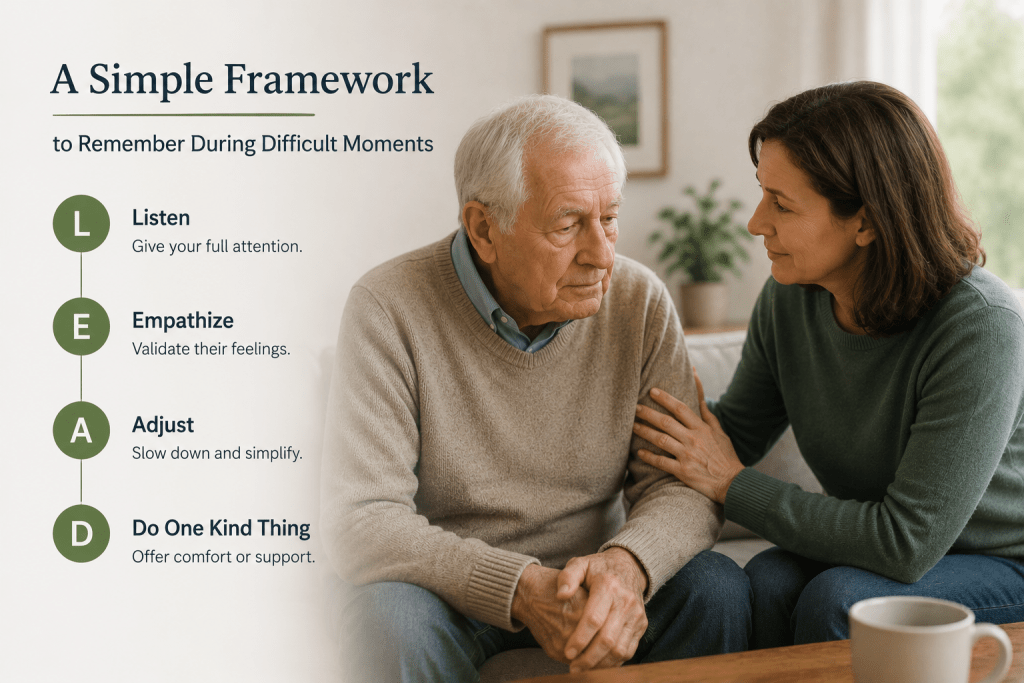
When emotions rise, remember this order:
1. Pause
Do not rush to correct or explain.
2. Reassure
Start with safety and comfort.
3. Validate
Acknowledge the feeling underneath the words.
4. Redirect Gently
Shift attention slowly toward something calming.
5. Stay Calm Yourself
Your emotional tone guides the interaction.
This approach works better than logic because dementia affects reasoning differently than emotional processing.
Even when memory changes, emotional experience often remains very strong.
The Most Important Thing to Remember
A person living with dementia may forget the exact conversation, but they often remember the feeling the interaction created.
That means your calm tone, patience, facial expression, and emotional warmth are never wasted.
You do not need perfect answers.
You do not need to stop every moment of confusion.
You do not need to win arguments or restore accuracy.
You only need to help the person feel less alone in that moment.
And often, the most powerful conversation starter is something very simple:
“I’m here with you.”
When conversations go off-track: validation, redirection, and the Three R’s
Sometimes a chat veers into a scene that feels unsteady and alarming—this is when steady care matters most.

Off-track moments are common. Your loved one may insist they must leave for work or ask about a person who has died. The disease changes perception of events. Arguing usually adds distress.
Start with feelings, not facts
Validate first. Name the emotion: “That sounds worrying.” “I can see you’re upset.” These simple lines calm the body and open a path forward.
Use the Three R’s: a clear way through
- Reassure: “I’m here. You’re safe with me.”
- Redirect: Move the focus — offer a snack, a walk, or a quieter room.
- Reminisce: Invite a memory with a photo or song: “Tell me about the job you loved.”
Short scripts and repeating questions
Keep answers brief. Repeat calm reassurance rather than proof. If a question repeats, reply with the same steady line and a small action.
“You’re safe. Let’s sit and have a cup together.”
De-escalation and pick-your-battles
Lower your voice and slow your movements. Offer a gentle touch if welcomed. Reduce light and noise. If a belief is not harmful, let it pass and focus on comfort.
If you feel frustrated, step away safely for a moment. Return with a soft voice and an open posture. One tense moment does not define your care.
For a practical escalation plan for unanswered check-ins, see the no-answer escalation plan.
Keep connection strong as communication changes over time
A steady rhythm of brief chats helps preserve warmth and lowers stress for both people.

Plan shorter, regular conversations to reduce fatigue
Short contact, often at the same time each day, gives structure and predictability. Aim for frequent, fifteen-minute check-ins rather than one long visit that drains energy.
Support independence without pressure
Invite participation in small tasks like folding towels or choosing an outfit. Praise effort, not perfect memory. That keeps dignity and offers real chances for engagement.
Later stages: presence, music, and emotion
When speech fades, presence matters most. Sit close, hold a hand if welcome, and play familiar songs. Tone, face, and calm body language communicate safety and care.
Language shifts and translation support
Some people return to a first language as memory changes. Bring a bilingual family member, use interpretation services, or try a translation app when needed. This restores comfort and richer exchange.
Caregiver well-being
Grief and stress are common. Schedule breaks, rotate tasks with family, and consider respite. Join a support group or ask for practical help—rest makes care more sustainable.
“You can love deeply and still need a break.”
If you want extra support staying connected between visits, sign up for JoyCalls: https://app.joycalls.ai/signup. JoyCalls offers friendly check-in calls and summaries that help families track information and keep care steady.
Conclusion
A calm presence, not a perfect answer, often makes the biggest difference.
Simple and calm is the best way forward. Reduce distractions, sit at eye level, use short sentences, offer small choices, and rely on warm non-verbal cues when words are hard. These tiny changes help your loved one feel safe and seen.
Use the Three R’s in tense moments: Reassure, Redirect, Reminisce. Connection matters more than perfect facts. Progress is not linear—some days bring comfort, other days feel like a loss, and both are valid.
Try one small change today: a single starter, a quiet room tweak, or a short script for repeated questions. If your family needs extra support between visits, JoyCalls offers friendly phone companionship and caregiver summaries.
Talk to Joy now: 1-415-569-2439. Sign up for JoyCalls: https://app.joycalls.ai/signup. For steps when a check-in is missed, see this guide at missed check-in steps.
FAQ
What are calm, simple conversation starters I can use?
Why do conversations change as the condition progresses?
What common communication challenges should I expect?
How does Alzheimer’s affect language and attention?
What kind of room setup supports better communication?
Why is positioning and eye contact important?
What should I check before starting a conversation?
When is the best time for deeper conversations?
How do I use simple, respectful language?
What should I avoid saying or doing?
How can nonverbal cues help when words fail?
When is touch appropriate and helpful?
What are good reminiscence prompts to spark connection?
What topics work well during family visits or in care settings?
Can you give example sentences caregivers can use?
What should I do when a person has a mistaken belief or is confused?
What is the Reassure, Redirect, Reminisce framework?
How should I handle repetitive questions?
What de-escalation steps help if they become agitated?
How can I keep connection as communication changes?
How do I support independence while communicating?
What works in late-stage care when words fade?
What about language changes or the need for translation support?
How can caregivers protect their own well-being?

Ana Avila is a healthcare and technology writer with deep expertise in artificial intelligence, senior care innovation, and the practical use of AI in healthcare operations. Her work focuses on how emerging technologies can improve the daily experience of older adults, support overburdened care teams, and help senior living communities deliver safer, faster, and more personalized support.
Ana’s background includes health informatics, aging care systems, and applied artificial intelligence. Her work explores how digital health tools, predictive analytics, and AI-assisted communication systems can improve care coordination, reduce operational delays, and identify early signs of risk among older adults. She brings an understanding of both the technical side of AI and the human realities of healthcare delivery.
Over the years, Ana has developed a specialized body of work around AI in senior living. She writes about how senior care providers can use intelligent systems to manage resident requests, answer routine questions, support family communication, improve after-hours coverage, and detect patterns that may indicate loneliness, confusion, distress, or unmet needs. Her articles often examine the gap between what senior living teams are expected to deliver and what traditional staffing models can realistically support.
Ana’s healthcare expertise is especially focused on the operational side of care. She has written extensively about call handling, resident engagement, front desk workflows, triage systems, caregiver communication, care escalation, and the hidden administrative burden placed on senior living staff. Her work explains how AI can help reduce repetitive tasks, organize incoming requests, prioritize urgent issues, and give human caregivers more time for meaningful resident interaction.
At the same time, Ana is careful not to present AI as a replacement for human care. A consistent theme in her writing is that technology should support relationships, not weaken them. She argues that the best AI systems in healthcare are not the ones that simply automate the most tasks, but the ones that make care teams more responsive, families more informed, and residents more supported. Her perspective is grounded in the belief that senior living technology must be designed around dignity, trust, privacy, and compassion.
Ana has also written widely on the ethical use of AI in healthcare. Her work discusses the importance of human oversight, transparent escalation rules, resident consent, data minimization, and responsible use of sensitive health and behavioral information. She often emphasizes that AI systems used around older adults must be easy to understand, carefully monitored, and designed with the limitations and needs of real residents in mind, including those with memory loss, hearing challenges, mobility issues, or social isolation.
Her writing has been used as a reference point in discussions about aging, elder care technology, digital health, and AI-supported senior living. She has published 12 papers in journals including JAMA, The BMJ, and SSRN. Some of her articles have also been cited by Wikipedia editors as supporting references on topics related to healthcare, aging, and technology. This has helped position her work as a useful educational resource for readers looking to understand how AI can be applied in real care environments.
In addition to her long-form writing, Ana has contributed research-based commentary, professional explainers, and practical guidance for healthcare operators, senior living decision-makers, and technology teams building products for older adults. Her work combines research literacy with operational practicality. She is able to take complex subjects such as natural language processing, predictive analytics, conversational AI, and care automation, and explain them in a way that is accessible to executives, caregivers, families, and non-technical readers.
Ana’s strongest area of expertise is the intersection of artificial intelligence and senior living operations. She understands that senior care communities face a difficult combination of rising resident expectations, staffing pressure, family communication demands, and increasing care complexity. Her writing explores how AI can be used to ease those pressures through smarter communication systems, faster response workflows, proactive check-ins, and better visibility into resident needs.
Her approach is both evidence-informed and deeply human. She studies AI through the lens of real-world care delivery: whether a resident gets help faster, whether a family member receives a clearer update, whether a caregiver avoids unnecessary administrative work, and whether a senior living team can identify a concern before it becomes a crisis. This practical focus makes her work especially relevant for organizations that want to adopt AI responsibly rather than simply follow technology trends.
Ana Avila is regarded as a thoughtful voice on the future of AI in healthcare and senior living. Her expertise combines research-driven analysis, operational understanding, and a strong commitment to humane technology. Through her writing, she helps healthcare leaders and senior living communities understand not only what AI can do, but how it should be used to improve care, preserve dignity, and strengthen the human relationships at the center of aging support.