


Nearly one in three quick family calls ends with hurt feelings after a careless line lands wrong.
This short guide shows simple language swaps that protect dignity and keep bonds strong as life changes arrive.
Picture a busy adult juggling work, kids, and a brief check-in. One sharp phrase can create silence or guilt. A kinder turn of phrase keeps the door open.
We’ll cover memory slips, repeated stories, everyday tasks, independence, driving, mobility aids, comfort, and living choices. Along the way you’ll get copy/paste swaps: “Instead of X, try Y.”
Need help staying connected without constant worry? Talk to Joy now: 1-415-569-2439. Sign up for JoyCalls: https://app.joycalls.ai/signup. For tips on tricky health chats, see this guide: how to talk about meds.
Key Takeaways
- Small wording changes protect dignity and ease stress.
- Practice adult-to-adult alternatives you can use today.
- Prep for hot zones: memory, independence, driving, and living choices.
- JoyCalls offers daily AI check-ins and caregiver summaries for peace of mind.
- Be kind to yourself — habit shifts bring calmer conversations.
Why your words matter with aging parents
Words shape how people feel about growing older; small slips can sting. Insensitive lines often amplify fear and create distance. Respect matters. So does an adult-to-adult tone.

How common phrases can feel dismissive, critical, or patronizing
Short examples show the harm: a sigh, a rushed correction, or “you’re not as sharp.” These cues can make feelings of loss worse.
“That sounds frustrating.”
Preserving dignity, respect, and the adult-to-adult relationship
Treating someone as an adult means asking, listening, and involving them in choices. Validation helps: name the feeling, then offer options.
Patience and empathy as the foundation for better conversations
Use a simple pause tool: breathe, lower your voice, ask an open question, then offer help. Scripts save time and stop criticism from slipping in.
- Explain why little phrases hit hard.
- Validate feelings without agreeing with every point.
- Use empathy framing: imagine your own perspective.
| Problem | Harmful line | Better option |
|---|---|---|
| Memory slip | “You’re not making any sense” | “That sounds frustrating — can you tell me more?” |
| Loss of independence | “Let me handle it” | “Would you like help or to try it together?” |
| Rushed moments | Sigh or impatience | Pause, lower voice, ask an open question |
For practical scripts and more ways to keep connection, see help a parent who refuses social.
what not to say to elderly parents when memory changes show up
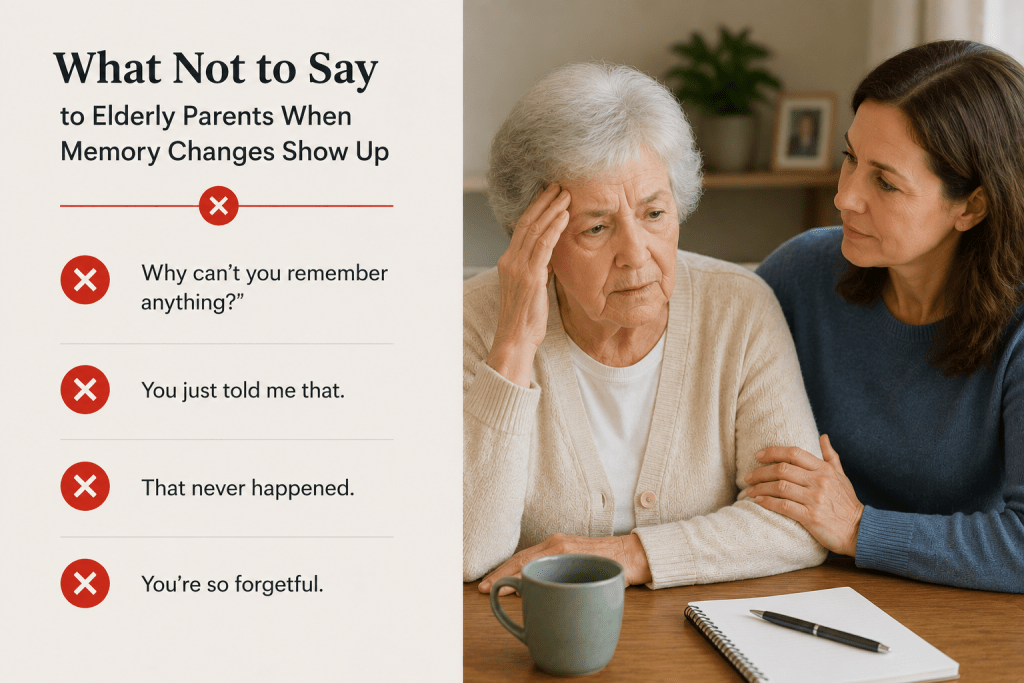
Small memory slips often spark big feelings; a gentle approach eases both.
Avoid language that shames forgetfulness
Shaming lines like “Why can’t you remember that?” or “You should know this by now!” make someone feel small and defensive.
Call out the shame trigger: embarrassment fuels silence and withdrawal. Replace blame with curiosity and calm.
Try supportive prompts that validate feelings and reduce frustration
- Don’t: “You told me this already.” — Do: “I love hearing about it—what happened next?”
- Don’t: “You should know this.” — Do: “It’s okay. Let’s work it out together.”
- Use prompts: “No rush,” “We can take it one step at a time,” “Want me to jot it down?”
Use practical solutions like writing it down and problem-solving together
Offer simple supports that keep dignity: one notebook, a shared calendar on the fridge, or a clear medication list.
Team language helps: “Let’s problem-solve” or “Would it help if we wrote this down?” invite cooperation rather than criticism.
“If memory slips become frequent, bring it up with their primary physician as a care step, not a judgment.”
| Problem | Don’t | Do |
|---|---|---|
| Repeated info | “You told me this already.” | “I love hearing it—tell me more.” |
| Embarrassment | “You should know this.” | “No rush—let’s work this out.” |
| Daily confusion | Scolding | Shared notes and gentle reminders |
Quick tip: a simple system saves time and reduces conflict for busy families. For extra support, consider daily check-ins that surface moments of confusion early — see this memory support guide for scripts and approaches.
What not to say when a parent repeats stories and memories
D. A repeated story can be a way of holding on to good times; your reaction shapes the next call.
Repetition often means comfort, identity, and a wish for connection. When a loved one shares the same memory, they are reaching for belonging.
Defensive lines like “You already told me that” can make someone feel like a burden and shut down future conversations.

Better responses that invite detail
- ✓ Try curiosity: “That’s a good one—what year was that?”
- ✓ Ask follow-ups: “Who else was there with you?”
- ✓ Use a two-minute connection: ask two engaged questions, then offer a gentle next step: “I love this—can I call tonight and hear the rest?”
- ✓ Create family consistency: coach siblings to use the same respectful lines so your loved one feels seen, not corrected.
- ✓ Capture the story: record a voice memo so repetition becomes a legacy, not a fight.
“They aren’t repeating to annoy you — they’re sharing a piece of themselves.”
| Common behavior | Harmful reaction | Better response |
|---|---|---|
| Repeating a favorite memory | “You already told me” | “Tell me the best part again—what made it special?” |
| Looping during a call | Short replies and change of topic | “That’s lovely—can I save this as a voice note?” |
| Seeking connection | Impatience | Two-minute questions, then a kind transition |
Good communication protects the relationship. It helps family members feel like their life mattered. For more easy prompts and conversation ideas for seniors, try short scripts that keep calls warm and steady.
What not to say when they’re struggling with everyday tasks
Everyday chores can hide pain or vision gaps that words often miss.
Try JoyCalls Free
No app or new device needed. Start with a free 7-day trial.
“This isn’t hard” brushes past real limits like arthritis, shaky hands, and dimming sight. That line can make someone feel rushed and small.

Offer help without taking over
Try gentle offers that keep independence intact. Ask, “Would you like me to help with that?” or “Want a hand, or do you want to try first?” These scripts give choice and build trust.
Phrases that preserve dignity and support
- “Let’s figure this out together.” — shares care and teamwork.
- “Tell me how you’d like to do it.” — preserves independence.
- “Take your time. I’m here.” — reduces pressure and makes them feel safe.
“Small adjustments — better lighting, a jar opener, larger text — help more than a rushed correction.”
If impatience rises, step away for 10 seconds. The right words and a bit of practical assistance increase cooperation and reduce future resistance. For guidance on language and tone, see this language and tone guide.
What not to say about independence, autonomy, and control
Taking over can feel like erasing a life’s routines; choice keeps connection alive.

Avoid “Just let me handle it” when they still want to participate
“I’ll do it” can sound like “You can’t.” Name the emotional core: control equals dignity. That matters more than fixing a chore.
Use choice-based language that respects what they would like
Offer scripts that keep agency. Try: “What would you like to do first?” or “Do you want me to sit with you while you do it?”
How to collaborate on options instead of dictating solutions
Frame the approach as teamwork. Say: “Let’s look at some options together.” List two choices and ask which feels best.
When frustration spikes: staying calm to prevent a heated conversation
- ✓ Name the feeling: “I can see this is frustrating.”
- ✓ Slow your voice and lower volume.
- ✓ Use a repair phrase if you slip: “I’m sorry—that came out wrong. I want to support you, not take over.”
“Control equals dignity — choosing keeps people involved and respected.”
Keep discussions adult-to-adult. Good communication protects independence and builds trust. When you can’t be there daily, an AI companion call can make your parent feel heard and ease pressure on a single conversation.
What Not to Say When Emotions, Health, and Big Decisions Come Up
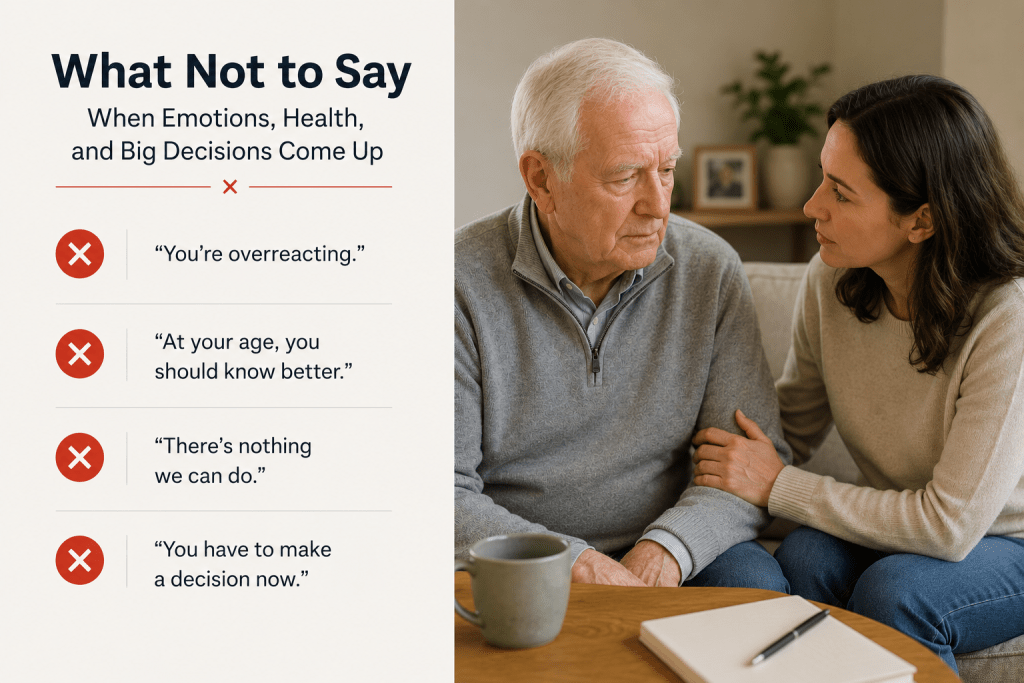
Some of the hardest conversations with older adults are not about one specific task. They are about feelings, identity, health, privacy, and the slow realization that life is changing. These moments can happen during a phone call, at a doctor’s appointment, after a fall, while discussing medication, or when a parent quietly says, “I just don’t feel like myself anymore.”
This is where many well-meaning families accidentally say the wrong thing.
Not because they are careless, but because they are scared. They want to fix the problem quickly. They want their loved one to agree, accept help, take the medicine, go to the appointment, stop worrying, or make the “right” decision. But when an older adult is already feeling vulnerable, rushed advice can sound like pressure. Reassurance can sound dismissive. Concern can sound like control.
The goal is not to avoid difficult topics. Families do need to talk about health, safety, money, loneliness, grief, and future care. The goal is to talk about those things in a way that protects dignity and keeps the door open.
A good rule is this: before you respond to the problem, respond to the person.
Avoid saying, “Don’t worry about it”
“Don’t worry about it” is usually meant to comfort. But to an older adult, it can feel like you are brushing aside something that matters to them.
If they are worried about a medical test, a new symptom, a bill, a missed appointment, or being alone at night, telling them not to worry may make them feel unheard. They may stop sharing because they assume you do not want to listen. Worse, they may start carrying the worry silently.
A better response is to make room for the concern before trying to reduce it.
Instead of saying:
“Don’t worry about it.”
Try:
“I can understand why that would be on your mind. Let’s talk through what we know and what the next step is.”
Or:
“That sounds stressful. Do you want me to just listen for a minute, or would it help if we made a small plan?”
This gives them two important things: emotional validation and practical support. It tells them their concern is not silly, but it also prevents the conversation from becoming overwhelming.
When an older adult repeats a worry, do not assume they are being dramatic. Repeated worry can come from uncertainty, lack of information, poor sleep, loneliness, pain, or fear of becoming dependent. The answer is not always a lecture. Sometimes it is a calm, steady sentence they can hold onto.
Try saying:
“We do not have to solve everything today. Let’s handle the next step first.”
That one sentence can reduce pressure. It also gives the conversation structure.
Avoid saying, “You’re fine”
“You’re fine” can be one of the most damaging phrases in health-related conversations. It may sound comforting to you, but it can feel dismissive to the person experiencing pain, fatigue, dizziness, anxiety, or confusion.
Older adults are often already worried about being seen as difficult. Some may minimize symptoms because they do not want to burden their family. If they finally speak up and hear “You’re fine,” they may decide not to mention symptoms again.
A better approach is to take the concern seriously without jumping to panic.
Instead of saying:
“You’re fine.”
Try:
“I’m glad you told me. Let’s pay attention to it and decide whether we should call the doctor.”
Or:
“That sounds uncomfortable. When did it start?”
Or:
“Has this happened before, or is this new?”
These questions are respectful because they show you are listening. They also help you gather useful information.
This does not mean every complaint needs an emergency response. It means the first response should not shut the person down. If your parent says they feel weak, lightheaded, unusually confused, short of breath, or different than usual, pause and ask specific questions. Keep your tone calm. Write down what they say if needed.
A helpful pattern is:
Acknowledge → ask → act.
For example:
“I hear that your chest feels tight. When did it begin? Let’s call your doctor’s office now and ask what they recommend.”
That sounds much better than:
“You’re probably fine. Just rest.”
The first response protects safety and dignity. The second response risks making them feel ignored.
Avoid saying, “At your age, what do you expect?”
This phrase can land very harshly, even when said casually. It suggests that pain, sadness, memory changes, loneliness, or reduced energy are simply the price of being old and not worth addressing.
Older adults already live in a world that often treats aging as decline. They may hear subtle messages that their discomfort matters less because they are older. Saying “at your age” can reinforce that fear.
Instead of using age as the explanation, focus on the specific experience.
Instead of saying:
“At your age, aches and pains are normal.”
Try:
“That sounds painful. Let’s see what might make it easier.”
Instead of:
“Well, you’re getting older.”
Try:
“I know this change is frustrating. Let’s figure out what support would help you keep doing what matters to you.”
This shift matters because it separates the person from the problem. Aging may be part of the context, but it should not become a reason to dismiss discomfort.
A more respectful way to talk about aging is to say:
“Bodies change, but you still deserve comfort, answers, and good care.”
That sentence communicates compassion without pretending aging does not exist.
It is also important not to make jokes about age when someone is sharing something serious. A light joke may be fine when both people are laughing, but it can hurt when the older adult is talking about a real fear.
If they say, “I hate that I can’t walk as far anymore,” avoid replying with, “That’s what happens when you get old.”
Try:
“That must be disappointing. What would make outings feel easier now?”
This keeps the conversation focused on adaptation, not decline.
Avoid talking about them as if they are not in the room
This mistake often happens during doctor visits, family meetings, hospital discharges, or discussions with caregivers. A son or daughter may answer every question for the older adult. A doctor may look at the family member instead of the patient. Relatives may discuss plans while the older adult sits quietly nearby.
Even if the intention is to help, it can feel humiliating.
Unless the older adult has asked you to speak for them, include them directly. Look at them. Ask what they think. Give them time to answer. Do not rush in just because they pause.
Instead of saying to the doctor:
“She has been forgetting everything.”
Try turning to your loved one first:
“Mom, do you want to explain what has been happening, or would you like me to add what I’ve noticed?”
This preserves dignity while still allowing you to help.
Instead of saying to a sibling:
“We need to move Dad somewhere safer.”
Try:
“Dad, we want to talk with you about what would help you feel safe and supported at home. What feels hardest right now?”
Even when cognitive changes are present, respectful inclusion matters. A person may need support processing information, but they should not be erased from the conversation.
If you need to share sensitive details with a doctor, ask permission when possible.
Try:
“Would it be okay if I mention what I noticed last week?”
That small question can make a big difference. It tells your loved one, “You are still in charge of your story.”
Avoid saying, “We already decided”
Big decisions can create conflict in families, especially when adult children believe the answer is obvious. Maybe they think their parent needs help at home, should stop driving, should move closer, should use a walker, or should accept a caregiver.
But saying “we already decided” can feel like a betrayal. It tells the older adult that decisions are being made around them, not with them.
Even when a change is necessary, the conversation should still include choice wherever possible.
Instead of saying:
“We already decided you need someone coming in three days a week.”
Try:
“We are worried about you managing everything alone. Can we talk about what kind of help would feel least intrusive?”
Instead of:
“You’re moving closer to us.”
Try:
“We would feel better if support was nearby. Let’s look at a few options together and talk about what you would want.”
When families remove all choice, older adults may resist even helpful solutions. Not always because the idea is bad, but because the process feels disrespectful.
A better strategy is to separate the non-negotiable concern from the flexible details.
For example:
“The safety concern is real. But there are several ways we can handle it. Let’s talk about which option feels most comfortable.”
This approach is honest without being forceful. It also reduces the chance of a power struggle.
When possible, offer controlled choices:
“Would you prefer help in the mornings or afternoons?”
“Would you rather try a caregiver once a week first or start with grocery delivery?”
“Would you like me to sit with you while we call, or would you rather make the call yourself?”
Choice does not mean ignoring risk. It means preserving dignity while addressing risk.
Avoid saying, “You’re being difficult”
Older adults may refuse help for many reasons. They may be afraid of losing independence. They may worry about money. They may feel embarrassed. They may not trust a new person in the home. They may still be grieving a spouse. They may need more time to adjust.
Calling them difficult turns the conversation into a character judgment.
Instead of saying:
“You’re being difficult.”
Try:
“I can see this does not feel comfortable. Help me understand what worries you most.”
Or:
“I know this is not the option you wanted. What part of it feels hardest?”
This changes the tone from accusation to curiosity.
When someone resists, do not push harder immediately. Slow down. Ask what the resistance is protecting. Often, the objection is not really about the surface issue.
For example, if your parent refuses a meal delivery service, the deeper worry may be:
“I do not want strangers thinking I cannot cook.”
If they refuse a medical alert device, the deeper worry may be:
“I do not want to look helpless.”
If they refuse daily check-ins, the deeper worry may be:
“I do not want to feel monitored.”
Once you understand the real concern, you can respond more effectively.
Try:
“I do not want this to feel like surveillance. I want it to feel like support. What kind of check-in would feel respectful to you?”
That sentence is much more likely to lead somewhere productive.
Avoid saying, “I’m only trying to help” in a frustrated tone
“I’m only trying to help” is often said when a caregiver feels hurt or unappreciated. That feeling is real. Caregiving can be stressful, especially when you are juggling work, family, distance, finances, and worry.
But when said sharply, this phrase can sound like guilt. It may make the older adult feel like they are a burden for having needs or preferences.
Instead of defending your intention, acknowledge the impact.
Try:
“I’m sorry. I think I came across as pushy. I do want to help, but I also want to respect how you feel.”
Or:
“You’re right to want a say in this. Let me slow down.”
This kind of repair is powerful. You do not have to be perfect. You just have to notice when the conversation is going off track and bring it back with humility.
A good repair phrase has three parts:
Name what happened.
Clarify your intention.
Return choice to them.
For example:
“I interrupted you. I’m sorry. I was worried, but I want to hear what you were going to say.”
This is much better than:
“I’m only trying to help, so stop getting upset.”
The second version may be true from your point of view, but it does not help the relationship. The first version lowers defensiveness and makes it easier to continue.
Avoid rushing serious conversations during stressful moments
Many families bring up difficult topics at the worst possible time: right after a fall, during a rushed visit, in the car, at the hospital, or when everyone is tired. The topic may be important, but the timing makes it harder.
If your loved one is hungry, exhausted, embarrassed, in pain, or surrounded by other people, they may not be able to have a thoughtful conversation.
Instead of forcing the full discussion immediately, name the concern and schedule a calmer time.
Try:
“I do want to talk about what happened today, but not while everyone is upset. Let’s rest now and talk tomorrow morning.”
Or:
“This matters, and I do not want to rush it. Can we sit down after lunch and go through it together?”
This gives the older adult time to prepare emotionally. It also helps you avoid saying things from fear.
For big topics, use a simple conversation structure:
First, ask permission.
Second, state the concern clearly.
Third, ask for their view.
Fourth, discuss one next step.
For example:
“Can we talk about something I’ve been worried about? I noticed you seemed unsteady on the stairs twice this week. How did it feel to you? Would you be open to trying a brighter hallway light or a rail on that side?”
This is strategic because it avoids dumping every worry at once. It also makes the next step small enough to accept.
Avoid correcting feelings with facts
Older adults may say things that are emotionally true even if they are not factually complete.
They may say:
“No one visits me.”
Even if you visited two days ago.
They may say:
“I’m useless now.”
Even if they still contribute to the family.
They may say:
“Everyone is trying to take over.”
Even if you are genuinely trying to support them.
The natural reaction is to correct the statement.
“That’s not true. I visited on Sunday.”
“You’re not useless.”
“No one is taking over.”
But facts alone rarely calm feelings. In emotional moments, correction can make someone feel even more alone.
Try validating the feeling before adding perspective.
Instead of:
“That’s not true. I call you every day.”
Try:
“It sounds like you’ve been feeling lonely. I’m glad you told me.”
Instead of:
“You’re not useless.”
Try:
“It hurts to hear you feel that way. You matter to us very much.”
Instead of:
“We are not taking over.”
Try:
“I can see why it might feel that way. I want us to make decisions with you, not around you.”
Validation does not mean you agree with every statement. It means you understand the feeling underneath it.
A helpful phrase is:
“I hear how it feels, even if I see it a little differently.”
This keeps the relationship safe while still allowing honest conversation.
Avoid using baby talk or overly sweet language
Some families slip into a sing-song voice, exaggerated praise, or childlike words without realizing it. They may call an older adult “young lady,” “sweetie,” or “good girl” in a way that sounds affectionate to them. But depending on the relationship and tone, it can feel patronizing.
Older adults do not need to be spoken to like children. They need clarity, patience, warmth, and respect.
Instead of using baby talk, use normal adult language with a calm pace.
Instead of:
“Good job taking your pills!”
Try:
“I’m glad the medication routine is working smoothly.”
Instead of:
“Let’s get you all cleaned up.”
Try:
“Would you like some time to freshen up before we leave?”
Instead of:
“Be a good girl and use your walker.”
Try:
“Please use the walker today so the outing feels steadier and easier.”
The difference is dignity.
Warmth is good. Affection is good. Family nicknames can be fine if the older adult likes them. The problem is not kindness. The problem is talking in a way that reduces the person’s adulthood.
When in doubt, ask yourself:
“Would I use this tone with another adult I respect?”
If the answer is no, adjust it.
Avoid making every conversation about health or safety
When an older adult starts needing more support, family conversations can become very practical. Every call becomes a checklist: Did you eat? Did you take your medicine? Did you sleep? Did the nurse come? Did you check your blood pressure?
Those questions may be necessary, but if they dominate every interaction, the relationship can start to feel clinical. Your loved one may begin to feel managed instead of known.
Make space for ordinary conversation too.
Ask about memories, opinions, preferences, neighbors, food, books, faith, music, old friends, family stories, or what they noticed outside the window. Let them be more than their care needs.
A useful pattern is connection before checklist.
Start with:
“What was the best part of your morning?”
“What have you been thinking about today?”
“Did anything make you laugh this week?”
“What would you like to talk about before we go over appointments?”
Then move into practical questions.
You can say:
“I want to hear about your day first. Then I’ll ask the two health questions I need to check.”
This makes the care conversation feel less like an inspection.
For families using daily check-ins, this is especially important. A good check-in should protect safety while still feeling human. The older adult should not feel like every interaction is a test they can fail.
A simple script for difficult conversations
When you are unsure what to say, use this structure:
“I care about you. I’m noticing something. I want to understand how it feels to you. Can we talk about one small next step?”
Here is how it sounds in real life:
“I care about you, and I want you to feel comfortable at home. I noticed the stairs seemed harder this week. How did they feel to you? Would you be open to looking at one small change, like better lighting or a handrail?”
Or:
“I care about you, and I know this is sensitive. I noticed you sounded worried after the doctor’s visit. What part is weighing on you most? Let’s write down the questions we want to ask.”
Or:
“I care about you, and I do not want to take over. I noticed the bills have been stressful lately. Would it help if we sat together for 20 minutes and sorted only the urgent ones?”
This script works because it avoids blame. It uses observation instead of accusation. It asks for their experience. It suggests one manageable step.
That is the heart of respectful communication with older adults: not avoiding hard truths, but delivering them with care.
Quick phrase swaps for emotional and health-related conversations
Here are some simple replacements you can use right away:
Instead of “Don’t worry about it,” try “I can see why that feels concerning. Let’s look at the next step.”
Instead of “You’re fine,” try “I’m glad you told me. Let’s pay attention to this.”
Instead of “At your age, that’s normal,” try “You still deserve comfort and support. Let’s see what might help.”
Instead of “We already decided,” try “We have concerns, but we want to talk through the options with you.”
Instead of “You’re being difficult,” try “What part of this feels uncomfortable?”
Instead of “I’m only trying to help,” try “I may have come across too strongly. Let me slow down.”
Instead of “That’s not true,” try “I hear that it feels that way.”
Instead of “Good job being cooperative,” try “Thank you for talking this through with me.”
Instead of making every call a checklist, try “Let’s talk about your day first, then I’ll ask the practical questions.”
The best conversations are not perfect. They are respectful, steady, and repairable. Older adults do not need family members to have flawless words every time. They need to feel that their voice still matters, their choices still count, and their emotions are not treated as obstacles.
When you lead with dignity, even hard conversations become easier to return to.
What to Say Instead: How to Keep Conversations Respectful, Supportive, and Useful

Knowing what not to say is important, but it is only half the work. The more helpful question is: what should we say instead?
Many people become overly cautious after learning that certain phrases can hurt older adults. They start worrying about every word. They avoid sensitive topics. They delay necessary conversations because they do not want to offend anyone.
But respectful communication is not about walking on eggshells. It is about learning how to speak with care, clarity, and patience. Older adults do not need every conversation to be perfectly worded. They need to feel heard, included, and treated as capable adults.
A good conversation with an older adult should do four things:
It should protect dignity.
It should make space for their point of view.
It should avoid unnecessary pressure.
And when a real concern exists, it should lead to a practical next step.
That balance matters. Being kind does not mean avoiding reality. Being honest does not mean being blunt. The best conversations combine warmth with usefulness.
Start with respect before offering advice
One of the most common conversation mistakes is offering advice too quickly.
You may see a solution clearly. Maybe your mother is struggling to keep up with housework. Maybe your father is missing appointments. Maybe a grandparent is lonely but refuses to admit it. Because you care, you want to jump in with suggestions.
But advice given too early can sound like criticism.
For example, saying, “You should hire someone,” may be practical. But the older adult may hear, “You cannot manage your life anymore.”
Saying, “You need to stop doing that,” may be meant as protection. But they may hear, “You are no longer trusted.”
Before giving advice, show respect for what they have already been handling.
Try saying:
“You’ve managed so much on your own for a long time. I respect that. Can we talk about what feels harder lately?”
Or:
“I know you value doing things independently. I’m not trying to take that away. I want to understand where support might actually make life easier.”
This approach lowers defensiveness because it begins with dignity. It acknowledges their history, effort, and competence.
Advice is easier to accept when it does not feel like an attack.
A useful rule is: appreciation first, suggestion second.
Instead of:
“You need help with the house.”
Try:
“You’ve kept this home running for years. I know that matters to you. Would it be helpful to take one or two tasks off your plate?”
Instead of:
“You should not be going to appointments alone.”
Try:
“You’ve always handled your appointments carefully. Would it help to have someone with you just to take notes or ask questions?”
This keeps the older adult in the role of decision-maker, not passive recipient.
Ask permission before entering sensitive topics
Some topics require extra care. Health changes, money, personal hygiene, memory, grief, driving, loneliness, and living arrangements can feel deeply personal. Even if you are close to the older adult, it is still respectful to ask before beginning.
Asking permission does not weaken the conversation. It makes the person more willing to participate.
Try:
“Can I bring up something a little sensitive?”
Or:
“Would now be an okay time to talk about something I’ve been concerned about?”
Or:
“I want to discuss this respectfully. Is this a good time, or would later be better?”
This gives the older adult a sense of control. It also helps you avoid starting a serious conversation when they are tired, distracted, in pain, or emotionally unprepared.
If they say no, do not treat it as rejection. You can respond with:
“That’s okay. It is important, so let’s choose another time.”
This keeps the door open without forcing the moment.
For example, if you are worried about memory lapses, avoid blurting out:
“You keep forgetting things.”
Instead, try:
“Can I talk with you about something I noticed? I may be wrong, but I want to understand it better.”
That phrase is gentle because it leaves room for their perspective. It does not turn one observation into a final judgment.
If the topic is urgent, you can still be respectful while being clear.
Try:
“I know this is not easy to talk about, but I do think we need to discuss it today because it affects your safety.”
That is direct without being harsh.
Use observations, not accusations
Older adults may become defensive when they feel judged. This is especially true when the conversation touches on independence or ability.
Compare these two statements:
“You’re not taking care of yourself.”
“I noticed there are several unopened meals in the fridge, and I’m wondering if eating has been harder this week.”
The first sounds like an accusation. The second gives a specific observation and invites explanation.
This difference is important. Accusations create arguments. Observations create conversations.
Instead of:
“You are always confused.”
Try:
“I noticed the medication schedule seemed confusing yesterday. What part of it feels unclear?”
Instead of:
“You never listen to the doctor.”
Try:
“I noticed the new instructions were hard to follow after the appointment. Would it help to write them in a simpler format?”
Instead of:
“You are isolating yourself.”
Try:
“I noticed you have not been going to the community center lately. Have you still been enjoying it, or has something changed?”
Specific observations are less threatening because they focus on the situation, not the person’s character.
A strong formula is:
“I noticed ________. I’m wondering ________. How does it feel to you?”
For example:
“I noticed you seemed tired after making dinner. I’m wondering if cooking every night is becoming too much. How does it feel to you?”
This formula helps you avoid blame. It also gives the older adult space to correct you, explain, or agree.
Sometimes they may say, “No, I’m fine.” Do not immediately argue. You can respond:
“Okay. I just wanted to check because I care. Please tell me if that changes.”
This keeps trust intact.
Do not turn one mistake into a permanent label
Everyone makes mistakes. Younger adults forget appointments, misplace keys, repeat stories, make poor decisions, and have bad days too. But when an older adult makes a mistake, people sometimes treat it as proof of decline.
One missed bill becomes “You cannot manage your money.”
One forgotten name becomes “Your memory is getting bad.”
One fall becomes “You cannot be alone.”
One emotional moment becomes “You are not thinking clearly.”
This is unfair and often frightening. It makes the older adult feel watched and judged.
Instead, respond to the specific issue without turning it into a global conclusion.
Instead of:
“You cannot handle your bills anymore.”
Try:
“This bill seems to have slipped through. Would you like to set up a reminder system together?”
Instead of:
“You are getting forgetful.”
Try:
“That name took a moment to come back. That happens. Would it help to write down important names before the visit?”
Instead of:
“You fell, so you clearly cannot live alone.”
Try:
“That fall worries me. Let’s understand what caused it and what could reduce the risk.”
This approach keeps the conversation practical. It avoids shame.
If a pattern is forming, you can still address it. Just do it carefully.
Try:
“I know one missed appointment can happen to anyone. I’m bringing it up because I’ve noticed it a few times recently, and I want to understand whether the current system is still working.”
That is much more respectful than:
“You keep messing this up.”
The goal is to solve the problem without turning the person into the problem.
Make requests instead of giving commands
Commands can make older adults feel controlled, especially when they are already experiencing a loss of independence. Even simple instructions can sound harsh if they are phrased as orders.
“Take your medicine.”
“Use your walker.”
“Sit down.”
“Stop doing that.”
“Call me when you get there.”
There may be times when direct instructions are necessary, especially in an immediate safety situation. But in everyday conversation, requests are usually better than commands.
Instead of:
“Use your walker.”
Try:
“Would you please use the walker today? I want the walk to feel steady for you.”
Instead of:
“Take your pills now.”
Try:
“Is now a good time to take the afternoon medication?”
Instead of:
“Sit down before you fall.”
Try:
“Let’s sit for a moment so you can rest before we continue.”
Instead of:
“Call me when you get home.”
Try:
“Can you call me when you get home? It would help me know you arrived safely.”
Requests preserve adulthood. They also explain the reason behind the suggestion.
When a request is connected to comfort, safety, or ease, it feels less like control.
A helpful phrase is:
“Would it be okay if we…”
For example:
“Would it be okay if we put the medication list on the fridge?”
“Would it be okay if we moved this rug so it does not catch your foot?”
“Would it be okay if I joined the appointment just to help remember the details?”
This wording makes collaboration easier.
Give choices that are real, not fake
Choice is a major part of dignity. But sometimes families offer choices that are not really choices.
For example:
“Do you want a caregiver, or do you want to keep struggling?”
That is not a fair choice. It pressures the person toward one answer.
Or:
“Would you rather move in with me or go to a facility?”
That may be too big and frightening as a starting point.
Real choices should be respectful, practical, and limited enough to avoid overwhelm.
Try:
“Would you prefer help with meals or laundry first?”
“Would mornings or evenings be better for someone to stop by?”
“Would you rather try a weekly check-in call or a daily short text?”
“Would you like to look at options today or this weekend?”
“Would you prefer I come to the appointment, or would you rather I help you prepare questions beforehand?”
These choices allow the older adult to influence the process.
If there is a non-negotiable concern, be honest about it while still offering choice.
For example:
“I do think we need a safer plan for the stairs. But there are a few ways to do that. We could add a rail, improve the lighting, or move some daily items downstairs. Which option would you like to discuss first?”
This is both firm and respectful.
Avoid overwhelming them with too many options. Three choices are usually enough. Too many choices can increase stress, especially when the topic is already emotional.
Slow down when the conversation becomes tense
When a conversation starts going badly, many people push harder. They repeat the point, raise their voice, bring in more evidence, or list all the reasons they are right.
That usually makes things worse.
If the older adult becomes quiet, irritated, defensive, tearful, or sarcastic, pause. Tension is information. It may mean the topic feels too threatening, the timing is poor, or your wording has landed badly.
You can slow the conversation without abandoning it.
Try:
“I think this is starting to feel stressful. Let’s pause for a moment.”
Or:
“I do not want this to turn into an argument. I care about the issue, but I care about how we talk about it too.”
Or:
“I may not be explaining this well. Let me try again more calmly.”
These phrases can prevent escalation.
You can also ask:
“What did you hear me saying?”
This is useful because sometimes the older adult hears a painful message you did not intend.
For example, you may think you said:
“I want you to be safe.”
But they may have heard:
“You are incapable.”
Once you know what they heard, you can repair it.
Try:
“I’m sorry it came across that way. I am not saying you are incapable. I’m saying I’m worried about this one situation and want to work on it together.”
This kind of repair keeps conversations productive.
Do not confuse silence with agreement
Some older adults will not argue, even when they disagree. They may nod, change the subject, or say “fine” just to end the conversation. This can happen if they dislike conflict, feel outnumbered, or believe their opinion will not matter.
Families may interpret silence as agreement. Then later they feel frustrated when the older adult does not follow through.
Instead of assuming agreement, check gently.
Try:
“I notice you got quiet. What are you thinking?”
Or:
“I do not want to assume you agree just because we talked about it. How does this plan feel to you?”
Or:
“Is there any part of this that you are not comfortable with?”
These questions invite honesty.
If they say, “It’s fine,” you can ask:
“Fine as in you feel okay about it, or fine as in you do not want to talk about it anymore?”
That question may feel direct, but it is often helpful. It gives them permission to be honest.
Also pay attention to body language. A person may say yes while looking upset, withdrawn, or tense. In that case, slow down.
Try:
“I hear you saying yes, but I’m not sure this feels right to you. Can we talk about what concerns you?”
This prevents false agreement and future resentment.
Match your communication to their needs without reducing their dignity
Some older adults have hearing loss, vision changes, slower processing speed, fatigue, or memory challenges. Communication may need to change. But adaptation should not become condescension.
Speaking louder is not always better. Speaking more clearly is.
Repeating the same sentence impatiently is not helpful. Rephrasing it calmly is.
Taking over the conversation is not supportive. Giving extra time is.
If hearing is an issue, face the person. Reduce background noise. Speak clearly. Do not shout from another room. Do not say, “Never mind,” when they ask you to repeat something. That can make them feel excluded.
Instead, say:
“I said the appointment is at 3 p.m. tomorrow. I’ll write it down too.”
If memory is an issue, avoid testing them unnecessarily.
Do not say:
“Do you remember what I told you yesterday?”
Try:
“We talked yesterday about the appointment. I wrote it here so we can both keep track.”
If they need more time to answer, do not fill every silence.
Try:
“Take your time. I’m listening.”
If they use a hearing aid, glasses, walker, cane, or other support, speak about it normally. Do not make it the center of their identity.
The goal is to make communication easier without making the person feel smaller.
End difficult conversations with reassurance and a next step
Serious conversations can leave older adults feeling unsettled. Even if the discussion went well, they may still worry about what it means. They may wonder whether their family now sees them differently.
That is why the ending matters.
Do not end with pressure or vague concern.
Avoid:
“We’ll see what happens.”
“You really need to think about this.”
“I hope you understand how serious this is.”
Instead, end with reassurance and one clear next step.
Try:
“Thank you for talking about this with me. I know it is not easy. The only next step for now is that I’ll call the clinic tomorrow and ask about appointment options.”
Or:
“I appreciate you being honest with me. We are not deciding everything today. Let’s just try the meal delivery once next week and see how it feels.”
Or:
“I love you. This conversation is about support, not taking over. We’ll keep talking and make decisions one step at a time.”
This kind of ending helps the older adult feel safe after a hard topic.
A clear next step prevents the conversation from feeling endless. It also avoids the anxiety of trying to solve everything at once.
A practical conversation checklist for families
Before bringing up a sensitive topic with an older adult, ask yourself:
Is this the right time?
Is the setting private and calm?
Am I starting with respect rather than frustration?
Can I describe what I noticed without accusing?
Am I asking for their perspective before offering my solution?
Can I give real choices?
What is the smallest useful next step?
How will I reassure them at the end?
This checklist may seem simple, but it can completely change the quality of the conversation.
For example, compare this rushed version:
“Dad, you cannot keep doing this. You forgot the stove again. We need to get someone in here because it is not safe.”
Now compare this more respectful version:
“Dad, can we talk about something important? I noticed the stove was left on yesterday, and it worried me. I know you value living independently, and I am not trying to take that away. How did that happen from your side? Could we look at one safety step, like an automatic shut-off device or a reminder near the stove?”
The second version still addresses the concern. It does not ignore safety. But it does so without shaming him.
That is the difference between control and support.
Final thought: the right words can protect the relationship
The way we speak to older adults shapes how safe they feel with us. A careless phrase can make them withdraw. A respectful phrase can help them open up.
When conversations are handled well, older adults are more likely to share concerns early, accept support, participate in decisions, and feel emotionally connected to the people around them.
That is why this matters so much.
Good communication is not just about being polite. It is a form of care.
It tells an older adult:
“You are not a problem to manage.”
“You are a person to respect.”
“Your feelings make sense.”
“Your choices still matter.”
“And we can face hard things together.”
What not to say about driving and giving up the keys
Losing the keys can feel as heavy as losing choice and daily freedom. That loss is real. It hits identity, routine, and spontaneity.

Why “You’re too old” lands as a loss
Labeling age removes dignity. A blunt line can spark anger, shame, or silence. It frames driving as a personal failure instead of a changing skill set.
How to raise safety concerns with empathy
Use specific observations and ask gentle questions. Try: “I noticed a few close calls and glare at night — can we talk about how to make driving easier?”
“I’ve seen a few missed stop signs and I worry. Can we plan for safer driving together?”
Plan alternatives that keep life moving
Offer concrete options. Scheduled rides, grocery delivery, community shuttles, faith carpools, and ride-share training keep social life active.
Try an easy invitation: “What if I pick you up at 10?” A practical offer feels less like punishment and more like care.
| Concern | What to avoid | Better approach |
|---|---|---|
| Loss of freedom | “You’re too old to drive” | “I know this feels like a big change — let’s find options that keep you connected.” |
| Safety worries | Publicly demanding they stop | Share specific observations, suggest a family driving plan |
| Isolation risk | Vague promises | Concrete rides, delivery, or a Hartford Center agreement |
Use The Hartford Center’s “Agreement with My Family About Driving” as a starting point and craft a caring, practical plan. For a guided family plan, try a family driving plan at family driving plan.
What not to say about canes, walkers, and other assistance
A gentle shift in phrasing makes mobility aids feel like practical tools, not punishments. Demanding a cane or walker often reads as a loss of independence. That triggers stubborn refusal more than cooperation.

Why demands create resistance
Flat orders like “You need a cane” label a person and make them defensive. Fear and pride surface. That shuts down any helpful conversation.
How to suggest aids as confidence and stability boosters
Use respect-forward lines. Try: “This could help you feel steadier and more confident getting out.” Offer a low-stakes trial: short hallway tests, different grips, and easy returns.
- ✓ Avoid scolding phrases about falling or weakness.
- ✓ Reframe aids as tools for freedom and safer outings.
- ✓ Ask, “Would you be open to looking at a few options?”
Make it their choice with the doctor involved
Invite clinical input. A doctor’s suggestion feels neutral and supports autonomy. Say: “Do you want me to ask the doctor what they recommend?”
“Your comfort matters most — we can try a few options and keep what feels right.”
| Issue | Poor approach | Better approach |
|---|---|---|
| Resistance | “You must use this now.” | “Want to try it for a few minutes and see how it feels?” |
| Fear-based talk | “If you don’t, you’ll fall.” | “This helps conserve energy and keeps walks easier.” |
| Caregiver worry | Demanding compliance | Doctor input, trial period, focus on autonomy |
Practical note: better stability often means fewer emergency calls and more peace of mind for caregivers. For gentle check-in routines that help introduce changes, see our check-in routine guide.
What not to say about comfort, temperature, and daily preferences
A quick correction about a sweater can feel like a larger judgment than you mean.
Why it stings: telling someone “you don’t need a jacket” can feel infantilizing. It dismisses real feelings and makes a parent seem like they can’t judge their own body.
Validate first, then offer a gentle option
“I hear you — that looks chilly.” That small line honors their experience and keeps communication calm.
- ✓ Explain the hidden reason: temperature sensitivity can be real — meds or circulation change how people feel.
- ✓ Swap the phrase: “If you’re feeling cold, let’s bring a light jacket—just in case.”
- ✓ Keep a spare wrap or jacket in the car so you solve things quickly instead of debating.
- ✓ Protect everyday dignity: small respectful moves build trust for bigger life conversations later.
“Tiny acts of respect around simple comforts go a long way toward steady, caring communication.”
What not to say about home, housekeeping, and living arrangements
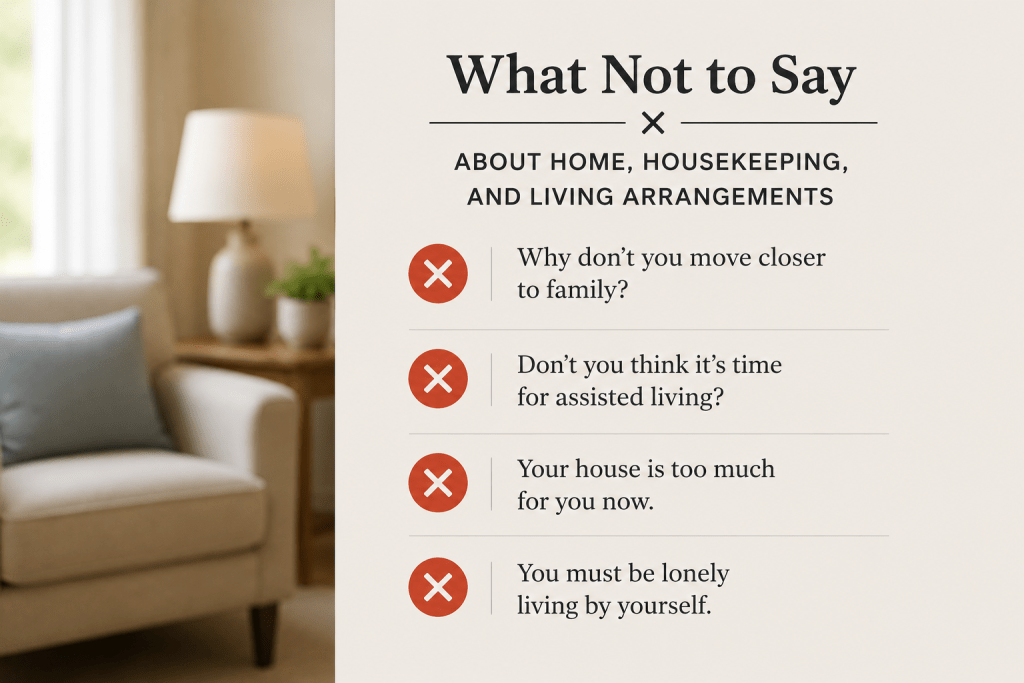
Home clutter can be a sign of pain, low energy, or memory gaps rather than carelessness.
Avoid criticism about a messy house
Blunt lines like “The house was a mess last time” spark shame. They make a parent defensive and end the conversation.
Better ways to offer help without triggering resistance
Try open offers that protect dignity. Ask, “Is there anything I can do around the house?”
Offer one small plan: “Want to tackle one drawer together?” Suggest real supports such as a vetted housekeeper, grocery delivery, or a weekly bill-sorting session.
Discussing assisted living as an upgrade and a proactive choice
Frame assisted living as more social time and maintenance-free living. Say it as an option that adds freedom, not as a last resort.
Use a gentle script: “I want your wishes respected. Can we talk about the kind of living setup you prefer—now or later?”
Talking about safety while honoring the wish to stay home
Discuss grab bars, better lighting, medication routines, and check-ins before forcing a move. Planning early helps the whole family avoid crisis decisions after a fall.
“Small offers and practical supports keep independence alive and make future choices easier.”
| Concern | Poor line | Better approach |
|---|---|---|
| Clutter | “The house is a mess” | “Would you like help with one area this week?” |
| Belongings | “You don’t need all this” | “Let’s sort together—tell me what matters most.” |
| Future living | “You can’t live alone” | “Have you considered assisted living options that offer more social life and support?” |
For guidance on opening housing conversations, see a practical family housing guide at housing conversations. For daily check-ins that support staying at home longer, explore our caregiver check-in schedule.
Conclusion
A few gentle phrase swaps can keep hard talks calm and protect closeness as life shifts.
Choose words that show love, respect, and understanding. Small swaps prevent shame, cut conflict, and protect the memories you carry. Use brief, adult‑to‑adult lines during daily communication and you’ll see the relationship steady.
Remember the pattern: avoid shame → validate feelings → offer choices → collaborate on solutions. You will slip up sometimes. Repair with a quick apology and try again. Time and consistency matter more than perfection.
Save these go‑to lines for hard moments: “Help me understand,” “What would you like?” “Let’s figure it out together,” “No rush.” Try one new phrase this week in a memory, driving, or home chat. Small changes add up.
Need another layer of support? Talk to Joy now: 1-415-569-2439. Sign up for JoyCalls: https://app.joycalls.ai/signup for daily check‑ins, summaries, and extra peace of mind.
FAQ
How can I keep conversations respectful when a parent’s memory changes?
What are gentle alternatives to saying “You already told me that”?
How do I offer help without taking over tasks they value?
What’s the best way to raise concerns about driving safely?
How should I introduce canes or walkers without causing offense?
What’s a kind response when they feel cold or hot but I disagree?
How do I talk about housekeeping without triggering defensiveness?
How can I present assisted living as a positive option?
What phrases should I never use around autonomy and control?
How do I stay calm when conversations become heated?
What supportive language helps when frustration about daily tasks shows up?
How can JoyCalls help with daily check-ins and keeping me informed?

Ana Avila is a healthcare and technology writer with deep expertise in artificial intelligence, senior care innovation, and the practical use of AI in healthcare operations. Her work focuses on how emerging technologies can improve the daily experience of older adults, support overburdened care teams, and help senior living communities deliver safer, faster, and more personalized support.
Ana’s background includes health informatics, aging care systems, and applied artificial intelligence. Her work explores how digital health tools, predictive analytics, and AI-assisted communication systems can improve care coordination, reduce operational delays, and identify early signs of risk among older adults. She brings an understanding of both the technical side of AI and the human realities of healthcare delivery.
Over the years, Ana has developed a specialized body of work around AI in senior living. She writes about how senior care providers can use intelligent systems to manage resident requests, answer routine questions, support family communication, improve after-hours coverage, and detect patterns that may indicate loneliness, confusion, distress, or unmet needs. Her articles often examine the gap between what senior living teams are expected to deliver and what traditional staffing models can realistically support.
Ana’s healthcare expertise is especially focused on the operational side of care. She has written extensively about call handling, resident engagement, front desk workflows, triage systems, caregiver communication, care escalation, and the hidden administrative burden placed on senior living staff. Her work explains how AI can help reduce repetitive tasks, organize incoming requests, prioritize urgent issues, and give human caregivers more time for meaningful resident interaction.
At the same time, Ana is careful not to present AI as a replacement for human care. A consistent theme in her writing is that technology should support relationships, not weaken them. She argues that the best AI systems in healthcare are not the ones that simply automate the most tasks, but the ones that make care teams more responsive, families more informed, and residents more supported. Her perspective is grounded in the belief that senior living technology must be designed around dignity, trust, privacy, and compassion.
Ana has also written widely on the ethical use of AI in healthcare. Her work discusses the importance of human oversight, transparent escalation rules, resident consent, data minimization, and responsible use of sensitive health and behavioral information. She often emphasizes that AI systems used around older adults must be easy to understand, carefully monitored, and designed with the limitations and needs of real residents in mind, including those with memory loss, hearing challenges, mobility issues, or social isolation.
Her writing has been used as a reference point in discussions about aging, elder care technology, digital health, and AI-supported senior living. She has published 12 papers in journals including JAMA, The BMJ, and SSRN. Some of her articles have also been cited by Wikipedia editors as supporting references on topics related to healthcare, aging, and technology. This has helped position her work as a useful educational resource for readers looking to understand how AI can be applied in real care environments.
In addition to her long-form writing, Ana has contributed research-based commentary, professional explainers, and practical guidance for healthcare operators, senior living decision-makers, and technology teams building products for older adults. Her work combines research literacy with operational practicality. She is able to take complex subjects such as natural language processing, predictive analytics, conversational AI, and care automation, and explain them in a way that is accessible to executives, caregivers, families, and non-technical readers.
Ana’s strongest area of expertise is the intersection of artificial intelligence and senior living operations. She understands that senior care communities face a difficult combination of rising resident expectations, staffing pressure, family communication demands, and increasing care complexity. Her writing explores how AI can be used to ease those pressures through smarter communication systems, faster response workflows, proactive check-ins, and better visibility into resident needs.
Her approach is both evidence-informed and deeply human. She studies AI through the lens of real-world care delivery: whether a resident gets help faster, whether a family member receives a clearer update, whether a caregiver avoids unnecessary administrative work, and whether a senior living team can identify a concern before it becomes a crisis. This practical focus makes her work especially relevant for organizations that want to adopt AI responsibly rather than simply follow technology trends.
Ana Avila is regarded as a thoughtful voice on the future of AI in healthcare and senior living. Her expertise combines research-driven analysis, operational understanding, and a strong commitment to humane technology. Through her writing, she helps healthcare leaders and senior living communities understand not only what AI can do, but how it should be used to improve care, preserve dignity, and strengthen the human relationships at the center of aging support.