


Surprising fact: nearly one in five older adults report significant anxiety that affects daily life — and many hide it behind a quick “I’m fine.”
You call after work. Your parent says, “I’m fine,” but the voice feels tight. You want to help without making things worse.
This short guide offers gentle conversation starters and calm steps you can use in five minutes or less. It is for busy adult children, family caregivers, and older adults who want kinder, steadier talk and better mental health support.
Our goal is simple: help your loved one feel safe, heard, and more in control — without arguing or fixing everything in one call. Anxiety isn’t a character flaw. You don’t need to be perfect to make a real difference.
If your parent needs a friendly voice today, Talk to Joy now: 1-415-569-2439. Want regular check-ins and caregiver summaries? Sign up for JoyCalls: https://app.joycalls.ai/signup.
For more on opening tough conversations about meds and care, see this helpful piece on respectful strategies: starting a medication conversation.
Key Takeaways
- Recognize signs: anxiety can hide behind short answers and a rushed tone.
- Use brief, gentle openers that invite sharing without pressure.
- Know triggers and listen for changes in daily routines or sleep.
- Offer steady support and simple steps that protect independence and life quality.
- Use JoyCalls for daily check-ins when you can’t be there every day.
Understanding anxiety in older adults and why it’s often missed
On a quiet afternoon you pause, sensing something has shifted in their voice. That small change may point to worry that is more than a passing thought.
What counts as an anxiety disorder? Worry is normal. The line is when it shrinks daily life — skipping errands, avoiding calls, losing sleep. An anxiety disorder is less about a label and more about whether worry is getting in the way of health and routine.
In the United States, anxiety may affect about 10%–20% of older adults. Yet many cases are missed. Seniors may call it “just aging,” feel shame, or report physical complaints instead of saying they feel worried.

Common disorders you might see
- GAD: Persistent, broad worry about many things.
- Social anxiety: Fear of groups or social situations.
- Phobias: Strong fear of specific places or events.
- OCD: Repeated thoughts or rituals that feel uncontrollable.
- Panic disorder: Sudden intense fear or panic attacks.
- PTSD: Lasting stress after a traumatic event.
Listen for this: constant “what if” thinking, fear of the worst, or avoiding people and places. These can be signs, not stubbornness.
“I’m noticing you’ve been carrying a lot of worry lately. Has it been feeling bigger than usual?”
Remember: anxiety often overlaps with depression and chronic stress. Treat it as a health concern, not a weakness. Support can be practical, respectful, and protective of dignity.
Signs and symptoms to listen for during everyday conversations

Even brief calls can reveal everyday signs that worry has grown louder. Listen for patterns, not a single sentence. This is about conversation listening, not diagnosing.
Emotional and behavioral cues
- Uncontrollable panic or sudden fear.
- Persistent obsessive thoughts or spiraling “what ifs.”
- Avoiding routine activities, restlessness, or ritual behaviors.
What it can sound like:
“My nerves are bad today.”
“I don’t want to go out.”
“I can’t calm down.”
Physical complaints that are often symptoms
People may report health worries: a racing heart, trembling, sweating, shortness of breathing, nausea, or headaches—even when tests look normal.
Validate those fears. A simple line helps: “That sounds uncomfortable. I’m here with you.”
Sleep and focus clues
Notice insomnia, nightmares, memory lapses, or trouble concentrating. Anxiety can make thinking feel foggy and worsen daily effects on routines.
Caregiver approach: reflect, then ask one simple question—
“When does it usually hit—morning, afternoon, or night?”
Track brief notes on timing, triggers, and what eased symptoms. This helps a doctor later and keeps the person feeling heard.
Try JoyCalls Free
No app or new device needed. Start with a free 7-day trial.
For more on older adult support and resources, see this guide: support for older adults. If appetite or health changes appear, consider a practical read: low appetite and care tips.

What can trigger anxiety in seniors today
Certain moments—new diagnoses, a missed step, a bill notice—can set worry spinning fast.
Sometimes anxiety is less about “worrying too much” and more about carrying too much. Below are common triggers and simple ways caregivers can respond with calm care.
- Health and chronic conditions: Frequent appointments, scary symptoms, and juggling multiple medications increase stress. Note medication side effects and keep a med list after any new prescription.
- Loss of independence: Mobility changes, not driving, or fear of falling can make someone feel like a burden. Small routines restore control.
- Grief and life changes: Losing a spouse, moving, or retiring can leave a gap that feeds worry and loneliness.
- Financial worries: Fixed incomes, rising costs, and scam fears create daily stress about life plans.
Caregiver-friendly ways: simplify choices, set predictable check-ins, and link loved ones to community groups or phone companions.
“What feels most heavy right now—health stuff, being alone, money worries, or something else?”
| Trigger | What to watch for | Quick caregiver step |
|---|---|---|
| Chronic health issues | More appointments, new symptoms, changes after meds | Keep a med list; note new side effects; share notes with the doctor |
| Loss / mobility | Reluctance to leave home, fear of falling, canceled plans | Offer safe transport; simplify home layout; schedule short outings |
| Grief & isolation | Quiet days, fewer calls, withdrawn mood | Set regular check-ins and invite local groups or phone companions |
| Financial stress | Worry about bills, avoiding mail, mentioning scams | Review benefits, create a simple budget, involve a trusted advisor |

For practical ways to build steady check-ins that seniors will accept, see this short guide on a gentle check-in routine.
How to talk to elderly with anxiety without escalating fear
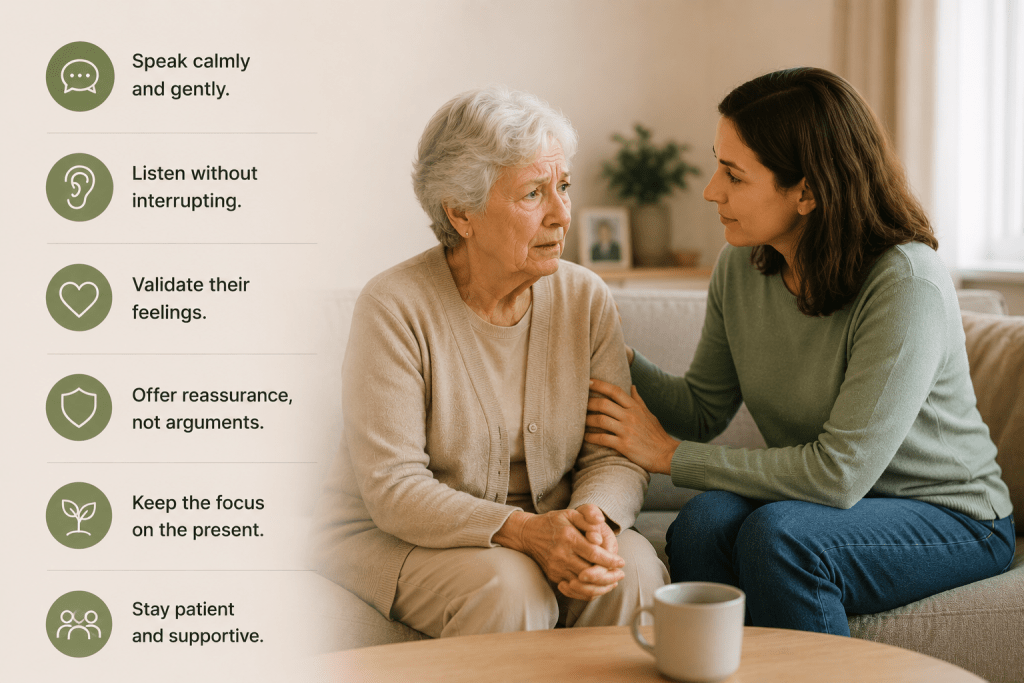
A single steady sentence can lower a racing heart and open the room for real sharing.
Start with active listening and validation. Sit with silence when needed. Repeat back one small detail. Use lines that honor feelings and dignity.
“That sounds really scary.”
“I can hear how heavy this feels.”
“You’re not alone.”
Calm language and steady pacing
Use short sentences. Ask one question at a time. A gentle pace reduces overwhelm and prevents fear from rising.
Common missteps to avoid
- Avoid minimizing: don’t say, “You’re fine.”
- Don’t argue about worries or rush to fix things.
- Skip fact-bombing or promises you can’t keep.
Permission and choices
Ask before sensitive topics. Try, “Can we talk about your sleep?” Offer two simple options: now or later. Choices restore control and ease worries.
When to pause and focus on calming
If panic spikes, stop problem-solving. Lead a short breathing break or grounding step. Normalize stepping away: “We can come back to details later.”
Simple conversation formula
| Step | What it does | Example line |
|---|---|---|
| Pause | Calms the moment | “Let’s sit with that for a minute.” |
| Validate | Respects feelings | “That sounds really scary.” |
| Ask | Gathers one detail | “When does this feel worst?” |
| Offer choices | Restores control | “Do you want to talk now or after lunch?” |
| Next step | Small, doable action | “Let’s try one breath together.” |
If missed check-ins are part of the worry cycle, this short guide on missed calls shows practical next steps: what to do if your parent misses a.
Gentle conversation starters that help seniors feel safe and understood
Start a call with a simple, kind line that makes it safe for them to speak.
Ready-to-use starters for phone calls, visits, or car rides. Low pressure. No interrogation.
Low-pressure openers for feelings, fears, and needs
“Want to tell me what your nerves are saying today?”
“What would help you feel safer right now?”
“Do you want comfort or solutions?”
Reminiscence prompts that ground and calm
Ask about favorite recipes, classic songs, or a first job. Music names like Sinatra or Elvis can bring a smile.
Try: “What was your favorite family meal?” or “Who was the neighbor you remember best?”
Connection prompts that reduce isolation
Invite small social steps. “Who have you enjoyed talking with lately?”
Offer options: a short walk, a call with a cousin, or a cup of tea together.
Health-focused prompts without alarm
Ask simple, practical questions: “Any new symptoms?” or “How’s the routine going with your pills these days?”
Offer help: “Want me to sit with you while we check appointment times?”
| Starter type | Example line | Quick benefit |
|---|---|---|
| Feelings | “Want to tell me what your nerves are saying today?” | Invites sharing without pressure |
| Reminiscence | “What was Grandma’s favorite birthday cake?” | Grounds memory; sparks calm joy |
| Connection | “Would you like a short walk or a call with your cousin?” | Reduces isolation; offers choice |
| Health | “How are the medications treating you?” | Checks safety without alarm |

Caregiver tip: swap direct probes for gentle phrasing. For example, use “How’s the routine going with your pills these days?” instead of a blunt yes/no question.
Even ten minutes of steady connection can soften anxiety. A short, regular check-in helps your loved one feel safer and more seen. For a quick script you can use every day, try this 2-minute daily check-in.
In-the-moment calming tools you can guide during a conversation
A short, guided practice can lower heart rate and bring back a sense of control.
Deep breathing that actually helps
Try this belly breathing: “In through the nose for 3—let the belly rise. Hold one beat. Slow out for 4.” Repeat 3–5 times.
Why it works: fast, shallow breathing feeds stress. Slowing the breath signals safety and can lower cortisol over time.
Mindfulness mini-breaks anywhere
Guide a 60-second grounding: name 3 things you see, 2 you feel, 1 you hear. Keep it short. It’s private and simple.
Gentle movement
Suggest a short walk, chair stretches, or slow side bends. Even 20 minutes a day helps mood and lowers worry.
Sleep habits that protect the next day
Keep a regular bedtime, cut late caffeine, and use a calm pre-sleep ritual. Poor sleep can raise next-day anxiety by about 30%.
Comfort aids (optional)
Weighted blankets, lavender scent, or calming audio can help. Check side effects—ask a doctor if breathing or sleep apnea is a concern.
“Ask what feels right for them. Choice makes calming tools work better.”
| Tool | Quick script | Why it helps |
|---|---|---|
| Deep breathing | “In 3…out 4…belly rise” | Slows heart rate; lowers stress hormones |
| Mindfulness mini-break | “Name 3, 2, 1” | Shifts attention; reduces rumination |
| Movement | “Let’s stand and reach slowly” | Boosts mood; reduces tension |
| Sleep routine | “Wind down at the same time” | Improves next-day calm and focus |

Caregiver tip: offer choices and try one short step together. If worry is frequent or intense, these skills can help now, but professional therapy or medical treatment may still be needed. For more calming ideas, see this short guide: six ways to calm your anxiety.
When to seek professional help and how to talk about treatment
When worry starts changing daily routines, it may be time for extra help. If symptoms last for months, avoidance grows, panic happens often, sleep collapses, or daily tasks slip—reach out to a doctor.
What caregivers can track for the clinician:
- When it happens and how long it lasts
- Triggers and physical signs (racing heart, sweating)
- What helped and what stopped—missed activities or appointments

What an evaluation may include
A visit often starts with a physical exam and a medication review to rule out medical causes. Then the clinician discusses mood, sleep, and daily impact and may refer for formal assessment.
Common options for treatment
Talk therapy such as CBT or exposure therapy helps thought patterns and avoidance. Online therapy can work when travel is hard. Medications like SSRIs or SNRIs are common; benzodiazepines are short-term and require caution due to fall and dependence risk. Beta blockers may ease physical symptoms.
“I’m not saying this is ‘in your head.’ I’m saying you deserve support for how awful it feels.”
Many adults have overlapping depression and an anxiety disorder. Treating both often improves overall quality life.
Script to invite care: “Would you be open to talking with your doctor about these symptoms? I can go with you or help write down what to say.”
If daily check-ins would help, Talk to Joy now: 1-415-569-2439. To set up companion calls and summaries, sign up for JoyCalls or learn about medication reminders with this helpful piece: medication reminder apps for seniors.
How to Turn Gentle Conversation Starters Into a Calming Daily Ritual

Conversation starters are most helpful when they are not used randomly. For many seniors with anxiety, the real comfort does not come only from the question itself. It comes from the way the conversation begins, the pace at which it unfolds, and the feeling that there is no pressure to answer perfectly.
A simple question like “How are you feeling today?” can feel supportive to one person and overwhelming to another. That is why caregivers, family members, companions, and callers should think of conversation starters as part of a calming ritual rather than a checklist. The goal is not to “get the senior talking.” The goal is to create a safe emotional space where talking feels optional, natural, and reassuring.
Start With Predictability Before Asking Anything Personal
Anxious seniors often feel more comfortable when they know what to expect. Sudden emotional questions can feel intense, even when they are asked with love. Before asking about feelings, memories, or worries, begin with something predictable.
For example, instead of opening with:
“Are you feeling anxious today?”
Try:
“Good morning, I was thinking we could have a slow and easy chat today. Nothing serious unless you feel like it.”
This gives the senior control. It tells them that the conversation will not demand too much from them. Predictability lowers emotional pressure, especially for older adults who may already feel mentally tired, physically unwell, lonely, or uncertain about their day.
You can also use repeated opening lines. This may sound too simple, but repetition can be deeply soothing. A familiar greeting such as “I’m happy to hear your voice today” or “Let’s take today slowly” can become a comforting signal that the conversation is safe.
Use “Low-Stakes” Questions Before Emotional Ones
A common mistake is moving too quickly into personal topics. Seniors with anxiety may need a few minutes to settle into the conversation before discussing feelings, worries, health, or loneliness.
Start with questions that do not require deep reflection:
“What did you have with your tea or coffee today?”
“Is the weather comfortable where you are?”
“Did you notice anything nice outside your window?”
“What sounds are around you right now?”
These questions may seem ordinary, but they help bring attention to the present moment. For someone feeling anxious, present-focused questions can gently interrupt spiraling thoughts. They also create an easy entry point into conversation without forcing the person to explain their emotional state.
Once the senior seems more comfortable, you can slowly move into warmer questions:
“What has felt peaceful today?”
“Was there any moment today that felt a little easier?”
“Is there anything you would like more help with this week?”
The order matters. Start light, then go deeper only if the senior seems ready.
Offer Choices Instead of Open-Ended Pressure
Open-ended questions can sometimes feel too broad. A senior with anxiety may struggle to answer questions like “What do you want to talk about?” or “Tell me what’s on your mind.” These questions are well-intentioned, but they may create pressure.
Instead, offer two or three gentle choices:
“Would you rather talk about your morning, something you remember fondly, or something relaxing?”
“Would you like a cheerful topic today, a quiet topic, or just some company?”
“Should we talk about food, music, or a happy memory?”
Choice-based conversation gives the senior control without making them do all the emotional work. It also reduces the fear of giving the “wrong” answer.
This approach is especially useful for seniors who are tired, grieving, socially withdrawn, or hesitant to speak. They may not know what they need, but they can often choose between simple options.
Build a Personal Comfort List Over Time
Not every conversation starter works for every senior. Some people love talking about childhood memories. Others may find the past painful. Some enjoy discussing family. Others may feel sadness, regret, or loneliness around that topic.
That is why it helps to build a personal comfort list.
After each conversation, mentally note which topics made the person sound calmer, brighter, or more engaged. Over time, you may notice patterns. Perhaps they respond well to food memories, old songs, gardening, pets, festivals, daily routines, or stories about kindness. These topics can become reliable anchors for future conversations.
You can also gently ask:
“Would you like me to remember that this is a nice topic for us?”
“Should we talk about this again another day?”
“That seemed to bring a smile. Would you enjoy more conversations like this?”
This makes the senior feel seen. It also helps future conversations become more personalized and less stressful.
Avoid Turning the Conversation Into a Problem-Solving Session
When a senior shares anxiety, family members often rush to fix it. They may say things like “Don’t worry,” “You’ll be fine,” or “There’s no need to think like that.” Although these responses come from care, they can make the senior feel dismissed.
A better approach is to acknowledge first, then support gently.
Try:
“That sounds heavy to carry.”
“I can understand why that would feel upsetting.”
“You don’t have to handle that thought alone right now.”
“I’m here with you. We can take this slowly.”
After validation, you can ask a soft next question:
“Would it help to talk about it, or would you rather shift to something lighter?”
This gives the senior permission to either express the worry or step away from it. Both choices are valid.
The aim is not to remove anxiety in one conversation. The aim is to help the person feel less alone inside it.
Use Sensory Questions to Create Calm
Sensory conversation starters can be especially helpful because they bring attention back to the body and the present environment. They are simple, grounding, and usually less emotionally demanding.
You can ask:
“What is something soft or comfortable near you right now?”
“Is there a smell you enjoy, like tea, soap, flowers, or food cooking?”
“What color do you see most around you today?”
“Is there a sound nearby that feels peaceful?”
“What would make your chair, room, or blanket feel more comfortable right now?”
These questions are useful when the senior sounds tense, restless, or overwhelmed. They gently shift the focus away from racing thoughts and toward immediate comfort.
You can also pair the question with a calming suggestion:
“Maybe while we talk, you can keep your feet flat on the floor and notice the support under you.”
“Let’s both take one slow breath before we continue.”
Keep it natural. The senior should not feel like they are being treated or managed. The tone should remain conversational.
Know When Silence Is Part of the Conversation
Many people feel nervous when there is silence on a call or during a visit. But for seniors with anxiety, silence can sometimes be soothing. They may need extra time to think, gather words, or decide whether they want to answer.
Do not rush to fill every pause.
You can say:
“Take your time. There’s no hurry.”
“We can sit with that for a moment.”
“You don’t have to answer quickly.”
This is especially important when asking reflective questions. A senior may have a meaningful response, but anxiety can slow down speech or make them second-guess themselves. Patient silence communicates respect.
The key is to make silence feel safe, not awkward.
Create a Gentle Closing So the Senior Does Not Feel Suddenly Left Alone
The end of a conversation matters as much as the beginning. If a senior is anxious or lonely, a sudden goodbye can feel emotionally abrupt. A thoughtful closing helps them transition back into their day with more steadiness.
Instead of ending with only “Okay, bye,” try:
“I enjoyed talking with you today. Before we finish, what is one small comfortable thing you can do next?”
“After we hang up, maybe you can have some water, sit near the window, or rest for a few minutes.”
“I’ll leave you with this thought: today does not have to be perfect. It just has to be gentle.”
You can also summarize something positive from the conversation:
“I loved hearing about your garden today.”
“That memory about your mother’s cooking was very special.”
“I’m glad we talked about something peaceful.”
This gives the conversation emotional closure. It reminds the senior that the interaction had warmth, meaning, and continuity.
Make the Conversation Feel Like Companionship, Not Assessment
Seniors with anxiety may become guarded if every conversation feels like someone is checking on their health, mood, medication, sleep, or problems. While these topics can be important, they should not dominate every interaction.
Balance practical check-ins with ordinary human connection.
Ask about preferences, opinions, memories, small joys, and daily comforts. Let the senior feel like a full person, not a list of concerns.
Helpful examples include:
“What is something you still know how to do better than most people?”
“What is a small habit that has helped you through difficult times?”
“What kind of music feels good for a quiet day?”
“What is one meal that always feels comforting?”
“What is something you wish people asked you about more often?”
Questions like these preserve dignity. They invite the senior to share wisdom, personality, and lived experience.
Conversation Starters That Help Seniors Feel Emotionally Safe During Difficult Days
Not every day feels manageable for seniors living with anxiety. Some mornings begin with worry before the day has even started. Other days may feel emotionally heavy because of loneliness, grief, health concerns, poor sleep, family stress, or simply the quietness that can come with aging.
During these difficult moments, conversation matters more than most people realize.
A thoughtful conversation can reduce emotional isolation, calm nervous thoughts, and help seniors feel connected again. But the wrong kind of conversation can unintentionally increase stress. Questions that feel too intense, overly cheerful, rushed, or dismissive may cause seniors to withdraw even more.
That is why emotionally safe conversations are so important.
An emotionally safe conversation is one where the senior does not feel judged, corrected, pressured, or emotionally cornered. They feel accepted exactly as they are in that moment. They know they can speak honestly, answer slowly, or simply listen without expectations.
This section explores how to create those kinds of conversations intentionally and compassionately.
Recognize the Difference Between Loneliness and Anxiety
Many caregivers assume that a quiet senior is simply lonely. But anxiety and loneliness often overlap in older adults, and the emotional needs behind them can be very different.
A lonely senior may want more interaction.
An anxious senior may want interaction but also feel overwhelmed by it.
For example, a senior experiencing anxiety may:
- Worry about saying the wrong thing
- Feel mentally exhausted during conversations
- Avoid phone calls even when they want connection
- Fear becoming emotional while talking
- Feel embarrassed about memory lapses
- Become overstimulated by too many questions
This means the goal is not simply “getting them to socialize.” The goal is creating conversations that feel emotionally manageable.
One helpful mindset is this:
Focus on helping the senior feel calm during the interaction, not impressive during the interaction.
They do not need to entertain, perform, explain themselves perfectly, or maintain long conversations. Emotional safety comes when the senior feels accepted even in silence, slowness, forgetfulness, or emotional vulnerability.
Use Reassuring Language That Lowers Emotional Pressure
Sometimes the most calming part of a conversation is not the topic. It is the language surrounding it.
Small phrases can dramatically change how emotionally safe a senior feels.
Helpful reassuring phrases:
- “There’s no pressure to talk about anything uncomfortable.”
- “We can keep this conversation very light today.”
- “You don’t need to have the perfect words.”
- “It’s okay if today feels difficult.”
- “We can simply keep each other company.”
- “You can answer as much or as little as you want.”
- “I’m happy just spending time with you.”
These phrases reduce performance anxiety.
Many older adults quietly worry about becoming a burden, sounding repetitive, forgetting details, or appearing emotionally fragile. Reassuring language removes some of that fear.
It tells them:
- They are not being evaluated
- They do not need to manage the other person’s emotions
- They are allowed to be human
This emotional permission is incredibly calming.
Ask Questions That Create Comfort Instead of Self-Reflection
Some conversation starters unintentionally force seniors into emotional analysis when they may already feel mentally tired.
Questions like:
- “Why do you think you feel anxious?”
- “What are you most worried about lately?”
- “What is making you unhappy?”
can sometimes feel emotionally demanding.
Instead, begin with comfort-oriented questions.
Examples:
- “What usually helps your day feel a little calmer?”
- “What kind of day feels easiest for you?”
- “What is one small thing that still feels comforting?”
- “What helps you relax even slightly?”
- “What has always helped you feel safe or settled?”
These questions focus on emotional support rather than emotional investigation.
They gently guide the senior toward calming memories, habits, environments, and routines instead of pushing them deeper into anxious thought patterns.
Help Seniors Feel Useful, Not Just Cared For
One hidden source of anxiety in older adults is the feeling of losing purpose.
Many seniors spent decades helping others, making decisions, solving problems, raising families, working, and supporting communities. Aging can sometimes make them feel as though they are now only receiving care rather than contributing value.
Conversations can help restore dignity and usefulness.
Ask for advice:
- “What is something your generation understood really well?”
- “What is one life lesson younger people should know?”
- “How did you stay mentally strong during difficult times?”
- “What helped you through stressful periods in your life?”
- “What do you think people today worry about too much?”
These questions communicate respect.
They remind seniors that their experience still matters.
For anxious older adults, this can be emotionally stabilizing because anxiety often grows stronger when people feel powerless or invisible.
Feeling heard reduces emotional helplessness.
Avoid Correcting Small Mistakes During Emotional Conversations
If a senior forgets a detail, repeats a story, loses track of time, or says something slightly inaccurate, resist the urge to constantly correct them unless necessary.
Frequent correction can unintentionally increase anxiety.
For example:
- “No, that happened in 1992.”
- “You already told me that.”
- “That’s not what the doctor said.”
- “You’re remembering it wrong.”
These responses may seem harmless, but they can make seniors feel embarrassed or mentally insecure.
Instead, prioritize emotional connection over factual precision whenever possible.
You can gently respond with:
- “That sounds like an important memory.”
- “I can tell that stayed with you.”
- “I like hearing your stories.”
- “That must have been meaningful.”
An anxious senior usually benefits more from feeling emotionally accepted than factually corrected.
Use Shared Activities to Reduce Conversational Pressure
Not all supportive conversations need to happen face-to-face with constant direct questioning.
Sometimes conversation flows more naturally when attention is shared with another activity.
This is especially helpful for seniors who:
- Feel nervous during direct emotional conversations
- Become mentally fatigued quickly
- Struggle with eye contact or focus
- Feel pressure when conversations become too serious
Gentle shared activities include:
- Looking through old photographs
- Watching birds outside the window
- Listening to soft music together
- Watering plants
- Folding laundry together
- Sitting outdoors quietly
- Watching a calming TV program
- Having tea during conversation
In these moments, conversation becomes softer and less intense because the activity itself provides emotional grounding.
Some seniors open up more naturally when they are not feeling emotionally “watched.”
Learn the Senior’s Anxiety Signals
Not every anxious senior openly says:
“I feel anxious.”
Many express anxiety indirectly.
Emotional signs may include:
- Repeating worries
- Asking the same reassurance questions
- Sounding restless or irritable
- Becoming unusually quiet
- Over-apologizing
- Difficulty making small decisions
- Talking faster than usual
- Frequently worrying about others
- Becoming overwhelmed by simple plans
Once you recognize these signals, you can respond more supportively.
Instead of:
“You’re overthinking.”
Try:
“You seem like you have a lot on your mind today.”
Or:
“We don’t need to solve everything right now.”
This approach lowers defensiveness and increases emotional trust.
Use Memory-Based Conversations Carefully
Many articles recommend memory conversations for seniors, but this should be done thoughtfully.
Memories can comfort some seniors and deeply upset others.
Topics connected to:
- grief
- loss
- regret
- estranged relationships
- illness
- traumatic experiences
may unexpectedly trigger anxiety or sadness.
Start with emotionally lighter memories first.
Safer memory prompts:
- “What food always made your home feel warm?”
- “What music reminds you of peaceful times?”
- “Did you have a favorite season growing up?”
- “What kind of celebrations did you enjoy most?”
- “What smell reminds you of happy moments?”
These sensory-based memories are often gentler and less emotionally risky.
If the senior becomes emotional, do not panic or rush to change the subject immediately.
You can calmly say:
“That memory seems very meaningful.”
Or:
“It’s okay to feel emotional while remembering important things.”
Emotional moments are not automatically harmful. Feeling emotionally safe enough to express emotion can actually reduce anxiety over time.
Give Seniors More Time Than You Think They Need

One of the kindest things you can do in conversation is slow down.
Anxiety often makes processing harder. Older adults may need additional time to:
- understand questions
- organize thoughts
- retrieve memories
- decide how much they want to share
Fast-paced conversations can create stress.
Avoid:
- interrupting quickly
- finishing sentences too often
- rapidly changing topics
- asking multiple questions at once
Instead:
- pause after questions
- speak calmly
- use shorter sentences
- allow quiet moments naturally
The slower pace itself becomes emotionally soothing.
For many seniors, calm pacing communicates patience, respect, and care more powerfully than words alone.
Help End Conversations on a Stable Emotional Note
If difficult emotions come up during a conversation, try not to end abruptly afterward.
A thoughtful emotional transition helps the senior feel grounded again before the conversation ends.
Gentle closing questions:
- “What is something comforting you can do after this call?”
- “What part of today feels most manageable?”
- “Would you like tomorrow to feel quieter or more active?”
- “What is one thing you can look forward to this week?”
- “Should we talk again soon about lighter things?”
You can also close with emotionally stabilizing reminders:
- “You handled today well.”
- “You don’t have to carry every worry at once.”
- “You matter very much to the people who care about you.”
- “It’s okay to take today slowly.”
These endings reduce emotional abruptness and help the senior leave the interaction feeling supported rather than emotionally exposed.
Why Gentle Conversation Matters More Than Most People Think
For seniors with anxiety, conversations are never “just conversations.”
The right interaction can:
- reduce emotional isolation
- interrupt spiraling thoughts
- restore calm
- strengthen trust
- improve emotional regulation
- increase feelings of safety
- reduce fear of being alone
Most importantly, compassionate conversations remind seniors that they are still emotionally connected to the world around them.
Not because someone is trying to fix them.
But because someone is willing to sit with them gently, patiently, and kindly exactly as they are.
How Family Members and Caregivers Can Keep Conversations Supportive Without Feeling Emotionally Exhausted
Supporting a senior with anxiety can be emotionally meaningful, but it can also become mentally draining for caregivers and family members if conversations constantly revolve around fear, reassurance, worry, or emotional distress.
Many adult children, spouses, companions, and caregivers quietly struggle with questions like:
- “Am I saying the wrong thing?”
- “Why do our conversations always return to the same worries?”
- “How do I stay patient without feeling emotionally depleted?”
- “How can I support them without carrying their anxiety myself?”
These feelings are normal.
One of the biggest misunderstandings about supportive conversations is the belief that caregivers must always have the perfect response. In reality, seniors with anxiety usually benefit far more from emotional steadiness than emotional perfection.
The goal is not to eliminate every fear or solve every anxious thought. The goal is to create conversations that feel calming, respectful, sustainable, and emotionally balanced for both people.
This section focuses on how caregivers and loved ones can maintain supportive communication while also protecting their own emotional well-being.
Stop Measuring Conversations by How “Positive” They Become
A common mistake caregivers make is judging conversations only by whether the senior sounded happier afterward.
But emotionally supportive conversations are not always cheerful conversations.
Sometimes success looks like:
- the senior feeling heard
- reduced emotional tension
- less loneliness
- feeling calmer than before
- feeling emotionally safer
- feeling less ashamed of their anxiety
A senior may still feel worried after the conversation ends. That does not mean the conversation failed.
In fact, many anxious seniors feel better simply because someone stayed emotionally present without rushing them, correcting them, or avoiding them.
Instead of asking yourself:
“Did I fix their anxiety?”
Ask:
“Did they feel emotionally supported while talking to me?”
That is a healthier and more realistic standard.
Avoid Becoming a Constant Source of Reassurance
It is natural to reassure anxious seniors. But excessive reassurance can accidentally strengthen anxiety over time.
For example, if a senior repeatedly asks:
- “Do you think something bad will happen?”
- “Are you sure I’ll be okay?”
- “Do you think the doctor missed something?”
- “What if something goes wrong tonight?”
caregivers often respond by repeatedly trying to guarantee certainty.
But anxiety rarely stays satisfied for long.
Instead of endless reassurance loops, focus on emotional grounding.
Instead of:
“Nothing bad will happen.”
Try:
“I can see that this worry feels very real right now.”
Or:
“You don’t have to manage this fear alone.”
Or:
“Let’s focus on what feels manageable today instead of trying to predict everything.”
This approach provides comfort without feeding the cycle of anxious reassurance-seeking.
Learn How to Redirect Gently Without Sounding Dismissive
Redirection is helpful when anxiety spirals become repetitive or emotionally overwhelming. But abrupt topic changes can make seniors feel ignored.
Avoid:
- “Don’t think about that.”
- “You worry too much.”
- “Let’s talk about something else.”
- “You already said that.”
These responses can increase shame and emotional withdrawal.
Instead, acknowledge first, then redirect gently.
Example:
“That sounds exhausting to carry around mentally. Would it help if we shifted to something softer for a few minutes?”
Or:
“I understand why your mind keeps returning to that. Maybe we can give your brain a small rest for now.”
This keeps the senior emotionally respected while still helping the conversation move away from spiraling anxiety.
Create Conversation Rituals Instead of Emergency-Only Calls
Many seniors begin associating communication with problems if conversations only happen during stressful moments.
For example:
- medication reminders
- health scares
- emotional breakdowns
- appointments
- bad news
- family concerns
Over time, this can unintentionally make phone calls feel emotionally heavy.
Instead, create low-pressure conversation rituals.
Examples:
- morning tea calls
- evening check-ins
- Sunday storytelling chats
- shared music sessions
- daily weather conversations
- gratitude conversations before bed
- weekly memory-sharing routines
Regular calm conversations help reduce anticipatory anxiety because the senior no longer associates communication only with stress.
Consistency creates emotional security.
Even short predictable interactions can become deeply stabilizing.
Protect the Senior’s Sense of Independence During Conversations
Anxiety often increases when seniors feel they are losing control over their life, decisions, schedule, or identity.
Conversations can either strengthen dignity or unintentionally weaken it.
Avoid overly controlling language:
- “You need to…”
- “You shouldn’t…”
- “I already told you…”
- “That’s not a good idea.”
- “Just listen to me.”
Even when caregivers are correct, constant directive communication can make seniors feel powerless.
Instead, use collaborative language.
Try:
“What feels most comfortable to you?”
“Would you like help thinking through this?”
“What option feels easiest today?”
“Should we decide together?”
Collaborative language reduces emotional resistance and preserves dignity.
For anxious seniors, feeling included in decisions often matters just as much as the decision itself.
Understand That Repetition Is Often Anxiety, Not Attention-Seeking
Many caregivers become frustrated when seniors repeat worries or ask the same questions repeatedly.
But repetitive questioning is frequently a sign of anxiety, not manipulation.
The senior may be trying to:
- regain emotional certainty
- reduce fear temporarily
- feel emotionally anchored
- confirm they are safe
- calm racing thoughts
Responding with irritation can unintentionally increase emotional insecurity.
Instead of:
“You already asked me that three times.”
Try:
“I know this worry keeps coming back for you.”
Or:
“It sounds like your mind is having trouble letting this go today.”
This response recognizes the emotional experience instead of criticizing the behavior.
Use Your Tone More Carefully Than Your Words
When seniors are anxious, they often become highly sensitive to emotional tone.
Even supportive words can feel stressful if delivered impatiently, hurriedly, or distractedly.
For example:
“Everything is fine.”
can feel calming or dismissive depending on tone.
What matters most:
- slower pacing
- warmth in the voice
- gentle volume
- emotional patience
- reduced urgency
A calm tone helps regulate anxious nervous systems.
In many cases, the senior may remember how the conversation felt emotionally more than the actual words spoken.
Do Not Force Optimism
Toxic positivity can make anxious seniors feel misunderstood.
Avoid phrases like:
- “Just stay positive.”
- “Other people have it worse.”
- “You should be grateful.”
- “Everything happens for a reason.”
- “You’re lucky compared to many people.”
Even when intended kindly, these responses can invalidate emotional pain.
Seniors with anxiety do not necessarily need forced optimism.
They usually need:
- emotional safety
- steady companionship
- patience
- grounding
- reassurance that difficult feelings are allowed
Balanced hope works better than forced positivity.
Try:
“This sounds hard, but you don’t have to face it alone.”
Or:
“Some days are heavier than others. We can take this slowly.”
These responses feel emotionally believable and supportive.
Watch for Emotional Exhaustion in Yourself
Caregivers sometimes become so focused on supporting the senior that they ignore their own emotional fatigue.
Signs of caregiver conversation burnout may include:
- irritability during calls
- emotional numbness
- dread before conversations
- impatience
- feeling trapped in repetitive discussions
- guilt after interactions
- emotional overstimulation
Ignoring these signs can eventually damage the relationship.
Supportive conversations work best when caregivers are emotionally regulated too.
This means:
- taking breaks when needed
- setting healthy boundaries
- asking for shared caregiving support
- not carrying every emotional burden alone
- allowing yourself recovery time
You do not need to become emotionally unavailable.
But you also do not need to become emotionally consumed.
Set Gentle Boundaries Without Sounding Cold
Boundaries are important, especially when anxiety leads to constant reassurance-seeking or emotionally overwhelming conversations.
The key is setting boundaries kindly.
Instead of:
“I can’t keep talking about this.”
Try:
“I want to keep supporting you, but I think we both need a calmer conversation right now.”
Or:
“I care about this deeply, but I think repeating the fear is making things harder for both of us.”
Or:
“Let’s pause this topic for now and return to something that helps you feel steadier.”
Gentle boundaries preserve emotional connection while preventing caregiver burnout.
Help Seniors Feel Emotionally Safe Without Making Them Emotionally Dependent
Healthy support encourages connection, not emotional helplessness.
This means helping seniors:
- identify calming routines
- reconnect with hobbies
- maintain social contact
- feel capable
- participate in decisions
- practice emotional grounding independently
Helpful questions include:
- “What usually helps you settle your mind?”
- “What part of your routine makes you feel most peaceful?”
- “What gives you comfort when nobody is around?”
- “What helps your evenings feel calmer?”
These conversations slowly strengthen emotional resilience instead of making the caregiver the only source of emotional stability.
Remember That Presence Matters More Than Perfect Advice
Many caregivers feel pressure to constantly say something wise, therapeutic, or deeply comforting.
But anxious seniors often remember simple emotional presence more than perfect words.
They remember:
- who stayed patient
- who listened calmly
- who did not rush them
- who treated them with dignity
- who made them feel emotionally safe
Sometimes the most healing response is simply:
“I’m here.”
Or:
“We can sit with this together.”
That kind of steady emotional companionship can reduce anxiety more powerfully than endless advice.
Why These Conversations Leave a Lasting Emotional Impact
As people age, emotional experiences often become more memorable than practical details.
A senior may forget parts of the conversation itself but still remember:
- whether they felt rushed
- whether they felt respected
- whether they felt emotionally safe
- whether they felt like a burden
- whether they felt cared for
That is why gentle conversation is never a small thing.
For anxious seniors, emotionally safe communication becomes a form of stability, dignity, reassurance, and human connection that carries into the rest of their day long after the conversation ends.
Conclusion
Small, steady words can change a tense moment into a breathing space.
You don’t need the perfect line. A calm presence, brief check-ins, and simple choices help more than long fixes. Notice signs, learn triggers, validate feelings, guide a short calming step, and seek professional care when daily life is affected.
Sticky-note script: “I’m here. You’re safe right now. Let’s take one small step next.”
Meaningful activities—music, recipes, short walks—protect mental health and keep life steady. Anxiety disorders are common and treatable; people can feel better with the right care and support.
If your loved one needs someone today, Talk to Joy now: 1-415-569-2439. For ongoing companion calls and summaries, sign up for JoyCalls or read a practical guide on building better phone connection here. For clinical signs and solutions, see this summary on hidden signs and options: anxiety in seniors: signs & solutions.
Your loved one is still themselves under the worry. With steady care, time, and the right support, life can feel lighter again.
FAQ
What are gentle conversation starters for seniors who feel anxious?
How does anxiety in older adults differ from normal worry?
Which anxiety disorders are most common in seniors?
What emotional and behavioral signs should caregivers listen for?
What physical symptoms might be mistaken for other health problems?
How does anxiety affect sleep and day-to-day focus in older adults?
What common triggers increase anxiety in seniors today?
How should I start a conversation without making fear worse?
What communication mistakes should I avoid?
What are helpful reminiscence prompts that soothe anxiety?
Which connection prompts reduce isolation and lift mood?
How can I bring up health topics without causing alarm?
What quick calming tools can I guide during a worry-filled call?
Are comfort aids useful during anxious episodes?
When should a doctor or mental health professional be involved?
What information should I track before a medical visit?
What evaluations and treatments might a clinician recommend?
How can family and services like JoyCalls help day-to-day?

Ana Avila is a healthcare and technology writer with deep expertise in artificial intelligence, senior care innovation, and the practical use of AI in healthcare operations. Her work focuses on how emerging technologies can improve the daily experience of older adults, support overburdened care teams, and help senior living communities deliver safer, faster, and more personalized support.
Ana’s background includes health informatics, aging care systems, and applied artificial intelligence. Her work explores how digital health tools, predictive analytics, and AI-assisted communication systems can improve care coordination, reduce operational delays, and identify early signs of risk among older adults. She brings an understanding of both the technical side of AI and the human realities of healthcare delivery.
Over the years, Ana has developed a specialized body of work around AI in senior living. She writes about how senior care providers can use intelligent systems to manage resident requests, answer routine questions, support family communication, improve after-hours coverage, and detect patterns that may indicate loneliness, confusion, distress, or unmet needs. Her articles often examine the gap between what senior living teams are expected to deliver and what traditional staffing models can realistically support.
Ana’s healthcare expertise is especially focused on the operational side of care. She has written extensively about call handling, resident engagement, front desk workflows, triage systems, caregiver communication, care escalation, and the hidden administrative burden placed on senior living staff. Her work explains how AI can help reduce repetitive tasks, organize incoming requests, prioritize urgent issues, and give human caregivers more time for meaningful resident interaction.
At the same time, Ana is careful not to present AI as a replacement for human care. A consistent theme in her writing is that technology should support relationships, not weaken them. She argues that the best AI systems in healthcare are not the ones that simply automate the most tasks, but the ones that make care teams more responsive, families more informed, and residents more supported. Her perspective is grounded in the belief that senior living technology must be designed around dignity, trust, privacy, and compassion.
Ana has also written widely on the ethical use of AI in healthcare. Her work discusses the importance of human oversight, transparent escalation rules, resident consent, data minimization, and responsible use of sensitive health and behavioral information. She often emphasizes that AI systems used around older adults must be easy to understand, carefully monitored, and designed with the limitations and needs of real residents in mind, including those with memory loss, hearing challenges, mobility issues, or social isolation.
Her writing has been used as a reference point in discussions about aging, elder care technology, digital health, and AI-supported senior living. She has published 12 papers in journals including JAMA, The BMJ, and SSRN. Some of her articles have also been cited by Wikipedia editors as supporting references on topics related to healthcare, aging, and technology. This has helped position her work as a useful educational resource for readers looking to understand how AI can be applied in real care environments.
In addition to her long-form writing, Ana has contributed research-based commentary, professional explainers, and practical guidance for healthcare operators, senior living decision-makers, and technology teams building products for older adults. Her work combines research literacy with operational practicality. She is able to take complex subjects such as natural language processing, predictive analytics, conversational AI, and care automation, and explain them in a way that is accessible to executives, caregivers, families, and non-technical readers.
Ana’s strongest area of expertise is the intersection of artificial intelligence and senior living operations. She understands that senior care communities face a difficult combination of rising resident expectations, staffing pressure, family communication demands, and increasing care complexity. Her writing explores how AI can be used to ease those pressures through smarter communication systems, faster response workflows, proactive check-ins, and better visibility into resident needs.
Her approach is both evidence-informed and deeply human. She studies AI through the lens of real-world care delivery: whether a resident gets help faster, whether a family member receives a clearer update, whether a caregiver avoids unnecessary administrative work, and whether a senior living team can identify a concern before it becomes a crisis. This practical focus makes her work especially relevant for organizations that want to adopt AI responsibly rather than simply follow technology trends.
Ana Avila is regarded as a thoughtful voice on the future of AI in healthcare and senior living. Her expertise combines research-driven analysis, operational understanding, and a strong commitment to humane technology. Through her writing, she helps healthcare leaders and senior living communities understand not only what AI can do, but how it should be used to improve care, preserve dignity, and strengthen the human relationships at the center of aging support.