


Surprising fact: older adults who stick to short, steady mental practice cut their risk of decline more than those who rely on rare marathon sessions.
Worried: “Am I doing enough to keep a parent sharp—without overwhelming them?” Many families ask that. You don’t need perfect plans. Small, steady habits matter most.
Brain activities include puzzles, word games, learning new skills, mindfulness and social games. The question of how often brain exercises seniors should do them matters because routine beats randomness.
Simple daily minutes add up. Programs like JoyCalls make it easy by adding regular conversation and prompts by phone—no app or device required. Talk to Joy now: 1-415-569-2439. For a practical next step, Sign up for JoyCalls: https://app.joycalls.ai/signup.
For guidance grounded in research, see this resource on cognitive health from the National Institute on Aging: cognitive health and older adults.
Key Takeaways
- Short, regular practice beats occasional long sessions.
- A mix of puzzles, learning, and social chats is best.
- Daily check-ins can build routine and reduce loneliness.
- JoyCalls offers phone-based support with no gadget fuss.
- Small steps are reassuring and realistic for busy caregivers.
Why cognitive health needs regular “brain workouts” as we age
Small daily mental habits protect thinking skills over time. They keep memory in motion and give the mind regular, gentle practice.
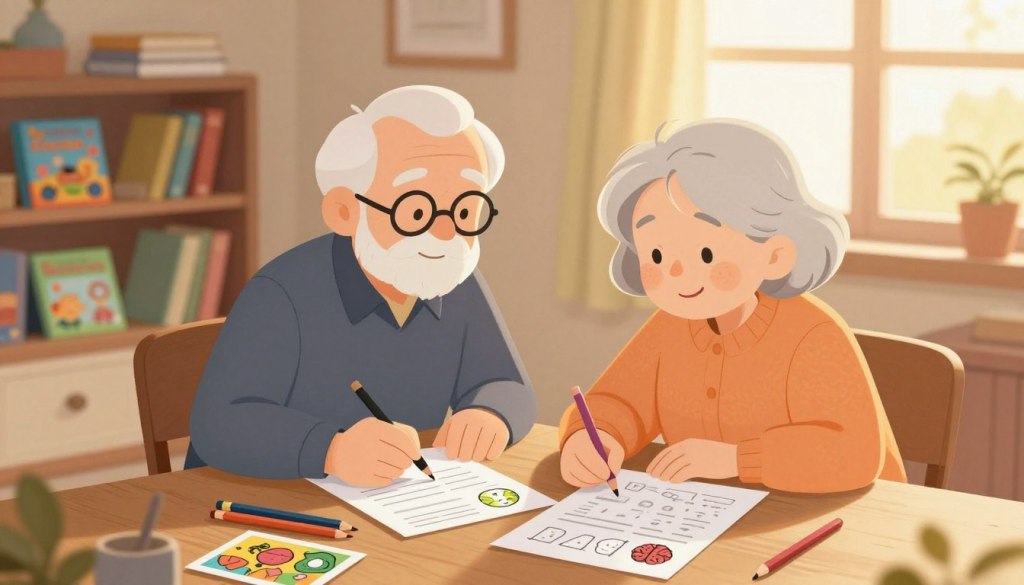
How stimulating activities support memory, focus, and mental agility
Cognitive health means thinking clearly, remembering names or appointments, and feeling confident making daily choices.
Short activities — puzzles, reading, learning a tune, or a chat — strengthen neural connections. This supports memory, boosts focus, and sharpens mental agility for switching tasks or following conversations.
Consistency and long‑term resilience
Regular practice builds resilience. Over months, steady sessions can help reduce the risk of cognitive decline without promising cures.
“Small, pleasant routines can feel like a protective layer for the people we love.”
- Reading
- Puzzles and word games
- Learning new skills or music
- Mindful breathing and group conversation ✅
For caregivers: these simple routines are doable and comforting. They add structure when other things feel uncertain.
Next question families ask: what’s a realistic weekly plan — and for how many minutes?
What research and expert guidance say about frequency and minutes per day
Research and expert panels give clear, practical targets for weekly mental activity.
Short, steady sessions beat marathon workouts. Small bursts protect attention and reduce fatigue. They are easier to keep up when energy dips.
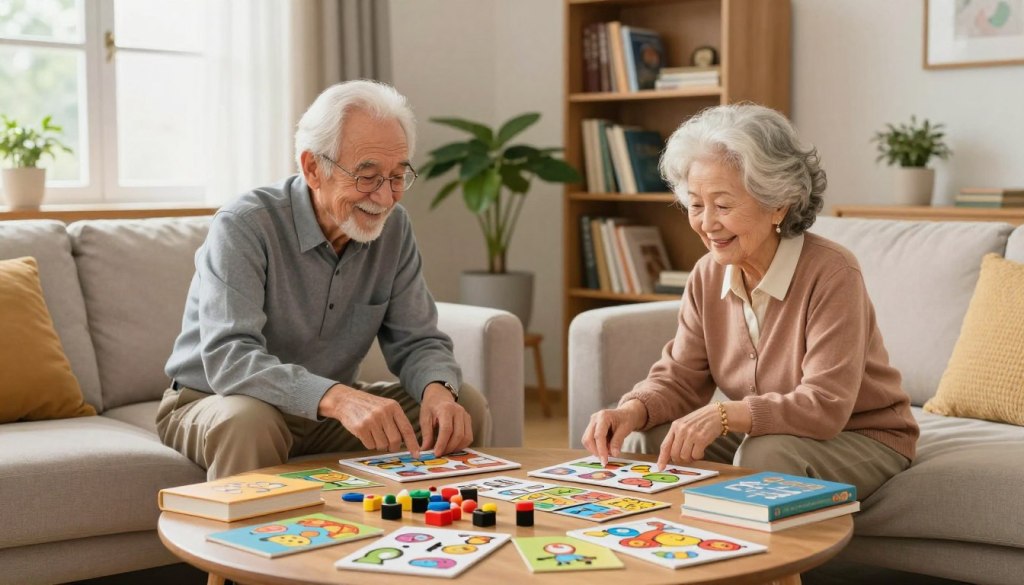
Practical benchmarks to remember
A simple rule caregivers can use: aim for three to five times per week, about 20–30 minutes per session. That pace fits into real life and builds habit without overwhelm.
Daily option for routine-lovers
If you prefer daily rhythm, try 15–20 minutes of puzzles and brain teasers. You can split the minutes day into two short bursts (example: 10 minutes in the morning + 10 minutes after lunch).
What a 10-week training study found
In one 10-week trial, adults 65+ who did 30 minutes a day of targeted training showed a small chemical change—acetylcholine rose ~2.3% in the anterior cingulate, an area tied to attention and memory.
“Casual games like solitaire did not produce the same change, so targeted training matters.”
- Takeaway: pick activities that challenge attention and speed, not only casual play.
- Consistency matters more than intensity. Regular training improves cognitive function over time.
- Even modest routines provide real value—any steady content that engages the mind is a win.
how often brain exercises seniors should do based on goals and energy levels
Start by matching goals to energy: decide if the aim is maintenance or improvement before picking a schedule. That choice keeps plans kind and doable.

Maintenance vs improvement: choosing a realistic cadence
For maintenance, try three sessions per week of 20–25 minutes. That pace helps seniors stay steady without fatigue.
For improvement, aim for about five short sessions weekly if health and mood allow. Small increases build attention and speed over months.
Adjusting for fatigue, attention span, and health conditions
Some days energy dips. That is normal. Shorten or skip a session and keep the routine gentle.
For sleep issues, pain, or medication changes, lower frequency or split minutes into two tiny bursts. This protects function and overall health.
Try JoyCalls Free
No app or new device needed. Start with a free 7-day trial.
When to scale up gradually
Scale up when tasks feel easy, attention holds longer, or your loved one asks for more challenge. Add five minutes or a slightly harder activity each week.
“Small, steady steps reduce stress and help reduce risk of cognitive decline.”
- Minimum effective dose: even 10 minutes keeps the habit alive.
- Caregiver tip: track mood after sessions. If irritability rises, shorten frequency for a week.
- Focus on long-term goals: support independence and better mental health.
Brain-boosting activities like puzzles, memory games, and learning new skills
Pick a short, enjoyable menu of mental tasks that fit daily life and mood. Tiny wins build confidence. Consistency matters more than intensity.
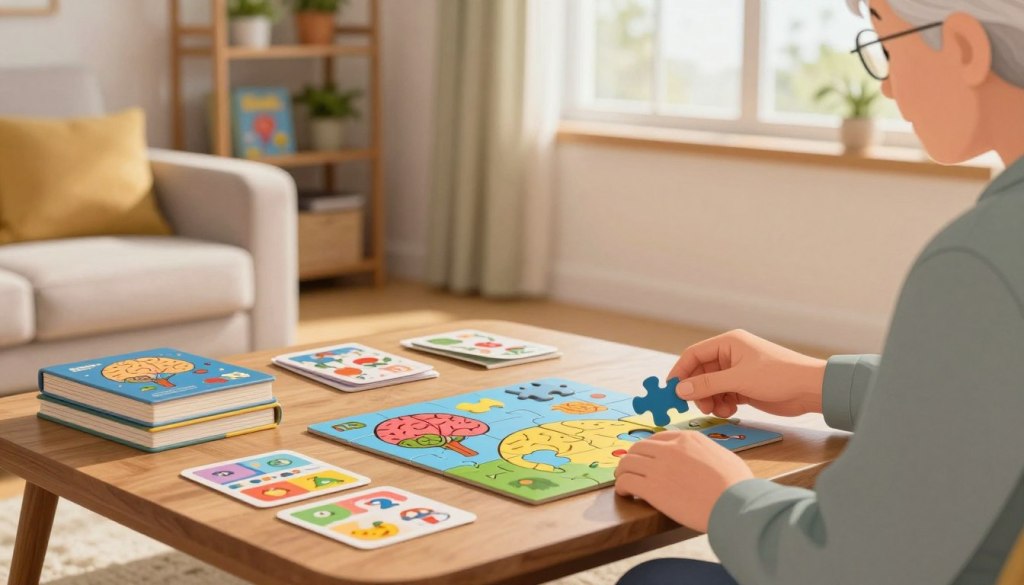
Puzzles and word challenges for problem-solving skills
Try crosswords, Sudoku, or jigsaw puzzles for 15–20 minutes a day. These puzzles sharpen logic and language. Senior-friendly apps let you change difficulty as skill grows.
Memory recall games to strengthen retention and reduce memory loss
Simple home games work well: recall a short grocery list, match cards, or name three things from a photo. These activities make remembering appointments and names easier.
Gentle practice supports retention without shame. Progress is small and steady—celebrate it.
Learning a new skill to promote neuroplasticity and keep mind adaptable
Learning something new helps the brain form fresh pathways. Try beginner language lessons, piano practice, knitting, painting, or gardening classes.
Start easy and raise the challenge slowly. That keeps the task rewarding and sustainable.
- Friendly menu: match preferences, don’t force “schoolwork.”
- For puzzles: crosswords, Sudoku, jigsaws, and apps with adjustable levels.
- Memory games: lists, card matching, and everyday recall tasks. ✅
- New skills: language, music, crafts, or community classes.
“The best activity is the one your loved one will do again tomorrow.”
Mindfulness, stress reduction, and focus training that also help seniors stay sharp
Gentle mindfulness habits give real gains: better focus, calmer mood, and steadier memory.
Mindfulness and simple meditation to support health and attention
Start small. Try 3–5 minutes of deep breathing or a short guided meditation. No special gear. No perfect form.
These tiny pauses reduce stress and help the mind settle. Reduced stress links to better sleep and steadier daily function.
For research-backed guidance, read a summary on mindfulness and cognitive benefits at mindfulness research.
Journaling and quiet creative tasks for focus and emotional well‑being
Use simple prompts: “Today I’m grateful for…,” “One thing I want to remember…,” or “What made me smile?”
Try quiet crafts, coloring, or arranging photos. These activities train attention without feeling like a test.
- Normalize stress: anxiety and loneliness can make memory slip worse.
- Easy starts: 3–5 minutes breathing, a guided track, or a mindful walk.
- Caregiver tip: call it “quiet time” or “reset minutes” if meditation feels intimidating.
“Calmer days often lead to clearer recall and better on-the-spot focus.”
To pair mindfulness with routine care and check-ins, see a helpful caregiver check-in schedule that also helps build consistent content and support.
Group activities vs solo training for seniors: what to choose and when
Group settings can light up motivation and turn small tasks into shared victories. Many people feel safer and more excited when others join in. That social boost helps with mood and keeps routines alive.
The emotional reality: if loneliness is part of your loved one’s day, group options often lift spirits fast. Social interaction supports emotional well‑being and can reduce isolation.
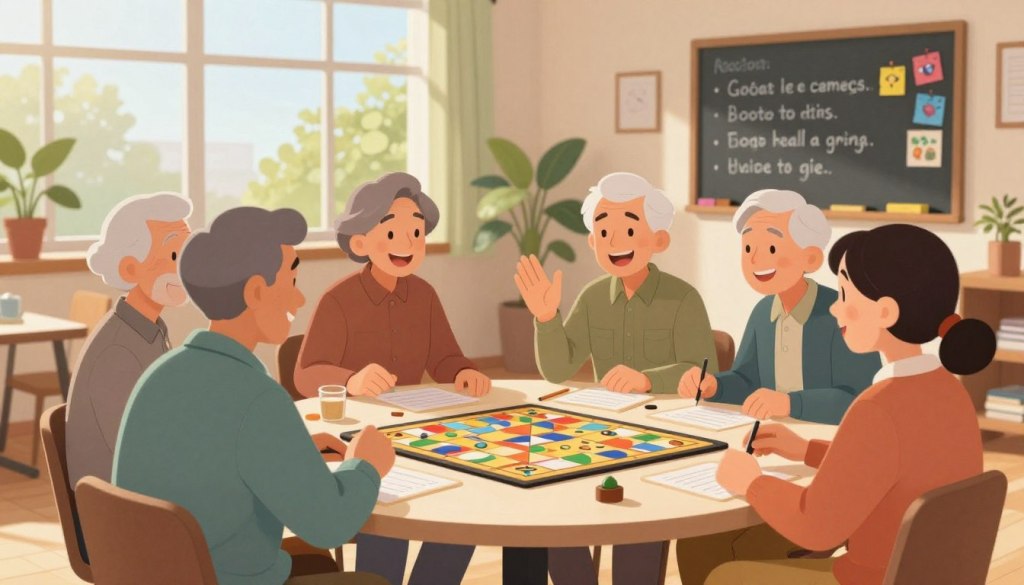
How social interaction boosts motivation, mood, and cognitive function
Teams and classes add friendly competition and conversation. That mix improves attention and supports cognitive function through verbal turns and collaboration.
When solo workouts are better for pacing and independence
Quiet, one‑on‑one practice fits days when energy is low. Solo work protects focus and honors a loved one’s pace without overstimulation.
Ideas for family-supported games and shared routines
Simple, repeatable rituals stick best. Try a weekly crossword call, a shared Wordle-style check, or a “name-that-song” hour with family.
| Option | Benefits | Best for |
|---|---|---|
| Adult day care group | Routine, guided activities, social interaction | Those needing structure and social contact |
| Small family games | Comforting, low tech, boosts mood | Loved one who values family time |
| Solo sessions | Focus, flexible pacing, independence | Fatigue days or introverted experience |
“Pick group for motivation and routine; pick solo for quiet or pain days.”
For planning details and timing tips, see this short guide on morning vs evening check-ins. Once you choose group or solo, build a weekly plan that fits your family and care needs.
How to build a weekly brain-activity plan that sticks
A weekly plan that sticks starts with tiny, clear steps that fit real life. Pick short slots and make them feel like friendly appointments. Small wins keep motivation steady.
Sample weekly routine
- Mon/Wed/Fri: 20–30 minutes of targeted brain training or structured cognitive activities.
- Tue/Thu: 15–20 minutes of word games + 10 minutes of journaling.
- Weekend: a short lesson learning a new skill + a social call or group game.
- Daily option: two 10-minute bursts if predictability helps.
Pair mind with movement
Physically active coordination like Tai Chi, slow dancing, or toss-and-catch links balance and attention. Try a gentle Tai Chi video or play a slow tune and sway together.
Track progress without pressure
Note signs: better memory recall, longer focus, simpler daily function. Treat them as signals, not grades. Celebrate small changes.
Make it sustainable
Reminders, variety, and right difficulty keep the plan alive. Change the challenge slowly. If an activity feels defeating, lower the level and try again.
“Consistent, gentle practice can help reduce long‑term risk cognitive decline by keeping the mind engaged.”
For more low‑tech game ideas, see a short list of worthwhile games.
Conclusion
Close with this: small, repeatable habits give the best protection for memory and mood.
Practical answer: most people do best with about 20–30 minutes, three to five times per week, or 15–20 minutes daily if that fits the day. Short sessions add up.
These routines don’t “fix” aging. They support confidence, slow memory loss, and add steady care to a broader dementia-aware plan that includes sleep, movement, social time, and medical support.
Choose activities your loved one enjoys. Keep plans gentle and family-friendly. For quick checks, also check for dehydration at home — it can mimic worse problems.
Talk to Joy now: 1-415-569-2439. Sign up for JoyCalls: https://app.joycalls.ai/signup.
FAQ
How often should older adults do mental activities to keep their minds healthy?
Why do we need regular “workouts” for thinking and memory as we age?
How do thinking activities support memory, focus, and mental agility?
Can consistent practice really lower the risk of cognitive decline?
What do experts recommend for frequency and minutes per session?
Why are short sessions better than occasional long ones?
Are daily 15–20 minute options effective?
What did studies find about a 10-week, 30-minutes-a-day training plan?
How should someone choose frequency based on goals and energy?
When should frequency be reduced because of fatigue or health issues?
When is it right to scale up the challenge?
What activities boost problem-solving and reasoning?
Which exercises help memory and retention specifically?
How does learning a new skill benefit thinking ability?
Do mindfulness and stress reduction help keep the mind sharp?
Can journaling or quiet creative work support attention?
Should someone choose group activities or solo practice?
How does social interaction improve cognitive training?
When are solo workouts preferable?
What family-supported activities work well?
How can someone build a weekly routine that sticks?
What’s a sample weekly plan combining training and movement?
How can physical activity be paired with thinking tasks?
How should progress be tracked?
How do you keep practice sustainable and enjoyable?

Ana Avila, PhD, is a healthcare and technology writer with deep expertise in artificial intelligence, senior care innovation, and the practical use of AI in healthcare operations. Her work focuses on how emerging technologies can improve the daily experience of older adults, support overburdened care teams, and help senior living communities deliver safer, faster, and more personalized support.
Dr. Avila’s academic background is rooted in health informatics, aging care systems, and applied artificial intelligence. Her doctoral work focused on how digital health tools, predictive analytics, and AI-assisted communication systems can be used to improve care coordination, reduce operational delays, and identify early signs of risk among older adults. Her training gives her a rare ability to understand both the technical side of AI and the human realities of healthcare delivery.
Over the years, Ana has developed a specialized body of work around AI in senior living. She writes about how senior care providers can use intelligent systems to manage resident requests, answer routine questions, support family communication, improve after-hours coverage, and detect patterns that may indicate loneliness, confusion, distress, or unmet needs. Her articles often examine the gap between what senior living teams are expected to deliver and what traditional staffing models can realistically support.
Ana’s healthcare expertise is especially focused on the operational side of care. She has written extensively about call handling, resident engagement, front desk workflows, triage systems, caregiver communication, care escalation, and the hidden administrative burden placed on senior living staff. Her work explains how AI can help reduce repetitive tasks, organize incoming requests, prioritize urgent issues, and give human caregivers more time for meaningful resident interaction.
At the same time, Ana is careful not to present AI as a replacement for human care. A consistent theme in her writing is that technology should support relationships, not weaken them. She argues that the best AI systems in healthcare are not the ones that simply automate the most tasks, but the ones that make care teams more responsive, families more informed, and residents more supported. Her perspective is grounded in the belief that senior living technology must be designed around dignity, trust, privacy, and compassion.
Ana has also written widely on the ethical use of AI in healthcare. Her work discusses the importance of human oversight, transparent escalation rules, resident consent, data minimization, and responsible use of sensitive health and behavioral information. She often emphasizes that AI systems used around older adults must be easy to understand, carefully monitored, and designed with the limitations and needs of real residents in mind, including those with memory loss, hearing challenges, mobility issues, or social isolation.
Her writing has been used as a reference point in discussions about aging, elder care technology, digital health, and AI-supported senior living. Some of her articles have also been cited by Wikipedia editors as supporting references on topics related to healthcare, aging, and technology. This has helped position her work as a useful educational resource for readers looking to understand how AI can be applied in real care environments.
In addition to her long-form writing, Ana has contributed research-based commentary, professional explainers, and practical guidance for healthcare operators, senior living decision-makers, and technology teams building products for older adults. Her work combines research literacy with operational practicality. She is able to take complex subjects such as natural language processing, predictive analytics, conversational AI, and care automation, and explain them in a way that is accessible to executives, caregivers, families, and non-technical readers.
Ana’s strongest area of expertise is the intersection of artificial intelligence and senior living operations. She understands that senior care communities face a difficult combination of rising resident expectations, staffing pressure, family communication demands, and increasing care complexity. Her writing explores how AI can be used to ease those pressures through smarter communication systems, faster response workflows, proactive check-ins, and better visibility into resident needs.
Her approach is both evidence-informed and deeply human. She studies AI through the lens of real-world care delivery: whether a resident gets help faster, whether a family member receives a clearer update, whether a caregiver avoids unnecessary administrative work, and whether a senior living team can identify a concern before it becomes a crisis. This practical focus makes her work especially relevant for organizations that want to adopt AI responsibly rather than simply follow technology trends.
Ana Avila is regarded as a thoughtful voice on the future of AI in healthcare and senior living. Her expertise combines academic training, research-driven analysis, operational understanding, and a strong commitment to humane technology. Through her writing, she helps healthcare leaders and senior living communities understand not only what AI can do, but how it should be used to improve care, preserve dignity, and strengthen the human relationships at the center of aging support.