

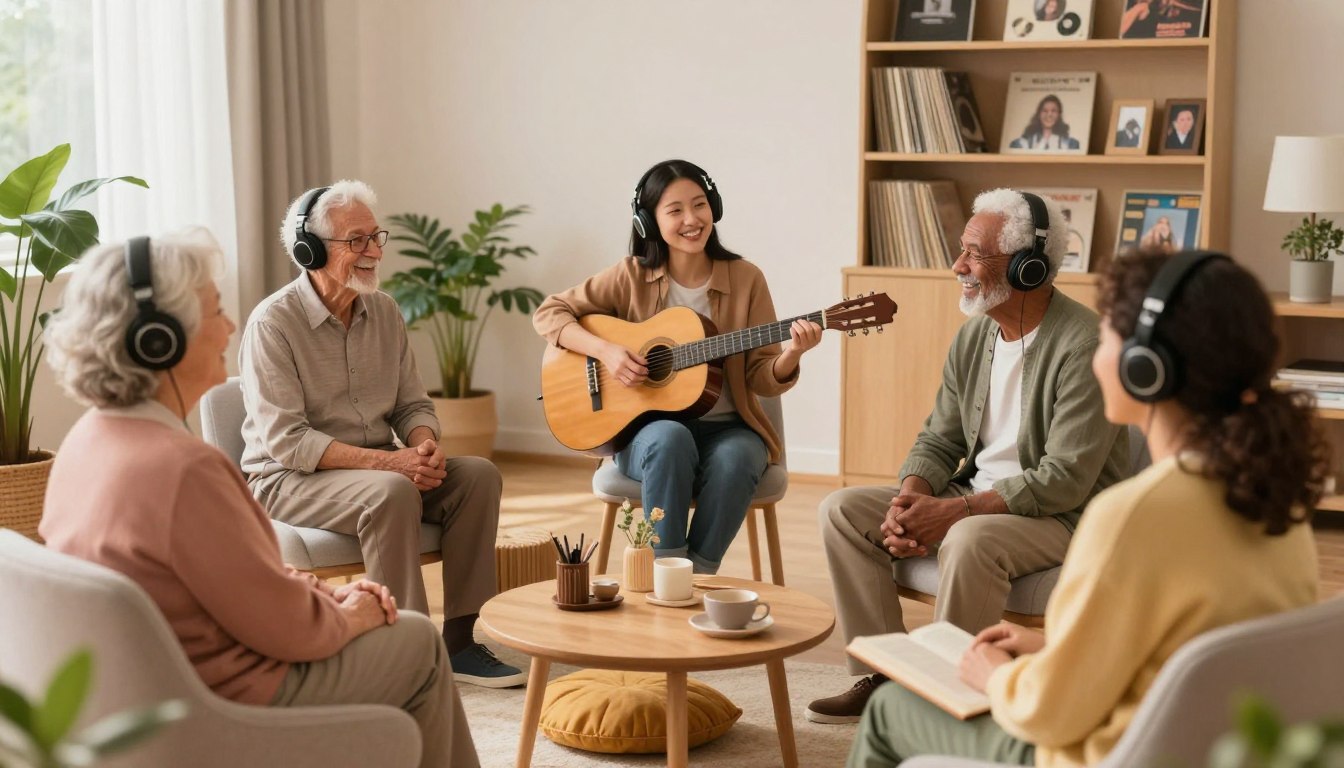
Surprising fact: A familiar song can unlock decades of feeling in seconds for many older adults.
You’re juggling work and life, and you just want one simple way to help Dad feel like himself again. This short guide shows how favorite songs can trigger strong emotion and recall. It explains why tunes can “take you back” and how to pick the right ones for your loved one.
We’ll cover what brain research says about the auditory cortex and reward systems, early preferred tracks, and simple ways to use playlists at home or in care settings—no fancy gear needed.
Realistic note: this is not a cure for dementia. It is a comforting tool for connection, routine, and calm moments. Expect easy, repeatable steps: timing, playlists, and watching reactions.
If you need help right now, Talk to Joy now: 1-415-569-2439. For ongoing check-ins, Sign up for JoyCalls. Learn more about clinical findings on caregiver-friendly research.
Key Takeaways
- Familiar songs can quickly spark emotion and recall.
- Simple playlists and timing make this an easy care tool.
- It soothes, connects, and supports daily routines.
- Not a cure, but helpful for agitation, sleep, and stress.
- Immediate help: call Joy at 1-415-569-2439; long-term: sign up for JoyCalls.
Why music and memory seniors are so closely linked in the brain
A single song often kicks off a networked response in the brain that links hearing, reward, and self.
How the sound system connects to reward and self
The auditory cortex first decodes rhythm and melody. Then reward pathways driven by dopamine light up if the tune feels enjoyable.
The medial prefrontal cortex acts as a “me and my life” hub. When sound, reward, and self join, autobiographical memories can appear.

Why early favorites stick
Songs from late teens or early adulthood often link to big life moments: first jobs, friends, faith groups. That gives them lasting power in the aging brain.
“Residents who barely reacted to classical pieces began singing when familiar folk tunes played.”
What recent research shows
- An 8-week mindful listening program increased connectivity between the auditory system and medial prefrontal cortex in older adults (study results).
- fMRI studies suggest early preferred tracks can activate areas preserved later into dementia.
- Caregivers should view this as a friendly cue, not forced recall.
| Part brain | Main role | Care takeaway |
|---|---|---|
| Auditory cortex | Processes sound and tone | Start with familiar recordings |
| Reward pathways | Dopamine-driven pleasure signals | Choose enjoyable tracks |
| Medial prefrontal cortex | Links self with past events | Use early preferred songs when possible |
Next: practical tips to pick the right selections when a loved one can’t say what they like.
How to choose the right songs for older adults, dementia, and Alzheimer disease
You don’t need perfect memory to find sounds that calm, spark smiles, or ease rest. Start simple. Ask family about weddings, church hymns, radio hits from youth, or songs played on long drives. Those clues speed the search.

Finding preferred music when words fail
Try the teen-to-early-adult window first. Play short batches — three or four tracks — and watch for softening faces, humming, tapping, or calmer breathing.
Use family, culture, and Billboard-era cues
Call siblings or old friends. Ask about dances, local genres, or language cues that signal “this is our life.” If no one knows, check Billboard charts from when the person was 16–24 and test top hits.
When instrumental works best
For bedtime and rest, choose instrumentals. Studies led by Darina Petrovsky show routines that use familiar tracks at 60–80 BPM help sleep in dementia. Lyrics can keep the mind active; gentle tones help it shut down.
Tempo and timing tips
Aim for 60–80 beats per minute for calming moments. Reserve mid-tempo tracks for daytime movement. Keep the playlist flexible — preferences shift as the condition changes. Update based on daily reactions.
Helpful resource: For routine care planning, see this caregiver check-in template to pair playlists with daily visits.
How to use music therapy techniques at home and in care settings
Start with small, planned listening moments that copy a therapy session but fit the living room.
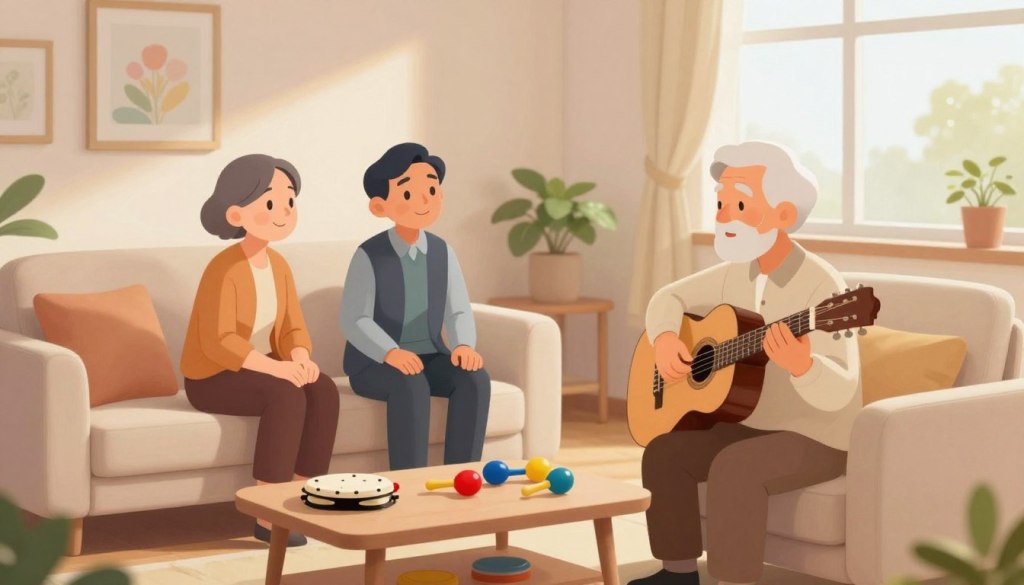
Mindful listening routines that may help reduce stress, anxiety, and agitation
Simple routine: same chair, same time, low volume, one playlist. Use a short prompt such as “listen for the piano”.
Repeat this daily for a week. Notice breathing, facial tone, or a slowed pace. Treat small wins as real progress.
Singing and choir-style participation to support social connection
Singing often unlocks joy even when words blur. Try a gentle two-song duet after lunch or at sundowning hours.
Try JoyCalls Free
No app or new device needed. Start with a free 7-day trial.
Group sessions work too. Julene Johnson’s Community of Voices found that choir participation reduced loneliness and increased interest in life for older adults.
Movement and dancing for balance, motor skills, and mood
Scale movement to ability: toe taps while seated, slow sways with a walker close, or a two-minute living-room dance to lift mood and support balance.
Learning an instrument later in life
Short, adapted lessons—keyboard or ukulele—can boost working memory and thinking speed over 10–16 weeks.
Tip: use large keys, short sessions, and praise progress to protect self-esteem.
Caregiver-friendly activities for assisted living and nursing home residents
Practical ideas: headphone calm sessions during busy dining hours, small sing-alongs after meals, or a gentle “name that tune” with era-based choices.
Share playlists with staff. Label them: “bedtime,” “calm,” “move.” Keep instructions one line long so they fit care workflows.
| Technique | Goal | Simple setup | Who benefits |
|---|---|---|---|
| Mindful listening | Lower anxiety, reduce agitation | Chair, low volume, one playlist | Home caregivers, residents |
| Choir/group singing | Reduce loneliness, boost interest | Short rehearsals, familiar songs | Older adults in groups |
| Movement/dance | Improve balance, mood | Chair taps, 2-min routines | Those with limited mobility |
| Instrument lessons | Enhance working memory, skills | 10–16 week plan, adapted tools | Motivated learners |
For more activity ideas in care settings, see structured activities for memory care residents. For timing and check-ins that pair well with these routines, review this caregiver check-in guide.
How to match music to specific symptoms and situations caregivers see over time
Caregivers notice patterns: sleepless nights, afternoon unrest, and hospital stays that change what helps most.
Sleep disruption: For dementia-related night waking, try a bedtime recipe: 30–60 minutes before rest, dim lights, low stimulation, and a short set of familiar, enjoyable tracks at about 60–80 BPM. Instrumental pieces often work best because lyrics can keep the mind active.
Why it can help: A slower tempo may guide breathing and heart rate down. This can help reduce arousal for patients and ease strain for caregivers.

Agitation and verbal outbursts
Research in nursing settings shows mixed weekly reports, yet targeted listening often gives short relief. The METRIcAL trial found no big change in staff weekly scores, but structured observations saw fewer verbal outbursts.
That means personalized playlists might not fix every charted result, but they can soften moments of distress and improve quality of life for residents.
Hospital and ICU delirium
Delirium affects roughly 70–80% of ventilated patients. Preliminary work suggests sequenced, relaxing sets—piano, rainfall, soft classical—given twice daily for about 60 minutes may lower delirium burden.
Some studies linked preferred relaxing choices with less anxiety, lower sedative needs, and earlier ventilator removal by ~1.4 days. Ask clinicians about trials and trial-like approaches used in critical care.
Track results in simple steps
Don’t only log “agitation: yes/no.” Note short-term effects: softer face, fewer call-outs, less pacing, more eye contact, calmer voice for 10–20 minutes.
Use a tiny log: date/time; playlist; what happened before; reaction; one line of feelings or connection (for example, “smiled,” “sang along”). Over weeks, these notes show real, practical effects.
“Personalized listening often gives a quiet window of comfort, even when charts stay the same.”
For clinical summaries and trial details, see this clinical trial summary. For pairing check-ins and reminders with routines, review this care reminder guide.
Turning Music Into a Daily Brain-Health Tool: Practical Strategies for Seniors, Families, and Caregivers
Many people understand that music can trigger memories. A familiar song from decades ago can instantly bring back emotions, faces, places, and experiences that seemed long forgotten.
However, the real opportunity goes far beyond simply listening to favorite songs occasionally.
Music can become a structured, intentional tool that supports memory recall, emotional well-being, social connection, mental stimulation, and even daily routines. For seniors, especially those experiencing mild memory changes, loneliness, cognitive decline, or reduced social engagement, the right musical habits can create meaningful improvements in everyday life.
The key is knowing how to use music strategically.
Rather than treating music as background noise, seniors and caregivers can turn it into an active part of a healthy aging routine. The following approaches are practical, easy to implement, and designed to maximize the cognitive and emotional benefits that music can offer.
Create a Personal Memory Playlist
One of the most effective ways to use music for memory support is to build a personalized memory playlist.
The brain responds most strongly to music that has personal significance. Songs connected to meaningful life events tend to activate emotional and autobiographical memory networks more deeply than unfamiliar music.
A memory playlist can include songs associated with:
- Childhood memories
- School years
- College experiences
- First jobs
- Courtship and marriage
- Family celebrations
- Religious or cultural events
- Favorite vacations
- Special friendships
- Milestone achievements
The goal is not to create the perfect playlist but to gather music that represents different chapters of life.
How to Build a Memory Playlist
Start by asking simple questions:
- What songs were popular when you were a teenager?
- What music was played at your wedding?
- Which songs remind you of your parents?
- What music was common during family gatherings?
- What songs were played during festivals or holidays?
Caregivers and family members can help by researching popular songs from specific decades and presenting options to the senior.
As memories emerge, additional songs can be added over time.
Many families find that creating these playlists becomes a meaningful bonding activity in itself.
Use Music to Encourage Storytelling
Music becomes even more powerful when it serves as a trigger for conversation.
After listening to a familiar song, encourage discussion about:
- Where the song was first heard
- Who was present at the time
- What emotions it brings up
- Important life events connected to the music
- Cultural traditions associated with the song
This process strengthens memory retrieval pathways while promoting social interaction.
Questions That Spark Meaningful Memories
Instead of asking:
“Do you remember this song?”
Try asking:
- What does this song remind you of?
- Who would have enjoyed listening to this with you?
- What was happening in your life when this song was popular?
- Did this song play an important role in any special event?
Open-ended questions often produce richer memories and deeper engagement.
Even if specific facts are forgotten, emotional memories may remain accessible, allowing seniors to reconnect with important aspects of their identity and life story.
Pair Music With Daily Activities
Consistency helps the brain create stronger associations.
One effective strategy is linking specific types of music with routine activities.
Examples include:
Morning Activation Music
Use uplifting, energetic songs during morning routines.
Benefits may include:
- Improved mood
- Increased alertness
- Greater motivation to start the day
- Reduced morning sluggishness
Relaxation Music in the Evening
Gentle music can signal the brain that it is time to slow down.
Benefits may include:
- Reduced anxiety
- Better relaxation
- Improved sleep preparation
- Lower stress levels
Music During Exercise
Walking, stretching, chair exercises, or physical therapy sessions often become more enjoyable when paired with music.
Research consistently shows that rhythmic music can improve movement, motivation, and exercise adherence.
For seniors who struggle to maintain physical activity routines, music can make exercise feel less like a task and more like an enjoyable experience.
Transform Listening Into Active Participation
Passive listening is beneficial, but active engagement often produces stronger cognitive stimulation.
Whenever possible, encourage participation.
Activities may include:
- Singing along
- Clapping to rhythms
- Dancing
- Playing simple instruments
- Tapping along with beats
- Learning new songs
Active participation engages additional brain regions involved in movement, language, coordination, attention, and memory.
Even simple actions like humming or tapping a foot can increase mental engagement.
Why Singing Is Especially Valuable
Singing combines multiple brain functions simultaneously.
It requires:
- Memory retrieval
- Language processing
- Breath control
- Auditory feedback
- Motor coordination
This makes singing a uniquely comprehensive brain exercise.
Group singing activities may offer additional benefits by combining cognitive stimulation with social interaction.
Use Music to Reduce Stress and Protect Cognitive Health
Chronic stress can negatively affect memory, concentration, and overall brain health.
Music can serve as a practical stress-management tool.
When people listen to music they enjoy, the body often experiences:
- Lower perceived stress
- Improved emotional regulation
- Greater relaxation
- Enhanced feelings of comfort and safety
Over time, reducing stress may indirectly support healthier cognitive functioning.
Creating a Calm Music Routine
Many seniors benefit from scheduling dedicated relaxation sessions.
For example:
- 20 minutes after lunch
- Before an afternoon nap
- Before bedtime
- During quiet reflection periods
Consistency helps transform music into a reliable emotional support tool.
Use Music to Strengthen Social Connections
One often-overlooked benefit of music is its ability to bring people together.
Social isolation can negatively impact both emotional and cognitive health.
Music creates natural opportunities for connection.
Family Music Sessions
Families can organize simple activities such as:
- Sharing favorite songs
- Discussing musical memories
- Watching old concert recordings
- Singing together
- Exploring music from different generations
These interactions often feel easier and more natural than formal conversations.
Music provides a shared focus that reduces pressure and encourages meaningful engagement.
Community-Based Music Activities
Many senior centers, community organizations, religious institutions, and local groups offer:
- Choirs
- Music appreciation clubs
- Dance sessions
- Live music events
- Instrument classes
Participating in these activities provides both cognitive stimulation and valuable social interaction.
Explore New Music Alongside Familiar Favorites
While nostalgic music is excellent for memory recall, introducing new music can also challenge the brain in healthy ways.
Learning new songs requires:
- Attention
- Pattern recognition
- Auditory processing
- Memory formation
This creates opportunities for continued cognitive growth.
Finding the Right Balance
A useful approach is combining:
- 70–80% familiar music
- 20–30% new music
This balance provides comfort while still encouraging mental stimulation.
New music does not have to mean modern music.
Seniors may enjoy exploring:
- Classical compositions
- World music traditions
- Jazz recordings
- Instrumental performances
- Folk music from different cultures
The objective is gentle cognitive challenge rather than overwhelming novelty.
Build a Weekly Music-and-Memory Routine
Like exercise, the benefits of music often increase when it becomes a regular habit.
A simple weekly framework might look like:
Monday: Memory Playlist Session
Listen to favorite songs and discuss associated memories.
Tuesday: Music and Movement
Combine music with walking, stretching, or light exercise.
Wednesday: Singing Day
Spend time singing familiar songs.
Thursday: Discover Something New
Listen to music from a different genre or era.
Friday: Family Music Hour
Share music and stories with loved ones.
Saturday: Relaxation Music Session
Focus on stress reduction and emotional well-being.
Sunday: Reflection Through Music
Listen to meaningful songs and reflect on positive life experiences.
This structure creates variety while ensuring regular cognitive engagement.
Helping Seniors With Dementia Use Music Safely and Effectively
For seniors living with dementia, music interventions should remain simple and person-centered.
The most effective music is usually:
- Familiar
- Meaningful
- Comfortable
- Non-overstimulating
Caregivers should observe responses carefully.
Positive signs may include:
- Smiling
- Singing
- Improved engagement
- Increased communication
- Relaxation
- Reduced agitation
If certain songs trigger distressing memories or emotional discomfort, they should be removed from the playlist.
The objective is emotional comfort and connection, not forcing memory recall.
Small Musical Habits Can Create Meaningful Results
Music is not a cure for memory loss, dementia, or cognitive decline.
However, it remains one of the most accessible, enjoyable, and meaningful tools available for supporting brain health during aging.
A favorite song can stimulate memories, encourage conversation, reduce stress, strengthen relationships, improve mood, and provide moments of joy that might otherwise be difficult to access.
The greatest benefit often comes not from occasional listening, but from making music a consistent part of daily life.
Whether through singing, storytelling, movement, social activities, or personal playlists, music can become a practical and powerful companion for healthy aging—helping seniors stay connected not only to their memories, but also to the people and experiences that give life meaning.
How to Create a Safe, Personal Music Care Plan for Seniors
Music can be comforting, but it works best when it is used with care. A song that relaxes one person may irritate another. A playlist that brings back happy memories one day may feel overwhelming on a tired or emotional day. That is why families should avoid treating music as a one-size-fits-all solution.
A simple music care plan helps seniors, caregivers, and family members use songs in a thoughtful way. The goal is not just to play music. The goal is to choose the right music, at the right time, for the right purpose.
This becomes especially important for older adults who live alone, have memory changes, feel lonely, experience anxiety, or depend on caregivers for daily routines.
Start With the Senior’s Preferences, Not Your Own
Family members often choose songs they think are “good for seniors.” But the best music is usually not the most relaxing, famous, or old-fashioned song. It is the music that has personal meaning for that specific person.
Before building a playlist, ask:
- What songs did they enjoy in their teens and twenties?
- What music did they play at home?
- What songs remind them of marriage, parenting, work, travel, or faith?
- Which artists did they dislike?
- Are there songs linked to grief, loss, or difficult memories?
This last question matters. Not every memory is pleasant. A song connected to a deceased spouse, a war period, a family conflict, or a painful life stage may cause sadness or distress.
If the senior can speak clearly, involve them directly. If they struggle to communicate, watch their body language. A relaxed face, soft smile, humming, tapping, or eye contact may suggest comfort. Frowning, restlessness, tears, repeated requests to stop, or turning away may suggest the song is not right.
Create Playlists for Different Needs
One playlist is not enough. Seniors often need different types of music at different times.
A practical music care plan may include:
A Morning Playlist
This should include gentle but uplifting songs. The aim is to help the person wake up, feel oriented, and begin the day with warmth.
Use this during:
- Washing and dressing
- Breakfast
- Morning tea or coffee
- Light stretching
- A caregiver’s first visit of the day
Avoid music that is too loud or fast early in the morning, especially if the person wakes up confused or anxious.
A Calm-Down Playlist
This playlist should include slower, familiar, soothing songs. It can be used when the senior feels restless, worried, overstimulated, or emotionally unsettled.
Use this during:
- Late afternoon restlessness
- After medical appointments
- Before difficult care tasks
- During anxious moments
- After a disagreement or stressful call
Keep the volume low. Sit nearby if possible. Do not force conversation. Sometimes the best support is simply being present while the music plays.
A Memory Playlist
This playlist should include personally meaningful songs connected to important life stages.
Use this during:
- Family visits
- Reminiscence conversations
- Photo album sessions
- Birthday calls
- Grandchildren’s visits
- Quiet afternoons
After each song, ask gentle questions. Instead of saying, “Do you remember this?” try, “What does this song make you think about?” This feels less like a test and more like an invitation.
A Movement Playlist
This playlist should have a steady rhythm that supports safe movement.
Use this during:
- Chair exercises
- Walking indoors
- Gentle stretching
- Physiotherapy exercises
- Clapping or toe tapping
Always match movement to ability. Seniors with balance issues should not be encouraged to dance without supervision. Seated rhythm activities can still be valuable.
A Bedtime Playlist
This should be soft, slow, and predictable. Instrumental music may work better for some seniors because lyrics can keep the mind active.
Use this:
- 20 to 30 minutes before sleep
- After lights are dimmed
- While reducing screen use
- During the final part of the evening routine
Avoid songs connected to emotionally intense memories at bedtime.
Keep Music Sessions Short at First
More music is not always better.
For many seniors, especially those with dementia, long listening sessions can become tiring. Start with 5 to 10 minutes. If the person responds well, extend slowly.
A good rule is to stop while the experience is still positive. Do not wait until the senior becomes bored, irritated, or tired.
Short, successful sessions are more useful than long sessions that end in frustration.
Watch for Overstimulation
Music can stimulate the brain, emotions, and body at the same time. That is why it can be powerful. But it can also become overwhelming.
Signs of overstimulation may include:
- Covering ears
- Agitation
- Pacing
- Irritability
- Confusion
- Repeatedly asking what is happening
- Increased breathing rate
- Trying to leave the room
If this happens, turn the music off calmly. Do not argue or explain too much. Reduce noise, lower lighting if needed, and give the person time to settle.
The lesson is not “music does not work.” The lesson may be that the wrong song, volume, timing, or environment was used.
Use Music Before Difficult Moments
Music can be especially helpful when used before stress builds.
Caregivers can try playing familiar calming music before:
- Bathing
- Dressing
- Medication reminders
- Meals
- Leaving for appointments
- Evening confusion
- Physical therapy
- Bedtime
This gives the brain a comforting cue before the difficult task begins.
For example, if bathing is stressful, play the same calming song five minutes before the routine starts. Over time, the song may become a signal that something familiar and safe is about to happen.
Make the Environment Music-Friendly
The setting matters as much as the song.
For a better music experience:
- Turn off the TV.
- Reduce background noise.
- Use comfortable seating.
- Keep the volume moderate.
- Avoid interrupting constantly.
- Make sure hearing aids are working if used.
- Keep the room well-lit during daytime sessions.
- Use softer lighting for evening sessions.
If headphones are used, choose comfortable ones and keep the volume safe. Some seniors may dislike headphones because they feel isolating or confusing. In that case, use a speaker at low volume.
Involve Family Members Across Generations
Music can help younger family members connect with older adults when conversation feels difficult.
Grandchildren can ask:
- “What music did you listen to when you were my age?”
- “Did you ever dance to this song?”
- “Who was your favorite singer?”
- “What songs did you play at family celebrations?”
This gives seniors a chance to share identity, not just memories.
Families can also create a shared playlist together. Each person can add one song and explain why it matters. This turns music into a bridge between generations.
For seniors who feel lonely, these small rituals can be deeply meaningful.
Keep a Simple Music Response Record
A music care plan improves when families track what works.
This does not need to be complicated. A notebook or phone note is enough.
Record:
- Date and time
- Song or playlist used
- Situation before the music
- Reaction during the music
- Mood after the music
- Whether to repeat or avoid it
Example:
“Tuesday, 5:30 PM. Played old devotional songs before dinner. She smiled, sang two lines, and ate calmly. Use again before evening meal.”
Over time, these notes reveal patterns. The family may discover that certain songs help with meals, others help with sleep, and some should be avoided.
Respect Silence Too
Music should support the senior, not fill every quiet moment.
Some older adults enjoy silence. Others may become tired if music plays all day. Constant sound can reduce the special effect of meaningful songs.
Use music intentionally. Let silence remain part of the day.
A balanced routine may include:
- Music during selected care moments
- Quiet time after meals
- Conversation without music
- Outdoor sounds during walks
- Silence before sleep if preferred
The goal is comfort, not constant stimulation.
Know When to Ask for Professional Support
Families can use music safely at home, but professional help may be useful in some situations.
Consider consulting a music therapist, dementia care specialist, occupational therapist, or healthcare provider if:
- The senior becomes distressed by many songs.
- Music triggers strong grief or trauma.
- Agitation is severe or frequent.
- Sleep problems continue despite routine changes.
- The senior has advanced dementia and complex care needs.
- Caregivers feel unsure how to use music safely.
Music is a supportive tool. It should work alongside medical advice, caregiving routines, social connection, movement, nutrition, and emotional support.
Make Music Part of a Larger Care Routine
The most helpful music habits are connected to daily life.
For example:
- A morning song can begin the day.
- A favorite devotional song can support prayer or reflection.
- A calming playlist can ease sundowning.
- A movement playlist can encourage safe activity.
- A bedtime playlist can signal rest.
- A family playlist can support weekly calls.
This turns music from entertainment into a reliable care cue.
For seniors, repetition can feel reassuring. When the same song appears at the same kind of moment, the brain begins to associate it with safety, comfort, and routine.
How Technology Is Making Music More Powerful for Senior Brain Health
For previous generations, enjoying music often meant turning on a radio, playing a vinyl record, or listening to a favorite cassette tape. While those experiences remain meaningful, today’s technology has dramatically expanded the ways seniors can access, personalize, and benefit from music.
Importantly, technology is not replacing the emotional power of music. Instead, it is making music more accessible, more personalized, and easier to integrate into daily life.
For older adults who live independently, experience memory challenges, have limited mobility, or feel socially isolated, technology can help transform music from an occasional activity into an ongoing source of cognitive stimulation, emotional support, and connection.
The key is using technology in ways that feel simple, comfortable, and meaningful.
Why Accessibility Matters More Than Ever
Many seniors stop engaging with music not because they lose interest, but because access becomes more difficult.
Challenges may include:
- Reduced mobility
- Vision impairments
- Arthritis affecting dexterity
- Difficulty operating devices
- Hearing changes
- Living alone
- Reduced transportation options
Technology can remove many of these barriers.
With voice commands, simplified interfaces, smart speakers, and personalized recommendations, seniors can enjoy favorite music without needing to navigate complex systems.
The easier music becomes to access, the more likely it is to become a regular part of daily life.
Voice-Controlled Music Can Reduce Frustration
One of the most senior-friendly innovations in recent years is voice technology.
Instead of searching through menus or typing on small screens, seniors can simply ask for what they want.
Examples include:
- “Play songs from the 1960s.”
- “Play devotional music.”
- “Play my favorite playlist.”
- “Play relaxing piano music.”
- “Play songs by Lata Mangeshkar.”
- “Play old jazz classics.”
This reduces frustration and increases independence.
For seniors with arthritis, tremors, vision loss, or mobility limitations, voice control can make music far more accessible.
Making Voice Technology Easier to Use
Family members can help by creating:
- Simple custom playlists
- Written voice-command reminders
- Large-print instruction cards
- Frequently used music shortcuts
For example:
“Say: Play Morning Playlist”
“Say: Play Relaxation Music”
“Say: Play Family Favorites”
Keeping commands simple improves confidence and encourages regular use.
Smart Playlists Can Support Different Emotional Needs
Technology now allows music to be organized around moods, goals, and routines rather than simply genres.
This can be especially useful for seniors.
Different playlists can support different needs throughout the day.
Playlist for Focus and Mental Activity
Ideal during:
- Reading
- Crossword puzzles
- Learning activities
- Crafts and hobbies
Typically includes:
- Instrumental music
- Light classical music
- Gentle acoustic tracks
Playlist for Relaxation
Ideal during:
- Quiet afternoons
- Stressful days
- Rest periods
- Evening routines
The objective is emotional regulation rather than stimulation.
Playlist for Positive Energy
Ideal during:
- Household activities
- Morning routines
- Exercise
- Social gatherings
Music can help create momentum and motivation when energy levels are low.
Playlist for Reflection and Reminiscence
Ideal during:
- Family visits
- Memory-sharing activities
- Journaling
- Looking through photo albums
This encourages autobiographical memory retrieval and meaningful conversation.
How AI Is Helping Personalize Music Experiences
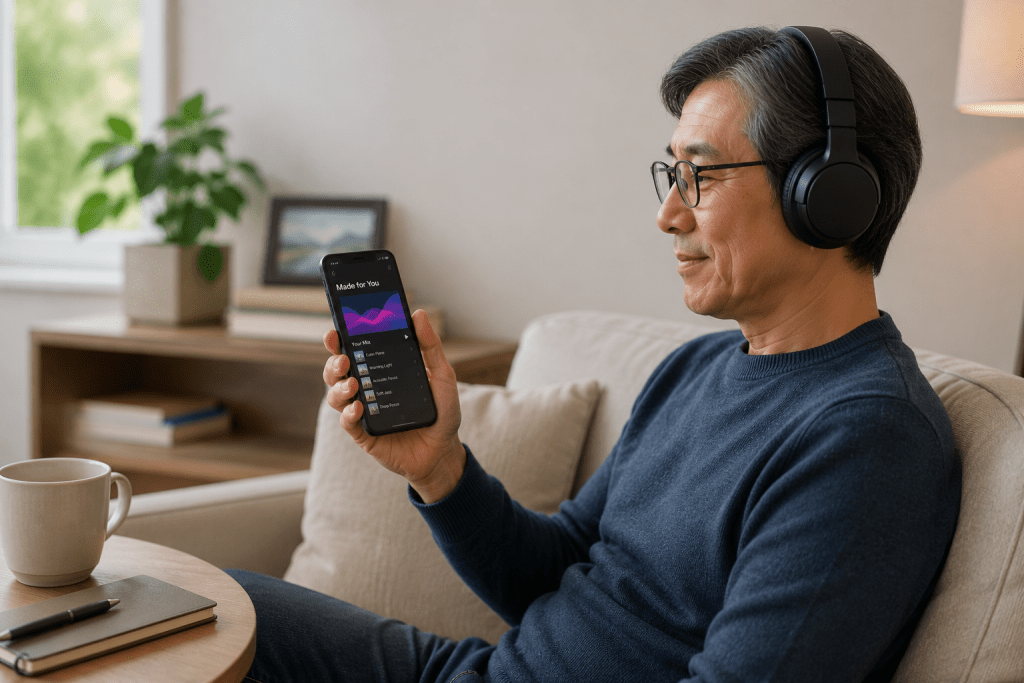
Artificial intelligence is changing how people discover and engage with music.
While some seniors may not realize it, many streaming platforms already use AI to recommend songs based on listening habits.
This creates opportunities for personalized cognitive stimulation.
Instead of repeatedly hearing the exact same songs, seniors can gradually discover:
- Similar artists
- Related genres
- New recordings
- Forgotten favorites
- Cultural music connected to their background
The experience feels familiar without becoming repetitive.
The Importance of Personalization
The most effective music experiences are deeply personal.
Two seniors born in the same year may respond very differently to the same playlist.
One person may connect with:
- Religious music
- Folk music
- Classical compositions
Another may prefer:
- Film songs
- Jazz
- Country music
- Dance music
Technology makes it easier to tailor experiences to individual preferences rather than relying on generic assumptions.
Music and Social Connection in the Digital Age
One of the greatest challenges facing older adults today is loneliness.
Research consistently shows that social isolation can negatively affect both emotional and cognitive health.
Music technology can help address this challenge.
Shared Listening Experiences
Families can create shared playlists that multiple generations enjoy.
For example:
- Grandparents add favorite songs from their youth.
- Parents contribute meaningful family songs.
- Grandchildren introduce modern favorites.
These playlists become conversation starters.
They help family members understand one another through music and personal stories.
Virtual Music Gatherings
Families who live far apart can organize:
- Online sing-alongs
- Shared listening sessions
- Virtual celebrations
- Music-themed video calls
Music often provides a natural topic of conversation when people struggle to know what to talk about.
This can be especially helpful when communicating with seniors experiencing mild cognitive decline.
Using Music With Digital Memory Activities

Music becomes even more powerful when combined with other memory-supporting activities.
Examples include:
Music and Photo Albums
Play songs connected to specific life periods while reviewing family photographs.
This encourages:
- Storytelling
- Memory recall
- Emotional engagement
Music and Life Story Projects
Families can document:
- Important memories
- Favorite songs
- Personal milestones
- Family traditions
Creating a personal life-history project can strengthen identity and preserve family heritage.
Music and Journaling
Some seniors enjoy writing down:
- Memories triggered by songs
- Emotional responses
- Reflections on life experiences
This combines memory stimulation with self-expression.
Balancing Convenience With Healthy Habits
Technology is valuable, but it should support human connection rather than replace it.
The healthiest approach combines:
- Music
- Conversation
- Physical activity
- Family interaction
- Community engagement
For example:
A playlist may encourage memory recall, but discussing those memories with a loved one creates additional emotional and cognitive benefits.
Technology works best when it enhances relationships rather than replacing them.
Helping Seniors Feel Confident With New Technology
Some older adults hesitate to use modern devices because they fear making mistakes.
Families can help by introducing technology gradually.
Practical Tips
- Teach one feature at a time.
- Use large text when possible.
- Create written instructions.
- Repeat demonstrations patiently.
- Focus on enjoyment rather than technical details.
- Celebrate small successes.
Confidence often grows quickly once seniors realize how easily they can access favorite music.
The objective is not technological expertise.
The objective is making meaningful experiences more accessible.
The Future of Music and Healthy Aging
Researchers continue exploring how music may support:
- Cognitive stimulation
- Emotional resilience
- Social connection
- Dementia care
- Quality of life
Emerging technologies may eventually provide even more personalized music experiences tailored to an individual’s preferences, habits, and daily needs.
Yet despite all these innovations, the most important element remains unchanged.
A meaningful song still has the power to evoke memories, inspire emotions, strengthen relationships, and bring comfort.
Technology simply helps deliver those experiences more consistently and conveniently.
For seniors navigating the challenges of aging, that accessibility can make a meaningful difference in everyday life.
Music has always been a powerful human experience. Technology is helping ensure that older adults can continue enjoying its benefits for years to come, regardless of physical limitations, distance from loved ones, or changing cognitive abilities.
Not All Music Affects the Brain the Same Way: Choosing the Right Music for Different Cognitive and Emotional Goals

Many articles discuss the benefits of music for seniors as though all music works in the same way. In reality, different types of music can influence the brain differently depending on factors such as tempo, familiarity, emotional associations, complexity, lyrics, and cultural relevance.
Understanding these differences can help seniors, caregivers, and family members use music more intentionally.
The goal is not to identify a single “best” type of music. Instead, it is to understand how various musical styles can support different cognitive, emotional, and social needs throughout the day.
When music is matched to a specific goal, it often becomes more effective and more meaningful.
Why Personal Preference Still Matters Most
Before discussing genres and styles, it is important to understand one principle:
The most beneficial music is often the music the individual genuinely enjoys.
Research has repeatedly shown that familiar and emotionally meaningful music tends to activate stronger responses than music selected solely because it is considered relaxing or intellectually stimulating.
A senior who loves old Bollywood songs may receive more emotional and cognitive benefits from those songs than from classical music they never enjoyed.
Similarly, someone who spent decades listening to jazz may respond more positively to jazz than to popular recommendations for relaxation music.
Personal connection remains the foundation.
Once that foundation is established, different musical styles can be used strategically.
Familiar Music and Autobiographical Memory
Familiar songs often produce the strongest memory-related responses.
These songs act like mental bookmarks tied to specific periods of life.
A familiar melody may trigger memories of:
- School years
- Friendships
- Marriage
- Parenting
- Career milestones
- Religious celebrations
- Family traditions
When Familiar Music Works Best
Use familiar music during:
- Memory-sharing activities
- Family visits
- Photo album sessions
- Reminiscence exercises
- Dementia care routines
Familiar music is particularly valuable because it often supports emotional security alongside memory recall.
For seniors experiencing cognitive decline, recognizable songs can provide a reassuring sense of continuity and identity.
Instrumental Music and Mental Focus
Music without lyrics may be useful when attention and concentration are the primary goals.
Lyrics require language processing. While this is beneficial in some situations, it can also become distracting during tasks that require focus.
Instrumental music may support:
- Reading
- Puzzle solving
- Craft activities
- Writing
- Learning new skills
Why Instrumentals Can Feel Less Mentally Demanding
Without lyrics competing for attention, the brain can devote more resources to the task at hand.
Many seniors find instrumental music calming because it creates a pleasant atmosphere without demanding active engagement.
Popular options include:
- Piano music
- Acoustic guitar
- Classical compositions
- Soft jazz instrumentals
- Nature-inspired instrumental tracks
The objective is gentle stimulation rather than complete silence.
Religious and Spiritual Music Can Strengthen Emotional Resilience
For many older adults, spiritual music carries decades of emotional significance.
Religious songs often connect people to:
- Personal values
- Community traditions
- Family memories
- Important life events
- Feelings of hope and comfort
This emotional depth can make spiritual music especially powerful.
Situations Where Spiritual Music May Help
Spiritual music may be particularly useful during:
- Illness recovery
- Loneliness
- Anxiety
- Grief
- Hospital stays
- Reflection and prayer
For some seniors, these songs evoke feelings of safety and familiarity that few other forms of music can provide.
Caregivers should consider cultural and religious preferences when creating playlists.
Upbeat Music and Motivation

Not every playlist should be designed for relaxation.
There are times when energy, movement, and motivation are more important goals.
Upbeat music can encourage:
- Physical activity
- Household participation
- Social engagement
- Positive mood
- Exercise adherence
Using Music to Increase Activity Levels
Many seniors become less physically active with age.
Music can make movement feel more enjoyable.
Activities that pair well with upbeat music include:
- Walking
- Chair exercises
- Stretching
- Light housework
- Gardening
- Group activities
The rhythm itself often encourages movement.
Even simple actions such as tapping fingers, swaying, or clapping engage both the body and the brain.
Slow Music and Stress Reduction
The aging process can bring many sources of stress:
- Health concerns
- Financial worries
- Caregiving responsibilities
- Loss of loved ones
- Reduced independence
Slow, calming music can help create moments of relaxation throughout the day.
Characteristics of Relaxing Music
While preferences vary, relaxing music often includes:
- Slower tempos
- Gentle melodies
- Predictable rhythms
- Softer dynamics
- Minimal abrupt changes
These characteristics may help create a sense of calm and emotional regulation.
Many seniors use relaxing music during:
- Afternoon rest periods
- Meditation
- Deep breathing exercises
- Evening routines
- Sleep preparation
The objective is not necessarily sleep itself but reducing mental and emotional tension.
Music From Youth Often Creates the Strongest Response
Many people notice that songs from adolescence and early adulthood remain especially memorable.
There are several reasons for this.
The teenage years and early twenties often involve:
- Major life transitions
- Strong emotional experiences
- Identity formation
- New relationships
- Significant personal growth
The brain tends to encode memories from this period particularly strongly.
The “Memory Bump” Effect
Researchers often describe a phenomenon called the “reminiscence bump.”
People tend to recall a disproportionate number of memories from roughly ages 10 to 30.
Music from this period frequently carries exceptional emotional and autobiographical significance.
For many seniors, these songs may unlock stories and memories that have not been discussed in years.
Families can use this knowledge when building memory playlists.
Cultural Music Can Reinforce Identity
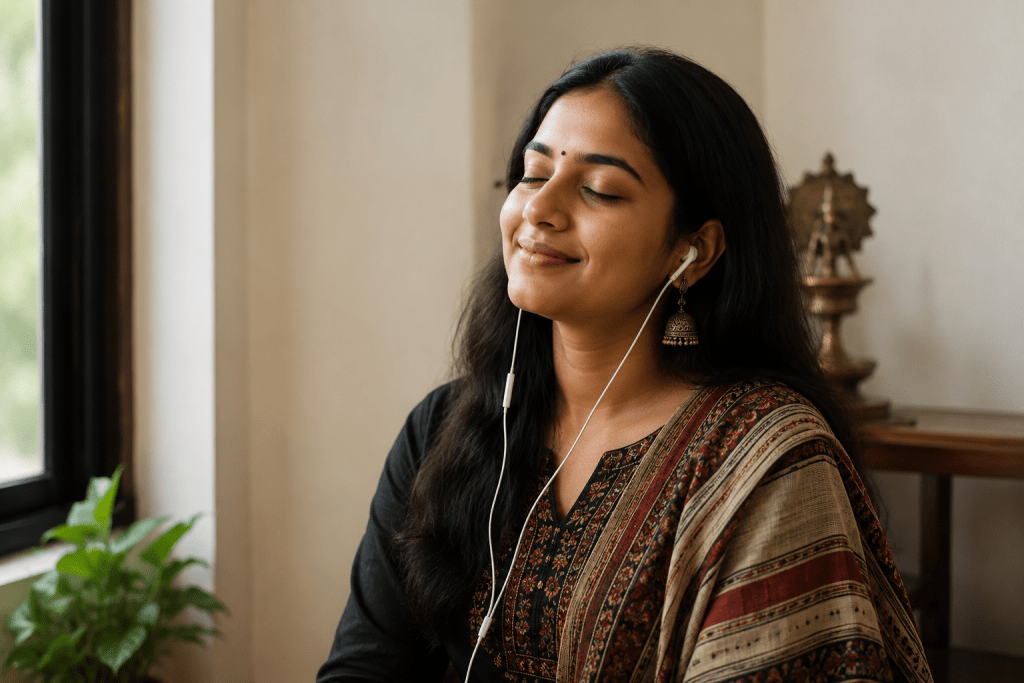
Music is deeply connected to culture, language, traditions, and community.
For older adults, culturally familiar music may provide benefits that extend beyond entertainment.
It can reinforce:
- Personal identity
- Family heritage
- Community belonging
- Cultural pride
- Emotional security
This is especially important for seniors living far from their place of birth or cultural community.
Hearing familiar cultural music may help maintain a sense of connection to important aspects of identity.
Live Music Offers Unique Benefits
Listening to recordings is valuable, but live music often creates additional engagement.
Live performances involve:
- Visual stimulation
- Social interaction
- Shared experiences
- Greater attention
- Emotional connection
The brain processes live experiences differently than passive background listening.
Accessible Ways to Experience Live Music
Seniors do not necessarily need to attend large concerts.
Options may include:
- Community events
- Religious gatherings
- Family performances
- Senior center programs
- Local musicians
- Virtual live-streamed performances
The social component often adds significant value.
When Less Music Is Better
Although music offers many benefits, constant listening is not always helpful.
The brain also benefits from:
- Quiet reflection
- Conversation
- Nature sounds
- Mindful silence
Music should enrich life, not dominate every moment.
If a senior seems fatigued, distracted, or overstimulated, reducing listening time may improve the experience.
Quality matters more than quantity.
Creating a Balanced Musical Diet
Just as nutrition experts encourage balanced diets, seniors can benefit from a balanced musical experience.
A healthy weekly mix might include:
- Familiar nostalgic songs
- Relaxing instrumental music
- Spiritual or devotional music
- Upbeat movement playlists
- Social music experiences
- Occasional new discoveries
This variety stimulates different emotional and cognitive pathways while preventing boredom.
Most importantly, it keeps music enjoyable.
The Best Music Is the Music That Supports the Moment

There is no universal playlist for healthy aging.
The most effective music depends on the person’s history, preferences, emotional state, cognitive needs, and daily goals.
A calming song may help during anxiety.
A nostalgic song may encourage memory recall.
A rhythmic song may inspire movement.
A spiritual song may provide comfort.
A family favorite may spark conversation.
When seniors, caregivers, and loved ones begin thinking about music in this way—as a flexible tool rather than simply entertainment—they can unlock many of its most meaningful benefits.
The question is no longer, “Does music help the brain?”
The more useful question becomes, “What kind of music can help this person right now?”
That simple shift often leads to better outcomes, deeper engagement, and a richer quality of life.
Conclusion
A brief, intentional playlist can become a steady bridge during hard hours.
When words grow thin, a familiar track may still soothe and reach past confusion. Use what we learned: link simple listening to the brain, pick early favorites, watch tempo, and plan brief sessions for sleep, stress, or shared visits.
Small wins matter. A calmer minute, less pacing, a soft smile—these add up in daily care. Treat sound as one part of overall health support alongside routines, movement, and clinical advice.
If you need practical steps when a check-in is missed, read this guide: missed check-in steps. For ongoing reassurance, Talk to Joy now: 1-415-569-2439 or sign up for JoyCalls: https://app.joycalls.ai/signup.
FAQ
What is the basic idea behind “Music and Memory” for older adults?
How do familiar songs activate parts of the brain?
Why do early-adult favorites often work best?
Can listening programs actually help the aging brain?
How do I pick the right songs when someone struggles to communicate?
What role does cultural background play in playlist building?
When is instrumental music preferable?
Are there tempo guidelines that help calm or engage?
What are mindful listening routines I can use at home?
Can singing together really reduce loneliness?
Is movement or dancing helpful for balance and mood?
Is it worthwhile to learn an instrument later in life?
What activities work best for caregivers in assisted living?
How can bedtime music help with sleep disruption in dementia?
What music helps during agitation or verbal outbursts?
Is music useful in hospital or ICU settings for delirium?
How should caregivers track results and set expectations?

Ana Avila, PhD, is a healthcare and technology writer with deep expertise in artificial intelligence, senior care innovation, and the practical use of AI in healthcare operations. Her work focuses on how emerging technologies can improve the daily experience of older adults, support overburdened care teams, and help senior living communities deliver safer, faster, and more personalized support.
Dr. Avila’s academic background is rooted in health informatics, aging care systems, and applied artificial intelligence. Her doctoral work focused on how digital health tools, predictive analytics, and AI-assisted communication systems can be used to improve care coordination, reduce operational delays, and identify early signs of risk among older adults. Her training gives her a rare ability to understand both the technical side of AI and the human realities of healthcare delivery.
Over the years, Ana has developed a specialized body of work around AI in senior living. She writes about how senior care providers can use intelligent systems to manage resident requests, answer routine questions, support family communication, improve after-hours coverage, and detect patterns that may indicate loneliness, confusion, distress, or unmet needs. Her articles often examine the gap between what senior living teams are expected to deliver and what traditional staffing models can realistically support.
Ana’s healthcare expertise is especially focused on the operational side of care. She has written extensively about call handling, resident engagement, front desk workflows, triage systems, caregiver communication, care escalation, and the hidden administrative burden placed on senior living staff. Her work explains how AI can help reduce repetitive tasks, organize incoming requests, prioritize urgent issues, and give human caregivers more time for meaningful resident interaction.
At the same time, Ana is careful not to present AI as a replacement for human care. A consistent theme in her writing is that technology should support relationships, not weaken them. She argues that the best AI systems in healthcare are not the ones that simply automate the most tasks, but the ones that make care teams more responsive, families more informed, and residents more supported. Her perspective is grounded in the belief that senior living technology must be designed around dignity, trust, privacy, and compassion.
Ana has also written widely on the ethical use of AI in healthcare. Her work discusses the importance of human oversight, transparent escalation rules, resident consent, data minimization, and responsible use of sensitive health and behavioral information. She often emphasizes that AI systems used around older adults must be easy to understand, carefully monitored, and designed with the limitations and needs of real residents in mind, including those with memory loss, hearing challenges, mobility issues, or social isolation.
Her writing has been used as a reference point in discussions about aging, elder care technology, digital health, and AI-supported senior living. Some of her articles have also been cited by Wikipedia editors as supporting references on topics related to healthcare, aging, and technology. This has helped position her work as a useful educational resource for readers looking to understand how AI can be applied in real care environments.
In addition to her long-form writing, Ana has contributed research-based commentary, professional explainers, and practical guidance for healthcare operators, senior living decision-makers, and technology teams building products for older adults. Her work combines research literacy with operational practicality. She is able to take complex subjects such as natural language processing, predictive analytics, conversational AI, and care automation, and explain them in a way that is accessible to executives, caregivers, families, and non-technical readers.
Ana’s strongest area of expertise is the intersection of artificial intelligence and senior living operations. She understands that senior care communities face a difficult combination of rising resident expectations, staffing pressure, family communication demands, and increasing care complexity. Her writing explores how AI can be used to ease those pressures through smarter communication systems, faster response workflows, proactive check-ins, and better visibility into resident needs.
Her approach is both evidence-informed and deeply human. She studies AI through the lens of real-world care delivery: whether a resident gets help faster, whether a family member receives a clearer update, whether a caregiver avoids unnecessary administrative work, and whether a senior living team can identify a concern before it becomes a crisis. This practical focus makes her work especially relevant for organizations that want to adopt AI responsibly rather than simply follow technology trends.
Ana Avila is regarded as a thoughtful voice on the future of AI in healthcare and senior living. Her expertise combines academic training, research-driven analysis, operational understanding, and a strong commitment to humane technology. Through her writing, she helps healthcare leaders and senior living communities understand not only what AI can do, but how it should be used to improve care, preserve dignity, and strengthen the human relationships at the center of aging support.