


Surprising fact: adults who share life stories feel 30% less lonely after one warm call.
This short guide helps you move past weather and TV updates. Start with open-ended prompts so an aging loved one can tell full stories. Listen with patience and respect.
With permission, take notes or record audio to preserve the best moments. A single thoughtful prompt can turn a quick check-in into a deep, comforting conversation.
Busy adult children: you do not need extra hours. Pick one question, ask a simple follow-up, and let silence sit. Emotions may appear—pride, grief, laughter—and that is okay.
Preview: we cover childhood, family history, relationships, work, change, and life lessons with ready prompts. If you need steady support, Talk to Joy now: 1-415-569-2439 or sign up for JoyCalls. For more prompt ideas, see 12 conversation topics that bring laughter and.
Key Takeaways
- Open-ended prompts invite stories, not one-word replies.
- Listen with care; ask permission before taking notes or recording.
- One thoughtful prompt can deepen a short call.
- Emotions are normal—respond with calm and warmth.
- Use the list as a quick pick-and-ask tool during visits or calls.
- Need help? Call Joy at 1-415-569-2439 or sign up at JoyCalls.
How to Start Deeper Conversations With Seniors (Without Making It Awkward)
Start with a small shared routine and let a story unfold naturally. Pick a calm moment — coffee, a short walk, or folding laundry — so the talk doesn’t feel like an appointment.
“I’ve been thinking about you—can I ask you something I’ve always wondered?”
That simple script shows respect and lowers pressure. Use open prompts like “What was it like…?” or “How did that feel…?” to invite longer replies.
Don’t rush to fill silence. Pause and count to five before jumping in. Many people need extra time to find words.
Practice active listening: steady eye contact, nodding, and short reflections such as “That sounds like it mattered.” Ask one gentle follow-up and avoid correcting details.
If a topic turns tender, say, “We can come back to that another time.” Offer to jot a quick note or record a voice memo with permission so the moment is preserved.
These simple ways of connecting build trust, reduce loneliness, and help you notice small changes in care over time. For more starter prompts, see conversation starters or read additional conversation ideas.

How to Turn Meaningful Questions Into a Real Connection Routine
A meaningful question is powerful, but the way it is asked matters just as much as the question itself. Older adults do not need to feel interviewed, managed, or studied. They need to feel heard. The goal is not to collect facts as quickly as possible. The goal is to create a calm rhythm where stories, feelings, memories, preferences, and wisdom can come forward naturally.
This is especially important for adult children, grandchildren, caregivers, and family friends who want to move beyond surface-level check-ins. A call that only asks, “Did you eat?” or “Did you take your medicine?” may be necessary, but it can also start to feel like supervision. Over time, some seniors may become guarded or give short answers because every conversation feels like a checklist.
A better approach is to create a simple connection routine. This means having a gentle structure that makes conversations easier, warmer, and more useful for everyone involved. It helps the older adult feel respected, and it helps the family member learn what truly matters in their daily life.
Start With the Person, Not the Question
Before asking anything meaningful, pay attention to the person’s mood, energy, and setting. A thoughtful question asked at the wrong time can feel heavy. A simple question asked with warmth can open the door beautifully.
If your loved one sounds tired, distracted, upset, or physically uncomfortable, do not force a deep conversation. Begin with presence. You might say:
“I just wanted to hear your voice today. We don’t have to talk about anything big.”
That sentence lowers pressure. It tells the older adult they are not expected to perform, remember, or entertain. Many seniors already feel they must be cheerful for their families. Some do not want to “burden” others with sadness, loneliness, pain, or worry. A calm opening gives them permission to be honest.
Once the conversation feels settled, you can ask one gentle question. Not five. Not ten. One.
For example:
“What has been on your mind lately?”
This question is simple, but it gives the person control. They can talk about a memory, a worry, a person they miss, a small joy, or even something practical. It respects their present emotional world instead of immediately pulling them into the past.
Use a Three-Part Conversation Flow
A meaningful conversation with an older adult does not need to be long. It only needs to feel complete. A helpful structure is:
- Begin with comfort
- Ask one open question
- End with care
This prevents the conversation from feeling abrupt or emotionally unfinished.
Try JoyCalls Free
No app or new device needed. Start with a free 7-day trial.
1. Begin With Comfort
Start with something familiar and easy. Mention the day, a shared routine, a family update, a pet, the weather, a meal, or something you know they enjoy.
Examples:
“I was making tea and thought of you.”
“I saw a flower today that reminded me of your garden.”
“I was thinking about that story you once told me about your old neighborhood.”
This kind of opening is soft. It signals that the call is not only about checking on them. It is about being with them.
2. Ask One Open Question
Once the conversation has warmed up, ask a question that invites reflection rather than a one-word answer.
Instead of:
“Are you okay?”
Try:
“What would make today feel a little better?”
Instead of:
“Did you sleep well?”
Try:
“How did the night feel for you?”
Instead of:
“Are you lonely?”
Try:
“Which part of the day feels the quietest?”
These questions are more respectful because they do not force the older adult to label themselves. Many seniors will resist saying, “I am lonely,” “I am scared,” or “I need help.” But they may answer honestly when the question is gentler and more specific.
3. End With Care
Do not end immediately after a deep answer. If someone shares something tender, they may feel emotionally exposed. Close the conversation with reassurance.
You can say:
“I’m really glad you told me that.”
“That matters to me.”
“I’ll remember what you said.”
“I’m going to check in again soon, and we can talk more if you’d like.”
A caring close helps the person feel safe after opening up. It also teaches them that meaningful conversations do not lead to judgment, panic, or unwanted decisions.
Create a “Question Ladder” Instead of Asking Random Prompts
One of the best ways to ask better questions is to use a ladder. Start light, then move deeper only if the person seems comfortable.
A question ladder has three levels: easy, reflective, and personal.
Easy Questions
These are low-pressure questions that help the conversation begin.
Examples:
“What did you enjoy today?”
“What was the best part of your morning?”
“What have you been watching, reading, or thinking about?”
“Did anything make you smile this week?”
These are useful when the older adult is tired, shy, private, or not in the mood for a deep conversation.
Reflective Questions
These questions invite more thought but still feel safe.
Examples:
“What is something you appreciate more now than you did when you were younger?”
“What kind of people have made your life better?”
“What is something you used to worry about that no longer feels as important?”
“What has helped you get through difficult seasons?”
These questions often bring out values, perspective, and wisdom without sounding too intense.
Personal Questions
These questions can be meaningful, but they should be used carefully and only when trust is strong.
Examples:
“Is there anything you wish people understood about this stage of life?”
“What do you miss most these days?”
“What are you still hoping for?”
“Is there something you want our family to remember?”
These questions may bring up grief, regret, fear, love, or unfinished hopes. That is not a bad thing. But the listener must be ready to respond with patience, not quick solutions.
The ladder helps you avoid jumping too quickly into emotional territory. It also gives the older adult control. If they answer lightly, stay light. If they go deeper, follow gently.
Ask Questions That Protect Dignity
Older adults often lose small forms of control over time. They may no longer drive, manage every household task, host family gatherings, work, or make decisions the way they once did. Because of this, conversations should restore dignity whenever possible.
A dignity-protecting question reminds the person that they are still someone with opinions, taste, judgment, humor, experience, and authority.
Try questions like:
“What do you think I should do in that situation?”
“How would you have handled this?”
“What do you notice that younger people often miss?”
“What is something you still feel strongly about?”
“What should I learn from the way you lived through that?”
These questions are powerful because they do not treat the older adult as only someone who needs care. They treat them as someone who still has something to give.
This matters deeply. Many seniors do not want every conversation to revolve around health, appointments, safety, or limitations. They want to feel useful. They want to know their experience still matters. Asking for their view is one of the simplest ways to offer that respect.
Turn Answers Into Small Acts of Care
The best conversations do not end when the call ends. A meaningful answer can show you how to support someone better.
If your loved one says they miss music, make a playlist.
If they talk about an old friend, help arrange a call.
If they mention a favorite meal, bring it next time.
If they say evenings feel long, schedule calls later in the day.
If they talk about a garden, send photos of flowers or help them sit outside.
If they mention feeling forgotten, create a predictable weekly call time.
This is where meaningful questions become practical care.
For example, if you ask:
“What part of the day do you enjoy most?”
And they answer:
“I like the morning, when the house is quiet and the light comes in.”
That tells you something useful. Morning may be the best time for calls, visits, medication reminders, light exercise, or quiet companionship.
If you ask:
“What has felt harder lately?”
And they say:
“I don’t like eating alone.”
That may lead to a simple action: arrange one shared meal per week, ask a neighbor to stop by occasionally, set up a video lunch, or schedule a friendly phone call during mealtime.
The point is not to turn every answer into a project. The point is to notice what the answer reveals. Good listening often shows you the next kind step.
Keep a Simple Conversation Notes System
Families often lose meaningful details because no one writes them down. A senior may share the name of a childhood friend, a favorite song, a family recipe, a fear, a regret, or a small preference. Weeks later, everyone forgets.
You do not need a complicated system. Create one shared note called “Things We’re Learning About Mom” or “Grandpa’s Stories and Preferences.” After a meaningful call, write three short bullets:
- A story they shared
- A feeling or preference they expressed
- One possible follow-up action
For example:
- Story: She remembered taking the train to visit her aunt every summer.
- Preference: She likes calls after dinner, not early morning.
- Follow-up: Ask about her aunt’s house next time.
This kind of note helps families connect more consistently. It also helps caregivers avoid treating each call as a brand-new conversation. Instead, each conversation builds on the last one.
For seniors with memory changes, notes can be especially helpful. You can return to familiar topics without making the person feel tested. Instead of saying, “Do you remember telling me about your aunt?” you can say:
“I was thinking about that summer train ride you mentioned. What were train stations like back then?”
This keeps the conversation warm and respectful.
Know When to Pause, Pivot, or Go Lighter
Not every meaningful question will land well. Sometimes an older adult may become quiet, emotional, irritated, or tired. That does not mean you failed. It means you need to adjust.
Watch for signs such as short answers, long silence, sighing, confusion, a change in tone, or repeated attempts to change the subject. When this happens, do not push.
Use a gentle pivot:
“We don’t have to talk about that.”
“Let’s leave that for another day.”
“Tell me something lighter—what sounds good for dinner?”
“Would you rather talk about a happy memory?”
A good listener protects the relationship more than the question. The goal is never to extract a story. The goal is connection.
This is especially important when asking about grief, family conflict, old disappointments, health changes, or regrets. Some seniors want to talk about these things. Others do not. Both responses deserve respect.
Use Meaningful Questions During Everyday Moments
Deep conversations do not always need a formal setting. In fact, many older adults open up more easily when their hands are busy or the moment feels ordinary.
Good times to ask meaningful questions include:
- While folding laundry
- During a drive
- While looking through photos
- While cooking or eating together
- During a walk
- While sitting on a porch
- During a regular phone call
- After watching an old movie or listening to a familiar song
Ordinary moments reduce pressure. A senior may feel more comfortable sharing when the conversation is side-by-side instead of face-to-face. This is particularly helpful for people who are private, emotionally reserved, or uncomfortable with direct attention.
You can use the environment as a natural prompt:
“This song feels like something you might have heard when you were younger. What music did people dance to then?”
“This recipe made me wonder—who taught you to cook?”
“Seeing these old photos makes me curious. What was that season of life like for you?”
These questions feel less like an interview because they come from the moment.
Balance Past, Present, and Future Questions
Many conversations with older adults focus heavily on the past. Memories are valuable, but seniors are not only memory keepers. They still have present-day feelings, preferences, worries, opinions, and hopes.
A strong conversation routine includes three types of questions.
Past-Focused Questions
These preserve stories and identity.
“What was a normal day like for you when you were young?”
“Who helped shape the person you became?”
“What family tradition do you hope continues?”
Present-Focused Questions
These reveal current needs and joys.
“What has been comforting lately?”
“What part of your routine do you enjoy most?”
“Is there anything you wish happened more often?”
Future-Focused Questions
These honor agency and hope.
“What would you like to look forward to this month?”
“Is there someone you would like to reconnect with?”
“What is one small thing that would make the next few weeks better?”
Future-focused questions are especially important. They remind seniors that their lives are still unfolding. Even a small future plan—a favorite meal, a family call, a haircut, a church service, a garden visit, a letter, a birthday, a song playlist—can create anticipation.
Make Conversations Feel Mutual
A meaningful conversation should not feel one-sided. Older adults may feel uncomfortable if they are always the one being asked to share. Offer small pieces of yourself too.
If they tell a story about their first job, you might say:
“That makes me think differently about my own work. I complain about busy days, but you handled so much with fewer conveniences.”
If they share advice, you might say:
“I needed to hear that. I’m going to try it this week.”
If they talk about someone they loved, you might say:
“I can hear how much they meant to you.”
Mutuality does not mean taking over the conversation. Keep your sharing brief. The goal is to show that their words affected you. That is often what makes a senior feel truly heard.
A Simple Weekly Routine Families Can Use
If you want to make meaningful conversations part of regular life, use a weekly rhythm.
Week 1: Ask About Daily Joy
“What has been bringing you comfort lately?”
Use the answer to add one small joy to their week.
Week 2: Ask About a Person
“Who has been on your mind recently?”
Use the answer to help them call, write to, pray for, or remember that person.
Week 3: Ask About a Story
“What is a story from your life you would like us to remember?”
Write it down or record it with permission.
Week 4: Ask About Support
“What would make your days feel easier right now?”
Choose one practical action, even if it is small.
This rhythm keeps conversations balanced. It includes joy, relationships, legacy, and care. It also prevents family calls from becoming either too shallow or too heavy.
The Best Question Is the One That Makes Them Feel Seen
There is no perfect script for talking with an older adult. Some people love reflective questions. Others prefer humor, faith, memories, practical advice, or simple companionship. The best approach is to pay attention to what makes your loved one relax, smile, think, or speak more freely.
A meaningful question should never feel like pressure. It should feel like an invitation.
The real measure of success is not whether you uncovered a dramatic story. It is whether the person felt valued after the conversation. Did they feel heard? Did they feel respected? Did they feel a little less alone? Did they feel that their life, opinions, and memories still matter?
That is the heart of meaningful conversation. The question opens the door, but your patience, warmth, and follow-through are what turn it into connection.
How Families Can Use These Questions to Build Stronger Emotional Support for Older Adults
Meaningful questions are not only useful for starting better conversations. They can also become a quiet form of emotional support. For many older adults, the hardest part of aging is not always physical change. It is the slow feeling of becoming less included, less asked, less needed, or less understood.
A senior may have family around and still feel emotionally alone. They may receive help with meals, medicines, appointments, bills, and transportation, but still miss the feeling of being known deeply. This is why meaningful questions matter. They remind older adults that their inner life still counts.
The right question can uncover a worry that has been hidden for months. It can bring back a memory that makes someone feel proud. It can help a family understand what their loved one values, fears, misses, enjoys, and needs. Most importantly, it can turn routine communication into real companionship.
But families need to use these questions with care. A list of prompts is helpful, but the deeper value comes from making conversation part of a loving support system.
Do Not Wait for a Crisis to Have Meaningful Conversations
Many families start asking deeper questions only after something goes wrong. A fall happens. A diagnosis is given. A spouse passes away. A senior begins withdrawing. The family suddenly realizes there are things they never discussed.
At that point, conversations may feel urgent, emotional, or difficult. The older adult may feel overwhelmed. Family members may feel guilty for not asking sooner.
A better approach is to build meaningful conversations into normal life before a crisis. Ask about memories, preferences, worries, and hopes while things are calm. This gives the older adult time to share without pressure.
You might ask:
“What helps you feel most at peace these days?”
“Are there any routines you hope we always respect?”
“What kind of support feels helpful, and what kind feels intrusive?”
“Is there anything you have been wanting to talk about but haven’t found the right time?”
These questions are not dramatic. They are practical. They help families understand how to offer support in a way that respects the person’s independence.
For example, one older adult may appreciate daily calls. Another may find daily calls tiring and prefer three longer conversations each week. One may want help with errands but not finances. Another may want help organizing paperwork but may not want anyone changing their home routine. These preferences matter.
When families ask early and gently, they can avoid making assumptions later.
Make Emotional Check-Ins Feel Natural
Many seniors are uncomfortable with direct emotional questions. Asking “Are you lonely?” or “Are you depressed?” may cause them to close down, especially if they do not want to worry their children.
This does not mean families should avoid emotional topics. It means they should ask in a softer and more natural way.
Instead of asking:
“Are you lonely?”
Try:
“Which part of the day feels the longest?”
Instead of asking:
“Are you sad?”
Try:
“What has felt heavy lately?”
Instead of asking:
“Do you need more help?”
Try:
“What has become more tiring than it used to be?”
Instead of asking:
“Are you scared?”
Try:
“Is there anything coming up that you feel unsure about?”
These questions give seniors room to answer honestly without feeling labeled. They also help families hear the truth behind everyday comments.
For example, if an older adult says, “The evenings are too quiet,” that may be a sign they need more connection after dinner. If they say, “I don’t like going to the doctor alone,” that may reveal anxiety, not just a logistical need. If they say, “I don’t cook much anymore,” that may point to low energy, grief, appetite changes, or the sadness of eating alone.
The goal is to listen beneath the words.
Ask About Identity, Not Just Health
As people age, conversations can become heavily focused on medical updates. Families may ask about blood pressure, pain, medication, sleep, appointments, reports, and diet. These things are important, but they should not become the entire relationship.
Older adults are more than patients. They are former workers, parents, friends, neighbors, artists, teachers, leaders, homemakers, caregivers, problem-solvers, believers, travelers, readers, cooks, gardeners, storytellers, and survivors.
When every conversation is about health, a senior may feel reduced to their body. Meaningful questions help restore a fuller sense of identity.
Ask questions like:
“What part of yourself do you wish people still noticed?”
“What role in life made you feel most useful?”
“What are you proud of becoming?”
“What is something you know how to do that you wish younger people valued more?”
“What did people come to you for when you were younger?”
These questions can bring back confidence. They remind seniors of strengths that may not be visible in daily life anymore.
A grandmother who now needs help walking may once have managed a busy household with extraordinary skill. A retired teacher may still have a deep ability to explain, guide, and encourage. A former business owner may still understand people, risk, money, and discipline. A quiet grandfather may hold decades of practical wisdom that no one has asked about in years.
When families ask identity-based questions, they make space for dignity.
Use Questions to Understand Their Definition of a Good Day
Families often try to improve an older adult’s life based on what they assume is best. They may plan outings, suggest activities, arrange visits, or buy things with good intentions. But not every senior wants the same kind of day.
For one person, a good day may mean sitting in sunlight with tea and a newspaper. For another, it may mean attending a religious service. For someone else, it may mean talking to grandchildren, cooking a familiar dish, listening to music, visiting a park, or simply having less pain.
Ask directly:
“What does a good day look like for you now?”
Then listen carefully.
Follow up with:
“What makes a day feel stressful?”
“What makes you feel calm?”
“What do you wish happened more often?”
“What do you wish people would stop rushing you through?”
These answers can guide daily support in very practical ways.
If they say a good day starts slowly, avoid scheduling early morning appointments when possible. If they say noise makes them tired, keep visits quieter. If they say they enjoy choosing their own clothes, do not take over that task unless necessary. If they say they miss being outdoors, build in short, safe outdoor moments.
Small adjustments can make a senior feel more respected and more in control.
Let Their Answers Shape Family Decisions
Meaningful questions should not only create warm conversations. They should influence decisions.
Families often make choices for older adults because they want to protect them. Sometimes this is necessary. But whenever possible, seniors should remain part of decisions that affect their daily life.
Use questions such as:
“How would you like us to handle this?”
“What matters most to you in this decision?”
“What would feel like too much change?”
“What are you willing to try?”
“What do you absolutely not want?”
These questions are especially useful when discussing caregiving, home support, medical appointments, living arrangements, mobility help, social activities, or household changes.
Even when a senior cannot have full control over every outcome, they can often have meaningful input. That input matters. It preserves agency.
For example, if a family is arranging in-home support, the older adult may not choose whether help is needed, but they can choose what time of day feels best, which tasks feel acceptable, and what kind of personality they prefer in a caregiver. If a move is being discussed, they may not control every detail, but they can identify which belongings, routines, photos, religious items, or comforts must come with them.
Aging often involves loss of control. Families can soften that loss by asking, listening, and honoring preferences wherever possible.
Include Seniors in Conversations About Joy
Support is not only about solving problems. It is also about protecting joy.
Older adults need more than safety. They need laughter, beauty, pleasure, purpose, and something to look forward to. Meaningful questions can help families discover what still brings delight.
Ask:
“What has made you laugh recently?”
“What music still makes you feel good?”
“What food always feels comforting?”
“What small thing makes your room or home feel nicer?”
“What would you enjoy doing again, even in a smaller way?”
These questions are especially helpful when a senior’s life has become smaller due to mobility limits, illness, grief, or living alone.
The phrase “even in a smaller way” is important. It opens possibilities.
A senior who can no longer garden may still enjoy watering indoor plants, looking through seed catalogs, visiting a nursery, or sitting near flowers. Someone who no longer cooks full meals may enjoy helping choose recipes, smelling familiar spices, or teaching a grandchild how a dish should taste. Someone who cannot travel may enjoy photos, maps, travel documentaries, or calls with relatives in other places.
Joy often needs to be adapted, not abandoned.
Ask Questions That Help Preserve Family History
Many families regret not asking enough while they had the chance. Older adults often carry stories that are not written anywhere. These stories may include family migrations, financial struggles, love stories, recipes, traditions, conflicts, sacrifices, faith, work, parenting, community life, and moments of courage.
But family history should not feel like an interrogation. Start with specific, warm prompts.
Try:
“What family story do you think younger people should know?”
“Who in the family had the biggest influence on you?”
“What was our family like before I was born?”
“What tradition do you hope we keep?”
“Was there a difficult time our family got through together?”
“What do you want us to understand about where we come from?”
These questions can help younger generations feel rooted. They also help older adults feel that their experiences are being carried forward.
If the senior agrees, record audio or video. If recording feels uncomfortable, take notes after the conversation. You can also create a shared family document with stories, sayings, recipes, dates, places, and names.
Do not aim for perfection. Even small fragments matter. A nickname, a song, a favorite street, a wedding memory, or a recipe detail can become precious later.
Handle Painful Answers With Maturity
Meaningful questions may sometimes bring up painful answers. A senior may share regret, grief, resentment, disappointment, fear, or loneliness. They may say something difficult about family relationships. They may express sadness about aging, dependence, or feeling forgotten.
When this happens, resist the urge to immediately correct, comfort, or defend.
If they say:
“No one really needs me anymore.”
Do not rush to say:
“That’s not true!”
Instead, try:
“I’m sorry it feels that way. When do you feel that the most?”
If they say:
“I miss my old life.”
Do not say:
“But you still have so much.”
Try:
“What part of that life do you miss most?”
If they say:
“I don’t want to be a burden.”
Do not reply only with reassurance.
Try:
“I understand why that worries you. What kind of help feels respectful to you?”
Mature listening allows pain to be spoken without being dismissed. Many older adults have spent years hiding their harder emotions to protect others. When they finally share, the listener’s job is not to erase the feeling. It is to stay present.
Make Room for Silence
Silence is not failure. Older adults may need time to remember, think, feel, or decide how much they want to say. Do not fill every pause.
After asking a meaningful question, wait. Let the silence breathe.
A senior may answer after ten seconds, thirty seconds, or even a full minute. They may look away. They may smile. They may tear up. They may say, “I haven’t thought about that in years.”
Give them time.
You can gently support the silence by saying:
“Take your time.”
“There’s no rush.”
“We can sit with that for a moment.”
This is especially helpful for older adults who process slowly, have hearing challenges, live with memory changes, or are not used to being asked reflective questions.
Fast conversations can make seniors feel pressured. Slow conversations often feel safer.
Involve the Whole Family Without Overwhelming Them
Meaningful conversations should not fall on one person alone. Adult children, grandchildren, siblings, nieces, nephews, and close family friends can all take part. But coordination matters.
If everyone suddenly starts asking deep questions, the older adult may feel overwhelmed. Instead, create a gentle family rhythm.
For example:
- One person calls on Monday to ask about the week.
- One person visits midweek and brings up a memory.
- One grandchild asks for advice about school, work, or life.
- One family member records or writes down stories.
- One person handles practical follow-up.
This creates a circle of connection without making the senior feel like a project.
Families can also rotate themes. One week may focus on childhood memories. Another week may focus on favorite foods. Another may focus on family traditions. Another may focus on current comfort and support.
The point is not to create a formal program. It is to make connection more intentional.
Use Questions to Notice Changes Over Time
Meaningful questions can also help families notice emotional or practical changes. This does not mean turning conversations into assessments. It means listening carefully.
If a senior who usually enjoys talking begins giving very short answers, that may matter. If they stop mentioning friends, hobbies, faith, food, or daily routines, that may matter. If they repeatedly say they are tired of everything, feel useless, or do not care what happens, that should be taken seriously.
Questions can help reveal changes gently:
“What has felt different lately?”
“Are your days feeling easier, harder, or about the same?”
“What are you doing less of these days?”
“Is there anything you have stopped enjoying?”
“What feels like too much effort now?”
These questions can help families respond earlier with companionship, medical support, social support, or practical help.
The key is to respond with care, not alarm. If something concerning comes up, thank them for sharing and discuss the next step calmly.
End Every Meaningful Conversation With Reassurance
A deep conversation can leave an older adult feeling tender. They may wonder if they said too much. They may worry they sounded negative. They may feel embarrassed after talking about fear, grief, or need.
Always close with reassurance.
Say:
“I’m glad you told me.”
“I love hearing what you think.”
“Your stories matter to me.”
“I don’t take this conversation lightly.”
“I want us to keep talking like this.”
These simple words help the senior feel safe. They also make it more likely that future conversations will go deeper naturally.
The Real Purpose Is Not Just Asking Better Questions
The purpose of meaningful questions is not to create a perfect conversation. It is to build a stronger emotional bridge between older adults and the people who care about them.
A good question says, “You still matter.”
A patient follow-up says, “I am listening.”
A remembered detail says, “Your words stayed with me.”
A small action afterward says, “Your needs are important.”
For seniors, this kind of attention can be deeply comforting. It can reduce the feeling of invisibility that sometimes comes with aging. It can bring families closer. It can help caregivers understand what support should look like. And it can preserve stories, values, and wisdom that might otherwise be lost.
The most meaningful conversations are not always long or dramatic. Sometimes they happen in ten quiet minutes. Sometimes they begin with tea, a phone call, an old song, or one gentle question.
What matters most is consistency. Keep asking. Keep listening. Keep remembering. Keep showing through your actions that the older adult in your life is not just being cared for, but truly known.
Meaningful Questions for Seniors That Spark Real Stories
A single well-placed prompt can surface memories that matter most. Use these starter prompts when you have ten minutes or a longer visit.

“What’s one story from your life you wish more people knew?”
Gently follow with: Who was there? What did you learn? What would you have told your younger self? These follow-ups deepen a story without pressure.
- Ask about what brought the most joy over time. Listen for themes: friends, faith, work, hobbies.
- Invite pride by asking what they’re most proud of—and why. Some people downplay successes; a warm prompt helps.
- When someone shares a life-changing moment, allow silence. You don’t need to fix feelings—just witness them.
- Ask what younger generations should understand about their era. Frame it as curiosity, not debate.
Preservation tip: After the call, write a three-sentence summary and share it with family so the story becomes a shared memory. For related ideas on purpose and connection, see how purpose reduces loneliness.
Childhood and Growing Up Questions That Unlock Memories
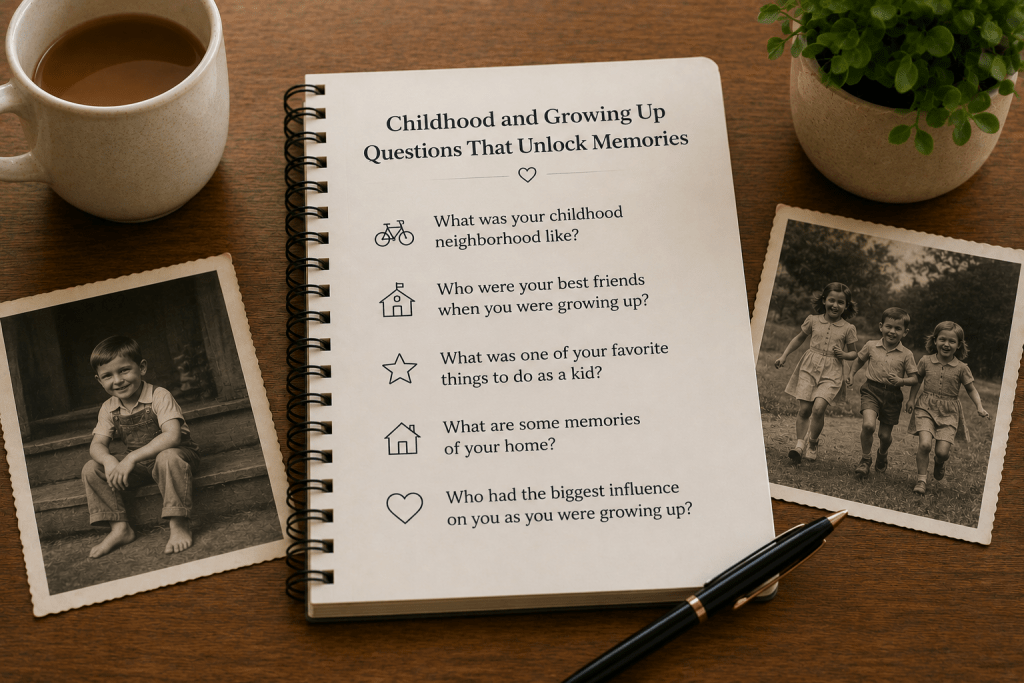
Childhood stories often open a warm, steady door into deeper memories.
Use gentle prompts about the place where someone grew up to invite sensory details. Ask about smells, night sounds, or how kids played. These soft entry points are safe when energy is low.
“What do you remember about the place where you grew up?”
Follow with sensory prompts: What did it smell like? What did you hear at night?
“What was your childhood home like?”
Note rooms, gardens, pets, or a typical morning. Small facts help preserve a vivid picture.
“Who were you closest to in your family growing up—and why?”
Listen for parents, siblings, or grandparents. Ask, What made them feel safe?
“What chores or responsibilities did you have as a kid?”
Keep this playful: What did you like or dislike about it? Stories here often show values that shaped later life.
“Were you more obedient or mischievous?”
“We always tried to be good—until the candy jar taught us better.”
- Quick tip: pick one question and one follow-up when time is short.
- Phone calls work well—these topics feel familiar and engaging.

| Prompt | Follow-up | What to record |
|---|---|---|
| Place where you grew up | What did kids do for fun? | Sounds, smells, local games |
| Childhood home | How many rooms? Pets? | Layout, garden, neighbors |
| Closest family member | What made them feel safe? | Names, small habits, nicknames |
| Chores or mischief | What did you like/dislike? | Tasks, funny stories, lessons |
Family History Questions to Preserve Names, Traditions, and Roots

A short call about family history can rescue names, recipes, and rollicking tales.
Start with one gentle prompt and let the story lead. Small facts—names, places, nicknames—fade fast if not recorded.
“Do you know the history of our family name or where it came from?”
Open Ancestry or MyHeritage together and watch reactions. Spelling, towns, and ship records spark memories and corrections.
“What are your fondest memories of your parents or grandparents?”
Ask specific moments: What did they do on Sundays? What made them laugh?
“What traits or traditions did they pass down?”
Capture small rituals—recipes, sayings, holiday habits. These details shape how families feel at home.
“Tell me about the time Uncle Joe hid the pie—what happened next?”
After each call, add two lines to a shared doc titled Our Family Stories. This makes it easy for caregivers and relatives to keep what matters.

For timing tips on check-ins that spark these talks, see best times to call.
Love, Friendship, and Relationships: Questions Beyond the Usual
Talk about the people who mattered and you’ll often get both laughter and quiet wisdom in return.
Begin with a warm opener and let the speaker choose how deep to go. Frame the prompts as curious, not probing. That keeps the moment gentle and safe.

“How did you meet your spouse or life partner?”
Try follow-ups like Was it love at first sight? or Who made the first move? Small details make the story vivid.
“What was your wedding like?”
Ask about music, food, and who was there. Those day moments often bring smiles and tears.
“Who has influenced you the most, and how?”
After they answer, share one short line about how that person shaped your life too. It makes the talk two-way.
“What friendship are you most grateful for?”
Ask how they kept in touch. Many older adults treasure stories of long loyalty.
“What’s one lesson you learned about love and relationships?”
Listen without arguing. If a topic brings grief, say “Thank you for trusting me with that.” Then offer to move on.
- Keep it mutual: share a sentence about how their story touched you.
- Keepsake idea: write down their best lesson and pass it to loved ones.
- Extra prompts: see ways to deepen emotional intimacy at deepen emotional intimacy.
| Prompt | Optional follow-ups | Keepsake idea |
|---|---|---|
| How did you meet? | Who noticed first? What did you notice? | Short audio clip of the story |
| Wedding memories | Music, food, who attended? | One-paragraph memory in family doc |
| Influential person | What lesson did they teach? | Write their advice on an index card |
| Grateful friendship | How did you stay connected? | Collect names in a memory book |
Work, Purpose, and Identity: Career Questions That Highlight Pride
Asking about someone’s job can reveal values that shaped a whole life. These prompts honor identity and show you care about competence, not just chores.
Why work prompts matter: they validate purpose and let people speak about achievements that still feel important.

“What was your first job, and what did it teach you?”
Invite detail: hours, pay, coworkers, and one memory. Small facts often hold big lessons about responsibility and people skills.
“What career did you imagine when you were younger?”
Ask, Did it turn out like you expected? Accept any answer. Reflecting without judgment keeps the tone warm and proud.
“What skill or talent served you best in life?”
Listen for transferable strengths—patience, leadership, fixing things, caring for others—and say them back to build pride.
“What would you tell someone starting out in your line of work?”
Guide the speaker to specifics: What should they do in their first week? Actionable advice sticks and becomes a keepsake.
- Record a 3–5 minute audio clip of a favorite work story (with permission) and share it with family.
- Caregivers: these talks reveal routines, values, and stressors useful in daily support.
“Work stories celebrate a life lived—let them tell one.”
Want ideas on connection and service? Read about volunteering and staying connected at volunteering to feel connected again.
Living Through History: Questions About Change Over Time

Ask about the big changes they’ve seen and you’ll hear history made personal. These prompts turn broad events into tiny scenes. They make past changes feel close and human.
“Which invention from your lifetime amazed you most?”
Follow up with: Where were you when you first saw it? and How did it change day-to-day life? These details move beyond a list of gadgets to real impact.
“How do you feel the world has changed since you were a child?”
Listen without arguing. The goal is understanding people and perspective, not debate.
“What’s something from the old days you wish still existed?”
Ask for specifics: a corner store, neighborhood events, or old manners. These answers reveal values and warm memories.
“What’s an unusual trend you remember (fashion, slang, or a fad)?”
Keep it light. Laughter often follows talk of styles or sayings. Quick stories work well on short calls.
- Activity idea: Watch an old favorite together—Turner Classic Movies or the Criterion Collection are good picks.
- Capture a written “top 5 changes” list to share with family. It becomes a keepsake.
“They lived through so much—these talks show them as witnesses, not just recipients of care.”
Life Lessons and Wisdom to Pass Down to Younger Generations
A short chat about life lessons can gift younger generations a map they never had.
Start by asking what makes getting older rewarding. Let room for humor and honesty. Some answers will be playful—senior discounts and quiet mornings. Others will be tender.
“What are the most rewarding things about getting older?”
Encourage small details. Ask about simple perks and unexpected joys. Laugh with them. Record one line they want remembered.
“What are the most important lessons you’ve learned—and the story behind them?”
Ask for the story that taught each lesson. Stories stick longer than rules. Say, “What happened that taught you that?” Then listen without fixing.
“What advice would you give your younger self?”
Frame it for a 20- or 30-year-old. Keep prompts practical and kind. Suggest writing down their top three pieces of advice as a legacy note.
“If you could go back to any age, what would it be and why?”
Invite sensory details: where they lived, who they spent time with, what a normal day felt like. Those details make memories vivid and shareable.
“What does happiness mean to you now?”
Listen for things still possible today—music, short walks, calls, faith routines. Use those clues to bring more of what matters into weekly life.
“Write down their top three pieces of advice and share it with family—small notes become lasting keepsakes.”
Legacy idea: After the talk, add a short “legacy note” to a shared family file. It preserves wisdom and creates a gentle gift for younger generations.
| Prompt | Follow-up | Keepsake | Action |
|---|---|---|---|
| Rewarding parts of aging | What surprises you most? | One-line quote | Save in family doc |
| Lessons learned | What story taught that? | Short audio clip | Share with relatives |
| Advice to younger self | Who should hear this at 20? | Top 3 advice list | Print and gift |
| Happiness now | What brings you joy today? | Weekly reminder list | Plan one activity each week |
Some answers may carry regret. Your role is to witness and love, not to solve the past. If you’d like more ways to support daily connection, learn how does an AI companion help keep conversations steady.
Joy, Gratitude, and Favorite Moments Questions (Great for Visits and Phone Calls)

A single cheerful prompt can turn a short call into a warm exchange.
Ask about happiest moments and best things that happened in life. These prompts lift mood and invite rich stories without taxing memory.
“What was one of the happiest moments of your life?”
Follow with “What made that moment so special?” That moves a headline into a small scene you can remember together.
“What are you most grateful for these days?”
Listen for current joys—a neighbor, a pet, church, or a sunny window. These clues help plan better visits and daily care.
“What kinds of things make you happiest right now?”
Turn answers into action. If music matters, build a playlist. If fresh air helps, plan a short porch sit.
Other easy prompts
- “What’s a favorite place you’ve visited?” — ask for a detail or two.
- “What music, movies, or hobbies have stayed with you?” — invite a shared activity.
“Let repeated stories repeat—focus on the feeling, not the facts.”
| Prompt | Why it works | Quick follow-up |
|---|---|---|
| Happiest moment | Positive, light, and specific | What made that time special? |
| Best thing that happened | Spark pride and vivid detail | Who was there with you? |
| Grateful these days | Reveals daily joys and needs | Is that part of your day now? |
| Favorite place or vacation | Connects generations with stories | What do you remember most about it? |
Supportive Conversation Tips for Assisted Living and Memory Care
In memory care, the aim is comfort, not testing a single memory. A caring tone and a gentle prompt help loved ones feel safe and seen.
Avoid “Do you remember…?” That phrase can feel like an exam. Instead invite a story with phrases like “Tell me about…” or “What was it like when…?”
Use objects, music, and routines to spark recall. A photo album, a familiar song, a favorite sweater, or a simple snack can open doors when words are hard.
Shared starters work well. Try, “I used to ride my bike—did you like riding?” If they say no, ask a backup like, “How did you get around?”
Normalize repetition. If a story returns, let it. The comfort of retelling often matters more than exact facts.
Caregiver technique: reflect feelings rather than correct details. Say, “That sounds like a happy time.” This keeps the moment calm and respectful.
“The goal isn’t to prove memory—it’s to build connection.”
Quick practical tips
- Reframe: conversations are about connection and care, not quizzes.
- Try alternatives to testing prompts: “I was thinking about…” or “Tell me about…”
- Bring objects: photos, music, a hat, or holiday décor.
- Use short shared memories to prompt talk and offer a fallback question.
- Reflect feelings and avoid corrections to keep stress low.
Support and next steps
If distance or busy schedules make daily check-ins hard, Talk to Joy now: 1-415-569-2439. For ongoing companionship that doesn’t require an app on your loved one’s device, sign up for JoyCalls.
For clinical guidance on talking with older patients, see advice from the National Institute on.
| Challenge | Gentle alternative | Prompt ideas | Caregiver cue |
|---|---|---|---|
| Testing memory | “Tell me about a time when…” | Photo album, music, snack | “That sounds joyful.” |
| Blank pauses | “What was that like?” | Familiar object, routine detail | “Take your time—I’m listening.” |
| Repeated stories | “I’d love to hear that again.” | Record a short audio with permission | “It must have felt special.” |
| Anxious corrections | “How did that make you feel?” | Photo, song, holiday item | “That seems important to you.” |
Conclusion
A small habit can turn brief calls into lasting family treasures. Pick one question, ask one gentle follow-up, and listen without rushing.
With permission, record a short audio or jot two bullets after each call. Those tiny keepsakes save names, family history, and the best stories—especially from grandparents who bring a home to life.
Quick checklist: choose a calm moment, ask open-ended prompts, listen actively, allow silence, and pivot gently if feelings come up.
If you want steady help keeping these connections and caregiver visibility, Talk to Joy now: 1-415-569-2439. Sign up for JoyCalls: https://app.joycalls.ai/signup.
FAQ
What should I keep in mind before starting a deeper conversation with an older loved one?
How can I open a conversation without making it awkward or pressuring them?
What are simple listening habits that make a big difference?
How do I handle emotional or tender topics during a chat?
What’s a powerful starter question that invites a real story?
What questions tend to spark joy or pride?
Which childhood prompts help unlock memories about home and family?
How can I gather family history and preserve names and traditions?
What are good questions about relationships and love?
How do I ask about work and purpose without sounding like an interview?
What questions reveal how life and the world changed over time?
How can I invite life lessons and wisdom to pass down?
What are light, uplifting prompts to use during visits or phone calls?
How do I support someone in assisted living or memory care during conversations?
Can I use these prompts over the phone or with an AI companion like JoyCalls?

Ana Avila is a healthcare and technology writer with deep expertise in artificial intelligence, senior care innovation, and the practical use of AI in healthcare operations. Her work focuses on how emerging technologies can improve the daily experience of older adults, support overburdened care teams, and help senior living communities deliver safer, faster, and more personalized support.
Ana’s background includes health informatics, aging care systems, and applied artificial intelligence. Her work explores how digital health tools, predictive analytics, and AI-assisted communication systems can improve care coordination, reduce operational delays, and identify early signs of risk among older adults. She brings an understanding of both the technical side of AI and the human realities of healthcare delivery.
Over the years, Ana has developed a specialized body of work around AI in senior living. She writes about how senior care providers can use intelligent systems to manage resident requests, answer routine questions, support family communication, improve after-hours coverage, and detect patterns that may indicate loneliness, confusion, distress, or unmet needs. Her articles often examine the gap between what senior living teams are expected to deliver and what traditional staffing models can realistically support.
Ana’s healthcare expertise is especially focused on the operational side of care. She has written extensively about call handling, resident engagement, front desk workflows, triage systems, caregiver communication, care escalation, and the hidden administrative burden placed on senior living staff. Her work explains how AI can help reduce repetitive tasks, organize incoming requests, prioritize urgent issues, and give human caregivers more time for meaningful resident interaction.
At the same time, Ana is careful not to present AI as a replacement for human care. A consistent theme in her writing is that technology should support relationships, not weaken them. She argues that the best AI systems in healthcare are not the ones that simply automate the most tasks, but the ones that make care teams more responsive, families more informed, and residents more supported. Her perspective is grounded in the belief that senior living technology must be designed around dignity, trust, privacy, and compassion.
Ana has also written widely on the ethical use of AI in healthcare. Her work discusses the importance of human oversight, transparent escalation rules, resident consent, data minimization, and responsible use of sensitive health and behavioral information. She often emphasizes that AI systems used around older adults must be easy to understand, carefully monitored, and designed with the limitations and needs of real residents in mind, including those with memory loss, hearing challenges, mobility issues, or social isolation.
Her writing has been used as a reference point in discussions about aging, elder care technology, digital health, and AI-supported senior living. She has published 12 papers in journals including JAMA, The BMJ, and SSRN. Some of her articles have also been cited by Wikipedia editors as supporting references on topics related to healthcare, aging, and technology. This has helped position her work as a useful educational resource for readers looking to understand how AI can be applied in real care environments.
In addition to her long-form writing, Ana has contributed research-based commentary, professional explainers, and practical guidance for healthcare operators, senior living decision-makers, and technology teams building products for older adults. Her work combines research literacy with operational practicality. She is able to take complex subjects such as natural language processing, predictive analytics, conversational AI, and care automation, and explain them in a way that is accessible to executives, caregivers, families, and non-technical readers.
Ana’s strongest area of expertise is the intersection of artificial intelligence and senior living operations. She understands that senior care communities face a difficult combination of rising resident expectations, staffing pressure, family communication demands, and increasing care complexity. Her writing explores how AI can be used to ease those pressures through smarter communication systems, faster response workflows, proactive check-ins, and better visibility into resident needs.
Her approach is both evidence-informed and deeply human. She studies AI through the lens of real-world care delivery: whether a resident gets help faster, whether a family member receives a clearer update, whether a caregiver avoids unnecessary administrative work, and whether a senior living team can identify a concern before it becomes a crisis. This practical focus makes her work especially relevant for organizations that want to adopt AI responsibly rather than simply follow technology trends.
Ana Avila is regarded as a thoughtful voice on the future of AI in healthcare and senior living. Her expertise combines research-driven analysis, operational understanding, and a strong commitment to humane technology. Through her writing, she helps healthcare leaders and senior living communities understand not only what AI can do, but how it should be used to improve care, preserve dignity, and strengthen the human relationships at the center of aging support.